
Tag: GST

  • New Emotions for Old


    By Shashidhar Nanjundaiah

     

    Unusually, the hashtag #Nonsense_Modi topped the Twitter trending list in the country for several hours earlier this week after a primetime debate, where a spokesperson of the Opposition repeatedly used the term “nonsense” to question the government’s apparent stance that any question around the Ladakh standoff was against the nation’s interests. Although the ruling party’s spokesperson tried to defend that charge, the opposition was loud and relentless. Under the hashtag, which emerged from behind and beat #Nonsense_Rahul to the top, went well beyond the Ladakh statement, tagging eclectic national issues from job losses to Covid-19 to GST.


    To a student of media communication, this is a sign. The nature of media audiences is that they look for new emotions to massage themselves with. You have to start to wonder–and fear–what lies next in BJP’s media-agenda armoury. Is the narrative using the same old emotive messages while the media users are hankering for new emotions? Fear, hatred, nationalism have played their part. What next? The popular media-alarm “Massive controversy erupts” may still evoke volcanic mnemonics in us, shaking us out of our bot-like social-media existence. But emotional appeals must evolve, it seems.


    GOING PARASOCIAL

    For, after all, emotions drive today’s audiovisual news more than ever before. The surprise lies in how late news got into the act, decades after motion pictures and non-news television—and the all-inclusive digital media—recognised the clear market for emotive messaging. Viewers play with the television screen in a “parasocial engagement”, according to media psychology scholars Horton and Wohl. Until the social media swept the audience attention, the audiovisual media continued to rely on rational appeal. Today, stung but clever enough to co-opt its competition, news television knows better.


    But that’s the nature of immersiveness. It is high-involvement but temporary. Emotions around issues, with the exception of long-term investments in emotional attachments, are often transient. “When India’s onboard [demonetisation], why isn’t the opposition?” asked a channel, more or less summing up the implied nationalistic emotion. Considering the trouble it caused on ground, that political detail would seem a sadly ironic emotion, in conflict with what people felt. The more recent “#ChinaGoBack” call, too, tied itself to narratives aimed at nationalistic emotions. 


    EMOTIONAL TRANSIENCE

    But are media houses running out of emotions? News editors’ stated role has been to set the agenda of what we must think about. But their new role is in setting an agenda of individual emotions that add up and galvanise themselves on social media to become public emotions. We can call this emotional agenda-setting. In a binary context, this role would be set against a traditional, editorialised form of agenda-setting.


    Aristotle had said that man is either a political animal or an outcast like a “bird which flies alone”. Individuals have personal, social and cultural needs that must be fulfilled through associations. The welter of social media messaging gives the individual a false sense of being the agenda-setter: One that must indulge, take sides, react. Some scholars have used a somewhat awkward term, masspersonal, to describe our current state of social media usership. The more conventional media routinely use the social media mores and norms to boost their own viewership, borrowing trending posts to create news. So it won’t be amiss to use this masspersonal nature of consumption to news television, which mobilises mass emotions by hashtagging personal emotions.


    News language’s new role is visual, drawing us in. The news media is there to help us construct our truths. One way is drawing our attention to ‘massive controversies’ erupting everywhere. To draw inferences that are more detached, we must feel a need to be media-literate in the new digital age. And as history will tell you, media literacy follows media technology and techniques. Regrettably, we can never really catch up or the game would be up.


    So sure, emotions are here to stay. But how to juggle those emotions periodically will determine how strategically a marketing head and editor can jointly manipulate public sentiment.


    As founder of BeingResponsible, the author Shashidhar Nanjundaiah is trying—really hard—to instil Responsible Media Literacy among younger citizens through courses at schools and colleges. The 20-hour courses are a combination of awareness, deep-reading media exercises, and basic rules-of-thumb forensics to recognise fakeness. Earlier, he has led media institutes of repute to positions of leadership. Prof Nanjundaiah can be reached shashi.nanjundaiah@hotmail.com. His views here are personal.

     

  • Sawaal 120 Crore Ka


    By Shailesh Kapoor


    Last weekend, Union minister Ravi Shankar Prasad gave a press statement, where he cited the combined first-day collections of War, Sye Raa Narsimha Reddy and Joker (Rs. 120 cr) to “prove” that there is no slowdown in the Indian economy. This comment, which can form a case study in a Logic 101 class on how not to construct an argument, has been the subject of many jokes and memes on social media over the last week.

     

    For most people in traditional businesses, the slowdown this year is a harsh reality. If we speak specifically of the media sector, most TV channels and print publications have started reporting declining sales this year, forcing them to rationalise expenses, while they wait and hope for a better 2020-21. The digital and online businesses have managed to hold on somewhat better, with the growth in data consumption countering the slowdown in some measure.


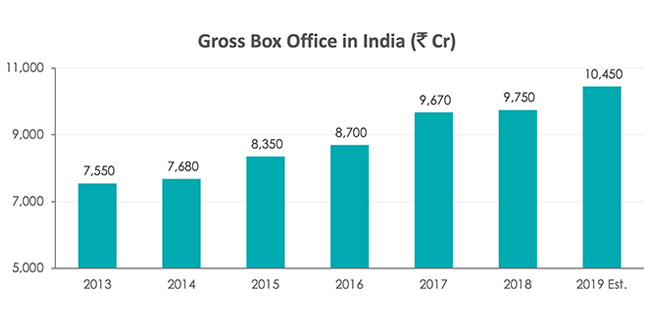
    I’m not an economist, and any further comment on the slowdown is out of syllabus for me. But the specific 120 Cr comment is definitely in my territory. The chart above and below captures the movement of the total box-office in India from 2013 to 2019. These are box-office collections across all Indian languages put together. Gross (pre-tax) numbers have been considered, as tax burden on film tickets has changed because of the arrival of GST, and then the change in the GST slab earlier this year. The numbers for 2019 are estimates for the entire year, based on the collections so far.


    A first look at the chart itself should tell us that there hasn’t been much of a steady growth in the box-office business in India over the last few years. The CAGR over the period 2013-2019 stands at a mere 5.6%, and even the best growth years have struggled to go much beyond 10% growth. Importantly, some of this growth is seller-led, coming only because of the continuous growth in ticket prices. Footfalls have remained largely stagnant, and even fallen in specific years.


    The other story in the chart is about how small the number Rs 10,450 cr is in itself. If you are aware of even the ballpark in which television revenues operate, you would know that the box-office collections from across the entire country can’t match up to the revenues of some of the big TV networks in India. Not that television is a very big industry to begin with.


    Hence, to even quote box-office as any indication of the health of the economy is fallacious and contentious. But if entertainment can provide fodder for more entertainment, however unintentionally, who’s complaining?


  • View on the Budget from Utkarsh Sanghvi, EY

    Here’s a view on the interim Budget from Utkarsh Sanghvi – Partner, Indirect Tax, Media & Entertainment, EY India: “The Government has already set up a Film Facilitation Office (FFO) for enabling a single window clearance for foreign film companies shooting in India. It is a welcome measure for Indian Films to take benefit of FFO.  Most of the permissions required from Central and State Government agencies are expected to be received from a single online application.

    From January 2019, GST rate on film tickets costing less than Rs 100 was reduced to 12% from 18% and tickets costing more than Rs 100 was reduced to 18% from 28%.  The art and cultural champion services sector was positively recognised by GST Council by reclassifying the entertainment service from luxury and sin bracket of taxation to standard rate schedule.”

  • Happy mcgarrybowen executes GST-ready campaign for Tally Solutions

    By A Correspondent


    Tally Solutions, a pioneer in accounting and business management software, collaborated with Happy mcgarrybowen, the creative agency from Dentsu Aegis Network, to launch its first ever campaign for its GST-ready software. With over 30 years of serving businesses across India, Tally is in an unrivalled position to deal with GST.


    Speaking about the campaign, Kartik Iyer, CEO and Co-Founder, Happy mcgarrybowen says, “Working with Tally has been an enriching experience at many levels. As pioneers in the business of Fintech, their insight and view into the GST era is unmatched. Their ability to break anything that is complex down to simple clear points is what makes them the leader undoubtedly. There is a lot to do together. We look forward to doing some great work for them.”


  • Dear MxM by Jaisurya Das: Is HT’s Pune edition a wise business decision?

    By Jaisurya Das


    Welcome back, Ladies and Gentleman to yet another week of Dear MxM, your friend in need!

    July has been an exciting month to say the least for all of us in this country. The introduction of GST and matters such taking centrestage. Now, it’s a different matter that a lot of us are still grappling with the above subject to put it mildly.

    From what I figure, most people are in the same boat as I am and their understanding of GST begins and ends with the fact that it is a goods and service tax. I know the media has been trying to cover various aspects of it but then who reads any longer… !

    My chartered accountant seems happy though since it obviously heralds some fresh business opportunities for his firm. I didn’t particularly enjoy the glee on his face though but that I guess is ok.

    The long and short of all this is the fact that we have dived into it and I guess there is no other way but to roll these things out all at one go..

    So, with deep understanding of everything save GST, we shall plod on with our lives.

    May I take this opportunity to wish you all a very happy learning experience. And, yes, if you do figure it all out, please do share your learnings…

    On that hopeful note, let’s move on to this week’s set of questions from our readers in Delhi, Ahmedabad and Chandigarh.


    I am one of those who got retrenched by Hindustan Times a few months back and I now learn that the paper has launched its Pune edition. This is the same city where two papers have shut editions – DNA and Mid-Day. Do you think the Pune edition of HT is a wise business decision?

    Thanks for writing in, my friend… I have answered this in my previous columns here. At this stage it is far too early to comment on its possible success, however they certainly do have an opportunity to do fairly well.

    The Pune market does need a strong No 2 with credible content and numbers to back it. As of now, my estimate would be an approximate circulation of 30,000 copies currently which could grow to a reasonable 75,000 over the next eight months.

    This would then give them a share of the local advertising revenue which is the mainstay of a newspaper from a business perspective.

    They are taking a more cautious route with marketing and DVC (Direct Variable Costs) and hence profitability levels are achievable at a lower threshold. Hence, yes, it could prove to be a sensible business decision down the line.


    Recently I heard of a friend’s father who is a mid-level advertising sales executive being hit by the heatwave because his work required him to always be on the field. But when it came to leaves his company disallowed them even though his state of health was caused because of his work. The company said even if the illness could be because of his work, it will need to count them as sick leaves, as per rules. Don’t you think it’s unfair? Or is that how it works when you work?

    This is certainly the way work is and there is no reason for him to be taking up a field job if his health does not allow for this.

    I don’t think the company is unreasonable with their decision and sick leave is the only option till he recovers. Being employee-friendly is one aspect but you cannot expect companies to have people on board who are away from work for long periods of time be it health or other reasons.

    I suggest he look at alternate roles to alleviate the current concern.


    Sir, don’t you get tired of the questions posed to you every week? Are you truly committed to counselling people? Playing Agony Uncle can’t be fun?

    Ha ha, indeed it can be very tiring and often monotonous save the few interesting questions like this one !

    For the record, I have been into counselling for years now both online and offline though not for profit. It is extremely satisfying to be able to help people who are going through tough patches at work and hence I don’t consider this role a task.

    And, yes, it can be fun too with some hideous questions coming in once in a while!


    And on that fun note, it is time for my exit for the week but you can be sure I will be back as the Agony Uncle in the hotseat!Till then, enjoy your rainy weekend and take good care of yourselves! Sayonara and God Bless!


    Jaisurya Das, maverick and media evangelist eats, sleeps and makes love to brands. His consulting interventions are aimed at making brands powerful and sustainable. He is also the Contributing Editor of MxM India and Co-Founder of pune365.com.For more on his work visit www.xanadu.co.in. The views expressed in this column are his own.


  • GST: Good, Sad,Terrific?


    By Indrani Sen


    Today is the third day after the introduction of the new tax regime under “Goods & Services Tax”. From the various articles and interviews I have read so far on the subject, it appears that our industry experts agree the short-term hiccups created by GST will be cured in the long run. They are hopeful that GST will eventually contribute to additional advertising revenue and growth of CGPA of the Media & Entertainment (M& E) Industry.
     

    Vanitha Kohli Khanderkar has done an excellent analysis which appeared on June 28, three days before D-Day http://www.rediff.com/business/report/gst-how-will-gst-impact-indias-media-and-entertainment-industry/20170628.htm. Khanderkar pointed out how GST will impact Indian M&E Industry would depend on three issues. First, the segment of the industry (film, TV, Print, online or integrated), second, its operation in the value chain (content production, distribution or retail) and the structure and business dynamics of the operation and third, its ability to manage the complexities involved in implementing the GST.


    The rate of GST will vary by industry segments and within the segment by the size/ type of the components which are to be taxed. For example, while movie halls/ multiplexes will pay 28% GST, Cable and DTH operators will pay 18% GST. However, movie tickets below Rs 100 (only 5% of the total box office collections) will attract 18% GST, while tickets above Rs. 100 (95% of the box-office collection) will attract 28% GST. Within the entertainment sector GST will be 18% for circus, theatre, drama, Indian classical dance, etc. and 28% for amusement parks, casino, race, any sporting events like IPL, etc.


    The introduction of GST will abolish the current entertainment tax which varies from state to state. Whether movie-goers will benefit from GST will depend on if the current entertainment tax in their state is higher or lower than the proposed GST. Khanderkar mentioned in her above article “An analysis of 20 states and union territories by the Multiplex Association of India shows that a 28 per cent GST on tickets will have a negative impact in 12 states, neutral in one and positive in 7.”


    Mint carried an article on May 25, 2017 warning about entertainment becoming more expensive due to additional local taxes levied by local bodies (municipal corporations, municipalities, panchayats, local and district councils) http://www.livemint.com/Consumer/UbDxhzE60hghZVX3VWPUJP/GST-effect-Additional-local-taxes-to-make-entertainment-exp.html. The article reported “For instance, a bill amending the entertainment tax law has already been introduced in Maharashtra legislative assembly to replace state entertainment tax with the local body entertainment tax. Madhya Pradesh, Gujarat and Rajasthan are likely to follow suit.” Apart from taxing the cinema halls, this local tax will be levied on cable and direct-to-home (DTH) operators.


    The effect of GST will be sad for the end-consumerwho will end up paying more for movie viewing in cinema halls as well as viewing TV at home. On the other hand, the effect will be good for the film and TV producers as they will be allowed to set off the GST on revenues against that in their input costs which was not possible with VAT and service tax. This may result in attractive offers for viewing movie/ TV content on OTT platforms and accelerate their growth.


    Digitalisation of TV has solved the problem of undeclared revenues by the cable operators only partially. GST, which will require the cable operators and the MSOs to account simultaneously for their output and input, is expected to put pressure on them to declare their actual revenues and pay taxes on the same. The indirect effect of GST can be terrific for TV channels as they may get a sudden windfall in their subscription revenue.


    Print, which enjoyed a tax holiday for long, has been brought under GST regime. The GST on newsprint has gone up to 5% from earlier 3% taxation. Selling of space for ads in print and services by way of job work in relation to printing of newspaper, both has been notified with 5% GST. Circulation stays under 0% taxation. The large newspapers are confident that they will be able to set off the tax on newsprint against the tax on advertising, but for the small and medium newspapers the burden of GST may be difficult to bear. The Finance Ministry is yet to release the details of GST related to print segment.


    Under the GST regime, the media owners(newspapers, TV, radio, etc.) as well as the advertising and media agencies have to register in each of the states where they have their operations against the earlier system where only central registration was required. The GST returns also have to be submitted to both central and state authorities. Whether these multiple registrations will impact the transfer of services within the offices of the same company and affect the profitability of the companyis not yet very clear with the entire industry in a “Learning GST” mode.


    The current service tax of 15% on advertising expenditure will be replaced by 18% GST. The 3% hike in taxation on advertising may see some reduction in advertising budgets as most advertisers are unlikely to increase their budgets mid-term. However, under the GST model,expenses incurred on advertising will be available for input credit on taxes paid on advertisements, so it is expected that the advertising budgets will bounce back to the planned level within a few months.


    The Pitch Madison Advertising Outlook 2017 predicted a 14% growth rate in AdEx during the period May to October 2017, but it appears now that the growth rate may be marginally reduced due to implementation on GST from July 1. However, our industry experts feel the new tax regime will be good for the media and advertising industry in the long run. They argue that advertisers, who will benefit from GST, will plough back part of their tax savings to advertising and AdEx will see an accelerated growth by next fiscal year.


  • GST and its impact on advertising: EY


    With GST just around the corner, most media companies are trying to understand the impact it will have on advertising budgets. EY has done a detailed analysis to understand how GST will impact advertising across industries. While sectors like FMCG and Consumer Durables show a positive impact on advertising spends, EY anticipates a negative impact on sectors like eCommerce and Banking and Financial Services. Sectors like Real Estate, Telecom and Insurance are not expected to have any significant impact. Over to the EY presentation for more…


    GST How it will impact advertising budgets_june2017