Tag: GroupM TYNY Report

  • 10.2% AdEx growth in 2024

    10.2% AdEx growth in 2024

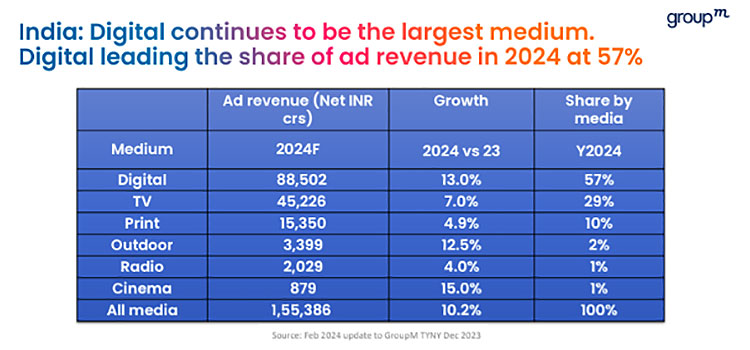
    GroupM India released its annual This Year Next Year (TYNY) report in Mumbai on Tuesdays. The overall ad revenue is expected to reach Rs 155,386 crore in 2024, with an incremental Rs 14,423 crores compared to 2023. This is a growth of 10.2 year-on-year.

    Digital at 13% growth is driving overall ad revenue growth in 2024, as per the report. It  will take 57% share of AdEx pie in the year. All other media combined to grow at 6.8% in the year.  Of the 14,423cr of incremental ad revenue in 2024, 70% to go to digital.

    Within digital, retail media driving growth; CAGR of 41% in 2019-24F. Digital extensions of TV estimated at INR 5,750cr in 2024. Auto, realty, retail, SME estimated to drive growth in 2024

    Prasanth Kumar
    Prasanth Kumar

    Said Prasanth Kumar, CEO, GroupM South Asia: “Despite facing macroeconomic challenges, we remain optimistic about the industry. At 10.2%, India will be the fastest growing top market. 2024 will also see an upside from the spends leading to the General Elections. Digital particularly retail media and digital extensions of TV are expected to drive the growth. SME continues to fuel the growth. Linear TV is at a point of inflection and needs to be enabled with rapid deployment of technology to stay relevant.”

    Ashwin Padmanabhan
    Ashwin Padmanabhan

    Added Ashwin Padmanabhan, President – Investments, Trading, and Partnerships, GroupM – India: “The advertising landscape is evolving with the fragmentation of search, rapid rise of influencer marketing and retail media. Reflecting this, at INR 88,502 crores of the overall Rs 155,386 crore, digital will contribute to 57% of all ad revenue. Within digital ad revenue, search contributes 22%, retail media 18% and the rest 60%. Sectors like Auto, Realty and Offline Retail are expected to power the overall advertising growth.”

    Parveen Sheik
    Parveen Sheik

    Said Parveen Sheik, Head of Business Intelligence, GroupM India:  “Global advertising presents a steady picture: a projected 5.3% global growth in ad revenue for 2024, reaching $936 billion, with digital leading the charge at a commanding 79% share of all ad revenue. India continues to be ranked 8th globally and its ad revenue growth among its peers is a testament to its potential and resilience. Adaptability is key to navigating an evolving advertising landscape amidst inflation and geopolitical tensions.”

    Parthasarathy Mandayam
    Parthasarathy Mandayam

    Added Parthasarathy Mandayam (Maps), Chief Strategy Officer – GroupM South Asia, “Zero Party Data will come to the fore, providing insights on attitudes, behaviour, and product consumption. The availability of granular data will lead to micromarketing strategies, be it in market prioritisation, ultra-niche consumer segments and micro influencers. Advances in AI will also transform measurement, messaging, and media optimisation.”

    Priti Murthy
    Priti Murthy

    Said Priti Murthy, President -GroupM Nexus, “In 2024, brands will shift their focus to consumer experience through performance marketing, integrating brand activities and emotions. Search marketing will become more diverse due to growing complexity and skillsets. Attention planning will impact growth narratives and ROI. Technology will aid hyperlocal marketing, but modern retail still has room for digital growth.”

    The GroupM TYNY report also unveiled several evolving trends for 2024.

    Key trends include:

    • Increasing influence of gen-alpha will drive distinctive marketing strategies
    • Attention Planning – customising insights for actionability
    • 21% of television homes to be addressable in 2024
    • Sports to focus on immersive experience journeys
    • Brand marketing becomes more accountable on performance, breaking silos
    • Step-up on search
    • Ecommerce drives deeper into organisations
    • India’s general and modern trade getting digitised leading to rise of omnichannel commerce
    • Rapid developments in AI will transform media, messaging, and measurement
    • AI and technology dominate the content landscape and creator economy
    • Importance of niche consumer segments will power the growth of micromarketing
    • With consent becoming critical, zero party data will empower various areas of marketing
  • TV still accounts nearly half of large marketer budgets…


    By Our Staff


    Earlier this week, GroupM unveiled its global end-of-year forecast of adspends. The WPP advertising clongomerate also publishes its India-specific numbers, so we are not doing a detailed look right now, but here are highlights of the This Year Next Year study, and a special focus on television thereafter.


    Excerpted from the GroupM report:

    The overall industry forecast:

    • 2021 growth: 22.5% (excluding U.S. political advertising), an upward revision from June’s prediction of 19.2%.

    • 2022 growth: 9.7% (excluding U.S. political advertising), an upward revision from June’s prediction of 8.8%.

    • Many underlying trends appear to be disproportionately concentrated in the U.S., the U.K. and China, which together account for approximately 70% of all the industry’s growth, despite making up about 60% of the total market.

    • Looking at the top 10 advertising markets over the next five years, growth should get back to the mid- to high-single digits:

    ° France, Germany, Australia and the U.S. all poised to grow in a range of 4-5% annually, on average, over the next five years.

    ° India, the U.K., Brazil, Canada, Japan and China are forecast to grow between 6-8% annually, on average.


    Here are the major areas considered in detail as we reach the end of 2021:

    Digital advertising: likely end 2021 growing by 30.5%, up from June’s forecast of 26% growth.

    ° Digital advertising accounted for 64.4% of all advertising in 2021, up from 60.5% in 2020.

    ° Alphabet, Meta and Amazon account for 80-90% of the global total.

    • Television advertising:forecasted to grow by 11.7% in 2021, up from June’s estimate of 9.3%. Given 2020’s decline of 13.7%, the industry is not expected to return to 2019 levels until 2023.

    ° Subsequent years will be roughly flat—up 1-2% per year through 2026—for television advertising in most major markets around the world, as the largest advertisers continue to incrementally shift spending.

    ° Overall, Connected TV+ will account for about 10% of total TV advertising in 2022 ($17 billion of a total of $171 billion) and is expected to double by 2026.

    • Audio advertising: Expectations for audio are that it will grow 15.6% in 2021 and 6.4% in 2022. In subsequent years, we assume a reversion to historical trends: largely flat.

    OOH advertising: Outdoor advertising is expected to grow 17.1% in 2021 and 14.9% in 2022. In subsequent years, we assume a reversion to historical trends: mid-single digit growth.


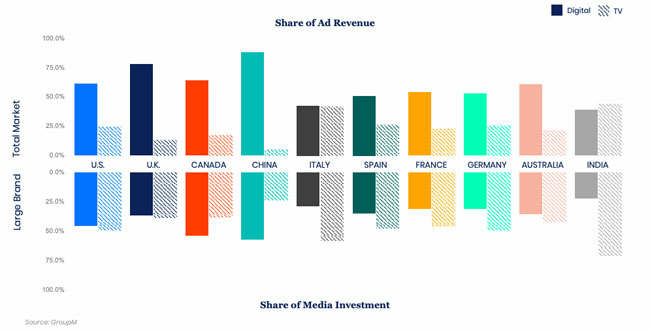
    Now, a superficial read of the data included in This Year, Next Year might leave one with the impression that because 64% of the world’s advertising revenue is generated by digital media and 21% goes to TV, that marketers are allocating 64% of their budgets to digital media and 21% to TV, on average. This would be a mistaken interpretation, because many advertisers—especially small ones and those whose businesses operate entirely online—often allocate all or nearly all of their budgets to digital media while large businesses typically allocate higher shares of their budgets to television.


    For smaller businesses, a high digital skew could occur because digital media’s precision targeting capabilities and automated sales platforms are uniquely capable of absorbing advertising budgets that are measured in hundreds or thousands of dollars. Larger advertisers that spend 100% of their budgets online might typically be doing so because their operations are entirely transactional or direct-to-consumer. For them, too, digital media platforms offer unique advantages connecting a budget for advertising with a tangible near-term outcome and the potential for active “growth hacking” strategies, which can work well, at least up to a certain scale.


    However, the world of media also includes businesses whose marketing goals are set around brand-building. They often do this by associating their products with top-tier video-based content or otherwise focusing on goals that are not most efficiently achieved through digital media. Further, for many, the combined use of different types of media can be synergistic in ways that are difficult to quantify. For example, we can reasonably assume that a strong brand should drive better performance of an e-commerce-focused advertising campaign versus the alternative of having a weak brand, although the factors that can drive a brand to accomplish this outcome can involve uncountable numbers of variables over many years or even decades


    Given our own focus as the world’s largest agency group, servicing larger brands primarily, we wanted to better assess the typical large advertiser media mix. To do this, we looked to GroupM’s own data to find useful illustrations of the ways in which different marketers allocate their budgets around the world. In studying these trends, we primarily focused on two dominant groupings of media, television and digital platforms, and then limited our analysis where possible to a subjectively defined group of large marketers on a like-for-like basis (meaning that we included only the same marketers in each period) within each of our Top 10 markets.


    The most accurate benchmark for large brands to consider is that in a typical large country during 2021, a large brand is allocating 47% of its advertising budget to television, including digital video extensions, and 35% to internet-based media, excluding those digital video extensions. For reference, in 2019, television typically accounted for 48%, while digital media typically accounted for 28%. These figures reflect wide gaps between the shares of revenue that media generates, with the difference driven by the wide range of brands that spend money in a given territory.


    For individual marketers, we recognize that this data may provide useful information about what other marketers are doing. However, the goal should not be to mimic them. Instead, we present this information to help spur questions about the right allocations for your brand. Well-developed media plans account for a marketer’s unique goals, apply some creativity to achieving those goals and consider what worked well for others who faced similar circumstances. It is our hope that the data presented here leads to the creation of more media plans that meet these criteria.


  • Spends decline of 4.4% in UK, 9% in US: GroupM TYNY


    By A Correspondent


    This is the time when various media agency networks release their annual forecasts. There’s GroupM, IPG Mediabrands and Zenith. And first off the block this year is GroupM. The reports are for the UK and US markets, but these are good indicators of what’s happening across the world.

    Given that the two media economies have a significant penetration of adspends in digital, normally what holds good for UK and US and many other digitally developed markets does not hold for India.

    But this year, things may change, and hence it becomes important for a careful study of the study.


    Chalo, let’s read what has been put up:


    The UK: A Decline of 4.4% for 2020

    It could have been worse. Nine months into the COVID-19 pandemic, the scale of its impact on the U.K. is relatively clear by now. Overall, our forecast predicts a decline of 4.4% for 2020, which is much improved over our prior expectation of a 12.5% decline that we forecasted in June. While the economy was historically weak as anticipated, marketers both large and small proved to be relatively resilient. ​

    One of the “bright spots” of advertising in 2020 has been in digital. We estimate that pure-play digital advertising will grow by 4.9% during 2020, following 2019’s 16% rate of growth. Next year should see additional growth of around 12%, tapering off toward 7% after 2021. While this year’s gains look strong in comparison to the rest of the industry, it reflects significant deceleration versus prior years.

    Additionally, e-commerce growth in the U.K. has seen accelerated growth—53%—economy-wide during the third quarter. We anticipate that e-commerce-related advertising will continue to experience rapid growth, rising around 50% this year and 66% next year, reaching £2.4 billion in media owner ad revenue by 2024.

    In television, for 2020, we estimate it will fall by 10%, the worst rate of decline since 2009, but better than we anticipated earlier this year. Our 2021 forecast now anticipates a 10% gain and a return to 2019 levels in 2022. Although streaming services receive much of the industry’s attention, traditional ad-supported television continues to do the bulk of the work supporting marketers’ brand-building efforts. SVOD is drawing consumption away from conventional TV, at least in line with the heightened levels of investment going into the new offerings from the media owners themselves. But legacy media owners’ platforms are finding ways to add value for their customers.

    Some other key takeaways:

    Print media, including newspapers, magazines and their digital extensions, will account for 7% of media owners’ ad revenue in 2020, down from 9% last year. We expect a decline of 23% this year, followed by a rebound of 13% in 2021.

    Out-of-home advertising is set for a decline of 45% in 2020; however, much of that loss should be regained next year, when we expect the medium to expand by 31%. Digital formats, which now represent around 60% of the medium’s activity, will continue growing next year and beyond.

    Cinema has been most heavily affected by the pandemic, with an estimated decline of 80% for 2020; however, we expect a strong rebound of 160% in 2021 as film studios seek to monetise their backlogs with a surge of highly anticipated launches. While this rebound may seem optimistic, we note that it only brings cinema back to 52% of pre-pandemic advertising spend.

    For 2020, we think audio will fall by 16%, and we expect growth of nearly 12% in 2021. The bigger question is what happens in the years beyond? The effectiveness of audio-based media has rarely been in doubt, though its appeal has been somewhat limited, as the medium commands only 2% of industry spending. Arguably, this presents opportunity for growth over time, especially as new digital formats emerge.

    For 2021 and beyond, Brexit uncertainty still weighs on the British economy. While the implications for media might not be obvious, the macroeconomic impact is potentially significant. At a minimum, our forecasts anticipate some degree of disruption to the economy in the early part of 2021 as adjustments are made; however, we think Brexit’s impact on the advertising market will be limited to a shift in spending away from the first quarter rather than meaningful full-year cuts. More generally, we continue to assume that “normal” activity will return by the second half of the year, which pre-supposes that Brexit will not cause ongoing problems and that an effective vaccine will be widely distributed across the population.


    **


    The US: Digital Advertising is the ‘Bright Spot’

    Despite a pace of economic decline that will produce the worst economy since the Great Depression, the ad market might end up falling by little more than we saw 2001. It will certainly be better than in 2008 during the fallout of the global financial crisis.

    And much like the overall economy, the advertising industry is experiencing a K-shaped recovery – the pandemic has seen rapid acceleration for e-commerce and advanced digital services and cratered industries like restaurants, bars, travel, entertainment and traditional retail.

    The bright side, though, is that the underlying rate of decline for advertising is not quite as bad as we thought it would be in our June forecast when we predicted a 13% decline. We think the decline will be closer to 9% because of the strength in digital advertising in particular or, more specifically, the unexpected pace at which digital’s small-business-skewed customer base expanded its spending.

    Digital advertising is the “bright spot” in an otherwise dark year for the industry. We estimate that pure-play digital advertising will grow by 5% during 2020 on an underlying (ex-political advertising) basis, following on 2019’s 17% rate of growth. During 2021, we estimate that digital advertising will account for 55% of all advertising we track. Political advertising has proved to be an important source of growth for digital media during 2020 as roughly 4% in total digital advertising was for political candidates and issues advertising, representing around 3% of the year’s gains.

    National TV advertising will see a decline of 7.9% during 2020 and rebound to grow by 6.6% during 2021 before returning to a flat or slightly declining longer-term trend. At this pace, national TV is faring better than every other category of media other than digital. Post 2Q, advertising has held up well because most of the dominant advertisers adapted their behaviors, at least on an aggregated basis, which translates to national TV ad spending at levels that resemble pre-pandemic levels.

    Underlying (ex-political) advertising for local TV will see a decline of 21% this year after a flat 2019 but, next year, we should see a 2.7% underlying gain. Revenue for political and issue advertising reached record levels by the end of November, with the hotly contested run-off elections for Georgia’s Senate seats still to come. If trends play out as expected, political and issue advertising on local broadcast and cable could reach approximately $7 billion for the year.

    Some other key takeaways:

    Print media is expected to decline 20% for magazine publishers and a 30% decline for newspaper publishers. It is our view that neither the magazine nor newspaper sectors will ever exceed $10 billion in ad revenue in their current forms, even including existing digital properties.

    OOH advertising, including its digital extensions, will decline by 31% during 2020 on an underlying (ex-political advertising) basis, following on 2019’s 10% rate of growth. Next year should see a partial rebound of 23% growth, which tapers off toward 5% in subsequent years.

    Cinema advertising is unlikely to see any meaningful rebound until traditional movie-going returns, and this will require studios to resume launching their major titles in theaters rather than via direct-to-consumer platforms. Even once the virus has receded, it seems unlikely studios will release as many titles in theaters as they did in pre-pandemic years, meaning admissions are likely to remain below 2019 levels for some time.

    Audio advertising, including its digital extensions, will fall by 27% during 2020 on an underlying (ex-political advertising) basis, following on 2019’s 2.1% rate of growth. Next year should see muted growth of around 6.6%, reflecting a weak local market for advertising and a first half that will probably be particularly negative for locally oriented media.

    Direct mail is estimated to generate around $13 billion in revenue during 2020, down 26% on an underlying basis but only 21% including political advertising. We expect to see a partial rebound next year for 17% growth, or 10% including political, before resuming single-digit declines.

    2021 and Beyond: Looking at 2021, an assumed second-half return to normalcy paired with the significant growth that followed the trough of 2Q this year leads to expectations for robust growth of 11.8% on an ex-political basis, or 6% including it. For subsequent years, we anticipate slightly higher growth than we previously forecast—now 5% in 2022 followed by 4% in 2023 and 2024—to reflect what we think will be an accelerated pace of investment in digital media by marketers of all sizes.

     

  • The Year Ahead for TV


    Published from the GroupM TYNY Report


    Globally, we estimate that television ad revenue declined by -3.6% in 2019, excluding U.S. political advertising (or -5.5% including it).


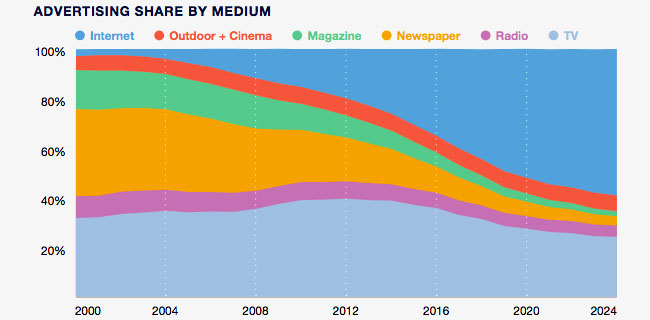
    Despite the inclusion of digital extensions associated with TV in some markets (including the U.S. and U.K.) and various other advancements, TV is unlikely to grow in the future on an underlying basis, and we expect just under $170 billion in annual ad revenue each year through 2024. New forms of TV—or premium video advertising— will likely lead to a shift in spending within the medium going forward. Although television arguably remains most effective in helping marketers build their brands, the relative effectiveness of television has likely fallen, at least incrementally. And, the share of budgets allocated toward TV have generally diminished incrementally with each passing year. This has occurred as some advertisers shifted some budgets out of TV and into digital, and other advertisers shrank in size and reduced media spending, including TV. Television now commonly represents around 40% of a typical large brand’s media budget, or 27% on average across all advertisers as reflected here for 2020. Interestingly, the median growth rate in 2019 was +0.1% and should be +1.8% in 2020, illustrating that there are many countries where TV advertising is still growing. The median country should see growth of between +1–2% each year through 2024.


    Top of mind for many marketers using television as a key part of their media mix is the impact of new SVOD services, especially the U.S.-based media giants. In a mature market such as the U.S., we can see the impact of the availability of streaming alternatives prior to the launch of Disney+: Cord-cutting and cord-shaving are accelerating to record levels, with total Pay TV subscribers now falling annually by low single digits, and the median network losing mid-single-digit percentages of subscribers on a similar basis.


    Traditional TV viewing across all audiences and all forms is down only slightly, but this masks the growth of streaming-related activity. Concurrently, consumption of television using internet-connected devices accounts for nearly 15% of TV-related activity, and is growing by around +30% year over year. A majority of this internet-connected-device viewing is directed to SVOD services.


    The leading driver of this behaviour is Netflix, of course, with 158 million subscribers in total, including approximately 61 million U.S. subscribers (50% of all U.S. TV households), 12 million in the U.K. (41% of all households there), 10 million in Brazil (close to 20%), six million in France (nearly 25%), and six million in Canada (nearly half). The competitive offering from Amazon’s Prime Video is nearly as widely subscribed, while other services primarily operating in single countries—including Baidu’s iQiyi, Alibaba’s Youku Tudou, and Tencent Video (all in China); Hotstar and Hulu (in India and the U.S., respectively, and both owned by Disney)—have also emerged. In addition, a growing range of specialist and niche services and streaming replacements for traditional TV networks is now widely available. And of course, much more is set to come in the year ahead following the 2019 launch of Disney+ and Apple TV, with pending launches of new services from Comcast/ NBCUniversal’s Peacock and AT&T/WarnerMedia’s HBO Max.


    For these new SVOD services to have a meaningful impact in the U.S. or elsewhere, meaningful investments will still be required—and the media owners making those investments will face hard financial choices. Some of the new SVOD services are launched by traditional TV owners, and accelerating investment in SVOD content will partially depend on overcoming the friction tied to cannibalising existing revenue streams. These are hard decisions. Taking risks and making investments will help futureproof their businesses, but not every company will do all they need to in the short term in order to ensure long-term health.

    Consider the scale of investment required to be competitive:

    • In the U.S. alone, Netflix is on track to spend around $3.5 billion this year on an accrual basis, or probably closer to $5 billion in cash terms (assuming one-third of the global $15 billion in expected spending this year is attributable to the U.S.). This amounts to around 5% of the ~$75–80 billion spent by all MVPDs and streaming services in the U.S. This spending is arguably reasonable, considering how much viewing Netflix generates: The company accounts for 37% of all streaming consumption on televisions in the U.S., and streaming accounts for around 14% of TV consumption, according to Nielsen data. From this data we can calculate that Netflix has a 5% share of viewing, roughly the same as their percentage of spending on content. Over the next several years, costs will undoubtedly rise as Netflix looks to maintain its audience share, and so it is not unreasonable to think in terms of $5 billion in spending on an accrual basis (or more than $6 billion on a cash basis) by 2024.


    • Disney expects to spend $5 billion annually on content for Disney+ by 2024, with one-third of subscribers inside the U.S., and presumably a proportional amount of spending on content assigned to their U.S. content expenses. This will be paired with spending on Hulu, which last year amounted to around $2.5 billion, and which will presumably rise significantly. Even backing out costs associated with Hulu’s vMVPD service, we could expect a $4+ billion streaming content bill for Disney’s domestic operations in 2024.
    • Similarly, AT&T has indicated that by 2024 it will be spending an incremental $3 billion on domestic programming for its HBO Max service, above and beyond what it already spends on HBO today.
    • According to the Financial Times, Apple has committed $6 billion to spending on original shows and movies for its TV service, presumably globally, over an unclear time horizon.

    If each of these services aims for viewing parity, it is not hard to imagine their spending $4 billion per year, on average. Additional services will also undoubtedly be significant buyers of content, including Comcast’s Peacock and ViacomCBS, which will presumably invest more heavily in their initiatives as the two companies formally come together. The total amount of annual spending in the U.S. alone would likely amount to around $30 billion if all of this plays out.

    All of this new spending would be consistent with recent increases in industry-wide programming costs. If the non-streaming world were able to hold the line on its content spending at around $70 billion, the $30 billion referenced above would represent an incremental $20 billion on spending (as streaming services currently spend around $10 billion on content annually). Over the next five years, this would equate to a roughly +5% increase in annual spending on programming by the services consumers receive in the U.S., a lower figure than the +7% increase in spending on programming we saw from cable and satellite operators over the past five years between 2013 and 2018.

    However, the economics of streaming services are very different than those of the traditional MVPD business. They are less favorable on a stand-alone basis and usually need to be considered in the context of other services with which they are bundled. Assuming that advertising attributable to streaming services will not be incremental to the industry, direct revenues probably won’t fully offset costs by much, if at all, leading to margin erosion.

    There will only be so much money to go around for subscription fees. If consumers continue to increase their spending on all forms of video (which amounted to $140 billion last year for video services, cinema and DVDs) at historical rates through 2024, there will only be an incremental $20 billion in consumer spending available for new services. This is roughly equal to the amount of new spending on content that we estimate above. And, unfortunately, advertising is not likely to be incremental for the industry (as there is only a limited relationship between changes in supply or improvements in targeting and changes in total spending in the advertising industry, unless new advertiser segments are brought into the medium).  This suggests that financial contributions from these new services will not be net positive anytime soon.

    Favourably for Disney, Comcast, AT&T and Netflix, at least, what money is available will mostly go to these companies, as Amazon and Apple appear to primarily look at streaming services as a value-added product and are not likely to attempt to recoup all of their costs directly. The overall economics of these services can be viewed more favorably if we consider their contribution to other business, including reduced churn or pricing premia for services with which they are bundled.

    For the media industry, the question is what media owners’ tolerance for margin erosion will be. This will drive the pace of change in the years ahead. Some owners of streaming services will be more tolerant than others and position themselves more favourably for the future. But it’s also possible that every one of them agrees that this kind of business reinvention ultimately leads to better business in the long run. For consumers, this world arguably looks quite favorable as it offers up better-quality content with the opportunity to purchase content packages more granularly, as needed, even if costs per hour of content purchased rises. For advertisers, some elements of television will worsen because ad inventory is likely scarcer, and reach is likely harder to come by. On the other hand, where advertising does exist in this new world—and many streaming services will embrace advertising as an element of their financial models—it will likely reach more engaged consumers, in potentially more valuable environments than those that have come before.

    Toward these ends, many advertisers want to prepare for such an eventuality. For those who believe it is prudent to make such plans, what should advertisers do? It bears repeating that ad-supported TV in its broadest definition—including streaming equivalents—remains strong in absolute terms and generally maintains superior reach relative to alternatives for most audiences. Of course, there are significant challenges to be overcome in managing campaigns optimised for reach and frequency, given the manner in which those campaigns must be run across different sellers of advertising and different devices, and given the limitations of existing measurement systems.

    If ad-supported TV declines relative to alternatives, different approaches to media planning may be considered. Beyond premium video, many advertisers may run video across environments that include other digital content or on digital out-of-home in an effort to sustain broad reach, albeit without the borrowing of content’s brand equity. Another alternative includes optimizing reach across a wider range of media, with a focus on using each medium to drive awareness as best as each can. Other marketers might find that a focus on outcomes as opposed to proxies for long-term outcomes (which brand awareness is arguably best at) rather than reach is a preferred approach.

    A future with less premium video advertising should present an opportunity to take a fresh look at how marketing is budgeted. If the insights and ideas supporting brands will be more impactful than any individual media execution, processes should focus more on investing in those insights and ideas. Investing in a broader notion of a consumer’s potential life cycle with a brand—ranging from brand ideas to media exposures, brand experiences and word of mouth (including all of the data and marketing technologies that support them)—will probably be impactful as well.

    We are mindful that U.S. trends may occur in other countries, but probably not everywhere—at least not in the same ways over similar periods of time. We see cord-cutting in some other countries, like Brazil, where we see mid- to high-single-digit annual declines in pay-TV subscribers. However, in many other places, the concept of cord-cutting is not meaningful yet, especially in countries where digital terrestrial TV makes it possible for consumers to access what Americans might think of as “basic cable” with a simple antenna, or through a free set-top box provided by an internet service provider. Viewing trends will also be impacted by the fact that pay-TV penetration has often been low to begin with in many countries. This would limit the hours consumers have historically spent with TV, at least relative to the U.S. Where that has been true, it is possible that the wider availability of SVOD services (and the premium content they offer) could lead to an expansion in viewing of the medium in its broader definition. More viewing, especially of high-quality TV content, should lead to more engaged viewers—all things being equal—and should prove to be positive for advertisers.


    TOMORROW: THE YEAR AHEAD FOR THE INTERNET