Media investment conglomerate GroupM released the GroupM India Digital Playbook in an attempt to guide brand advertisers on the fast evolving digital media space in India.
To help brands in this endeavour, GroupM has got some of the best digital minds in the country to come up with 7 actionable opportunities in the coming year – like mobility, real-time content and media, digital and experiential platforms. The playbook further details several milestones – including creating a matrix of outcomes and drafting a mobile first view- that brands should aspire to achieve this year to capitalize on these opportunities. The playbook recommends that brand advertisers adopt a holistic insights and data driven approach with integrated marketing technology framework as the key enabler.
We publish here with permission one of the chapters from the book – Â titled The Technology Imperative In Marketing (the book may be downloaded at http://indiadigitalplaybook.com/IndiaDigitalPlaybook2014.pdf) and bring you an interview Tushar Vyas, Managing Partner – GroupM Interaction South Asia
Marketing was perhaps the last discipline to get impacted by technology. While business functions such as finance, accounting, manufacturing, and even human resources adopted technology, marketing remained as the ‘last man standing.’ Technology has now become a critical element in marketing, so much so that large organisations now have a designated role of ‘Chief Marketing Technologist.’
| Jaldi 5 Q&A with Tushar Vyas: More and more marketers will take a hard look at media investments from the lens of outcome and not output
 The Group M India Digital Playbook aims at providing a blueprint to help guide marketers through the twists and turns that await us, says Tushar Vyas, Managing Partner Interaction South Asia. An exclusive interview with MxMIndia.com on the release of the GroupM India Digital Playbook 2014-15 The Group M India Digital Playbook aims at providing a blueprint to help guide marketers through the twists and turns that await us, says Tushar Vyas, Managing Partner Interaction South Asia. An exclusive interview with MxMIndia.com on the release of the GroupM India Digital Playbook 2014-15
01. Despite the mobile turning ubiquitous and a fairly number of people embracing digital in the way they conduct their professional and personal lives, the adspends on Digital is still in single digits. What would you attribute the reasons for this?
Digital is the highest growth medium in media mix currently – almost 3x the AdEx growth. In many categories like BFSI and auto the number is significantly high. This is an indication that we are reaching a tipping point. The complexity of the digital ecosystem and still evolving KPIs/Benchmarks are current challenges. Through the Playbook we are trying to address these.
02. While almost all media and creative agencies have embraced digital either organically or inorganically, marketer who otherwise spend loads internationally are still content with the TVCs on TV or even the traditional print advertising. Comments?
Today, the discussion on digital has moved away from “Why digital ?”.  You rarely hear this question. However, in many cases digital is still on the side of the plate and treated as an add-on. Brands need to start looking at an integrated approach towards media and define the role of digital. Digital medium scores pretty well on efficiency as well as effectiveness parameters. We need to continue the education process and build empirical data as well, to support the claim for higher digital media mix.
03. While the number of avenues of advertising is limited on TV and print or outdoor or radio, in digital there are many – the good ol’ banners, to search, to social, to  mobile? Do you think the multitude of opportunities could have taken away from the focus on hte  platform?
Multiple mediums and formats are converging into Internet and that’s making the process complex.  Again, it’s important to start with the objective/ expected outcome clear in your mind. Too many marketers are caught in the output driven metrics (like GRPs,Clicks) while in reality they should just be milestones in the journey. What matters is the outcome- be it consideration, affinity, sales. This year, more and more marketers will take a hard look at media investments from the lens of outcome and not output.  This will certainly lead them to invest time and money in mediums like digital where customers are engaging heavily.
04. Your report talks of the scope for videos in India. But the connectivity speeds is still a huge problem here, right?
India is the third largest online video market globally in spite of the constraints . That’s a reflection of the potential that exists in this market. The growth will be multifold from here on as  penetration of smartphone/ devices, content ecosystem and connectivity improves. Even today we have a sizeable active base and online platforms like youtube are already part of top 10 television channel list for most target audiences.
05. There is a statement in the study that’s interesting: Mobile Internet will undoubtedly become the superhighway that connects rural India to the world. But given literacy levels being low in rural India, don’t you see that as a challenge?
The web is becoming more visual (Image and Multimedia) and that’s where literacy levels may not be important. Same is the case for audio on the Internet and voice based solutions. Today a significant part of the content getting consumed is on recommendation rather then self-discovery— in a way your peer/ social group will help identify and filter content which is relevant for you in terms of common interest or cultural context. Audience will naturally gravitate towards content that is suitable for them.
|
Impact of technology in marketing is at two levels. First it is an enabler in ‘story-telling.’ Essentially, that is all the technology that can deliver consumer experiences while telling a story-whether it is interactive screens or your sneakers talking to your phone. This is fuelled by consumer adoption of technology, which is faster than business adopting technology. An interesting data from a survey says “72% of 18-24-year old know how to connect a device to Wi-Fi. Only 8% know how to poach eggs.”
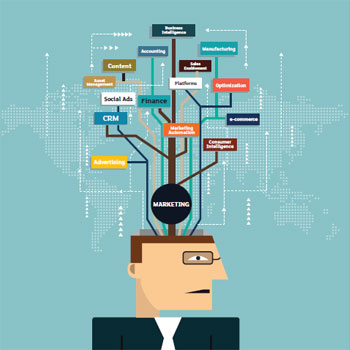
Second, the adoption of marketing technologies drives efficiencies and effectiveness in the marketing function. As of now there are over 1,000 known companies providing software for marketers across 43 categories and 6 classes. These categories are as wide ranging as e-mail marketing, display advertising, testing & optimization, asset & content management, e-commerce, search & social ads, business intelligence, CRM, and sales enablement, to name a few. A Gartner report that says in the next 2-3 years, CMOs will spend more on technology than CIOs, does not raise eyebrows anymore. While some marketers are already using some of these technologies, here are a few technologies you just cannot ignore in the coming year:
1. Integrated Digital Marketing Platforms.
This perhaps is the most important-adoption of unified technology platforms. As advertising becomes more technology driven, it is becoming more complex with endless choices of formats, new innovations, and rapid changes. In the process cycle of planning, activation, optimization, and reporting, the planners and campaign managers need to rely on disparate set of tools, data sources, and implementation techniques. For instance, there are up to 20 intermediaries, such as ad-servers, DSPs, exchanges, bid managers, data management platforms, and so on, between advertisers and publishers today. There are display reservation & biddable buys, exchanges, search, re-marketing, video ads, social ads, mobile, and more. There are multiple and dynamic creatives, landing pages, and different call to actions. And finally, there is the lack of a single view of campaign performance metrics. The need to adopt integrated platforms is a necessity to navigate the operational complexity as well as bring efficiency.
Today, an integrated platform like DoubleClick by Google brings together an ad server streamlining workflow for planning, trafficking, and targeting; demand-side platform (DSP) accessing inventory with real-time bidding and creation of audience segments; creative production and workflow tool; data management platform; rule-based ad serving; and a robust reporting module. As digital marketing grows in volumes and complexity, adoption of integrated platforms is a must for marketers this year.
2. Marketing Automation.
Marketing automation software enables processes such as defining, scheduling, segmenting, and tracking of marketing campaigns. Customers can be scored based on multiple parameters, segmented, and addressed one-to-one with customized messaging.
Early adopters were verticals with large customer database such as BFSI, retail, and telecom. Now with the staggering growth of data-transactional data, call centre data, social touch points, and the like, customer segmentation can be far richer. Other categories such as media, automobiles, and e-commerce are now embracing marketing automation. IBM (Unica), SAS and Oracle (Eloqua) are some of the players in this space.
3. Content Marketing Tools.
Content marketing has been a buzzword for some time now. Social media has accelerated the adoption of content marketing. As content marketing takes centre stage, technology is again becoming a key driver.
Technology adoption is in the areas of content distribution platforms (tools such as Thismoment, HootSuite, and Uberflip) and content discovery (Outbrain).
4. Consumer Intelligence.
Consumer Intelligence is normally referred as a subset of CRM and is in relation to the existing customer base. But with the advent of social media, consumer’s collective voice is a source of consumer intelligence.
Some marketers have started using technology for ‘social listening’ to get a better understanding of their consumers and respond with better products and services. Adoption of these tools (e.g. Radian6, Meltwater, and Explic8) will significantly rise in the coming years.
Consumers, empowered like never before; marketers with new tricks of the trade; data, explosive and big; and questions on privacy and security-all these make marketing as interesting as ever and more challenging.
And, technology remains the silent enabler.
The GroupM India Digital Playbook may be accessed at http://indiadigitalplaybook.com/IndiaDigitalPlaybook2014.pdf