
Tag: GroupM Global

  • Future of Safety for Brand Marketers


    By A Correspondent


    A new brand safety report has been released by GroupM, WPP’s media investment group, offering new category-specific recommendations for marketers on the future of brand safety.


    The report reveals how brand safety may evolve into the future within the context of political, social and technological shifts impacting brand safety at a high level. Then looks to specific challenges in five categories currently undergoing rapid transformation: Connected TV, Digital Out-of-Home, Location Data, Audio and Gaming.


    Said John Montgomery, GroupM Global EVP, Brand Safety: “In the first six months of 2020 alone, CCPA has taken effect, Google announced they would be phasing out third cookies, the home stretch of the 2020 presidential campaign has come into full focus – increasing the attention on fake news – the world has been hit with a global pandemic and most recently protests related to racial inequality,” adding: “Each of these events marks a unique opportunity to continue to challenge our brand safety practices. And, as people continue to evolve in how they consume content, there is always opportunity to push the envelope to create an even safer, more trustworthy online world. We look forward to continuing to do that for our clients and partners.”


    Some of the key items to consider in the evolution of brand safety:

    • Policy shifts such as GDPR and CCPA, among many others around the world, have created a seismic ripple throughout the industry, the full effects of which are yet to be felt. As old measurement methodologies such as third-party cookies fall away, the industry has an opportunity to collectively create better standards.


    • The Covid-19 pandemic has established a ‘new normal’ ‘digital first’ lifestyle for the majority of the global population. Consumption habits have changed (more news, gaming and streaming content). Where consumers go, advertising follows and, with it, new opportunities to strengthen brand safety measures arise. Aggressive keyword avoidance demonetizes online news, especially so during the Covid crisis, as the audiences increase and at a time when the public needs reliable information. Local news faces an existential crisis.

    Fake news and technologies that create deepfake videos are growing more sophisticated and threaten to further erode institutional trust. Brands must be more proactive than ever in preserving their core assets and demand transparency in all transactions.


    • Connected TV promises to command a larger share of budget in the coming years. However, measurement is fragmented across devices and publishers. Brands should demand greater transparency and interoperability among key players.


    •  Digital Out-of-Home is set to grow more advanced and complex as programmatic buying becomes more commonplace. While out-of-home has long been used for broad awareness, it remains an open question as to whether brands will have—or need—access to more granular targeting and measurement solutions.


    •  Gaming presents a huge opportunity in terms of audience, but brands must navigate a vast landscape of platforms, titles, player personalities and publisher relationships. Esports continues to grow in popularity, but brands must be aware of adjacency risks (violence and language, particularly). If people continue to stay home in the aftermath of the coronavirus, gaming audiences will retain some of the recent, rapid growth.


    Added Christian Juhl, GroupM Global CEO: “Consumers and brands use technology to access media in new and interesting ways. As behaviours, habits and preferences shift with social factors, responsible brand safety requires a constant assessment of these changes and their impact on how brands continually earn consumer trust. GroupM has long acted as an industry advocate in shaping how we manage brand safety across new and established media partners. It’s never been more important than it is now, and we stand by our commitment with this latest guidance.”
     

  • GroupM report predicts online media surpassing Linear TV in 2018

    By A Correspondent


    GroupM has released a new report, ‘State of Digital’ offering intelligence on consumer media consumption and advertising investment trends worldwide. The  new report focuses on the impact of technology and digital capabilities on consumers and advertisers.


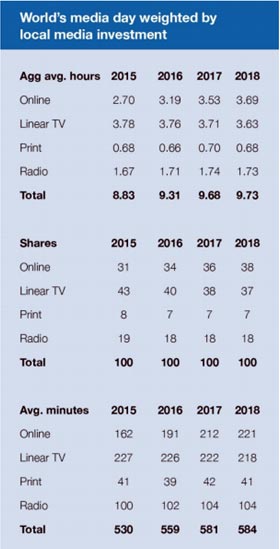
    GroupM tabulated consumers’ time spent with each media format, globally, and calculated average time spent with media overall. In 2018, consumers will spend an average 9.73 hours with media, up from 9.68 hours in 2017 (figures weighted by media investment). Additionally, GroupM predicts time spent with online media will overtake time spent with linear TV for the first time, globally, in 2018. Online will have a 38 per cent share, TV 37 per cent, and the balance spread primarily across print and


     

    Increased time spent with online media supports ongoing e-commerce escalation. Thirty-five countries supplied 2017 e-commerce data to GroupM revealing cumulative transactions worth $2.105 trillion, growth of 17 per cent over the prior year. GroupM predicts 15 per cent growth in 2018 to $2.442 trillion or about 10% of all


    For the report, GroupM also examined programmatic (automated) ad investment trends. On average across reporting countries, 44 per cent of online display investment was transacted programmatically in 2017 versus 31 per cent in 2016. This will rise to 47 per cent in 2018. For online video investment, programmatic is smaller; 22 per cent in 2017 versus 17 per cent in 2016 and predicted to rise to 24 per cent this


    GroupM also surveyed WPP’s network to better see the forest for the trees on industry hot topics.

    Blockchain: So far, there is scant evidence of practical application. “Blockchain’s main attraction is its distributed ledger which tells everyone everything and thus presents the opportunity to reduce inefficiency or cheating. However, its Achilles’ heel is the need to keep every participating computer updated with everything all the time, and that’s too slow for a real time world,” states Adam Smith, GroupM’s Futures Director.


    AI: Conversely, respondents reported ample development and scaled deployments with Artificial Intelligence (AI). “Arguably, today’s most advanced marketing tools are the advanced algorithms helping brands analyze which creative or media placement is performing the best, at scale and speed,” states Smith. “Among many future applications, we expect AI to helpfully emerge in fighting fraud that evades conventional rules-based


    Data: Regarding marketer application of data to media investment, respondents cited ample room for improvement. Clients are increasingly aware of the value of owned/acquired data, but are often risk-averse to harvesting, storing and distributing it. In many smaller countries, available data is poor. Most U.S. clients are using first-party data to activate digital media, and they’ve frequently invested in enterprise data management platforms (DMPs). Other markets are not so far along for varying reasons. Marketers most often using first-party data are performance-oriented, e-commerce driven, and typically in auto, travel, hospitality, banking, or sometimes supermarkets with well-managed end-point of sale


    Digital video competition: Because measurement of premium video audiences across platforms is woefully inadequate in every market, GroupM asked respondents to simply estimate the share of TV incumbents versus digital insurgents. Legacy TV players are believed to hold three-fourths of all video hours but less than a third (29 per cent) online video hours.


    Metrics & viewability: GroupM believes that effective advertising must be in view and/or in hearing, and we take a leading position in setting industry and commercial viewability practices. Constituents reported some industry works-in-progress to enhance measurement of omni-platform video audiences. As this progresses, viewability continues to be debated with some contrarians suggesting 100 per cent in-view ads in mobile environments can sometimes be intrusive and can be negative to consumer experience and thus brands.


    In-housing: Respondents said this is more often talked about than done, but several countries reported hybrid arrangements – typically, clients taking on strategy but leaving execution to agencies. Most inhousing involved the biggest clients doing the simplest programmatic functions.


    Price inflation: Respondents cited two inflation drivers: high demand for premium, brand-safe content and poor measurement of OTT and mobile platforms; the scarcity of measurable inventory drives up prices.


    The duopoly: No look at the global digital landscape would be complete without acknowledgement that Google and Facebook continue to be the key growth drivers. Google search is critical to clients, and YouTube is increasingly important for scaled, premium video. Concerns over the quality of programmatic inventory in the Google Display Network persist, but remedies are being pursued. Facebook’s success is partly due to the delivery of younger audiences via Instagram. The surge in large-advertiser investment in 2016-2017 also helped double Facebook’s share of digital investment ex-


    “Automation and talent are the big themes in advertising’s current revolution.” said Kelly Clark, CEO, GroupM Global. “One of the downsides of specialization is the increase in specialists who know more and more about less and less. We have to use automation to liberate brain-power, so talented people can look across the entire media ecosystem to help clients optimize short-term results and create long-term brand value.”


  • Leaning into change: Lindsay Pattison


    When we met her in Mumbai a few weeks back, a senior GroupM official had alerted us that she was the Global CEO-in-waiting.  Lindsay Pattison has been successfully leading Maxus in the UK for five years, taking it in that time from a ranking of 14 to a No 7 position, and from 30 people to now over 250. She has also held the global Chief Strategy Officer role for the last two years, overseeing product, planning, marketing, new business and effectiveness.


    And now Pattison replaces Sakhuja as Global CEO of Maxus. She will co-locate between London and New York and will report to GroupM Global President Dominic Proctor. “I am thrilled to step up into this role,” she said in the communique announcing her appointment. “I love the energy of Maxus and I relish opportunity that comes from our unique and fortunate position as the challenger brand within GroupM.”


    Pattison, who will be succeeded in the UK CEO role by Nick Baughan, currently the MD, joined Maxus in October 2009 in the newly created position of CEO to drive the agency brand to a new level, both in the UK and as part of the global management team. In August 2012, she was named as the new Global Chief Strategy Officer for Maxus, working alongside her duties in the UK. She would take direct responsibility for global planning, data and insights, digital, marketing and new business functions.


    In between her travel from London to New York, Pattison took time off to respond to the questions from Pradyuman Maheshwari


    Having seen Maxus grow from a small, smart media agency to one of the world’s brightest, your sentiments as you take charge as CEO of the agency?

    To reiterate my quote before I am thrilled to step up into this role. I love the energy of Maxus and I relish the opportunity that comes from our unique and fortunate position as the challenger brand within GroupM. I am most energised by our people; we have people with PACE; passionate, agile, collaborative and entrepreneurial and we take those values and behaviour very seriously. It all comes from having brilliant colleagues, solving client challenges At Maxus we have a mantra to lean into change. In fact it’s really to lead change for our clients, navigating the complexity and embracing the possibilities offered in a digitalised, mobile, always-on media landscape. It’s an incredibly exciting time to lead a media agency.


    You have been Chief Strategy Officer since the last few years and hence have been shaping the course of the agency’s business for a bit. Is there something that you would like to see happen over the next few months and years?

    We still need Growth - in our people as they broaden their skillsets and help our clients business navigate the multifarious opportunities in today’s media landscape. We want a win-win in the success of our clients’ businesses as without them we are nothing. And of course more growth for Maxus globally as the smallest and fastest growing media agency worldwide outright, and of course the fastest growing agency within GroupM.


    You were in India just a fortnight back. Any thoughts on Maxus Team India?

    Maxus India is a shining star in our global network. As the dominant agency in the Indian media scene, we’re in a tremendous position because of the incredible passion and energy of Kartik (Sharma) and his team in all our offices. I was delighted to see our teams in action as we met with several of our key clients. I could see the mutual respect and the strategic value our clients get from Maxus. And there is a palpable entrepreneurial zeal in our team in India - whether that is developing world leading commumications platforms such as the ‘Power of 49’ for Tata or developing fascinating partnerships with academia, Moribus. There is a restlessness to keep striving for better that is a real delight to see.


    Is the new digital, programmatic order scary for media agency businesses such as yours?

    Digital, and programmatic buying as a subset, is all about opportunity. I know it can be somewhat overwhelming for some clients - but our role at Maxus is to be a trusted advisor in this space and work with our clients to make the most of the opportunities on offer, to help them lean into change rather than be fearful of change. With programmatic specifically in mind, there is a huge benefit to clients working with Maxus and GroupM, where I see amazing talent and deeply impressive tech supporting our clients in their business goals.


    While new clients and great work are fine, eventually it’s the bottomline that shareholders are looking at. Any immediate thoughts on how you are looking at pushing profitability in your tenure?

    Well I think the answer to continued profitability is to focus on your clients’ needs and ensure you are delivering great work with great people - it’s a virtuous cycle. That’s how we’ve grown Maxus faster than any other media agency network over the past 5 years, and that’s what we will continue to do.


    And lastly, as he makes way for you, a word on Vikram Sakhuja as Global CEO?

    Vikram has been a breath of fresh air to Maxus, bringing an entrepreneurial zeal to our agency and in his own words, brought ‘systems to scale, whilst retaining the soul of a start-up’. I am looking forward to working with him closely in the future.


    First appeared on dna of brands dated October 21, 2014


  • Exclusive! Jaldi 5 with Rob Norman, Chief Digital Officer Global, GroupM: There’s no doubt mobile internet will be massive in India

    Meet Rob Norman. In August last year, he took charge as Chief Digital Officer of GroupM Global from the position of CEO of GroupM. The job requires him to oversee the world’s largest buyer of online media with more than $5 billion in billings.


    Prior to taking this role in 2012, Mr Norman served as CEO of GroupM North America where he was responsible for the general management as well as strategic and administrative activities at each of GroupM’s four media agencies-Maxus, MEC, MediaCom and Mindshare.  He assumed that role in March 2010 after serving since 2007 as head of Group M Interaction.


    Mr Norman has worked for more than two decades in the media agency business in a wide range of increasingly senior roles, mostly at MEC, where he was named UK Chairman in 2003.  He joined the company in 1986 prior to the merger, when the agency was known as CIA. In 2002, following the merger of CIA with Mediaedge, Mr Nomran was appointed Worldwide Director of New Business Development.


    On the eve of his visit to India, Rob Norman addressed MxMIndia’s question and gave a special message to the fraternity in India.


    A message for India as you embark on your visit here?

    Millions of young people with a desire for media and connectivity is the most fertile imaginable ground for growth. Your telecom industry and the infrastructure it creates are an outstanding asset and if they provide access to bandwidth and devices they will be rewarded by high engagement from consumers, content creators and brands. Together this is a god recipe for economic growth.


    01. As you oversee the the world’s largest buyer of online media, are you happy with the way the online media is progressing globally?

    Yes, in broad terms. There is a direct relationship between e commerce as a % of GDP and online as a % of advertising. E-commerce depends on infrastructure in connections, payments and in retail and other sectors. Where those things are slow to develop so is online advertising.


    02. Why do you think has the progress in markets like India been so slow?

    Infrastructure. India has limited PC broadband distribution and limited smartphone penetration as a % of all phones. Not much is going to change the former but Airtel, Vodafone, Samsung and Android are changing the latter. There’s no doubt in my mind that the mobile internet will be massive in India.


    03. In markets like India, consumption of mobile media has far overtaken that of computer-based. Given the growth of the smartphone market, do you see mobiles ahead of traditional large-screen-based internet?

    Yes. The only barrier is keeping the price of data to the consumer down. There is a huge social and economic upside to a vibrant connected mobile population and wide distribution of devices, content and commerce depend on data pricing


    04. One of reasons why the lack of quality advertising on digital in India is that the monies which agencies earn on digital is much lower. There aren’t million-dollar TV commercials and there are much lesser spends. Is this the scene globally? How do see things changing in markets like India?

    This is an Indian challenge but a global one. The fragmentation of audiences and service / device proliferation allows sharper targeting by behaviour, geography and time. The economics of this are good for brands and it would be a terrible thing if brand owners invested more in the agencies that manage these channels and the assets required to populate them.


    05. Do you see the return of full-service agencies in digital given that clients are desirous of all services under one roof?

    No. Structurally, the full service model is dead. It needs to be replaced by client mandated behaviors that align the financial incentives of disparate experts.