Tag: GroupM ESP

  • India sports grows 49% to 14kcr


    By Our Staff


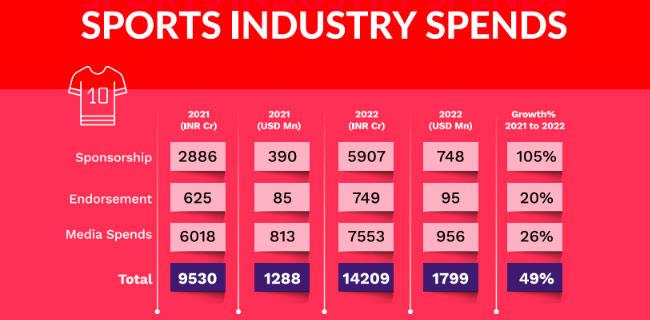
    GroupM ESP launched the 10th edition of the Sporting Nation Report 2023 on sports sponsorship in India on Wednesday. The Indian sports industry witnessed a significant growth curve in 2022, with spends crossing over INR 14,000 crore.


    Sporting Nation 2023 highlights the growth of sports sponsorship in India, with spends on-ground, team, and franchise rising by INR 3021 Cr, a 105% growth from 2021, making the total sponsorship spends INR 5907 Cr. The overall increase in spends was due to the rise in the number of IPL matches, the addition of two new IPL teams, the ICC T20 World Cup, Asia Cup, FIFA World Cup, and the return of emerging sports events and tournaments like PKL, marquee marathons, Maharashtra Open, and Commonwealth Games 2022. Indian women athletes and women cricketers saw a phenomenal rise, with the Indian women’s cricketers making a name for themselves on the international stage.


    The report highlights key aspects of how brands are expected to approach spending on sporting events differently with the rise of OTT, and the sports industry is one of the better-performing sectors in the economy with a 14% CAGR. Two big international racing events, Formula E & Moto GP, are to be held in India for the first time in 2023. The renewal of IPL Sponsorships post the 2023 season, BCCI Home Series Title ad Central Sponsorship along with team India sponsorship, BCCI Home Series Media Rights, and the inaugural season of WPL in March 2023 will be the tipping point for Indian cricket. Overall, the rise of Indian cricket, the performance of Indian athletes and the number of emerging sports leagues have all contributed to India becoming a sporting nation in the last ten years.


    The report reveals that cricket continues to dominate the Indian sports sponsorship landscape, contributing to 85% of the sponsorship spends, while emerging sports like football, kabaddi and marathon have seen a massive upsurge in the sponsorship spends, contributing to the remaining 15%.


    The growth of cricket sponsorship can be attributed to several reasons, including the Indian cricket team playing almost the double number of matches, as compared to 2021. The Indian Premier League (IPL) contributed the major revenue by adding two new franchises – Gujarat Titans and Lucknow Super Giants, and a full house of central sponsorship.


    Said Prasanth Kumar, CEO – GroupM South Asia:  “The Indian sports ecosystem is experiencing a revolutionary transformation, with athletes becoming influential role models for the youth and sports sponsorships gathering immense momentum. In this scenario, brands hold tremendous potential to tap into the passion and loyalty of Indian sports fans. Despite facing unprecedented pandemic challenges, the exceptional performance of the sports industry in 2022 reflects its resilience and unwavering commitment. As we move forward, technology will play an increasingly pivotal role in content management and fan engagement, while opening new and exciting opportunities in sports. Live sports will continue to be highly coveted as monetizable properties, making it a promising sector for investment.”


    Commenting on the report’s findings, Vinit Karnik, Head – Sports, Esports and Entertainment, GroupM South Asia, said: “The Sporting Nation report illuminates the explosive growth of sports sponsorship in India, a testament to the nation’s fervent passion for sports and the industry’s enormous potential for brands. With the rise of new sports and leagues alongside the unparalleled popularity of cricket, brands have unprecedented opportunities to connect with fans through sports. The report also highlights the burgeoning trend of sports celebrity endorsement, with cricketing stars blazing the trail. Brands can leverage these insights to tap into the power of sports sponsorship and accomplish their marketing goals with unmatched effectiveness.”


    According to the Sporting Nation Report, the sports celebrity endorsement market in India has seen significant growth, with a 20% increase with total value of INR 729 Crore. Out of the 505 brand endorsement deals, 85% of the total brand endorsement value has come from cricketers. The top athletes in sports celebrity brand endorsement include Virat Kohli, MS Dhoni, Rohit Sharma, Sachin Tendulkar, Neeraj Chopra, and PV Sindhu. Cricketers’ endorsement has grown by 18%, with Virat Kohli, MS Dhoni, and Rohit Sharma endorsing over 30 brands each, and adding new brands in 2022. Other cricketers such as Hardik Pandya, Jaspreet Bumrah, KL Rahul, and Surya Kumar Yadav are also scoring big in the endorsement space. Neeraj Chopra and PV Sindhu continue to be leading the non-cricketing athletes leading the endorsement deals.


    The report also notes that apart from cricket leagues, the successful hosting of several other tournaments like Indian Super League, Pro Kabaddi, the Commonwealth Games, Prime Volleyball League, and Ultimate KhoKho, along with the return of marathons and the Women’s Indian Open Golf tournament also helped in building a diverse sports content portfolio in the country bringing in more eyeballs and creating multiple opportunities.
     

  • Cricket nets 87% share of Indian Sports Sponsorship


    By Our Staff


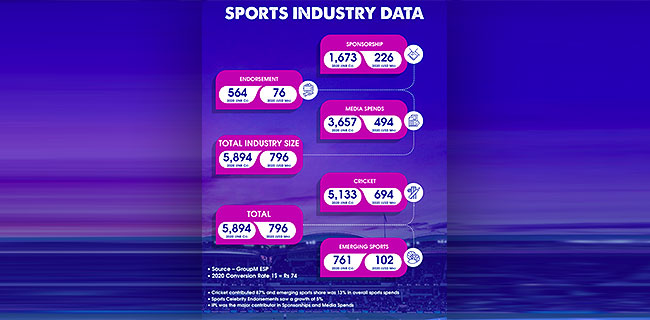
    GroupM ESP, the entertainment, esports and sports division of GroupM India has released the sports sponsorship report for India 2020. The size of the Indian sports industry in 2020 is estimated at Rs 5894 crore. This report takes into consideration – sponsorship spends, celebrity endorsement and media spends on sports properties.


    The biggest share here goes to media, where advertisement spends on TV, Digital and Print media contributed to Rs 3657 Crore, which accounts for 62% of the total spends. Sponsorship Spends included On-Ground Sponsorships, Team Sponsorships and Franchise Fee, and this took up 28% of the industry pie, which translates to an amount of Rs 1673 Crore. An interesting shift that gained momentum in 2020 was the athlete endorsement which grew 5% over 2019, against the run of play in a year ravaged by the pandemic.


    During the period of inactivity in sports, there was a significant step jump in the level of social media influencer activity among popular athletes. Here again, cricketers ruled the roost, with a 92% share of the pie. Of the 377 endorsement deals that happened last year, 275 involved cricket players. 2020 also saw female athletes pulling in brands and the continued success of these stars is proof of the fact that our champions are loved, and we are proud of them. As the sporting nations wait eagerly in anticipation, the stocks are highly in favour of endorsements from our athletes.


    The lockdown had also catalysed the growth in certain sectors. The absence of live sports along with a sub-optimal supply of fresh OTT content led to the shift towards gaming; the month of April 2020 saw an 11% increase in users per week along with a significant jump in average time spent per gamer. This led to a sudden boom in e-sports in 2020, with communities getting built and multiplayer activities gaining ground. Over the last three years, there has been a doubling in the gamer base as well as viewership numbers in the time.


    Despite Covid-19 threat and multiple risks, India’s foremost sporting league, the Indian Premier League (IPL) got underway in UAE in September much to the delight of fans, players, franchisees, sponsors, and rights holders. The success of the IPL was a great demonstration of the qualities of brinkmanship and improvisation, just what the doctor ordered to lift the spirits of a nation in which cricket is followed with religious fervour. Even as the absence of a fair share of events has rendered year-on-year comparisons irrelevant, two things are extremely heartening. First, the overall levels of business seen in the industry in 2020, and then, the high running momentum as we exit the year and move on to 2021.In November, the Indian Super League (ISL) got underway in three venues in Goa with strict protocols and adherence to bio-bubble considerations. This was the first major sports event to be held in India after the pandemic; giving ample demonstration of our ability to pull off an event of this magnitude under such circumstances.


    Said Prasanth Kumar, CEO – GroupM South Asia: “With the lockdown being enforced and subsequent stoppage of play on the field, the void was stark with no visibility on how the anti-Covid efforts would pan out. And even without any activities, our sports heroes stayed close to us. They came closer by actively engaging with their followers on social media and the spontaneity of this online content flow and with the open arms that we welcomed it, is the demonstration of the power of sports in our country. Speedy responses and improvisations are on the go where what the situation demanded and among the many things the Covid-19 situation taught us marketers, was the need to be adaptable as the tide turns fast around us.”


    Added Vinit Karnik, Head – Sports, Esports and Entertainment, GroupM South Asia: “Many sports properties were either cancelled or postponed and even sponsorship and media spends were impacted. But it is commendable how the sporting ecosystem reacted to this crisis taking into consideration the very fact that sports were back sooner than expected. Even in the face of an adverse context, the stakeholders came together to provide the spark the industry needed. The IPL and ISL are an exemplary demonstration of India’s preparedness to host major sporting events under such taxing circumstances. With many sporting events lined up in 2021, fans might have to make choices between certain events in terms of what, when and how much to watch, leading to a rise in demand for subscription viewing in live sports. 2020 looks like that proverbial backward step we take before a giant leap, like the one we are expected to take in 2021, as part of the making of the sporting nation.


  • Opportunity Knocks for Sports in India


    By A Correspondent


    Vinit Karnik

    GroupM’s ESP Properties released its ‘Business of Indian Sports Playbook’ in the backdrop of Covid-19. The playbook is a guide for multiple stakeholders like broadcasters, fans, sponsors, right holders, and the government, who play a vital part in the sporting ecosystem.


    It notes that the sports sponsorship industry in India has been growing at a CAGR of 12.8 per cent over the last 10 years, with the overall sports sponsorship market in India crossing the mark of Rs 9,000 crore for the first time, highlighted the GroupM ESP report on the business of Indian Sports in the wake of the crisis.


    Further, it states that mobile gaming will be the biggest gainer in the post Covid-19 era, with 20 per cent increase in the monthly active users during the lockdown in India, with daily average session going up to 45 minutes and frequency of these sessions increasing to 5-7 per day.


    The report also states that the situation is an opportunity for sports in India. India is a sporting nation in the making with the sector showing strong growth in the last 6-7 years. At a world level, everything is a standstill. It therefore needs to focus on athletes and performance of sports and have a strong vision for 2024 and 2028 Olympics. Keeping the fans engaged is an important KPI for a rightsholder and  broadcaster.


    Government partnerships in the sports realm are the need of the hour, it states. Government and sponsors have worked together as Public-Private-Partnerships.


    Talent needs to make full use of the lockdown to enhance relationships with fans via social media. Live talent interaction on social media has caught the eyes of a large fanbase since the fans need to see some action happening between the talent instead of no-action. Gaming & virtual sports should definitely be in the consideration set for active fan engagement, it noted.


    Here’s the executive summary:


    Business of Indian Sports COVID-19 Outlook Context – Sports sponsorship industry in India has been growing at a healthy CAGR of 12.8% over the last 10 years, with overall Sports Sponsorship market in India crossing the mark of INR 9,000 Crore for the first time

    1. 2020 was a year of Tokyo Olympics, T20 World Cup, Euro 2020 along with major tournaments like Vivo IPL. With most of the sports tournament either cancelled or indefinitely postponed, YOY growth / estimation for year 2020 pre COVID-19 will not hold true.


    – While there are many speculations around Sports to be conducted for TV audience only with no fans or limited fans in the stadium, anything is a possibility at this point in time. But from an audience appetite standpoint, fans are hungry and waiting for live sports.


    – Sports is a universal language that connects people regardless of their origin, background, religious beliefs, economic position. Sports brings us together. Once the dust around COVID-19 settles down, sports will play a pivotal role in helping fans deal with the emotional stress, post-pandemic trauma and give people at large reasons to look forward to.


    – This situation is also an opportunity for sports in India. India is a sporting nation in the making with the sector showing strong growth in the last 6-7 years. At a world level, everything is a stand still. We need to focus on our athletes and performance of sports and have a strong vision for 2024 and 2028 Olympics.


    – Mobile gaming will be the biggest gainers in the post COVID-19 era. We’ve already seen 20% increase in the monthly active users during the lockdown in India, with daily average session going up from 30 min. to 45 min. and frequency of these sessions increasing to 5-7 per day as against 3 sessions per day during pre COVID-19. Internationally, we’ve also witnessed rightsholders toying with gaming and virtual sports as a concept to keep athletes and fans engaged in the lockdown times (for example: UAE Tour launching cycling event namely ‘UAE Tour Mubadala Ramadan Virtual Challenge’ on virtual cycling platform Zwift). We see more of these pushing the envelope of virtual and real-world merger.


    – In a parallel world, esports has been trying to emulate traditional sports for some time now to reach a larger and more mainstream audience. It had already become a billion-dollar industry pre-COVID pandemic with tournaments witnessing arenas filled with screaming fans and sponsors increasingly injecting monies in the ecosystem globally. With the lockdown in place and millions forced to stay at home; esports has shifted to online format filling up the void for many of the LIVE sports’ hungry fans worldwide.


    Further breaking the playbook down, here are the key takeaways:


    I. The post COVID-19 time is expected to define “new normalcy” which in turn will have a telling effect on all aspects of business including sports


    II. Keeping the fans engaged is an important KPI for a rightsholder & broadcaster. The lockdown times could be a perfect opportunity for both to make heroes off their fans


    III. Broadcasters should toy around with various non-live sport-ainment formats as the fan acceptability quotient is high right now. Innovative content formats need to be thought of between the talent and broadcaster to make the most out of a fan’s interest in some sporting action.


    IV. Government partnerships in sports realm is the need of the hour. Government & sponsors have worked together beautifully as Public-Private-Partnerships. Post COVID-19 time will call for many such initiatives


    V. Talent needs to make full use of the lockdown to enhance relationships with fans via social media. Live talent interaction on social media has caught the eyes of a large fanbase since the fans need to see some action happening between the talent instead of no-action. Gaming and virtual sports should definitely be in the consideration set for active fan engagement during current times taking a cue from how cricket world cup winner Ben Stokes engaged with his fans through F1 esports Vietnam Grand Prix.


  • Saina Nehwal outpaces Sania Mirza & Mary Kom in top female sports endorser race

    By Ratna Bhushan


    Kellogg, the world’s largest breakfast cereal maker, has signed badminton player Saina Nehwal to an endorsement deal pegged at close to Rs 1.5 crore, two people aware of the development said.


    The two-year deal makes Nehwal – the world No. 2 in women’s singles — the highest paid female sports endorser in the country ahead of tennis player Sania Mirza and boxer Mary Kom.


    A Kellogg India spokesperson confirmed the association with Nehwal but declined to give details of the deal. Darshan Machdar, director at Spoment Ventures, the sports marketing firm that represents Nehwal, was unavailable for comment.


    “Kellogg is looking for a repositioning exercise with Saina… the advertising is likely to break next month,” one of the persons quoted earlier said.


    The 25-year-old already has endorsement deals for Yonex, Bajaj Nomarks cream, Iodex pain reliever, Indian Overseas Bank and the Sahara group, which, sources said, were signed for least 20% less.


    Vinit Karnik, national director, sports and live events at GroupM ESP, the sports marketing division of media buying group GroupM, said, “In the current scenario, Saina is the highest paid woman sportsperson in the country. Sania Mirza’s endorsement fee used to be the highest till about five years back. But Saina has been far more visible on the circuit, which is what brands look for.”


    Nehwal had topped the women’s world ranking list in March this year. Some talent managers, however, believe that Nehwal has remained under-marketed when it comes to endorsement fee. Also, the gap between what male and female sports persons earn outside of the sports arena remains wide.


    According to industry executives, cricket captain MS Dhoni charges upwards of Rs 10 crore for brand endorsement while Virat Kohli’s fee is Rs 5-6 crore. However, endorsement rates can vary as they depend, to a large extent, on the relationship the celebrity has with the brand.


    Talent management firm Kwan’s promoter Anirban Das said, “It’s a reflection of the popularity of the sport rather than a function of gender.


    The reach of cricket still hugely overshadows any other sport in India.” He pointed out that in Bollywood, the gap between what men and women earn has seen a lot of correction over the recent past. “Someone like Deepika Padukone earns a lot more than many other popular actors now,” he said.


    Source:The Economic Times

    Copyright © 2015, Bennett, Coleman & Co. Ltd. All Rights Reserved

    Licensed to republish


  • 10 Trends to look forward to in Sports Broadcasting


    By Jai Lala


    2014 has undoubtedly been a great year for Sports in India, and in turn it has also opened up new avenues for the broadcasting and advertising community. With India making a foray into League sports, and games other than cricket making a mark, one can look forward to exciting times in 2015 for the Sports Broadcasting Industry.


    Here are 10 Trends to look forward to in Sports Broadcasting


    1. From a single sports country to a multi-sport country: We are witnessing sports boom in India. Hockey, Badminton, Kabbadi, Tennis are seeing reach like never before. Albeit it is still smaller compared to cricket it is growing and we are seeing growing interest from advertisers and viewers alike.


    2. TV+ Digital the lines are blurring: World cup had more than 25 million views on Digital. IPL is slated to surpass that in the 2015 season. Is it just catch up TV or is it individual viewing only time will tell but currently the lines are blurring. World Cup on Starsports.com was sponsored by the biggest names in cricket advertising Hero, Vodafone, Pepsi all sponsors of the previous edition of World Cup 2011 but in 2015 have moved from TV to Digital


    3. Pay per view can it be a reality: The acquisition cost of sports growing and advertising yield at a matured level subscription seems to be the only resolve. With increased digital penetration as well as viewing pay per view is not far


    4. Sports viewing is more‘Lean Forward’ than ‘Lean Back’: The passion and the interest which evokes on sports can be “heard” on social media. Ball by Ball commentary, opinions and even Backlash is growing on Social Media.


    5. Sports & Mobile: With the mobile penetration in excess of 900 million coupled with multi-screen viewing there is a huge opportunity for advertisers to cash in. Heineken ran a contest on mobile which can only be answered by watching the live UEFA match on TV. No other sport lends itself to interactivity more than cricket


    6. Split beam: India being a diverse regional market with large linguistic preference networks are offering feeds in regional languages. This will grow further with split beams leading to adversioning and even regional advertisers getting a slice of the pie


    7. Rural: Radio is the only means for the rural audiences but with growing mobile penetration and DTH this could add on to the experience especially for updates and other opportunities


    8. Sports programming: In the US, ESPN Sportscentre is one of the most viewed programmes and it does not relay live telecast. Whilst in India non-live programming is only 1/7th of Live telecast it is growing


    9. Extra coverage for the passionate viewer: Cameras on umpires helmets to players helmets. View from the slip cordon to chatting with players during live match. We shall see more & more of this


    10. Revival of Print: Print in its traditional sense has seen challenges on sports coverage. Sportstar is nearly dead and many more such sports magazines. Blogging is reviving it. Can digital print revive the coverage?


    Jai Lala is Managing Partner, Trading and Partnerships, Central Trading Group, GroupM


    Extracted from the GroupM ESP-SportzPower India Sports Sponsorship Report 2015


  • Cricket losing its charm, sponsors bat big time for hockey, football, says GroupM ESP report

    By Pritha Mitra Dasgupta & Ravi Teja Sharma


    Cricket, which has ruled the hearts of millions of Indians for years, may be losing just a little bit of its magic. In 2014, other sports — football, tennis, hockey and even kabaddi — gained in popularity, according to a report by GroupM ESP, the entertainment, sports and content arm of media agency GroupM.


    Value of ground sponsorship for cricket fell to Rs 464.7 crore in 2014 from Rs 508.3 crore in 2013 while team sponsorship fell from Rs 389.2 crore in 2013 to Rs 347.8 crore, even as the sports industry grew 10 per cent.


    Ground sponsorship is the money central sponsors in any sport pay to the organisers of a tournament. Team sponsorship is the money each team earns from selling the real estate on its apparel. The report compares calendar years. The 10 per cent growth in the sports industry, from Rs 4,372.5 crore in calendar year 2013 to Rs 4,809.69 crore in 2014, is due to the emergence of new tournaments.


    Indian Super League for football, two tournaments each for hockey and kabaddi as well as the International Premier Tennis League, among others. The size of the sports industry by revenue includes a number of components: ground and team sponsorships, franchise fees, endorsements and on-air revenues of advertisers.


    For cricket, the numbers seem low in 2014 because India played host to fewer international games than in the previous year, says Vinit Karnik, national director (sports and live events) at GroupM ESP. “But it is a fact that there was a price correction in the payouts to BCCI from title rights holders in 2014.”


    The Indian cricket team’s sponsorship price dipped to Rs 2 crore per match in 2014, the amount Star agreed to pay, from Rs 3.33 crore per match in 2013 that Airtel was paying. The downward trajectory in the level of interest in cricket can be gauged by the fact that only two companies — Star and Micromax — showed interest in obtaining title rights compared with the last bidding cycle when over 10 contenders were in the fray.


    Other sports are starting to attract serious money. Football, for instance, saw a 227 per cent year-on-year increase in the total value of team sponsorship from Rs 26.5 crore in 2013 to Rs 60.3 crore on the back of the new Rupert Murdoch and Mukesh Ambani-backed Indian Super League. Other sports leagues — kabaddi, tennis and others — saw a massive jump of 1,064 per cent in team sponsorship, from just Rs 7 crore in 2013 to Rs 74.5 crore in 2014.


    GroupM ESP says in the report that overall team sponsorship across all sports rose a healthy 14 per cent from Rs 432.7 crore in 2013 to Rs 493.6 crore in 2014, despite the 10.6 per cent fall in cricket team sponsorship. And while noncricket sports together accounted for just 10 per cent of the team sponsorship pie in 2013, it has now risen significantly to just under 30 per cent, a startling shift in the course of a year.


    IPL STILL GOING STRONG

    IPL, the Twenty20 cricket tournament, still remains a strong franchise with Pepsi committing Rs 80 crore a year to bag the title sponsorship of the league, despite the controversies it has sometimes seen. After a dip in revenues in 2014 because of the Lok Sabha elections and the consequent shifting of a part of the league to the United Arab Emirates (UAE), IPL’s broadcaster Multi Screen Media is expected to make close to Rs 950 crore from the ongoing 2015 edition.


    While Pepsi might have grown on the back of non-cricket sports properties globally, here in India, it is one of the biggest spenders on cricket.


    Ruchira Jaitly, senior director-marketing (beverages) at PepsiCo India, contends that cricket hasn’t taken any hit. “It’s just that the pool has expanded because of the emergence of other sports in India,” she says. However, as other sports gain in popularity, Pepsi is seriously investing in kabaddi, soccer and hockey. “This is also because international quality of programming has arrived in India,” Jaitly says.


    “While cricket continues to be the mother ship, and will continue to be big, brands are slowly opening up to the potential of other sports, especially brands that don’t have massive budgets,” says Indranil Das Blah, CEO of sports management firm Kwan.


    For big brands with national campaign plans, cricket and Bollywood are still the preferred platforms, he says, but for smaller brands one can use that money a lot more intelligently by associating with other sports. However, in terms of numbers or reach, no other sport will even come close to cricket in the next five years.


    “But the bridge is certainly forming. Five years ago, there were no options, three years ago there were a few options but now there are loads of options. So that gap is slowing being reduced between cricket and other sports,” he says.


    Source:The Economic Times

    Copyright © 2015, Bennett, Coleman & Co. Ltd. All Rights Reserved

    Licensed to republish


  • Top 10 trends of IPL Season 8


    According to GroupM ESP, the entertainment and sports partnerships unit of media buying house GroupM, the sports industry has come of age in addressing sponsorship sales and integrating technology to drive audience engagement and advertising deals. “From selling tickets to selling an experience, Indian Premier League has come a long way,” said Vinit Karnik, National Director, GroupM ESP.


    In 2015, while teams will continue to beef up the in-stadium experience, there is an additional focus on technology integration. “It makes sense because if fans aren’t in the stadium, they’re watching it somewhere else – at work or home or in a café. And we also see a lot of new generation brands jump onto the IPL bandwagon,” he added.


    Here are the top 10 trends of IPL season 8, says GroupM ESP:

    1. E-commerce brands will dominate ad spends on broadcast platform. Top e-commerce companies including Amazon, Quikr, Flipkart, Paytm, Go-Daddy and Car Dekho have signed up for IPL 8


    2. Realistic sponsorship pricing strategies resulting in repeat purchases and a stable sponsor ecosystem Brands including USPA, Flying Machine, Ed Hardy, Ultratech, Videocon D2H, Sansui, Aircel, Etihad, HDIL, Tata Prima, HTC, Huawei and Idea Cellular have renewed contracts


    3. Increased dependence on crowdsourcing to create excitement around brands. Pepsi’s main summer campaign that will break during IPL 8 is crowdsourced and made by consumers


    4. Apparel is an emerging and popular sponsor category among franchises. Top brands like USPA, Flying Machine, Ed Hardy, Jack & Jones have committed to spending with various IPL teams


    5. IPL Fan Park idea to heighten interest and involvement in smaller cities and towns. IPL has launched Fan Parks – to create a stadiumlike experience by showing matches on giant screens – in 14-15 cities


    6. Enhanced broadcast production quality with regional language feeds. Sony Max is expected to broadcast the match in at least five regional languages including Tamil, Telugu and Bengali


    7. Digital platforms to create sustained and deep engagement with real-time analytics. All sports apps including those owned by Multi Screen Media, the cricket board and IPL teams are going to be active on Facebook and Twitter and other platforms to grab fan attention. This will also help with interactive data analysis


    8. Technology to enhance spectator interactions and engagement inside stadium. Mumbai Indians, Royal Challengers Bangalore and Kolkata Knight Riders are planning Wi-Fi inside stadiums


    9. Surround content to drive social conversations. The cricket board and all IPL teams have planned to release behind-the-scene content and is planning contest around IPL 8


    10. Smart talent acquisition by franchises has increased competitiveness with teams evenly matched. Post the auction in February, all IPL teams look equally competitive in Season 8.


    Source:The Economic Times

    Copyright © 2015, Bennett, Coleman & Co. Ltd. All Rights Reserved

    Licensed to republish


  • What makes the World Cup a win-win


    By Vinit Karnik


    Vinit Karnik

    The countdown to this year’s biggest sporting spectacle, the International Cricket Council (ICC) Cricket World Cup 2015 is drawing near and more than a billion hearts are pinning their hopes on Team India winning the Cup that counts this time too. This edition of the tournament to be jointly co-hosted by Australia and New Zealand, promises to be much bigger than previously held editions of the tournaments. For advertisers and brands, this will be 2015’s biggest moneyspinner and provide an opportunity to jump on the brand bandwagon in order to reach their audiences and there is a lot that one needs to watch out for during this year.


    Advertisers on ground and on air:

    Traditionally we all have been used to seeing on ground sponsors taking sponsorship slots on air as well. But there is all likelihood that we might see a change in this strategy during this World Cup. On-ground ICC partners that are ‘evolve’ brands may look at the digital media environment and surround content to effectively engage with their respective target audience. This might give way to new and emerging categories like e-commerce and newer brand launches to take the television route to gain visibility.


    Linear TV:

    Official broadcaster Star India will air the World Cup in six languages in Bengali, Tamil, Malayalam and Kannada, apart from English and Hindi – making it far more inclusive than any other sporting tournament on television. The network has revamped its programming around the World Cup across platforms in a manner presenting brands opportunities to associate with the tournament at various levels. While brands with deeper pockets will definitely look at investing at the national level, smaller brands who could previously not associate with the World Cup, will be able to put in their money at the regional level thus targeting their markets specifically. The strategy of using geo-targeting will allow local brands to avoid spillover. The network has taken a step to broadcast select matches in 4K or Ultra High Definition production ensuring a change in the television viewing quality habits for the better.


    Surround Content:

    Lot of surround content around cricket will be a part of channel programming. This will be pre-/post-match analysis by cricket experts, celebrities, social influencers and fans. Surround content will also extend itself to digital medium for convenience of viewing anytime anywhere. The commentary panel will feature 13 World Cup captains, 20 World Cup winners and 26 World Cup semi-finalists. The likes of Allan Border, Kapil Dev, Wasim Akram, Shane Warne, Mark Waugh, Graeme Smith, Ian Botham, Rahul Dravid, Sunil Gavaskar, Saurav Ganguly among others will be sharing their expert insights and analyses.


    Social Layer:

    The dynamic social media space will be hyperactive around World Cup with live and non-live action. Cricket experts, ex-players, celebrities, social influencers and fans will keep the conversations active all the time. We may see advertisers effectively leveraging this trend and stay relevant through the World Cup. User- and fan-generated humour content is to be watch out for including pre- and post-match reviews this World Cup. Most of the trends on social media platforms like Facebook and Twitter will be dominated by the World Cup.


    World Cup Format:

    Team India’s fitness concerns are not going to be much of a concern. Two pools of seven teams will be playing in a round-robin format. The top four teams from each pool will proceed to the knock-out stage of the tournament, which will comprise quarter-finals, semi-finals and the final. Unless an extremely massive upset takes place, this format will almost ensure all top teams play in the quarter-finals. This will definitely keep the viewers and advertiser interest alive at least this stage of the World Cup.


    Vinit Karnik is National Director, GroupM ESP


    Image courtesy: ICC


  • GroupM ESP releases top 10 trends of entertainment and sports marketing for 2015

    By A Correspondent


    GroupM ESP (Entertainment & Sports Partnerships), a specialist business unit of GroupM has unveiled their top 10 trends for 2015. It is well known by now that sports in India, is undergoing a transition. With the rise of leagues across various sporting formats and with increase in cobranded promotions, the opportunities for brands to associate with movies and sports are also increasing.


    Uniquely positioned at the intersection of media and marketing, GroupM ESP predicts the following trends:

    1. Increased role and usage of celebrities as digital influencers

    2. Sporting entities will evolve by building digital and social assets to drive their valuation

    3. Blurring gap between Entertainment & Sports

    4. “Associative” to “Associative + Integration + Surround + Social”

    5. From Advertisers to Sponsors

    6. New avenues for traditional licensing – ex. branded real estate

    7. TV fiction characters as Brand Ambassadors

    8. Non-cricket sports to expand sports business ecosystem

    9. Sports businesses to build strong grassroots engagement through experiential programs

    10. Music concerts to grow bigger than award shows


    Commenting on the trends Vinit Karnik- National Director, GroupM ESP said, “As we scale up our practice, 2015 will see a change in the way consumers interact with the sports and entertainment category. Sporting entities will evolve by building digital and social assets to drive their valuation and brands will increase role and usage of celebrities as influencers especially across digital assets. We have strategically positioned ourselves to embrace this change and are confident that it will help us achieve our clients’ objectives by offering innovative brand solutions.”


    Adding further he said, “Celebrities have been using the digital space extensively for their work. From promoting their movies to inviting fans to attend a social cause, celebs make use of the digital platform in a great way. With millions of followers, celebrities have the power to influence their fans and effectively get their message forward.”


    “Digital and social assets are used by sports entities to keep their fans up to date. In order to increase the fan base, sporting franchisees and leagues will develop fan following around them by efficient use of digital medium. With immense focus on digital rights of sporting leagues, digital video sites will be competing with television broadcasters for eyeballs in the near future.”


  • Why the $$$s are finally going beyond Cricket


    Once upon a time there were the seasons for sports. But now with the various leagues in play, we have them all year round – be it the summer, winter or the rains. The formatting and packaging have led to even sports like kabaddi attract revenues and viewers.


    We asked Vinik Karnik, National Director, Sports and Live Events- GroupM ESP, to give us his views on why and how non-cricketing sports are attracting sponsorship money. Here goes:


    By Vinit Karnik

    1. Increase in awareness about sports

    New Age India consumes multiple sports and is exposed to world class leagues and formats. Real-time broadcast and analytics have ensured high degree of interest within the younger audience to watch and follow sports they like. This is leading to an increase in fans following sports on television.


    2. Multiple language broadcast

    Sports being promoted and broadcasted through multiple platforms and languages is the next big thing. This will increase the reach of sports in a big way. For instance, IPL 2014 reached a total audience of 191 million, Pro Kabbadi league reached 128 million. Expect ISL to create new benchmarks in terms of reach because of its broadcast strategy


    3. Digital is the new Traditional

    An increase in digital penetration has helped the sports business substantially. The live streaming of most sporting leagues helps fans to catch live action on their mobile phones or tablets while on the move. The world of apps help the fan with statistical data and trivia which they love to share on social media.


    4. Improved performance by Indians at the highest stage in the World of Sports

    The likes of Saina Nehwal, Mary Kom,Yogeshwar Dutt etc and the Indian hockey team have helped respective sports other than cricket stay relevant and aspirational


    5. Mushrooming sporting leagues provide for more career opportunities for budding sportspersons pushing the performance envelope higher

    Sporting leagues have generated a new ecosystem which develops high interest in the catchment areas. Grassroot development programmes ensure penetration of sports in rural areas. Very soon we will see young India take to sports as a profession. Talent and support functions both will be seen as professional careers


    6. Sports is Entertainment

    In a land where movies and cricket rules the roost, sports is slowing becoming an avenue of entertainment. Film stars investing in sporting franchise and sport stars premiering on TV or in some cases movies comes as a culmination of the two biggest passion points of India.


    7. Multiple sports like Football, Badminton, Kabaddi and Hockey vying for No 2 spot makes for competitive pricing and lucrative deals

    Sporting leagues are actively investing to make their sport the No 2 ensures a well-balanced on-air + on-ground entitlements packaging. Marketers will look at sports to involve and engage their target audience through their passion points. Sports will become one of the most effective and efficient way of engaging the target audience


    With the sports industry on a high, advertisers have more options and opportunities to consider. Sports sponsorship helps and advertisers drive the communication in the most engaging manner. While advertisers chase eyeballs, sports is garnering more followers which translates into eyeballs. It’s a win-win situation for both and hence sponsorship in sports as an ecosystem is growing leaps and bound and will continue to challenge the status quo and create new benchmarks.


    This article first appeared in ‘dna of brands’ in October 2014.

  • GroupM ESP executes key campaigns for SIIMA

    By A Correspondent


    GroupM ESP has executed key sponsorship deals for SIIMA 2014 including AskMe.com, Havells, RedBus.in and Chola MS. GroupM ESP has been a key enabler for clients and their brands to leverage the SIIMA sponsorship platform thereby providing end-to-end SIIMA related solutions.


    Last week, the city of Kuala Lumpur played host to the South Indian film fraternity a midst much fanfare. SIIMA (South Indian International Movie Awards), the biggest South Indian movie awards platform globally, saw the presence of prominent stars of the fraternity in full attendance.


    Vinit Karnik

    Commenting on the achievement, Vinit Karnik- National Director of Sports and Live practice, GroupM ESP says “SIIMA is one of the best awards covering all 4 states in South India delivering high impact and value to advertisers. SIIMA as a property offers compelling content in the native language for the audience to watch it on Television. We believe brands can leverage the celebrity and entertainment appeal of the property by seamlessly integrating in the content. Content integrations in SIIMA can help brands break the clutter this festive and effectively communicate their proposition.”


  • Leagues to see big growth for sports in 2014

    Source – GroupM ESP


    By A Correspondent


    Well, India has just been knocked out of the ongoing Asia Cup tournament, thanks to a Shahid Afridi batting blitzkrieg that saw Pakistan nail hosts Bangladesh to make it to the finals. One would put the blame squarely on the Indian squad that failed to perform as a unit when it mattered the most. In fact, the men in blue may have given the media and critics another opportunity to go heavy on them after a spate of poor performances outside the continent including their recent Series loss to South Africa and New Zealand. But does this failure imply that sunny days for the sport in India may all but be over and that the popularity and revenues that it managed to rake until now could see a downward slide from here on?


    A report by GroupM ESP, the sports and entertainment arm of marketing services major Group M and sports business information resource SportzPower, may all but rubbish the above claim as it predicts that the best days are yet to come for the sport in India. In fact, the report goes on to add that a few more sports – as upcoming and promising as cricket – would be changing the sports dynamics in a country that has just about started to harness the benefits that non-cricket sports have to offer.


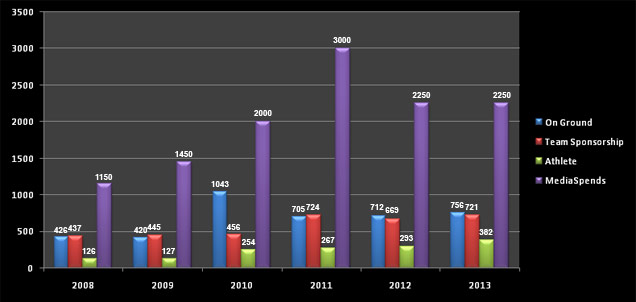
    The report notes that the sports marketing spends grew about 92 percent in the period between 2008-2013 reporting figures of Rs 41.1 billion in 2013 from the Rs 21.39 billion amount that was recorded in 2008.


    The report is the first of its kind in India that documents important events during these eventful years, including the emergence of league-format sports in India like the Indian Premier League (IPL), Hockey India League (HIL), and Indian Badminton League (IBL). To increase its utility to Rights Owners, Advertisers and Agencies, the report has been divided into four segments – On Ground Sponsorship, Team Sponsorship, Athlete Management and On Air.


    Elaborating on the future of sports marketing in India, CVL Srinivas, CEO, Group M, South Asia says, “This decade will be transformational for sports in India with a spectator base of over a billion people, a dozen sports television channels beaming content round the clock and a rapidly growing list of keen corporates and brands waiting to invest in cricket and other alternate sports. The next few years marketing investment in sports will no longer be peripheral, and it will be paralleled with that of entertainment and mainstream cinema.”


    Rise of non-cricket sports

    The report notes that while cricket will continue to remain popular, in the next few years the market is going to grow exponentially, with other sports complementing the cricket story. The report notes that the real opportunity lies in the number 2, 3, 4, 5… sports that are often under-leveraged and under-monetized, which otherwise have a sizeable target audience juicy enough for brands to associate with.


    It should serve as a wake-up call for all stakeholders in the sports sector that in the six-year time frame that the study covers, the highest share of On Ground revenue cricket has commanded in percentage terms was in 2009 – all of 79 per cent. And the lowest was just 52 per cent in 2010, which was also the year when New Delhi hosted the Commonwealth Games.


    The report notes that On Ground sponsorship has a direct linkage to stadium attendance. And therefore reflects active fan engagement. What this shows is that in the IPL era, it takes an event the size of the Commonwealth Games to significantly shift the needle. But that is not to say that the ground is not shifting as far as other sports are concerned. In 2012, the share of non-cricket On Ground sponsorship stood at 34.5 per cent, dipping to 32.8 per cent in 2013, ironically a year that saw the launch of two new IPL-style tournaments – the Hockey India League as well as the Indian Badminton League


    According to the study, football remains the problem child of Indian sport. There is a huge underlying potential here that is yet to translate into deliveries. What is clear though is that if and when football makes that big leap forward, its rise will be phenomenal. Proof of that is provided by the impact delivered by one-off events like the Argentina vs Venezuela friendly in 2011, which saw the world’s best player Lionel Messi strutting his stuff at the hallowed Salt Lake Stadium in Kolkata before an adoring and star-struck audience. Another being the Audi Football Summit played in January 2012 at the Jawaharlal Nehru Stadium in New Delhi between the Indian national team and German giants FC Bayern Munich.


    It is also a telling indictment of the people who administer the world’s most popular game that a niche sport like Golf and a mass participation one like the Marathon, both of which are presumed to be TV unfriendly, garner far higher numbers than football!


    Between 2008 and 2013, while On Ground sponsorship in football went up from Rs 85 million to Rs 142 million, in Marathons it rose from Rs 285 million to 420 million. Football clearly has a way to go before it can deliver numbers anywhere close to Distance Running in India, let alone Cricket. But at least it can lay claim to a steady, though extremely poor, increase year-on-year in the period under review.


    Not so golf, the report states. From Rs 327 million in 2008, after hitting a high of Rs 375 million in 2012, it was down to Rs 280 million in 2013 and will fall even further in 2014. Two of the three biggest professional golf events in India (Indian Open is the biggest) – Avantha Masters, and Gujarat Kensville Challenge – have been discontinued and will not be held this year onwards.


    Media dominance to continue…

    The report further notes that sports television broadcasting will continue to be dominated by cricket in the foreseeable future contributing about 80-85 per cent of sports media revenues. But the other sports such as football, hockey, badminton, motorsports, etc are also expected to perform well and bring good revenues to broadcasters.


    According to Thomas Abraham, co-founder, SportzPower, Indian sports TV broadcast was, is, and will continue to be dominated by cricket for the foreseeable future, contributing to 80 to 85 per cent of the total television sports media revenues. “However, other sports are also gaining prominence, especially Football, though interest remains predominantly for international leagues/tournaments,” he said.


    All in all, the report notes that 2014 has more upsides than down. While there will be no Indian Grand Prix next year, there will be more leagues where sports like basketball are making rapid strides, and the whole wellness and  fitness movement gaining ever increasing traction, which in turn means more interest in sport as a participation activity and not just as spectator engagement.


    Emphasizing on the key developments expected in 2014, Vinit Karnik, National Director, Sports & Live Events, GroupM ESP said: “Even though the IPL is off to a rough start this year, in the long run, accountability, better corporate governance, more transparency, are all good for not just the IPL, but the BCCI too. The successful launch of the hockey and badminton leagues has set the stage for an action-packed 2014 as far as franchise-based leagues are concerned in cricket, football, hockey, badminton, tennis, wrestling and kabaddi.”