Advertising industry veteran Gopi Kukde has been felicitated by the Maharashtra government for his outstanding contribution in the field of advertising.
Minister of Higher and Technical Education Rajesh Tope presented the award, which is given at a ceremony along with prizes for the government’s annual state-level art competition.
Mr Kukde, best known in recent times for creating and developing the ‘Onida Devil’, has had an illustrious career in advertising, including the foundation of Advertising Avenues, and a long association with the Communication Arts Guild.
Veteran adperson Gopi Kukde was one of the mentors invited by Population First for the creative thinking workshops engaging mass media students on gender issues. Although the International Day of the Girl Child was celebrated last week, Mr Kukde has been travelling and he completed this interview via email over the last week.
01. It was good to see the first ever International Day of the Girl Child being celebrated last week. How do we prevent it from being mere tokenism (as in, what are the steps that need to be taken to avoid it being just another ‘day’)?
It always happens that a ‘top-of-mind’ event is spoken about and celebrated for a few days. Unless we feel for the cause from bottom of our hearts it is difficult, rather impossible to convert it into a revolution. Nevertheless one must keep on trying!
02. In your experience with interacting with marketers and advertising agency professionals, do you think they are sincere in their attempts to appreciate the responsibility towards the ‘girl child’ in a society like ours?
Yes and no. While most of them look at it as an opportunity to win an award, which is why you see most shallow attempts time and again, there are some professionals in this award-crazy world who do it as a social responsibility.
Though I feel that a lot of professionalism and science needs to be added to our attempts for, the task is a mammoth one. It is an issue that is spread across the country for centuries, in different levels, sometimes absolutely contradicting each other.
Do you think self-regulation bodies like ASCI and Advertising Club and AAAI should also take it upon themselves to promote the cause?
Although I believe that advertising is a smaller part of the pie in such a movement, the larger part depends on the government, the media and the social leaders. In this situation, the more the merrier, without making it a case of too many cooks complicating matters. For this we need a systematic approach and a strong belief in the cause. The more systematic we are better the results would be.
03. Your views on gender biases in today’s advertising?
For the last 35 years I have not come across any instance like this, which is why I am proud of advertising as a profession!
04. One view of marketers is that they need to sell to consumers given the prevailing behavioural patterns and they can’t be correcting those. How do change this view? (Marketers often feel that they need to sell according to prevailing Indian consumer attitudes and mentality and that there is little they can do to change that. How do you think this can be tackled?)
I don’t think so. Advertising has changed many perceptions. Yes, it might take time, but constant efforts will definitely show results.
05. Television serials, television and print media content also further aggravate this image of women. What is your view on this?
You are right, our television serials and some other media do portray a woman the way she shouldn’t be. The ultimate goal they look for is TRP and sales. This would automatically reduce once this small effort becomes a movement.
Jaldi 5 with Dr A L Sharada: More ads must say: Yes, she can
Population First has been at the forefront of the initiative on the way the girl child has been projected in the media. Dr A L Sharada, Director, Population First, spoke to MxMIndia on the girl child and the media and how we can prevent the celebration of the International Day of the Girl Child from being mere tokenism.
01.  It’s good to see that the first ever International Day of the Girl Child is being celebrated. How do we prevent it from being mere tokenism?
I welcome the UN, as a global body declaring October11, as the International Day of the Girl Child. This gives us an opportunity to take stock of the work that we have done so far, look further into what needs to be done and how we could take the issue at hand, forward. However the fear that it may turn out to be yet another gesture of tokenism is a valid one. The only way we can stop it from becoming yet another international day celebrated as a formality every year, is through concerted efforts to work on some of the major issues regarding the girl child.
There are many issues concerning girls such as child marriages, low enrolment in schools and neglect of their health and nutrition needs. We need to advocate and lobby for more focused policies and programmes to improve the status of the girl child. We need to use the opportunity provided by the International Day of the Girl Child, every year to reflect upon achievements, fine tune our policies and redesign our programme, if required.
Do you see that Population First’s efforts have had an impact on the media?
I see lot of positivity and openness from the media towards these issues and a willingness to approach them differently. In the current media scenario, many of these issues are being addressed but more need attention. We, at Population First believe that we have to start a dialogue with all stakeholders, media being a primary stakeholder. We, as a nation have internalised, and have deeply ingrained patriarchal values to an extent that unless someone points it out, at times we are unaware of a possible patriarchal tone in our public communications. We need to initiate dialogues with all groups of society, so that together we can build a more gender-sensitive society.
02, In your experience interacting with marketers and advertising agency professionals, do you think they are sincere in their attempts to appreciate the responsibility towards the girl child in a society like ours?
Our experience with the advertising professionals has been very positive. We found them to be open-minded, willing to look at our standpoints and revise their current approach. From the time we began interacting with professionals in the advertising industry in 2008 up to today, we find a much greater presence of girls in advertising and many advertisements that are now projecting positive and non-stereotypical images of girls.
03.  Do you think self-regulation bodies like ASCI, Advertising Club and AAAI should also take it upon themselves to promote the cause?
Yes, definitely. It is important that activists working on gender issues and the regulatory bodies of media and advertising work together to ensure that the media does not project demeaning and negative images of girls. It is also imperative that media does not consciously or otherwise, support or promote negative social attitudes and practices such as eve-teasing, commodification, objectification of women and violence.
04.  What are your views on gender biases in today’s advertising?
In 2008, during our analysis of advertisements showing girl children, we found that girls had a lesser presence and were often presented in a stereotypical fashion, for example mostly endorsing products that have been promoted by their mothers too. It was also observed that an ideal family is always shown as mother-father with one daughter and one son, or two sons. Rarely did we find ads showing two daughters. While a lot has changed in the last few years, in terms of projection of girls in advertisements, it is still rare to find an advertisement where two daughters are shown in a family setting. This, I believe, promotes the perception that a son is a must in the family. In a context where the country’s sex ratio is declining, this is a very disturbing trend.
Television serials, television and print media content also further aggravate this image of women. What are your views here?
Yes, it is true that the portrayal of women in print and electronic media is regressive and voyeuristic in flavour and we have to work on changing this. This is why we have instituted Laadli Media Awards for Gender Sensitivity. We have received 1500 entries this year and the quality of the content is improving. There is a lot of potential for change. The most pertinent example here is that of the popular show, Satyamev Jayate, which has suddenly got numerous issues into our drawing rooms. It shows the effect of one strong programme with a potent combination of Aamir Khan, an industry giant like Reliance and a media tool like Star TV. This shows that there is potential to bring social change. New media and its various options are also democratizing the way news now reaches out and has gained momentum with youth across the country as tools for creating public opinion. It is an exciting time to be, in terms of working with media on social issues
05.  One view of marketers is that they need to sell to consumers, given the prevailing behavioural patterns, and that they are not in a position to correct these attitudes. How do we bring about a change in this view?
I would like to highlight two ads here. For instance, an HDFC investment plan ad shows a father investing for his daughter’s education instead of a more common notion, such as saving for her marriage. This is a positive and refreshing approach to the product and in no way undermines the value of the product. The other ad I would like to mention is the Tata Nano ad where a small girl hugs the car, and the father gives her the car keys. This shows that the father is proud of his daughter. Giving visibility to girls in ads, is by itself crucial. We need to see more such instances where girls have to be shown in a capable light and in diverse concepts while selling a product. After all, communication is all about conveying the message effectively, is it not?
(Interviewed by Fatema Rajkotwala)
Last December, the United Nations declared that it would annually observe the International Day of the Girl Child, starting from October 11, 2012. Supported by the United Nations Population Fund (UNFPA), in partnership with Whisper, leading non-government social welfare organization Population First will celebrate the first International Day of the Girl Child today (October 11) at Mumbai’s Y B Chavan Centre (*see disclosure below).
The first ever International Day of the Girl Child is marked to help prioritize girls’ rights as the salient issue in the coming decades. ‘Laadli‘ is Population First’s Girl Child campaign against sex selection and falling sex ratio. It focuses on creating a positive image of the Girl Child in society.
Veteran adperson Bobby Sista is Executive Trustee, of Population First. Mr Sista spoke to MxMIndia about the positive response from the advertising world towards the issue, “The response from the advertising world has been encouraging. We, at Population First are absolutely delighted that at last a global body has recognised that the girl child is a special category that needs special, global attention. One of our primary focuses is to eradicate the horrible practice of pre-birth sex selection. I have been highlighting and propagating the economic value of the woman as a homemaker in our society and her contribution to the country’s GDP. A woman is at least four times better at being a manager, or doing any job today. Why always talk about the girl child in a suppressed context? What is it that a woman cannot do today, that a man can do?”
Dr A L Sharada, Director, Population First spoke about the need for activists and media bodies to work together to bring about social change, “It is important that activists working on gender issues and the regulatory bodies of media and advertising work together to ensure that the media does not project demeaning and negative images of girls. There is a lot of potential for change. New media and its various options are also democratizing the way news now reaches out and has gained momentum with youth across the country as tools for creating public opinion. It is an exciting time to be, in terms of working with media on social issues.”
Part of the multi-stage campaign, ‘Question Everything’ was a two-day workshop on Creative Thinking, Communication and Gender. Organized by ‘Laadli’ Changemakers Club of Population First, the workshop engaged students from Mass Media colleges across Mumbai, with an aim to involve the youth in a dialogue on gender issues, with a focus on enhancing the image of the girl child. Highly experienced advertising and media professionals such as Gautam Rakshit, Gopi Kukde, K V Sridhar (eka Pops), Dolly Thakore and Zoya Akhtar shared their expertise and guidance with students. The event will see the launch of 1MM, one-minute movies made by college students questioning gender inequality and injustice.
Says Mr Sridhar, National Creative Director, Leo Burnett , “We have realised that at times, lack of knowledge and sensitivity tend to be the reason for negative content. But when you’re creating something, you have a white paper in front of you, you can create anything. We need to influence content creators first, then clients, then people themselves to come out of years of reinforced images of family planning. When you sensitise teens and youngsters, power to impact is higher. The new mantra for communication in the digital era is- Play, Buy and then Share. Young minds involved in making a one minute movie raise issues without fear to express and once you get involved, you think about it, play it with experience, then you buy into the philosophy, then you share it. Youth sharing via mass media tool such as Facebook or Twitter have a far reaching impact. This is a process that has been initiated. That is how social revolutions were made, religions and value were spread.”
Part of the event’s agenda is to recognise young women achievers such as the female fire-fighters of the Mumbai Fire Brigade. The event will also felicitate celebrity parents and daughters who have made a mark for themselves in media, corporate and political circles.
Population First has also introduced the Laadli Media Awards for Gender Sensitivity to encourage and recognise media content that has positive social messages for the girl child.
Disclosure: MxMIndia has published for Population First a special volume on the First International Day of the Girl Child that will be released at an event in Mumbai this evening (October 11). Also, we strongly believe in the cause and feel that media and entertainment can play a key role in changing gender perceptions. – Ed.
(with generous inputs from a speech by Gangadharan Menon)
Those who’ve been part of the ad and media fraternity for less than a decade may be wondering why the Big Story today is on the Cag Awards. In fact the only CAG in their lives is perhaps the Comptroller and Auditor General, better known for unearthing scams and irregularities so very frequently.
The reason why most of our youth is unaware of what Cag is has perhaps got to do with the decay that has set into the way ad awards were being conducted. Communication Arts Guild, or Cag (written in upper-lower as against all caps) as is popularly known as in advertising circles, was founded in 1950. The sole purpose then, and now, is to spot, nurture and reward talent in the field of creative communications. Initially it started off specifically for commercial artists, but over the years it expanded to include all forms of creative communications. And in fact, the name too changed from Commercial Artists Guild to Communication Arts Guild to reflect this change.
The highlight every year was the Annual Cag Awards in various communication categories, culminating in the Art Director of the Year and the Cag Hall of Fame. The following year would see the release of the Cag Annual that would feature the previous year’s awardwinning work.
Somewhere in the mid-90s, the much-coveted Cag Awards were discontinued. Reason: the unchecked and uncontrolled proliferation of what came to be known as scam advertising. Meaning, advertising that was never released in mass media, but was created only for the purpose of winning awards. The client was fictitious (or perhaps that cobbler or panwallah down the road who never needed any advertising), the brief was non-existent and the media was unaware of their existence. When 90 per cent of the entries started belonging to this obnoxious category, Cag called it quits. And with it stopped the highly sought-after Cag Awards, and thereby dried up Cag’s only source of funding. But the very next year, Cag started the Young Cag Awards, to spot, nurture and reward the young creative talents in the various art colleges across the city. And for a dozen years, it has been feeding the advertising and allied applied arts industries with a steady stream of young talent.
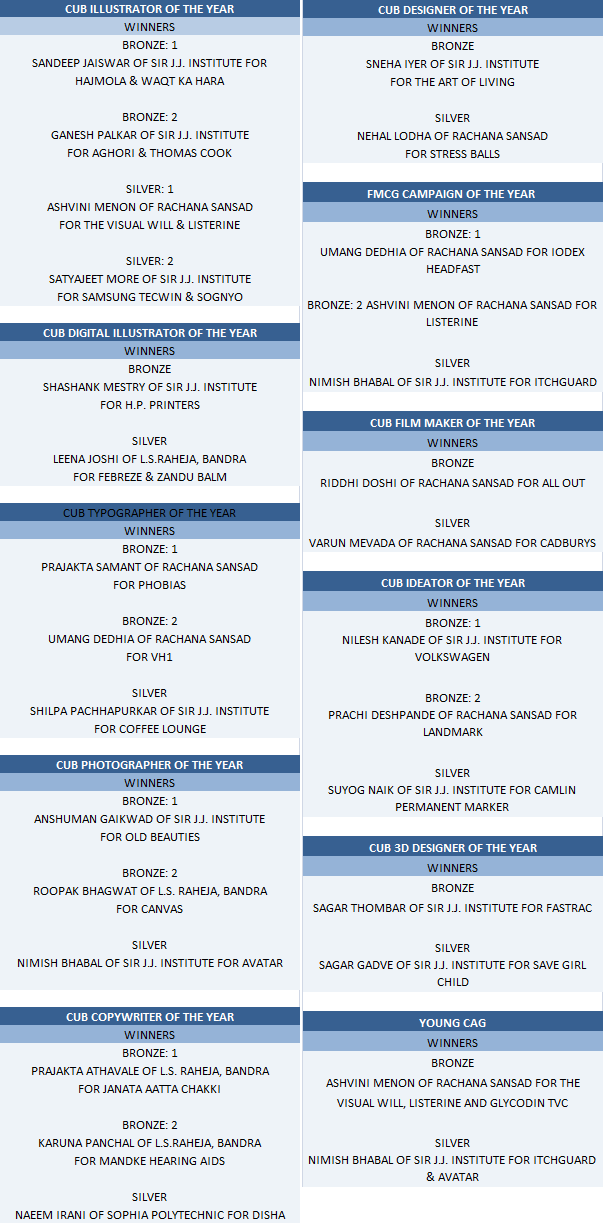
Over the academic year, Cag holds various workshops by practising professionals, and at the end of the year conducts a meticulous talent hunt across all art colleges. Starting this year, the hunt has been extended to art colleges across the country. This culminates in various awards given across categories: Cub Illustrator, Cub Photographer, Cub Copywriter, Cub Typographer, Cub Designer, Cub Ideator and Cub Art Director of the Year. An exhibition of this awardwinning work is held every year after the awards function to inspire younger students to excel in the creative communications field.
These awards are purely funded by the interest earned from the earlier kitty generated by the Cag Awards for Professionals. There is no fresh source of funding as Cag doesn’t believe in charging award entry fees to students. The people who work for Cag do it pro bono, merely giving back to an industry that gave them fame and fortune.
In the year 2010, Cag took a decision to go digital. And it digitised around 36 Cag Annuals and put them on its website. This is a treasure-trove of advertisements that appeared between 1950 and 1995; and is the only source for students, academicians and professionals who want to understand the creative evolution of Indian Advertising.
One of the recognitions that continued uninterrupted is the prestigious Cag Hall of Fame. A citation and award that recognises and acknowledges an individual’s seminal contribution in the field of creative communications, spanning a few decades. This illustrious Hall has already inducted various luminaries into its hallowed precincts: Kersy Katrak, Panna Jain, Ravi Gupta, Frank Simoes, Gerson da Cunha, Avinash Godbole, Arun Kale and Arun Kolhatkar.
This year, Kiran Nagarkar was inducted into the Cag Hall of Fame. For his outstanding contribution in pioneering some of the finest campaigns in Indian advertising and for his versatile talent in other fields of creative writing: as a playwright, screenplay writer and an award-winning novelist.
Nagarkar made a plea to the audience to not let Cag to die and made a clarion call to young creative professionals to shun scam advertising.
# #
What would you expect creative boys and girls to be doing on a Saturday morning? Majorly hung over, getting off their beds a little before noon? Guess we’ve got it all wrong. On Saturday, April 7, right in the middle of the looong Good Friday weekend, Cag held its 63rd annual awards function. At the Ravindra Natya Mandir at Prabhadevi. Since most of the award-winners were students, it was a packed house. Except for the front rows since the ad fraternity and some of the other leading lights among ‘communication artists’ don’t appear to quite care about being present. “It’s perhaps because Cag is now essentially a students’ show with just one veteran being awarded,” said one senior art director.
The Cag committee comprises veteran professionals like Samir Khanzode, Gangadharan Menon, Sunil Mahadik, Gopi Kukde, Brendan Pereira, Ranjan Joshi and Sachin Puthran. Cag, according to vice president Gangadhar Menon is clear it doesn’t want to revive the awards for seniors. Unfortunate, because surely there ought to be a way in which one should be able to eliminate scam ads. Or at least minimise them. Cag comprises and celebrates creativity. It must now find a creative (and effective) solution to the problem.