Goafest 2014:: Text and Pictures by Pradyuman Maheshwari, Shailesh Mule, Labonita Ghosh & Dyanne Coelho
More stories coming up tomorrow (Tuesday, April 14)
By Pradyuman Maheshwari
For some years now, Goafest, the annual congregation of advertising, media and marketing professionals, has been known for the controversies surrounding it. Some from the creative fraternity, which constitutes a majority of the delegates, have said the knowledge sessions have not been too exciting, and the Abby, the awards run by the Advertising Club, has been plagued by its own set of problems in the recent past. Even as the organisers tried to cleanse the system, there were charges of plagiarism and scam ads and allegations that the Ad Club wasn’t doing enough to check these.
The problems at the 2013 event led to doubts being raised about the need for an overhaul. The parliamentary elections got the event last year shifted to end-May.
While there may have been some logistical issues, the awards process at Goafest 2014 was cleaned up, although big players like Ogilvy and Lowe Lintas continued to stay away. That this negative sentiment of the Big 2 is only towards the Creative Abby at Goafest, and not directed at the Advertising Club as a whole, is evident from the fact that both participate in the Effie that the Ad Club also conducts annually.
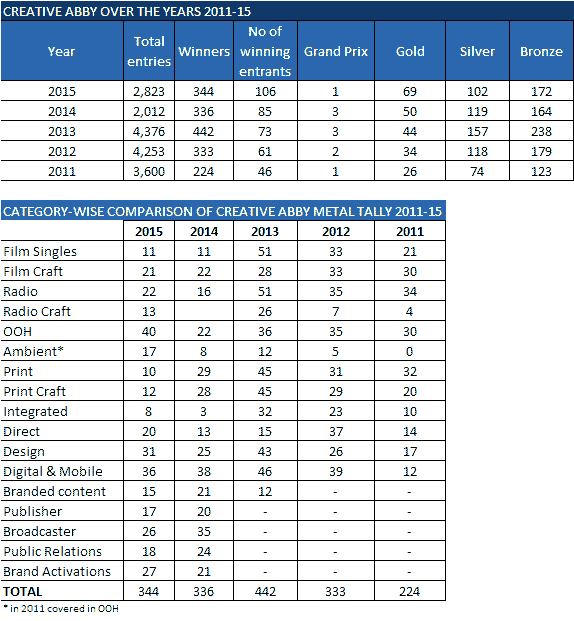
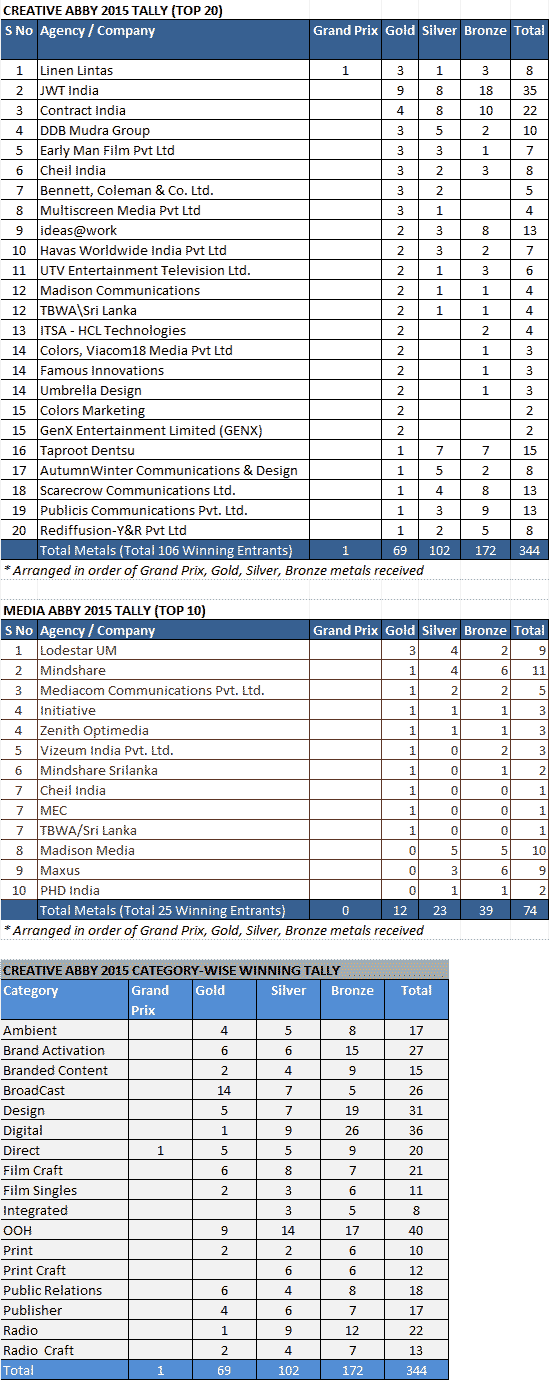
So how did Goafest 2015 go? It was a far improved version of the 2014, to be sure. The awards were controversy-free. Linen-Lintas, part of the Lowe Lintas family, won the sole Grand Prix for its #BraveandBeautiful ad campaign for Dabur. JWT India maxed the Creative Abby with 35 metals (nine golds, eight silvers and 18 bronze) followed by its own group agency Contract bagging 22 metals. In the Media Abby, presented on Day 1 of Goafest, Lodestar UM won three Golds in its tally of nine metals, but Mindshare and Madison gained more in terms of metals with 11 and 10 metals respectively. Maxus earned nine metals.
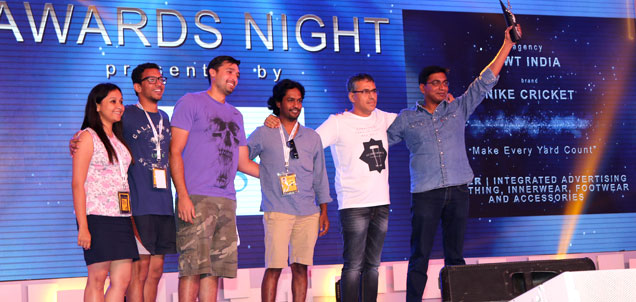
JWT India wasn’t available for comment. In fact, normally the team winning the maximum metals at the Creative Abby assembles on stage for a celebration and photographs. Sadly, that didn’t happen, which is why you don’t see the stage crowded with the JWT team pic as our Big Story image today. Just one with Senthil Kumar and team collecting a metal for Nike.
Meanwhile, for Advertising Agencies Association of India President MG ‘Ambi’ Parameswaran, Advertising Club President Pratap Bose and Goafest 2015 Organising Committee Chairman Nakul Chopra, the event has been a resounding success. Both Bose and Chopra told ‘dna of brands’, that this year’s fest has ticked all the desired boxes.
Now, all eyes on Kyoorius’s ‘Melt’ and Advertising and Digital Awards next month.
| Goafest 2015 – Day One |
| Goafest 2015 – Day Two |
| Goafest 2015 – Day Three |
 By Bobby Pawar
The gamification of awards has perverted the very reason why advertising awards were birthed.
The first award shows came about when some of the finest practitioners of the craft came together to cherry-pick the best work. It was put on stage so we could all celebrate it, learn from it, and hopefully, be inspired to beat it. That was a noble purpose.
Yes, it was still a contest. But it was a field where one idea jousted with another. The biggest ones won the day, and their creators bathed in the applause of their peers. Careers were made in those moments, not just of the people who held aloft the shining statuettes of their creativity, but also of those in the audience who were fired up to do work that was great enough to get them there, one day. Almost all of today’s creative legends, even those who now bemoan the awards, became what they are because their shelves glitter with gold.
It was all good, till it wasn’t. What happened? When did awards lose their innocence?
My theory is that the wheels came off when statistics slipped a roofie in our creative cocktail. Agencies stopped merely celebrating great ideas and started counting the awards that they won. The thing is when you start keeping score, what you are doing becomes a game. Everyone knows the objective of a game is to win. When that became a corporate imperative, and let’s not fool ourselves it has, the objective became to win at all cost.
Awards were supposed to put a spotlight on what’s best about our business, now they have become a for-profit business. Every award show has become a festival and the people who attend have gone from being fans of great work to delegates. Duck me with a fork and call me Daisy.
Now you may call me a regressivist, a naïve fool or simply a fool, but the question still remains are we better off now than we were all those years ago?
Bobby Pawar is Director and Chief Creative Officer – South Asia, Publicis Worldwide. The views here are his own. A slightly shorter version of this appeared in ‘dna of brands’ dated April 13, 2015
 As Goafest 2015 concluded after the last of the Creative Abby Awards were presented, Nakul Chopra, chairman of the Organising Committee, tells Pradyuman Maheshwari that he is content to have helmed a successful edition of the three-day fest. And that he certainly achieved what he set out to do
As Chairman of Goafest 2015, your views on how the event was this year…
I feel all the boxes I wanted to tick have been ticked. I wanted this to be a grander, bigger, wider, deeper Goafest than it has ever been before. I wanted it to be a slickly-produced show. I wanted it to have all the elements, and I think I have done what I set out to do. Now it is for people to give us feedback about what they liked or didn’t like.
Is there something that you would like to include next year or in the years to come?
For me, a single-screen Goafest, 10 years after it was established, is the biggest shortcoming. We need to have a multi-screen, multiple-track event. Not everyone is interested in the same thing at one time. I need to give people a choice.. There are limitations, no doubt. But if I had to say what would be the target for next year, I would like add one more screen to the event.
But can’t you do something about the time of the event? April is too hot and humid…
What is the problem with the season? There are 2,000 people here. Does it seem like it an issue? I don’t think it is.
But the 2,000 could increase if the weather was better. In the past, Goafest has seen a larger number of people particpating
The maximum we’ve had is about 2,600. At this venue (Grand Hyatt), 2,000 is the upper limit. But 2,000 people do not all eat at the same time. And it’s a three-day festival, and almost half or more of the people attend on a two-day pass. They come either for the first two days or the second and third day. So I never have 2,000 people here all at once. Next time I don’t mind willing to take the risk of registering 2,300 delegates provided I am not selling them a three-day pass.
So will you continue with this venue?
I am not sure. Last year, we got feedback that the delegates missed the outdoors.  And this year, all the feedback I’ve got points to this being a better venue. So I don’t know. We had logistical issues with this venue last year. But I must say the hotel has done a great job. So there is a very high chance we will be back here next year.
What do you have to say about some sessions having poor attendance and half-empty halls?
I don’t think we need to have 800 people in the room for a session to be a success. For me, even if 200 interested people attend and go back saying they’ve got something from the session, it’s been a great one.
How do you ensure that the biggies from your fraternity turn up for Goafest?
I think the two things need to be separated. There is an awards event and there is a festival. The awards are a question of trust and credibility. According to me, that wasn’t an issue, and that’s why I am here. But we have to win back that trust and the credibility. Second is the question of the festival itself and how useful or meaningful it is, and what value can agencies extract from it. I may participate in the awards, but do I send 20 to 70 people to attend the festival as well? We are working very hard to make it people-oriented. So that they can plan more and focus on the young guys. The job the festival had to do, is demonstrate these values. I think we demonstrated that value this year. It took us a little time to build it up in a particular way. We had to reinvent things last year. So give us a little time, and we’ll get back. One day you and I will stand here and discussing the 4,000 delegates who attended the fest.
 Is there anything to ask, Advertising Club’s Pratap Bose asked us, minutes after announcing the 2015 edition of the Abby Awards. The awards have been controversy-free so far, and save the non-participation of some of the bigger advertising agencies, they could be termed a huge success. In this Q&A, Mr Bose speaks to Pradyuman Maheshwari on how the awards have been this year, and whether the Ad Club will ever be able to bring Ogilvy and Lintas back to participate.
Your broad view of how the Abby Awards have been this year…
I think on the personal front I am happy because we continued with what we did last year. My objective was to deliver a fair and controversy-free process at Goa, which will ultimately bring back the confidence of most advertisers in the future. Now, whether they come next year, or the year after, I won’t hazard a guess. But I think the credibility of the event, the awards and the awards metals we gave out, have been restored.
Would you say it was scam-free also?
That’s a debate I can have for three days with you. What is the definition of a scam? We are not the Interpol at the Ad Club. It’s work that has ticked all the boxes in terms of the process. That’s been done and adhered to. It is very difficult to say it is a scam ad. Has it been created just for the awards? If that is the case, it’s been sanctioned, it’s been delivered, the client’s approved it and it’s gone out in the market, on even one release. Can you then call it a scam? I think you should be able to answer that question.
JWT is the No 1 agency in terms of the number of metals (it has won). But then, Since you’ve not had an Ogilvy or Lowe participating in the Abby. Do you think JWT can rightfully say they are the No 1 creative agency in the country?
We don’t take the position on whether they are No 1 or not. I think they have won the most number of metals in terms of the actual number of awards. In that sense they have been the most successful agency. It would be unfair of me to comment  on whether they are the most creative agency or not. Our job is to deliver an awards event that celebrates creativity. That’s always been the mantra at Goafest. We haven’t gone back to the old days where we declared an ‘Agency of the Year’.
What do think will get an Ogilvy and Lowe to come back?
I think it’s largely the leadership at the top which takes those calls. It’s not going to be easy. For example, Balki has clearly said I’m not going to enter the creative awards though the Grand Prix winner this year – Linen Lintas – is part of the same group. I don’t know whether he is going to smirk or have a smile on his face (because of this). But I think it’s difficult for anyone else to say whether they would participate or not because at the end of day, it is the boss who needs to decide.
You’ve been leading the Ad Club and the Abby for two years. Must be sad to see these guys not participating. Is it a kind of unfinished agenda?
Of course, if you had every agency in the country participating without exception, that’s always the best cake you could get. But life is not always about pretty roses.
How do you take it to the next level?
That’s something we need to get back to the drawing board for, because Goafest is a templated event over three days. It has graduated from two days, to three.
Will Abby continue to be part of Goafest?
Yes, that is the intention as we go forward.
One of the reported reasons for an Ogilvy to not participate in the Abby is it’s not in Mumbai…
Well, no one holds any one at ransom. An agency can’t decide where the awards ceremony is going to be held.
You think combining an Abby with an Effie will help bring back Lowe and Ogilvy, both of whom participate in the Effie?
Both the events are completely different. This is a creative show.
One message to the people who did not participate…
Goafest is a celebration of work. I would say there is nothing you gain by not participating. And you only stand to gain when you do. We are not ranking agencies over here; that’s the media’s job. But I think it’s for the younger people that work in the agency, to give them a sense of pride, a sense of achievement in their hard work. That’s one of the biggest reasons I would recommend every agency to participate.
 By Sanjeev Kotnala
Since its inception in 2006, Goafest been something of an annual pilgrimage for me. Its birth had all the excitement of a baby being born in the extended family of advertisers, media and advertising agencies. It was an event everyone was looking forward to.
It took off in style at Cavelossim beach. My own introduction to Goafest was nothing short of shocking. When I checked into the hotel room at the venue in 2006, I found a mystery pouch from one of the sponsors (I think it was MTV). The pouch, kept next to the pillow, claimed to have the three most essential items one might need at the fest – a mouth freshener for managing foul, beer breath; an antacid to deal with the next day’s hangover, and a condom for the opportunities that may come. That was a trend being set. Since then, Goafest has evolved in many ways, but somehow the ‘beer and rain dance’ have continued as its brand identity.
This three-day fiesta has fought many a battle, but lived to create its own niche. Goafest started as an independent property of the AAAI with an aptly-designed Dolphin trophy, to remind people about its roots. It got a boost when, in 2008, when ‘Ad Club’ came on board and the Abby moved to Goafest. The Dolphin trophy, sadly, became history.
In the eyes of the industry, the Creative and Media Abby became the main attraction of Goafest. It survived the 2014 boycott of the awards by some agencies. It withstood the high-decibel complaints about jury bias, internal awards trading and scam ads, like the JWT fiasco with Ford, the withdrawal of radio spots by Leo Burnett or the local politics. It outlasted the controversy of a business daily publishing the names of the winners ahead of the awards ceremony. Goafest has only emerged stronger after all these challenges.
The beer had started flowing from the very first year. Indeed, Kingfisher has remained the one, stable sponsor for the event. Initially, with free beer being served between 10 am and 4 pm, the beach would be littered with empty bottles the following day. When people complained about too much beer being consumed, a Tughluq-like decision was implemented offering the beverage only with coupons. Fortunately, good sense has prevailed and the fizz is back at Goafest, though the beer is no longer as easily or widely available.
The knowledge seminars have experimented with Indian speakers as well as speakers – legends in their field – from abroad. Now the fest seems to have acquired a touch of ‘spirituality’ and contemporaneity: The young start-up icons are now also invited to the seminars, alongside tried-and-tested creative and media speakers.
To engage both the young and energetic, as well as the young-at-heart, water sports were introduced. An unfortunate incident in 2010 when a delegate plummeted 200 feet during a parasailing event has made the organisers stop this. In its new avatar, Goafest offers sailing and kayaking instead.
The late-night parties at Cavelossim beach were one of the most happening, raucous and full of energy. But the heat, the need to set up hangers on the beach every year and some obliquely-referenced local issues have forced Goafest to move to a hotel instead. Parties now take place in relatively cramped halls, but they go for much longer.
The move to relocate Goafest indoors took away the discomfort of walking in the blazing sun, but it also brought the curtains down on the lively, though informal, fashion and glamour quotient of the delegates that held a charm for some participants.
One year, the India chapter of the International Advertising Association joined the Goafest gang. It held its debate and the first Olive Crown awards here.
The industry conclave, which started out as an ‘invitee only’ event, has evolved into a more democratic meeting today, being now open to all delegates. But one might argue that that has made it lose some of its seriousness and importance. Goafest also experimented with a two-and- three-day delegate registration, but then reverted to the single-registration package. Thankfully, the hugely-successful ISA-associated, and the hugely-subsidised young advertiser registration packages continue.
The awards have increased with Digital and Activation being added. In 2014, the Public Relations, Publisher and Broadcasting category was also added.
Transport arrangements for the delegates, with buses plying between the main hotels, is a boon. It is well-managed and adds to the success of the fest. But when you sometimes see empty halls, it raises questions about whether there is a mismatch between the selection of speakers of what they would speak on, and what the delegates actually want.
An industry event like Goafest is possible only because of its sponsors. Media companies have always acted as the prime sponsors. Hopefully, we will soon see brands taking on that role, and thereby showing their willingness to reach out to this hugely-influential prosumer population. Meanwhile, Goafest will keep evolving and remain a useful platform for media, advertising and marketing professionals to come together.
Sanjeev Kotnala is a leading marketing and brand consultant and trainer. He is founder of Intradia. The views expressed here are his own. A shorter version of this appeared in ‘dna of brands’ dated April 13, 2015
By Dyanne Coelho
This is what the various speakers said on the three days of Goafest.
Day 1
“A brand and its agency are like a marriage. You have to make a commitment and try really hard before getting a divorce.” — Anand Kripalu, MD & CEO, United Spirits Ltd and Member, Diageo Global Executive Committee
“We are getting seduced by so many tactics that we lose sight of our brand.” — D Shivakumar, Chairman and CEO, PepsiCo India
“Content quality matters the most, not the platform. If the message is great, it will get ewarded. The quality of the message will determine the rewards.” — R. Chandrasekar; Head of Communication and eCommerce, Nestle South Asia Region
“Our Boards, who have been in the industry for years, are new to social media. Thus we must have people in their 20s who are tech-savvy, mentoring our seniors on the digital space.” — Sanjeeb Chaudhuri; Global Chief Marketing Officer and Regional Head, South Asia, Standard Chartered Bank.
Day 2
“I am often accused of not listening to the other side. There was one day I let someone speak, and that man was Rahul Gandhi.” — Arnab Goswami, Editorial Director and Editor-in-chief, Times Now.
“Companies are self-obsessed, and they make ads that are self-congratulatory.” — Chetan Bhagat, writer
“We ought to focus, not on where the money is spent, but on where we need to work the hardest.” — Guy Abrahams, Worldwide Strategic Marketing Director, ZenithOptimedia
“Don’t try and cram everything into the ad> Instead sequence messages effectively.” — Neil Stewart, Head of Agency, APAC, Facebook
“Stop spamming, stop annoying. Treat consumers like humans, not simply ad targets. Is social media the new dumping ground?” — Jonny Stark, Senior Vice President, APAC, Razorfish
“Every time the tide pulls back, we hire talent and buy companies.” — Ashish Hemrajani, Founder-CEO, Bigtree entertainment
Day 3
“The idea of Vishnu and Shiva and God as a whole, has remained constant even after 2000 years. That kind of consistency is what brands ought to strive to achieve.” — Devdutt Pattanaik, Leadership consultant and Mythologist
“It’s hard to shift perspective when everyone feels safe with the obvious.” — Alan Moseley, President and CCO, 180 Amsterdam
“Build your own dreams before someone hires you to build their’s. Take risks, we need to encourage the young to make new mistakes.” — Suhas Gopinath, Founder, CEO and Chairman of Global Inc.
“Comedians are also brands, and you need to find the right partner while choosing a comedian to advertise your own brand.” — East India Comedy
“You’re lucky if your life gets disrupted, as you are more likely to reach a breakthrough then.” — Vikas Bahl, filmmaker and screenwriter.
The Goafest Creative Abby Judging has been on in Mumbai with Juries being appointed in different verticals. The Jury Chairs were announced to the media by the Goafest Creative Abby Award Governing Council.
Santosh Padhi of Taproot is chairing the Abby Print and Print Craft Jury this year. Bobby Pawar of Publicis returns after a gap of 5 years to head the Abby Film Jury. Ashish Chakravarty of Contract India is Jury Chair of Radio and Radio Craft Abby while Prashant Godbole of ideasatwork is heading the Out of Home and Ambient Abby Jury. Manish Bhatt of Scarecrow is heading the Integrated Abby Jury.
Chairing the Creative Abby Direct Jury this year is Rakhshin Patel of Pi Communications. Prashant Kanyalkar of KA advertising and design is the Jury Chair in Design Vertical of Creative Abby. Carlton D’Silva of Hungama is the Jury Chair for Digital Abby while Namita Roy Ghose of White Light Moving Picture is heading the Film Craft Abby Jury.
Aneil Deepak of DDB Mudra is the Jury Chair in Brand Activation & Promotion Abby Jury. Anita Kaul Basu of Big Synergy is Jury Chair in Branded Content Abby.
Paresh Chaudhry of Madison PR headed the Public Relations Abby Jury. Avinash Kaul of Network18 led the Broadcasters Abby Jury while Shailesh Amonkar of Sakal is Jury Chair of Publishers Abby.
Pratap Bose,President of Ad Club said, “Our heartfelt thanks to the Jury members who gave their time and passion debating the selection of winners.â€
Commented Ajay Chandwani Abby Awards Governing Council Member in charge of Jury appointments and Judging,†We are very fortunate to have the time and cooperation of very high powered juries in each of the verticals. Many of our jury chairs and judges have been judging at major international festivals over the years. An award derives its prestige from the standards set by juries and Abby has indeed retained its leading status in India.â€
By A Correspondent
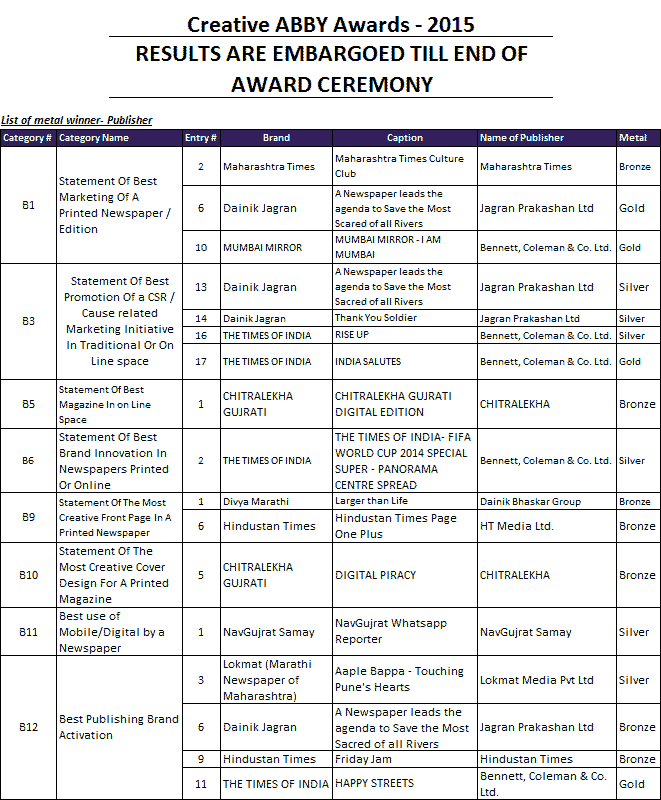
The Publishers Abby category of the Creative Awards at Goafest 2015 may have got a lukewarm response from the print players – some of who have in fact partnered Goafest in the form of sponsorship, but it’s a sound beginning nevertheless and in an industry where there aren’t too many awards for print publishers, this could well see growth in forthcoming years.
There were 62 entries in all from across 10 publishers and 17 metals were awarded. There were four Golds, six Silvers and seven Bronze metals.
Bennett, Coleman and Company Ltd (The Times of India group) bagged three Golds, three Silvers and one Bronze. The Dainik Jagran group followed by one Gold, two Silvers and one Bronze. Lokmat bagged one Silver while HT Media and Chitralekha bagged two Bronze metals each. The Dainik Bhaskar group bagged one Bronze. Among the publisher brands, The Times of India scored the maximum.
By Dyanne Coelho
The first day of Goafest typically sees CxOs from across the spectrum of media, advertising and marketing professionals converge at an Industry Conclave for an interface with leading lights from amongst industry professionals.
Following the inauguration of Goafest’s tenth edition in the afternoon on Thursday, the Conclave saw keynotes by Anand Kripalu, MD and CEO, United Spirits and Member Diageo Global Executive Committee, D. Shivakumar, Chairman and CEO, PepsiCo India, R. Chandrasekar; Head of Communication and eCommerce, Nestle South Asia Region and Sanjeeb Chaudhuri; Global Chief Marketing Office and Regional Head, South Asia, Standard Chartered Bank.
Shivakumar highlighted the dawn of the social media, digital space and e-commerce. “Recruit tech savvy people,†he said, adding: “We are getting seduced by so many tactics that we lose sight of our brand. Don’t be data rich and insight poor,†he added. Shivakumar included a checklist for agencies in his talk; strategic planning, quality of management, buying, creativity, insights, value and tech solutions are the key, he said
Anand Kripalu was up next, talking about the sacred relationship between a brand and its agency. “A brand and its agency is like a marriage, only divorce after you’ve tried bloody hard,†he said. Kripalu stressed the importance of agencies and clients creating value together. “Today organisations are becoming less and less important to talented people,†he said.
Chandrasekar Radhakrishnan of Nestle pretty much backed up Kripalu talking about the timeless relationship between a client and its agency. “People don’t just buy products, they buy into products.† Like the previous speakers, Radhakrishnan too highlighted the importance of creating quality content. “Content quality matters the most, not the platform. If the message is great, it will get rewarded. The quality of the message will determine the rewards.†He added the importance of increased creativity. “Brush aside safe creativity to make way for impactful and compelling creativity. Creativity must be relevant, not safeâ€
The last speaker for the day was Sanjeeb Chaudhuri. “Consumers decide what they want to listen to, they have the ability to make or break your brand,†he said. The bulk of responses that brands receive have to do with consumers increasingly venting out on social media platforms. We need people today, who can listen and acknowledge the problem and offer solutions, he said.
In Arrangement with MxMIndia.com

By A Correspondent
“It’s all in the family,†said CVL Srinivas, CEO South Asia, GroupM on his network of media service agencies in India winning 28 metals at the Media Abby last evening. Held as part of the ongoing three-day Goafest, behind held in Goa, the Media Abby is conducted by the Advertising Club for excellence in use of media. Goafest is jointly organised by the Advertising Agencies Association of India and the Ad Club.
According to Pratap Bose, President of the Ad Club and also Chairman of the Media Jury, as many as 70 leading professionals constituted the judging process which was held over four days. There were 674 entries as against the 619 of last year from 53 agencies. “This year we attracted the best possible response in the Media category over the years,†added Nakul Chopra, Chairman of the Goafest Organising Committee. There were a total of 74 metals awarded – 12 Golds, 23 Silvers and 39 Bronzes.
“The quality of entries was more or less similar to that of last year with nothing really very outstanding and hence there was no Grand Prix awarded,†explained Bose.

Commenting on the overall trends in the entries, Bose said that with the pressure on margins and the bottomline, getting creative in media is possibly taking a backseat.
Meanwhile, Shashi Sinha, CEO, IPG Mediabrands India is happy to see his network of agencies winning 14 metals. The maximum number of golds won by an agency this year – three – was from his network’s Lodestar UM. “It speaks for the splendid work put up by our teams from across all our offices,†Sinha said.
The Advertising Club does not award a title of Media Agency of the Year at the Media Abby and also does not rank agencies in any specific order of metals.
Along with the Media Abby, the Publisher Abby category of the Creative Abby was awarded on Day 1 of the Goafest. There were 62 entries in all from across 10 publishers and 17 metals were awarded. There were four Golds, six Silvers and seven Bronze metals. Bose admitted that the awareness for the Publisher Abby needs to be raised to generate more entries from across the print media.
Result


By A Correspondent
It’s that time of the year when advertising, media and marketing professionals head to the sunny climes of Goa for an annual dose of some knowledge, networking and winning awards. It’s also celebration time as this is the tenth edition of Goafest, the annual congregation organised by the Advertising Agencies Association of India and the Advertising Club.
The latter brings to the party the Abby Awards which have been expanded since last year to include various members of the media ecosystem. What started as essentially a Creative Awards show now includes Media, Digital, Print, Film, Film Craft, Out of Home, Ambient Media and Design, Radio, Direct, Branded Content and Entertainment, Brand Activation and Promotion, Print Craft, Integrated Advertising, Public Relations, Broadcaster and Publisher. Awards will be presented category-wise on each day of Goafest – that’s starting today, April 9 through April 11.
Yes, there are naysayers, but they’ve been silenced by the response that the event has generated. After the inauguration today, the Industry Conclave will start mid-afternoon followed by the Media and Publishers Awards.
Said Nakul Chopra, Chairman of Goafest 2015 organising committee: “It is our endeavour to make Goafest 2015 better and superior. We will bring together the best minds in the field of advertising, communications, marketing industry to discuss, debate, interact, offer thoughts and experiences, share ideas and questions on our industry.â€
Meanwhile, Ad Club president Bose is ecstatic about the number of entries he has received this year. While some of the leading agencies like Ogilvy, Lowe Lintas, McCann and Leo Burnett have not sent entries, Bose boasts of a near-35 per cent increase from 2014. “The fact that we followed a rigorous judging process last year brought back the faith in the system which had eroded in the previous Abby.â€Â The number of entries is up 900 to 3500 with participation from 200 creative and digital agencies. In the Media Abby, the number of entries has grown from 574 to 612 from across 53 agencies. “Agencies you thought weren’t participating are doing so,†Bose smiles. “Some clients have pushed their agencies to participate while many others have entered directly.†Talking of the new categories introduced last year, he said that Public Relations has shaped up well and so has the Broadcaster category. When asked about efforts being taken to woo back the agencies which have boycotted the awards, he said: “We tried our best to persuade them.†Bose is of the view that agencies don’t gain by staying away. “For the sake of the young professionals who do some splendid work, they must enter.â€
At the time of writing, the final numbers of registered delegates at Goafest was not known.
| If there were no awards, you wouldn’t even have half the participation in Goa: Nakul Chopra |
|
Many sleepless nights because of Goafest? Â I never had sleepless nights because of GoaFest.
But must be a thankless job? That’s why it must be done. I think you hit the nail on the head. To share an honest personal experience with you, I got into Goafest actively because I was a vocal critic. I protested 2011 and was chairman of Goafest in 2013. It’s easy to sit and critique others. I’ve done both with a very cynical filter in how I saw things. Except, when you look at it from the perspective of what you said: It’s a thankless job. Somebody spends a lot of time and effort to make something happen and you don’t look at the stuff that worked or you could appreciate. Instead, you catch onto the three things that didn’t work or that personally pissed you off for some reason. It could be just the food or who got the awards…
Last year you didn’t do it because the timing wasn’t right? Last year, the timing had to be changed, so, I thought it better if somebody else did it. This year, the AAAI President didn’t give me a choice. I think we all have to, turn by turn, take the responsibility. Either the association decides they don’t want to do it, so, they should parcel it off to some third party to do it. But, if the two associations want to continue to do it, somebody has got to take responsibility.
Obviously, you run a network of agencies. Goafest is also more than a full-time job for a couple of months. It must be taking away from your time here at Publicis. It takes away from time at Publicis and at home. It does. I’m fortunate that we have a very strong team at Publicis. We have also a good team helping out with Goafest… many people pitching in to take on different responsibilities.
You’ve done Goafest in the past, so you obviously know… But the grammar has changed from an organisation and logistics standpoint. There was the Beach GoaFest which was the first three or four years. Then there was the GoaFest at Zuri. When you do it on the same format with similar vendors, by Year 3, things become much simpler. You’ve learnt from the mistakes, you know what can go wrong. Last year was the first year at Grand Hyaat. Many of the things worked for us. From a sheer organisation standpoint, it wasn’t that well-organised, perhaps.
What about the festival format? The general perception is Goafest is more about the beer than the knowledge or conclave or the people speaking…  This is a little bit of an unfair pseudo comment to make. Firstly, is it fair to say Cannes Lions is more a corporate junket than it’s about people learning? If I’m not mistaken, there are maybe 8 to 10,000 delegates who register for Cannes. There isn’t even a room large enough to hold more than 1,500 of them and in most cases the rooms aren’t full. If you start seeing something in a uni-dimensional sense, are people studiously sitting in the knowledge seminars and listening? I don’t think that’s the only form of learning. Second, Goafest, unlike really any other festival of its kind in the world, has an inverted participation where as much as 60 per cent or more people who attend are under-30. There are more people sitting in the room to listen and learn in Goafest than there are in any other such festival anywhere else in the world. Young people have something which is part of their nature. If you make Goafest an attendance-oriented class, the young people won’t come. They will learn in an atmosphere of fun and frolic. It’s an over-exaggerated view of the Goafest that it’s just about the booze and the beer. It’s not!
Without getting into speakers are there one or two standout things this year that one could look forward to? I think Goafest is beyond that phase of being about one standout thing. We’ve consistently invested behind building some properties. And we amend or change or junk some of them basis the feedback we get. Last year was the first year we had three award nights and we are continuing with that.
How critical is the Abby to Goafest? Last year, I remember, there was a statement made that the Goafest is not all about awards. It’s not all about awards, but it’s been around the awards as well. Goafest is not an awards fest, in which case it might as well have been in Mumbai. But it’s not fair to say, Goafest is more about the festival than it is about the awards either. I think it’s a balance of both. The celebration is more about the awards. The participation is more about the festival. At its peak, we have had more than 3000 people… Three thousand people don’t win awards.
Ogilvy and Lowe have no issues participating in the Effie Awards. Obviously, there’s something wrong with the creative Abby that stops them from coming there. I don’t think that would be a fair thing to say about the Creative Abby. There have always been some agencies, different ones in different years including Pubicis in one year that may have felt upset or slighted by something that happened and that’s understandable. In the case of the Effie, the points here are part of the global Effie agency rankings.
If you had no Abby, you’d have Ogilvy and Lowe as part of fest? If that’s true, they can still send people to the Goafest. There’s no restriction on your coming and participating in the festival part if you’re not participating in the awards part. If there were no awards, you wouldn’t even have half the participation in Goa.
|