By A Correspondent
Global media and marketing consultancy NewBase (eka Publicitas) has launched its latest report titled ‘The Evolving Marketer’ where it spoke to 120 global CMOs across 20 markets and asked them about their views on everything from where budgets were increasing to how they used data and good their team is. The report shows that CMOs feel their status has risen as marketing’s value in driving revenue has come to the fore.
The key findings are:
:: 60% of CMOs are not going to increase advertising  spend. Only four in 10 CMOs are going to increase advertising spend but three quarters (72%) are growing budget in content marketing
:: CMOs are challenged by data – saying that their businesses don’t use data to the fullest extent – half of all data is unused. Even so three quarters of CMOs are going to be spending more on data
:: 97% of CMOs don’t have the perfect skill set internally and more than half say they have an internal skills shortage
:: Two thirds of CMOs are looking to bring more services back in house
This global study of senior marketing leaders reveals five key themes firmly on the CMO agenda: revenue generation, customer experience, data, content and processes.
 Go for growth
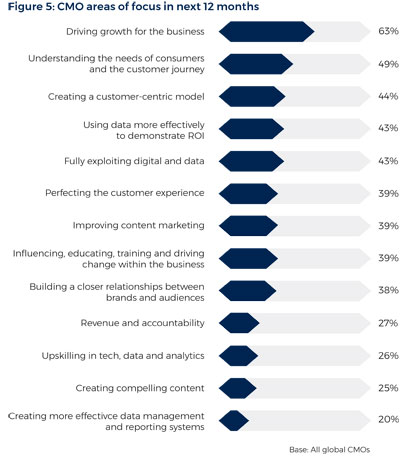
Business growth is a given and driving this is undoubtedly a core part of the marketing leader’s remit, as underlined by the move to rename CMOs ‘Chief Growth Officers’. The emphasis on revenue is keenly felt by senior marketers with over eight in ten (82%) of CMOs saying the role has become more financial results focused. Almost two thirds (63%) of marketing leaders say their key priority is going to be driving growth for the business. With this concentration on the bottom line it is only natural that the status of marketing should have risen. 82% of CMOs think that marketing’s influence has increased internally.
Customer minded
It is understandable that those focussed on growth are going to turn their attention to understanding customers’ needs to see if there are any issues to be addressed or processes to be streamlined. One in two CMOs have looking at the consumer journey top of their to-do-list and almost half (44%) of marketing leaders also say that they are going to ensure a customer-centric model is in play. Two thirds of global CMOs state marketing decisions should be based upon how they impact the customer rather than the business.
It’s all about the data
With the heightened focus on both the customer and growth, data is more important than ever. One in two senior marketers say currently they have budgetary control for data and analytics. However, this is set to grow, as more than 80% of CMOs are saying they are getting more money to invest in data. This budget will no doubt be gratefully received as more than three quarters state data management and analytics is taking up more of their time. But simply having more data available does not necessarily mean that it can be used effectively.
Data mountain
Global CMOs highlight over half the data available to the business is not being used to its fullest potential and three quarters agree they are only able to use a small portion of the data they have at hand. This is an opportunity for senior marketers, with over nine out of ten (92%) saying that creative and analytics need to work more closely to drive business success. With the budget offered for data increasing but over half of all data not being used to its full potential, there is scope for CMOs to marry the ‘magic and the maths’ using brand awareness advertising, story-telling and experiential with data to drive revenue.
 In/Out
Two thirds of CMOs are moving towards more in-house marketing services, but only 3% say they currently have the perfect skill set internally. Marketing bosses looking to bring more functions in house are challenged by both budget and team capabilities.
Just under one in two CMOs have good internal team capability, and 68% say that it is essential to have people on board who are skilled enough to evolve with technology developments. However, due to the martech explosion and dramatic growth of digital marketing and programmatic advertising, more than half of CMOs (55%) state they have an internal skills shortage.
With the skills gap and implied talent scarcity it looks as if outsourcing suppliers (agencies, martech vendors, etc.) is still going to be essential in ensuring CMOs can deliver on their objectives.
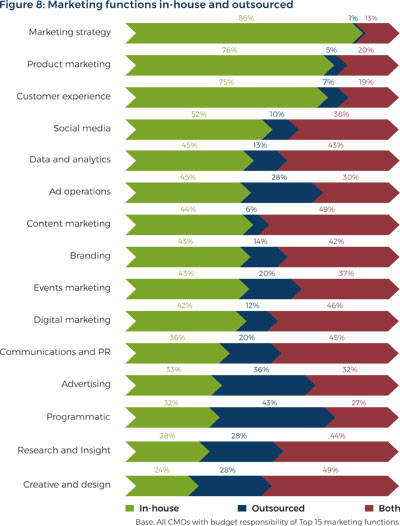
The results reveal that 43% of CMOs still entirely outsource programmatic, which is the highest fully outsourced function. Over a third of senior marketers outsource advertising (36%), and over a quarter fully outsource creative and design, and research and insight (both 28%).
Key elements such as marketing strategy, pricing and product marketing as well as customer experience tend to be handled in-house. Among the top 15 areas where marketing leaders have budget responsibility, marketing strategy is the number one function delivered entirely in-house (86%), followed by product marketing (76%) and customer experience (75%).
Budgets
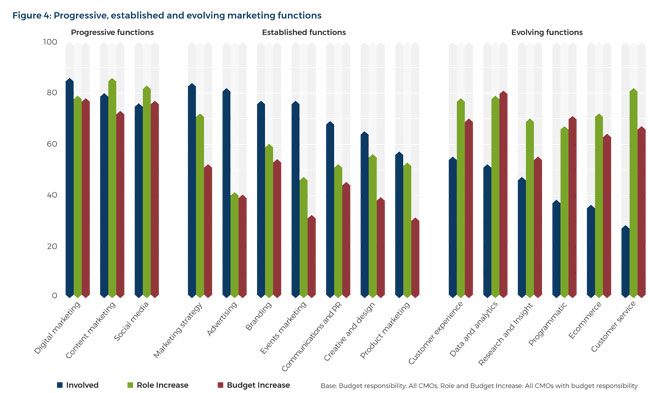
While CMOs overall say they have to achieve more with less, there are some functions where involvement is already high and budgets are increasing, along with the time investment required by marketing. Marketing leaders are expecting to spend more on digital, content marketing and social in the short term with three quarters of marketing leaders allocating increased budget to these channels. They are also expecting the time that they have to invest in these functions to increase along similar lines. These are described as ‘Progressive marketing functions’.
For more ‘Established marketing functions’ such as marketing strategy, advertising, branding, PR, design and product marketing, while a minority of CMOs are anticipating budget rises, the majority are not. Four in ten senior marketers are envisaging advertising spend increase, one in two are forecasting a rise in branding investment and almost 40% are going to spend more on design. Just under half are also looking to invest more in communications and PR in the next year.
There are some ‘Evolving functions’ where currently CMOs are seeing their expertise called upon, and alongside this, budgets increased. Customer experience, customer service, e-commerce, data and research are now increasingly important too. However, because these areas are not solely marketing’s remit the CMO does not presently have total budget control over these, but this is likely to change.
Three quarters of CMOs say they will receive more budget for customer service and a similar proportion are expecting an increase for customer experience.
The influence of time
“The Evolving Marketer†reveals significant variations in the global CMO agenda based on length of tenure. Those in their roles for over five years, the established CMOs, are firmly entrenched, their priorities (bar driving growth) are very different from more recent CMOs (under five years’ tenure). One in two established CMOs are focussing on building internal collaboration (45%) and perfecting the customer experience (47%).
More recent CMOs (under five years) are still in the set-up stage for their role and thus focussing on sorting out infrastructures, putting new systems and processes in place and creating models to exploit the data they have access to.
Newer CMOs are emphasising the customer journey (57%) vs. only 39% of established CMOs and creating a customer model that aligns with business strategy (52% vs. 33%). Using data to its fullest potential is prioritised by half (49%) of recent CMOs as opposed to only a third (35%) of established CMOs.
Revenue and accountability are prioritised almost three times as much by established CMOs compared to newer marketers (41% vs. 17%).
Making an impact
84% of newer CMOs claim it takes less than five years to really make a difference, whereas only half (49%) of established CMOs think the same.
Said Mike Jeanes, Global Head of Insight, NewBase: “Over the past few years, the CMO’s remit has escalated significantly from a largely promotions and creative role to becoming the centralised lift-shaft of the business, servicing every level and function of the organisation, and providing the data-driven connection between the brand and the consumer. The role of the CMO is varied and complex. They are increasingly challenged to drive business growth and adjust their resources to keep up with industry change and consumer demands.â€
The full report can be download here.