Tag: Girish Menon

  • M&E to rebound by FY22, notes KPMG


    By A Correspondent


    On Wednesday, on the last day of the second quarter of FY 2020-21, KPMG in India launched the twelfth edition of its Media and Entertainment (M&E) Report, titled ‘A year off script: Time for resilience’. It examines the performance of the M&E sector in “particularly challenging” period that prevails.


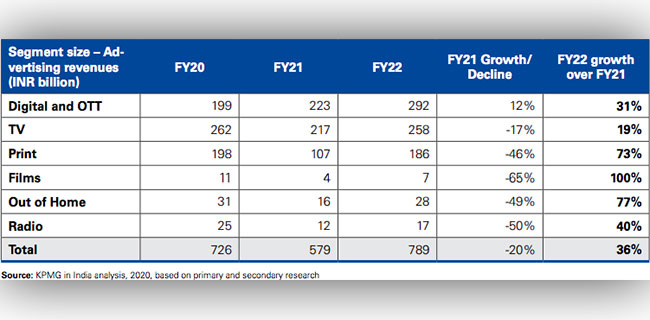
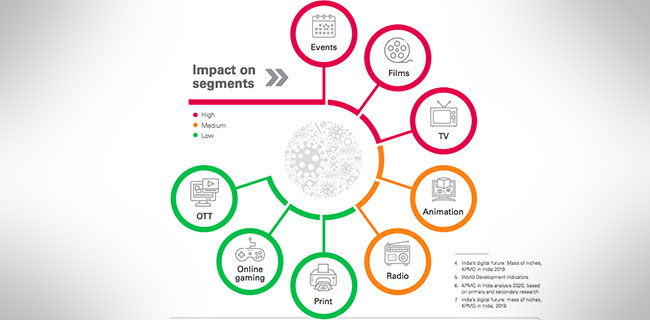
    Notes a communique: “India was already experiencing a slowdown in economic activity even prior to the outbreak of COVID-19 in March, and the onset of the global pandemic and ensuing lockdown dealt a severe blow to the Indian economy. The M&E sector has been affected but to varying degrees: outdoor entertainment formats (films and events) and traditional media (print and TV to some extent) have been badly impacted as people stayed indoors and advertising spends dried up. Digital advertising, OTT and gaming fared much better, with massive spikes in digital consumption during the lockdown across geographies and socio-economic classes. Digital advertising spends are now set to overtake those on TV by FY21, which is an important milestone and turning point in the evolution of M&E in India.


    Said Satya Easwaran, Partner and Head, Technology, Media and Telecom, KPMG in India: “The distinction among segments of M&E has become more pronounced with the experience of the lockdown. Marketing spend has moved perceptibly towards digital media and away from traditional segments like print, radio and to some extent TV. A greater reliance on subscription and other paid options as well as the development of a credible digital business model is going to be inevitable for these traditional media segments.”


    Added Girish Menon, Partner and Head, Media and Entertainment:  “There will be a deeper integration of digital technology across the M&E value chain – from content production to distribution. Technology adoption could however face some challenges in terms of skill development and the shift to a digital-first mindset but will result in operational cost savings and potentially lower lead times over the longer term.”


    According to the report, the M&E sector should recover to its current levels and post a 33 per cent growth in FY22 (following a contraction of 20 per cent in FY21), which still implies a loss of around two years of growth. The two areas that offer encouragement are the continued economic growth of Bharat and the universal acceleration of digital adoption among users across geographies and SECs. As per our revised estimates, India could be home to a billion digital users by 2028 rather than the earlier projected 2030 timeline. There have been several structural changes to digital behaviour on account of the experience of the lockdown resulting in a new homogeneity among users, and it is our belief that many of these changes will translate into a more democratic and sophisticated digital citizenry within the country.


  • Impact of Covid-19 on M&E: KPMG


    By A Correspondent


    Given the ongoing Covid-19 pandemic, KPMG has released a report titled “Covid-19: The many shades of a crisis- A media and entertainment sector perspective” which discusses the impact of Covid-19  in the media and entertainment industry.


    The report highlights that media consumption overtime has tended to be income inelastic, however the current environment could result in a dip in media consumption in the near term; and also foresees key trends across Television, Print media, Films, OTT platforms during Covid-19 along with the recovery time for the same.


    Furthermore, the report highlights that due to Covid-19, traditional media could face some challenges in the near to medium term, and there is likely to be a long-term upward shift in the integration of digital technologies into our everyday lives with media and entertainment being an immediate beneficiary.


    Speaking on the ongoing situation, Satya Easwaran, Partner and Leader – Markets Enablement, Technology, Media and Telecom (TMT), KPMG in India said: “The Covid-19 pandemic has resulted in a drastic cut in advertising expenditure across all media. However, with people being homebound, consumption of media and entertainment – and digital media in particular – has seen considerable growth. Post crisis, we anticipate an even greater integration of technology into our everyday lives with a marked digital progression of Indians across socio-economic classes. Monetisation however might remain a challenge in the near term.”


    Added Girish Menon, Partner and Leader – Media and Entertainment, KPMG in India said “The Covid-19 experience is likely to result in a long-term upward shift in the integration of digital technologies into our everyday lives, with India’s ‘digital billion’ trajectory likely to accelerate materially. We expect greater affinity to be seen for at-home entertainment with subscription models, cord-shaving and streaming to larger screens seeing exponential pick-up in the near to medium term. Outdoor entertainment options including – films, events, theme parks – particularly in Covid-19 hotspots could see lingering risk aversion even in the medium term. With monetisation, particularly ad-spend, under pressure, the focus for M&E companies in the near to medium term would be on cash management and profit protection with greater technology integration. Organisations might need to be risk focused and innovate existing business models and processes to survive and emerge stronger.”


    Below are the key highlights of the report:


    Insights into the crisis and its aftermath:

    • Ad-spend pressures to linger on the back of weak economy and lower domestic consumption

    • Longer time lag to return to normalcy for weaker economic sections of the populations

    • Digital consumption to see rapid incremental growth with India’s digital billion trajectory likely to accelerate materially

    • At-home entertainment options (digital, TV, gaming) to see an upswing as ‘lockdown behaviour’ results in habit formation

    • Outdoor entertainment (films, events, theme parks) particularly in Covid-19 hotspots to see lingering risk aversion even in the medium term. ‘Pent-up’ demand behaviour among some sections of population may provide some respite

    • Delayed expansion plans though digital businesses aggressively target market opportunity


    Impact on the Media and Entertainment sector:

    • Supply chain:

    ¤ Innovations in content pipeline: A focus on building a stronger content bank may result in working capital being locked up across the value chain, leading to higher cash flow requirements

    ¤ Innovations in delivery models: With outdoor entertainment and recreation facing challenges in the near term, innovative outreach and delivery models are likely to evolve

    ¤ Greater emphasis on predictive analytics: Companies could place an increasing amount of reliance on Artificial Intelligence (AI)/ Machine Learning (ML) to predict consumer behaviour in these uncertain times


    • Consumption:

    ¤ India vs. Bharat dichotomy could likely widen

    ¤ At-home consumption, particularly OTT and gaming, to see continued accelerated growth

    ¤ Outdoor media consumption: M&E segments such as films, events and theme parks are looking at a prolonged recovery cycle, owing to risk aversion towards social gatherings, particularly in COVID-19 affected cities and hotspots, which unfortunately includes some of the major cities

    ¤ While India’s media consumption remains upbeat during the lockdown, indulgent expenses around purchase of latest hardware, technology upgrades etc. could be postponed for a while

    • Monetisation:

    ¤ Longer timelines for ad spend recovery

    ¤ Penetration of subscription based digital models to accelerate: Digital subscription revenues could see an upswing post Covid-19 as habit formation in terms of OTT video consumption sets in

    ¤ Print will get a new lease of life

    ¤ Medium term downside risk for outdoor entertainment segments: Aversion to social gatherings in the medium term (particularly in major Covid-19 hotspots) could result in lower footfalls and ticket sales for films, events and theme parks

    ¤ M&E services build on domestic opportunities: There is likely to be a greater emphasis on domestic markets in the services space, particularly in the animation and VFX segments, as global pipelines come under severe pressure


    Framework to help companies work through the transition to normalcy:

    • Immediate focus for companies will be on value preservation and protection

    ¤ Protection of the workforce:Focus first on the physical and mental well-being of the workforce with a gradual reintegration process. Time for leadership to deliver clear messages on organizational priorities and provide a fair assessment of the impact of the crisis on their business to employees

    ¤ Stakeholder communication includes not just employees but also external parties including vendors, partners and customers

    ¤ Identify short-term cash flow challenges and enable cost levers for savings opportunities


    • Medium term objective will be value creation

    ¤ Agree and implement the recovery plan

    ¤ Incorporate learnings from the crisis to streamline processes and potentially provide better insulation from such shocks

    ¤ Devise tactical working capital projections in acknowledgement of the changed environment

    ¤ Invest in upskilling teams to adapt to the new normal


    • Long-term vision will be value realisation

    ¤ Carve-out of non-core businesses to unlock value

    ¤ Identify strategically aligned inorganic growth opportunities

    ¤ Develop deep and credible succession plans


  • Industry Reax to Budget 2020-21


    A cross-section of the industry reacts to Nirmala Sitharaman’s maiden Budget 


    Girish Menon, Partner and Head, Media and Entertainment, KPMG in India

    Although there was no direct reference to the media and entertainment sector in Budget 2020, the focus on improving India’s digital connectivity bodes well for the sector. The Honourable Finance Minister’s announcement that an amount of INR 6,000 crores will be spent on BharatNet initiatives will see more citizens connected to the proposed pan-India FTTH network. Media and entertainment is increasingly becoming a digital medium and an enhancement of the underlying digital communications infrastructure will support more immersive experiences. Finally, the focus on building a vibrant start-up ecosystem with measures to improve access to funding and IP protection will help India emerge as a global hub for technological innovation.


    Rakesh Jariwala, Partner – International Tax Services, EY India

    Removal of exemption on sale, distribution and exhibition of cinematograph film will subject theatrical revenues to domestic withholding tax considerations and could pose working capital considerations for already funding constrained film industry. Amendment of source taxation rule to include advertising income relating to customer based in India while global consensus is being formed on digital taxation rules may result in short term pain for the foreign businesses which do not have access to a tax treaty. Reduction of withholding tax rate on technical services to 2% will provide relief on potential rate related disputes on production services. Reduction in import duty of news print should help the ailing print businesses. 


    Ashish Bhasin, CEO, APAC and Chairman, India – Dentsu Aegis Network:

    I think this is a good budget in some ways because it has attempted to put money in the hands of the middle class through rationalisation of tax rates as well as has concentrated on looking after the agricultural sector, including introduction of best practises like storage for producers and other measures. However, I do feel that the expectations from the budget were much more and it does feel like a bit of a missed opportunity.


    While it is good to see that the dividend distribution tax has been abolished, I expected more on the rationalisation of direct taxes, particularly the cess introduced over and above the tax rates.


    It is good to see efforts being made to encourage new-age skill development as well as helping the start-ups and what’s particularly interesting is the proposal to set up data centre farms all over the country. This will prepare India for the economy of tomorrow. It is also good to see attempts at simplification of taxation through digitisation but the proof of the pudding will lie in seeing its implementation on ground.


    It would be fair to say that at best it is a mixed budget and while there are some encouraging decisions, enough does not seem to have been done for the situation the economy is in.


    Karan Darda, Executive Director, Lokmat Media Group:

    We welcome the proposed reduction in custom duty on import of newsprint and light-weight coated paper. In recent years, newspaper industry has been facing many headwinds and the environment has overall been very challenging. 10% customs duty was introduced last year and that added to the burden. The reduction in customs duty would ease the burden and help the industry in this critical juncture. 


    Anand Bhadkamkar, CEO, Dentsu Aegis Network (DAN) India:

    The budget has provided relief to middle class with lower tax rates which is a welcome move, as it will provide more liquidity. On direct taxes, the abolition of DDT and introduction of a tax dispute resolution scheme is a welcome step alongside tax reliefs for startups.


    The budget is focusing on easing and simplification of compliance, with changes in corporate laws as well as in GST and direct taxes. However, I was expecting further simplification of cess and surcharges beyond tax rates across slabs.


    The proposals for development of road infrastructure, setting up data centre parks and skill development initiatives are welcome steps in addition to allocations for social welfare schemes.


    However, the expectations from the budget were high on the background of current economic slowdown, and as such seems to be short on matching those expectations, with no specific industry sector focused sops to provide stimulus. While the budget shows focus on long term growth and social development, overall in the current scenario it looks like a mixed budget, falling a bit short of market expectations of more corrective measures.


    Gautam Sinha, CEO – Times Internet:

    Budget 2020 is a promising step towards establishing India’s future as an enduring digital economy. The increased focus on improving data connectivity under Bharat Net, steps to boost the smartphone manufacturing industry and the Rs 8,000Cr allocation for the National Mission on Quantum Computing & Technology will help build better digital infrastructure to support this sector’s rapid growth. Finally, deferring tax on ESOPs for startups is also a major move that will help promising startups attract and retain talent that would fuel our burgeoning digital ecosystem.


    Redickaa Subrammanian, Co-founder and CEO, Resulticks:

    Digital disruption has transformed India’s business landscape and the announcement for building more data centre parks will further aid in laying a strong foundation for a digitally connected country. INR 8000 crore allotment for developing quantum technology is impressive, and this in tandem with the grassroots level skilling initiatives, make for a strong technology ecosystem. Engineering students will also gain real-world experience through the new internship programs, creating a digitally skilled talent pool equipped to work in a digital economy.


    As a fast-growing AI and ML based technology start-up, we welcome setting up of the investment clearance cell. The proposed revisions in the income tax structure should lead to increased consumer demand and provide an overall impetus for economic growth in India. The announcement made in Budget 2020 showcases the government’s support for India’s technological advancement and we are excited about the entrepreneurial spirit it promotes.”


    Prashan Agarwal, CEO – Gaana:

    We appreciate the efforts of the government to boost the digital ecosystem in the country. The increased focus on improving connectivity under the Bharat Net scheme and the emphasis on Artificial Intelligence will allow OTT players to offer bespoke and personalised solutions to consumers. Additionally, the impetus to the smartphone manufacturing industry will make internet consumption accessible to a wider section of Indian society that will expand the scope of revenues for OTT players. The allocation of Rs 8000 crore for setting up the National Mission on Quantum Computing and Technology will also boost the development of the industry by making resources cost-effective.


    Mitesh Shah, Head of Finance, BookMyShow: 

    At the onset, we would like to laud Government for growth driven budget. We welcome the progressive policies aimed at encouraging rural demand, changes in personal taxes spurring consumption and impetus to infrastructure development, measures aimed at bolstering growth and reverse slowdown. Additionally, taxation related on ESOPs as perquisite and removal of DDT are significant moves. However, the benefits of taxation relief on ESOP should be expanded to companies at various stage of growth.


    Compliance on e-commerce has been increased by mandating them to deduct TDS @1% on all goods and services sold on e-commerce platforms. This would be in addition to TCS under GST and this amendment might further increase the cost of compliance for e-Commerce companies. Government’s vision to build data centre parks, allocation towards quantum computing and its focus on using artificial intelligence in statistical and other government departments will take India’s growth story to the next level.


    Increase in compliance on e-commerce by mandating deduction of TDS @1% on all goods and services sold on e-commerce platforms. This would be in addition to TCS under GST and this amendment might further increase the cost of compliance for E-Commerce companies. Government’s vision and focus on investing in new age technologies to build data centre parks, allocation towards quantum computing and its focus on using artificial intelligence in statistical and other government departments will certainly give an impetus to ‘Digital India’.


    Kunal Bahl, CEO & Co-founder, Snapdeal:

    Thankful to the Hon’ble FM for accepting the start-up sector’s request for ESOP taxation reforms. Also, the higher time & turnover limits for carry forward of losses for start-ups will enable them to optimize growth decisions in formative years.


    Overall, Budget 2020 is a thoughtful weaving together of specific proposals to tackle varied issues. Measures to improve access to finance for MSMEs and reduced taxation for the middle-income segment are welcome steps. Boosting physical infrastructure, expanding digital connectivity and growing use of technology in government functioning are important building blocks for the long-term growth of the Indian economy.


  • KPMG-Eros Now OTT report maps consumption habits of Indian viewers

    By A Correspondent


    KPMG India and Eros Now launched the report, ‘Unravelling the digital video consumer: Looking through the viewer lens’, to check the consumption habits of Indian OTT viewers and their content preferences, across 16 Indian cities.


    Said Girish Menon, Partner and Head Media & Entertainment, KPMG in India,: “The online video consumer in India has evolved in a significant way in the last couple of years. With consumption now going mass and viewers spending close to 8.5 hours a week on online video, we see a homogenous pattern of consumption emerging cutting across age groups, income levels and professions. Our report also touches upon the future of this consumption evolution, and how online video could potentially disrupt traditional distribution in the coming years. This represents a large opportunity for platforms to tap into the ever expanding universe of digitally connected Indians.”


    Added Rishika Lulla Singh, Chief Executive Officer, Eros Digital: “India is one of the fastest growing entertainment and media market globally and is expected to keep that momentum. As data and digital infrastructure has become exceedingly accessible even in small cities of India, the market for OTT has widened enormously. At Eros Now, we strive to constantly engage the existing consumers and expand our reach by offering new and innovative services.”


    Key insights from the Indian online video consumer-survey include:

    :: The Indian OTT viewer spends more approximately 70 mins/day on online video platforms, with a consumption frequency of 12.5 times a week i.e. more than once a day. Viewers are also accessing ~2.5 platforms at a given time. While the customer sets are fairly heterogeneous, there is a trend of homogeneity that was observed in terms of consumption frequency and duration across age groups, income levels and genders.

    :: Indians continue to love their movies and movie related content; 30% of the respondents prefer watching movies on OTT platforms.

    :: Original content is fast emerging as an important category, with close to 10 per cent respondents alluding to preference for the same. This is significant given the limited supply on original content on platforms at present, as compared to library content.

    :: Long-form content is gaining traction, while short form content continues to remain relevant, especially to cater to the millennial audience.

    :: 30 per cent of the respondents prefer watching content in languages other than Hindi and English. The preference for content consumption is significant in the native languages across large parts of the country, with south India observed to be the most loyal to their native tongue.

    :: 87 per cent of the respondents consumed content on their mobile phones, with nearly 28 per cent of the respondents consuming content during the traditional office hours of 10 – 6pm. Online video in India is truly an ‘Anywhere Anytime’ phenomenon.

    :: Three out of 10 users are watching online video on telco platforms, outlining the importance of the medium in terms of distribution. Integrated telco billing is one of the factors that is likely to help drive VOD subscriptions in the future

    :: Freshness and uniqueness of content the key determining factors for installation and uninstallation of apps, as well as respondents subscribing to platforms; 87 per cent of the respondents install an app considering the quality of content


  • M&E CAGR of 11.5 per cent over FY15-FY19: KPMG


    By A Correspondent


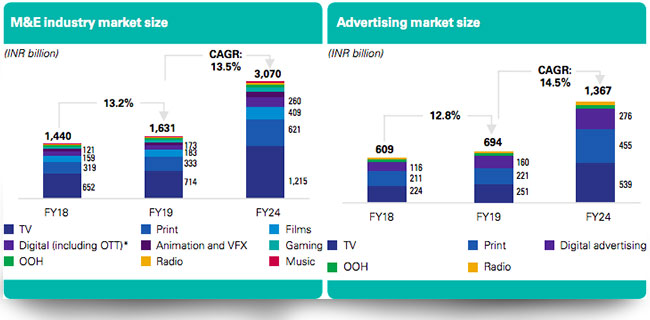
    The M&E industry in India posted a solid growth of 13 per cent during FY19 to reach a size of INR 1631 billion with a CAGR of 11.5 per cent over FY15-FY19. KPMG India launched the 11th edition of its Media and Entertainment (M&E) report titled ‘India’s Digital Future: Mass of Niches’.  Digital has been a recurring theme across all segments of M&E causing disruption in TV and print and fueling growth in digital advertising and gaming. The digital market is poised to become the second largest segment in India after TV, and also attract the maximum advertising spend by FY22.


    The report examines the evolution of India’s digital demography to 2030. It also covers the industry’s performance across segments, along with the key underlying themes and growth drivers.


    The study notes that there are favourable factors for both digital access (smartphone penetration and low data costs) and content supply (investments in original and regional digital content), which together will continue to drive up online consumption. The investments in regional content is an outcome of the growing importance of regional language markets in India, which is another key theme of the report this year. With the digital migration of English-speaking audiences almost complete, most new users coming online – and there are expected to be 500mn of them by 2030 – will access the internet in a local language.


    The 500mn new users by 2030 present digital businesses with an unparalleled market opportunity but not without some complexity. Segmentation will become important as the market evolves into a mass of niches. The report examines major consumer archetypes that together provide a framework to better understand the socio-economic profile as well as media and entertainment consumption patterns and preferences of the projected billion internet users.


    Said Girish Menon, Partner & Head Media & Entertainment, KPMG in India: “The theme of the report this year is India’s digital future – and although the term ‘digital revolution’ has become somewhat of a cliché, there can be no other way to explain the extent of digital integration in our lives today. With no major constraining factors, digital is expected to be a dominant force going forward and in FY23, it is likely to be the second largest segment after TV and attract the highest marketing spend among all media formats. In 2019, as digital behaviour evolves, there seems to be a growing consensus that in the future, subscription models will have a greater role in monetisation of digital platforms. Further, evolving technologies are also presenting opportunities for companies in the media and entertainment industry to achieve greater operational efficiencies.”


    Added Menon: “In the coming years, it will be hard to ignore the pessimistic signals emerging from global economies but they will not have long term impacts on the industry and are unlikely to alter the strong fundamentals and momentum of M&E consumption, especially digital, in India. As an industry, we will remain upbeat on the prospects for both.”


    Said Satya Easwaran, Partner & Head Technology, Media and Telecom, KPMG in India: “By 2030, we estimate that there will be a billion people in India who are connected to the internet. Our initial hypothesis is that the user will primarily be a non-English speaking, mobile phone user, from a developed rural area/ non-metro urban setting who is increasingly willing to pay for content online. But why is the profile of India’s digital demography relevant? The digital disruption has forced a pivot of business models in media and entertainment from an erstwhile B2B2C model to a D2C one. And therefore, segmentation and demographic, psychographic and behavioral profiling will all become increasingly important, as they have historically been in other consumer businesses.”


    Click here for Media Report


  • Digital infra will boost OTT: KPMG


    By A Correspondent


    KPMG in India brings this report at a crucial juncture when the era of on-demand content has reached a tipping point with consumption shifting to the mobile screens and going ‘mass’ – particularly on the back of a successful 4G roll out. OTT consumers will demand seamless access to services, compelling stories and value for money.  As the OTT landscape gets hyper competitive, organisations which are able to tick all the above boxes may stand a chance to emerge as the preferred platforms for consumers. To pivot from their traditional businesses, media organisations would need to commit zealously to an organisational transformation initiative, which aims to harness the collective energies of all stakeholders towards a single minded ‘Digital First’ cause.  Right from telling the digital story to the internal stakeholders to implementing the digital architecture on ground, each step in the digital transformation process holds the key to survival and potentially to success in the market.

    The report gives an insight into the key themes of the Indian OTT market, key pillars of success for an OTT platform, roadmap to a digital transformation journey divided into four significant phases from a digital vision and strategy, customer proposition, business design and execution planning. The report also delves into operationalisation of the actual pivot of a traditional technology organisation into a digital avatar, highlighting two nodal frameworks for digital enablement, strategy and architecture realisation. The last section highlights the critical considerations for implementation of digital initiatives.

    Commenting on the OTT evolution in India and road ahead for digital and digitising businesses in India, Girish Menon, Co-Head, Media and Entertainment at KPMG in India, said “OTT consumption in India has reached a tipping point, with the 4G rollout and related data wars which have resulted in a dramatic and rapid growth in internet penetration and video consumption.  This has also fundamentally altered the consumption demographics and patterns, with OTT viewership becoming more mass.  Organisations can no longer afford to take baby steps and will need to wholeheartedly commit to build out their digital businesses.  However, pivoting to a digital business requires a change in organisational DNA and a ’digital first’ mindset. Building a digital business is an evolving process and organisations would need to adopt a systematic approach balancing scalability and flexibility with speed to market and customer centricity.”


    The ‘Over the top’ (OTT) video consumption in India has rapidly evolved over the last year, given the advancements in digital infrastructure and efforts by platforms to create compelling content for consumers at price points which provide value.


    Market potential

    Growing internet penetration and data consumption is likely to help increase digital advertisement spends in India at 30.8 per cent CAGR between 2016 and 2021 with mobile advertisement spends and social media aided digital video advertisement spends expected to grow at 50.9 per cent and 40 per cent CAGR between 2016 and 2021 respectively.

    The OTT landscape in India is punctuated by the following key enablers, around which both the growth of the segment as well as potential success of platforms are woven.


    Digital infrastructure

    The mass launch of 4G services by Reliance Jio in H2, 2016 and subsequent launches by incumbents was an inflection point in India’s data story. This disruption led to a rapid surge in data usage on the back of promotional offers by all leading telecom operators.

    Further, other enablers such as Government of India’s ‘Digital India’ initiative, growing usage of affordable smartphones, rising internet penetration in rural India and rapid growth of digital payments has further strengthen India’s digital infrastructure. This has resulted in video dominating data consumption, which is expected to continue to grow in the near future.


    OTT content consumption and evolving trends

    The OTT content consumption is evolving from niche to mass based content and long form content is gathering traction. The increased popularity of large screens and investments in original content creation is further driving the consumption. Live streaming has emerged as a focus area for OTT players, with the sports genre especially attractive from a viewership and monetisation point of view.


    OTT distribution

    The OTT distribution landscape is dominated by own platform players, although social media platforms YouTube and Facebook still constitute a major chunk of video viewership in India. With telcos betting big on data, partnerships with telcos is also emerging as an important medium to reach a fairly large, and a mass user base.


    Monetisation models and associated challenges

    While Advertisement Video on Demand (AVOD) remains the primary source of monetisation for the OTT players in the country, the Subscription Video on Demand (SVOD) and Freemium models are seeing traction, largely on the back of compelling content, including sports. Sponsored content has also emerged as an important monetisation tool, with brands baking in the advertising messages into the content itself.

    The growth in monetisation though, is partially held back due to challenges around digital viewership measurement and rampant content piracy which must be addressed in order to realise the true potential of OTT platforms and build a sustainable model in the future.

    Further, digital video businesses require high investments, and returns are currently not commensurate given the still evolving business models. Media organisations are currently attempting to bridge the gap between market share acquisition and economic viability, as they attempt to build long term sustainable digital video businesses.


    Changing consumer demands mandate companies to transform digitally

    When users stream videos on their mobile phone through an OTT platform, little do they know the entire digital infrastructure that is set in motion to ensure that the content streams flawlessly. It is this internal infrastructure that defines the ‘OTT player of today’, and is a key ingredient for ensuring continue success in the competitive OTT landscape.

    The adoption of digital infrastructure has evolved from resistance towards digital technologies to their mass adoption. Success in the digital world is dependent on various factors such as time to market, customer experience and the will to constantly innovate and change with the relevant developments in the market. This requires OTT platforms to identify and design digital solutions comprising strategies to predict, influence and respond to customer behaviour.

    Building a successful digital video business in the long run requires sustained commitment to the digital transformation process and a ‘digital first’ mindset.


    Digital transformation rests on four pillars

    The path to digital transformation encompasses a holistic approach including; clearly defining the organisation’s digital vision and strategy, thorough understanding of the customer proposition, accurately assessing the business design and, finally, carefully designing the execution plan.


    Key drivers for successful digital transformation:

    :: Innovation focussed mind-set: Innovation has become hygiene for OTT players, given India’s crowded platform market. For a fruitful digital transformation, it is critical for the leadership to evaluate their business through a number of facets and set up in-house labs to drive both internal and consumer focused innovation. Companies could also look to set up incubation centres in the form of accelerator programmes, or partner with third-party innovation labs.

    :: Integration across organisational DNA: Digital transformation requires a holistic strategy that permeates across the entire organisation including front, middle and back offices. The OTT organisations should move past silos that have a traditional media (for eg: TV) bias and adopt a ‘Digital First’ mindset.

    :: Data analytics: Data has evolved in type, volume, and velocity with rapid uptake of digital technologies. It has become a new currency and key for OTT players to understand the consumers and decode their viewing patterns. Big data technologies along with advanced analytics help answer key content and engagement questions, enable quick reaction and draw meaningful and actionable insights to fuel the customer facing productivity and enhance overall performance of the platform.

    :: Data protection and IP security: With OTT business models inherently digital in nature, data and content security has become even more paramount. It is vital for the platforms to protect data and content across systems, devices and the cloud.


    A successful transformation needs a strong technology foundation

    A strong technology foundation acts as the backbone of any digital transformation initiative.

    The pivot from a traditional IT to ‘today’s’ digital function is underlined by an architecture that is agile, flexible, and is able to deploy technology frameworks to give quick insights for decision making around customer behaviour and content strategies.

    The ‘all-in’ commitment of the entire organisation to the cause is a non-negotiable and is a precursor to embarking upon the technology deployment.

    In conclusion, the digital transformation journey of a media company comprises a marked strategic shift, with customer centricity at the core, and an internal thinking process that needs to change the organisational DNA into ‘Digital First’ mind-set.
  • 14% growth over 2017-21: FICCI-KPMG report


    By A Correspondent


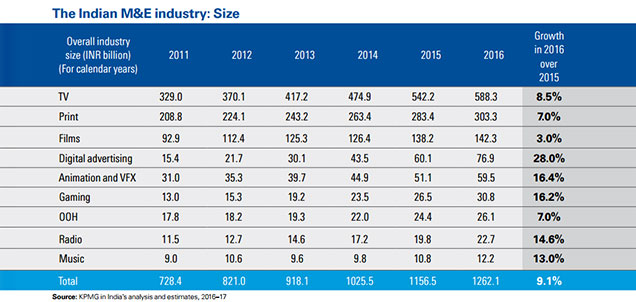
    The Indian media and entertainment industry in 2016 was able to sustain a healthy growth on the back of strong economic fundamentals and steady growth in domestic consumption coupled with growing contribution of rural markets across key segments. These factors aided the industry to grow at 9.1 per cent on the back of advertising growth of 11.2 per cent, despite demonetisation shaving off 150 to 250 basis points in terms of growth across all sub-segments at the end of the year. The ‘FICCI – KPMG Media & Entertainment Industry Report 2017’ launched at FICCI Frames 2017 in Mumbai, aims to capture a comprehensive picture of the industry’s growth story, challenges, future projections, and key underlying themes.


    The big story in 2016 has been the evolution of FTA channels post expansion of rural measurement in the television segment coupled with the impact of the 4G rollout and the resulting price wars. Both these factors have resulted in media consumption penetrating deeper into India, resulting in a realignment of strategy by media companies and advertisers alike.


    Compared to 2016, the industry is projected to grow at a faster pace of 14 per cent over the period of 2017-21, with advertising revenues expected to increase at a CAGR of 15.3 per cent. The year 2017 is likely to witness a marginally slower rate of 13.1 per cent as the economy recovers from the lingering effects of demonetisation and initial uncertainties arising from GST implementation.


    Commenting on the industry’s performance and way forward, Uday Shankar, Chairman, FICCI M&E Committee and Chairman & CEO of Star India, said: “The industry has gulped down the bitter pill of demonetisation trusting its long-term benefits and yet is set to bounce back to a steady growth, thanks to strong fundamentals. Building solid infrastructure and continued government support will help the industry reach the tremendous potential it holds for employment and creating socio-economic value for the country. A commitment towards a quick transition to digitisation will ensure growth for all stakeholders.”


    Added Girish Menon, Director, Media and Entertainment, KPMG in India: “[The year] 2016 was a mixed bag for the industry with digital media making its way to the centre stage rapidly from being just an additional medium. It is compelling existing players to rethink their business models. To accelerate growth, M&E organisations must rebuild their strategies to fit and thrive in the changing, digitally-oriented landscape. Nimbleness and flexibility will be at the core of sustainable businesses…. The long-term factors driving the future growth are expected to remain positive, with growing rural demand, increasing digital access and consumption, and the expected culmination of the digitisation process of television distribution over the next two to three years.”


    Sector-wise analysis:

    Television:

    The TV industry clocked a slower growth in 2016 at 8.5 per cent, attributed to tepid growth of 7 per cent in subscription revenues and a lower than estimated 11 per cent growth in advertising revenues. A key theme in 2016 was the emergence of FTA channels as a key focus area following the expansion in rural measurement by BARC and the resultant increased interest by both broadcasters and advertisers. Additionally, strong performance of sports properties and increased spending for the launch of 4G by telecom operators helped alleviate some of the pressure. The industry is expected to grow at a CAGR of 14.7 per cent over the next five years with advertising and subscription revenues projected to grow at 14.4 per cent and 14.8 per cent, respectively. The projections remain robust due to strong economic fundamentals, rising domestic consumption and growing contribution of rural markets coupled with the delayed, but eventual completion of digitisation.


    Print:

    The revenue growth rates of print continued to witness a slowdown at 7 per cent in 2016, as English newspapers remained under pressure. Regional language papers demonstrated strong growth, but were adversely affected by demonetisation given their high dependence on local advertisers. Print is expected to grow at 7.3 per cent, largely driven by continued growth in readership in vernacular markets and advertisers’ confidence in the medium, especially in the tier II and tier-III cities. Rise in digital content consumption poses a long-term risk to the industry.


    Films:

    Films grew at a crawling pace of 3 per cent in 2016. The segment was impacted by decline in core revenue streams of domestic theatricals and satellite rights, augmented by poor box office performance of Bollywood and Tamil films. Expansion of overseas markets, increase of depth in regional content and rise in acquisitions of digital content by over-the-top platforms are expected to be the future growth drivers that would help the segment bounce back at a forecasted CAGR of 7.7 per cent. However, factors such as dwindling screen count and inconsistent content quality could prove to be limiting factors.


    Digital advertising:

    Continuing to ride on a high growth trajectory with a 28 per cent growth in 2016, digital advertising has captured 15 per cent share in the overall advertising revenues, with a minor hiccup due to demonetisation. 4G rollouts and the resultant data price wars are providing further impetus to the growth as digital consumption and habits are becoming more mainstream. It is projected to grow at a CAGR of 31 per cent to reach INR294.5 billion by 2021, contributing 27.3 per cent to the total advertising revenues. Advancement in infrastructure, evolving audience measurement technology leading to better content and lowering data costs will drive user habits towards greater digital consumption, driving tremendous growth for the industry.


    Animation and Visual Effects (VFX):

    The industry grew at 16.4 per cent, driven majorly by a 31 per cent growth in VFX due to increase in outsourcing work, growing use of VFX in domestic film productions and increase in demand for domestic animated content on television. The industry is estimated to grow at a CAGR of 17.2 per cent over 2017–21.


    Out of Home (OOH):

    The industry registered a slowdown in growth rate at 7 per cent majorly due to adverse impact of demonetisation. OOH is projected to grow at a CAGR of 11.8 per cent primarily driven by development of regional airports, privatisation of railway stations, growth in smart cities, setting up of business and industrial centres, and growing focus on digital OOH.


    Radio:

    Radio recorded a 14.6 per cent growth led by volume enhancements in smaller cities, partial roll out of Batch 1 stations and a marginal increase in effective advertising rates. However, weak uptake in Batch 2 auctions of Phase 3 and delays in the rollout of majority of Batch 1 stations, coupled with adverse impact of demonetisation dampened the overall sentiment. Nevertheless, it is expected to be the fastest growing amongst the traditional mediums at a CAGR of 16.1 per cent, arising from operationalisation of new stations in both existing and new cities, introduction of new genres and radio transitioning into a reach medium.


  • What will make Digital tick?


    By Anuka Roy


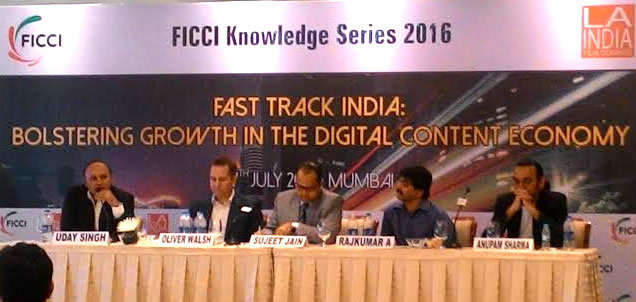
    For the past few years we have hearing that ‘Digital has arrived’. That ‘Digital is the future’ etc. But how has it arrived and more importantly how will it be our future? So, on Wednesday (July 27) some top executives from the India’s motion picture and digital industries concluded that accessibility, affordability, quality content and online content protection will be the key drivers to sustain growth in India’s digital economy.‘Fast Track India: Bolstering Growth in the Digital Content Economy’, a knowledge series forum by the Federation of Indian Chambers of Commerce (FICCI) in association with the Los Angeles India Film Council (LAIFC), assessed the extent to which screen content acts as a key driver of the digital economy in India. The industry experts assessed the current regulatory and infrastructural challenges, reviewed future growth trends and underlined innovative ways of monetising digital content to stimulate growth in India’s digital economy.


    Noted filmmaker and Co-Chairman, FICCI, Entertainment division, Ramesh Sippy started the conference by highlighting the fact that increased connectivity, technological innovation and new content delivery platforms all combine to increase growth. He said that government’s role is pivotal to enabling legitimate content delivery platforms to protect and monetise their content in order to achieve their full potential in a rapid changing marketplace. Digital India has the potential to create opportunities for businesses, promote innovation and create jobs. However online content theft, varying levels of broadband access and affordability in terms of data tariffs continue to present challenges for providers to deliver value to consumers. These factors will have a significant impact on how digital media evolves in the future.


    Girish Menon, Director, Transaction Services, KPMG India moderated as well as introduced the first panel discussion. The first panel ‘Making Sense of the Economics of Digital Media’ featured a keynote presentation by KPMG. Menon said, “The advent of the OTT services and on-the-go content aided with competitive tariffs and falling average retail price of smartphones has helped to drive video consumption in India. However, profitability still continues to be a major challenge coupled with infrastructure and affordability of data tariffs and payments models. It is imperative for the OTT players to address these concerns through innovative means to achieve the medium’s full potential.” Speaking about the future of OTT content services, Ajay Chacko Co-Founder and CEO, Arre said, “As in the case of broadcast TV in India, the relatively infant digital content economy is showing signs of secular, organic growth driven by an increasingly young India. We already have more than 120 million consumers of digital content. As with every paradigm shift, audience shifts will be followed by a shift in advertiser preferences and finally consumer monetisation. So I am quite hopeful that the digital content economy will see the exponential growth that has been witnessed in the 2000-2010 decade in TV, in the next three to five years.” While film producer Vishesh Bhatt, expressed his concern about serious content makers still not understanding the digital ecosystem. However, Karan Bedi, COO, Eros Digital, was optimistic about the future and gave the example of Pokemon Go, about how the game has caught the attention of the consumers. He said: if consumers are compelled by content, they will eventually pay for subscription as well.  Said Archana Anand, Business Head, dittoTV: “In light of the accelerated digital media consumption across the country, it is wonderful that FICCI and the LA India Film Council provides this much needed platform to discuss the market potential of this space and the innovations and challenges thereof.”


    Moving on from the concerns about monetising digital content, the other looming concern is around the rules and regulations of the digital media. The second panel discussion on ‘Regulatory and Infrastructural Challenges for Digital Media’, Abhishek Joshi, Head, Marketing and Analytics, Digital Business, Sony Pictures Networks India Pvt Ltd. said “The OTT industry has graduated from the innovators stage to the early adopters stage within the innovation diffusion curve, based on distinguished product strategies by players in the market. However to cross the chasm to gain the majority market, policy makers will have to play a very big role. Infrastructure and regulatory policies are going to be the biggest differentiators for industry growth for the next 18 months.” Akash Banerji, Head, Marketing and Partnerships, VOOT was very hopeful about the future. According to him, even though the industry is still learning, the consumers will be in a demanding position in the future and eventually mobile data will also come down. Siddharth Roy, COO, Hungama.com, stressed on the fact that branded IP (Intellectual Property) will be one of the key drivers of content regulation. But Rajeshree Naik, Co-founder, Ping Networks, had other concerns. She said that it is the collective responsibility of the industry is to see to it that government stays out of digital media regulations. This session was moderated by journalist and author Mayank Shekhar.


    The final panel discussion was on ‘Building a Robust Enforcement Model to Protect Content In a Digital Economy’ and was moderated by Uday Singh, Managing Director, Motion Pictures Association, India Office. Oliver Walsh, Regional Director, Online Content Protection, Motion Picture Association- International(MPA-I) said, “The Indian film and TV industry supports 1.8 million jobs which are at risk because of rising online content theft. The future of legitimate content delivery platforms depends on effective enforcement measures supported by Indian State Governments. The Telangana Intellectual Property Crime Unit (TIPCU) is a great example of a dedicated law enforcement unit to tackle organised online film piracy and will set a gold standard approach to significantly reduce online infringement of films and television shows. I hope it is the first of many such enforcement units across India.” Rajkumar Akella, Honorary Chairman, Governing Council, Anti Video Piracy Cell, Telugu Film Chamber of Commerce said, “As we have been witnessing in recent days, the problem of online piracy is most urgent. The greatest threat now has become the pre – movie release leakages. Without real time interventions from the government and industry, it will go out of control. In this scenario, the latest initiative – TIPCU by the Government of Telangana, the Telugu Film Industry & the Motion Picture Association, India office, is a very significant step in tackling Movie Piracy, particularly Online Piracy. It is a collaborative, dynamic model,where the Government works seamlessly with the Industry and all stakeholders. The unit will be making optimum use of Technology besides policy, enforcement and outreach. This is a step in the right direction to root out piracy in India.” The General Counsel of Viacom 18, Sujeet Jain suggested the formation of digital courts to deal with piracy and protect online content. Anupam Sharma, Director, Film and Casting Temple, Australia was of the opinion that educating the consumers was the first step in stopping illegal downloading of content. He showcased a short video where the cast and crew of his movie are shown to be thanking the audience for not watching pirated videos and acknowledging the fact that the audiences are also a part of the film industry. This video was made to create awareness against video piracy.


    Biren Ghose, Country Head, Technicolor India, in his concluding remarks, said, “Content is assuming new life in the emerging digital economy. Technology enables innovations in imagery that could hitherto neither be produced nor consumed. FICCI and LA India Film Council need to be complimented on encouraging the conversation for the Indian agenda in this space.” Panelists concluded that a combination of government and private initiatives would need to be rolled out to achieve the ambitious goal of a truly Digital India.


  • GroupM wins media mandate of Malaysia Airlines

    By A Correspondent


    GroupM along with Mindshare and m/SIX, has been appointed in Malaysia as the media agency for Malaysia Airlines. Malaysia Airlines is the national flag carrier of Malaysia and a member of the oneworld airline alliance.

     

    GroupM won the account following a competitive pitch, which included the incumbent IPG, Starcom, Havas, and Zenith. The appointment is effective May 1st 2016, and covers Global Channel Planning, Media Buying and Optimization, and Search Engine Marketing and Re-marketing. The entire global digital buying will be done by the Malaysia office.


    The win came on the back of Mindshare and m/SIX pitching a proprietary framework “AIR” to Malaysia Airlines, that provides the client with dynamic audience segmentation and targeting capabilities.


    Girish Menon, CEO of GroupM Malaysia said: “Malaysia Airlines is the most prestigious global Malaysian brand. We are excited to be their business partner. This appointment is a testament of the teams’ understanding of the dynamic consumer journey, and applying the insights through effective use of real time data and technology. With our proprietary planning framework of Adaptive Marketing, the team helped in sharing breakthrough ideas to the client.”


    Grace Chan, Head of Group Branding and Communication, Malaysia Airlines added: “We are excited and looking forward to working with GroupM, who has clearly demonstrated adaptive strategic thinking using their proprietary framework and capabilities. We will be working with the best of the resources from the group as Team MH.”


  • Varun Channa is MD, Mindshare Malaysia

    Varun Channa

    By A Correspondent


    Mindshare APAC, the global media agency network part of WPP, has appointed Varun Channa, to the role of Managing Director, Mindshare Malaysia.  He joins Mindshare after six years with Danone Indonesia, where he helped to turn around their fresh dairy business and developed the roadmap for their Isotonics. Prior to that, he was Marketing Head and part of the start-up team for Danone India and also spent nearly 15 years with JWT India at its flagship Mumbai office working with Unilever and other key clients.


    Gowthaman Ragothaman

    Commenting on the appointment, Gowthaman Ragothaman, COO of Mindshare Asia Pacific, said:  “We are totally delighted to welcome Varun on board, who brings a wealth of experience across industries and markets. This is the beginning of a new chapter in the whole new world of connected media, where content, creativity and consumer data in the Malaysian market is at the centre of all activities and importance. “ Adding on to this, Girish Menon, CEO, GroupM Malaysia said: “With Varun, we have hit upon a fantastic combination – with JWT, he honed his skills in developing communications solutions for some iconic global brands and then as a tech-savvy marketer with Danone in tree different fast-growing, competitive markets, he got his hands dirty developing marketing solutions to deliver strong business results. I believe these are the combination of skills and experiences that our clients increasingly expect from the head of their agency, so I am confident that Varun will lead Mindshare to even greater success!”


    Commenting on his appointment, Mr Channa said: “It’s a pleasure to be part of Mindshare Malaysia in these exciting times when media is playing a even greater role in growing our clients’ business. Seeing the pipeline of innovative digital solutions we have, I look forward to us adding greater value to our clients’ business.” Mr Channa takes over the role from Gerald Wittenberger, who returned to Europe at the end of 2014.