Tag: Girish Agarwal

  • Dainik Bhaskar cites HBR article on marketers returning to traditional media

    By Our Staff


    Questioned often on the efficacy of traditional media vis-à-vis digital and the growing clout of the streaming platforms esp amongst high-spending premium customers, the print media has been dismissed as a medium with diminishing primacy especially amongst younger readers.


    Given this, a recently published article in Harvard Business Review titled ‘Why Marketers Are Returning to Traditional Advertising’ comes as a shot in the arm for print major in the country.


    Some highlights from the article:

    :: Traditional ads are experiencing increased engagement, with the consumer-facing companies leading the shift, with B2C service companies predicting the largest increase in traditional advertising spending (+10.2%), followed by B2C product companies (+4.9%). Companies that earn 100% of their sales through the internet are leading this inflection.


    :: The top five most trusted advertising formats are all traditional, with customers trusting most print advertising (82%) and as a result, marketers can use traditional advertising to build brand credibility and trust with jaded buyers.


    Said Girish Agarwal, Promoter director, DB Corp Ltd: “The Dainik Bhaskar Group has always maintained that Print Media holds the highest trust amongst its readers as a result of higher editorial integrity. The advent of fake news has also taken a toll on the trustworthiness of some of these digital media and as a result advertisers were unable to establish a strong connect with their target audience. The HBR article validates a trend that we had begun witnessing a couple of quarters ago where even new age businesses were looking at Print Media in general and Dainik Bhaskar in particular, for their ad campaigns. Importantly, it validates what we have always believed in – keeping the readers at the centre of all our efforts.”


  • MxM Leadership Series with Girish Agarwaal


    By Pradyuman Maheshwari


    Those who know him would appreciate what a candid conversation with him means. For Girish Agarwaal, Promoter Director of the Dainik Bhaskar Group doesn’t mince words. And is perhaps the Indian newspaper business’s biggest evangelist.


    Over the last few months, Agarwaal and his team of over 10,000 people across the country have been working overtime to undo the damage that the Covid-19-led pandemic caused to the newspaper business. And the proof of the pudding is in the eating: Dainik Bhaskar and Divya Bhaskar has had some blockbuster, jumbo editions in the last few weeks.


    As part of the MxM India Leadership Series interviews, I had a 23-odd-minute chat with Girish Agarwaal, clearly one of the most influential newspaper owners in the country. When you watch the interview – especially his clarion call to advertisers and media agency folk, you know why he’s like few others.


    Watch. Enjoy. Like


  • Das ka Dum with Dr Bhaskar Das: In the service of which boss did your soul feel the bestest – the Jains, Subhash Chandra/ Punit Goenka, Girish Agarwal & now Arnab Goswami?

    Bhaskar Das

    We’ve got Dr Bhaskar Das to do what he’s super at: share his gyaan in his inimitable manner. Presenting The Wizard of Words with Das ka Dum. Week 3, Day 4.

     If you want to access the archives, please go to the Das Ka Dum tab on the website’s top navigation bar..


    Q. You have worked with various media mavens in the last decade. Samir and Vineet Jain, Subhash Chandra and Punit Goenka, Girish Agarwal and now Arnab Goswami. Since you are a spiritual person, please tell us: In the service of which boss did your soul feel the bestest?


    A. Any soul is impervious to external triggers. Besides, there is no duality between two interacting souls. I saw them in me and I was in them. At a cognitive level, all the referred names in your question have enriched me and whatever I am today is due to the cumulative enlightenment they have ushered on me.

    I can imagine the answer won’t satiate your vibrant mind. I can assure you that real correctness is apolitical. My answers come from the core of my heart. They are socio-politico agnostic.

  • Dainik Bhaskar becomes India’s largest circulated multi-edition daily

    By A Correspondent


    There is a sense of jubilation at the offices of Dainik Bhaskar now with the government acknowledging that it is the nation’s largest circulated multi-edition daily. I&B Minister SmritiI rani released the Press in India Report 2016-17 prepared by Registrar of Newspapers of India earlier this month. It names Daink Bhaskar as the country’s largest circulated multi-edition daily.


    Said Girish Agarwal, Director, Dainik Bhaskar Group: “Being crowned the undisputed leader by nation’s apex body is a verdict that could not be more unanimous. This will give impetus to our efforts of delivering cutting edge content for our readers. We value the sheer trust of our readers who wake up every morning to our independent newspaper.”


    Dainik Bhaskar has also been ranked World’s fourth largest circulated daily by WANIFRA in its World Press Trends 2016 report.


    Added Vinay Maheshwari, SVP-Sales and Market Development & Brand Marketing, Dainik Bhaskar Group: “This achievement is a resultant of our reader centric approach followed consistently every day. This is also fuelled by the right mix of content and promotion in adherence with stringent quality management systems”.


  • MRUC appoints six new Board Members

    By A Correspondent


    The Media Research Users Council has announced the changes in its Board post its Annual General Meeting held in Mumbai earlier this month.


    As was reported Ashish Bhasin, Chairman and CEO – South Asia, Dentsu Aegis Network, is the new MRUC Chairman. The new MRUC Board consists of six new members, namely Raj Jain, CEO, Bennett Coleman & Company; Rajiv Varma, CEO, HT Media; Girish Agarwal, Director, DB Corp; Vikram Sakhuja, Group CEO, Madison World; Sandeep Sharma, President, RK Swamy Media Group; and Sameer Satpathy, Chief Executive – Personal Care, ITC.


    Other members of the Board include Inderjeet Singh, Brand Leader – Consumer and Market Knowledge, Procter & Gamble India;  Pratap Pawar, Chairman, Sakaal Media Group;  Ravindra Kumar, Editor and Managing Director, The Statesman; Satvir S Kataria, President, Marketing, Hari Bhoomi; Siddharth Kothari, Director, Rajasthan Patrika, Kartik Sharma, Managing Director, South Asia, Maxus; Anupriya Acharya, CEO,  Publicis Media India; NP Sathyamurthy, Executive Director, DDB Mudra Group and President, OMD Max; Shashi Sinha, CEO, IPG Media Brands; Rohit Gupta, President, Sony Pictures Network India, I Venkat, Director, Eenadu, Shailesh Gupta, Director, Jagran Prakashan; Punit Misra, CEO – Domestic Broadcast,  Zee Entertainment Enterprises; and Rajeev Singh, Member (Finance), Prasar Bharti.


    Commenting on his appointment as an MRUC Board Member, Vikram Sakhuja said, “It is a privilege to serve on the MRUC Board. In an era of burgeoning multiple media, the need to have a single credible media baseline is important. It is also critical to have a good fix on print readership to support and give confidence to one of the few markets where print continues to grow. The IRS has played this role all these years, and is now coming back after a gap. Inevitably there will be some gainers and losers. The challenge lies in holding all constituents together in this cause irrespective of how they fare. I see an opportunity in building robustness of data by collating both readership and circulation data under the aegis of RSCI.”


    On being elected as a Board Member, Girish Agarwal, said, “I am very excited to join the MRUC Board as I strongly believe that this is the most opportune time for the industry to provide relevant data to the stakeholders. MRUC has contributed a lot for the industry. In the given changed scenario, under the leadership of a new chairman, the high energy board will certainly do a lot going forward in terms of helping the stakeholders get the required and much awaited knowledge and information from research.”


    Added Sameer Satpathy: “The Indian media industry is witnessing a radical change in the way it is consumed. In an always-on social world, media and marketing research is set to become more dynamic. I am happy to be a part of the MRUC Governing Board and look forward to working closely with the Board to help create a robust research framework,”


    Said Sandeep Sharma commented on his appointment: “MRUC is a premier industry body and I am happy to be part of the Board. I look forward to encouraging multi-media research measuring “efficacy and impact” to aid better ROI driven decisions by the industry. Secondly MRUC should leverage new age media and technology to enhance the research process and offer new research products incorporating real time data.”


  • Print still rules in India, despite TV & Digital


    By A Correspondent


    In a show of strength, captains of the print media and members of the advertising and marketing sectors have got together to evangelise the print media.


    Their view: Yes, television exists and digital is growing rapidly, but print is growing fast too.

    Gathered in a central Mumbai hotel, under the aegis of the Audiot Bureau of Circulations, a near-70-year-old organisation that certifies circulation figures of member publications twice a year. The trend of certified circulation figures by ABC show that the print medium (member publications of ABC) is thriving, growing and expanding in India inspite of stiff competition from all other mediums namely, Television, Radio and Digital, notes the ABC.


    As on date, ABC certifies 910 Daily and Weekly Newspapers, 57 Magazines and Annuals. Other members of the ABC include media and ad agencies, print media advertisers, government organisations and the DAVP. The total number of ABC members is 967.


    Few reasons why print publications are growing in circulation:-

    :: Impact of education – Growth in literacy and education have created substantial 
headroom for growth of newspapers.

    :: Advantage of India’s Economic growth – It is believed that the growth of newspapers in India is directly related to urbanisation leading to higher aspirations, heightened interest in buying assets etc.

    :: Reading newspaper a part of daily routine combines well with ease of reading at your own time.

    :: Easily accessible and available at home – newspapers are home delivered in India, unlike in the West

    :: Competitive pricing – newspapers are the cheapest source of news.

    ::Customised sections and pull outs cater to various segments of readers together 
with localized content.

    :: Power of the written word – Newspapers have continued their strong traditions over the years to provide accurate and reliable news to their readers.


    As compared to the world print market, India is one of the brightest spots in the print media: India one of the few countries where print advertising revenue is growing,India’s paid-for daily circulation is growing whilst most other countries are declining, Number of paid-for titles in India highest in the world and growing while number of titles in other countries declining


    Print is growing at an incredible 4.87% increase in CAGR over a 10-year period. As many as 2.37 crore copies were added in the last 10 years accompanied by an increase of 251 publishing centres. Largely regional language newspapers have contributed to the growth, we were informed.


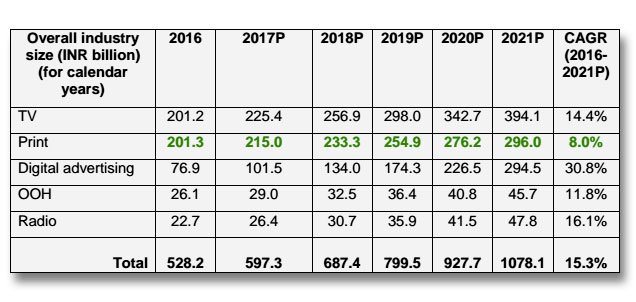
    Leading the presentation made by ABC was Shashi Sinha, CEO, IPG Mediabrands, India. While highlighting the above along with Girish Agarwal, Director, Dainik Bhaskar group, he quoted KPMG India figures to show that in terms of advertising revenues, print is thriving (see table above).


    Print is Growing Presentation

  • Dainik Bhaskar is largest circulated daily, as per RNI report

    By A Correspondent


    DB Corp Limited (DBCL), publishers of Dainik Bhaskar, Divya Bhaskar, Divya Marathi and Saurashtra Samachar, have announced that Dainik Bhaskar it is the largest circulated multi-edition daily in India. This was shared by Venkaiah Naidu, Minister for Information and Broadcasting, Government of India while releasing the Press In India Report 2015-16 prepared by Registrar of Newspapers of India (RNI).


    This year Dainik Bhaskar was ranked world’s fourth largest circulated daily by WAN-IFRA in its World Press Trends 2016 report, notes a communiqué, adding: “Audit Bureau of Circulation, in its latest audit report of Jan-Jun 2016, has also ranked Dainik Bhaskar as India’s largest circulated daily.”


    Girish Agarwal

    Following this development, Girish Agarwal, Director, Dainik Bhaskar Group said “This is truly a great moment for us. All our hard work and sincere efforts has culminated into this recognition and in being crowned the undisputed leader by RNI


    We are excited about the future and look forward to working even harder towards our mission of being a key partner and enabler of India’s socio-economic transformation.” Added Vinay Maheshwari, SVP-Sales and Market Development & Brand Marketing, Dainik Bhaskar said “This achievement is a resultant of our reader-centric approach which forms the core of our editorial and operational philosophy. We are very excited and understand that as a team we need to bring even more efforts to live up to this acknowledgement. This also speaks of our endeavours to constantly bring the best quality content, create the right kind of product and promotion mix for our associates, all the while ensuring total adherence to stringent quality management systems”.


  • Dainik Bhaskar joins Tata Steel, Ranbaxy to hire UK firm to attend to whistleblowers

    By Sachin Dave


    Indian companies are increasingly roping in specialists to manage their whistle-blowing mechanisms at a time when employees don’t hesitate to vent out their frustrations on social networking sites or to rush to regulators in case of a suspected fraud or an irregularity.


    While the Companies Act makes it mandatory for the listed firms to have a whistle-blowing mechanism, some companies such as Tata Steel, Ranbaxy Laboratories and DB Corp have gone a step ahead to hire the UK-based InTouch MCS to attend their whistle blowers through a specialised BPO facility in Bengaluru.


    “As Indian companies aspire to go global, whistle blowing is something they cannot afford to ignore. While setting up call centres inside the company do work, but it’s not as effective and a whistle blower may not always get the confidence to report to them, on a fear of being identified,” said John Wilson, managing director at In-Touch, which has set up independent whistle-blowing mechanisms for about 15 Indian firms.


    InTouch has 40 people working at its Bangalore facility to deal with whistle blowers who either call on the hotline or mail them. These complaints are then forwarded to the concerned to the senior official in the company who may or may not investigate the matter. InTouch has tied up with Ernst and Young recently where the latter could take up the investigation in the frauds in case the company wants them to do so.


    Girish Agarwal

    “We wanted to boost employee confidence, so we decided to include a multi-channel option for whistle blowers. The employees were provided with several options, which range across a 24×7 hotline, website reporting and email,” said Girish Agarwal, director at DB Group.


    According to industry insiders, hiring is the toughest part for the specialists as convincing the whistleblower to share all the details may not be easy. Psychiatrists and trained councillors are in demand to handle nervous whistle blowers.


    Industry trackers say that often Indian companies have been looking to just “tick the box” by setting up whistle blowing mechanisms in house. Insiders say that many Indian companies tend to get worried about the whistleblowers and often don’t want the allegations to backfire on the company.


    “Often Indian companies are worried that if a proper whistle blowing mechanism is set up it can backfire on them. However, the risk of having none is worse, as the whistleblowers can then go to regulators or take it to the social networking platforms,” said a senior official who is currently investigating a whistle blowing case in a multinational based in India. In the case, initiated after a whistle blower had shot emails alleging fraud, the investigations are now being carried out by one of the big four audit firms, the person said.


    Globally, independent whistleblowing firms get about 2.4 complaints per 1,000 employees. While 50% of the total complaints are made on phone, the remaining are made through email and a miniscule 5% through post.


    “It is tough to say how many of the concerns raised by the whistle blowers are genuine. But companies tend to investigate the more serious ones, especially around sexual harassment and fraud or bribery allegations,” said Arpinder Singh, partner and national leader, fraud investigation & dispute services (FIDS), EY India.


    Research says that about 60% of the whistle-blowing complaints are about HR issues like sexual harassment and about 10% are about corporate governance issues. Going ahead, it is expected that even Sebi may have to set up a whistleblowing mechanism.


    Source:The Economic Times

    Copyright © 2015, Bennett, Coleman & Co. Ltd.

    All Rights Reserved, Licensed to republish


  • Ogilvy to handle creative communications for Brand Bhaskar

    By A Correspondent


    Dainik Bhaskar has awarded Ogilvy the creative duties for its brand Dainik Bhaskar. With a single state presence till the year 1997, the brand has aggressively expanded its footprint across 14 states in India since then; the most recent launch being in the state of Bihar in January 2014. Today, Brand Bhaskar is a leader in print readership operating in the highest growth markets in India, being an integral part of daily lives of 19.8 million readers.


    As the new partner, the creative agency will be responsible for all creative communications which will be rolled out under the brand. Ogilvy will focus significantly on building strategic pillars for the brand’s communication and articulating it’s positioning to Brand Bhaskar’s relevant audiences across the country.


    Girish Agarwal

    On aligning with Ogilvy as the brand’s creative partner, Girish Agarwal, Director, Dainik Bhaskar commented “Brand Bhaskar has come a long way and we constantly ask ourselves ‘what next and where do we take the organisation and the brand’. We welcome Ogilvy on board as they bring with them their expertise and strong repute of building sustainable brands. The Bhaskar way of journalism has always believed in ‘kendra  mein pathak – putting the reader first’ and is highly trusted for its unbiased, objective coverage. As our partners the Ogilvy team plays an immensely significant role in integrating our values and philosophy in their creative approach that will resonate with our audiences in a way that they continue to take pride in associating with the Bhaskar Brand.”


  • Say Cheers! Madison predicts 16.8% adspend growth in 2014


    By Johnson Napier


    With so much being reported and analysed about how the oncoming Lok Sabha elections would benefit or harm the prospects of the economy, there is one section of the trade for whom the election year indeed holds good stead. Going by the growth projections that the election season are expected to bring in 2014, the media advertising business in India is in for a big surprise if numbers revealed in a recent report are anything to go by.


    According to growth projections released by the Pitch Madison Media Advertising Outlook 2014 report in Mumbai yesterday, the advertising revenues are expected to grow by a robust 16.8 per cent in 2014 at Rs 37,216 crores. This is a sharp rise from the healthy 11.1 per cent that was reported by the industry in 2013. In fact the growth in 2013 is much more then the benchmarked figure of 7.4 per cent that was initially predicted by the report.


    Presenting the numbers to the fraternity in Mumbai, Sam Balsara, Chairman and Managing Director, of leading media services conglomerate Madison World said that the time to be cautious – which was the state that the industry was in for much of 2013 – was almost over and that the year ahead would be even more fulfilling with growth projected in the range of 16.8 per cent.  The report was presented by Madison World in conjunction with the exchange4media group’s Pitch magazine.


    “It is great to be clocking a growth rate in double digits, which has come as a boon to the industry that was stuck in clouds of uncertainty given the economic downturn that was witnessed for much of last year,” affirmed Mr Balsara. “Compared to 2012 that registered revenues to the tune of Rs 28,694 crore, the year 2013 reported numbers equalling Rs 31,877 crore, growing by 11.1 per cent. In fact 2014 would outperform the previous year and would register an estimated growth of 16.8 per cent, with revenues totalling Rs 37,216 crore,” said Mr Balsara, beaming.


    According to Mr Balsara, the core factor that would bring in the growth for the industry would be the Lok Sabha and the state Assembly elections scheduled for 2014. This would also include spendings by individual political candidates that would be investing money in reaching out to the masses.


    Presenting a medium-wise break-up to the gathering, Mr Balsara said that like last year, this year too belonged to Print that emerged as the numero uno medium. Advertisers took a liking to the medium as it reported a growth of 10 per cent with revenues equalling Rs 13,167 crore. This was largely due to increased advertising by sectors such as FMCG that contributed by 12.3 per cent to the overall ad pie (replacing Auto from the top spot) and Auto that contributed around 11.7 per cent. Education though saw a decline to 9.71 per cent versus 10.6 per cent share registered last year.


    When asked by MxMIndia to share his observations on the projections for the medium of Print, Varghese Chandy, Chief General Manager, Marketing, Advertising Sales, Malayala Manorama said that the growth was indeed a bullish one for the sector. “I am excited by the numbers that we have managed to throw up as a medium. The fact that we have still got the advertisers attention by being the number one medium of choice is a big thing.” Sharing further on what will drive the sector in 2014, he said that the Lok Sabha elections and the assembly elections that will take place in 2014 will bring in the necessary revenue growth that the medium is known for. But he had a word of caution for the magazine sector as he said that it would still be a task for magazines to contribute as much growth as newspapers too. “While niche and regional magazines will continue to deliver good growth, overall the magazine industry will still be challenged on the growth front.”


    Following the medium print closely was Television that recorded a growth of 8.2 per cent with revenues totalling Rs 12,410 crores. This was in sharp contrast to 2012 where the medium registered a zero per cent growth. Where sectoral contribution was concerned, Media, Retail, Alcoholic Beverages and Corporates registered a negative growth with only FMCG registering a positive growth for the medium. The medium is further expected to grow by 15 per cent in 2014.


    The next medium to vow the advertisers was Digital that has now become the third-most preferred medium for advertisers on a consistent basis. With revenues totalling Rs 3,050 crore the medium grew by a good 32.4 per cent and is expected to grow by 29.5 per cent in 2014 as well. Of this, display advertising will continue to have an upper hand compared to search with revenue numbers totalling to Rs 2,150 crore.


    Siddhartha Mukherjee, Category Director, Chocolate and Media, Cadbury India, Mondelez International was optimistic of the returns that the medium would deliver in 2014. Affirming to this writer, he said, “Going by the projections that were presented today and by the points bought up by panellists, there is no doubt that digital will continue to remain a go-to medium for many advertisers. That is what would be of importance to us too.”


    The mediums of Radio, Outdoor and Cinema combined accounted for the remainder 12-13 per cent of the ad chart with Radio accounting for revenues totalling Rs 1,097 crore (18 per cent growth), Outdoor clocking a growth of 6.2 per cent at Rs 1,977 crore and Cinema registering a growth of 10.4 per cent at Rs 167 crore.


    The evening also witnessed keynote addresses being delivered by dignitaries including Adi Godrej, Chairman of the Godrej Group, Uday Shankar, CEO of Star India, and Girish Agarwal, Director, Dainik Bhaskar Group who presented a roadmap that the industry could adopt to change their business fortunes and also derive positive growth for the several mediums under Media.


  • What M&E wants from this year’s Budget


    By Ananya Saha and Meghna Sharma


    Girish Agarwal, Promoter Director, DB Corp Ltd

    Fundamental need of the hour is to boost the economy, which is essential for growth of M&E. The following steps are expected for sustained economic growth:

    • The budget should send a clear message of “Stability, credibility and long-term vision for reforms”.
    • Government revenues should increase without hurting growth while strict control on expenditure (especially non-plan) is expected from the budget.
    • Clear roadmap for reforms/key bills viz.: Companies Bill, Mining, GST, DTC, Insurance, land acquisition etc. is expected.
    • With rise in inflation and reduced earnings, savings have substantially gone down over the past 2-3 years. Appropriate tax breaks would boost savings.


    The above basic steps should result in fresh and long term investments from domestic as well as international markets. Old policies for governing M&E sector must be revisited and reworked considering current business scenario. Policies should be framed in such a fashion that decisions at Govt. level are smooth and fast.


    For Radio industry, we expect Govt. to roll out old pending 3rd phase of auction, immediately with clear transparent bidding process. We expect the 3rd phase license with larger period validity and also extension of time period to 15 years, for players related to 2nd phase of bidding. Prior to the same, we expect Govt. to address music royalty issue along with long pending demand of radio players of relay of news bulletins in FM radio. Further, renewal of 2nd phase of license, after expiry of its period, needs to be worked out in an acceptable and reasonable valuation, in order to ensure adequate return on investment for all radio players.


    T Gangadhar, Managing Director, India, MEC

    It is important for the government to create policies that stimulate taxes and widen the tax base, not necessarily by lowering the taxes. It is important that in current economic situation, to raise consumer sentiment. We have been hearing of uniform GST, which has not been undertaken yet. Also, it is important to lower interest rates.



    Rakesh Jariwala, Partner, Tax and Regulatory Advisory Services, Ernst & Young

    In the Direct tax category:

    • Reintroduce erstwhile benefit available under Section 80-IB of the Income-tax Act, 1961 – profit linked deduction for multiplexes to boost their growth for tier 2 and tier 3 cities
    • Introduce alternate mechanism or a monetary threshold for obtaining income-tax clearance for foreign performers, entertainers, etc before departing from India as the procedure is time consuming and onerous
    • Introduce incentives for content creation and infrastructure to encourage the Indian film industry
    • Currently, there is uncertainty with respect to income attributable to India in case of Foreign Telecasting Companies (‘FTCs’). Guidance should be provided by way of specific provisions for determining taxable income of FTCs.


    Indirect tax:

    • Provide exemption from service tax on costs of film making in line with the exemption provided on temporary transfer of copyright in cinematograph films
    • Reinstate the exemption on service tax on services provided by digital cinema service distributors in a digitized encrypted format transmitted directly to a cinema theatre for exhibition – this exemption was withdrawn with the introduction of the negative list based service tax legislation
    • Clarify that service tax is not attracted in case of post production services provided in respect of content temporarily imported into India for the purpose of re-export
    • Exempt from service tax, services rendered by players and coaches to private sports leagues / bodies in line with the exemption provided for services to recognised sports leagues / bodies
    • Subsume entertainment tax in the proposed Goods and Services Tax legislation without creating a window for its levy at the local or state level to ensure simplicity in the tax structure


    M&E industry is expected to outgrow the Indian economy with an expected cumulative annual growth rate of around 15% over the next four years. To keep up the momentum, the industry deserves tax incentives in the upcoming Finance Bill, 2013 thereby providing an impetus to the industry and bolstering growth.


    Budget 2012 was a bag of mixed beans and a budget wherein the M&E industry was not given its share of adequate encouragement. Key highlights are cited below:

    Incentives:

    Indirect tax

    • Exemption of service tax on temporary transfer of copyrights in cinematograph films
    • Inclusion of admission to entertainment events and amusement parks in negative list of taxable services
    • In addition to the print sector, advertisements in media (except radio and television) including the internet or in outdoor media shall not be liable to service tax
    • Services provided in capacity of referee, umpire, coach or manager to recognised sports body for participating in tournaments shall not be liable to service tax


    Dampeners for M&E industry:

    Direct tax

    • Retrospective amendment to the definition of royalty thereby characterising payments for use of computer software, transponder, information databases, uplinking facilities, leased lines, etc as royalty under domestic tax laws. Hence, impacting the use of digital media
    • Tax rate of non-resident sports persons and sports associations increased from 10% to 20%


    Indirect tax

    • Levy of service tax on costs on film-making
    • Withdrawal of exemption of service tax on digital distribution of films tantamounting to the levy of service tax on such services
    • Levy of service tax on services provided by players and coaches to private sports leagues / bodies


    Tarun Katial, CEO, Reliance Broadcast Network

    For the broadcasting industries of radio and television we look forward to clarity, uniformity and relief from taxes. Advertisement in free to air mediums like radio should be treated differently and lower or nil service tax should apply for the same, aligning with the print and out of home industries. Also, FDI in non-news radio operations needs to be brought at par with television broadcasting. Customs duty on radio and television broadcast equipment should also be relaxed.
     

    The TV Broadcast and Distribution industry is already reaping benefits from the success of the digitization initiated by the Government. We look forward to necessary fiscal incentives in the form removal/ reduction of multiple taxes and levies and regulations which ensure transparency and power of choice to the end customer.


    Sandeep Ladda, Executive Director/Partner and National Leader – Entertainment & Media – Tax and Regulatory, PwC

    On the direct tax front, we could look at the following key areas:

    • Clarification on the applicability of withholding tax provisions on discount offered by DTH operators for selling recharge coupons through subscribers to third parties and on payments made by TV channel companies to uplinking companies
    • Providing a clarification stating that benefits of carry forward and set off of unabsorbed losses in amalgamation or demerger etc. also available to service sector companies
    • Proposal to sign more Co-production treaties, to get the tax credits and subsidy benefits
    • To provide a 10-year tax holiday to exports in the gaming, animation and the VFX (visual effects) industry for Indian content development, as they are emerging sectors (whether or not these are set up in an SEZ)


    Key expectations on the indirect tax front include:

    • To promote the domestic gaming industry, excise duty on local manufacture of gaming content could be brought down to 0%
    • Service tax applicability to the DTH industry could be eased for a limited period till the phased implementation of digitization is complete
    • Copyright services could be excluded from service tax net to avoid dual levy of service tax and VAT
    • Multiplex operators could be exempted from levy of service tax on property rentals and to distributors for exploitation of cinematographic rights, till GST is introduced to result in a seamless pass through of these indirect taxes


    The industry has been growing at a pace of around 17 percent YoY and is expected to maintain the momentum. The recent liberalization of foreign investment norms for a majority of broadcasting carriage segments and the radio phase III roll out will surely provide a fillip to the entertainment and media sector. Similar liberalization measures could be extended to the remaining broadcasting carriage segments like local cable operators. Also, the Phase III rollout could be implemented early for the industry to reap in the allied benefits flowing from the same.


    There were a few positive steps seen in the 2012 budget such as eligibility of investment linked deduction to hotel owners even if operations are carried out by third parties and service tax exemption on temporary transfer of copyright in cinematographic films. However, on the whole, budget of 2012 left a lot to be desired:

    • Retrospective amendments to widen the scope of royalty by including payments for transmission by satellite cable, optic fibre etc. as royalty were not expected. The relative standing of some of these retrospective amendments vis a vis India’s tax treaties has also been questioned by recent tax tribunal decisions. This has only added to existing confusion surrounding such royalty payments.
    • The budget also introduced provisions casting obligations on a non resident having no presence in India to withhold tax on any payments being made to a non resident of income accruing in India. This measure has impacted some of the India content broadcasting transactions happening between non resident parties.
    • Tax rates in case of non-resident, non-citizen sportspersons, non resident sports associations were increased from 10 percent to 20 percent on gross basis. Similarly, non resident entertainers were also brought under the tax net @ 20 percent on gross basis. Both these measures were burdensome.


    Sunil Lulla, Managing Director and CEO, Times Television Network

    The burden on the growing service sector needs to be reduced, so it may accelerate India’s growth. In prior years, in recent times, we have not seen anything progressive as such via the budget. Investment norms in some parts of the sector have already changed, for encouraging investment. The industry has been asking for lower duties on STBs so that digitization can progress and benefit millions of consumers. This is vital. As for the last year, the economy has been slow, sluggish and behind expectations – 2012 has been a disaster!


    Responses are in alphabetical order by surname.


  • @FF12: Day 3: Industry expects thoughts to lead to pertinent actions

    By A Correspondent


    The last day of FICCI Frames 2012 was an eventful day — insightful sessions, a lot of networking, sharing of ideas, deals being cracked — and amongst all of this, the highlight was the session on Women in Media and Entertainment.


    The day started off with a keynote presentation by Ashok Chawla, Chairman, Competition Commission of India (CCI). He said that the media and entertainment (M&E) industry was one of the fastest growing sectors inIndiawith an expected CAGR of 14-15 per cent. He then proceeded to outline the role of the CCI and its importance: “CCI is an overall market regulator whose objective is to ensure that market forces operate with transparency and fair play. It has been put in place to identify the boundaries of behaviour of the industry.


    Mr Chawla opined that self-regulation was of prime importance to avoid infringement of law or market practices and cautioned industry players that consumers should be given primary importance.


    Taking on the Digital threat

    The next session was on “Sustaining Long-term Newspaper Loyalty” by two biggies — N Ram, former Editor-in-Chief, The Hindu and Girish Agarwal, Director, Dainik Bhaskar Group, who shared their views on the future prospects of the newspaper industry.


    Mr N Ram started off his speech by stating that there was ‘anxiety and gloom’ over the fact that journalism was seeing a meltdown in the mature markets. He outlined two media world phenomenon next, where the less developed countries are witnessing increase in circulation of newspapers unlike the mature market. But he added a word of caution when he said that TV, even in the developing world, is going through a crisis which it has so far covered by showing entertainment as part of news. Inspite of this, Mr Ram was optimistic that the medium term prospects for the media industry are looking good.


    As is been spoken widely about, the key factor for the decline in the newspaper is the increasing popularity of the digital media. Mr Ram called this the Digital Age Paradox and added that in recent times the newspapers have seen an increase in the readership of their online editions but have witnessed a “double squeeze” on their revenue, as they have had to subsidise digital journalism, which in turn is cannibalising their circulation.


    On how to sustain loyal readers, he tipped, “Stick to the basic principles of journalism – they can build a relationship with the readers, which it can rent out to the advertisers. And most important – “newspapering” should not be reduced to consumer marketing of news.”


    Mr Girish Agarwal took the stage next. Contrary to Mr Ram’s belief, he said that Indian newspapers are growing in their circulation and readership. He spoke about the need to engage the ‘consumer’ by asking “How relevant are we (newspapers) to the reader?”


    He opined that a newspaper cannot rest on its past glory but should move ahead by acknowledging and understanding what the consumer wants and giving him what they think he needs. On how to keep pace with changing times, Mr Agarwal said that newspapers should have global vision and hyper local content.


    After the speeches the floor was opened to the audience who questioned Mr Ram and Mr Agarwal about threat perception of the culture of medianet and media houses being bought over by MNCs. Mr Ram denounced paid news as a rogue practice which has been rubbished by the Press Council. Mr Agarwal said that ethically media should report anything that may be perceived as defaming by the parent company but the ground reality is not always so rosy.


    Women to the fore

    A big highlight of Day 3 was a session titled   ‘Women in Media & Entertainment circa 2012: Leading from the front’.

    The panel members of this session were Vidya Balan, Actor; Anurradha Prasad, Managing Director, BAG Films; Jeni Tosi, CEO, Film Victoria; Ekta Kapoor, Creative Director, Balaji Telefilms; Barkha Dutt, Group Managing Editor, NDTV; and Usha Uthup, Singer. The session was moderated by Rajeev Masand, Entertainment Editor, CNN-IBN.


    This session discussed the journey of each of the above eminent women personalities and the challenges they faced during their journey. As the moderator, Rajeev Masand put it: “Traditional media, for long, was dominated by men, but not any longer. It’s become outdated.”


    All the eminent women personalities claimed that despite all their challenges they had an incredible journey and the results have been fruitful.  Ms Tosi observed that there would always be obstacles in a woman’s journey but, at the same she also admitted that at times a little bit of luck and timing also plays a part in one’s success nevertheless, she must also be hard working and committed to succeed.

    According to Ms Dutt, the real heroes are the women who came before them i.e. those who made a mark and their presence felt in the male dominated industry.


    One of the topics discussed at the session was whether ambition for men meant one thing and another for women, and how society reacts to ambitious women. Ms Ekta Kapoor agreed that ambition for men is a virtue, but for women it is seen as something negative. “I never took being a woman as a disadvantage. Today I am successful not in spite of being a woman but, because I am a woman,” she added.


    Ms Prasad said: “Today women have become mature, and so have their families. Women have to juggle multiple roles. Had I thought that since I am a woman, I cannot take on a task, then I would not have been successful. If you are happy with what you are doing, you will be successful in life.”


    Ms Uthup was of the view that what has really changed is the audience. “The field of Arts has been a level playing field for women. You really don’t have gender bias. I believe if we want change to take place, the people need to be awakened. Men and women must work together, but then there are things that women can do and men can’t and there are things men can and women can’t do.”


    Ms Balan said: “The Indian actress today has been humanized; she is getting to play a part in the story. I have never seen my gender as a disadvantage, all I knew was I had to be strong to move ahead in life. There is a wide variety of roles for women today and the fact that there is no model code for women any more is liberating.”


    While all these eminent women had plenty of inspiring stories to share, each of them have had to overcome their own tough challenges, change the societal mindset about women being weak and docile, to climb their way to the top.


    The road is set for 2013


    In a session which ran parallel to the one on Women in M&E, a panel of regional TV experts got together to discuss growth avenues. Moderated by Nachiket Pantvaidya, Executive Vice-President, Star Pravah and with speakers like K Madhavan, Managing Director, Asianet and Sharada Sunder, EVP – Regional Channels, Zee, the session concluded that “Regional was the new National.” One issue which was discussed in the session was how to attract talent and also how does regional broadcast channels attract youth, the single largest segment inIndia.


    A session on GEC regulation discussed dos and don’ts as far as content is concerned, what is permissible and what not. It included Justice AP Shah, Prof Jonathan Askin, Ashok Nambissan of Sony Entertainment Television and Naresh Chahal of IBF.


    The general feedback from delegates was that Frames 2012 had pertinent topics discussed. One hopes that industry put the many ideas and resolutions discussed to action.