By Shruti Pushkarna
 Growing up in Delhi, I never really encountered a child with a disability in my locality or school. The only exposure I had to someone with an impairment was via fictional characters in films and television series. One of them was Dhritrashtra from the Mahabharat. In him I saw a mix of helplessness, greed, envy and frustration. I didn’t see him capable of altering the storyline or making big decisions despite being the ruler of Hastinapur, the disputed kingdom. As I grew older, I encountered disabled people begging on the streets, blind singers in buses and trains accepting small change in return. I assumed all disabled people were poor. My view slowly evolved as I saw and read about achievers who overcame their disability through good education and hard work. But the overall picture was dominated by the prevalent stereotype of dependency, barring a few heroic accounts.
After working in the disability sector, I realised how ill-conceived and limited those notions were. There are several factors responsible for the near invisibility of persons with disabilities from the mainstream. While their absence is a reason for our inability to conceive their reality, the portrayal of disability in the media hasn’t helped much. By media, I mean radio, print, TV, advertising and films.
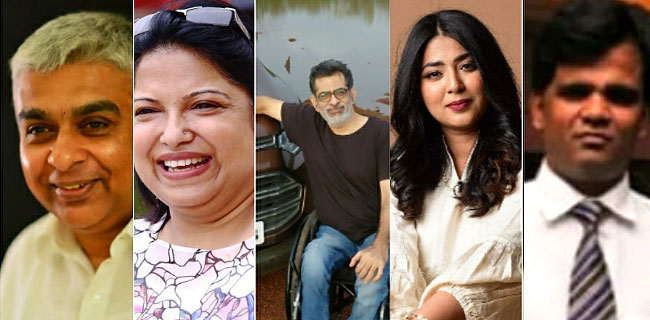
I spoke to a few people employed in different capacities, living with a certain type of disability, to share their views on the subject. Here’s what they thought of the representation of disability in the media and the changes they would like to see.
George Abraham- CEO, Score Foundation; Founding Chairman of World Blind Cricket Council (Visually Impaired)

I think it’s time that the media grew out of treating disability as a mere human interest story. They need to see it primarily as a ‘citizen’ story. The coverage needs to move beyond the idea of a vulnerable group, showcasing the disabled as positive stakeholders.
Recently, there was a news report on 150 girls from Miranda College coming together to record books in different languages for visually impaired students. The girls who volunteered must have felt good and would be granted certificates for their effort. But as I see it, when you are educating blind girls, having a library for them should be a given, a basic requirement. It shouldn’t be anything special that needs to be done or written about. In a way, how journalists respond is an extension of how the society behaves.
In the Amitabh Bachchan-starrer Namak Halal, the heroine’s brother was blind. At first, the hero is jealous of him but when he finds out about the blindness, his reaction drastically changes to that of sympathy. This has happened to me personally too, how people behave. On discovering my vision impairment, their dealing drops to another dimension. One could argue that films are a depiction of social realities, and should a filmmaker depart from those realities when portraying people with disabilities.
My personal view is that while you portray reality, you must also make films with disabled characters playing mainstream roles. The other issue is that the moment you portray a blind character, people with vision impairment take it as being a documentary. The community is so starved for exposure that they want to see positive portrayals only. They forget that the blind person is only human. He/she could be evil-minded, like one of the early gurus of Osama bin Laden who was a blind cleric. He was convicted of conspiracy in the 1993 World Trade Center bombing.
There are also villains with one eye or one leg but I feel that’s more to do with the physical grotesqueness of their appearance. But for the viewing public, it has created associations between disability and villainy over the years. Disability is also linked with spirituality, with characters who are shown singing bhajans, spending most of their time engaged in religious activities.
Films have a huge influence on behaviour patterns and that’s why the need for the media to be more aware and responsible.
Dr Anjlee Agarwal- Accessibility, Mobility and WASH Specialist; Founder & Executive Director, Samarthyam (Assisted wheelchair user due to Muscular Dystrophy)

Media tends to look at disability from only one angle. The two earmarked days for them are the Union Budget and the International Day of Persons with Disabilities, focusing on the cuts/ additions in funds or featuring role models. That’s the only time they seek a response from the disabled. Otherwise there is no connect with the different things happening in the country. Although there was some attention given to the disabled during the Covid-19 outbreak, that was perhaps only because disability advocates like me pushed for such coverage.
We hardly see disabled people in films barring a few exceptions like Black, Taare Zameer Par or Margarita with a Straw. The portrayal of people with disabilities in films and television is more like a ‘bechara’ sitting in a wheel chair, preferably an old person. There are 21 disabilities listed in the RPWD Act but it’s only the wheelchair user that might get some attention.
As compared to other vulnerable groups like senior citizens, transgender or homosexuals, people with disabilities are the most invisible. The print media covers some sensational or hyped news items related to disability but there is no consistent reporting. It’s like a flash mob, it’s there and then it’s gone.
There is so much happening in the country. Let’s take the example of Swachh Bharat Abhiyan, no one still realises the need for accessible toilets for 21 crore disabled citizens. These are required for living with safety, dignity and independence. Sanitation and hygiene drives don’t include people with disabilities as potential beneficiaries even after Covid.
A huge campaign like Accessible India launched by the Prime Minister didn’t attract consistent news coverage despite the fact that access audits were conducted rigorously in 2016. On the contrary, the accessibility campaign in the US was driven by the media and that’s one of the reasons for the successful implementation of the American Disability Act. If Accessible India got its due coverage, probably it would have attracted more funding like in the case of Swachch Bharat.
Globally, with the changing times, countries have made progress but in India, people are still struggling for basic needs. In the 21st century, there are so many disabled children who haven’t seen the insides of a school. Instead of fixing the environment and making it conducive, we started fixing the disabled people, limiting their options in education, employment and so on. And this is where the media needs to step in. They need to speak for us and insist on funds and the political will to make services accessible.
Salil Chaturvedi, Writer (Paraplegic)

Rather than seeing a change in a mediaperson’s attitude towards someone with a disability, what I would really like to see is the representation of persons with disability within the media. It would be powerful to see a disabled news anchor or reporter or hear from a radio jockey with a disability. The medium then also becomes part of the message.
An example from my own life is that I worked as an editor of a feature agency more than two decades ago. Since I am a disabled person (using a wheelchair because of a spinal injury sustained in an accident), I made sure that we covered disability issues with fair regularity, and supplied stories on disability to newspapers.
In parallel, it would also help, I feel, to bring in a component of disability in the curriculum of media courses. This could initially be done through guest lectures that involve disabled persons as faculty, while also developing a curriculum in consultation with disability organisations.
I remember that when I played the role of Jugadoo in Galli Galli Sim Sim (the Indian version of Sesame Street), a number of children would come up to me on the Delhi Metro or in a marketplace asking for an autograph. The decision to cast a person on a wheelchair in the show was a strong message that broke stereotypes without too much explaining needed. So, we definitely need more portrayal of persons with disability in a normalised way. Currently, there is always some sort of sensationalising of disability, though things have improved a little (only a little) over the years.
Dr Anubha Mahajan- Founder, Chronic Pain India (Suffers from an invisible disability called Complex Regional Pain Syndrome)

There is a lack of awareness about disability types and issues and an absence of empathy in how the media interacts with the disabled. I have noticed that often stories on disabled heroes are done without an in-depth understanding or an involvement in the cause. It seems like journalists are casually filling an empty slot on their news agenda. Disability accounts are considered sob stories to garner eyeballs. It’s obvious how the impairment is mentioned even before the person’s name or qualification. The community doesn’t need sympathy, we need a fair picture to be put out before the society. Our issues have to be normalised just like any other section of the population.
Talking of films, the 90s cinema portrayed the disabled as an object of ridicule. I had a neighbour with an intellectual impairment and most residents refused to interact with the whole family. Some kids even made fun of that child, forcing the family to keep him confined and hidden from society. There are some serious movies on disability too, but the message is one of despair, rather than optimism.
But recently I have noticed a change. In a new series on Netflix called ‘Mismatched’, there is a character who is a wheelchair user. In an episode, he expresses anger on the absence of an accessible washroom on campus. But just like silly humour, this character is shown to explode with too much aggression. Such depictions can lead to wrong stereotyping, because every disabled person isn’t funny or belligerent. Still, the series is a step forward because there are enough disabled people who can relate to his issues.
Disability activists work with small groups but mass media can bring about a change in mindset at a wider level.
Zamir Dhale, Founder-Director, Society for the Empowerment of the Deafblind (Deaf, blind and speech-impaired)

I had the wonderful opportunity to work on the Bollywood film, Black. I worked as an assistant to Rani Mukerji who played the role of a deafblind child, like Helen Keller. Once the film was released, the general public became aware of challenges that people like us go through on a daily basis. While awareness was a good thing, but because of the portrayal of Rani’s character, some people thought that all deafblind children are wild and need to be tamed with training. Some even seemed afraid and hesitated to communicate with me. They thought I was dangerous and needed to be controlled.
The word deafblind became famous after the film but certain misconceived stereotypes were also created. And those are hard to change. Now, slowly as people get to know me, they understand that I’m different from that Bollywood image and that all deafblind are not the same.
Speaking of general coverage, when I was young, media portrayed us like people from another planet or a unique species. Gradually, things improved and now when mediapersons speak with us, they understand more about the condition. This is a good change. This is how the world starts to listen to our voice, our experience, our opinions. Also, online media today, gives us the freedom to share our views directly with the public. This is also a process of slowly countering the stereotypes.
Shruti Pushkarna heads operations of the New Delhi-based Score Foundation where she works as Director-Programmes & Communications. She is a former journalist (part of the founding team of MxMIndia) who has moved full-time to the social sector. Shruti writes for MxMIndia every other Thursday. Her views here are personal. She can be reached via Twitter at @shrutipushkarna
 By George Abraham