
Tag: Gauri Lankesh

  • India is one of world’s most dangerous places for journalists, says RSF


    By Ranjona Banerji


    Ranjona BanerjiWe are obviously shocked by the latest school shooting in the USA. We cannot believe that the world’s most advanced country is so lax and backward when it comes to gun laws. We are outraged at a culture where school children can buy assault rifles and then shoot each other.

    It barely registers when Shubhash Kumar Mahto is shot at close range when he was coming home after a wedding party.

    Mahto was a journalist who lived and worked in Bihar.

    He investigated the liquor and sand mafias.

    He had received death threats.

    His death is an execution.

    In fact, I would not have known about it if I did not subscribe to Reporters Without Borders.

    The death of one more journalist barely makes the news in India.

    Mahto was not a fancy TV anchor.

    He was a stringer for Hindi newspapers and posted his work on a digital news-sharing platform.

    According to RSF, India is one of the world’s most dangerous places for journalists. Earlier this year, Rohit Kumar Biswal, a photojournalist was killed by an explosive in Odisha.

    https://rsf.org/en/india-journalist-reporting-mafias-shot-dead

    The sad truth is that the divisions within the journalistic community are stronger than anything that binds us. The way we practise journalism, what we think journalism means and is and what we think we must achieve are all at odds with each other.

    This is different from rival media houses competing with each other. The same journalists after all can work for any or all of them. The issue has become starker for us: what does being a journalist mean?

    The murder of journalist Gauri Lankesh, by Hindutva rightwing assassins at her doorstep in 2017, is often discussed. But it is journalists who let her death pass them by. As they will of Biswal and Mahto. The claims of the murderers get precedence over that of their victims. It is perhaps politically inconvenient to take on Hindutva forces. Or financially inconvenient to take on local business interests. All this will take precedence over the deaths.

    I will undoubtedly be schooled now by some all-knowing usually male person, because how can I possibly know something so obvious, how small town and language newspaper owners often use blackmail tactics to make money. And how their reporters are used to do this blackmail. In this copout explanation we see several of our prejudices. That journalists only exist in big cities. That small, local media owners are crooks. That only urban, English-speaking journalists do any actual work.

    I put this to you: anyone who makes money doing business in India has to resort to some crookery. The bigger the business, the more the crookery. Check the biggest loan defaulters. And the owners of India’s largest media houses. Speaking in English and living in a big city does not make you more competent. You only have to watch 30 minutes of primetime English language “debate” television to know that.

    India is falling apart.

    And those who write the first draft of history are being killed while no one cares.

    Or celebrating the collapse.

    On live television.


    Ranjona Banerji is a senior journalist and commentator. She writes on MxMIndia every Tuesday and Friday. Her views here are personal
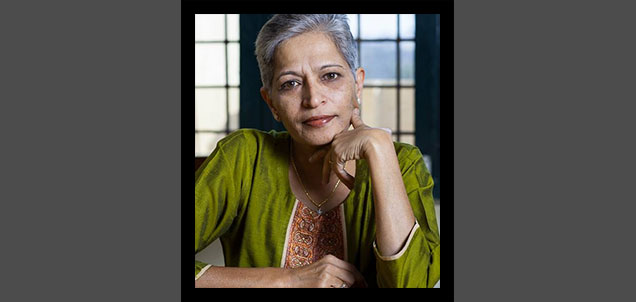
     

  • RIP, Gauri Lankesh


    By Ranjona Banerji


    The murder of senior journalist and activist Gauri Lankesh, 55, sent shock waves through one part of India. And open gloating and mockery through another part of India. This is the “New India” brought upon us by Hindutva forces, after the victory of the Narendra Modi-led BJP in the general elections of May 2014.

    She was shot on the doorstep of her home in Bengaluru, with seven bullets fired at her, all at close range. The similarities with the murder of writer MM Kalburgi in 2015, killed for his anti-Hindutva stance, are chilling.

    Lankesh was an outspoken critic of Hindutva and rightwing forces although she also criticised other political regimes. She lost two defamation cases filed against her by the rightwing, including one by BJP MP Prahlad Joshi and was sentenced to six months in jail in November last year. She was out on bail pending appeal.

    “The right to dissent is being threatened,” she said at the time.

    These are obvious means of harassment by a party preening itself with power, flexing its muscles. A member of the BJP’s IT cell had tweeted at the time of Lankesh’s conviction that he “hopes other journos take note”. That is a threat, whichever way you look at it and sadly, so many of our “neutral” commentators will not until something tragic like this happens.

    News channels discussed the murder last night but as usual allowed rightwing forces to run amuck with their usual whataboutery, defensiveness and the invisibility cloak of “law and order being a state subject”. Some Indian journalists have not fully comprehended the idea of “objectivity” and confuse it with a series of “false equivalences”. Therefore, we never really stand up for our own.

    Is it normal in India for writers, rationalists and journalists to be shot dead while out on their morning walks or in their homes? Is this the “New India” promised to us? Is this not a matter which needs greater study and action than primetime debates where political forces yell at each other?

    Can we continue to deny that there is a growing majoritarian militancy and a force of intolerance of free thought running through society? For how long can you keep pretending that objecting to the BJP government’s policies and to the hatred of the RSS towards religious minorities is not becoming increasingly dangerous?

    This is our country too.


    **


    What happened on social media after news of Lankesh’s murder broke is equally if not more frightening. The online rightwing trolls were out in full force, mocking, gloating and threatening.

    One gentleman on Twitter, followed by the Prime Minister of India, no less, had this to say, in Hindi: “A bitch dies a dog’s death and all the puppies start howling in one voice.” He has since deleted the tweet but it is representative of a mindset. After all, if the head of the BJP’s IT cell sends out a warning to journalists, why should the party’s online army of trolls exercise discretion, compassion or even humanity?

    A few BJP ministers did put out tweets expressing shock and dismay without any qualifications which is very welcome. But alas, other BJP followers – including several rightwing journalists – could not find it in themselves to even pretend to mimic their masters and hold their bile for once. A sad reflection on our times.


    **


    Press Clubs and associations all over India are holding meetings and candlelit vigils in Lankesh’s name. They all urge the Congress-led Karnataka government to act fast – unlike the slow pace of the Kalburgi investigation.

    I quote from the Mumbai Press Club release:

    “If this is how the Fourth Estate is going to be treated by the powers that be, while the government looks the other way, it is indeed a black hour for Indian democracy.”

    Indeed. What else is there to say?


    Ranjona Banerji is a senior journalist and columnist. She is also Consulting Editor, MxMIndia. The views expressed here are her own