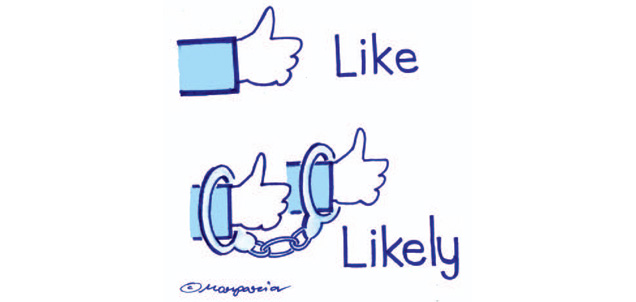
- Cartoonist Hemant Morparia’s take on the controversy. First appeared in Mumbai Mirror. Republished with the permission of the cartoonist
By Ananya Saha
“Everyday thousands of people die. But the world still moves on. Just due to one politician dead. A natural death. Everyone just goes crazy. They should know. We are resilient by force, not by choice. When was the last time did any one show some respect or even 2 mins silence for Shahid Bhagat Singh, Azad, Sukhdev, or any of the people because of whom we r free living Indians. Respect is earned, not given. N definitely not forced. Today, Mumbai shuts down. (sic)”
These are the words, posted as her Facebook status, that got a 21-year-old girl arrested. Not only that, her uncle’s hospital was ransacked in protest. If you cannot say ‘what’s on your mind’ on Facebook, and share with your friends, what good is social media? Well, you could have ‘Liked’ the status, and landed up in jail too. That is what happened to her friend. Both have now completely logged off Facebook. And everybody is left asking, what is wrong with the system?

- Maheshwar Peri
Maheshwar Peri, Chairman, Pathfinder Publishing opined, “It is ridiculous whoever accepted the complaint based on a Facebook status. Social media is all about interaction with my friends and whoever subscribes to or believes in my opinion.” According to him, if the private discourse on internet or otherwise has been intruded upon leads to a police complaint and the police acts on it, it is ridiculous.
The girls were charged with 505 (2) of the IPC and 66 A of the IT Act, arrested and later granted bail. The last few months have seen some interesting places in this regard, whether it is Aseem Trivedi, Karthi Chidambaram or the present case, which only point to the inefficacy of Indian cyberlaw.

- Pavan Duggal
Pavan Duggal, Advocate, Supreme Court of India and President, Cyberlaw Asia, explained, “The entire case has demonstrated the complete inadequacy of the Indian Cyberlaw. The language and scope of provisions used under Section 66A are very wide and are capable of distinctive varied interpretations. Seen from another angle, Section 66A can be effectively used as a tool for gagging legitimate free online speech. The problem under Section 66A is that it comes up with extremely wide parameters which have not been given any specific definition under the law. These parameters are capable of being interpreted in any manner possible, by the law-enforcement agencies. As such, while Section 66A talks about sending any information that is grossly offensive or having menacing character, the law does not give any guidance as to what is grossly offensive or information having menacing character. Thus, it is left to the subjective description of the law-enforcement agencies in this regard. Further Section 66A(b) talks about sending any information by means of a computer resource or a communication device which a person knows to be false, but has been sent for the purposes of causing annoyance, inconvenience, obstruction, insult, injury, criminal intimidation, enmity, hatred or ill-will, persistently by making use of such computer resource or a communication device. All these wide meaning terms used under Section 66A have not been defined, which itself provides huge amount of flexibility in Section 66A to be used in any circumstances perceivable. Thus, huge portions of legitimate free online speech could also be brought within the ambit of Section 66A of the amended Information Technology Act, 2000.”
The present case has once again brought to the forefront as to what is the concept of liking on Facebook and its legal ramifications. Mr Duggal further pointed out that when a person clicks on “Like” button on Facebook, it does not constitute an offence under Section 66A. “Technically speaking, a person is only clicking the button of “Like” but is not per se either sending any information that is grossly offensive or has menacing character. Neither is the said person sending any information which he knows to be false but which has been sent for the purposes of causing annoyance, inconvenience, obstruction, insult, injury, criminal intimidation, enmity, hatred or ill-will. In the present case, Section 66A has been erroneously invoked,” he pointed out.
While Pranesh Prakash, Policy Director at Centre for Internet and Society, maintained that just because something is published ‘online’, it does not mean that it is exempt from law, he added, “The online laws in India are even worse than the laws applied offline and some of those laws that are applied online, are unconstitutional.” The fact that people were posting their views about Mumbai Bandh on various other media, it remarkably shows the unconstitutional application of the applied laws.
“Indian cyberlaw is only aimed to be an enabling legislation for promoting growth of e-commerce, m-commercial and online free speech. Indian cyberlaw should not act as an impediment to the evolution and growth of online free speech, nor should it be seen as a handle to suppress free online speech. Section 66A needs to be serious quickly reviewed and amended so as to ensure that it does not become a tool for silencing genuine legitimate online free speech, under the garb of the parameters detailed therein,” said Mr Duggal.
But that is exactly what it is doing, according to Mr Peri. He said, “If you look at the entire ecosystem we are living in, you have a govt which enjoys control, you have a law which can be misinterpreted, you have law enforcement agencies which are not as free as they are supposed to be and you have a mainstream media which is fearful of the big and mighty. Three of the four pillars of democracy are fearful of repercussion. How can you and I enjoy personal freedom then?”
However, as Mr Duggal explained, certain restrictions have been put online free speech. “For example, the online free speech does not give the license to defame. Similarly, the entire issue pertaining to the Facebook status needs to be examined more carefully. There are various nuances under the Information Technology Act, 2000 which could be applicable,” he said. The present controversial action arose because Section 66A provides parameters for its inherent misuse. There are tremendous loopholes under the existing law. There is a need for ensuring that the Information Technology Act, 2000 needs to be amended in such a manner so as to ensure that the provision like Section 66A of the amended Information Technology Act 2000 are not used to the detriment of online free speech.
Mr Duggal asserted, “In this particular case, it is well possible for the Government to have adopted the route available under the Information Technology Rules, 2011. In this case, Facebook is an intermediary under Section 2(1)(w) of the amended Information Technology Act, 2000 and could be mandated by virtue of direction by the Government under the Information Technology (Intermediary Guidelines) Rules, 2011 to remove such content. Such an action could have been done best in a manner that would have ensured minimal disturbance and yet would have ensured that the relevant language is removed.” However, what we are now seeing on the Internet is that more and more people reproducing the same lines and content that the girls posted.
Section 66A also brings up the huge conflict that it has with the Article 19 of the Constitution of India. Article 19 (1)(a) of the Constitution of India guarantees to all citizens the fundamental rights to freedom of speech and expression. The restrictions given under Article 19(2) are the guiding lights for regulating free speech including online free speech. However, the parameters and restrictions granted under Section 66A are far more broad and wider than Article 19(2) of the Constitution of India. “Seen from another angle, Section 66A appears to be perfect tool to promote and propagate the concept of Internet censorship and censorship of free speech inIndia,” said Mr Duggal.
The complexity of India may make it easy for such assaults on freedom of expression. But the democracy of India is where the solution lies. Is India’s social fabric strong enough?