Conservative media titan Rupert Murdoch is making news again – this time, with a secretive effort to change an irrevocable trust. That trust has important ownership interests in both Fox Corp. and News Corp., so it affects broadcast news as well as The Wall Street Journal and other publications.
Under the current terms of the trust, upon Murdoch’s death, his four oldest children – Lachlan, James, Elisabeth and Prudence – will have “an equal voice” in determining the future of the news empire.
But as The New York Times recently reported, the 93-year-old Murdoch has been trying to alter the trust to ensure his oldest son, Lachlan, stays in charge of his media properties. The legal dispute played out behind closed doors for months, and it might have stayed there if the Times hadn’t obtained a sealed court document shedding light on the conflict.
Murdoch is calling his efforts to change the terms Project Harmony, reportedly out of the belief that doing so would head off any intrafamily wrangling.
The effort to change the trust is so secretive that a spokesperson for the Nevada probate court where the proceedings are occurring stated that all information related to the case is confidential, based on a court order.
As law professors who teach trusts and estates, we are intrigued by the publicity surrounding a somewhat obscure method for holding property. Trusts are private documents that don’t get filed in court unless there’s a dispute.
All about trusts
Trusts are an estate planning technique for giving away property. In our law classes on trusts and estates, we explain how they can be useful for minimising estate taxes, protecting assets, making charitable contributions, avoiding probate and, in certain circumstances, qualifying for government benefits.
Unlike making an outright gift and transferring full ownership to someone else, the donor of a trust – called a “settlor” – transfers legal control of the gifted property into the trust.
The people who hold the legal title to the property in the trust are called “trustees.” They manage the property and make decisions about how and when to distribute funds to the beneficiaries, who are the actual recipients of trust property.
Trustees are fiduciaries, which means they are under strict legal requirements to manage the property in the sole interests of the beneficiaries. If the property in a trust includes shares in a business, then trustees have the power to exercise any voting rights for those shares.
Trusts allow donors to prolong their control over their property by appointing trustees to carry out their objectives after they die or become incapacitated. Trusts are useful when giving away complex business interests that require extensive supervision and sophisticated decision-making, all of which can be administered by trustees according to the settlor’s preferences stated in the trust.
The view from Nevada
In Nevada, where the Murdoch case is playing out, a settlor can’t unilaterally change any trust’s terms unless the trust itself specifically reserves the right to do so. In other words, trusts are presumed to be irrevocable, or irreversible.
But even when a trust is irrevocable, there are still ways to change its terms.
In any state, including Nevada, irrevocable trusts can be altered by court order if the settlor and all beneficiaries agree to the modification. In some cases, trusts can also be modified without court approval through a process known as “trust decanting,” which can be performed by the trustee without the consent of settlors or beneficiaries.
Nevada is unusually permissive in allowing settlors to maintain secrecy about the trust, even with respect to trust beneficiaries. In most states, trust beneficiaries have much broader rights to receive financial information about the trust.
Nevada also explicitly protects confidentiality in trust proceedings by law, even without a court order. Indeed, having reviewed thousands of trust cases from courts around the country, we find Nevada to be especially protective of the donor’s interests. That may be one reason the Murdoch Family Trust is located there.
The stakes of the dispute
The Murdoch Family Trust holds a variety of types of property, including a family farm in Melbourne, Australia; the Murdoch art collection; and shares in Disney, News Corp. and Fox. The property in the trust is managed by a corporate trustee, Cruden Financial Services.
The trust terms at the center of this dispute appear to stem from Murdoch’s 1999 divorce from his second wife, Anna. She negotiated an agreement to ensure that their three joint children – Lachlan, James and Elisabeth – along with Prudence, Murdoch’s daughter from an earlier marriage, would inherit News Corp.
The trust document sets out what will happen to ownership of the media assets upon Murdoch’s death: His voting share will be transferred to the four oldest children. That could lead to a scenario in which the children are fighting over the future of the media assets. Fear of that outcome seems to have motivated Rupert Murdoch to seek this change to the trust.
Although Lachlan is now the chair of News Corp. and executive chair and CEO of Fox Corporation, the children have already aired some of their disagreements over the political direction of the media companies. For example, James and his wife have criticized Fox’s move to the right. Murdoch may well see this as a threat to the company’s business model, which caters to a conservative audience.
Even though Murdoch’s trust is irrevocable, it reportedly “contains a narrow provision allowing for changes done in good faith and with the sole purpose of benefiting all of its members.” Rupert Murdoch’s argument is that by taking away governance rights from James, Elisabeth and Prudence, Lachlan will be able to manage the family business more profitably, thereby increasing the value of trust assets for all beneficiaries.
Because some of Murdoch’s children object to his proposed governance changes, Murdoch appears to be relying on the power he retained as settlor to modify the trust in good faith for the beneficiaries’ benefit.
A court will decide later this year whether the changes really are in good faith; If so, then Murdoch will be able to change the trust as he would like so that Lachlan can continue to control the family business.
The saga shows the ways that trusts can protect a family business. But when the next generation lacks a shared vision for the future of that business, even irrevocable trusts can’t ensure family harmony.
Naomi Cahn, Professor of Law, University of Virginia and Reid Kress Weisbord, Distinguished Professor of Law and Judge Norma Shapiro Scholar, Rutgers University – Newark. This article is republished from The Conversation under a Creative Commons license. Read the original article.
When businesspeople retire at an advanced age, it seldom makes headlines.
But when 92-year-old Rupert Murdoch announced in September that he was stepping away from his multicontinent media empire and turning it over to his son Lachlan, it was breaking news that generated countless stories speculating about the futures of two of his most storied holdings, Fox and News Corp.
As a scholar who studies media organizations and their political and economic influence, I see this level of attention as an indicator both of the significance of the companies Murdoch built and the way he used them to alter the media and political landscape.
Murdoch the believer … or opportunist?
Murdoch infused his print and television properties, first in his native Australia and later in the U.K. and the U.S., with a generally right-of-center slant.
But his reputation as a promoter of conservative ideals was at odds with his past. While a student at Oxford University, Murdoch kept a bust of Lenin in his room and annoyed his father, Sir Keith Murdoch, with his socialist views.
When his father died suddenly in 1952, Murdoch inherited a small newspaper in Adelaide and soon was using its profits to buy up suburban papers all over Australia, as well as licenses for television stations.
His conquest of the U.K. began in 1969 with the purchase of a majority interest in News of the World, a major circulation Sunday tabloid. Eventually, he would add to it the daily tabloid The Sun and the redoubtable but financially struggling Times and Sunday Times.
Through the 1970s, his politics moved to the right, culminating in his support – and The Sun’s much sought-after editorial endorsement – of Margaret Thatcher’s Conservative Party.
Despite the conservative outlook of his publications, there always has been nagging speculation about the sincerity of Murdoch’s ideological beliefs – whether they were tightly held or simply manifestations of political opportunism and his ability to anticipate the popular mood. Murdoch’s The Sun backed the center-left Tony Blair when Conservative Party prime minister John Major fell out of favor in 1997.
His successes in the U.K. provided him with the strategic template for his eventual entry into the more lucrative U.S. market: Buy undervalued sources of content creation and then use their profits, along with a combination of emerging technology and political influence, to expand their distribution.
In the U.K., that meant the secretive construction of a high-tech automated printing facility that bypassed the labor unions. In the U.S., it might have contributed to a US$4.5 million book deal for House Speaker Newt Gingrich with Murdoch’s publishing house HarperCollins. It came as the media tycoon was facing questions about where the money for his U.S. television properties was coming from – questions, it was suggested by critics, that the speaker’s influence could help smooth over.
Building an American empire
Murdoch’s American empire started in 1976 when he purchased the tabloid the New York Post. There, borrowing from his experience in the U.K., he flipped the newspaper’s ideology from liberal to conservative and used splash headlines and prurient content to more than double its circulation.
Also echoing a strategy he had employed in the U.K., he added the more respected Wall Street Journal to his holdings a number of years later, extending the reach of his influence from blue-collar to white-collar readers.
Anticipating the uncertain future of the newspaper business, Murdoch expanded his empire to include television.
He purchased the Twentieth Century Fox film and television studio in 1985 to provide both production facilities and a library of content. The following year, he bought the television station holdings of Metromedia to form the distribution nucleus of what would become the Fox television network.
Doing so required a series of moves to meet Federal Communications Commission regulations. First, Murdoch would have to become a U.S. citizen. Second, Fox would have to limit its hours of broadcast in order to avoid meeting the official definition of a network and in so doing break FCC rules that at the time stated that a single company could not be both a network and a syndicator of programs.
Third, he would have to sell the New York Post, since another rule prohibited common ownership of a daily newspaper and television station in the same city. The FCC would later allow him to repurchase the Post out of bankruptcy in 1993, rather than see the newspaper fold.
The birth of Fox News
Unable to secure licenses for terrestrial television stations in the U.K., Murdoch launched the Sky satellite service in 1989 as both a content provider and a distribution system. Among Sky’s channels was Sky News, the U.K.’s first 24-hour news channel. Once Sky News had become profitable, Murdoch announced he would bring his brand of 24-hour news to the U.S. By October 1996, Fox News Channel, led by former Republican Party strategist Roger Ailes, was on the air.
While Fox News is now very much associated with a viewership that skews older, conservative and white, the Fox broadcast network’s path to success with audiences and advertisers was initially based in its appeal to underserved audiences among young adults and African Americans.
Shows like “The Simpsons” and “Married … With Children” were seen as edgy in their representation of dysfunctional families. Meanwhile, “In Living Color,” “Roc,” “The Bernie Mac Show,” “Martin” and “Living Single” followed “The Cosby Show” playbook of focusing on Black authorship and autobiography to attract not just African Americans but audiences of all races and ethnicities.
When Fox secured rights to the National Football League’s NFC games in 1993, the network began targeting more mainstream audiences as well. As he had done in the newspaper business, Murdoch established his foothold in a niche market he perceived as being underserved and ripe for exploitation before setting his sights elsewhere.
A less-than-graceful exit
Despite his reputation as a buccaneer who took huge risks in expanding his holdings, skirting regulations and delaying repayments of loans from financial institutions, Murdoch avoided major legal and business setbacks for most of his career.
That only began to change in the mid-2000s.
First there was Myspace. News Corp. bought what was then among the world’s most popular websites in 2005. But it soon went into decline, weighed down by failures to update its technology and features. Then, in 2011, a backlash from a scandal involving the hacking of cellphone accounts of a murdered teenage girl, British service personnel killed in action and a host of celebrities forced the closure of Murdoch’s first U.K. newspaper, the News of the World.
More recently, News Corp. settled a lawsuit brought by the parents of the late Seth Rich, a Democratic National Committee staffer, after Fox News repeated right-wing conspiracy claims about the murdered man. It also reached a $787.5 million settlement with Dominion Voting Systems, which several Fox News hosts had accused of rigging the 2020 presidential election against Donald Trump. A similar defamation suit by Smartmatic is pending.
For a man whose career was built on a shrewdness for reading the media landscape, such failures might well leave a bitter taste in retirement. But nonetheless, Murdoch will step down from his empire leaving mighty footprints.
It remains to be seen how his son Lachlan will fill them – or if he also inherited his father’s instincts and will lay down tracks for the empire in a new and unexpected direction.
Bruce Drushel, Professor of Media, Journalism and Film, Miami University. This article is republished from The Conversation under a Creative Commons license. Read the original article.
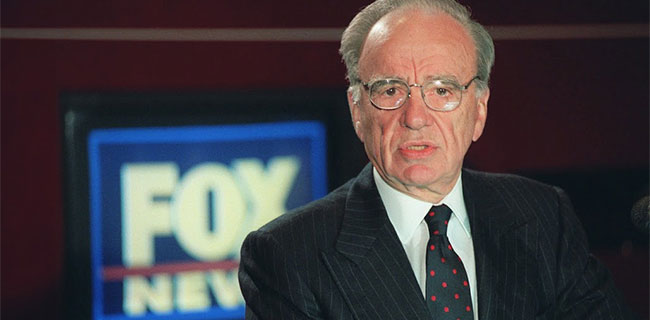
Rupert Murdoch. Photograph by David Shankbone. Published under Creative Commons Licence
On Thursday, September 21, following career that began nearly 70 years ago in 1954, Fox Corporation and News Corporation announced that Rupert Murdoch is stepping down as chairman of each board effective as of the upcoming Annual General Meeting of shareholders of each company in mid-November 2023. Murdoch will be appointed Chairman Emeritus of each company. Following the Annual General Meetings, Lachlan Murdoch will become sole Chair of News Corp and continue as Executive Chair and Chief Executive Officer of Fox Corporation. “On behalf of the FOX and News Corp boards of directors, leadership teams, and all the shareholders who have benefited from his hard work, I congratulate my father on his remarkable 70-year career,” said Lachlan Murdoch. “We thank him for his vision, his pioneering spirit, his steadfast determination, and the enduring legacy he leaves to the companies he founded and countless people he has impacted.” We present here a feature republished from The Conversation
By Simon Potter
Global media tycoon Rupert Murdoch has announced his retirement as chairman of Fox and News Corp, making way for his son Lachlan. He has been demonised as a puppet master who would pull the strings of politicians behind the scenes, as a man with too much power. But what influence did he and his fellow media moguls really wield?
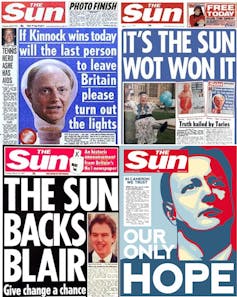
The day after the 1992 UK general election, Murdoch’s tabloid The Sun claimed credit for the Tory victory with the notorious headline “It Was The Sun What Won it”. Murdoch subsequently denied he had such influence.
But in 1995, and with another general election on the horizon, Labour leader Tony Blair certainly thought it was worth courting the media mogul. Blair, along with his chief press secretary Alistair Campbell, travelled to Hayman Island, Australia, to address a News Corp. conference. Two years later The Sun turned its back on the Conservatives and backed New Labour, which emerged victorious from that year’s general election.
Commentators have argued that Murdoch’s US media empire, notably Fox News, gave Donald Trump significant public support in his quest for presidential power. Although Murdoch now seems to have gone cold on Trump, his latest biography quotes the tycoon’s ex-wife Jerry Hall as telling him: “You helped make him president.”
More than a century ago, commentators were worrying about the power of the “press barons”. The archetype of this malign figure was Lord Northcliffe, who as Winston Churchill put it, “felt himself to be possessed of formidable power” after helping to unseat a prime minister and install the next one. According to Churchill, “armed with the solemn prestige of The Times in one hand and the ubiquity of the Daily Mail in the other”, during the first world war Northcliffe “aspired to exercise a commanding influence on events”.
Of course, the media landscape has changed dramatically since then. Indeed, it has even been transformed in the years since The Sun’s political interventions of the 1990s. Today’s press barons have had to come to terms with a digital revolution which has uprooted the traditional business model of newspapers: readership has declined and advertising revenues have collapsed, hoovered up by tech giants such as Google and Meta. Local newspapers have borne the brunt of the financial damage caused by this and by collapsing print sales, but national newspapers have struggled too.
Front pages of The Sun backing – and mocking – different political leaders. wikipedia
One good example is the Telegraph Media Group: bought by the Barclay Brothers for £665m in 2004, but valued at just £200m by 2019. The group is now up for sale again.
Meanwhile “alt truthers”, like Russell Brand, amass huge followings on social media while railing against a “media elite” that seems to include most of the traditional newspaper press.
As the 2024 election looms, it is timely to consider how the power and influence of newspapers – and newspaper owners – has waxed and waned, and to ask what this history might tell us about the state of the press and public life in the UK today.
A ‘free press’ is born
By the middle of the 19th century, the British newspaper industry was one of the most diverse and sophisticated in the world. Campaigners had, over the previous decades, successfully lobbied to see the dismantling of government restrictions and taxes on the press. Britain now had a “free press”, with no prior censorship of what could be printed and an essentially free market with little state regulation. Campaigners hoped this would usher in a period of democratic political expression in print. The free market would supposedly give everyone a voice, allowing a multiplicity of viewpoints to be published each day.
For a fleeting moment, this seemed to be borne out in an immediate flourishing of new titles. In the six years after the 1855 repeal of the newspaper stamp duty, 492 new newspapers were established, many of them in provincial towns and cities which had never previously had their own newspapers. The reforming Manchester Liberal MP John Bright applauded the “great revolution of opinion on many public questions” that was taking place thanks to “the freedom of the newspaper press”.
However, many of the new titles quickly went to the wall and during the later 19th century a very different type of newspaper industry emerged. A new generation of entrepreneurs realised that they could benefit financially from market opportunities by applying novel technologies and techniques to newspaper production and distribution.
Recently constructed national and international telegraph networks allowed them to bring in the latest news from around the country, and around the world, scooping their rivals. Steam engines could be used to power printing presses, allowing them to print vast numbers of newspapers quickly enough to sell them the same day. And steam trains provided a way to get those newspapers to readers across the country using the new rail network. Fleet Street became the centre of a truly national industry.
Edward Levy (later Levy-Lawson) led the way. From 1855 he owned The Daily Telegraph: the name of the paper was itself a reference to the new technologies being deployed in the newspaper industry.
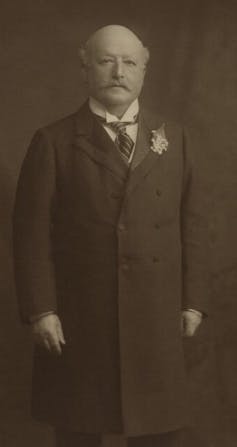
Edward Levy Lawson 1st Baron Burnham. Image taken in the early 1900s. NPG, CC BY-NC
Levy-Lawson’s Telegraph combined serious, up-to-date news reporting with American-style journalistic innovations, including lurid crime reporting, plenty of sports coverage and publicity stunts, such as backing H. M. Stanley’s 1874 expedition across Africa on the Congo River.
The purpose of all this was to sell more newspapers. By 1877, the Telegraph’s circulation approached 250,000 – the highest daily sales figure for any newspaper anywhere in the world.
Levy-Lawson saw newspapers primarily as a business, not as a route to political influence or social advancement. Although he was made Lord Burnham in 1903, the established elite looked down on his commercial origins. That snobbery was reinforced by antisemitic prejudice. The most disgusting public attacks on Levy-Lawson came from Henry Labouchere, editor of a newspaper called Truth, who raved against the influence of “Hebrew barons” on British public life.
Levy-Lawson established a template for a new type of press proprietor who was, first and foremost, a businessman. These entrepreneurs formed public companies to raise the vast sums of capital required to build their newspaper empires. They priced their newspapers aggressively low to attract the largest possible readership.
As a result, sales revenue fell well below enormous running costs. They made up the shortfall by raking in money from advertisers attracted by the large circulations and national reach of their papers. The battle was now for scale. Each press baron wanted to control the biggest possible newspaper empire.
The Napoleon of Fleet Street
By the late 19th century, a fortune could be made from owning newspapers. Alfred Harmsworth came from a modest background but built up a stable of publications aimed at entertaining, amusing and interesting the enormous new literate public created by Victorian universal primary education and rapid urbanisation.
Harmsworth used a range of eye-catching schemes to publicise his papers, including a competition that awarded the winner a pound a week for the rest of their life. By 1894, his newspapers and periodicals had a combined circulation of almost two million, constituting the world’s largest publishing business.
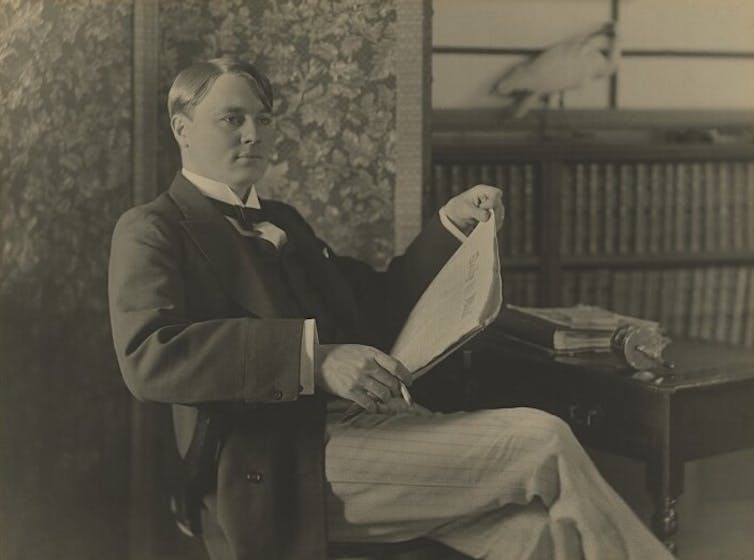
Alfred Harmsworth, 1st Viscount Northcliffe in 1896, the year he launched The Daily Mail. NPG, CC BY-NC
In 1896 Harmsworth launched the Daily Mail, a daily paper selling for a halfpenny. It targeted an aspirational lower-middle-class national readership, made up of women as well as men – an attractive demographic for advertisers. The paper was to contain everything that could be expected from a “serious” daily, presented in a respectable-looking package, but with more life, human interest and entertainment.
Content was condensed into short articles, presented in a punchy, accessible style, aimed at the new breed of office workers and commuters. Harmsworth’s brother Harold (later Lord Rothermere) ran the commercial side of the business on efficient, industrial lines.
In 1905, Harmsworth was made Lord Northcliffe. He chose this title in part because it allowed him, half-jokingly, to initial his correspondence “N”, in the style of Napoleon. He became infamous for his dictatorial, erratic, pedantic, obsessive and abusive management style. He would sometimes appoint two people to the same post and make them compete with one another to keep their job. Employees faced lavish rewards, alternating with frequent threats of dismissal. Fleet Street journalists warned prospective job applicants that Northcliffe would “suck out your brains, then sack you”.
Northcliffe cultivated informers in the Daily Mail office to tell him what was going on behind the scenes and to monitor private telephone conversations. He liked his staff to be his “creatures”. A later newspaper editor thought that there was “something more than a little nauseating about his relations with many of his chief associates; one wonders how they could stomach the humiliations he imposed and retain their self-respect.”
The political elite, and many journalists, looked down on Northcliffe and his popular papers. Lord Salisbury famously dismissed the Mail as being produced “by officeboys for officeboys”. Northcliffe’s former employee, E.T. Raymond, thought that the press baron had “an uncanny way of arriving at the results of thought without thought itself”. Another contemporary described Northcliffe as “brainless, formless, familiar and impudent”.
Northcliffe’s purchase of The Times in 1908 marked an attempt to expand his political influence, but some contemporaries still doubted whether he was very important. Lord Esher remarked that “he evidently loves power, but his education is defective, and he has no idea to what uses power can be put”. Many of Northcliffe’s press crusades seemed harmlessly apolitical, such as his campaigns to promote the consumption of wholemeal bread or to grow better sweet-peas.
However, others worried about the consequences of allowing a small number of very rich men, running enormous corporate conglomerates, to dominate the British newspaper industry. The writer and journalist R. A. Scott-James lamented in 1913 that “privilege” now dominated public debate, and that the press had become “a vehicle for false notions and antisocial ideas”.
The writer Norman Angell (a former Northcliffe employee who subsequently became a Nobel-prize-winning peace activist) similarly argued that the “modern industrialised Press” had become the most powerful instrument for the “capture of the mind by our industrial aristocracy”. Newspapers, Angell claimed, now worked to “exploit human weaknesses” for the purpose of profit, corrupting public debate.
Press, politics and the first world war
Concern about the power of press barons grew exponentially during WWI. From 1914, Northcliffe used his newspapers constantly to critique the Liberal government’s coordination of the war effort. His main targets were Prime Minister Herbert Asquith and the secretary of state for war, Lord Kitchener. In 1915, Northcliffe accused Kitchener, in print, of failing to supply the army with enough high explosive artillery shells. Initially, this made the Mail unpopular. Circulation dropped dramatically and the paper was ceremonially burned on the floor of the London Stock Exchange.
However, as its claims about government mismanagement began to seem justified, the Mail’s popularity recovered. The “shell scandal” contributed to the fall of the Liberal government and the establishment of a reconstituted coalition under Asquith’s leadership.
The ambitious Liberal politician David Lloyd George worked closely with Northcliffe in order to further his own career and Lloyd George was rewarded when he was made Minister of Munitions in the wake of the shell scandal.
But Northcliffe’s criticism of the government continued and Cabinet members worried that German propagandists were exploiting his public attacks on the British war efforts to undermine morale. Northcliffe’s campaigning finally helped precipitate the resignation of Asquith in December 1916. The Daily News (a national newspaper founded in 1846 by none other than Charles Dickens) branded Northcliffe a “press dictator” for his role in the prime minister’s downfall.
Northcliffe’s ally Lloyd George took Asquith’s place as prime minister. However, Lloyd George now cannily kept the press baron at arm’s length, giving him relatively minor official jobs that came with little power while making it difficult for him to attack a government with which he was now identified. At the end of the war, Lloyd George finally broke openly with Northcliffe, attacking the press baron in a vitriolic speech delivered in the House of Commons. Northcliffe was deluded, Lloyd George suggested, in thinking that as part of his “great task of saving the world” he had the right to dictate the terms of the 1919 peace settlement with Germany. Lloyd George spoke of Northcliffe’s “diseased vanity” and tapped his own forehead meaningfully as he delivered the speech to the assembled MPs.
By this point Northcliffe had become a serious liability to Lloyd George, and was indeed ill, both physically and mentally. His behaviour had become more erratic and aggressive than ever, and his language increasingly foul and paranoid. At one point he was reported to have brandished a revolver at his doctor.
Northcliffe died in 1922 leaving no legitimate heirs, although he had had several mistresses and two secret families. Management of his media empire passed to his brother, Lord Rothermere, who sold The Times and went on to expand in more profitable directions, conducting vicious commercial warfare against his rivals. Rothermere later became a prominent public supporter of Oswald Mosley’s British Union of Fascists and an admirer and personal acquaintance of Hitler.
The rise of Beaverbrook
The first world war also saw the rise to prominence of another archetypal press baron, Max Aitken. Like Northcliffe, Aitken came from a humble background. He was born in Ontario, raised in New Brunswick, and made his fortune through somewhat dubious Canadian business dealings. He came to England in 1910, forged new political connections and was elected as a Conservative MP.
By the end of 1916 Aitken had purchased a controlling interest in the Daily Express, the main rival to the Daily Mail. He was involved in the behind-the-scenes political intrigue that toppled Asquith as prime minister and brought Lloyd George to power that year, though his exact role was never made clear. Lloyd George treated Aitken more generously than he had Northcliffe: Aitken was made Lord Beaverbrook and in 1918 was appointed minister of information, taking charge of British wartime propaganda and entering the cabinet.
During the 1920s and 1930s, Beaverbrook turned the Daily Express into the biggest-selling newspaper in the UK. The paper adopted an aspirational, aggressive, populist tone to appeal to a broad audience and maximise advertising revenue. Beaverbrook used the Express to support his political allies, and to attack enemies like the Conservative leader, Stanley Baldwin.
Following the Wall Street Crash, Beaverbrook launched his “Empire Crusade” in the Express, seeking to turn the British empire into a tariff-protected economic union (a little like an English-speaking version of the later European Union). This campaign, also supported by Lord Rothermere of the Daily Mail, constituted a further direct threat to the leadership of Baldwin, now prime minister.
In a speech in parliament, Baldwin famously used words provided by his cousin Rudyard Kipling to castigate Rothermere and Beaverbrook. He argued that by weaponising “direct falsehoods, misrepresentation, half-truths” the press barons aimed at “power without responsibility – the prerogative of the harlot throughout the ages”.
Baldwin eventually defeated Beaverbrook’s crusade, but the press baron continued to prosecute his personal vendetta. In supporting the embattled Edward VIII during the abdication crisis of 1936, Beaverbrook admitted in private that his main aim was to “bugger Baldwin”.
Conrad Black – the ‘moneylogue’
Half a century later another wealthy Canadian, Conrad Black, used his fortune to build his own press empire. Black inherited substantial Canadian business holdings from his father, which he refocused on newspaper ownership. During the 1980s and 1990s he built up a vast portfolio of media investments in north America, the UK, Israel and Australia. In Britain, his key possession was the Telegraph Group.
Unlike some other notable press barons, Black revelled in the glamorous lifestyle that his wealth brought him. Newspapers were, for him, partly a status symbol. “The deferences (sic) and preferments” that the UK’s political culture “bestows upon the owners of great newspapers are satisfying,” as he once put it. But his press investments also helped fund his lavish spending. By the early 1990s, The Daily Telegraph was generating substantial profits and supporting Black’s other businesses interests.
Max Hastings, editor of The Daily Telegraph between 1986 and 1995, concluded from his time working for Black that it was, at root, all about the money.
Whatever the professed convictions of proprietors, most are moneylogues rather than ideologues. Their decisions are driven by commercial imperatives. Stripped of their own rhetoric, the political convictions of most British proprietors throughout history add up to an uncomplicated desire to make the world a safe place for rich men to live in.
True to form, Black anticipated the coming slump in the newspaper industry and sold off many of his press interests while their value was still high, including the Telegraph Group in 2004.
In 2007, Black was sentenced for fraud in the US and served 37 months in prison. In 2019, US President Donald Trump granted him a full pardon. The previous year Black had published a flattering biography: Donald J. Trump: a President Like No Other. Commentators were left to draw their own conclusions.
Enter the ‘Dirty Digger’
The preeminent press baron of our time has, of course, been Rupert Murdoch, who from the 1960s extended his Australian newspaper empire to the UK (buying The Sun and The News of the World in 1968 and The Times in 1981). From the 1970s he also made inroads into the US newspaper industry.
Murdoch established a reputation for selling newspapers using previously unacceptable levels of sensationalism and sex (Private Eye magazine labelled him the “Dirty Digger”). He later bought into the global film and television industry, building a US$17bn (about £14bn) fortune and establishing a reputation for meddling in politics around the world.
Biographer Michael Wolff has suggested that Murdoch does not greatly value his personal wealth or relationships, writing: “Working isn’t the means to an end; it’s the end. It’s one man’s war – a relentless, nasty, inch-by-inch campaign.”
According to Wolff, what Murdoch loves is playing the game of high-stakes business, being in the room where it happens, doing the deal, owning more newspapers, and destroying his rivals. He enjoys gossip and gathering information about those with political power, using it to protect his commercial interests and to support the political agendas of those he favours. Beneficiaries have included Margaret Thatcher, Blair and Trump.
In running his media concerns, like Northcliffe and Beaverbrook before him, Murdoch is aggressive, interventionist and hands-on. Wolff claims that Murdoch did not want his employees to be partners but would rather they serve him as subordinates, and so surrounds himself with sycophants. He is seemingly willing to accept short-term financial losses to secure long-term market dominance. This approach is rooted in the golden age of the press barons, when the dominant business strategy was to take over or shut down the competition, allowing the victor to rake in windfall profits unopposed.
Perhaps this strategy still makes sense: as the profits made by traditional newspapers dwindle, the remaining rewards might go to the last man standing.
Murdoch’s media empire has endured its periods of commercial crisis. The disastrous failures of journalistic ethics at the News of the World embroiled the newspaper in the phone hacking scandal and the paper was closed down by Murdoch in 2011. In the US in 2023, Fox News settled a lawsuit over on-air accusations concerning the role of voting machines during the US elections of 2020, costing the network almost US$800m (£650m).
However, other elements in Murdoch’s empire continue to produce a profit. After an initial near-disaster, Murdoch’s takeover of The Wall Street Journal has proved a financial success. He paid US$5.6bn (about £4.4bn) for it in 2007. Now thanks to a stunningly successful drive for subscribers (3.78m of them, 84% digital-only) the paper is worth around US$10bn (£8bn). In the UK, successful management of the digital transformation has similarly meant that The Times and The Sunday Times have gone from a £70m annual loss in 2009 to a £73m profit in 2022.
Press barons of the future
The figure of the press baron has recently found a new fictional archetype in Logan Roy, the dark heart of HBO’s series Succession. Roy has a number of reasons for wanting to own newspapers and other media outlets. Primarily, he simply needs to acquire more stuff, compulsively buying new titles to build an empire capable of eradicating all challengers.
Like Murdoch, expansion – doing the deal – is for Roy a reward in and of itself. He also loves the influence his media interests bring and wants to dominate those with political power, partly to protect his business, but largely because he craves control. The wealth and the lifestyle that accompany his media empire, in contrast, seem to give him little pleasure.
Succession reflects continuing concerns about who owns the media, how they make their money, and what they want to get out of their media outlets. As the show’s British writer, Jesse Armstrong, reflected:
The Sun doesn’t run the UK, nor does Fox entirely set the media agenda in the US, but it was hard not to feel, at the time the show was coming together, the particular impact of one man, of one family, on the lives of so many.
But does the press still have such influence over politics and public life? The many challenges facing traditional newspapers do seem to threaten their historical role. The UK’s newspaper industry has been rocked by scandals about phone hacking, professional ethics and behind-the-scenes links between journalists, politicians and the police.
And then there is the declining readership and advertising revenue. In 2019, a somewhat uninspired official report on the future of British journalism summarised some of the challenges, but offered few meaningful solutions. That was the same year the Telegraph Media Group was valued at just £200m.
London’s Evening Standard is meanwhile facing an annual loss of £16m, and relies on loans from its Russian-British proprietor, Evgeny Lebedev, to stay afloat. The same Lebedev who was controversially given a peerage in 2020 by then prime minister, Boris Johnson.
Newspapers are also in danger of being dismissed as “mainstream” or “legacy” media: old-fashioned, obsolete and unable to counter the mendacities and conspiracy theories of online “alt truthers”. Recently, following allegations presented in newspapers and on television, the comedian Russell Brand immediately sought to discredit “coordinated media attacks” which he claimed served some shadowy hidden agenda.
Meanwhile, as their own profits dwindle and they lay off more journalists, the capacity of newspapers to investigate public lies and misdeeds is drastically reduced. Some worry that the newspapers themselves are having a damaging effect on public debate – apparent, for example, in the polarising and sometimes inaccurate press coverage and comment that accompanied the Brexit referendum and its aftermath. Fuelling culture wars, rather than mounting an informed defence against them, seems to be a key tactic in staying afloat for some titles.
Yet the reasons why press barons want to own newspapers remain much the same today as they did for Northcliffe, Beaverbrook, and Black: making money, securing a place in the national (or global) economic and social elite, generating political influence, and delivering the thrill of the great corporate deal.
And the old media dynasties endure: in 2022 the 4th Lord Rothermere, great-grandson of the Daily Mail’s co-founder, took the Daily Mail & General Trust group out of public ownership, and became its chief executive.
Above all else, traditional newspaper titles retain their appeal to potential owners because, in a crowded marketplace for online news, they can represent a trusted and prestigious brand. The fate of Buzzfeed has demonstrated the difficulties of creating a viable online presence without such an established base.
Traditional newspapers will continue to scale back print runs over the coming years. Probably, at some point, they will just stop printing newspapers. But some of these companies will live on as profitable online brands.
In a post-Murdoch age, future press barons – digital media emperors – will want to invest in these brands because they offer recognition and respectability, following the early example set by Amazon founder Jeff Bezos, who purchased The Washington Post in 2013.
Potential buyers for the Telegraph Media Group take in UK businesses, including the Mail’s Rothermere and the owner of the rightwing GB News. But there is also interest from Europe and the US, as well as the Gulf states. Surprisingly, perhaps, the Barclay family has itself assembled a portfolio of potential Middle Eastern finance to try to buy the business back from Lloyds.
Some of these international players may see the Telegraph Group as offering a respectable voice in the British media landscape and a route to political and popular influence, something that only a traditional newspaper business can provide. And they are no doubt interested in the brand’s asset of nearly one million subscribers, many of them digital – data being the be all and end all in today’s market.
Whichever way that sale goes, we are still a long way from the dream of a democratic utopia promoted by 19th-century campaigners for press freedom. They believed that the free market would liberate the press and, by doing so, liberate us all. Sadly, it seems like Logan Roy was closer to the truth when he said to his wannabe successors: “Money wins. Here’s to us.”
Simon Potter is Professor of Modern History at the University of Bristol. This article is republished from The Conversation under a Creative Commons licence. Read the original article.
The Rupert Murdoch-owned News Corporation has been demerged. News Corp will now have publishing firms like The Wall Street Journal and Harper Collins and education firm Amplify, while 21st Century Fox will have Star, Twentieth Century Fox, Fox, Sky, National Geographic, Fox News, Fox Sports and FX.
The old News Corporation announced yesterday that it has completed the previously announced separation of its business into two independent publicly-traded companies.
21st Century Fox’s assets will span a global portfolio of cable and broadcasting properties, including Fox, FX, Fox News Channel, Fox Sports Network, National Geographic Channels, Star, Fox Pan American Sports, as well as film studio Twentieth Century Fox Film and television production studios Twentieth Century Fox Television and Shine Group. The Company’s assets also include leading pay-tv businesses Sky Deutschland, Sky Italia and its equity interests in BSkyB and Tata Sky.
“21st Century Fox launches as a unique force bringing news and entertainment to more than a billion customers every day in over 100 languages,” said Rupert Murdoch, Chairman and CEO of 21st Century Fox. “Our success will continue to be rooted in a deep belief in originality and a commitment to empowering creative minds and entrepreneurs around the world. Our management teams are the best in the business and we will drive growth and shareholder value by expanding our existing assets and brands, while embracing new opportunities and technology.”
While Mr Murdoch will be Chairman and CEO, son James Murdoch isDeputy Chief Operating Officer, Chairman and CEO, International. Chase Carey is President & Chief Operating Officer of the company.
Meanwhile, the new News Corp will be a global network brands in news and information services, sports programming in Australia, digital real estate services, book publishing, digital education, and pay-TV distribution in Australia. News Corp’s global portfolio includes Amplify, The Australian, The Courier Mail, Dow Jones, Fox Sports Australia, Foxtel, HarperCollins, Herald Sun, The New York Post, News America Marketing, REA, The Sun, The Sunday Telegraph, The Sunday Times of London, The Times of London and The Wall Street Journal. Bedi Ajay Singh is Chief Financial Officer of News Corp.
Robert Thomson, Chief Executive of News Corp, said, “We are continuing a proud tradition and fashioning a prosperous future in the new News Corp. We have a valuable collection of complementary companies and our task is to make the new News more than the sum of these distinguished parts. We have a robust balance sheet and a team of creative, energetic and passionate employees who are determined to make the company a resounding success and to make a positive difference in their communities.”
“The new publishing company will be a test for investors and their appetite for print assets,” noted a Reuters report, adding: “While the company also has pay-TV assets and an equity stake in a real estate classified site in Australia, it is coming out as a separately traded company during a challenging times for newspapers. Advertisers are choosing to put their dollars elsewhere, especially in digital products. Although News Corp, like other publishers, is a player in the virtual work, advertising in digital media commands lower prices than traditional print publications.”
According to a report in The Guardian, London by Lisa O’Caroll, “The demerger is the culmination of a two-year campaign to “detoxify” the News Corp brand that started in the summer of 2011 with the abrupt closure of the News of the World and finished with the announcement in the last week that News International’s brand in London would be axed and the company rebranded News UK.”
Dying to watch the latest season of Big Bang Theory or want to know who’s going to win the current MasterChef Australia series? Then, you have two options: either download it or wait for a channel to telecast it here.
Of course, many of us opt for the first option as Indian channels still lag in getting the latest seasons of these international shows to India . MxM India explores if the internet is indeed posing a threat to the genre.
Internet, a menace?
Anurag Bedi
Consumer trends have changed over the past few years; and if one gets his dose of entertainment, it doesn’t matter it’s on which platform. “The viewer is platform-neutral. So, as far as one gets certain amount of entertainment quotient, it doesn’t matter even if he’s doing it illegally i.e. by downloading. And with the internet reaching out to every nook and corner of the country, it won’t be wrong to say that internet poses a threat to content owners or channels,” explains Karthik Sharma, managing partner, Maxus.
The internet remains the biggest threat to the English general entertainment channels. Most of these channels are not able to telecast various popular international shows like Games of Throne, Weeds, Sherlock and others, hence viewers log online.
Saurabh Yagnik
“Today, the television audience is experimenting with content. They are quite receptive to exploring new, innovative and unconventional content. Considering the change in lifestyles and the impact of globalization, our audience is more aware than ever. Viewers have the knowledge of the scope of entertainment available on various platforms,” said Anurag Bedi, Business Head, Zee Cafe.
Saurabh Yagnik, GM & senior VP, English Channels, STAR India Pvt. Ltd added: “STAR World’s constant endeavour has been to bring international shows to India , at the same time as their broadcast in US. We, in fact, had the World Television Premier of shows such as Missing, Touch on our channel. Even for Masterchef Australia Season 4, we are broadcasting the show very close to its telecast in Australia this time. This also becomes possible due to our strong and exclusive associations with international production houses such as Disney, Fox, and others.”
Ricky Ow
On an optimistic note, Ricky Ow, executive VP, Networks, Asia, Sony Pictures Television feels that though the internet adds to the competition, it helps one realize what the market is looking for: “If one studies the internet, then it can definitely turn out to be an asset as it gives us an opportunity to look at what the audience is interested in. For example, it helps us know what the India n audiences’ interests are outside AXN.”
However, the newest entry on the block, Comedy Central’s Ferzad Palia, senior VP and GM – English Entertainment, Viacom 18 Media Pvt Ltd feels that internet should be seen as a complimentary asset rather than just as competition. “With technology, the social mindsets of people are changing too. And now people have become more accepting towards western culture. Thus, it’s good for us as more and more people identify with the content.”
Ferzad Palia
The buying game
There is no doubt that the English-language general entertainment market is developing. Almost every channel is trying its level-best to keep the audience hooked on by getting more and more international shows to the living rooms. One question still remains: why are channels not able to show what their TG wants?
“It is difficult to bring popular international shows to India , especially at the same time as their release in other markets. However, we have been driving our efforts to realize this for a long time with our property titled Torrentz, wherein we brought international shows very close to their release in other markets,” said Mr Yagnik.
New channels coming up are giving a tough competition to the likes of Star World, Zee Cafe and AXN. Media professionals feel that, though the competition is good, it can become a burden on English channels as they have a limited TG. This has lead to rise in the cost of procuring rights. So, if a channel is paying more for an acquisition of shows which are popular abroad, they might not be able to recover money as mass channels do.
Mr Ow added that though it cannot be categorized as easy or difficult, the onset of more channels has definitely risen the costs: “If we want a show, we try our level best to get it. AXN’s programming formula is simple – we are an action-adventure destination. Therefore, it narrows down the competition as we look for series, movies or reality shows which cater to that genre.”
On the other hand, Mr Palia feels that though procuring rights is a complicated process, nothing is easy when it comes to running a channel. “It’s a part and parcel of starting a channel. What is more important is the selection process of the shows which will interest the India n audience. Demand for international shows has increased in the country of late and people have become choosy about what they want to watch.”
Hence, many channels are now associating with production houses or producing their own shows as they feel it will help them grow their market without too much of a trouble.
Vishal Rally
“There could be 100 popular international shows, but we cannot telecast them all. So, a channel needs to choose what their TG wants. Thankfully, we are backed up with a studio and a JV which allows us to telecast shows simultaneously in India as well. We telecast shows like Survivors, NCIS at par with their international seasons. That’s our USP,” said Vishal Rally, business head, BIG CBS Network.
Nevertheless, most channels agree that it isn’t an easy task to get good international shows to India , but to keep the competition at bay, they have to try to out-do internet but also each other by bringing the latest shows to their audience’s living rooms ASAP.
Many broadcasters are also aware that the internet viewership of popular shows is small, and the public still prefers a bigger screen experience. As one broadcaster said, high speed broadband connections exist, but not with everyone. And the buffering is a pain. It’s a huge negative for the viewers who watch English GECs.
But low broadband speeds and poor connectivity will soon be a thing of the past, right? Yes and so will dated soaps and old seasons be, says the broadcaster, requesting anonymity. “Right now, we are catching up with old seasons since most people haven’t watched them… For instance, how many people have watched The Newsroom, which has been receiving rave reviews?” There’s also an issue of copyright and picture quality. “Some of what you see on YouTube is pirated and is being yanked off the site when caught in the act. And if it is available somewhere, it appears to have been recorded on the microwave oven… Who wants to view Masterchef where a tomato looks like a potato!!!”
Hmmm. Surely reason for us to wait and watch. Or in this case, watch and wait.
A young man who currently works in one of the Big Three television networks dropped by for some career advice last week. After graduating from business school, he has spent almost five years at the job, the first two in Ad Sales and the next three in Marketing. He feels like he is beginning to stagnate and has raised the issue with his boss. Boss suggested that he move back into Ad Sales.
What would you advise him?
If he planned to be in the broadcast industry for the long haul, say the next decade, I suggested that he stay in Marketing. If it was just the next two or three however, he was likely better off shifting back to Ad Sales.
Seems cryptic? Hang on, we should soon see why.
Marketing’s role at most Indian broadcasters only comes in when all aspects of the channel, show or event have already been finalized. All that remains is to build awareness of the impending launch to try and ensure the quickest possible pace of sampling among viewers. Talented creative agency is called in and briefed. Wit, emotion, action and drama are poured in and out pops a striking, often award winning, campaign. All that remains to be done is splashing out a large sum on a media plan and the job is done.
If you learned your Marketing at one of the putative Universities of the discipline, P&G or Unilever or one of the beverage majors for instance, you would expect to lead, not follow the process and centre every decision at each stage on the consumer. It would probably offend you to be treated merely as a deliverer of advertising and media campaigns. Given the circumstances, you would want to shift closer to either the Content or the Ad Sales side of the business, where the action really was.
Things are going to start changing. As soon as July 1, 2012 actually.
For as long as we’ve had C&S TV inIndia, going on 20 years now, the biggest impediment in its expansion has been limited bandwidth due to analog delivery. With capacity of less than 70 channels delivered at indifferent resolution and scratchy audio, the biggest challenge before a channel is to get distribution at whatever cost. Once this hurdle has been negotiated, it enters a relatively limited range of options available in any given genre. The rest depends on casting as wide a content net as possible. Almost every channel tries to be all things to all viewers.
Mandatory digitization arrives in the big metros on July 1. In a fell swoop, channel choice is set to grow three-fold or more. Costs of distribution should fall rather sharply, removing a significant entry barrier and opening doors for many more content providers. Inevitably, the days of every channel wanting to be ‘One size fits all’ must give way to specific consumer needs driving product design. International channels already show this precision in proposition and content. Comedy Central makes no bones about what it stands for and will stay close to the promise. Fox has a whole portfolio of well-designed channels that identify and then single mindedly go after a tightly defined benefit.
And make no mistake. This is the direction where all of Indian television is headed; the era of the Marketing-led broadcasting business.
Paritosh Joshi was until recently CEO, Star CJ. He has been a marketer, a mediaperson and been a key officebearer on industry bodies. He can reached via his Twitter handle @paritoshZero
India’s film industry will benefit from an increased collaboration with Hollywood in the areas of film entertainment, education, VFX and tourism, according to Ernst & Young in a report issued for an initiative launched by the LA Film Council.
The report, ‘Film Industry in India: New horizons’, has also said that with Hollywood already contributing Rs850 crore to Rs900 crore, or 10-12 per cent of the overall box-office revenue in India, the Indian film industry will witness an accelerated growth than competition from countries like China, Japan, Russia and Brazil.
There has been 42 per cent increase in the number of Hollywood movies shot in India between 2010 and 2011, and that number is expected to grow, the report said. At least five big-ticket Hollywood productions, including the next James Bond, will be shot in India, while Fox is looking at two more films.
The Indian film industry is projected to grow from $3.2 billion in 2010 to $5 billion by 2014 at a CAGR of 14.1 per cent. With close to a 1,000 films produced a year, India’s filmed entertainment industry is the largest in the world coupled with its theatrical admissions at around $3 billion.
A greater collaboration between India and US will result in increased film tourism, cultural and technological exchanges and boosting local talent, and most importantly serve as a showcase on the global stage for India art, culture, history and talent. Perhaps, this is a beginning of a revolution similar to the one we witnessed in the IT industry at the beginning of this millennia,” Rakesh Jariwala, partner and segment champion, filmed entertainment at E&Y, said.
According to estimates, there are more than 40 major domestic VFX companies catering to domestic and international clients. Currently, India accounts for only around 10 per cent of the total animation and VFX outsourcing pie. However, there is room for growth and the amount of work coming to India from Hollywood is on the rise.
Of late, the VFX industry has been shifting toward higher-end assignments. India has well developed post-production facilities available at low cost. A foreign producer who comes to shoot in India can complete his entire movie here, from shooting to post production to cut costs. Industry players are also tying up with film and entertainment companies on dedicated projects.
As far as India’s travel and tourism industry goes, it contributed $1.7 trillion (or 2.8 per cent of the global GDP), which is expected to rise to 4.2 per cent ($2.9 trillion) by 2021. Furthermore, investments in the global travel and tourism industry are expected to grow at a CAGR of 5.4 per cent to reach $1.5trillion by 2021 from $0.6 trillion in 2010.
Many US states such as California, New York, Michigan, Nevada and Utah offer incentives to film and television production companies from India. Canada also offers incentives to producers of film, television, animation and visual effects from India and has attracted many Bollywood producers, who have shot movies in the country.




 The Rupert Murdoch-owned News Corporation has been demerged. News Corp will now have publishing firms like The Wall Street Journal and Harper Collins and education firm Amplify, while 21st Century Fox will have Star, Twentieth Century Fox, Fox, Sky, National Geographic, Fox News, Fox Sports and FX.


 By Paritosh Joshi