Tag: Forbes India

  • One Network18 rejigs top deck

    By Our Staff


    Continuing its vision of building converged ‘One Network18’, Network18 has announced appointments and enhanced duties in its top leadership. The strategic move aims to establish an integrated broadcast and digital ecosystem, driving growth and innovation across all brands within the network. Karan Abhishek Singh, Smriti Mehra, Mitul Sangani & Shivakumar others get additional responsibilities.


    As part of this development, Network18 has enhanced roles of key executives to within the organisation.


    Shivakumar has been appointed as the President of News18 Studios. He will be responsible for leading the converged business mode. His role will encompass all business clusters and brands, with a focus on creating a pan-India appeal.


    Karan Abhishek Singh, CEO of the Hindi News Cluster, will also have an expanded role, taking charge of revenue, ratings, and reputation for the cluster. With a focus on brand growth across channels and platforms, Singh will drive cross-functional collaboration between editorial, product, technology, and other departments.


    Smriti Mehra, CEO of the English News Cluster, will now oversee revenue, ratings (audience growth), and the reputation of the portfolio. Mehra will drive brand growth across channels and platforms through cross-functional coordination, bridging editorial, product, technology, and other functions.


    Mitul Sangani, CEO of the Regional News Cluster, will now be responsible for revenue, ratings, and reputation for all regional television news channels and digital properties. Apart from this, he will also drive Local18, Network18’s hyper-local brand.


    Abhinay Chauhan, Executive Vice President of Government Sales, will continue to strengthen Network18’s relationships with state governments and PSU bodies, while identifying new business opportunities in this vertical.


    Ruchir Khanna, COO of Firstpost, has been appointed to develop the product and website, setting it apart from other players in the genre.


    Preeti Sahni, COO of Forbes India (Print + Digital), will continue to lead of international sales for the network while extending her responsibilities to lead the Forbes brand across multiple platforms.


    Pranav Bakshi has joined Network18 as Head of Partnerships, focusing on creating new opportunities for audience growth and monetisation across platforms. He will also work on revenue maximization by leveraging the network’s extensive video content repository.


    This leadership team will report to Avinash Kaul and Puneet Singhvi, the co-owners of ‘One Network18.’ Together, they will drive Network18’s vision to become a truly integrated media ecosystem, ensuring continued growth, innovation, and audience engagement.


  • Forbes India unveils the first-ever Showstoppers edition

    By Our Staff


    Forbes India magazine unveils the first-ever Showstoppers edition in January, featuring 50 personalities from entertainment and sports whose achievements made them outperformers in their respective fields in 2022. The list of 50 – 20 from films, 15 from OTT and 15 from sports-is unranked and is curated by a jury of experts. The latest issue will be available on stands this week.


    The Showstoppers list is part of a six-cover special edition. There’s actor Alia Bhatt, in one of her first conversations with the media after the birth of her daughter Raha. And actors Manoj Bajpayee and Shefali Shah, have finally got their due, thanks to OTT. The edition also tracks the rise of actor Deepika Padukone as a powerful fashion ambassador. It explores how Smriti Mandhana, the opening batter for the Indian women’s cricket team, is just getting started after notching up quite a few milestones early on in her career. There’s also a profile on how, after thirty years of multiple National Awards, two Oscars and Grammys, AR Rahman continues to push boundaries: As a musician, producer, writer and filmmaker.


    Said Brian Carvalho, editor, Forbes India: “This year we deviate from the familiar script. Sure, we have the celebrities, but along with them, there are up-and-comers from the OTT and non-Bollywood brigade, and sportspersons (not just cricketers), who blazed a trial on track, field, in the boxing ring and over 64 squares.”


    Added Preeti Sahni – COO, Forbes India: “The Celebrity issue is all about mapping milestones and achieving new landmarks of success. This year, we have curated a list of celebrities who are breaking barriers in their fields. Whether it be sports or entertainment, Forbes India has covered them.”


  • Meanwhile, Network18 strengthens ETV’s revenue team

    By A Correspondent


    Network18 has announced the elevation of key sales personnel. It has announced the appointment of Mukul Gupta and Tauquir Zaidi as National Sales Heads for ETV News HSM (Hindi Speaking Markets) channels and ETV News Language channels, respectively.


    Joy Chakraborthy

    Commenting on these appointments, Joy Chakraborthy, President – Revenue, TV18 & CEO Forbes India said, ‘We are very happy that Tauquir and Mukul have joined our ETV News Network, I welcome them. They bring vast and varied experience of media sales, which will strengthen an already good team.’


    Prior to joining Network18, Gupta was Head Sales – Special Initiatives at Zee News’s regional bouquet of channels. Before that he was head of corporate sales with ETV News. On the other hand, Zaidi was National Sales Head with Prasar Bharati – Doordarshan channels, Region Head with Times Now, NDTV Media and has spent more than six years in Star India.


    Both Mukul and Tauquir will be reporting to Sudip Roy, EVP and National Revenue Head, ETV News Network, Network18, who in turn reports to Chakraborthy.


  • Network18 announces key elevations

    By A Correspondent


    Network18 has re-organised the leadership roles within the function by announcing key elevation sunder the leadership of Joy Chakraborthy, President- Revenue for TV18 and CEO-Forbes India.


    Commenting on these elevations, Chakraborthy said: “In the past one year, we were able to utilise and leverage strengths of our network, leadership and people with a cohesive sales structure. For the new fiscal year, we are geared up to look at newer opportunities and face different challenges. Keeping in line with our strategy to move ahead, we feel it is imperative to re-jig leadership roles to make the most of individual forte, team and network strengths in extracting our best from market situations and opportunities.”


    Mukund Setlur takes on the role of National Sales Head for News18 India, IBN Lokmat and CNBC Bajar and Sudip Roy will be incharge of ETV News Channels’ sales as National Sales Head. Amit Tripathi who currently leads the sales team for government businesses of TV18 channels as well as that for the Hindi speaking markets for ETV News channels, will now also manage government businesses of language channels under the ETV News Network. Sonia Kapoor, in addition to being National Sales Head for her present Focus portfolio comprising CNBC- TV18, CNN News18, Moneycontrol, Forbes India and Firstpost, will also head Focus nationally for CNBC Awaaz, CNBC Bajar, News18 India and IBN Lokmat.


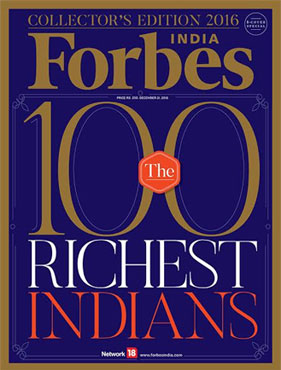
  • Samir/Vineet Jain family gallops ahead in Forbes Richest 100 list

    By A Correspondent


    It’s that time of the year when the Forbes India Rich List is released. The magazine volume, that’s scheduled to hit shopshelves today, has already revealed some numbers. That Mukesh Ambani continues to be the richest. And Acharya Balkrishna, the brain behind the slew of products bearing the Patanjali brand name, is in the Top 50, at #48.


    So how do our media biggies fare?


    We got some advance data from the magazine, and we learnt that there are just three whose primary source of wealth is in the media (or so we presume).


    They are Subhash Chandra (at #18), the Jain Family at #36 and Kalanithi Maran at #40. Interestingly, and as per our headline, the Jain Family – Samir and Vineet Jain’s family – has moved from #57 to #36.


    The others in the table below have investments in media but that’s not the primary source of wealth.


    2016 (in billion dollars) Rank 2016 2015 (in billion dollars) Rank 2015
    Mukesh Ambani

    22.7

    1

    18.9

    1

    Hinduja Bros

    15.2

    3

    14.8

    4

    Subhash Chandra

    5.6

    18

    4.8

    18

    Anil Ambani

    3.4

    32

    2.9

    29

    Jain Family

    3.2

    36

    1.85

    57

    Kalanithi Maran

    2.9

    40

    2.6

    32

    Rajan Raheja

    2.55

    45

    2.04

    46

    Anand Mahindra

    1.42

    90

    1.12

    99

    Sanjiv Goenka

    1.4

    91

    1.17

    97


  • Amith Prabhu: 30 under 30 and what they need to do

    By Amith Prabhu


    I was a member of the jury that chose the first list of 30 under 30 in Indian PR. Two things that clearly stood out were, that there is great talent out there and the future of our profession will be in great hands in the years to come. The other interesting takeaway is that some of these should also feature in the list that Forbes India brings out and there are some who would make the cut but do not nominate themselves.


    Now that brings me to a Twitter discussion I was having with Deepa Dey who heads Corporate Communications at a leading consumer healthcare company (it’s a different matter that she refers to the discussion as an argument). She felt it was saddening that PR professionals did not feature in the Forbes India list whereas I felt how does Forbes find out that some bright sparks exists unless they do some PR for themselves or come under the radar of the journalist compiling the list. I think it is really optimistic to want to see PR professionals in this list and never impossible.


    I’m reproducing the methodology that Forbes India used to arrive at the list from their website:

    The research process was three-fold: One, interviews by Forbes India staffers with sources across relevant categories as well as through studies of databases and media coverage. Two, an online application on forbesindia.com, inviting applications from entrepreneurs/ professionals who felt they qualified. Three, by spreading the word through social media. This helped arrive at a long list which went up to over 300 names across 13 categories. (Finance as a category was dropped for lack of adequate representation.)


    Now the question is whether Public Relations as a category even featured at all? And if it did, whether PR professionals featured in the minds of sources that Forbes India staffers spoke to. Also, did PR professionals who felt they qualified, even apply to be in the list. When I refer to PR professionals I mean both – those who work inhouse and those who work in consultancies.


    Keeping both the above in context the question I have is how many PR professionals across the below-30 and above-30 category innovate or do something remarkably outstanding? If they do, why is it not brought into the fore? Well, the answers to these will never be found.


    The point I’m trying to make is that PR professionals get into the profession to contribute towards building reputations using the power of communications in different forms. Very rarely do PR professionals want to hog the limelight. It is a strategic backroom job with a lot of power and responsibility.


    Now that we have our own list that features not one or two but thirty bright, smart professionals we should celebrate and get more people to apply next year. Let’s hope these 30 contribute in outstanding ways to themselves, their organisations and to the profession. And may some of these apply to be in the Forbes India List in 2016.


    More importantly, may some of our own who are in the 40s and 50s get to be the people Forbes India speaks to next year! Till then here’s cheering up the 30 under 30. May their tribe increase and may our optimism grow.


  • Gurmit Singh quits Forbes India as CEO to join Yahoo as India MD

    By A Correspondent


    Gurmit Singh

    The announcement was made WPP’s Stream digital unconference being held in Jaipur. Former CEO of Forbes India Gurmit Singh will be the new Managing Director for Yahoo India. As MD, Mr Singh will oversee the internet giant’s business in the country and responsible for its growth. He will report to Yvonne Chang, VP & Head of India and South East Asia at Yahoo. The position of MD at Yahoo India was vacant since Arun Tadanki resigned last year.


    With over 20 years of experience, Mr Singh brings with him a deep understanding of the M&E sector in India..


    Commenting on the appointment, Yvonne Chang, VP & Head of India and South East Asia, Yahoo said, “Gurmit comes to Yahoo with a strong track record of delivering growth. His understanding of users and advertisers will be a great asset for Yahoo as we bring a number of product innovations to India. Yahoo is a loved brand in India, and we are very happy to have a leader of Gurmit’s caliber leading the team.”


    Mr Singh, who starts his assignment with Yahoo today, said “An Internet industry pioneer, Yahoo is now at a very exciting point in its journey. It truly reflects the energy and spirit of the world’s largest startup. Working together with an extraordinary team in India and colleagues across the world, I am looking forward to unlocking the full potential of Yahoo products and services in India.”


    During his career Gurmit has held leadership roles across Consumer Products, Music & Entertainment and Media sectors, working for companies such as Sony Music, Hindustan Times, India Today Group, Rajshri Media, Marico Industries and most recently at Network 18 where he worked until yesterday.


    Although there is no official statement from Network18 on who will replace Mr Singh, it is rumoured that Anil Unyal, COO – Network18 Media and Head TV18 Media Operations will hold additional charge of the magazine.


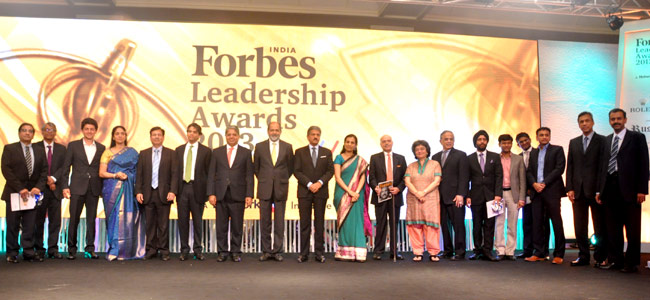
  • Anand Mahindra is Forbes India ‘Entrepreneur for the Year 2013’

    Forbes India Leadership Awards Winners


    By A Correspondent


    With the Twitter, there has been a sudden and very dramatic shift of power to the consumer and businessmen can use the microblogging platform to build brand credibility and counter negative word-of-mouth.


    Words of wisdom from Anand Mahindra, Chairman and Managing Director, Mahindra & Mahindra, who was declared ‘Entrepreneur of the Year’ at the third annual Forbes Leadership Awards.


    The evening started with opening remarks by Forbes editor-in-chief R Jagannathan. Other than the awards, there were a set of three debates moderated by Adil Zainulbhai, Chairman-India of McKinsey & Co.


    A high-powered jury headed by Mr KV Kamath, non-executive chairman of ICICI Bank, comprised Mr Zainulbhai, Akhil Gupta, Chairman of Blackstone Advisors India, Ajit Rangnekar, Dean of the Indian School of Business, Zia Modi, Senior Partner, AZB Partners, and Raghav Bahl, Founder and Group Editor of Network18. KPMG was knowledge partner of the event.


    The following is the list of winners at the Forbes India Leadership Awards 2013:

    1.Start Up for the Year

    Phanindra Sama – redBus


    2. Nextgen Entrepreneur for the Year

    Tarang Jain – Varroc Engineering


    3. Entrepreneur with Social Impact

    Ranjan Sharma – IKSL


    4. Conscious Capitalist Company for the year

    HUL


    5. Best CEO – Multinational Company

    Francisco D’souza – Cognizant Technology Solutions Corp


    6. Best CEO – Public Sector

    Rakesh Tandon – IRCTC


    7. Best CEO – Private Sector

    Chanda Kochhar – ICICI Bank


    8. Woman Leader for the Year

    Chitra Ramkrishna – NSE


    9. Lifetime Achievement Award for the Year

    Brijmohan Lall Munjal – Hero MotoCorp


    10. Entrepreneur for the Year

    Anand Mahindra – Mahindra & Mahindra


  • Forbes will stick to its DNA: R Jagannathan


    R Jagannathan or Jaggi, as he’s popularly known, is a veteran business editor, having worn the biz ed hat several times over. As Executive Editor of BusinessWorld (way back in 1987 till 1990), Business Editor, India Today (1990-91), Founding Exec Editor, Business Today (1992-93), Resident Editor, Business Standard (1993-96), Editor, Financial Express (1996-2000), Editor, myiris.com (2000-02), Exec Editor, Business Standard (2002-05) and Editor – DNA Money (2005-07). In June 2007, he was made Managing Editor and later Executive Editor of the six-edition DNA news daily, a position he held till 2010. He joined the Network18 group in 2011 to launch Firstpost and in March this year, he was elevated to Editor-in-chief, web and publishing for all of the Network18 group’s print and online publications.


    Late last month (May 2013), Mr Jagannathan took charge of Forbes India after four senior editorial heads including Founding Editor Indrajit Gupta exited the organization in controversial circumstances. The Editors’ Guild of India and Press Club Mumbai deplored the development and issued statements even as, according to rumours, Mr Gupta and his colleagues have taken the Forbes India management to court on the issue.


    MxMIndia spoke with Mr Jagannathan last week to find out how the transition has been and specifically what are the changes he’s planning to bring about in the fortnightly magazine.


    One can’t start this chat without asking how the transition has been. There was evidently much sound and fury when it happened.

    Yes, as far as I am concerned it was totally unexpected because as late as last year and even early this year there were several meetings with Indrajit and all to discuss common newsroom ideas and various things so I thought everybody would’ve been little bit prepared for it. So when the announcement was made in March, we were ready for it and we were not pushing it too fast also because we wanted people to buy into the idea of the common newsroom. I think for about a month I was attending their meetings just to understand their processes and various things. I always believe integration processes are slow, it takes time and we need to get people’s buy-in so that’s what I was working towards. But somewhere along the line, probably they were not happy with the idea.


    As a journalist who’s been through the ranks and who has seen things from both sides, did you find the entire episode unnerving?

    No, it was not unnnerving for me because I believe that certain things have to happen because today the cost of content is very high regardless of whether you are running a print publication or a dotcom. You have to see how you can synergize and get additional kinds of content from multiple sources so the move towards common newsrooms sort of has to happen. In India, it is happening at a slower pace than elsewhere.


    Integration is always a tough process…

    Of course it is. You are dealing people who have a way of doing things. Let’s say if you are in a magazine you are used to writing, say, one story in a fortnight whereas in Firstpost we are in a newsroom where we are churning out lot of copy on a dynamic level so obviously it will take some time…


    As somebody who has set up and worked with business magazines for long, what was your view of Forbes India when you took charge? And how has it been so far?

    Forbes is a fantastic product and is well accepted by the market. Anybody starting Forbes four years ago was doing the right thing by going in the direction that they were going. Later, ForbesIndia.com was set up so everything was going according to the plan. The only thing is that as you move along, you’ve got to see the challenges ahead and be pro-active. As a category, magazines have been stagnant for a long time and struggling in all domains. So just because you are not struggling does not mean that you should not prepare for the future. It’s this thinking that led the management and us to look at how Forbes needs to be in the future.


    You’ve helmed Forbes India editorially for a month-odd now. Any changes planned?

    No, nothing very significant because it’s not that everything in the past was wrong. We have made incremental changes in some parts which were not working… which you have to do regardless of who is the editor. You have to constantly keep reviewing the product and make it elegant.


    The one important thing that I am probably changing has to do with the fact that you are a franchised edition of a globally accepted product. So, there is no need for you to reinvent the wheel in India, you don’t have to stuff in India content because you are a foreign product with an Indian DNA. In fact if you make it more and more Indian, you are competing with Business Today and Business World. Now you want to be in a category where you are a global publication which has an Indian element in it. So what I am doing is not chucking great content and replacing it with 70 percent of your content. You do the other way around… you make sure that the 30 percent of the Indian content measures with the global brand and do that.


    What is the content ratio now and what it’s going to be?

    We haven’t significantly changed it but we have started the process. I think earlier Forbes US content was more like 40-50 percent or maybe lesser. Sometimes it was even 30 percent to 20 percent. But we are making it more like 50-60 percent range…


    Forbes India often was often fairly aggressive in its journalism. There was this story on DNA I guess when you were editor which was pretty damning… Are you going to follow the same aggressive approach?

    See, I do not know entirely what was done in the past, but you certainly have to tell the truth. There’s no doubt about that. But, as far as the core philosophy of Forbes is concerned, it’s largely pro-business, it is not meant to be an NGO. It is not meant to be anti-capitalism. We are for capitalism but not for crony-capitalism, so there is a difference. We don’t want to say that capitalists are good even if they are doing rotten things. We are not in the business of saying that the government is a lovely thing, food security is great. All those things we are not going to do, so I think shift in focus is happening little by little. We have not entirely changed it. We have an approach where we say entrepreneurship is key. We believe that if entrepreneurs are given the right inputs, India will benefit because entrepreneurs can create jobs that governments cannot.


    So good business is good and bad government is bad. We want less government and more business very clearly. I mean those are the broad philosophies of Forbes and that philosophy we have to adopt here.


    Will you continue with the current periodicity?

     Yes, we will be fortnightly as we have always been. In fact what we do is like even in the past when we have special issues, we will have additional issues.


    And will Forbes life continue as is?

    We do plan to do some tweaking in the product because I think it is little more artistically-oriented right now. It should be a little more lifestyle-oriented so we will be looking at content probably in the next few weeks. The current issue is going to bed, it’s doing well and has a fair amount of ads. We want to see if we can make it much better commercially and it’s far more oriented towards Forbes Life as it is in the US.


    Internationally, Forbes has a few extensions like Forbes Woman. Are you looking at those in the near future?

    No, what we may have is special issues which might come free with the magazine but that is like once in a year. We want to make sure that the core brands – Forbes India and Forbes Life, and Forbes India more than Forbes Life – will really succeed. It is a crime for Forbes India to not make money. Forbes is about the rich, about being profitable. So Forbes has to be profitable and we will be profitable if we stick to our core DNA, which we will.


    But the dynamics of the business are such that they weigh against all magazines.

    Yeah, so we are also tweaking the business model which is basically to be a little more asset light. That is we have a core team of editors who will continue to remain there but we are also taking more content which we will get others to do on a project basis so it’s not like we want to do everything in-house. Hence many things will get changed so that the cost factors probably work out a little better.


    Does this mean you will shed some weight?

    No, we are not shedding any more weight except if anything happens through the process of natural attrition.


    But there will be some re-allocation?

    Yes, because we are expecting people to contribute more so you bring down costs either by getting people to be more productive or you don’t replace when people leave.


    And on the website, will we see changes there too?

    We think ForbesIndia.com is eminently monetizeable because it has a very strong business environment in which advertisers want to put in money so we think we will build the brand by increasing the content in that and certainly it will be grown


    Will it be a business-y Firstpost?

    No, Firstpost and Forbes are two different brands and there is no question of mixing the two brands. Firstpost is an edgy, opinionated site. What we may do is occasionally re-publish some stuff from here for Forbes. And where it is relevant, the reverse also. People working for the two places might contribute separately for the two brands. A brand is a brand, you don’t want to screw up by mixing up the two brands.


    It’s about people synergy that is the person in Forbes might write something for Firstpost and the person in Firstpost might contribute and do something in Forbes Life. So in a sense it’s like free-of-cost content in some ways because you are doing it in the spare time. You are doing additional work, so it’s not about mixing up the brands.


    So, how do you divide your time? You have held multiple hats in the past but here Forbes must be taking a fair bit of your day?

    I think it’s largely a time management issue. In the first half of the day, I work for Firstpost and in the second half, I look at Forbes. This is a fortnightly so you need not have to look at it daily. At a later stage, there may be a line editor working under me who will be doing the actual running of the Forbes part but we have not come to a decision on whether to do that or not. In the foreseeable future at least I will be running the magazine and after that we have to internally discuss how it will go forward.


    What about the other publications which are part of your portfolio?

    There also there are some degrees of synergies that we have built in…


    Journalists typically crib about more work for the same amount of money!

    I have always believed that it’s not about more work or less work. It’s that journalists are very bad time managers. When I was in Business Standard, we had a Financial Times editor working with us and we used to ask him how he manages to file five stories a day. He said, “We have our beats and everything and there may be a story outside the beat that the editor might assign you. It’s a standard formula in terms of what kind of stories you do. You talk to a guy, a rival or whatever it is. Writing a 500-word story doesn’t take more than an hour or an hour-and-a-half so I can easily file five stories a day.” And this is for a newspaper. The point is in India the average newspaper reporter does one story and thinks it’s a great thing. Of course we do have great faith in the so-called exclusives. Often the exclusives are defined by the reporter and not actually what the reader wants. At Firstpost, I could do much more in the 8-10 hours because if you constantly look at how your time is going, you realize that you can actually do more.


    Would it help having a different breed of journalist for an integrated newsroom?

    Yes, unfortunately we tend to recruit the same people we know but when DNA started, one of the suggestions I made to the promoters was that beyond a few top level editors, you should spend six months taking on an entirely new breed of journalists who can be trained in your drill. On what makes for a story, how you should write a story and this is how many stories I expect you to file. Be internet-driven first and then write for the newspaper. This was the plan that I had made, but they were so excited about the product at that stage that we never went into it. But now there’s an opportunity to achieve that…


    Finally, would you say it’s going to be business as usual for Forbes?

    Yes, the responsibilities of content for the people will change a bit. But that’s at the margin because we want them to settle in first and then start contributing in other parts.
     

  • R Jagannathan is Network18’s ed-in-chief for web & print

    By A Correspondent


    Network18 group has strengthened the editorial structure at its web and publishing arms by elevating veteran journalist R Jagannathan (“Jaggi”) as Editor-In-Chief. Mr Jagannathan will be responsible for leading editorial strategy and driving content synergies across a bouquet comprising some of the country’s leading news and special interest brands. This is part of the group’s progression towards an integrated publishing and digital editorial operation.


    This mandate includes Moneycontrol.com and Firstpost.com, Forbes India and Network18 Publishing, which spans a portfolio of 18 B2C and B2B titles such as Overdrive, Better Photography, Chip, T3, Entrepreneur, Search and Auto Monitor.


    Mr Jagannathan had taken charge of Moneycontrol.com and Firstpost.com at the time of joining Network18 in 2011. In this expanded role, he will be additionally responsible for Forbes India and Network18 Publishing. Editors at each of these brands will now report to him with immediate effect.


    With a career spanning over 36 years, Mr Jagannathan has been the editor of several print and digital publications across the general and business news space. Prior to joining Network18 Group in 2011, he was the Executive Editor at DNA. Earlier, he was the Executive Editor at Business Standard and he has also been the Editor at Financial Express, Indian Management and Business World. He was the founding Executive Editor of Business Today in the early 1990s and Business Editor of India Today before that. His first foray into the digital world came when he became Editor at Myiris.com at the height of the first dotcom boom.


    Raghav Bahl, Founder and Editor, Network18 said, “Platform neutrality in publishing is almost a truism now and as one of the country’s largest news and digital players, we’re best placed to lead this broadening trend. It’s critical that our brands access the best expertise across the group while they continue to fulfil their distinct content mandates and they do so through a structure which mirrors the new digital reality. We have entrusted the task of leading this effort in the able hands of Jaggi.”


    B Sai Kumar, Group CEO, Network18 said, “In Jaggi, we have one of the finest editorial minds in the industry with an unmatched breadth of experience and a proven track record, which includes the stellar performance of our digital brands under his command, Moneycontrol and Firstpost. We’re confident that in this expanded mandate, he will help us further enhance our editorial product and deepen audience engagement and market leadership.”


    Mr Jagannathan remarked, “Network18 has some of the country’s most loved brands which enjoy the highest levels of trust and credibility with audiences and each represents a unique editorial voice. I look forward to working with the teams to ensure that we strengthen our proposition across platforms.”


  • Corporate leaders vie for top honours at Forbes India Leadership Awards 2012

    By A Correspondent


    Forbes India has announced the Forbes India Leadership Awards 2012 to be held in Mumbai on September 28. Celebrating transformational leadership, this year Forbes India will honour outstanding leaders who have epitomized success in their fields and are the visionary champions in creating sustainable future.


    The theme for the evening this year is ‘Seeing What Next’ – the one common feature that most leaders showcase. It’s their ability to see what’s coming ahead, react to it before everyone else that makes them the visionary. The Forbes India team has invited some of the leading business and thought leaders of the country to present their thoughts in precisely 3 minutes on “The one thing that will change everything for people in this room, except that they haven’t heard of it”. These speakers will then be rated real time by the audience on their thoughts and ideas. The list speakers for the evening include names like Adil Zainulbhai – MD, McKinsey & Co India, Kumar Mangalam Birla – Chairman, Aditya Birla Group, N Chandrasekharan – CEO, TCS, Akhil Gupta – Chairman, Blackstone India, Karl Slym – MD and CEO Tata Motors, William Bissell – MD, Fabindia, Nitin Paranjpe – CEO & MD, Hindustan Unilever and Lakshmi Narayanan, Vice – Chairman, Cognizant.


    The nominees have been chosen by a jury panel that includes Jury Chairman KV Kamath, Non-Executive Chairman, ICICI Bank & Chairman, Infosys; Dr. J.J Irani, Former Director, Tata Sons; Adil Zaniulbhai, Chairman, McKinsey India; Akhil Gupta, Chairman, Blackstone Advisors India; Zia Mody, Founder AZB Partners and Raghav Bahl, Founder & MD, Network 18 Group. These jury members along with knowledge partners KPMG, through a rigorous and exhaustive process, chose five nominees in each of the ten categories, and 10 winners were selected from the list of 50.


    The categories for the awards are:

    Outstanding Start-up

    NextGen Entrepreneur for the Year

    Best CEO – Public Sector

    Best CEO – Private Sector

    Best CEO – Multinational

    Woman Leader for the Year

    Entrepreneur with Social Impact

    Entrepreneur for the Year

    Lifetime Achievement

    Conscious Capitalist for the Year

    More details on the awards and nominees are at forbesindia.com/leadershipawards/index.html.


  • Rich list going down: Forbes India

    By Akash Raha


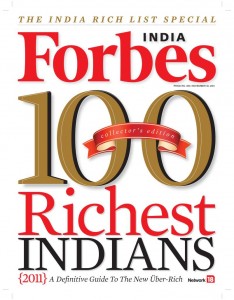
    According to the 2011 Forbes India Rich List inflation, corruption scandals and falling stock and currency prices are causing the wealth of India’s richest to diminish. According to the 2011 Forbes India Rich List, the combined wealth of India’s 100 percent richest people is down 20 percent from a year ago to US$ 241 billion. This year’s list also has 57 billionaires in all, a dozen less than last year.


    Mukesh Ambani holds the top spot for the fourth year in a row, with a net worth of $22.6 billion this year, despite seeing a drop of $4.4 billion. Steel tycoon Lakshmi Mittal remains No.2 with a net worth of $19.2 billion, down 26% from last year. Despite the recovery in steel demand, shares of his flagship, ArcelorMittal, the world’s largest steelmaker, plunged 40% due to surging costs.


    The biggest dollar loser was Mukesh’s younger brother, Anil Ambani, down $7.4 billion; he slipped out of the top 10 for the first time since his 2004 debut to No. 13 this year. His net worth is estimated at $5.9 billion, down from $13.3 billion last year.


    Third richest is Azim Premji, head of IT outsourcer Wipro, whose net worth of $13 billion is lower by 26 pecent from $17.6 billion last year. Mr Premji donated $2 billion worth of shares last December to a trust to fund his education charity.


    Naazneen Karmali, India Editor of Forbes Asia and Mumbai bureau manager of Forbes magazine, said: “This has been a turbulent year for India’s richest. Despite the economy growing at close to 8 percent, a spate of corruption scandals and rising inflation have taken a toll.”


    There are 14 new faces on the list this year. The richest debutante is Ajay Kalsi, coming in at No. 38 with a net worth of $1.39 billion. He is the founder and CEO of London-listed oil and gas outfit, Indus Gas, in which he has more than two-thirds stake.


    Father-son duo Kapil and Rahul Bhatia of travel group, InterGlobe Enterprises, make their debut at No. 51, with a net worth of $1.09 billion after their budget carrier IndiGo became India’s third-largest and most profitable airline. Making the list for the first time is also V G Siddhartha, who is ranked 84 on the list with a net worth of $595 million. He founded and runs Café Coffee Day, India’s answer to Starbucks.


    Indrajit Gupta, Editor of Forbes India, said: “Even though it’s been another tough year for the wealthiest Indian entrepreneurs on the 2011 India Rich List, the fact that there are as many as 14 new entrants is a clear pointer to the exciting and diverse business opportunities in this part of the world.”


    Among the 15 who dropped out of the top 100 altogether are Vinod Goenka and Shahid Balwa, former billionaires now in jail for their alleged involvement in a telecom corruption scandal; both deny wrongdoing. L. Madhusudan Rao of power producer, Lanco Infratech, saw his net wealth fall 78%, more than anyone else on the list.


    Only 19 of the 85 who return to the ranking are better off. One notable winner is Sun Pharmaceutical Industries’ Dilip Shanghvi at No. 11. He is the biggest dollar gainer and worth $6.7 billion, up by $1.5 billion from last year. The biggest percentage gainer is Hero Group patriarch, Brijmohan Lall Munjal, ranked No. 21 with $2.7 billion, who broke off his long-standing partnership with Honda Motor.


    This year, a minimum net worth of $370 million was needed to make the list of 100, down from $500 million last year. The full list of India’s 100 richest can be found in the October 2011 issues of Forbes Asia and Forbes India, which are available on newsstands now.

    The top 10 richest in India are:


    1) Mukesh Ambani; US$22.6 billion


    2) Lakshmi Mittal; $19.2 billion


    3) Azim Premji; $13 billion


    4) Shashi & Ravi Ruia; $10.2 billion

    5) Savitri Jindal; $9.5 billion


    6) Sunil Mittal; $8.8 billion


    7) Gautam Adani; $8.2 billion


    8) Kumar Birla; $7.7 billion


    9) Pallonji Mistry; $7.6 billion


    10) Adi Godrej; $6.8 billion


    Net worths are based on shares prices and exchange rates on October 12. Privately held companies were valued by comparing them with similar publicly traded companies. This ranking, unlike the Forbes billionaires list, has been broadened to include family fortunes.


    For more information and the complete list, visit www.forbes.com/india.