Tag: FM

  • Time to welcome Diversity in Radio?


    By Shruti Pushkarna


    Shruti PushkarnaAs you read this, commercial and state-owned radio stations all across the world are celebrating this day on air. Yes, it’s World Radio Day today.


    Surely a medium that has managed to stay relevant for over 120 years (since the first radio device was invented by Guglielmo Marconi in 1899) calls for celebration.


    With new technology and increasing penetration, the content development business is more dynamic than ever. Radio too has been experimenting with various avatars when it comes to programming models or expansion on digital platforms.


    But what hasn’t changed is its devoted listenership, which cuts across culture, age, ethnicity, gender, religion, economics and so on. I start my day with tuning in to my favourite station every morning as I drive to work. You can hear the radio blaring in the local chaiwallah’s shop (no reference to our dear PM here!). Cab drivers, hawkers, housewives, college students, senior citizens, all take in their daily diet of radio content.


    Another ardent group of listeners are millions of visually impaired citizens living in different nooks of our country. Did you know that 20% of the global blind population resides in India? That’s around 63 million people according to the World Health Organisation.


    And this large section of the population depends on radio for not just entertainment but information. Like several persons with disabilities, blind people are often treated as a burden by their families. Confined in the four walls of their homes, they remain isolated from the society. Deprived of education, they have little or no access to information.


    They find a friend in the RJ, solace in music and in that moment, the impairment ceases to be.  As part of my work, in an interaction with a parent, I learned that his 14-year-old blind boy who was absolutely tucked away from the outside world had no skills of communication or the ability to carry out any activities of daily living. But he could sing and dance because he listened to radio for most part of the day.


    In this cricket-loving nation, sighted fans may have moved on to mobile devices for live video streaming, but a visually impaired fan still tunes in to the good old radio commentary.


    Radio fascinates visually impaired people, because they can easily relate to it. There is no discrimination there, in terms of lack of access.


    The question is: are radio producers aware of this audience and their needs? Are they devising any content that is targeted towards the average visually impaired listener? There are a lot of social campaigns various stations undertake. They align with a cause, person or an organisation and garner support through their wide reach.


    I feel radio can contribute a great deal by initiating a campaign to sensitise people about the challenges faced by visually impaired people. Or let’s say how to offer help to a blind person you may encounter on a street, on the metro, in a bus or at an airport.


    Radio also has the potential to offer employment to blind people. India’s first visually impaired radio jockey K Srikanth started off his career with All India Radio and later worked with the BBC. There are private and non-profit institutions that offer courses in storytelling and radio jockeying. Among the section of blind people that has access to mainstream education and technology, there are many students who opt for media courses.


    Not long ago, I’d engaged with a graduate in mass communication from Bengaluru who wanted to become an RJ. He found no luck because he was blind. This young boy was well verse with technology, had acquired all skills of scripting, editing etc. He needed professional training like all newbies do, that’s all.


    This year the theme of World Radio Day is ‘Radio and Diversity’.  Perhaps a cue for the radio industry to promote inclusion and educate the society about ‘diverse’ needs of people who are just as equal citizens of India as you and I.


    Shruti Pushkarna is a former journalist (part of the founding team of MxMIndia) who has now moved full-time to the social sector. She heads operations of the New Delhi-based Score Foundation where she works as Director-Programmes & Communications. She writes for MxMIndia every other Thursday. Her views here are personal. She can be reached via Twitter at @shrutipushkarna


  • 92.7 Big FM goes retro in Mumbai too

    By A Correspondent


    After achieving much success in Delhi with the retro re-positioning adopted late last year, 92.7 Big FM’s Mumbai station has also turned retro. With its new tag line ‘Hit the, Hit Rahenge’, the station promises music from the 1960s to the 1980s along with heritage songs from the ’50s.


    The repositioning was effected on Sunday, June 23 and unveiled to the media last Friday (June 28). The announcement comes close on heels of its show ‘Suhaana Safar with Annu Kapoor’ launching with much fanfare.


    Said Ashwin Padmanabhan, Business Head – 92.7 BIG FM, “The decision to turn retro is backed by extensive research and audience mapping. As has always been our endeavour, we innovate with our offerings to ensure highest levels of listener engagement providing a ‘Life Banao’ experience. Our new positioning allows listeners to live in the present, while celebrating the past and we are confident of an excellent response as we look forward to further engaging with listeners and marketers alike.”


    According to a communique, the relaunch also promises a local flavour with Marathi-speaking RJs and play-out of Marathi music in the course of the week. The revamped content strategy will offer updates on stock and gold prices, city and sports news, traffic and weather status, music-related trivia, etc.


  • FM radio will generate Rs 14bn in coming year: E&Y report

    By A Correspondent


    India’s private FM radio segment is expected to generate revenue of around Rs 14 billion in 2012–13. With 245 private FM stations operating in 86 cities, the sector has been growing at a CAGR of 14 percent annually. Furthermore, the sector is expected to grow to INR 23 billion, at a CAGR of 18 percent, within three years of Phase III being rolled out, according to ‘Poised for Growth: FM radio in India’, the latest study by CII and Ernst & Young. The sector accounts for around 4 percent of the country’s total ad industry. Globally, radio’s average share of the total ad industry is between 5 percent and 10 percent.


    According to IRS 2012 Q2 data, radio has an estimated audience of 158 million people (out of which FM radio accounts for 106 million), as compared to 563 million in the TV segment and 352 million in the print sector. Advertising revenues comprise more than 85-90 percent of the total revenue generated by FM radio companies; non-FCT sales can contribute up to 20 percent of a radio company’s total revenue today.


    Ashish Pherwani

    Ashish Pherwani, Partner, Ernst & Young said, “The report is a compilation of the views of 23 industry stakeholders including radio companies, regulators, music labels, etc. It highlights the need for a speedy implementation of Phase III, which can grow the radio industry from INR14 bn to INR23 bn in three years, subject to enabling networking and cost management, development of a measurement metric which supports the industry, and ensuring license fee prices during Phase III auctions are not irrational. The report also highlights operational, tax and technology implications of the industry.”


    Current state of the industry

    Radio is not considered a primary advertising medium due to its limited number of stations. While larger cities are mostly covered by it, advertisers interested in regional ad campaigns prefer using regional print (which can enable them to reach several more cities and towns than radio currently can) or regional TV, which has grown significantly since 2005. Therefore, radio is only used as a back-up medium for most ad campaigns. However, with the implementation of Phase III, with 839 frequencies being made available for auction, radio is expected to provide advertisers with a much deeper reach.


    More than 50 percent of FM radio consumption is in homes, followed by people listening in transit (on mobile phones and in-car listening) and out-of-home listening at restaurants, offices, shops and so forth. Around 25 percent of total radio listenership is now on mobile phones, fuelled by handset manufacturers that have made FM radio a standard feature in most of their models. Some radio companies claimed that their research indicates that mobile phone listenership in metros comprises more than 75 percent of their total listenership.


    The study highlights the fact that the key challenges faced by this industry today include limited inventory, inability to demonstrate ROI and slow recovery of ad effective rates (ERs). Therefore, the need of the hour is for radio industry is to collaborate and implement a measurement system that supports the growth of the industry.


    Phase III

    Phase III of FM radio licensing promises further growth opportunities for the Indian FM radio industry, since it covers 294 cities and 839 licenses.  However, only 52 of these licenses are in high revenue-generating category A+, A and B cities.


    They expect the share of local retail advertising to increase from current levels to more than 50 percent of the total revenues generated in the segment, and activations and other below-the-line marketing initiatives to play a more important role in generating revenues. The margins of radio stations are projected to decline in the short run, stabilize in three to five years and then rise. The growth in mobile and internet ad spends could, however, pose a threat to the rise of FM radio.


    Phase III is also likely to make the industry more conducive to M&A due to proposals such as reduction of the license lock-in period from 5-3 years, an increase in the license period from 10 to 15 years, significantly more networking between all the stations to enable cost optimization, ownership of multiple frequencies in a city and an increase in the foreign investment limit to 26 percent from the current 20 percent. The industry needs to push for parity with the FDI norms of other media segments such as broadcast TV.


    In the long term, significant growth for the private FM radio industry will only be possible if several thousand stations are operationalized, burden of high licence fees is removed by increasing the variable component and reducing fixed costs, and news dissemination is equated with other media.


  • We plan to expand to newer markets: Radio GupShup

    By A Correspondent


    Launched in 2005, Radio GupShup is the radio arm of Purvy Broadcasts Pvt. Ltd. (PBPL). The Guwahati based private FM radio station is said to have its presence in districts of Kamrup, Darrang, Morigaon, Nalbari, parts of Baksa, Udalguri, Barpeta, Goalpara, and Nagaon districts in Assam as well as Ribboi District of Meghalaya and Samdrup Jongkhar in Bhutan.


    While Radio GupShup aims to further consolidate its position in the year 2012, achieving break-even may still be a distant dream. Come FM radio phase III, Radio GupShup hopes to further expand to newer markets. Besides, the FM station which has only recently re-launched its website hopes to reach not only the online community, but also the media agencies. In addition to these developments, Radio GupShup is said to be in a strategic sales alliance with Radio Mirchi which not only helps the Guwahati based private FM station (Radio GupShup) get exclusive business assistance but, also helps the FM station to enhance its sales capabilities (Radio Mirchi has its network across 14 states with 32 stations). Currently, Radio GupShup plays Assamese hits, Hindi and English hit music.


    In conversation with MxMIndia, Mr S Wassim Ahmed, Station Head, Radio GupShup spoke about the growth targets of Radio GupShup, break-even targets, the FM phase II plans and much more.


    Q: How would you rate the year 2011-12 for Radio GupShup?

    The year 2011 – 12 has been good. Both the programming and sales team have done a decent job and we want to further consolidate our position across markets.


    Q: What are your growth targets for 2012?

    As I have already said in 2012 we will look forward in consolidating our market position as a name to reckon with in the FM radio in Assam


    Q: What are your break-even plans?

    Break even would not happen within a couple of years as the FM radio business is not an easy money spinning business. As the saying goes … FM radio investor got to be a ‘laamba race ka ghoda’.


    Q: What are your phase iii plans?

    As and when Phase III happens, we at Radio GupShup would definitely go in for an expansion.


    Q: What about the website? How active are you on your website? Any specific plans for the website i.e. listening online radio etc.

    We have recently re-launched our website. This had been our weak point.

    We would be interested to reach out to the online listenership base, provided we have get link or some knowhow. More over as per my knowledge this concept would take some time to materialize because of I & B Ministry’s clearance has not yet happened.


    Q: And what was the thought process behind re-launching the website…?

    To keep in touch with the media planners since we need some kind of connect with the people outside the state vis -a- vis our radio sound, kind of shows we have, music we air etc. The media agencies also get a hang of our station. In nut shell it helps to pitch in for national commercials.


    Q: Has there been an increase in the ad rates?

    This ain’t petrol price where the rate can go up. In fact the rates at times go down below the Rs.100/spot mark. So you can imagine how competitive the market is.


    Q: What about the advertising categories on Gupshup?

    In my opinion the advertisers/media planners have gradually become more aware about the cost effectiveness of FM radio medium. Since TV and Newspaper advertising rates are humongous, Radio advertising as you might know is a good ‘sasta aur tekao’ medium


    Q: Do you have a creative and media agency?

    We do not have a creative agency, we produce our own stationalities.


  • Continuing the WorldSpace legacy @ Timbre

    By A Correspondent


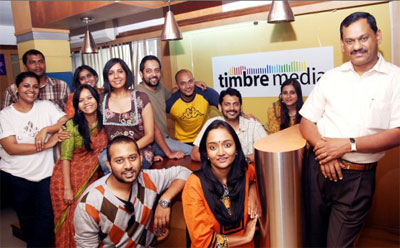
    The year 2012 has already begun with a series of announcements of radio on the web and other digital platforms. PlanetRadiocity.com for instance has launched a new genre – IndiPop Radio on their Web Radio station in March, 2012, and a Bengaluru based internet radio company- Venturenet Partners will be launching a premium model internet audio service- Radiowalla in April 2012. Formed in 2010 by former employees of WorldSpace India, Timbre Media is also slated to announce its internet radio station – Timbre Radio. All these players not only aim to provide innovative but, differentiated content and world class radio programming to their listeners, all through the power of audio.


    Besides the internet, Timbre Media plans to exploit the potential of the audio medium across digital platforms including mobile and DTH Television. On the mobile front, the Bengaluru based Timbre Media has already aligned with Vodafone India to offer listeners multiple music genre radio stations across the country. Listeners will have to pay Rs. 30 per month for 300 minutes of free usage. However this mobile radio service is not available in Andra Pradesh, Gujarat, Himachal Pradesh and Kolkata. Saregama India Pvt Ltd. which has acquired 10 per cent stake in Timbre Media provides the company (Timbre Media) with access to their music database.


    Timbre Media offers customised radio content for multiple broadcast platforms. It has four studios in Bengaluru and two studios in Mumbai among other studios in different parts of the country. In conversation with MxMIndia, M Sebastian, Co- founder and CEO, Timbre Media spoke about business model of Timbre Media, his break-even plan, the trends to watch out for, on traditional FM radio and much more.


    Q: Can you share with us how Timbre Media was formed? And what was the thought process behind the launch?

    Timbre Media was formed in 2010 by the erstwhile employees of WorldSpace India, to continue the legacy of world class radio programming that we provided through WorldSpace to our listeners.


    Q: What is the team size? Timbre Media is currently headquartered in Bangalore… Will you be setting up offices in other parts of the country too? When?

    We are a team of around 80 people, spread across different Indian cities.


    Q: Timbre Media specializes in programming radio contents for corporate entities, FM stations etc… Can you throw some light on the USP of Timbre Media? Also are you in talks with any FM station for radio content?

    Timbre Media has the unique advantage of a talent pool that introduced subscription based radio service in India and popularized the concept of genre based radio programming in our country. Our content is different, rich and compelling. We have learnt a lot about the expectations and aspirations of our target customers in the last 10 years of our association with WorldSpace Satellite Radio and its elite customers who valued quality and variety.

    We are in discussions with potential customers in every vertical that we are operating in.


    Q: What is the business model of Timbre Media? Is it advertising-led or a subscription model?

    Our business model is based on our philosophy that is to provide customized content that is different, rich and compelling and monetize the same in the best possible manner. It could be advertisement- or subscription-based depending on the vertical and the ecosystem we are operating in.


    Q: How many channels are in the offing? Which genres will you be offering? Will news also be part of it?

    We can’t say at this moment how many and what types of channels we will be offering. As I said, it is a function of the vertical and the prevailing ecosystem. We are focusing on providing customized content solutions to various customers and it could vary from one to the other. We are not averse to a particular type of programming or platform.


    Q: When are these channels scheduled to launch? Will it be only through mobile or will one be able to access them on the internet and DTH as well?

    We are not averse to any programming or platform. We are interested in utilizing our experience and expertise to meet the aspirations of the end user by using every available opportunity and monetizing the same to ensure the growth of Timbre Media.


    Q: Whom do you consider as competition?

    As such I do not think there is anyone who has the same experience and expertise that we have, and provide the same products and services that we offer.


    Q: How has 2012 welcomed Timbre Media? What are your growth plans?

    We have made considerable progress in the last two years. Thank God and the committed and passionate team that Timbre have, we have done extremely well compared to most of the start-up enterprises. We want to be a unique media enterprise that touches every customer who values quality audio content through all possible platforms and devices in the next 5 years.


    Q: Any specific trends you see in the Indian radio industry, particularly in the internet and mobile space?

    Radio industry is growing, and listeners are appreciating quality content for which they are willing to pay. The technology and platforms are enhancing the ecosystem every day and enabling the consumer to get what he wants, in the way he wants at the time he wants.


    Q: Also, should traditional radio begin to worry with your entry?

    There is sufficient space for everyone to co-exist and grow. Rather than worrying, we need to identify areas of partnerships that lead to mutual benefit and faster growth and work towards realizing the full potential of the audio medium.


  • RAMcheck: What women listen to…

    By A Correspondent


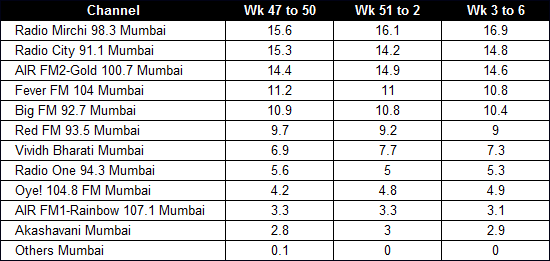
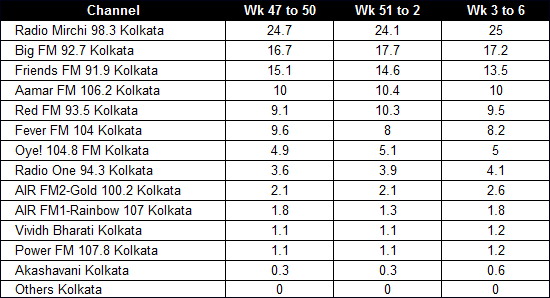
    Which are the most popular FM stations among women? MxMIndia shifts focus on women listenership trends in the four RAM (Radio Audience Measurement) – Mumbai, Delhi, Bengaluru and Kolkata. The data consists of women who are 12 years of age and above, all places of listening from WK 47, 2011 to WK 6, 2012. The most popular FM stations among women in the four metros are Radio Mirchi, Radio City, Big FM, Red FM and Fever FM.


    Delhi:

    Fever FM is the most popular FM station among Delhi women listeners, followed by Radio Mirchi, AIR FM2 Gold, Red FM and Radio City – the top five FM stations for women in Delhi. The listenership share of Fever FM has in fact moved slightly higher on Wk 3 to Wk 6 as compared to Wk 47 to Wk 50. The top five FM stations in the city have managed to sustain their listenership rankings from wk 47 to 50, 2011 to Wk 3 to 6, 2012. The other FM stations in the city are Big FM, Radio One, Oye! FM, Hit FM, AIR FM1 Rainbow, Vividh Bharati and Akashvani.


    Mumbai:

    For the women listeners in the commercial capital, Radio Mirchi is the numero uno FM station, at least in terms of station share. Radio City is the second most popular FM station among the women listeners of Mumbai followed by AIR FM2 Gold which is ranked three. The other two FM stations in the top five category are Fever FM and Big FM, which are ranked four and five respectively. While these top five radio stations have received a double digit listenership share, the other FM stations in the city are Red FM, Radio One, Oye! FM, Vividh Bharati, AIR FM1 Rainbow and Akashvani.


    Bengaluru:

    The Bengaluru women listen to Radio City the most. Radio City has maintained its leadership position among women listeners from Wk 47 to Wk 50, 2011 to Wk 3 to Wk 6, 2012. Ranked second is Radio Mirchi followed by Big FM, the third most popular FM station of the city. Ranked four and five are Red FM and AIR FM1 Rainbow. The top four FM stations have infact witnessed their share per cent in double digits. The other FM stations in the Bengaluru market are Radio One, Fever FM, Radio Indigo, AIR FM1 Vividh Bharati, Akashvani and Gyan Vani.


    Kolkata:

    Radio Mirchi is clearly the most popular FM station for Kolkata women. The FM station has maintained a significant lead in the city with 25 per cent of the market share as on Wk 3 to Wk6, 2012. Its nearest rival in Kolkata is Big FM with a share of 17.2 per cent followed by Friends FM with 13.5 per cent of the share. Aamar FM and Red FM are ranked four and five with a share of 10 per cent and 9.5 per cent respectively. The other FM stations in the city are Fever FM, Oye! FM, Radio One, Power FM, AIR FM2 Gold, AIR FM1 Rainbow, Vividh Bharati, and Akashvani.


  • The Anchor: 4 reasons why radio needs content innovation

    By Amitabh Srivastava


    #1 Emerging Technologies:

    Keeping in view the emerging technologies, it is very important that everything is taken into consideration; for instance social media can be of great help in terms of getting more interactive with listeners.


    #2 To Engage Listeners:

    These days the maximum listenership is through moving vehicles, so if there is some innovation catering to those audiences, then it would be a very good option.


    #3 Rise of Internet Radio:

    Internet radio is fast growing all over the world, and India is no exception. Internet radio will be emerging as the big thing very shortly.


    #4 Two-Way Communication:

    This is most important because the moment you get interactive there will be an increase in participation from the listeners also.


    Amitabh Srivastava is the Country Manager – South Asia, Radio Netherlands Worldwide.


  • Budget 2012: Entrepreneurs may find fund-raising easy with removal of restrictions for VCs

    By Paramita Chatterjee


    The eco-system for early stage companies is set to improve as the FM proposes to remove restrictions on venture capitalists, who earlier gained tax benefits on investments in nine specified sectors. The removal of this sectoral cap will make fund raising easier for entrepreneurs going forward.


    Besides, the proposal to float a Rs 5,000 crore India Opportunities venture capital fund with SIDBI to help start-ups is seen as a step to benefit micro and small enterprises (MSMEs) across the country. As per estimates of Federation of Indian Micro and Small & Medium Enterprises (FISME), there are currently 26 million MSMEs present in India, of which only 5% has access to institutional funds. “Any kind of equity support to MSMEs is welcome as it was greatly needed,” said Anil Bhardwaj, secretary general at FISME.


    However, analysts feel the amount is still too little. “The initiate to set up a fund for MSMEs is good but the budget allocation is small,” said Raja Lahiri, partner at advisory services firm Grant Thornton. But overall, its a good start, as currently not many MSMEs would require capital for expansion, said Bhardwaj.


    Source:The Economic Times

    Copyright © 2012, Bennett, Coleman & Co. Ltd. All Rights Reserved


  • 5 things you will never see any FM announcing in the Budget

    By A N Chorrea


    Yes, it’s Budget Day and while you tune into the various Budget Day specials, here’s our list of five things which you’ll never find the Finance Minister do.


    1. Reduce levies on cigarette: Alcohol may have seen some rationalization thanks to various international policies, but taxes on the cancer stick never goes down. Rightly so?

    2. Service tax net being narrowed: No way! If your service falls under a category which can be defined to not fall under any listed until now, be sure your celebrations won’t be endless. The FM’s folks keep widening the net every year.

    3. Dramatic reduction in income tax: Ha Ha Ha Ha Ha. Will never happen, even though every one tries all tricks in the game to duck direct taxes

    4. Make some really sound economic decisions. Remember, the Budget is as much a political document as it’s economic. And when you have in your Finance Minister also your government’s Political Troubleshooter #1, what can you expect.

    5. Abolish Budget speeches. It took many years after the British left us to bring the presentation to the forenoon. Now, it might make perfect sense to do away with the Budget, but no one’s complaining. Not the media definitely, as it’s one tamasha we all love… it helps up ratings and readership. And earn some good revenues.


    A N Chorrea is a seasoned media-watcher writing under a pseudonym


  • Anil Thakraney: Good FM, pathetic ads!

    By Anil Thakraney


    Okay, so I have ‘upgraded’ to 94.3 Radio One and have chucked all my CDs into the Arabian Sea. Spending time in the car, despite Mumbai’s horrendous traffic conditions, has become fun once again. And I must say the RJs don’t ramble much, and the music collection is superb. A good mix of new stuff and retro. So far so good.


    The only problem is the bloody ads. Most of them are sick, boring and nerve-wracking to hear. And each ad enjoys high frequency because radio is an inexpensive medium. Imagine what a downer it is to listen to rubbish in the middle of Coldplay and U2. This is like a tapori waiter on duty at the Zodiac Grille. Doesn’t work. So who’s at fault here, can we blame the radio station? Ideally, 94.3 should be picky about the sort of ads they broadcast, so that the overall ambience of the station doesn’t get screwed. They cannot disown the ads completely. But private FM radio stations are bleeding in India, so we really can’t blame them for lapping up whatever ads they can get their hands on. They have to survive, no? So I guess the station can be forgiven.


    What cannot be forgiven is the sad quality of the radio ads. I cannot understand why, after all these years, agency creative directors don’t get this fantastic medium. At a very low cost, one can produce award winning work in this space. With no dependence on visuals, the listeners’ imagination can be fired, they can be left to fit in their own images. And how very tantalizing that can be! I suspect the key reason radio advertising continues to languish is that the entire attention of the ad agencies is focused on TV commercials. And perhaps radio spots are still being written by bored copy trainees, who must be treating it as a chore rather than as a creative challenge.


    [youtube width=”400″ height=”200″]http://www.youtube.com/watch?v=oG3JPvH3tO0[/youtube]

    Come on, dear Creative Directors. It’s a fab medium and a huge opportunity. Don’t waste it. And I would also appeal to the clients not to accept garbage scripts. They must put pressure on their agencies to come up with sparkling radio spots. Even if the spots cost less, money is being spent on them, so they better be paisa vasool. If the brand managers quietly accept mediocrity, then that’s what will be dished out to them.


    ***


    PS: Haha. Armani shows you how to tip the room service staff. I strongly suggest you don’t try this out in a desi five star hotel. The consequences can be grievous!


  • Will private FM soon be allowed to freely air news?

    By Robin Thomas


    While it is known that private FM radio broadcasters will be permitted to air news and current affairs restricted to AIR (All India Radio), MxMIndia has learnt that all this could soon change with the setting up of a Central Monitoring System by the government.


    Mr Uday Chawla, Secretary General, Association of Radio Operators for India (AROI) has confirmed the development to MxMIndia, “The Government will be setting up a Central Monitoring System for content, following which restriction of content including news will be removed.”


    In fact, in an earlier interaction (interview) with MxMIndia, Ms Anurradha Prasad, President, AROI was of the same opinion that once a central monitoring system is set up there will be no restrictions to air news on private FM radio. When asked why the government is reluctant to allowing complete independence to private FM radio on news and current affairs, Ms Prasad stated, “The issue is of setting up a monitoring system so that radio content can be monitored by the government. Once this is ready, we don’t think the government will have any reason to limit news on FM radio.”


    The monitoring system will allow the government to monitor content aired on radio and perhaps prevent any possible adverse effects of the content aired. It is however not known when the central monitoring system will be set up by the government. At present private FM stations are not allowed to air news and current affairs on air and only a year back in July 2011, the government had given its nod to the MIB proposal which allows private players to carry news bulletins of All India Radio.


  • Why FM is more than just a recall medium: Rabe Iyer

    By Rabe T. Iyer


    Old media don’t die! They just bounce back in new avatars. Not so long ago, radio had been written off as dreary, downmarket and not so cool. Television and, later, “new media” were touted as being media of the future. Thanks to advancements in technology and a change in lifestyle, radio has made an incredible comeback.


    FM radio stations are one of the most popular entertainment mediums, offering millions of Indians a great mix of shows covering music, contests, discussions, humour and gossip, delivered in local flavour by popular young radio jockeys.


    Radio is a medium of the senses, bringing the listener’s imagination to life and taking him into an exciting new world of his own. Thanks to local FM stations, marketers have been able to connect with their target group, especially the youth, like never before.


    According to industry experts and analysts, there are 250-300 million radio users today. This penetration is surprisingly more than that of newspapers, known to be the oldest among present day media. In addition, at 145-150 minutes per day, the consumption time of radio is more than that of television, which stands at 140.  Today, 80-90 per cent of mobile users access the radio on their phones.  The fact that the medium is mobile has clearly helped to increase its usage and popularity.


    With the rollout of Phase III licensing, the Indian radio industry is optimistic of huge growth. The industry, which currently brings in around Rs1,100 crore revenue, will see 800 new radio stations across 300 towns coming up.


    Here, radio-based advertising can be used effectively for communication and positioning. It is to be used well since it can target a large audience because of its immense reach. It is useful in increasing awareness about a brand or business and helps in enhancing the brand image. The past couple of years have witnessed a flurry of activity in the FM sector. Not surprisingly, the radio industry of today can be compared to television in the early and mid-nineties, and one that is all set to boom further.


    With carefully worded scripts, brilliantly created situations, and tailor-made strategies, radio advertising is getting more innovative and effective day by day. It is perhaps one of the simplest yet most cost-effective and powerful means of communication in today’s world.


    Studies indicate that instead of two back-to-back commercials on television, one commercial on television and another one on radio give about a 20 per cent higher brand recall. Also, a television commercial, if aired on radio, works very well as the listener can then visualize the entire advertisement. Hardly surprising that over the years, print based publications and television channels have been using radio as a support medium, as a reminder medium, and as a mean to building up frequency.


    As mentioned earlier, another interesting facet of the Indian radio story is the mobile phone explosion and its convergence with FM. This has exponentially increased the width and depth of the market.


    Radio offers tremendous opportunities for advertisers and media planners who need to explore various options, following which they can effectively use the medium in their media mix. Conversely, broadcasters need to develop the market by being more responsive to an advertiser’s needs. This will provide an opportunity for the market to arrive at the final verdict on the effectiveness of the medium inIndia.


    Rabe T. Iyer is Business Head, 92.7 BIG FM