Tag: FIFA

  • Das ka Dum with Dr Bhaskar Das | If a country like Morocco could dazzle in the Fifa World Cup, what’s stopping a billion-plus-strong India? What should we do to win the Cup in, say, 2034?

    Bhaskar DasWell, it’s a question that’s been asked a billion times over. But we thought we should still ask our Wizard with Words yet again. Here’s the December 16 edition of Das ka Dum with Dr Bhaskar Das. Read on…


    If you wish to access the archives, please go to the Das Ka Dum tab on the website’s top navigation bar or click here: https://www.mxmindia.com/category/columns/das-ka-dum/


    Q. In 2021, Morocco population was 3.73 crore, India: 139.34. If a country like Morocco could dazzle in the Fifa World Cup, what’s stopping a billion-plus-strong India? What should we do to win the Cup in, say, 2034?


    A. Your question is very legit, and aspirationally desirable. It needs a complete culture hacking from the current mindset.

    Thanks to content streaming across density of devices, consumers are exposed to global content. Football ultimately is content and hence to be in that content game, we have to focus on football very differently, as we look at cricket, for instance. The potential players have to be identified and they have to be exposed to the game and it’s technology. Football technology is spreading in new ways globally. Once the potential players are identified, the government has to extend all facilities with a global benchmarks. The soccer players are, more often than not, burdened with the need for earning for their families (financially). They have to be freed from that, their health, food, training etc have to be taken to a different level than what is done now. I am confident if we can start (as I proposed and it can be bettered by experts) immediately, India can aim for 2026 participation.

  • Budweiser India ropes in trailblazers for last leg of FIFA campaign

    By Our Staff


    Budweiser, an Anheuser-Busch InBev (AB InBev) global brand, has collaborated with four trailblazers of the country for the latest leg of the FIFA 2022 campaign. Kissnuka, Siddhant Chaturvedi, Masaba Gupta and Santanu Hazarika come together to celebrate the shared passion and spirit of Budweiser and football with a war cry that unites people across borders– “The World Is Yours To Take”. Sharing their journey to the top like never before, the celebrities dive into the trials and tribulations they faced, the triumphs they rejoiced, and the immense anticipation experienced before any big moment – just like a football player does as he makes his way from the tunnel to the field.


    On the campaign, Vineet Sharma, VP Marketing – South Asia, AB InBev, said: “With over 35 years of collaboration with FIFA, Budweiser continues to create high energy consumer moments and conversations that shape the cultural fabric of the country. Through this  campaign, The World Is Yours To Take, we want to engage with consumers, celebrate the greatness of the sport and the determination, courage it takes to achieve success. We have collaborated with four phenomenal stars – Kissnuka, Siddhant Chaturvedi, Masaba Gupta and Santanu Hazarika, who inspire millions, through their journeys, to follow their dreams despite the challenges that may come their way.”


  • Brand Lessons from Football

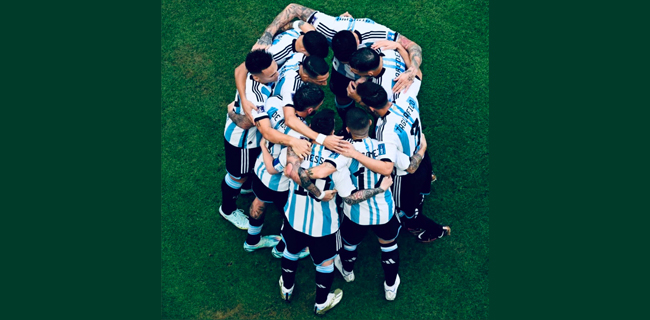
    Nicolas Otamendi’s photograph saying: Hoy más que nunca (today more than ever). Indeed! Picture source: @Notamendi30


    By Avik Chattopadhyay


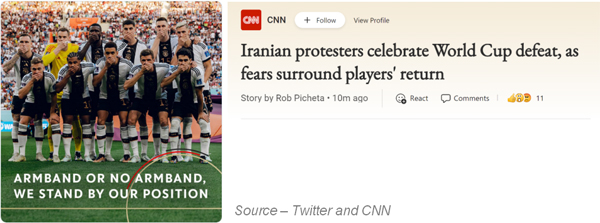
    Avik ChattopadhyayThe biggest sporting festival in the world is in full swing. Like every previous edition, this too is having its share of delights and controversies. Each day for the last 10 days, has thrown up one new story outside of the sport. Starting with the general narrative of human rights abuses and contract worker deaths in Qatar, the spotlight moved on to beer not being allowed in the stadia despite Budweiser being a sponsor, to the Iranian team not singing their national anthem in their first match, to the Germans doing the team gesture in support of the ‘OneLove’ movement, to the ex-Danish prime minister sitting next to the FIFA chief wearing a dress with rainbow sleeves, to a tweet before the US-Iran game showing the Iranian flag without the central crest and then to celebrations in Tehran on the national team failing to qualify for the next round. Guess Gianni Infantino has had his fill of hair-raising anxieties for one lifetime!


    Since we do not have actual wars and battles as frequently as till the 1800s, the sportsfield has been the battleground. Between countries. For movements. For protests. For spreading fear. For claiming ‘victories’. And football has been one of the biggest sporting platforms since the first World Cup in 1930. Given that 140-odd nations play the game and are ranked by FIFA, no other sport comes close by a mile in terms of popularity. It is the only team sport that has no hierarchies in terms of the elite performers and the also-rans. This is one team sport that has broken down barriers of colour, race, region and faith… time and again. Therefore, the lessons a brand can draw from the sport are priceless. And the current FIFA World Cup is no exception.


    The first 10 days have reiterated the following realities that every brand manager should pay heed to:


    No place for pedestals

    There are no hierarchies in the marketplace. There is a leader and a challenger. And that is all. What was good for yesterday is not good enough for tomorrow. And no challenger fears the holder of the crown. Champions are meant to be beaten. The higher ranked teams might not even go into the next round. They will be made to struggle for survival at every stage. Every new market or segment or target customer is a totally fresh playground.


    Possession is nothing

    This is the biggest learning from the game. One can possess the ball for only one-third of the time and yet win the game. In this edition too several teams have done so repeatedly. One does not get any point for possession but only on scoring goals. Quality over quantity!


    Counterattacks are critical

    The ability to react against intense competitive pressure is to take the game into the other camp and strike. For this planning counterattacks as part of the core strategy is important. The counterattack cannot be random and whimsical. It needs to be thought out, rehearsed and then deployed for maximum impact. The counterattack has the ability to break the morale of competition.


    Conversion matters

    One cannot come away from the game happy that the team made 17 attempts of which two hit the crossbar, five were parried away and six were corners. Every free kick within 25-30 metres of the opposition’s box needs to be converted. Same with every corner. These are opportunities given to you by the other team, so wasting them is almost a crime. Leads and footfalls need to be converted just like these chances, especially if handed over by competition.

    As I write, it is half-time in the Argentina-Poland game.

    Argentina must win this to move into the next round.

    It has had 65.8% possession, nine shots inside the box, seven shots on target, two shots blocked and one penalty saved. If this continues and Argentina cannot make it, who else is to blame? (Argentina beat Poland 2-0, and, yes, it has advanced to the next stage – Ed)


    Plan B in reserve

    Superstars can be injured. Pivots can underperform on certain days. Have alternatives ready in reserve. Also, have a balance of specialists and generalists. There will be the traditional defenders and midfielders who have clear roles but also the ‘liberos’ who can operate in different positions depending on the situation. Players who can use both feet to shoot are prized for any team. Ivan Perisic of Croatia typically switches flanks from his favourite left to the right when the game demands. And the opposition is typically not prepared for such sudden changes in plan. Multi-tasking works in football too as Johann Cruyff and his Dutch team demonstrated in the 1974 World Cup!


    Regard and respect

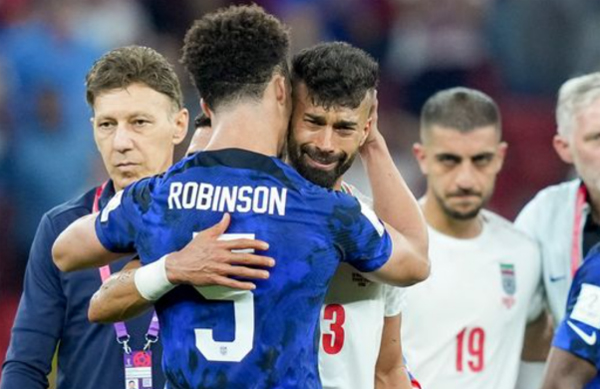
    At the end of the 90 minutes, once the battle is over, you go over and embrace the player of the other team. If you tackle a player, you give him a hand too to get up. When an injured opposition player is being tended to, you do share a bottle of water with his teammate. And when your opposition has been knocked out of the tournament, you do lend a shoulder to cry on. For it is a game after all. It is to win and not to kill, to defeat and not to destroy.


    Antonee Robinson of the US team comforts Ramin Rezaeian of Iran after the latter are knocked out of the 2022 FIFA World Cup – Source Getty Images


    Like a good Bong, Avik Chattopadhyay is nuts about football. Just as he is about brands, automobiles, advertising, culture, religion, Indian politics, American politics, British politics… almost everything. Like a good Bong, we told you. This is his column, which is published every other Thursday. His views are personal. And, yes, he’s a strategy consultant based in Gurugram.


  • FIFA World Cup 2022 announces Byju’s as an Official Sponsor

    By Our Staff


    Byju’s has been announced as an official sponsor of the FIFA World Cup Qatar 2022. Through this partnership, Byju’s will leverage its rights to the FIFA World Cup marks,  emblem, and assets, and run unique promotions. Byju’s joins many other global and regional majors who are official sponsors of the World Cup scheduled to be held later this year (November 21 to December 18 in Qatar).


    Screenshot from FIFA.com

    Said Kay Madati, FIFA’s Chief Commercial Officer: “FIFA is dedicated to harnessing the power of football towards the goal of enacting positive societal change. We’re delighted to be partnered with a company like BYJU’S, which is also engaging communities and empowering young people wherever they may be in the world. We look forward to supporting the promotion of BYJU’S educational learning opportunities, as  well as having them join the global drumbeat of excitement for the FIFA World Cup 2022 through  its association with this groundbreaking tournament.”


    Byju Raveendran, Byju’s founder, and CEO, said: “We are excited to be sponsoring the FIFA World Cup Qatar 2022, the biggest single-sport event in the world. It is a matter of pride for us to represent India on such a prestigious global stage and champion the integration of education and sport. Sport is a big part of life and brings together people across the world. Just as football  inspires billions, we at BYJU’S hope to inspire the love of learning in every child’s life through  this partnership.”


  • How & Why the U-17 W Cup can transform India’s sports landscape


    By Mahesh Ranka


    Indian football is at its Inflection point, waiting to explode, with the never-before focus and extensive media coverage of the FIFA U-17 World Cup. Never has India seen such high decibel, and mostly unpaid, coverage of a sporting event, probably outside a cricket event.


    The first ever truly world event is underway in India, the FIFA U-17 World Cup. And yes, the World’s watching. With 23 of the top teams in the world and the hosts competing to win the coveted title, this edition of the championship has more going for India, Indian Football and Indian Sports than any other sporting event hosted by India.


    A week into the FIFA U- 17 World Cup, India and it seems like Football (and the Indian team) is already a part of many a conversation. When you see Prime MinisterNarendra Modi, leading the Government of India support, The legend Amitabh Bachchan on the top-rated Kaun Banega Crorepati, and atleast one or two pages of coverage in leading dailies or definite part in the sports bulletins across channels, amongst many others supporting and urging India to follow football and support the event and team India, there’s only one way the event popularity is bound to travel.


    India – World’s New Playground!

    With India seemingly putting up a fantastic world event of the FIFA family, the country can put up claim and bid to host many more world sporting events. This bodes well for sports in general for India. Needless to say that with immaculate planning, the local economy gains in the short term and long term by hosting these events. Hosting of events has become a significant tool for combined Sporting and economic development across the world, and India must be on this bandwagon sooner than later.

    Thanks to FIFA, the digital following and information dissipation across over 10 million twitter followers alone, in addition to the local media coverage in at least 23 countries that are participating.

    This however is a long-term thought. Let’s see what we have in store in the near term. Football will grow, so will the following, the training and development and the infrastructure. Yes, this will all converge well for the corporate and sponsor support that becomes imperative these days for the growth, popularity and riches in the sports field.


    Focus on Football

    With the focus on football growing, government will actively look towards improving the infrastructure and support for benefit and development of the sport. With the current Sports Minister actually being a sportsperson, it’s likely that more action will happen on ground than being restricted to paper.

    The U-17 team of India and its performance clearly shows the potential Indian football has, and this will be heartening to the officials of the AIFF, who would want to have a programme to nurture and hone the skills of the current lot of youngsters, event as the senior team performance will be focus of improvement. This can only be done in form of a solid and scientific development programme set in a process that is replicable across the country.  We surely will have heroes more than that can be counted on the fingers of one hand, and that will help the following of the sport and potentially have footballing icons that will propel large scale support.

    Perception of football is likely to change, or the process started with Football be seen as a career option (mostly by parents of interested children), even as Indian Super League, I-league : in its new avatar will be present and be spoken about for five to eight months of a year, clearly showcasing a possible opportunity for potential players.

    We see some international clubs and development programs already in the country for some time and post the U-17 World Cup, more such providers will want to make India their home for new talent and business. It’s very clear that there is a massive gap in the current football in India (senior) and world over, and the only way for India is to close the gap rapidly, even leapfrog some aspects, as it’s done in many other fields.


    India the New market

    In many ways, the FIFA U-17 World Cup is like a test launch for FIFA’s ambition to spread football fever far and wide in India. There is clearly scope for at least 3 more sports (other than cricket) to have significant standing in India. FIFA would want to have Indian businesses spreading their wings globally be a part of the FIFA sponsorship programme, to widen the sponsorship and broadcast reach as well as create more competition for better pricing. E.g. Hero MotoCorp, with significant business interests in Football crazy markets, would be an ideal brand for FIFA to associate with in the current form.

    ISL and I-league import players and also have potential to export players to other markets, however larger football business in India will mean better financials and this may lead to many BIG names being a part of Indian football clubs.


    The Business of Football

    With the focus of the international community and India, firmly on Indian football, coupled with growth potential, it’s only natural that the final piece of the puzzle sets in. It usually becomes the most important part for inorganic and significant growth. Revenue.

    Broadcast, gate collection, licensing and merchandising and sponsorships are the key revenue earners for any sport. And one of the key pillars of the success of any sport is the volume of revenue generated through various avenues.


    Possible Rub-off Effect on other Sports

    Any significant cause brings in many effects, and with the potential of football, other sports would stand to benefit, as more people will be open to sampling different sports (watching/ participating/ competing). The focus of the administrators and government will also be on growing facilities and development plan for other sports. This effect should truly make India a multi-nation sports over the next decade or so.


    Mahesh Ranka is a sports management and strategy consultant and an expert on the business of sports.
  • Social Media ranking of International Sports Organisations reveals amazing findings

    By A Correspondent


    Burson-Marsteller and its specialised sport consultancy, TSE Consulting, have published a‘Social Media and Olympic Sport Ranking’ which gives an overview of how of international Olympic organisations are performing on social media.


    Over the past decade, the Olympics has dominated social media channels and the International Olympic Committee (IOC) and its 35 International Sports Federations, have all added Facebook, Instagram, Twitter, YouTube and Snapchat channels into their communications mix. The first-ever Olympic Ranking looks at how these international sports governing bodies use their social media channels, how effective their channels are and what lessons they can learn from each other.


    The rankings offer new insights into which sports have the largest social media fan base, as well as the sports which, while they may have a smaller fan base, nevertheless manage to create a stronger impact. The study finds that the IOC is in a league of its own, topping the rankings on both Facebook and YouTube. The Olympics Facebook page, with more than 15 million likes, is the most-liked page of any international organisation with twice as many likes as UNICEF.


    The International Football Association (FIFA), on the other hand, is ahead of the Olympics on both Twitter and Instagram. The FIFA Twitter account boasts 9.3 million followers, almost twice as many as all Olympic accounts combined. The Top five sports on Twitter are football (soccer), basketball, rugby, cycling and athletics.


    Despite having fewer followers, the IOC makes more impact with its Twitter communication, with each tweet being shared an average of 467 times compared to 108 times for the @FIFAcom account. However, @FIFAcom is among the most active sports federations on Twitter, with 23 tweets per day, 10 times as many as the @Olympics account thereby managing to gain more impressions than its Olympic rival.


    Jeremy Galbraith, CEO, Europe, Middle East & Africa at Burson-Marsteller said, “International sports organisations are discovering powerful new opportunities to engage directly with fans via social media. But our new study reveals that even global sports bodies with millions of followers, such as the IOC and FIFA, can still do much more to maximize the effectiveness of these new communications channels. Social media will continue to become ever more influential for sports governing bodies in years to come, both for engagement with fans and stakeholders, as well as being integral to their commercial strategies.”


    Lars Haue-Pedersen, Managing-Director, TSE Consulting commented, “Social media has become a critical avenue for international sports organisations, not only for communications but also as a strategic lever with the opportunity for these bodies to engage directly with the wide range of members, fans and other stakeholders worldwide. I look forward to seeing how sports governing bodies choose to incorporate and fully integrate these platforms in the way they run their core operations in the future.”


    The study finds that the presidents and chief executives of the 35 international sports federations appear somewhat reluctant to have personal profiles on social media. Only 12 sports leaders are active on Twitter, with Sebastian Coe, President of the International Association of Athletics Federations (IAAF), the most followed with 110,000 followers. In second place is Brian Cookson, UCI President, and third is Brett Gosper, CEO of World Rugby.


    Finally, the study also looked at who might be influencing Olympic sports federations through being followed on Twitter, the platform most likely to create connections between influencers, journalists and the media. Not surprisingly, the IOC Twitter accounts @Olympics and @IOCMedia are connected to most other sports federations.


    The Olympic sports news website Inside the Games is the most-followed media organization, just ahead of its rival Around the Rings, with the NBC Olympics Twitter feed in third position. The BBC’s Ollie Williams is the sports journalist most followed by Sports Federations, ahead of Ed Hula, founder of Around the Rings and sports writer Alan Abrahamson from 3 Wire News.


  • Utterly Butterly FIFA-licious! [updated]

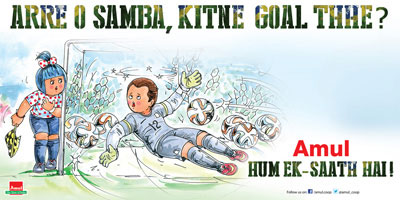
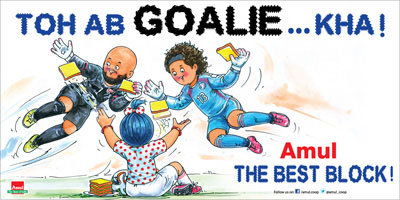
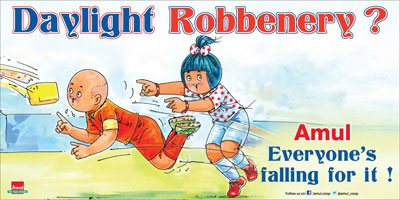
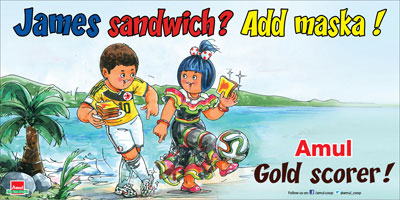
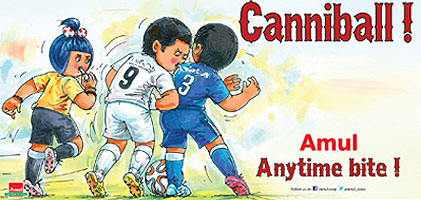
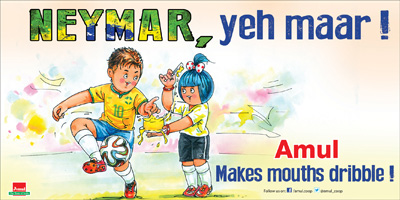
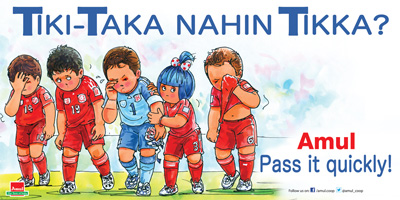
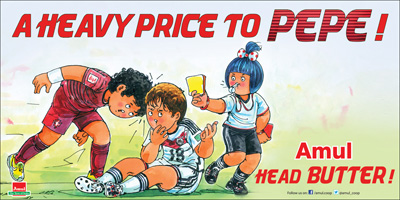
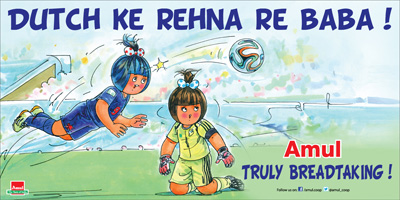
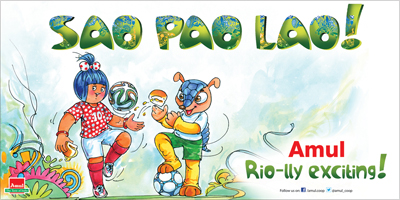
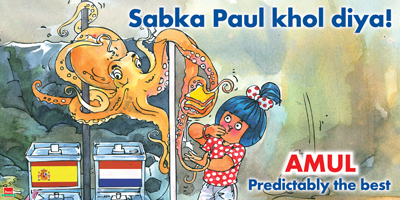
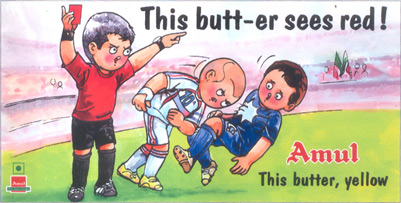
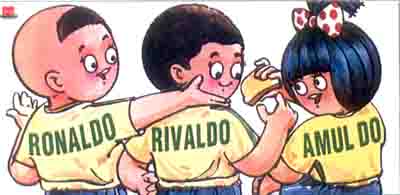
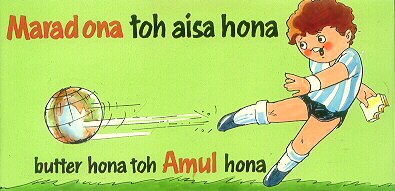
    You know how much we love to tell various stories via Amul ads. Over the years, they’ve indeed been the true chronicler of the times. Given the growing interest in the FIFA World Cup, there have been 12 ads created by da Cunha Associates for Amul Butter for the just-concluded championship in Brazil… six more since we had the first instalment of this feature on June 30. There have also been some classics over the years, though we couldn’t locate our favourite on Paolo Rossi from 1982 (Pau lo Roz hi) on the Amul website. Enjoy


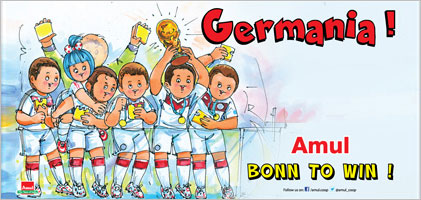
    FIFA World Cup winners ! – July ’14


    Brazil’s humiliating defeat ! – July ’14


    Lax officiating breaks Brazil’s back – July ’14


    The stars of FIFA 2014 ! – July ’14


    Dutch footballer fakes dive! – July’14


    Leading goal scorer – Rodriguez – June’14


    Uruguay striker uses his teeth! – June’14


    Brazilian star excels!


    Reign of Spain ends – June’14


    Portugese player’s aggro behaviour ! – June’14


    Persie helps Netherlands thrash Spain!


    FIFA fever begins…


    And here are some classics:

    Octopus Paul predicting the outcome of the World Cup Football final (2010)


    On French Captain Zinedine Zidane shown red card sending him off for vicious
    head-butting Italian defender in the chest during the World Cup Football Final (2006)


    On the Brazilian team’s star football players (2002)


    Football sensation Diego Maradona takes on the world by storm (1989)


  • Eikona samples football popularity before World Cup

    A week before the launch of any product, film, or event is extremely crucial. The pre-buzz prior to the launch created with multiple touch points across editorial, advertising, teasers / promos not only build up curiosity but also pulls the target audience to sample it, at least once. More so, for a massive global sporting event like FIFA, the communication has to get through boundaries of Age, Gender and SEC (Socio Economical Classification), Geography etc.


    Effectively, FIFA is not a very new phenomenon to India. The roaring success in FIFA 2006 has played a key role in repositioning Soccer as one of the most preferred sporting events among the Indian TV audiences. What made FIFA 2006 bridge with the Indian TV audiences? Amongst many, buzz creation was one of cornerstones towards making FIFA 2006 a success story. Within the construct of FIFA 2006 buzz, PR played a key role in influencing and pushing Indian audiences to take interest, watch and re-watch FIFA telecast.


    Eikona, the PR Audit division of TAM, did a curtain raiser on the PR buzz created by the FIFA custodians during the week prior to the opening day in the Print media in comparison with India – West Indies Cricket Series. According to the findings, soccer received an amazing 3 times higher editorial coverage than cricket during the 6 days ending on the first day of FIFA 2006 – June 9, 2006. Front page, sports sections, special supplements etc. FIFA was everywhere in practically every newspaper. Needless to say, these play a vital role in diverting eyeballs towards the channel and the game.


    Having proved the media hype created around soccer, if one were to analyze the day by day build up, one notices that June 9th, the first day of FIFA 2006 received the highest editorial coverage touching 54,000 CCMs as compared to cricket with a mere 7,000 CCMs – a huge 8 times higher.


    Across the six metros (Delhi, Kolkata, Mumbai, Chennai, Bangalore and Hyderabad), Mumbai newspapers generated the highest editorial volumes focusing on Soccer/FIFA touching close to 48,000 CCMs. Incidentally, cricket too received the highest volumes in Mumbai, only at one third that of soccer. Infact, across the 6 metros, soccer on an average received 3-4 times higher editorial space than cricket.


    It furthernites that across the six metros, at a language level, while English newspapers contributed 140,000 CCMs of editorial space to soccer, cricket received a mere 41,000CCMs. Soccer crazy Bengali papers allotted 11,000 CCMs to Soccer while cricket simple received 800CCMs.


  • Ranjona Banerji: TV does right by Baby Mahi!

    Ranjona Banerji

    By Ranjona Banerji


    Let’s cut TV news a little flak. What! Did I really just say that? The story of “baby Mahi” who fell into an abandoned borewell on her birthday last week but could not be rescued for almost five days is a made-for-TV story. Most newspapers would have reduced the story to a brief, if they carried it at all. Human life or in this unfortunate case death means very little in Indian newspapers unless it concerns high net worth individuals or happens in large numbers. Here also the concern is relative: for a Mumbai newspaper a bus that falls into a ravine and kills 50 of a marriage party in Bihar means less than an accident on the Mumbai-Pune expressway which kills 15. Geography and proximity carry more weight than the idea of death itself.


    TV news, however, challenges these assumptions made by the print media. While some may find TV’s attention to baby Mahi excessive or indeed point out that people fall into wells all the time, they are missing the point. Newspapers belong to the old, fatalistic India, where you took everything in your stride because life taught you that horrible things happen to everyone and especially to poor people. TV belongs to New India and as we learn every night, India always wants to know.


    And some questions, we must admit, need to be answered. There is no reason why people should regularly die because they accidentally fall into wells. There is no reason why we should not insist that safety protocols be put in place to prevent such accidents. There is no reason why local officials are not pulled up for being callous.


    Even if the hyperbole and hysteria generated by TV reporters and anchors can be vastly annoying, it does not mean that the reason they are having fits is not genuine. It took every bit of fortitude I could muster at midnight to listen to Arnab Goswami’s impassioned outburst against apathy and indifference (Wimbledon means I cannot get to TV news before midnight, yes I have no life and thank god I don’t watch football!) but behind all the bluster – there was a point.


    The trick for TV now is not to let this baby Mahi case turn into a real-life version of Peepli Live. They have to continue with the campaign they have begun so that they do not become as cynical as print journalists. It may be a tall order, but they started it.


    * * *


    I greatly admire Pakistanis who appear on Indian TV news discussions about terrorism. It takes great courage to withstand all that solid evidence against them and continue selling their government’s line. And they seem to be quite happy to do it. I do not get to watch Pak TV any more so I do not know if Indians appear on panel discussions to get pilloried. Does anyone know?


    * * *


    Football has taken over our newspapers. It is now emerging as cricket’s biggest competitor. We all know that Indian football does not generate any interest at all (somewhat like Indian hockey) but every FIFA tournament brings the lives of others to a standstill.


    The test I suppose is when cricket (with India playing) and football tournaments happen at the same time. Who do you think will win? Or will we then know whether sports pages are just lazy or have some top class brains involved in the planning?


    * * *


    The Times of India in its little debate section on the edit page has gone for and against on the use of the term “Bollywood”. It’s an old argument and an amusing one. We all know that the term is derogatory and was coined in the 1970s with that in mind. We also know that as long as the Hindi film industry continues to make song and dance potboilers, the term will continue to stick. No one calls Shyam Benegal or his oeuvre “Bollywood” so we all know the difference. TOI could have suggested options like “Goregaon”, since that’s where so many films are made and that’s how Hollywood got its name. Any takers?