Tag: FICCI-KPMG

  • 14% growth over 2017-21: FICCI-KPMG report


    By A Correspondent


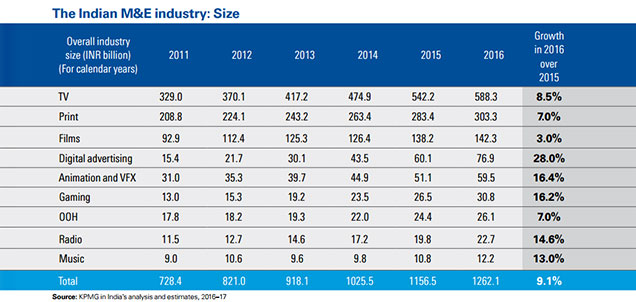
    The Indian media and entertainment industry in 2016 was able to sustain a healthy growth on the back of strong economic fundamentals and steady growth in domestic consumption coupled with growing contribution of rural markets across key segments. These factors aided the industry to grow at 9.1 per cent on the back of advertising growth of 11.2 per cent, despite demonetisation shaving off 150 to 250 basis points in terms of growth across all sub-segments at the end of the year. The ‘FICCI – KPMG Media & Entertainment Industry Report 2017’ launched at FICCI Frames 2017 in Mumbai, aims to capture a comprehensive picture of the industry’s growth story, challenges, future projections, and key underlying themes.


    The big story in 2016 has been the evolution of FTA channels post expansion of rural measurement in the television segment coupled with the impact of the 4G rollout and the resulting price wars. Both these factors have resulted in media consumption penetrating deeper into India, resulting in a realignment of strategy by media companies and advertisers alike.


    Compared to 2016, the industry is projected to grow at a faster pace of 14 per cent over the period of 2017-21, with advertising revenues expected to increase at a CAGR of 15.3 per cent. The year 2017 is likely to witness a marginally slower rate of 13.1 per cent as the economy recovers from the lingering effects of demonetisation and initial uncertainties arising from GST implementation.


    Commenting on the industry’s performance and way forward, Uday Shankar, Chairman, FICCI M&E Committee and Chairman & CEO of Star India, said: “The industry has gulped down the bitter pill of demonetisation trusting its long-term benefits and yet is set to bounce back to a steady growth, thanks to strong fundamentals. Building solid infrastructure and continued government support will help the industry reach the tremendous potential it holds for employment and creating socio-economic value for the country. A commitment towards a quick transition to digitisation will ensure growth for all stakeholders.”


    Added Girish Menon, Director, Media and Entertainment, KPMG in India: “[The year] 2016 was a mixed bag for the industry with digital media making its way to the centre stage rapidly from being just an additional medium. It is compelling existing players to rethink their business models. To accelerate growth, M&E organisations must rebuild their strategies to fit and thrive in the changing, digitally-oriented landscape. Nimbleness and flexibility will be at the core of sustainable businesses…. The long-term factors driving the future growth are expected to remain positive, with growing rural demand, increasing digital access and consumption, and the expected culmination of the digitisation process of television distribution over the next two to three years.”


    Sector-wise analysis:

    Television:

    The TV industry clocked a slower growth in 2016 at 8.5 per cent, attributed to tepid growth of 7 per cent in subscription revenues and a lower than estimated 11 per cent growth in advertising revenues. A key theme in 2016 was the emergence of FTA channels as a key focus area following the expansion in rural measurement by BARC and the resultant increased interest by both broadcasters and advertisers. Additionally, strong performance of sports properties and increased spending for the launch of 4G by telecom operators helped alleviate some of the pressure. The industry is expected to grow at a CAGR of 14.7 per cent over the next five years with advertising and subscription revenues projected to grow at 14.4 per cent and 14.8 per cent, respectively. The projections remain robust due to strong economic fundamentals, rising domestic consumption and growing contribution of rural markets coupled with the delayed, but eventual completion of digitisation.


    Print:

    The revenue growth rates of print continued to witness a slowdown at 7 per cent in 2016, as English newspapers remained under pressure. Regional language papers demonstrated strong growth, but were adversely affected by demonetisation given their high dependence on local advertisers. Print is expected to grow at 7.3 per cent, largely driven by continued growth in readership in vernacular markets and advertisers’ confidence in the medium, especially in the tier II and tier-III cities. Rise in digital content consumption poses a long-term risk to the industry.


    Films:

    Films grew at a crawling pace of 3 per cent in 2016. The segment was impacted by decline in core revenue streams of domestic theatricals and satellite rights, augmented by poor box office performance of Bollywood and Tamil films. Expansion of overseas markets, increase of depth in regional content and rise in acquisitions of digital content by over-the-top platforms are expected to be the future growth drivers that would help the segment bounce back at a forecasted CAGR of 7.7 per cent. However, factors such as dwindling screen count and inconsistent content quality could prove to be limiting factors.


    Digital advertising:

    Continuing to ride on a high growth trajectory with a 28 per cent growth in 2016, digital advertising has captured 15 per cent share in the overall advertising revenues, with a minor hiccup due to demonetisation. 4G rollouts and the resultant data price wars are providing further impetus to the growth as digital consumption and habits are becoming more mainstream. It is projected to grow at a CAGR of 31 per cent to reach INR294.5 billion by 2021, contributing 27.3 per cent to the total advertising revenues. Advancement in infrastructure, evolving audience measurement technology leading to better content and lowering data costs will drive user habits towards greater digital consumption, driving tremendous growth for the industry.


    Animation and Visual Effects (VFX):

    The industry grew at 16.4 per cent, driven majorly by a 31 per cent growth in VFX due to increase in outsourcing work, growing use of VFX in domestic film productions and increase in demand for domestic animated content on television. The industry is estimated to grow at a CAGR of 17.2 per cent over 2017–21.


    Out of Home (OOH):

    The industry registered a slowdown in growth rate at 7 per cent majorly due to adverse impact of demonetisation. OOH is projected to grow at a CAGR of 11.8 per cent primarily driven by development of regional airports, privatisation of railway stations, growth in smart cities, setting up of business and industrial centres, and growing focus on digital OOH.


    Radio:

    Radio recorded a 14.6 per cent growth led by volume enhancements in smaller cities, partial roll out of Batch 1 stations and a marginal increase in effective advertising rates. However, weak uptake in Batch 2 auctions of Phase 3 and delays in the rollout of majority of Batch 1 stations, coupled with adverse impact of demonetisation dampened the overall sentiment. Nevertheless, it is expected to be the fastest growing amongst the traditional mediums at a CAGR of 16.1 per cent, arising from operationalisation of new stations in both existing and new cities, introduction of new genres and radio transitioning into a reach medium.
     

  • Big role for direct selling: FICCI-KPMG


    The direct selling industry has recorded a high double digit growth of about 16 per cent over the past four to five years, notes a FICCI-KPMG report released on Wednesday. The market has grown to become a key channel for distribution of goods and services in the country, especially for health and wellness products, cosmetics, consumer durables, water purifiers and vacuum cleaners.


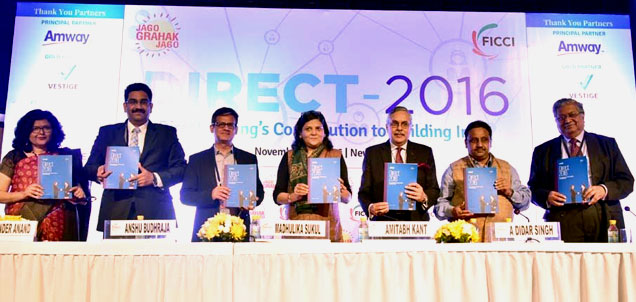
    Releasing the report titled ‘’The contribution of Direct Selling to Building India’’, Madhulika P Sukul, Additional Secretary, Ministry of Consumer Affairs said was delighted to see the contribution of the sector towards women empowerment and the figures of more than 60% women workforce associated with the sector has been astounding. Sukul urged the industry to join hands with MoCA and work towards the effective implementation of the guidelines for the sector that the ministry has come up with. The Additional Secretary promised that MoCA would continue to work towards the welfare of the consumers with active industry support and encouragement.


    Meanwhile, Amitabh Kant, Chief Executive Officer, Niti Aayog who was chief guest at the event said that direct selling will have to be given a great thrust as it empowers women, MSMEs and promotes manufacturing in India.  Kant applauded the efforts of the Ministry of Consumer Affairs to come up with the guidelines to govern the direct selling industry and is hopeful for its implementation by various states. He added that an effective and time bound implementation of the guidelines would act as a growth stimulator for the budding DS industry.


    He also urged the industry to embrace technology as the industry can deliver better and even faster once technology becomes its strength. He congratulated the direct selling industry for the efforts that they are putting in towards building the national economy and said that the sector is a major contributor towards the Indian growth story and promised to support the industry in addressing the hindrances and bottlenecks in due course of time. Also, he added that there is a huge opportunity that the industry raises in terms of pushing India towards the digital age.


    Later, Anshu Budhraja, GM, Amway India Enterprises presented the industry perspective and said the sector has immense potential in terms of the workforce that it trains and the job opportunities it generates. Budhraja said that the industry needs to work as per the gold standards, of which self-governance is a core concept. He congratulated MoCA for coming out with the much awaited guidelines for the sector and said that the guidelines would help in adding further value to the growth path of the industry. Anshu Budhraja added that “by 2025 the industry is expected to grow to ₹ 72000 crore from ₹ 7200 crore in 2016 providing 1.8 million self-employment opportunity.”


    Praveen Khandelwal, General Secretary, CAIT, emphasised on the need of having a retail policy that will encompass the cross sectorial approach and would help in adding avenues of growth for the sector. He said that there is a need to convert the guidelines proposed for the DS sector into laws towards which the Government is working relentlessly. Also, Khandelwal quoted that the passing of Consumer Protection Bill in the parliament would add more flavours to the development of the sector by reducing the mischief and [onzi operators. He also said that a board of internal trade that would look upon the matters associated with the internal trade and retail sector should be formulated with adequate representation from all the concerned stakeholders from the industry as well as the Government. Khandelwal said that retail, direct selling, e-commerce and SME’s are the four core pillars for the development of the national economy.


    FICCI Secretary General Dr A Didar Singh, Secretary General, FICCI said “Indian Direct Selling Industry is an important component of the Indian economy and acknowledging this, we at FICCI through our focused task force on direct selling is working dedicatedly towards the growth of this industry and seeking regulatory clarity for this new industry. FICCI is working closely with the Central and State Governments on the same and today’s conference is a step in that direction. I would like to congratulate MoCA for implementing the much awaited guidelines to govern the sector. I am certain that the effective enactment of the same would facilitate the further growth of the sector and act as a growth catalyst.


    Dr Singh said that Industry 4.0, or Industrie 4.0, is the current trend of automation and data exchange in manufacturing technologies. It includes cyber-physical systems, the Internet of things and cloud computing. Industry 4.0 creates what has been called a “smart factory” and urged the industry leaders to adhere to same. Dr. Singh also added that the bussing direct selling industry is exceptionally gender friendly and has been a crucial part of women empowerment.


    Direct selling, one of the oldest and traditional forms of selling, is a successful industry operating in over 100 countries, with a market size of USD180 billion. In India, the market was estimated at INR75 billion (2013‐14), and forms around 0.4 percent of the total retail sales in the country. To showcase the potential and highlight the opportunities and challenges faced by the DS industry, FICCI organizes its annual event on Direct Selling ‘DIRECT’ every year.


    The event witnessed intense panel discussions on the topics ‘’Way Forward Post Direct Selling Guidelines’’ and ‘’Direct Selling Contribution in Skilling, Women Entrepreneurship & As Food Distributors’’ which comprised of representation from wide array of concerned stakeholders including the Government and the industry.


    The panels suggested an effective implementation of the guidelines by the states in a time bound manner would yield wonders for the sector and would be an asset to it’s growth trajectory. Also, the sessions highlighted how the direct selling has evolved as a core pillar of the Skill India campaign and trains significant amount of workforce and makes them job ready. Also, the contribution of the DS sector towards the empowerment of women has been significant and the phenomenal number of 62% women workforce involved in the sector is remarkable.


    This year’s KPMG report takes a look at how the Direct Selling industry has positively contributed to several flagship schemes launched by the Government of India in the past 2 years, namely:

    :: Skill India: The Skill India scheme seeks to provide the institutional capacity to train a minimum of 400 million people by 2022. The Direct Selling industry annually trains over 5 million people in marketing and communication skills, personality development and leadership skills.

    :: Make in India: Many Direct Selling companies now make in India. Some rely on MSMEs for manufacturing their products, investing in & providing the right equipment and machines to the MSMEs for production. Driven by these initiatives, several MSMEs have now developed capabilities to cater to the needs of other MNCs and have commenced supplying to them, in the process promoting the Make in India initiative

    :: Women Empowerment: Due to the dominance of women centric products offered under Direct Selling, the industry provides self-employment opportunities to a large number of women. In 2015 alone it has provided self-employment to over 3 million female distributors. By providing income generation opportunities and trainings, Direct Selling promotes holistic development of women.

    :: Digital India: The Direct Selling industry is adopting measures in the digital sphere that not only benefit the Direct Selling entities, but also ensure ease of doing business for its distributors and improved experiences for its end consumers.  Mobile applications and websites have been launched by Direct Selling companies for its distributors to order products, monitor payments and access training modules.

    :: Startup India: Direct Selling entities, are now catering to global FMCG clients. Direct Selling has also promoted startups in avenues such as transportation and logistics, trainings, app development, etc.


  • M&E CAGR 2014-19: 13.9 %, as per FICCI-KPMG


    India is taking its place on the global stage as a market with tremendous growth potential — and a country with exciting investment opportunities.


    Offering the world’s largest youth workforce, an expanding middle-class that constitutes one of the biggest consumer bases, and a robust, well-functioning democratic system, India, along with its pro-reforms government, is now scripting a turnaround story. The global economy is struggling to gain momentum, as China suffers a slowdown, the Euro-zone slips into deflation, and Japan’s economy is too soft to absorb the fiscal consolidation plan. Despite its shaky global economy, India is performing relatively well, with a stable macro-economic environment (inflation eased while the current account deficit came under control) bolstering the economic outlook. The Indian economy is on a strong footing, with an estimated growth of 7.4 per cent in the Financial Year 2015, while growth is pegged at between eight and 8.5 per cent in FY16.


    As a result, there is a marked shift in investor sentiment towards India. Global investors are increasingly beginning to view the country with renewed interest and optimism, thanks to the government at the Centre and its reform agenda. The government’s recent Budget announcements underpinned this sentiment further. An improved business climate, together with policy reforms, could boost the country’s long-term growth potential.


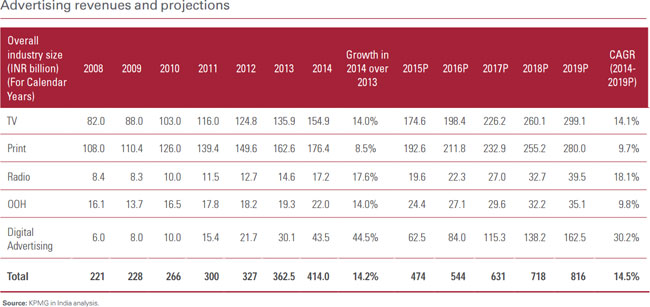
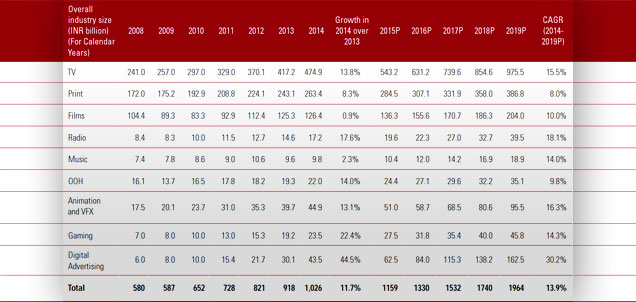
    This growth story then extends itself across the Media and Entertainment sector. We estimate that the Indian market is poised to grow at a CAGR of 13.9 per cent, to increase from Rs 1026 billion in 2014, to Rs 1964 billion by 2019 — a growth rate that is almost double that of the global media and entertainment industry.


    The growth in popularity of digital media continued to surge in 2014, with a significant increase of 44.5 per cent (over 2013) in digital advertising. At the same time, traditional media continued to exhibit healthy growth rates as well, with the television sector continuing on its path to cable digitization; advertising across media buoyed by the spends during the 2014 Parliamentary elections, and the emergence of e-commerce as a significant new category. Advertising revenues in 2014 grew at a rate of 14.2 per cent over 2013, to reach Rs 414 billion, of which print (43 per cent) and television (37 per cent) captured the lion’s share.


    The media and entertainment sector in the country is poised for exciting times, powered by the growth in digital media consumption, and the supporting environment created by regulatory reforms. The new digital ecosystem, however, brings with it a new set of challenges, like an increasingly-fragmented and on-the go audience and hurdles to monetise digital platforms. To seize the opportunities, front-runners are expected to continue to place consumers, both domestic and global, at the heart of their strategies for content and access channels.


    Collaboration across players may remain the key to success. Efficient and transparent measurement systems at an industry level, and focus on big data analytics at a stakeholder level, can be critical to measure and monitor performance. The momentum generated by regulatory reform needs to be underpinned by strong implementation on the ground, and partnership across the value chain.


    And then a ‘global superpower’ may be a not-too-distant reality.


    Extracted from #shootingforthestars. The FICCI-KPMG  Indian Media and Entertainment Industry Report 2015


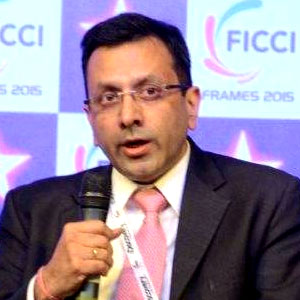
  • Star India’s Sanjay Gupta shares broadcast mantras at FICCI 2015

    By A Correspondent


    The broadcast subscription side of Media & Entertainment Industry alone has the potential to grow ten-fold to Rs 300,000 crore a year, provided it moves from a pre-liberalization mindset of price control to free market, addressed Sanjay Gupta, COO, Star India, to an audience of M&E professionals at FICCI Frames 2015. He was speaking at ‘Vision 2020 – laying a transformative roadmap for Indian Broadcasting’ with other leaders from the M&E industry and MIB and TRAI in a thought-provoking discussion moderated by celebrated media writer Vanita Kohli Khandekar.
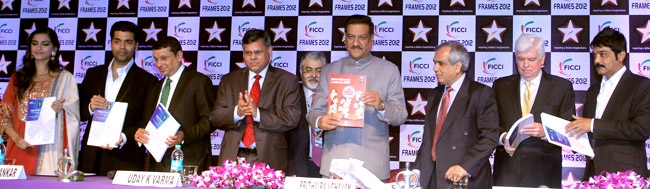
     

    Even as the FICCI-KPMG Indian Media & Entertainment Industry Report 2015 revealed that the total industry had grown to Rs. 102,600 crore in calendar year 2014, Gupta said that the true value of the industry is far from being unlocked.


    “All broadcasters are creating as much as 100,000 hours of fresh content each year, engaging 700 million consumers in this country, which is not a small number,” Gupta said, “but what are people paying for consuming all of this content? Around Rs 30,000 crores a year. See how that compares to a simple market like soaps and detergents, for which people are paying Rs. 100,000 crore a year in India!”


    He raised the question on how big this industry can be: “I believe it (broadcast subscription) can be Rs. 300,000 crore, instead of Rs. 30,000 crore. How do we get this to happen?”


    “The fundamental issue is that we have regulated this industry from a very wrong perspective.” He brought in the example of Telecom industry which has shown dramatic growth in the last 10 years – from 40 million subscribers to 900 million subscribers and from an $8Bn to a $100Bn – on the back of de-regulation and players themselves taking measures to benefit consumers.


    Citing glaring and illogical price disparities in media, Gupta said: “We charge Rs.10 for Star Plus, which caters to a very large consumer base; for Star World, where only a small set of consumers watch English content, the price is Rs 2.5!  It is ironic that in India the pricing for premium content is less. Another example – in Kerala, we had priced Asianet, the No.1 channel in that market, at Rs. 5.35 and the regulator asked us to take out that extra 0.35 paise! I don’t know what the right price should be, but let the market determine that.”


    Explaining how pricing is still genre-based and not driven by nature of content, he said: “In sports, despite the big difference in costs between World Cup cricket, which possibly everyone is watching, and UFC – which many would not have even heard of – the pricing remains the same!”


  • @FF12: Opening session weighs pros & cons of digitization


    By A Correspondent


    FICCI Frames 2012, now in its 13th year, kicked off on March 14, Wednesday at Hotel Renaissance, Mumbai. The morning session started with a welcome address from Karan Johar, Co-chair, FICCI Entertainment Committee. After Mr Johar’s welcome address, Uday Shankar, CEO, Star India & Chairman, FICCI Broadcast Forum, took the stage to address the audience.


    In keeping with the theme, ‘Embracing the Digital World’, Mr Shankar said “digitisation is a big reality which will revolutionise the way content (creation and distribution) is offered”. Even though he said that digitisation will create a level playing field for the broadcasters and the cable operators, he had a word of caution to ad when he said that his biggest concern was “the chaos which will be caused by the broadcast industry’s inaction”.


    Mr Shankar was of the opinion that instead of lamenting the loss of carriage fees, the MSOs should appreciate the opportunity of “customisation and localisation of content” being presented by digitisation.


    Though Mr Shankar admitted that there is a need for legislative enablers to remove the bottlenecks, he also said that the broadcast industry is still not ready to move to the digital format. To drive home his point he used the example of the film The Artist, where the star of the silent era films loses out when he refuses to move with times. With this word of caution, Mr Shankar ended his keynote address.


    Prithviraj Chavan, Chief Minister,Maharashtra, next took the stage to talk about the “exciting times that we are living in”. He said that the challenge is to adopt the regulatory framework to the new technology and ensure that over regulation doesn’t kill a good thing. He also said that the move towards digitisation will create a huge employment opportunity. He stressed on the need to balance technology with creativity, adding that “growth should not be lopsided but all inclusive”.


    Shri Chavan also stated that the government is taking all possible steps to ensure that content piracy is curbed but accepted that the state has not delivered on its promises to curb piracy till now.


    He also touched upon the need for regulation and said that regulation is a major challenge. Shri Chavan suggested that instead of the state regulating the media; it should look at self regulation.


    Moving on, Shri Chavan welcomed the foreign delegates and announced that his government was creating new centres for film shooting in the state. He stated that the first such centre will come up atKolhapur, where entrepreneurs would be provided with lots of financial incentives. He said that the government will “protect any creative attempt within the framework and not allow any fascists elements to disrupt it”. He also assured the film industry that its concerns over policing on film locations would be looked into.


    The Chief Minister also released the FICCI-KPMG Indian Media and Entertainment Industry Report 2012; FICCI-Amarchand Lawbook and ‘Positivity: The impact of television on India’ by The Indian Broadcasting Foundation.


    Mr Jehil Thakkar, Head, Media & Entertainment Practises, KPMG made a brief presentation about the highlights of the FICCI-KPMG Indian Media and Entertainment Industry Report 2012.


    Senator Chris Dodd, Chairman, Motion Pictures Association of America, who took the stage next, underlined the need to look into stringent regulations against content theft.  “When content is stolen, 95 per cent of the people who contribute to the vitality and success of a film are adversely affected”, he said. Quoting an Ernst & Young report, he said, movie theft contributes to a loss of US$ 1 billion annually and threatens the jobs of half a million people. He stated thatIndiais among the top 10 nations as far as online copyright infringement is concerned. He said that technology (digitisation) and content need each other and one can’t be without the other.


    Mr Uday K Varma, Secretary, Ministry of I&B, opened his address by stating that the concerns that the industry had over digitisation and the Phase 3 of FM radio have been addressed by the move to allow 839 new FM stations and 500 community radio stations.


    He stressed that the government is committed to ensure time bound digitisation and said that come July 1, the four metros will switch over to the digital format and the plan is to ensure that the move to digitalisation is completed by December 31, 2014. He agreed that the challenge was mammoth- to convert 80 million analog connections to digital format but added that the move will ensure faster and deeper penetration. “This will address a plethora of issues facing the television industry, such as addressability, carriage fees, audience measurement and consumer choice,” he said.


    Mr Varma added that in order to combat piracy, they intend to carry out an all-encompassing multi-media campaign during the 12th five year plan period involving all stakeholders from the film and music industries.


    He also outlined the ministry’s plan to celebrate 100 years of cinema inIndia. Mr Varma said that the Government of India, in cooperation with the film industry, has a line of activities between May 3, 2012 and May 3, 2013. It also proposes to present a tableaux of ‘100 years of Indian Cinema’ at the Republic Day parade next year where the plan is that the stalwarts of the industry also take part.


    Mr Varma also announced that the government is setting up a National Film Heritage Mission to safeguard India’s celluloid history by undertaking picture and sound restoration of more than 2,500 films. In Addition, theMission, with a budget of over Rs500 crore, would also look at constructing preservation vaults for archiving restored material, and for conducting workshops and training.


    The session closed after a vote of thanks given by Dr. Rajiv Kumar, Secretary General, FICCI.


  • @Ficci Frames 2012: KPMG study says M&E sector is set for good times ahead

    By A Correspondent


    HILE the effects of the economic downturn were felt across sectors and industries last year, it was a steady year for the Indian Media & Entertainment (M&E) industry that registered a growth of 12 percent over 2010, to reach INR 728 billon. According to the FICCI-KPMG report, the growth trajectory was backed by strong consumption in tier 2 and 3 cities, continued growth of regional media, and fast increasing new media business. Overall, the study predicts the industry to register a CAGR of 15 percent to touch INR 1,457 billion by 2016.


    But despite the positive numbers recorded, the report agrees that 2011 has indeed been a challenging year not just for the Indian M&E industry, or even the Indian economy, but for the larger world economy. While India is still expected to grow at a healthy pace, growth is projected to be lower than expectations.


    The report notes that television continues to be the dominant medium while sectors such as animation & VFX, digital advertising, and gaming are fast increasing their share in the overall pie. Radio is expected to display a healthy growth rate after the advent of Phase 3. Print, while witnessing a decline in growth rate, will continue to be the second largest medium in the Indian M&E industry. Also, the film industry had reason to cheer, with multiple movies crossing the INR 100 crore mark in domestic theatrical collections, and INR 30 crore mark in C&S rights.


    Advertising spends across all media accounted for INR 300 billion in 2011, contributing to 41 percent of the overall M&E industry’s revenues. Advertising revenues witnessed a growth of 13 percent in 2011, as against 17 per cent observed in 2010. In terms of performance, 2011 proved to be a year with mixed results in terms of growth across different sub sectors. The traditional media businesses experienced a slowdown compared to last year, especially in the second half of the year. However, the new media segments like Animation and VFX, Online and Gaming businesses witnessed phenomenal growth rates.


    Highlighting some visible trends spotted in the report, Dr. Rajiv Kumar, Secretary General, FICCI said, “The key highlights are rise in digital content consumption, launch of diverse content delivery platforms, strong consumption in tier 2 and 3 cities, rising footprint of the players in the regional media, rapidly increasing new media business and regulatory shifts.”


    Putting forth a more pragmatic outlook, Jehil Thakkar, Head of Media and Entertainment, KPMG said, “The Media & Entertainment industry landscape is undergoing a significant shift. Cable digitization, the promise of wireless broadband, increasing DTH penetration, digitization of film distribution, growing internet use are all prompting strategic shifts in the way companies work. Traditional business models are evolving for the better as a host of new opportunities emerge.”


    Key trends and industry drivers:

    – Growth in digital content consumption across media


    Key Highlights –

    Print: The print industry grew by 8.3 percent from INR 193 billion in 2010 to INR 209 billion in 2011. The growth was slightly lower than our expectation of 9.5 percent last year due to the challenging macroeconomic environment and reduced advertising spends.


    Television: The over-all television industry is estimated to be INR 329 billion in 2011, and is expected to grow at a CAGR of 17 percent over 2011-16, to reach INR 735 billion in 2016. The share of subscription to the total industry revenue is expected to increase from 65 percent in 2011 to 69 percent in 2016. The TV industry continues to have headroom for further growth as television penetration in India is still at approximately 60 percent of total households.


    Films: With several high budget Hindi releases lined up across the year, 2012 is expected to sustain the growth momentum witnessed in 2011. The Indian film industry is projected to grow at a CAGR of 10.1 percent to touch INR 150 billion in 2016. The industry is estimated to be INR 93 billion in 2011 indicating a growth of 11.5 percent vis-à vis 2010.


    Music: While 2010 was the year of structural shift from physical formats to digital ones, 2011 provided users viable options of music consumption through different digital platforms. The Indian music industry achieved revenues of INR 9 billion in 2011, registering a growth of 5 percent over 2010.
    Radio: Overall, the industry grew 15 per cent in CY 2011 to reach INR 11.5 billion, compared to INR 10 billion in CY 2010. Volume increases in certain markets and rate increases for the leaders in metros drove growth.


    New Media: Digital advertising is expected to grow at a CAGR of 30 per cent from 2011-16; digital adspend reached approximately 5 per cent of total M&E industry advertising revenue in 2011. Growth is largely driven by increase in internet penetration and proliferation of new devices.


    Animation & VFX: Animation, VFX and Post Production industry achieved estimated revenues of INR 31 billion in 2011, a robust growth of 31 percent over 2010. Growth was achieved on the back of increased contract work, higher VFX content in movies, 2D/3D conversion projects.


    Out of Home: The OOH sector was hit relatively harder by the global economic slowdown than other sectors of the Advertising industry. The sector registered a Y-o-Y growth of 7.6 percent.


    Digital technology continues to revolutionize media distribution – be it the rapid growth of DTH and the promise of digital cable, or increased digitization of film exhibition – and has enabled wider and cost-effective reach across diverse and regional markets, and the development of targeted media content.


    There has been increased proliferation and consumption of digital media content – be it newspapers and magazines, digital film prints, and online video and music or entirely new categories such as social media. Accordingly, online advertising spends have seen a spurt in growth vis-a-vis spends on traditional media.


    – Rise of new age user devices

    Smart phones, tablets, PCs, gaming devices, etc. all form the foundation of a new wave in media usage. This is gradually impacting the way content is being created and distributed as well. Multiple media including TV, films, news, radio, music etc are being impacted with this change.


    – New age consumers adapting themselves to the newer technologies

    As Indian consumers evolve, there is a heightened need to engage them across platforms and experiences. There is a greater need for integration and innovation across traditional and new media, with changing media consumption habits and preferences for niche content. Media companies today have no choice but to provide more touch points to engage with audiences.


    – Regionalisation

    Regional television and print continued its strong growth trajectory owing to growth in incomes and consumption in the regional markets. National advertisers are looking at these markets as the next consumption hubs and the local advertisers are learning the benefits of marketing their products aggressively.


    – An advertising revenue dependant industry

    The ARPU (Average Revenue Per User) for television, average newspaper cost for print and average ticket price for films continue to be low on account of hyper competition in these industries. Segments like Radio and a significant portion of online content are available free of cost to consumers. Owing to this, the Indian consumer is still not used to paying for content and hence the industry players are sensitive to the impact of the slowdown which affects the budgets of advertisers.


    – Awaited regulatory shifts

    Lastly, apart from the shifts in consumer preferences, company strategies and business models, one big change awaited for the next growth wave is the implementation of recently enacted and regulations on digitisation for cable, implementation of Phase 3 and copyright for Radio and the roll out of 4G. These shifts are expected to be game changers in terms of how business is being done currently and what could be the path going forward.


  • Is radio not good enough for premium brands?


    By Robin Thomas


    Over the years, growth of Radio as a medium has been restricted, thanks to TV. But, to the credit of many a radio expert over the years and advertisers who have believed in the medium, radio continues to sail; and sail even more promisingly when times are choppy.


    Also, sample this: The FICCI-KPMG Indian Media and Entertainment Industry Report 2011 states that the radio industry in India is expected to grow at 20 per cent CAGR (Compounded Annual Growth Rate) from the current base of around Rs 1000 crore. Radio’s share of media spends is also expected to rise from 4 per cent to 5 per cent by 2015. Among categories that advertise on Radio, Real Estate, Telecom, Retail, Education and TV channels are the ones advertise the most.


    The medium promises reach, greater recall and marketing solutions that are cost-effective. Despite this, why do premium advertisers shy away from advertising on the medium? It is known that premium brands prefer speciality magazines, internet and mobile and TV more than radio.


    Harish Bijoor, CEO, Harish Bijoor Consults agrees that premium brands don’t advertise much on radio. “Premium brands look at radio as a non-premium medium. There is ample research available which reveals that premium-category shopper do not depend on awareness scores for luxury brands from radio. In fact, radio tends to negate effort for luxury brands as of now and proves counter-productive to the effort. Radio is much too mass for luxury brands.”


    According to B Surender, Senior Vice President and National Sales Head, Red FM, the share between national and local advertisers on radio are 50:50 of which premium advertisers contribute merely six to eight per cent of the overall national advertisers. BMW, Volkswagen, Mercedes, Skoda, Blackberry, Marks & Spencer, Louis Philippe, Tanishq, smartphones , Lufthansa , British Airways ,Virgin Atlantic, Singapore Airlines, Emirates are some of the premium advertisers advertising on radio.


    For most of these premium brands radio is more or less a reminder medium, it is an extension of the television or print advertisements. Luxury watch brand, Seiko for instance does not advertise on radio at all whereas Jet Airways and HDFC Life heavily advertise on internet and television.


    Both internet and television have an edge over radio on premium luxury brands. While television has the benefit of being an audio-visual medium, internet is a highly interactive medium.


    Manish Dureja, Vice President, Marketing, Jet Airways said that the airline brand banks more on internet and mobile as against radio. “We are not advertising much on radio or on television as most of our marketing budget is performance driven, where we look to generate sales through search engine marketing and predominantly digital marketing. With internet penetration and the emergence of internet mobile, it has become mandatory for us to be present in the online domain. Radio, on the other hand is a localised medium and caters to a specific city. More importantly through digital media, I am able to reach consumers far more effectively than any other medium.”


    For Sanjay Tripathy, Executive Vice President-Head Marketing and Direct Channels, HDFC Life, television and the internet are the preferred medium because of the reach and better ROI. “Television is the preferred medium for HDFC Life because of the awareness it creates, and maximum reach it offers, whereas the internet has delivered better ROI for us. Radio on the other hand is more of a brand recall medium so most of our marketing budge or the media spends is skewed towards television and the internet” he said.


    Disagreeing that premium luxury advertisers are apprehensive about advertising on radio, B Surender of Red FM said that although there was a perception issue in the past, some of them wrongly assumed that the quality of FM listenership profile may not be very good. “Contrary to this belief, there are instances of advertisers abroad specifically using radio to target billionaires and rich entrepreneurs, since radio could reach out to them better than other mass media. But, in the past one or two years there is a positive change in our country as well with more and more premium brands in automobile, international airlines, consumer durables, telecom, jewellery, finance, retail etc have regularly started using radio as a part of their media plan. However, I feel there is enough scope to further improve the usage of radio by luxury brands in the near future.”


    With the rollout of phase III, radio will see an increase in reach in India. Multiple frequencies will allow FM stations to offer targeted or niche programming for the elite listeners. However, there are many challenges too: The radio industry will have to educate the premium luxury advertisers, not only about the effectiveness of the medium in delivering better ROI for their brands, but also about the quality of its listenership profile.


    Perhaps for now at least, radio is too large, too ubiquitous; a bit too common a medium for the un-common luxury brand. There is more thinking required on the part of radio station heads to get premium brands on board.