By A Correspondent
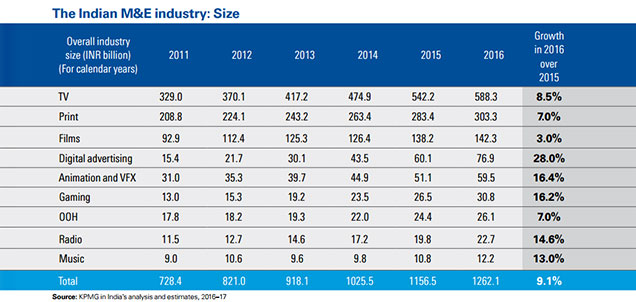
The Indian media and entertainment industry in 2016 was able to sustain a healthy growth on the back of strong economic fundamentals and steady growth in domestic consumption coupled with growing contribution of rural markets across key segments. These factors aided the industry to grow at 9.1 per cent on the back of advertising growth of 11.2 per cent, despite demonetisation shaving off 150 to 250 basis points in terms of growth across all sub-segments at the end of the year. The ‘FICCI – KPMG Media & Entertainment Industry Report 2017’ launched at FICCI Frames 2017 in Mumbai, aims to capture a comprehensive picture of the industry’s growth story, challenges, future projections, and key underlying themes.
The big story in 2016 has been the evolution of FTA channels post expansion of rural measurement in the television segment coupled with the impact of the 4G rollout and the resulting price wars. Both these factors have resulted in media consumption penetrating deeper into India, resulting in a realignment of strategy by media companies and advertisers alike.
Compared to 2016, the industry is projected to grow at a faster pace of 14 per cent over the period of 2017-21, with advertising revenues expected to increase at a CAGR of 15.3 per cent. The year 2017 is likely to witness a marginally slower rate of 13.1 per cent as the economy recovers from the lingering effects of demonetisation and initial uncertainties arising from GST implementation.
Commenting on the industry’s performance and way forward, Uday Shankar, Chairman, FICCI M&E Committee and Chairman & CEO of Star India, said: “The industry has gulped down the bitter pill of demonetisation trusting its long-term benefits and yet is set to bounce back to a steady growth, thanks to strong fundamentals. Building solid infrastructure and continued government support will help the industry reach the tremendous potential it holds for employment and creating socio-economic value for the country. A commitment towards a quick transition to digitisation will ensure growth for all stakeholders.â€
Added Girish Menon, Director, Media and Entertainment, KPMG in India: “[The year] 2016 was a mixed bag for the industry with digital media making its way to the centre stage rapidly from being just an additional medium. It is compelling existing players to rethink their business models. To accelerate growth, M&E organisations must rebuild their strategies to fit and thrive in the changing, digitally-oriented landscape. Nimbleness and flexibility will be at the core of sustainable businesses…. The long-term factors driving the future growth are expected to remain positive, with growing rural demand, increasing digital access and consumption, and the expected culmination of the digitisation process of television distribution over the next two to three years.â€
Sector-wise analysis:
Television:
The TV industry clocked a slower growth in 2016 at 8.5 per cent, attributed to tepid growth of 7 per cent in subscription revenues and a lower than estimated 11 per cent growth in advertising revenues. A key theme in 2016 was the emergence of FTA channels as a key focus area following the expansion in rural measurement by BARC and the resultant increased interest by both broadcasters and advertisers. Additionally, strong performance of sports properties and increased spending for the launch of 4G by telecom operators helped alleviate some of the pressure. The industry is expected to grow at a CAGR of 14.7 per cent over the next five years with advertising and subscription revenues projected to grow at 14.4 per cent and 14.8 per cent, respectively. The projections remain robust due to strong economic fundamentals, rising domestic consumption and growing contribution of rural markets coupled with the delayed, but eventual completion of digitisation.
Print:
The revenue growth rates of print continued to witness a slowdown at 7 per cent in 2016, as English newspapers remained under pressure. Regional language papers demonstrated strong growth, but were adversely affected by demonetisation given their high dependence on local advertisers. Print is expected to grow at 7.3 per cent, largely driven by continued growth in readership in vernacular markets and advertisers’ confidence in the medium, especially in the tier II and tier-III cities. Rise in digital content consumption poses a long-term risk to the industry.
Films:
Films grew at a crawling pace of 3 per cent in 2016. The segment was impacted by decline in core revenue streams of domestic theatricals and satellite rights, augmented by poor box office performance of Bollywood and Tamil films. Expansion of overseas markets, increase of depth in regional content and rise in acquisitions of digital content by over-the-top platforms are expected to be the future growth drivers that would help the segment bounce back at a forecasted CAGR of 7.7 per cent. However, factors such as dwindling screen count and inconsistent content quality could prove to be limiting factors.
Digital advertising:
Continuing to ride on a high growth trajectory with a 28 per cent growth in 2016, digital advertising has captured 15 per cent share in the overall advertising revenues, with a minor hiccup due to demonetisation. 4G rollouts and the resultant data price wars are providing further impetus to the growth as digital consumption and habits are becoming more mainstream. It is projected to grow at a CAGR of 31 per cent to reach INR294.5 billion by 2021, contributing 27.3 per cent to the total advertising revenues. Advancement in infrastructure, evolving audience measurement technology leading to better content and lowering data costs will drive user habits towards greater digital consumption, driving tremendous growth for the industry.
Animation and Visual Effects (VFX):
The industry grew at 16.4 per cent, driven majorly by a 31 per cent growth in VFX due to increase in outsourcing work, growing use of VFX in domestic film productions and increase in demand for domestic animated content on television. The industry is estimated to grow at a CAGR of 17.2 per cent over 2017–21.
Out of Home (OOH):
The industry registered a slowdown in growth rate at 7 per cent majorly due to adverse impact of demonetisation. OOH is projected to grow at a CAGR of 11.8 per cent primarily driven by development of regional airports, privatisation of railway stations, growth in smart cities, setting up of business and industrial centres, and growing focus on digital OOH.
Radio:
Radio recorded a 14.6 per cent growth led by volume enhancements in smaller cities, partial roll out of Batch 1 stations and a marginal increase in effective advertising rates. However, weak uptake in Batch 2 auctions of Phase 3 and delays in the rollout of majority of Batch 1 stations, coupled with adverse impact of demonetisation dampened the overall sentiment. Nevertheless, it is expected to be the fastest growing amongst the traditional mediums at a CAGR of 16.1 per cent, arising from operationalisation of new stations in both existing and new cities, introduction of new genres and radio transitioning into a reach medium.
