
Tag: FICCI Frames

  • EY-FICCI report rediscovers Indian Customer Segmentation


    By Indrani Sen


    Indrani Sen

    It has been nearly two weeks since the FICCI-EY Report on Indian M&E Industry “A billion screens of opportunity” was released at the 20th FICCI Frames held in Mumbai on March 12, 2019. Most leading financial newspapers and industry websites have carried the press release issued by FICCI with highlights of the findings.


    This website www.mxmindia.com carried a report with highlights of the findings on March 13, 2019 http://www.mxmindia.com/2019/03/me-grows-13-rs-1-67-trillion-in-2018-ey-ficci-report/. The marketing and advertising industry experts have been busy analysing and internalising the findings and useful insights given in the report and their strategic significance.


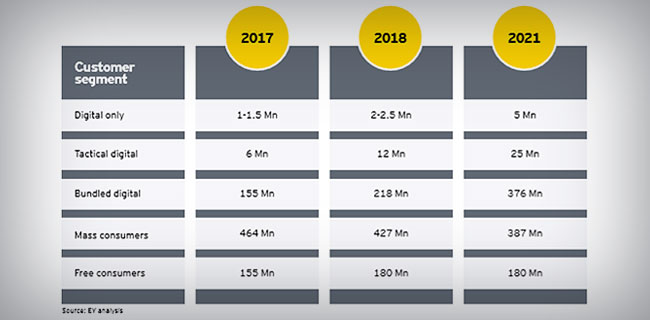
    To me, the most significant insight of the report is its estimate of the customer segmentation in India by their access to various media consumption platforms. Last year, EY introduced the idea of this type of customer segmentation by introducing us to three types of segments, digital only consumers, tactical digital consumers (Pay TV & Pay OTT) and mass consumers (Pay or Free TV & Free OTT) and projected that by 2020 there will be 4 million digital only subscribers, 20 million tactical digital subscribers and 500 + mass subscribers.  I was delighted to discover that EY has refined their estimation of the customer segmentation by introducing another segment “bundled digital” consumers (as provided by telecom services) and segregating the mass consumers from the free consumers as shown in the chart below:

    Customer segmentation by media consumption platforms
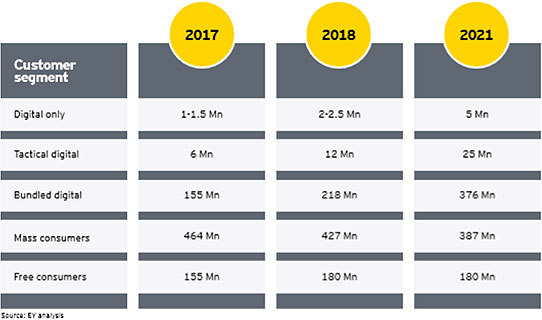
    Source: FICCI-EY Report 2019

    The broad category of mass consumers accounting for 500 +million in 2020 has become more specific with 943 million subscribers in 2021 spread across three categories. This analysis of customer segmentation introduced in the FICCI EY report not only has strategic implication for marketers in the short run, but also will help to further accelerate the growth in digital advertising in the long run.

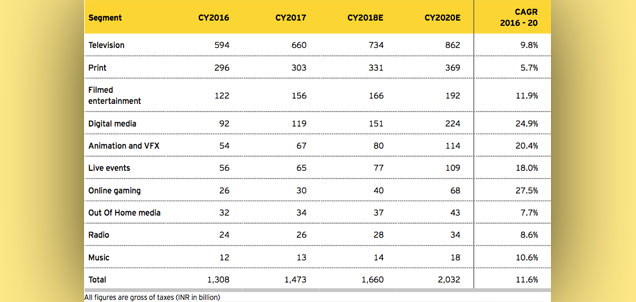
    Digital media has been consistently contributing to the growth of M&E sector. It is expected that digital will overtake filmed entertainment (currently in number 3 position) in 2019 and print (currently in number 2 position) by 2021. TV clocked the highest share (44%) of the entire industry in 2018 and is expected to grow by 8.8% from 2018 to 2021 but its share is estimated to drop from 44% to 40%. Digital media, growing at 28% from 2018 to 2021, is estimated to have 15% share of the entire sector in 2021 from 10% in 2018. It is difficult to predict what will happen in the next ten years and EY has not ventured into that forecast, but it will not be surprising if digital media overtakes TV by end of the next decade.

    In fact, MRUC should consider adopting this customer segmentation for revising their criteria for new socio-economic classifications as the current structure based on ownership of durables etc. is not reflecting the disposable income correctly, given the availability of easy financing schemes for purchase of white goods, etc. and the aspirations of the upwardly mobile population in rural and semi-urban areas.

    Uday Shankar, Chairman of the FICCI Committee said in his opening remarks at the FICCI Frames    “… in my humble opinion, the great Indian media & entertainment story has just begun. We are standing at an inflexion point. In business strategic inflexion point is described as a period when the individually the organisations and collectively the industry needs to respond effectively to the disruptive change in the environment in order to survive and grow.  The Indian ME industry entered the inflexion point/ period in 2018, when Indian ME Industry was at the “Digital Tipping Point”. The scope of making a choice no longer exists for the various segments belonging to the Indian ME industry and in order to stay in the race they need to adapt to the disruptive changes including the customer segmentation based on access to media consumption platforms.
  • India Today’s ‘So Sorry’ series now a mobile game

    By A Correspondent

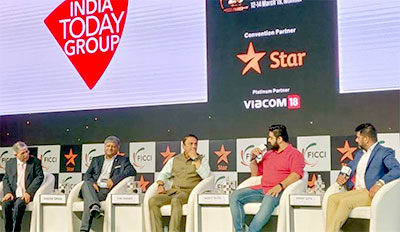
    The India Today group unveiled its gaming app titled So Sorry Gully Cricket’, featuring politoons in the lineup of players. The app was launched at FICCI Frames last week by former cricketer Sunil Gavaskar alongside Sam Balsara and Shashi Sinha.

    Said Kalli Purie, Vice-Chairperson, India Today Group, “We are really excited to announce the launch of the new game ‘So Sorry Gully Cricket’ at Frames in the presence of such a distinguished audience. ‘So Sorry Gully Cricket’ is a unique game that portrays life and politics in a way that is interactive, real and interesting.  With India heading for Parliamentary elections the timing could not be more perfect. It’s a super example of an integrated use of technology n content.”

    Added Alok Kejriwal, Founder and CEO of Games2win India, the company which devised the app: “Cricket is potentially a religion. We had a perfect ingredient in So Sorry characters and the fusion of the two will work for sure,”. “You will recognise all the characters and sounds. It’s a treat to the ears as well.”

  • M&E to cross Rs 2tn by 2020: FICCI-EY report


    By A Correspondent


    FICCI-Frames 2018 took off on Sunday evening with I&B Minister Smriti Irani as Chief Guest. As part of the inaugural session, the annual M&E industry report, this time presented by the team at Ernst & Young (EY). The venue this year is the Grand Hyatt in Santacruz East, away from the Renaissance at Powai where Frames has been happening for 16 of the 18 editions.


    Back to the report: the Indian Media and Entertainment (M&E) sector reached almost INR1.5 trillion (US$22.7 billion) in 2017, a growth of around 13% over 2016. With its current trajectory, it is expect to cross INR2 trillion (US$31 billion) by 2020, at a CAGR of 11.6%. The digital segment-led growth, demonstrating that advertising budgets are in line with the changing content consumption patterns The  FICC-EY report is appropriately titled ‘Re-imagining India’s M&E sector’ and captures key key insights from the Indian M&E sector.


    The M&E sector continues to grow at a rate faster than the GDP growth rate, reflecting the growing disposable income led by stable economic growth and changing demographics. The report states that subscription growth outpaced advertising growth in 2017 but advertising will continue to grow till 2020 led by digital advertising. The report estimates that approximately 1.5 million consumers in India today are digital only and would not normally use traditional media. It is expected that this customer base will to grow to ~4 million by 2020 generating significant digital subscription revenues of approximately 20 billion. Going forward, micropayments, enabled through the Unified Payment Interface (UPI) and Bharat Interface for Money (BHIM) platforms developed by the National Payments Corporation of India (NPCI) will further accelerate subscription revenues for entertainment content.


    Said Farokh Balsara, Partner and M&E Leader, EY India:  “Indian M&E sector reached INR1.5 trillion in 2017 led by digital. With digital subscribers expected to reach 20 million by 2020, has Indian M&E reached its digital tipping point? We now need to re-imagine the future of  Indian M&E sector.”


    Added Ashish Pherwani, Partner and M&E Advisor Leader, EY India: “Growth in 2017 was led by the digital, film & animation & VFX segments. We expect sectors like digital and gaming to grow between 2 to 3 times by 2020.”


    Key findings

    :: Television:
    The TV industry grew from INR594 billion to INR660 billion in 2017, a growth of 11.2% (9.8% net of taxes). Advertising grew to INR267 billion while distribution grew to INR393 billion. Advertising comprised 40% of revenues, while distribution was 60% of total revenues. At a broadcaster level, however, subscription revenues (including international subscription) made up approximately 28% of revenues.

    Key insights– While advertising is 41% of the total revenues today, the report expects it to grow to 43% by 2020. There are over 30% households in India which are yet to get television screens, but being at the bottom of the pyramid, these households will tend to move towards first towards free and sachet products.


    :: Print:
    Print accounted for the second largest share of the Indian M&E sector, growing at 3% to reach INR303 billion in 2017. Print media is estimated to grow at an overall CAGR of approximately 7% till 2020 with vernacular at 8%-9% and English slightly slower. This growth is expected despite the FDI limit remaining unchanged at 26% and therefore, restricting access to foreign print players and the imposition of GST at 5% on the advertising revenues of the print industry for the first time in history. While magazines contributed 4.3% to the total print segment, the segment was at largely status quo with not many significant new launches in 2017.

    Key insights– Today, 98% of readers read dailies and 20% read magazines. Reader base is 395 million, or 38% of the population. Readership has grown by 110 million over the last 3 years. Rural (52%) reader base is larger than urban (48%). 44% of children (aged 12 to 17 years) read a newspaper or magazine. Magazines have a higher readership in urban areas (57%) as compared to rural areas (43%).


    :: Films:
    The Indian film segment grew 27% in 2017 on the back of box office growth – both domestic and international – coupled with increased revenues from sale of satellite and digital rights. All sub-segments, with the exception of home video grew and the film segment reached INR156 billion in 2017.The Hindi films comprise the majority component of the Indian film segment. They contribute almost 40% of the net domestic box office (BO) collections annually, despite comprising only 17% of the films made. Films in 29 other Indian languages account for approximately 75% of the films released but they contribute approximately 50% to the annual domestic box office collections. Hollywood and international films comprise the balance. The top 50 films contributed approximately 97.75% of the total net box office collection. Box office collections of the top 50 films grew by 11.60% in 2017.

    Key Insights: Regional movies drove the growth in number of releases in 2017. Screen count increased from 9,481 in 2016 to 9,530 in 2017. Number of Hindi movies crossing the INR1 billion mark was highest in 2017 in the past 5 years. From 31 movies in 2016, Hindi dubbed movies increased more than 3 times to 96 in 2017.


    :: Digital media:

    Digital media has grown significantly over the past few years, and continues to lead the growth charts on advertising. Subscription revenues are emerging and are expected to make their presence felt by 2020. In 2017, digital media grew 29.4% (27.8% net of the impact of GST) on the back of a 28.8% growth in advertising and a 50% growth in subscription. Subscription, which was just 3.3% of total digital revenues in 2016, is expected to grow to 9% by 2020.

    Key insights: 250 million people viewed videos online in 2017 and expected to double to 500 million by 2020. Around 40% of total mobile traffic came from the consumption of video services in 2015. This figure is expected to touch 72% by 2020. 93% of time spent on digital videos is in Hindi and other regional languages. OTT subscription in India is expected to touch INR20 billion by 2020.

    M&A in M&E


    The Indian M&E sector witnessed a relatively new trend in deal activity with emerging segments such as gaming and digital gaining momentum, while the deal activity in the traditional media segments was slower. The slowdown can be partially attributed to challenges faced by the advertising segments of the industry due to demonetisation and GST. Overall, the number of transactions in the M&E sector decreased from 56 deals in 2016 to 40 deals in 2017. Further, the total deal value was also lower at US$1,261 million in 2017 compared to US$2,863 million in 2016.


    The entire report can be accessed at here


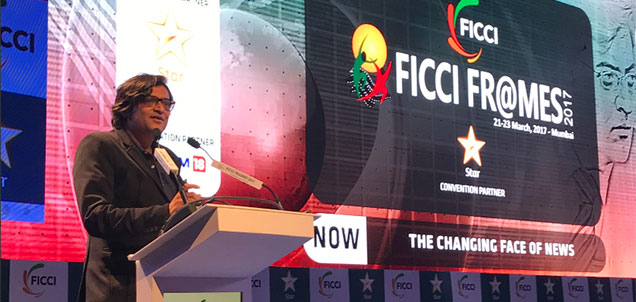
  • NewsWar2017 Round#1: ‘David’ Arnab Goswami takes on ‘Goliath’ Times Now, Newshour-ishtyle!


    By A Correspondent

    It was mixed set of emotions for the folks at the Federation of Indian Chambers of Commerce and Industry. Ballroom 1 and 2 at the venue of the 18th edition of FICCI-Frames was packed to the aisles. There was some place to stand, but just about. As almost everyone gravitated towards this hall, the other venues weren’t as packed at sessions being held simultaneously or immediately after this one.

    Around four months after having exited primetime news on television in the country, ArnabGoswami is still a star. And as much of a crowdpuller as a Bollywood or sports biggie.

    And on Wednesday noon, Goswami thundered. Like he’s known for. Theatrics that the nation loves him for. Except this time around, he appeared to have a lot more people rooting for him. For, Goswami has turned entrepreneur.

    In a country which loves to champion the underdog, see a chaiwallah turn into Prime Minister, a modest investor outpace some of the biggest, the media and entertainment fraternity in attendance were happy to see Goswami evangelising his craft.

    Interestingly, it was also the day, when Goswami’s former employer, fired its first salvo in its #AttackArnab offensive. The hashtagging is our doing, in Newshour-ishtyle. So Magicbricks Now which seemed to be going nowhere in revenues and ratings, has been dumped and rechristened Metro Now. For a while, the real estate channel has been been airing metro-centric news, and talking heads-led nightly debates.

    So let’s get back to what Goswami said, around a month before unveiling his all-new news channel-led platform: Republic. By hiring former armyman Major Gaurav Arya, he has clearly indicated that he will continue his ‘My heart bleeds for India’ offensive every evening.

    Speaking at the FICCI-Frames 2017, Arnab thundered: “Those who will understand the hidden script – because I don’t mince my words- will understand what I am saying today: This is a David Vs Goliath fight,” he said. And then paused and smiled at the audience before continuing.

    “And I stand here before you proudly to say Goliath has tried to crush me and already failed. Because you can’t crush a thought. David thought on his feet, Goliath did not. David had the speed and David out-thought Goliath. I want to tell Goliath today: Come, out-think me, if you can,” he added.

    “I have with me a bunch of Davids. Davids have emerged on their own. And they want to shackle the Davids. Because a bunch of Davids free is a threat to the Goliath. Our bunch of Davids will make old monopolies fall once again, as they have in the past,” he declared.

    “Republic will ensure that new ones will come and these new ones – these new guys will be the ones that show the world from right here in India that Content is King, not Money. Money will fail and people will watch the screens that they believe in and not the screens that sell to them,” he pledged and promised that “putting the focus back on each one of you is my only determination.”

    And then he asked: “Which side would you be on? With David or with Goliath?”

    It may be argued that the editor-anchor-and-now-entrepreneur could well be talking about Goliaths like the AroonPuriemanaged-owned India Today and MukeshAmbani/Reliance Industry-run CNN-IBN, but it’s evident that his angst is against Times Network. The Times of India group-owned television network is of course known to be fierce in the battlefield especially when it thinks a newbie could be an aggressor. It did that when the Ambanis launched a business paper to take on The Economic Times in 1990. In 2005, when Hindustan Times and DNA were getting set to enter its bastion Mumbai, it launched Mumbai Mirror and got very aggressive in its offers to advertisers. And now as stiff competition comes in from the man who built it, Times Network under the leadership of an old Times group warhorse MK Anand, has unveiled a manifold offensive.

    First, ensure that the attrition is under check. Some elevations have happened. Some more have been motivated to stay back.

    Second, get the content plan in order. Anand is reportedly active on the editorial front too, and is marked on key newsroom decisions and stories, a move that upset some

    Third, launching a ‘flanking product’. Hence Mirror Now

    Fourth, Times Now to also go into HD (which is to be announced soon)

    And fifth: fight Republic on the street… Revenues, Ratings, Regulators, MIB, ASCI… wherever necessary.

    When Goswami popped the ‘David v/s Goliath’ question, there was applause. Taaliyaan! He also took on the Delhi-centric channels saying that the national media is “content in Lutyens Delhi that you stop fighting for the people of the country”.

    Citing the example of the Kansas City killing of 32-year-old Srinivas Kuchibotla, he said: “The satiated Lutyens media was content in labelling it as quote unquote ‘hate crime’. And I ask you today: isn’t there a dent needed in the Indian media to shake it up…to fight for families like that of Kuchibotla. How can you be so satiated in Lutyens Delhi?”

    After taking on his seniors (and the mighty) in the capital, he moved on to talks about his style of journalism. “The focus is on India and the focus is on English but English done the Indian way. When I started off as a journalist…they said i should take pauses at the right places…..I won’t speak in the polished way..I will speak English the Indian way…I want to speak in the language that the 25-year-old in the Indian newsroom relates to”, he said. Regular watchers of his shows recall how he would often break into an ‘Arre Baba’ while speaking to guests. Defending his brand of journalism, which is in every possible way is being pursued by the existing dispensation at Times Now, he said: “..They’ll tell you facts are sacred and opinion is free. I say facts are available and opinion is sacred. Opinion in the media is especially sacred because it is a differentiator between a journalism that is confrontational and a journalism that is happy to be docile and subdued. Opinion in the media is especially sacred because it is a differentiator between a journalism that choses to takes the right side of the truth and one that prefers to be falsely neutral in order to perpetuate the status-quo… opinionated media that has the potential to be activist. It is opinionated media that has the potential to be a change agent to being merely a supplier of information. I refuse to be simply a supplier of information,” Arnab said, throwing the gauntlet again down- this time at the old traditional definition of journalism.

    We haven’t heard the last from Arnab Goswami’s Republic and Times Network’s MK Anand. Both are known to fight hard, and both are known to be happy losers. But who is?


  • #FF14 Day 1: Frames takes transformational route in 15th year


    By a correspondent


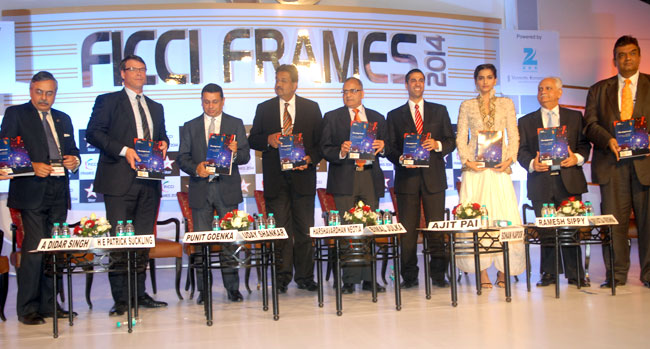
    The 15th edition of the much anticipated annual event of the Media & Entertainment industry – FICCI Frames 2014, got off to a captivating start in Mumbai on March 12, 2014. The event began with an inaugural session that saw the big guns from the media and allied sectors including the I&B Ministry delve on the theme of the conclave – Transforming Lives – while also highlighting the current state of the M&E sector and its scope for the future.


    The lineup of the dignitaries for the inaugural session included Harshavardhan Neotia, Vice President, FICCI; Uday Shankar, Chairman, FICCI Media and Entertainment Committee, and CEO, Star India; Punit Goenka, CEO & MD, Zee Entertainment Enterprises Ltd; Shri Bimal Julka, Secretary, Ministry of Information & Broadcasting, Government of India; Shri Srivatsa Krishna, Secretary, Department of IT, BT & ST, Government of Karnataka; H.E. Patrick Suckling, Australian High Commissioner to India and Ajit Pai, Commissioner, FCC, USA.


    Highlighting the state of the M&E industry in 2013, Uday Shankar said that while there was much talk about doom and gloom in the economy it was not the case for the M&E industry that grew by almost 12 per cent. But he cautioned that the goal of attaining the $100 billion landmark was a distant dream as yet. Mr Uday went on to highlight the role that the government could essay in simplifying several issues facing the industry and how it could work in tandem with the industry in resolving them.


    Echoing a similar point of view, ZEEL’s Punit Goenka too laid the pitch for a collaborative effort as he said that the M&E sector has played a key role in enhancing the prospects of the economy, especially on the jobs front. “The M&E industry has been a shining example of how an industry could work towards achieving a common goal of inclusive growth and being a facilitator to all concerned. It is a matter of pride for the sector to be employing more than 6 million people with the scope of providing employment to many more in time to come.”


    Mr. Goenka further highlighted the role that digitization has played in the year gone by, and how it would alter the broadcast landscape in the future. He affirmed to the audience that it was time to give back to the industry for whatever it has given us and that the same should be done by unleashing innovation and creativity as the core. In fact the collective aim should be to transform the lives of the global community and not just India, asserted Goenka.


    Having been introduced to the various loopholes and issues facing the industry at the introductory session, Shri Bimal Julka, Secretary, Ministry of Information & Broadcasting was vocal when he said that it was not just the government but the industry that should take responsibility in finding a solution to the problems at hand. “The role of the government is that of a facilitator, it would be great if the industry takes a collective stand on issues themselves and come to us if at all they face any hurdles.”


    Highlighting the several initiatives undertaken by the I&B ministry, Mr Julka said that the first two phases of digitization have met with reasonable success in about 42 cities and it could be credited as being the smoothest and fastest such initiative of its kind. The focus now would be on Phase 3 & 4 of the drive where an additional 110 million STBs are scheduled to be rolled out. “While there are a few issues concerning the digitization exercise, we are taking efforts to sort them out including at the level of broadcasters, MSOs, LCOs etc. But the good thing is that digitization has managed to bring in transparency in the broadcast sector, which was the main goal of the whole exercise.”


    Mr Julka said that the I&B ministry was also concerned about the content that was being shown to the viewers and urged the broadcasters to practice self-regulation. With 800 channels already existing and a further 250 plus awaiting clearances, it was important for broadcast companies to figure out how to dish out content that is accepted by the viewer.


    Mr Julka also touched upon the challenges facing the industry including control on monopoly & cross-media ownership, content monitoring, transponder capacity problem facing DTH players etc.


    The session proceeded to an engaging perspective on the US broadcast market that was provided by Ajit Pai, Commissioner, FCC, USA and also a keynote address by Shri Srivatsa Krishna, Secretary, Department of IT, BT & ST, Government of Karnataka.


  • #Frames2013: Need to grow the kids’ pie further

    By Johnson Napier


    While increasing importance is being given to Hindi GECs and sports broadcasting in India, a genre that has been steadily pushing itself up the growth chain is children’s entertainment. Accounting for nearly 7 per cent of the growth pie, kids’ channels in India have been throwing up interesting growth trends over the past few years.
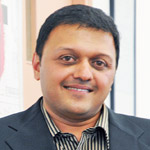
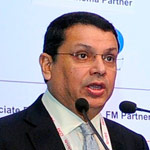
     

    At the session on ‘Trends in Children’s Entertainment’, panelists presented their viewpoints on the genre and what was the way forward. The panelists comprised Harpreet S Tibb of Kellogg India, Vijay Subramaniam of Disney UTV, Ashish Karnad of IMRB, Krishna Desai of Turner, and Pradeep Hejmadi of TAM.


    Harpreet S Tibb, Marketing Director, India & South Asia, Kellogg said, “The focus for marketers is to strengthen our brand and also that the message gets conveyed to the desired TG. The thing about kids today is that they are increasingly gravitating to newer mediums and it is therefore essential that the broadcasters come up with content that is valuable and meaningful. There is also a need for players to create content that is interactive and relevant.”


    Vijay Subramaniam

    Vijay Subramaniam, Executive Director, Kids Network, Disney UTV highlighted how the focus by his group was to tell stories that are great.” We have always been known to present stories that are innovative and pioneering. While much of our content is centred around kids, it is also made keeping the family audience in mind. The challenge facing the genre is of financial viability.”


    Ashish Karnad, Group Business Director, IMRB International presented his outlook as he said that boys consumed different content while the girls too consumed content that was different from boys. “There was not much differentiation that was observed between the two subsets earlier but that is seeing a change now. And as we all would be aware, there is a huge demand for locally produced content.”


    Krishna Desai

    Krishna Desai, Director-Content, South Asia, Turner International India elaborated on how the broadcast players were waking up to providing new content options for the kids of today. “Admitting that animation as an industry is still in its infancy, Mr Desai said that it was indeed picking up in growth. “Overall the kids’ genre is still small compared to the other genres as the ad spends around the medium are still very low. But there are other positives that are emerging inclusing its ability to ship content to outside markets. The industry is evolving and it is up to us to unite and take it to the next level.”


    Earlier Pradeep Hejmadi of TAM went on to present his perspective of the kids’ genre in India and what was in store for the players in the years to come.


  • #Frames2013: Unlocking M&E’s true potential for a billion consumers

    By Johnson Napier


    That the media and entertainment sector in India is one of the liveliest and has been delivering a robust growth year-on-year is what makes it a favourite for many. Little doubt that when the economy is just about struggling to stay afloat the M&E industry surprised one and all by posting a 12.6 percent growth rate in 2012 (according to data from FICCI-KPMG).


    There have been a stream of avenues that have led the industry to achieve the kind of growth it is seeing thanks largely to the emergence of new mediums and technologies which in turn have led to a growth in the number of audiences out there to consume such mediums. The challenge going forward would be how the industry can engage a billion people in an era when the consumer will be king and would be faced with an array of choices for consumption. The panel discussion ‘Engaging a billion consumers in the M&E industry’ saw a high-profile display of knowledge and mantras from speakers including Ravi Dhariwal of Bennett & Coleman, Punit Goenka of ZEEL, Sidharth Roy Kapur of Disney UTV, Sudhanshu Vats of Viacom 18, Rahul Johri of Discovery and Shailesh Rao of Twitter Inc. The session was moderated by Uday Shankar, chairman of FICCI Frames 2013.


    Uday Shankar

    Uday Shankar, chairman of FICCI-Frames 2013, began by warming up the audiences on the quality of panellists that had assembled at the session who according to him were among the best in the business. “If any change has to happen in the M&E industry then it has to begin with us (pointing at the speakers) and if we cannot do it then nobody else can and it will eventually be a failure,” remarked Mr Shankar.


    Ravi Dhariwal

    Presenting the mantras that get practiced at his workplace, Ravi Dhariwal, CEO, Publishing, Bennett & Coleman began by saying that for him it was important to concentrate on the smaller audiences, which is roughly about 1 per cent of the total population, and try and make a business model out of it. “To get this going we lay more emphasis on hiring good creative people and give them the freedom to do what they feel like. Ours is a very federal system where we let our people do what they want to do whether it is television or Radio Mirchi, TOI etc. With this, we also make it a point to hire good marketing professionals as we believe that the creative people also need to understand where the market is moving and be able to hear the voice of the customer. We try and make this combination come together to develop brands.”


    Sudhanshu Vats

    On the question on whether the industry is geared to cater to the entire range of diversity in terms of content, Sudhanshu Vats, Group CEO, Viacom 18 Media said that the emphasis going forward would be to be able to build more of this ability and be able to segment and target. “In order to cater to a billion Indians we sharply need to segment and target them.” Pointing out to three trends that were helping the industry move forward, Mr Vats said, “The first trend is the mega-consumer trend where people generally tend to fall under the ‘collectible’ category and believe in sharing with the others around them and the ‘I’ category where people focus more on themselves and what they desire. The other trends include multiple screens that are here to stay and also the role that digitization will be playing in delivering focused content for both the mediums of television and print.”


    Punit Goenka

    For Punit Goenka, CEO & MD, ZEEL, the industry has just about taken baby steps and there is still a long way to go. “In fact if we are not geared for it then fragmentation is going to be the order of the day. And if do not do something about this then the consumer is going to go away.” Adding further he said, “From a television POV we have to stop calling ourselves as broadcasters and call ourselves content creators and aggregators. As in the end we will have to customise content even to the last individual. The problem is that the industry does not believe in working together today and if the entire value chain cannot work together then it cannot be done.”


    Sidharth Roy Kapur, MD – Studios, Disney UTV said that where films is concerned what has happened in ten last 7-8 years is that commercial and parallel cinema have learnt to co-exist and also become popular too. “Films have managed to bridge the gap where you have audiences who like a Rowdy Rathore and are also enjoying a film like Barfi at the same time. And these are not two different set of audiences. I think the massive gap that we have in our country is infrastructure. In India there are only 12 screens per million viewers compared to the US who have 130 screens for the same number. So you can see the unlimited potential that exists in our country. Even the scope of catering to the outside diaspora is large but we hardly are doing anything to cater to their needs. The thing is that we haven’t even scratched the surface of where we want to go with our content and as we keep experimenting I think our job is to keep expanding the footprint and it needs to be done collectively.”


    Rahul Johri

    Rahul Johri, Sr VP & GM, India – Discovery Networks said, “Where localisation of content is concerned we have our channels available across multiple languages. The fact is that we need to have a right mix today; the way we are looking at the market is that people come to our brand to see what is happening around the world. Today about 60 per cent of the population is in the youth category and how do we engage this set of audiences that is an important TG is what is core to us. For us it is not about ratings and creating sensationalism but about building strong brands.”


    Putting forth his observations, Shailesh Rao, Head of Global Operations, Twitter Inc remarked, “Where the Indian M&E industry is concerned I honestly think that it is one of the finest in the world in terms of creativity and diversity of content and product that’s brought out in the market. So while we have huge assets at our disposal we have to see what is it that will make us aspire to deliver more. And I think it is technology that will help us deliver that.” According to Mr Rao the way technology can  help connect the dots is in the following manner: “We have always seen broadcast and print as a push medium but I think there is a role for something like Twitter that is used to pull. We have to ask the audience what they like and communicate with them on a continuous basis. The other thing is to use technology for effective distribution. I see mobile playing a huge role in the way we communicate with the consumers, especially SMS.”


    The panel proceeded by discussing other ways, including regulatory challenges, that would make this industry amongst the most preferred and profitable for the economy.


  • Govt may set up own body if it doesn’t see action on BARC by November

    By A Correspondent


    Even as I&B secretary Uday Verma met stakeholders of the three industry bodies who are setting up the Broadcast Audience Research Council (BARC) – the Indian Broadcasting Foundation (IBF), the Indian Society of Advertisers (ISA) and the Advertising Agencies Association of India (AAAI) – yesterday, MxMIndia learns from sources that the government is exceedingly upset with the delay and if it doesn’t see any action by November 2012, it may set up a joint government-industry committee to take things forward.


    Other than the collective pressure of the News Broadcasters Association, the NDTV case against TAM and its principals and Doordarshan’s own misgivings on the issue are among the compelling reasons why the I&B ministry is in a rush for the formation of the BARC. The government is aware that like in the case of content regulation, it would not like to play a role in the issue, however it believes that precious time has been lost. MxMIndia was told the pressure consumer/advocacy groups and Members of Parliament have also been asking for a look-in at the ratings process.


    While representatives of the IBF, ISA and AAAI have reassured the Secretary that all is well, the fact is that misgivings are still simmering given the recent charges that have been traded between the IBF and the ISA and AAAI.


    BARC was mooted way back in 2008 and the formation process had started in 2010, with an announcement on the setting up earlier this year – in March at FICCI Frames, to be precise. However, there have been stumbling blocks, all of which have been are said to have been cleared.


    BARC and consequently an all-new system of data collection could mean investment of around Rs 1000 crore, depending on the number of measuerement boxes to be installed. To start with, a CEO needs to be appointed as presently all stakeholders have their own business responsibilities, the demands of which are increasing with the festive season coming up.


  • Counting on digital to be M&E’s trailblazer


    @FF12: Day 1: Digital attracts ‘desirable’ status
    on Day1
    @FF12: Day 2: Seamless blending with traditional mediums – a big want!
    @FF12: Day 3: Industry expects thoughts to lead to pertinent actions
    @FF12: Takeaways: Digitization rules the roost @FICCI Frames 2012

    By A Correspondent


    Those familiar with the going-ons at FICCI Frames would testify how an infatuation gets displayed by delegates at the event each year so as to summarise the mood of the convention even before it broadly takes off across the three days that it is entitled to. But probably, the setting was a bit different this time around when the delegates – joined in unison by the media – were running ballroom to ballroom trying to ingest giveaways that were being thrown up abundantly across several sessions. May be, it was a year where each day had something new to offer to the delegates that kept them at tenterhooks throughout the 3-day event. And going by the loud decibels that were being emanated across every nook and corner of the venue, it was evidently clear that there was some motivating factor that was driving the gathering to go on an overdrive spree.


    The organisers of FICCI Frames 2012 have every right to take credit for coming up with a theme around a medium that attracted the attention of one and all. Having kept it on the sidelines till last year, digital was finally given its due at the convention as experts, authorities and enthusiastic youngsters came face to face to deliberate and come up with outcomes that would redefine the way the consumers consume the medium. From television to print to films and even radio, digitisation and the benefits and effects it would cast on these sectors were discussed in length at the venue. In fact Star India CEO Uday Shankar in his keynote address didn’t hesitate in thanking the FICCI committee for putting across a theme that would go on to redefine the way the industry functions in the future.


    What was apparently clear through the various sessions at the convention is that with the nearing of date for total digitisation across key metros by June 30 2012, and then across the country by 2014, broadcasters had to relook their distribution and content provision models so as to keep the consumer at the heart of every shift that will transpire in the future. Emphasising on the current digitisation scenario in the country, Mr Shankar said, “Most of the discussions that I have participated in are still around whether digitization will happen and if it indeed were to go through, how chaotic it would be. But all these are meaningless discussions triggered by a bunch of retrograde interests who are living in denial.” According to Mr Shankar, digitisation of distribution is a big reality and the 40-45 million homes that have bought DTH boxes at some point or the other are a conclusive evidence of that.


    Shooting back at critics who had doubted whether the makeover to digital would ever be a reality, Mr Shankar said, “To the critics and the cynics who are still wondering whether digitization would happen, my answer is: Look around, it is already happening and the rest of it is bound to happen because even in this country it would be difficult to undo such a momentous shift. To those who wonder how chaotic it would be, my response is that there would be some chaos, but chaos is not necessarily bad if the alternative is status quo or regression. When a transition at such a scale is happening that affects the illegitimate but strong vested interest in certain pockets, then there is an incentive to put up with chaos in the interest of the larger social objectives.”


    A broader outlook was provided by a few panellists who said that digitization will come in as a relief for broadcasters who will be benefitted from additional subscription revenue, relaxation on paying heavy carriage fees, and of course providing viewers with a superior content experience – MSOs and cable operators have to quickly respond to the digitization mandate by investing in set-top boxes – the cost that is only possible to recover after four years.


    Sounding off the challenges that digitisation would present for the broadcast sector, Tarun Katial, CEO of Reliance Broadcast Network Ltd said that, “For television, it will be a combination of content as well as marketing. The old model which was a combination of carriage and product, as it stands today, won’t work. The business plan which currently has a very high rate of carriage will obviously see the content taking precedence.” And as for content, it will be niche content that will call the shots for broadcasters as according to experts at the convention, niche isn’t niche any more as all niche channels put together command a share that is equivalent to the share of Hindi GECs and the mass channels, so to say.


    Perhaps the many advantages that digitisation will have on several mediums was rounded off by Vikram Sakhuja, CEO, South Asia, Group M who said, “The inherent power that digital brings along with it is interactivity and its ability to link multiple devices. Also the ability to enhance real-time consumption of content; linked to that is the entire thing about going mobile.” On the roadmap for the industry, Mr Sakhuja said, “I think integrated media is the best way forward. Today when people think of multimedia planning, they do a separate TV plan, print plan, radio plan, internet plan and so on. I believe that if you actually look at media agnostically and at common metrics of each cost per thousand impressions, these are the ways in which you can construct a media agnostic plan. What it does is, it suddenly gets more money into digital, and when more money can come into digital, that’s when focus is going to come in.”


    While digitisation was the mainstay of every discussion, the all-important issue of regulation too was taken up by panellists who chose to have the government respond to the many queries surrounding the topic. Uday K Varma, I&B Secretary, said that “if people at large seem to be happy with self regulation, I think the government would have no problem in legitimizing them. But I think the self regulation mechanism which has been set up by both the news broadcasters and the entertainment broadcasters, they’ll have to really prove it, not to the government but to the people at large.” He was joined in his cause by Prithviraj Chavan, Chief Minister ofMaharashtrawho said that the challenge would be to adopt the regulatory framework to new technology and ensure that over regulation doesn’t kill a good thing. The Chief Minister emphasised on the need for regulation and suggested that instead of the state regulating the media, the medium should look at regulating itself.


    The other important announcements that came up at the venue included the soon-to-be-passed Copyright Amendment Bill, the roll-out of the imminent phase 3 radio policy that would steer the growth of the medium and increased government aid for the film & entertainment sector.


    New ventures @ FICCI


    BARC takes wings

    In between the many promises and hopes that were being doled out at the sessions came the news of the Indian Broadcasting Foundation (IBF), the Indian Society of Advertisers (ISA) and Advertising Agencies Association of India (AAAI) announcing the official formation of a nationwide audience research joint body — Broadcast Audience Research Council (BARC).

    While IBF will have 60 per cent stake in BARC, ISA and AAAI will each hold 20 per cent stake. The Board of the council will have 10 members, six members from the IBF and two members each from the ISA and AAAI.


    Discovery Kids to flag off ops in April

    Another important announcement was made by President & CEO of Discovery Networks International, Mark Hollinger who announced the launch of its new network for children inIndia, ‘Discovery Kids’. Mr Hollinger said, “Launching in April, the network will initially be available in three languages – Hindi, English and Tamil. The channel will offer children a fun and entertaining way to satisfy their natural curiosity with stimulating and imaginative programming,” he said. The company plans to roll out the channel inPhilippinesandIndonesialater this year.


    Ten Golf tees off

    Taj Television India Pvt Ltd announced the launch of Ten Golf, a dedicated 24-hour golf channel. Ten Golf is the fifth channel from Taj Television India Pvt Ltd and began transmission on March 15, 2012. The dedicated golf channel will showcase a mix of live, non-live and feature programming. The channel will also broadcast live, high quality Golf action from around the world.

    Ten Golf has acquired rights for European Tour and Asian Tour till 2016, and has also entered into partnership with PGTI for three years to telecast the Indian Tour. Further, Ten Golf will be telecasting 400 hrs of golf programming in association with NBC.


  • TRAI invites views on ads policy for broadcasters

    By A Correspondent


    It was bound to happen, only its timing – soon after the not-very-exciting Budget and the uncertainties thrown up by digitization staring in its face – could’ve been unfriendlier. On Day 3 of FICCI-Frames, Big brother Telecom Regulatory Authority of India (TRAI) released a consultation paper titled “Issues Related to Advertisements in TV Channels”.


    First some background, in TRAI’s words: “The advertisement revenue has been a substantial portion of the overall television industry revenues. Perhaps, this has led to the tendency of pushing more and more advertisements in the television programmes in both pay and FTA channels. The increasing duration and distracting formats of advertisements has, however, adversely affected the consumers’ viewing experience. This has been reflected in numerous consumer complaints and opinions being expressed at various fora.”


    The TRAI is hence reviewing the existing regulations on duration of ads and how they should be presented given complaints that these are not being followed. Here goes:


    1. The limits for the duration of the advertisements shall be regulated on a clock hour basis i.e. the prescribed limits shall be enforced on clock hour basis.

    2. No FTA channel shall carry advertisements exceeding 12 minutes in a clock hour. For pay channels, this limit shall be 6 minutes.

    3. The 12 minutes of advertisements will not be in more than 4 sessions in one hour. In other words, there will be continuous airing of the TV show for at least 12 minutes each. Not more than three advertisement breaks shall be allowed during telecast of a movie with the minimum gap of 30 minutes between consecutive advertisement breaks.

    4. In case of sporting events being telecast live, the advertisements shall only be carried during the interruptions in the sporting action i.e. half time in football or hockey match, lunch/ drinks break in cricket matches, game/set change in case of lawn tennis and so on.

    5. There shall only be full screen advertisements. Part screen advertisements will not be permitted. Drop down advertisements will also not be permitted.

    6. In so far as News and Current Affairs channels are concerned, they are allowed to run not more than two scrolls at the bottom of the screen and occupying not more than 10 per cent of the screen space for carrying non-commercial scrolls, tickers etc.

    7. The audio level of the advertisements shall not be higher than the audio level of the programme.


    The text of the Consultation Paper is available on TRAI’s website (http://www.trai.gov.in/WriteReadData/trai/upload/ConsultationPapers/289/ cp_aproved_Authority.pdf). Written comments on the issues raised in the Paper are invited from the stakeholders by March 27, 2012, and counter-comments by April 2.


  • @FF12: Text of Star India CEO Uday Shankar’s keynote

    Good morning.


    Senator Dodd, Secretary Uday Verma, Chief Minister Chavan, Prosenjit, Jehil and my dear friend Karan Johar, the remarkable team of FICCI that has organized this fabulous event, friends from media, ladies and gentlemen.


    A couple of years ago when I was asked by FICCI to take over the chair of FICCI Broadcast Forum, none of us had an exact idea of the timeliness of that decision.  FICCI was seized off the maturity and the size of Broadcast media and felt that the time had come for it to sharpen focus on this aspect of media and not merely treat it as an adjunct of films.  However the momentous changes that have happened in the Broadcast media landscape in the last 2 years clearly justify the wisdom of FICCI.


    I find a powerful validation of the significance of television and broadcasting in “Positivity” – a report by the IBF on the impact of television. IBF has gone ahead and spoken to our viewers – the key findings of the research are gratifying and humbling for the industry. I don’t want to give too much away, but must highlight two interesting results – Over 90% of our respondents believe that television is a source of encouragement and motivation and a similar percentage of women respondents believe that Television has given them the confidence to believe in the capabilities and potential.


    Gratifying as it may be, it is just the beginning. We are at the cusp of what is set to completely transform broadcasting in India forever.  I am talking about the universal digitization of television distribution.  This is a subject that has dominated all discussions at all forums in the last year and I presume will continue to do so for a long time to come.  But let’s pause a minute and recall what the discussion is centered around.  Most of the discussions that I have participated in are still around whether digitization will happen and if it indeed were to go through, how chaotic it would be.  With all humility may I suggest that it is a meaningless discussion triggered by a bunch of retrograde interests who are living in denial.  Let’s get some basic facts -The Cable Television Networks Amendment Act is not the beginning of digitization.  Digitization of distribution is a big reality and the 40 – 45 million homes that have bought DTH boxes at some point or the other are a conclusive evidence of that.  In fact as we speak, India may just have overtaken the United States as the world’s largest DTH market.


    What Minister Ambika Soni, Secretary Uday Verma and his team are doing is to create a structured, institutional framework for shaping this big social reality.  More than 25 crore people who have stated their preference for DTH over analogue cable have clearly spoken out that this country is now ready for universal digitization and the current move is merely to create a level playing field.


    So, to the critics and the cynics who are still wondering whether digitization would happen, my answer is: Look around, it is already happening and the rest of it is bound to happen because even in this country it would be difficult to undo such a momentous shift. To those who wonder how chaotic it would be, my response is that there would be some chaos, but chaos is not necessarily bad if the alternative is status quo or regression.  When a transition at such a scale is happening that affects the illegitimate but strong vested interest in certain pockets, then there is an incentive to put up with chaos in the interest of the larger social objectives.


    Actually my biggest concern now is a chaos of another kind that we are all set to create by our inaction.  Whether we like it or not, in a few years time, the vast majority of this country will receive its content through digital media – digital cable, DTH, 4G, wireless and internet.  But are we preparing for that? The answer is a big NO.  I worry that while we debate a digital future day-in-and -day-out we are doing nothing to transform or find business models for a digital world. Let’s face it – universal digitization is going to force us to change the way we do business and we are so not ready for it.  We often blame the cable operators and MSOs that they are not ready but I am afraid that even the broadcasters and the content creators are not ready for a digital world.  Are we then setting ourselves up to become uncompetitive and irrelevant?


    In case you think I am a scaremonger, let me ask a question – we all know how many people DTH services and now a large number of them have evolved services like HD, DOLBY sound and digital video recorder and yet what are we doing differently to service this segment?  DTH has been around now for about 6 years and is there one thing that we as broadcasters or the content community have done that we could point out as an example of a strategy to exploit the new technology?  This is despite an intuitive and an experiential understanding that the behavior and the consumption patterns in DTH homes are significantly different from analogue homes. The data also show that the average time spent on content in digital homes is much more and yet we do not treat them differently.


    It is perhaps scary how we have force-fitted an analogue broadcasting model into the digital domain.  Is that what we are going to do even after cable goes digital?  I am afraid if the past behavior is anything to go by, we are not ready to offer anything significantly different and therein lies the biggest crisis and risk of a chaos.  We have often spoken about how digitization would enable a multiplicity of niche channels to emerge.  Digitization of TV and even film infrastructure for that matter can revolutionize the way media is consumed in India.  There is enough global experience to suggest that digitization leads to de-centralization, regionalization or localization of content creation and distribution.  Creatively, it is a huge catalyst for innovation and diversity.  Essentially what it means is that with universal digitization the business models of broadcasting which are built on centralized creation and distribution of content and even a centralized advertising revenue model may come under a huge pressure.  I am proud to lead one of the finest media companies in this country and the world and yet I must confess that all of us have built our businesses in an environment where access to distribution was complicated, expensive and even impossible.  That is all set to change. So the big incumbent advantage is set to slowly, if not rapidly disappear. Socially, it is all very desirable because the plurality of this country is very valuable and digitization is a big catalyst for that plurality.  But, are we ready to re-tool our strategies and our businesses?  The cable community is still busy lamenting the potential loss of carriage fees not realizing what an amazing opportunity it has to participate in the local economic boom that is sweeping most parts of this country.  The first phase of digitization that covers the 4 metros will be a huge unshackling of broadcasting and content opportunities.  These are the cities that have crumbled under the weight of analogue frequency limitations.  Just imagine the opportunities that these metros also our economic hotspots present when, from the first of July access to frequency will no longer be a constraint.  So to my mind the MSOs and the cable operators may potentially become a powerful content creator that the traditional broadcasters have to contend with. There may be new creative talent ready to ride this technological transition.  As the subsequent phases roll on, the decentralization of broadcasting is bound to gain enormous momentum.  However, I don’t see anyone trying to race ahead to take a pole position here.


    Now let’s look at the content and the creative community that I myself am a part of.  But I am struck by our obliviousness to the opportunities and changes awaiting us.  Let me explain this with a slightly different example.  It’s been for a few years now that HD TV sets have been available in this country.  While many people were buying them, their off-take was still low primarily because there was no HD content and nobody was willing to invest in HD content because there were not enough HD consumers.  It was the classic chicken and egg problem.  However early last year, when we at Star launched 5 HD channels with DOLBY 5.1 surround sounds even we were surprised by the rapidity with which HD gained acceptance. Today, in less than a year there are around 25 HD channels. But, I have to admit with a touch of disappointment that I am yet to see an adequate recognition of the potential of HD and a superior sound possibility by my fraternity.  It is a classic case of the old mindsets struggling with a new technology.


    Are we going to stay locked into this struggle or are we going to create a new generation of television which would be designed for the digital world?  It will require all of us to change.  The creative and broadcasting community has to change their approach to content and the distribution mindset needs to change equally. If you are a cable operator or an MSO -  carriage fees is not the reason why you came into this business and people do not take a connection so that you can earn carriage fees. We are all in the business of delivering best television experience for the consumers and they will be happy to pay for it.  There is enough evidence that people want to consume content and lots of it – but they love it when it is customized to their taste.  Today there is an opportunity to do that and let’s put our heads together to take advantage of that opportunity.  Let’s determine what we require from the Government and the regulator. I have been an admirer of the current information and broadcasting dispensation which I think has shown more vision than any other dispensation in my two decades of interaction with the broadcasting establishment.  However, let me point out that we still need a lot of official and legislative enablers to remove the bottlenecks on this expressway.  For instance, a clear policy to enable multiplicity of beams and splits would be a powerful trigger for proliferation of content and revenue opportunities.


    I could go on.  But I would like to end by just reminding you of the latest Oscar success from Hollywood – The Artist – which is an amazing portrayal of how a talented and accomplished artist from the silent era could become completely irrelevant because he refused to see that the times have changed. Let’s not try to thwart a revolution which people are crying for.  We will only hurt ourselves.  The question is whether we will lead the change or whether we will vacate the space for a new set of entrepreneurs and visionaries who will replace us.  It is up to us to use it or lose it. Thank you very much.


    Photograph: Fotocorp

  • @FF12: Opening session weighs pros & cons of digitization


    By A Correspondent


    FICCI Frames 2012, now in its 13th year, kicked off on March 14, Wednesday at Hotel Renaissance, Mumbai. The morning session started with a welcome address from Karan Johar, Co-chair, FICCI Entertainment Committee. After Mr Johar’s welcome address, Uday Shankar, CEO, Star India & Chairman, FICCI Broadcast Forum, took the stage to address the audience.


    In keeping with the theme, ‘Embracing the Digital World’, Mr Shankar said “digitisation is a big reality which will revolutionise the way content (creation and distribution) is offered”. Even though he said that digitisation will create a level playing field for the broadcasters and the cable operators, he had a word of caution to ad when he said that his biggest concern was “the chaos which will be caused by the broadcast industry’s inaction”.


    Mr Shankar was of the opinion that instead of lamenting the loss of carriage fees, the MSOs should appreciate the opportunity of “customisation and localisation of content” being presented by digitisation.


    Though Mr Shankar admitted that there is a need for legislative enablers to remove the bottlenecks, he also said that the broadcast industry is still not ready to move to the digital format. To drive home his point he used the example of the film The Artist, where the star of the silent era films loses out when he refuses to move with times. With this word of caution, Mr Shankar ended his keynote address.


    Prithviraj Chavan, Chief Minister,Maharashtra, next took the stage to talk about the “exciting times that we are living in”. He said that the challenge is to adopt the regulatory framework to the new technology and ensure that over regulation doesn’t kill a good thing. He also said that the move towards digitisation will create a huge employment opportunity. He stressed on the need to balance technology with creativity, adding that “growth should not be lopsided but all inclusive”.


    Shri Chavan also stated that the government is taking all possible steps to ensure that content piracy is curbed but accepted that the state has not delivered on its promises to curb piracy till now.


    He also touched upon the need for regulation and said that regulation is a major challenge. Shri Chavan suggested that instead of the state regulating the media; it should look at self regulation.


    Moving on, Shri Chavan welcomed the foreign delegates and announced that his government was creating new centres for film shooting in the state. He stated that the first such centre will come up atKolhapur, where entrepreneurs would be provided with lots of financial incentives. He said that the government will “protect any creative attempt within the framework and not allow any fascists elements to disrupt it”. He also assured the film industry that its concerns over policing on film locations would be looked into.


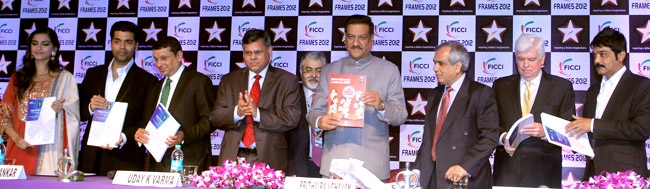
    The Chief Minister also released the FICCI-KPMG Indian Media and Entertainment Industry Report 2012; FICCI-Amarchand Lawbook and ‘Positivity: The impact of television on India’ by The Indian Broadcasting Foundation.


    Mr Jehil Thakkar, Head, Media & Entertainment Practises, KPMG made a brief presentation about the highlights of the FICCI-KPMG Indian Media and Entertainment Industry Report 2012.


    Senator Chris Dodd, Chairman, Motion Pictures Association of America, who took the stage next, underlined the need to look into stringent regulations against content theft.  “When content is stolen, 95 per cent of the people who contribute to the vitality and success of a film are adversely affected”, he said. Quoting an Ernst & Young report, he said, movie theft contributes to a loss of US$ 1 billion annually and threatens the jobs of half a million people. He stated thatIndiais among the top 10 nations as far as online copyright infringement is concerned. He said that technology (digitisation) and content need each other and one can’t be without the other.


    Mr Uday K Varma, Secretary, Ministry of I&B, opened his address by stating that the concerns that the industry had over digitisation and the Phase 3 of FM radio have been addressed by the move to allow 839 new FM stations and 500 community radio stations.


    He stressed that the government is committed to ensure time bound digitisation and said that come July 1, the four metros will switch over to the digital format and the plan is to ensure that the move to digitalisation is completed by December 31, 2014. He agreed that the challenge was mammoth- to convert 80 million analog connections to digital format but added that the move will ensure faster and deeper penetration. “This will address a plethora of issues facing the television industry, such as addressability, carriage fees, audience measurement and consumer choice,” he said.


    Mr Varma added that in order to combat piracy, they intend to carry out an all-encompassing multi-media campaign during the 12th five year plan period involving all stakeholders from the film and music industries.


    He also outlined the ministry’s plan to celebrate 100 years of cinema inIndia. Mr Varma said that the Government of India, in cooperation with the film industry, has a line of activities between May 3, 2012 and May 3, 2013. It also proposes to present a tableaux of ‘100 years of Indian Cinema’ at the Republic Day parade next year where the plan is that the stalwarts of the industry also take part.


    Mr Varma also announced that the government is setting up a National Film Heritage Mission to safeguard India’s celluloid history by undertaking picture and sound restoration of more than 2,500 films. In Addition, theMission, with a budget of over Rs500 crore, would also look at constructing preservation vaults for archiving restored material, and for conducting workshops and training.


    The session closed after a vote of thanks given by Dr. Rajiv Kumar, Secretary General, FICCI.