Tag: FICCI Frames 2014

  • #FF14 Day 2: Despite advent of multiple platforms, television still rules

    By A Correspondent


    With the explosion of a host of content delivery platforms in India, it is increasingly becoming demanding for traditional mediums to spruce up their offering and do it in a manner that is platform-agnostic. The observation is particularly true for the medium of television that is being confronted with newer challenges as a host of platforms are making a beeline to offer content in their own unique ways.


    The session on ‘Television is Dead – Long Live Television’ on day 2 of FICCI Frames discussed how content providers can reach out to consumers in a multi-platform world and who will be the ecosystem winners and losers in the future. The panelists comprised of Anuj Gandhi, Group CEO, Indiacast Media Distribution; Sanjay Gupta, COO, Star India and Todd Miller, CEO, Celestial Tiger Entertainment. The session was moderated by Vivek Couto, Executive Director, MPA.


    Mr Couto began by shedding light on how the traditional medium of television was still ruling the viewership pie and was not being as impacted by the emergence of other digital options including mobile. He presented the example of a developed market like US that was still seeing a healthy growth trend. Asserting that the future will be about consolidation, Couto said that the medium needed to get away from its garb of being a defensive medium and rather play the role of being an aggressor.


    Sanjay Gupta began by taking the audience back to a decade ago where it was prophesied that the medium of print would die with the invasion of television. “But that is obviously not the case with the medium of print growing by two times its total share today. We therefore are living in exciting times as new mediums are providing newer opportunities.” Mr Gupta advised that instead of looking at it as a TV business, the players should be platform-agnostic and receptive of changes that the newer platforms have to offer.”


    For Anuj Gandhi, the last two years were indeed exciting for the Indian broadcast industry largely for the digitization exercise that was undertaken on a national level. “While there were more than 40 companies that were launched, more than half of them shut down after facing challenges. The problem is that we lack scale,” said Gandhi. Mr Gandhi affirmed that it was still looking at opportunities on the digital platforms in terms of providing content for ‘binge viewing’ format.


    Todd Miller pitched in by saying that whatever the prevailing trend, the important medium to connect with the viewer still continues to be television. Despite the emergence of multiple platforms, television will still be the preferred vehicle as that is where the viewer’s tend to be the stickiest, he said.


    Offering an advice to the audience, Sanjay Gupta said that there was no attempt being made in terms of scale for viewing content of choice on linear platforms. “That is a challenge that the content creators need to resolve,” he said.


    According to Anuj Gandhi, the challenge still remains that the bandwidth speeds for accessing data on internet continues to be problematic. And this is despite the explosion of smartphones and tablets in the country. He cautioned the gathering that brands needed to be ready with high-value content when technologies like 4G etc take off. But come what may, television will continue to evolve as a medium and will become more ‘pull’ medium for attracting viewers than being a ‘push’ medium.


  • #FF14 Day 2: Traditional or sensationalism – what works more for primetime?

    By A Correspondent


    The tone for the session was already set by the speaker from the earlier session, who was invited to make a keynote address to the audience on Day 2 of FICCI Frames 2014. Having shared with the audience his secrets to being a popular anchor on news television, Arnab Goswami of Times Now became a subject of debate in the next session titled ‘The Big Fight for Primetime’.


    The panelists included Ashok Venkataramani, CEO, MCCS India; Dr Bhaskar Das, CEO, ZEE Media; Vishnu Som, Editor & Sr Anchor, NDTV and Jon Sopel, Senior Anchor, BBC Global News who moderated the session.


    Sounding put off by the adulation that his friend and former colleague had received at an earlier session, Vishnu Som was critical as he said that what sells in news journalism today is an element of sensationalisation or entertainment. “The job of any news journalist is to provide news, not infotainment or entertainment. I find Arnab’s Goswami’s style of reporting a bit more dramatic or aggressive if you may call it. Personally, what matters for me is providing content that is high on quality. In that sense, the old style of journalism is much better and remains desirable even today.”


    Bhaskar Das highlighted how it was essential to have content that was centered around the interest levels of the viewers. Ultimately, he opined, if you manage to provide good content that will result in better viewership which will translate to better revenues for the channel at large. “It is essential that news broadcasters figure out what is the primetime for the viewer and work towards providing content accordingly.”


    On a question on the high number of news channels in operation today, Ashok Venkataramani said that there were too many channels existing in the marketplace which was not feasible. “There are too many news channels operating today and beyond the top 3 players, others will continue to face survival challenges. That is possible by having a sound business model with renewed focus on content.” Mr Venkatramani went on to add that the best way to see that people do not chase TRPs is to stop giving them TRPs. He asserted that it was important to build brands that stayed loyal to their core objective and accordingly, give them enough space to grow.


    Taking a hard jibe on the regulators, Vishnu Som was quite vocal when he said that one of biggest problems arising out of the ongoing primetime battle is due to a flawed measurement system. “I find the ratings system to be highly flawed as it is based on limited number of meters installed at homes. In fact, an internal study undertaken by us show NDTV as the clear No 1 in primetime but that is not the case with the current measurement system.” Adding further Som said that news channels today were relying only on advertisers for making money and therefore when the numbers were not right it was causing a dent on the revenue making model for channels.


    Pointing again to antics followed on rival channel Times Now, Som said that the primetime in India is majorly between 7-11pm and people have realised that all it takes to get numbers is get in people to talk. “Talking is a cheap exercise as there are no costs involved in getting panelists to speak on air for free, but it results in certain channels getting undue favour from advertisers while those offering quality content don’t get the desired returns. All this needs to change.”


    Bhaskar Das opined that the challenge for news channels will be to get the youth hooked on to the content especially since many new platforms were evolving that were offering similar content. But the good thing is that digital is still evolving as a medium and there is still about 3-5 years for television to make changes if it had to stay relevant in the future as well, he remarked.


  • #FF14 Day 2: Internet – playing catalyst to change

    By A Correspondent


    The year 2014 is turning out to be a turnaround year for political parties who are turning to the digital world to reach out to the masses. While their popularity with the masses on the medium is questionable, what is noteworthy is that it has managed to play the role of a catalyst in disseminating information to the people at large. But it is not as smooth for most politicians who are looking at the medium as an intrusion into their public life.


    These and many more aspects concerning the digital world were discussed in detail at the session ‘Internet and Democracy: Interloper or Catalyst?’ The panelists at the session included Chetan Krishnaswamy, Head, Public Policy and Govt Relations, Google India; Suparna Singh, Director of Strategy, NDTV, and Managing Editor, NDTV.com; Ronak Samantray, Founder, NowFloats.com; Mike Best, Berkman Center for Internet & Society, Harvard University and Roger Fisk, PR Expert, President Obama’s Campaign. Jon Sopel, Senior Anchorperson, BBC Global News was the moderator at the session.


    Chetan Krishnaswamy of Google began by warming up the audience on the spectacular growth story being put up by the medium of digital. “From what it was around a decade ago, internet has grown by 600 per cent to a $2.5bn industry today. In fact over the next six years, the country would have about half a billion users accessing the internet, easily surpassing countries like US and being a close second to China.” Krishnaswamy went on to add that much of the growth on digital was coming from the mobile platform with over 4 million users using the medium to access content. “What is interesting is the growth that is being reported from non-English websites or language websites that have grown by more than 56 per cent whereas the English websites have grown by just 11 per cent. All these are indications that the internet can only make the democracy better and act as a catalyst.”


    According to Suparna Singh, what social media, in addition with players like facebook, twitter can do is become an apparatus of change. “What is being witnessed right now is that such platforms are becoming more opinion oriented and not informational; it needs to shed its baby weight and become more mature. There needs to be more dialogues and exchange of ideas and information on these websites,” reiterated Singh.


    Highlighting the action that was being witnessed on the medium with the general elections around the corner, Singh said that though there has been an invasion from the political parties on these platforms, it is still in its infancy. “But that will change in the next general elections where a lot more political parties will take a liking to the medium and will be reaching out to the masses in a much profound manner,” affirmed Singh.


    Highlighting the work done by his firm, Ronak Somantray said that the objective of his firm was to get businesses online and promote them largely through the medium of messaging (SMS). There is a lot of response that we have generated in the marketplace and are hopeful of making a big impact in the future as well, he said.


    According to Mike Best, the role of social media is not being comprehended in a manner that it should. “If you see the impact that social media websites created on countries like Iran and Syria during the turmoil, it was quite an extraordinary effort.” Best bought up the example of Nigeria where his company had helped the country in the run-up to the elections by providing insights and data on the trends that were being spotted. This, he said, prepared the people to either vote for change or be ready for the worst. Highlighting his objective in 2015, Best said that his company will be monitor social media as well as well as observer missions at the same time when the elections take place again in Nigeria.


    The panelists went on to discuss the intricacies surrounding privacy on the internet and how the process had to be simplified so that the owners do not face a harrowing time answering questions from the consumers’ end.


  • #FF14 Day 1: Text of Uday Shankar’s speech

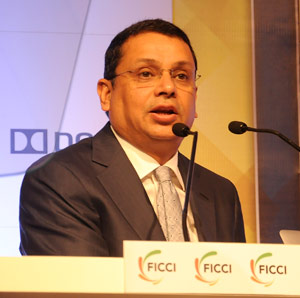
    Mr. Uday Shankar, Chairman of Ficci’s M&E Committee and Star India CEO giving the Opening Remarks at FICCI Frames 2014

    Opening Remarks by Uday Shankar, Chairman, FICCI Media and Entertainment Committee, and CEO, Star India, on Day 1 (March 12) of FICCI Frames 2014. Text courtesy: PR Department, Star India


    Good morning and welcome everybody.


    Honourable minister Manish Tewari, United States FCC Commissioner Ajit Pai, Dr. Khullar, Secretary Julka, my dear friends Punit and Karan, the wonderful team of FICCI that have organized this event, ladies and gentlemen.


    Amidst an environment of gloom and doom, the media and entertainment industry registered an impressive growth of 12% last year. The fact that we have been able to deliver this in light of an overall economic growth of 4% and a major resetting of exchange rates is a testament to the tenacity of the industry’s leaders and stakeholders. However, while delivering a growth rate three times that of the country at large is cause for satisfaction, the truth is that in dollar terms, we have barely made a dent this year. And, even more importantly, we remain at a great distance from the goal of growing the sector to 100 billion dollars.


    But, this is not a sector whose value is measured just by the size of its financial contribution. Media and entertainment remains central to defining the direction of India’s social and economic path; its work remains key to the imagination and inspiration of a billion Indians every day; and its health will be central to the ethos and values of the society we collectively shape.


    And, therefore, it is hugely important that we are gathered here in the days and weeks leading up to the national elections – one which comes at a particularly important time in our post-independence history. We have run the course on exploiting the momentum of the first set of economic reforms unleashed in 1991. We have created enormous opportunities and wealth for many. And, now, we are faced with a far more complex set of economic and social choices, including on the ideal role of the government, its relationship with industry and, in fact, the relationship of the private sector with the overall society at large.


    And no relationship is more important than the one between the government and the media. In many ways - and not uniquely to India - this is a relationship which by the very nature of its constituents is conditioned to be adversarial.Governments and political leaders are deeply aware of the power of shaping the message. The natural instinct of the state is to control the message. And, where it can, to control the messenger. The natural instinct of the media, whether the news media or the creative community, is to resist control, is to question authority. There is, therefore, tension inherent in the conflicting instincts of the two constituents.


    In India, that relationship has often moved from being just adversarial to flirting on the boundaries of dysfunctionality. Used to only a compliant state media, successive central governments have often used policy to limit free expression.And, increasingly, state governments have crossed the boundary to actually own and run private media enterprises.Why just run channels when you can integrate across the whole value chain, and run entire businesses from delivery to content?


    It is surprising indeed that irrespective of the political party or government, the expectation from the media is that they will always be flag bearers for the party line. So, there is no complaint when the media builds up the image of a clean, technocratic Prime Minister. Nor is there any problem when the media trumpets the idea of a youth leader or champions the development achievements of state leaders. But dare they cross the line into seeking accountability or evidence ofperformance, they are dubbed as incompetent, or worse,corrupt. What truly outraged me was the recent turn of events. It was the media that had created rock stars out of a bunch of street artists and protesters. It was the relentless 24 by 7 coverage of fasts and high decibel theatrics that created a political party from thin air and installed them in the government. You would have thought these leaders would have been grateful to the media for nurturing them. And, yet, even they resorted to accusations of corruption the minute the conversation turned to accountability for their choices and performance!


    Of course, the media has been more than just a silent victim in creating this environment. Too often, the news media has focused on what is sensational rather than what is important. Too often, the point of news seems to be to reduce the extraordinary diversity of the country to the most banal, a contest between extremes that can only be resolved through a shouting match on live television. With singular dominant narratives, the trend seems to be of creating heroes on a particular day only to be labelled as thugs and crooks the next.


    Legend has it that, in the early years of independence, Prime Minister Nehru used to write criticisms of his own government under pseudonyms published in leading newspapers. So concerned was he about a press that was not free and was not fiercely independent. It is ironic that today, it is perhaps easier to get articles published for a fee in newspapers than to place an honest criticism of the government. Nehru’s successors, both in politics and in the media, have strayed a long way away from that aspirational vision of the role of media in Indian society.


    Instead, it is now a broken relationship, and one that has dire consequences for both the industry as well as the government. The failure to establish credibility and importance has meant the industry perennially stays on a back foot, defending itself against every new wave of regulation aimed only at further curtailing its wings. In return, the government has not been able to leverage either the impact that mass media can have in India or harness the power of media as an economic engine that can create jobs and wealth.


    It is therefore appropriate that the weeks before the elections is the right time to call for a new contract between the government and the media. One that reaffirms both stakeholders to the theme of this year’s FICCI Frames: Transforming Lives.


    The central principle of this contract should be the recognition that this industry is a unique and powerfuleconomic enterprise. It is capable of creating employment and wealth much faster than most other sectors and with the ability to be a force multiplier, like it is in most countries. It is particularly relevant in India because it can be an employment generator without sizable public investments and without being hampered by the deficiencies of public infrastructure.


    Why would you not nourish an industry which has the potential to become a huge employer? Why would you not fuel an industry that can grow with more policy support than resource support?


    Second, the next government should recognize that it matters what the agenda of the Information and BroadcastingMinistry is. It matters what the Ministry sees as its dominant priority.  Do you see media as a tool for transforming lives thereby using it in the interest of serving the population or as something so powerful that it needs to be controlled? The regulatory agenda is one of the most crucial parameters that will shape how this industry will look like in the next 5, 10 and 15 years, and after some progress in the last few years, this agenda has now completely stalled. Whether in accelerating the digitization of television delivery, or creating progressive frameworks on consumer pricing, this agenda is waiting the arrival of a transformational government.


    And, this is particularly important when you review the media landscape today. It is littered with unviable and unhealthy media companies that cannot survive in the current framework. And unless all stakeholders are committed to retaining the vibrancy of the sector, the biggest victim will be free expression. No value is more important to this countrythan preserving the ability of a free media to showcase plurality in opinion and creative expression.


    I hope that the next few days will give us an opportunity to lay the foundations of a constructive relationship with a newgovernment for the next 5 years.


    Thank you.
     

  • Frames: Fifteen years of being the biggest M&E event in India

    Source: KPMG in India Analysis


    By A Correspondent


    The fifteenth edition of FICCI-Frames had reason for some special celebration. But, save the strong mention of this milestone, it would appear like any other Frames.


    The presence of a film star at the inauguration, the FICCI officebearers, a representative or two from the government and a large industry presence.


    Yet, it’s possibly the biggest event of the media and entertainment sector each year, and even the curation of the conference was wanting, as a celebration of the industry, it was unparalleled.


    But first a disclosure. MxMIndia is a media partner of the event, as it is of many FICCI M&E events through the year. Though that’s not the reason why we are covering the event. By the sheer presence of industry heavyweights around, it gains importance.


    Unlike the issue of digitization in the year 2012 which made the thirteenth edition of Frames such a huge pull, what we had last year was a disappointment. And this year’s edition is a continuation of that. To say that it’s a conference of the entire media sector may be incorrect. Successive editions of the event have given shoddy treatment to the print and sectors other than television and cinema.


    The FICCI-KPMG report on the sector -  in the backdrop of the various adspend reports published by media agencies – is a reference volume for the trade. Although the report is available online, the near-9MB, 293-page hardback is best consumed on print.


    An extract from the summary capturing the highlights of 2013:

    The Indian Media and Entertainment (M&E) Industry, one of the most vibrant and exciting industries in the world, has had a tremendous impact on the lives and the Indian economy. As the M&E industry widens its reach, it plays a critical role in creating awareness on issues affecting, channelling the energy of and building aspirations among India’s millions. As it entertains and informs the country, the M&E industry has been a catalyst for the growth of large parts of the Indian economy. Take for example, a villager – illiterate and previously unaware of what life has to offer, who begins to see a better life through entertainment programs on TV and aspires for a better life for him and his family. This drives demand for various products and services. These aspirations have been key to self motivated transformation taking deep root in India – Transformation not just from handouts and government schemes, but transformation stemming from ambition and aspiration. The media plays a significant role in our lives today and is all pervasive with touch points ranging from television to newspapers to films to radio to outdoor properties. With the addition of new media such as social networking services, animation and VFX, online gaming and applications running on mobile devices, a new dimension has been added to the world of media that was dominated by traditional media. In addition to their implicit impact, all media platforms provide a great opportunity to carry explicit messages to create social impact. Further, interactive and social platforms give people a voice.


    Examples include –

    • Films: Short films on disadvantages of tobacco consumption/smoking before each film screening in a theatre


    • Television: TV shows on social issues to raise awareness, such as Crime Patrol – Dastak (Sony Entertainment Television), Savdhaan India – India fights back (Life OK) and Satyamev Jayate (Star Plus).


    • Radio: Content highlighting social initiatives aired on radio such as Mirchi for Muzaffarnagar (Radio Mirchi), Munni Vardaan Hui (Red FM), and Green Ganesha (Big FM).


    • Print: Friends of Hindustan (Print campaign by Hindi daily Hindustan in Patna), Good is in our DNA (print campaign by DNA).


    Social Media: UNICEF India’s campaign of ‘Take Poo to the Loo’ on Facebook, Twitter and Youtube to spread the message of the harmful effects of open defecation;4 connects consumers with each other and provides a platform for opinion generation.


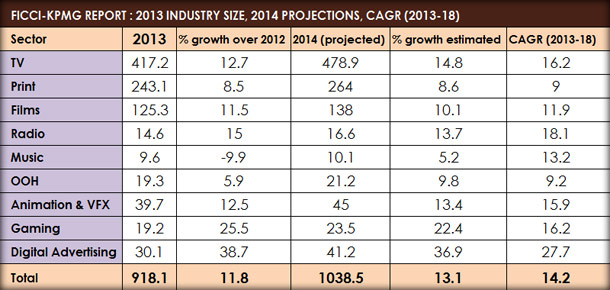
    In calendar year 2013, the Indian Media & Entertainment (M&E) industry registered a growth of 11.8 per cent over 2012 and touched INR 918 billon. The overall growth rate remained muted, with a slow GDP growth and a weak rupee. Lower GDP meant lower demand from the consumer and this impacted advertising. At the same time, the industry began to see some benefits from the digitisation of media products and services, and growth in regional media. Gaming and digital advertising were the two prominent industry sub-sectors which recorded a strong growth in 2013 compared to the previous year, albeit on a smaller base. For projections till 2018, digital advertising is expected to have the highest CAGR of 27.7 per cent while all other sub-sectors are expected to grow at a CAGR in the range of 9 to 18 per cent. Overall, the industry is expected to register a CAGR of 14.2 percent to touch INR 1785.8 billion by 2018.


    The Indian M&E sector showed some resilience and began to grapple seriously with some structural issues it has long talked about but not engaged with. These include TV and Print industry measurement, advertising volumes, inventory and rates, actions to see digitisation through and reap its benefits, working out the MSO-LCO relationship, copyright laws and operational efficiency. Many of these remain alive and will take a few years to sort through. Others, like phase III of radio – are still pending regulatory action.


    Increasing digitisation across sub-sectors of M&E industry, rate increases in TV, channel packaging by MSOs, innovative strategies to monetise digital content, rapid growth of new media powered by increasing smartphone penetration, and campaign spending during the general elections are likely to be the key levers of growth for the Indian M&E industry in 2014. A well thought out, consistent and long term outlook on regulation is also the key to create an M&E industry that is world class in scale and plays its part in transforming India.


  • #FF14 Day 1: Frames takes transformational route in 15th year


    By a correspondent


    The 15th edition of the much anticipated annual event of the Media & Entertainment industry – FICCI Frames 2014, got off to a captivating start in Mumbai on March 12, 2014. The event began with an inaugural session that saw the big guns from the media and allied sectors including the I&B Ministry delve on the theme of the conclave – Transforming Lives – while also highlighting the current state of the M&E sector and its scope for the future.


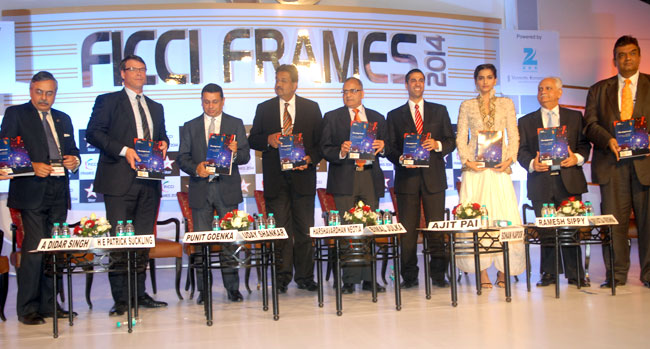
    The lineup of the dignitaries for the inaugural session included Harshavardhan Neotia, Vice President, FICCI; Uday Shankar, Chairman, FICCI Media and Entertainment Committee, and CEO, Star India; Punit Goenka, CEO & MD, Zee Entertainment Enterprises Ltd; Shri Bimal Julka, Secretary, Ministry of Information & Broadcasting, Government of India; Shri Srivatsa Krishna, Secretary, Department of IT, BT & ST, Government of Karnataka; H.E. Patrick Suckling, Australian High Commissioner to India and Ajit Pai, Commissioner, FCC, USA.


    Highlighting the state of the M&E industry in 2013, Uday Shankar said that while there was much talk about doom and gloom in the economy it was not the case for the M&E industry that grew by almost 12 per cent. But he cautioned that the goal of attaining the $100 billion landmark was a distant dream as yet. Mr Uday went on to highlight the role that the government could essay in simplifying several issues facing the industry and how it could work in tandem with the industry in resolving them.


    Echoing a similar point of view, ZEEL’s Punit Goenka too laid the pitch for a collaborative effort as he said that the M&E sector has played a key role in enhancing the prospects of the economy, especially on the jobs front. “The M&E industry has been a shining example of how an industry could work towards achieving a common goal of inclusive growth and being a facilitator to all concerned. It is a matter of pride for the sector to be employing more than 6 million people with the scope of providing employment to many more in time to come.”


    Mr. Goenka further highlighted the role that digitization has played in the year gone by, and how it would alter the broadcast landscape in the future. He affirmed to the audience that it was time to give back to the industry for whatever it has given us and that the same should be done by unleashing innovation and creativity as the core. In fact the collective aim should be to transform the lives of the global community and not just India, asserted Goenka.


    Having been introduced to the various loopholes and issues facing the industry at the introductory session, Shri Bimal Julka, Secretary, Ministry of Information & Broadcasting was vocal when he said that it was not just the government but the industry that should take responsibility in finding a solution to the problems at hand. “The role of the government is that of a facilitator, it would be great if the industry takes a collective stand on issues themselves and come to us if at all they face any hurdles.”


    Highlighting the several initiatives undertaken by the I&B ministry, Mr Julka said that the first two phases of digitization have met with reasonable success in about 42 cities and it could be credited as being the smoothest and fastest such initiative of its kind. The focus now would be on Phase 3 & 4 of the drive where an additional 110 million STBs are scheduled to be rolled out. “While there are a few issues concerning the digitization exercise, we are taking efforts to sort them out including at the level of broadcasters, MSOs, LCOs etc. But the good thing is that digitization has managed to bring in transparency in the broadcast sector, which was the main goal of the whole exercise.”


    Mr Julka said that the I&B ministry was also concerned about the content that was being shown to the viewers and urged the broadcasters to practice self-regulation. With 800 channels already existing and a further 250 plus awaiting clearances, it was important for broadcast companies to figure out how to dish out content that is accepted by the viewer.


    Mr Julka also touched upon the challenges facing the industry including control on monopoly & cross-media ownership, content monitoring, transponder capacity problem facing DTH players etc.


    The session proceeded to an engaging perspective on the US broadcast market that was provided by Ajit Pai, Commissioner, FCC, USA and also a keynote address by Shri Srivatsa Krishna, Secretary, Department of IT, BT & ST, Government of Karnataka.


  • #FF14 Day 1: Issues abound but collective stand will help boost industry morale

    By a correspondent


    Starting off from where the inaugural session left, the session on ‘De-bottlenecking the regulatory hurdles’ on Day 1 of FICCI Frames 2014 saw the panelists touch upon grave issues facing the industry and how the government could play an integral role in allaying the fears of all the stakeholders concerned.


    The panelists for the session comprised Bimal Julka, Secretary, Ministry of Information & Broadcasting, Government of India, Uday Shankar, CEO, Star India, Sudhanshu Vats, Group CEO, Viacom18 Media Pvt. Ltd, Punit Goenka, CEO, Zee Entertainment Enterprises Ltd, Rahul Johri, Sr VP & GM, South Asia, Discovery Networks and  Ajit Pai, Commissioner, FCC, USA. The session was moderated by Vikram Chandra, Group CEO, NDTV.


    Taking the opportunity to open up, Uday Shankar began by saying that the regulatory scenario in India was very diverse in its approach with some sectors being over-regulated while the others were under-regulated. “Lack of clarity on the intent of a regulation is something that is of concern. It has to be aligned with goals that have been set by the society”, said Mr. Shankar. He went on to highlight other issues that needed industry attention including the 10+2 ad cap provision and also the just introduced aggregator policy for stakeholders.


    Sudhanshu Vats presented a few indicators of his own as he said that there was a need to have a purpose to regulate. This, he said, could be achieved by having multiplicity of choice, have the need to operate like a free market and have adequate transparency and data. Adding further he said that the other essential needs were clarity, accountability and foresight.


    Rahul Johri pitched in by saying that there was indeed a need to have clarity on where the industry was headed on the issue of regulation and finding out what the core objective is. “We have regulated ourselves very well but there are too many regulations being imposed right now and we need to find a way to tackle them systematically. The aim should be to regulate well for the future of India.”


    Left to defend his turf, Shri Bimal Julka did a decent job of pacifying the panel as he said that it was a collaborative effort and that the responsibility rests with all stakeholders to get the job done. “Whatever the issues, we can agree in cohesion that it is the viewer towards whom our efforts have to be directed. Thus keeping such interests of the viewer in mind, the policies are framed with the intention of achieving inclusive growth,” he asserted.


    On the several impending problems facing stakeholders, Shri Julka said that the focus by the government was to throw open the field for a healthy discussion amongst all players so that they could arrive at an amicable solution. Mr. Julka asserted that despite the problems the digitization exercise was showing positive results as well including the carriage fees reporting a downward slide and more transparency being bought into the system.


    Mr Julka went on to add that the challenge would be to complete the phase 3 & 4 schedule of digitization and only after that could the issues of subscription versus carriage fee be resolved. But he cautioned that the stakeholders also had a role to play including deciding on how to make their content standout amongst a plethora of options facing the viewer.


    Sudhanshu Vats went to the extent of saying that there was no need to have a licensing system except for the spectrum allocation and that even if there is a licensing system there needs to be a fixed timeframe to address that. He added that things will be clear once the entire digitization exercise is complete but prior to that it was important that the industry take a hard look on addressability factor of digitization.


  • #FF14 Day 1: Seamless content delivery across multiple platforms the way forward

    By a correspondent


    With so much being written and said of the emergence of multiple platforms and content delivery mechanisms in India, it was only apt to gather opinion from those that are driving the change to get a firsthand feel of the effects being spotted. The session on ‘Television 3.1’ on day 1 of FICCI Frames saw the panelists assess the future of the broadcast industry, in terms of content, marketing and distribution strategies in the era of convergence and multiplatform delivery mechanisms.


    The panelists comprised speakers like Tarun Katial, CEO, Reliance Broadcast, Vikram Chandra, CEO, NDTV Group, Mathieu Bejot, Executive Director, TV France International, Bharat Ranga, Chief Content and Creative Officer, ZEE Entertainment, Ashok Mansukhani, President, MSO Alliance and Todd Miller, CEO, Celestial Tiger Entertainment. The session was moderated by Janine Stein, Editorial Director, Content Asia.


    Vikram Chandra began by highlighting how 4G and smartphones will be the next big change agents in the Indian media landscape. “The recent months have witnessed a lot of people moving to the second screen to access content of their choice and with the access becoming more fast and affordable, smartphones will be the next big thing where content consumption is concerned,” he said.


    For Todd Miller, what will drive India in the months ahead will be the explosion of HD technology. Assisting that would be content from China that would be finding its way around the world, including India.


    Providing a different perspective, Bharat Ranga said that the way his network functioned it was a matter of tackling markets on a ‘meta’ level. Meta-national approach by companies that caters to market-specific conditions will drive the growth for broadcasters. Also, it will be essential for broadcasters to have a consumerist understanding of data and not marketing understanding. With the emergence of new platforms, Ranga noted that the industry will see the emergence of budding talents who will be able to bring in a different perspective.


    Ashok Mansukhani proposed that each stakeholder should be able to make money from the digitization exercise but that the consumer should have the final say. He said that the phase 3 and 4 of digitization will see a lot of players going fiber. While that will boost output, it is essential that the distribution rights of such an exercise are retained with the distributor, he noted.


    Tarun Katial said that India was ready to see content as the core subject that can be created for various platforms. The ability to have good investment strength and also the right mix of talent and content will help companies achieve the goal faster, he noted. Mr Katial added that while earlier ‘Content was King and Distribution was God’, the phrase has now changed to ‘Content is king and Technology is God’. Going forward, it is important that broadcasters have a hold on the IPs as that is what will matter in the future. And while much of the content at Reliance is being rented, Mr Katial added that very soon they will be working on producing content that would be their own.


  • FICCI Frames turns 15, 2014 edition to focus on how M&E influences social change

    By A Correspondent


    The Federation of Indian Chambers of Commerce and Industry (FICCI) has announced the 15th edition of its annual Frames convention for the media and entertainment industry.


    FICCI Frames 2014 will be held from March 12 to 14, 2014 in Powai, Mumbai. Nearly 2000 Indian and 600 foreign delegates are expected to attend. The theme of Frames 2014 is “Media and Entertainment: Transforming Lives” highlighting the role of media and entertainment as a vehicle for social change (*See Disclosure).


    The convention will discuss reforms and regulatory endeavours along with working on ideas on socially meaningful and quality content. The inaugural keynote will be by FCC Commissioner Ajit Pai who will touch upon content in the regulatory landscape in the US. Raghav Bahl, Controlling Shareholder and Managing Director of the TV 18 Group will make the theme keynote address on Media and Entertainment as  a Vehicle for Social and Economic Change.  Aroon Purie , Chairman India Today Group,  will deliver the keynote on Print Industry: Surviving All Odds in the Digital Era. Justin Osofsky, VP – Media Partnerships, Facebook will talk on ‘Establishing Social Networks as the Primary Online Forum for Public Conversations ‘.


    Apart from the core theme, Frames 2014 will focus on key avenues for monetising the sector such as Talking Numbers: Hard Facts about M &E’s Economic Contribution; TV 3.1: Content, Strategies and the Future of Broadcast; De-bottlenecking the Regulatory Hurdles, The Changing Dynamics of the Film Exhibition Landscape.


    Stakeholders and thought leaders such as Uday Shankar, CEO, Star India and Chairman FICCI Entertainment committee, Karan Johar, Chairman , Ficci Frames, Punit Goenka, MD & CEO , Zee Entertainment, Sudhanshu Vats, Group CEO Viacom 18, Mathieu Bejot, Executive Director, TV France International, Roger Fisk, Presidential PR Guru from President Obama’s electoral campaign; Jim Egan, CEO, BBC Global News, Andrew Lack, Chairman, the Bloomberg Group; Bill Livek , CEO, Rentrak,  Kim Dalton, Chairman, Asian Animation Summit; Hiromichi Masuda, Vice Chairman Business Committee, The Association of Japanese Animations,Todd Miller, the CEO of Celestial Tiger Entertainment, a Lionsgate joint venture and former head of Sony Pictures Television, are slated to speak at Frames 2014.


    Frames 2014 has been planned with some off-the-cuff sessions to broaden the conventional boundaries of the summit. Sessions such as “Internet & Democracy: Interloper or Catalyst?”, “The Film that Changed My Life” and “The Indian Electronic News Media: On Fine Balance?” will be held.


    A discussion specific to attracting the influx of private equity for the sector has been planned and film funding is a subject which will be deliberated upon. A Producers’ Masterclass wherein producers like Andy Paterson and Guneet Monga will discuss the overarching role of a producer in taking a film from start to finish. Masterclasses with acclaimed Hollywood VFX supervisors such as George Murphy , Oscar winner and Chief Creative Officer, Reliance Media works , Jon Cowley and Ben Murray  of Prime focus world are also in the offing. The cinema exhibition sector will be dealt with at the “Cinema Advertising & Alternative Models: The Changing Dynamics of the Film Exhibition Landscape” session. Creative sessions on “The Past Present and Future of Good Cinema: Film-making for a Cause” and “Cuts so Deep: Are we Sacrificing Creativity at the Altar of Morality” will focus on ‘meaningful cinematic content’.


    Australia is the partner country and Karnataka the “Partner State” at FICCI Frames 2014. Srivatsa Krishna , Secretary, Deptartment of IT , BT & S and T , Govt. Of Karnataka will touch upon how Karnataka has been doing much to promote growth and development of its M&E industry


    An innovative feature of this year’s edition of Frames will be the FICCI-Ink Salon, an exclusive by-invite only daily hour-long session with speakers from the Indian part of TED talks. The BAF award show and networking evenings will as usual be the hallmarks of the after-hours.


    *Disclosure: MxMIndia is a Media Partner of FICCI Frames 2014