Tag: FICCI Frames 2012

  • Rockstar triumphs at FICCI Frames Excellence Awards

    By A Correspondent


    The 13th edition of the FICCI Frames 2012 culminated with the FICCI Frames Excellence Awards 2012 at Hotel Renaissance, Mumbai recently. Celebrating excellence in the verticals of Film, Television and Radio, the FICCI Frames Excellence Awards was hosted by Mandira Bedi and featured stunning performances by the talented Usha Uthup and rock sensation Papon.


    Rockstar won a total of 4 awards making it the most prolific winner of the evening. Imtiaz Ali won Best Director for the film while Ranbir Kapoor bagged the Best Actor Award. A R Rahman was felicitated with the Best Music Director Award and Mohit Chauhan with Best Singer – Male for the same film.


    Farhan Akhtar and Ritesh Sidhwani walked away with the award for Best Film for the path-breaking movie Zindagi Na Milegi Dobara. Vidya Balan received the Best Actor – Female award for The Dirty Picture and newbie Parineeti Chopra got the Best Debut – Female for her comedic role in Ladies VS Ricky Behl. The Award for Best Debut – Male went to Vidyut Jamwal for Force and Abhinay Deo was adjudged Best Debut Director for the highly acclaimed Delhi Belly. Usha Uthup and Rekha Bhardwaj received the award for Best Singer Female for the film 7 Khoon Maaf. Prashant Panday of Radio Mirchi took home the award for Best Radio Channel while Big FM received the award for Largest Radio Network.


    Amitabh Bachchan was honoured with the Award for Maximum Impact made by a Personality while Sony received the award for Maximum Impact created by a Television Channel.


    Earlier, the convention was witness to the FICCI-BAF Awards on the second day of the event. While Redchillies.vfx won the Special Jury Award (VFX Shot of the Year) for Ra-One, Red Digital bagged the Special Jury Award (Open Category) for Lufthansa Park & Fly.


    FICCI FEAMES 2012 DAY ONE
    Digital attracts ‘desirable’ status on opening day
    Text of Star India CEO Uday Shankar’s Keynote
    Discovery to launch kids’ channel in India
    Financing, a cause for concern in media and entertainment
    IBF, ISA and AAAI announce launch of BARC, finally
    Inaugural session weighs pros & cons of digitization
    Entertainment has become a revolution
    TV influences life: IBF study


    FICCI FEAMES 2012 DAY TWO
    Price control equals creative shackles for broadcast: Hernan Lopez, Fox Intnl Channels
    No alternative to the cloud: Manish Agarwal
    Time to experiment with technology
    ‘Console gaming in India is in big trouble’
    Phase III will bring more innovation in radio
    Niche isn’t niche any more
    Dedicated tee time as Ten Golf is launched


    FICCI FEAMES 2012 DAY THREE
    How relevant is newspaper content to the reader?
    Integrated media best way fwd: Vikram Sakhuja
    Digitisation will allow broadcaster to make money off ground: Tarun Katial
    No disadvantage of being a woman
    CCI is an overall market regulator: Ashok Chawla
    Adapt to the digital tide or be left out
    Digital will decide the fate of TV
    Turning 3 into 10, a percentage issue for digital


    FICCI FEAMES 2012 wrap-ups and takeaways
    Counting on digital to be M&E’s trailblazer
    Day 1: Digital attracts ‘desirable’ status on Day 1
    Day 2: Seamless blending with traditional mediums – a big want!
    Day 3: Industry expects thoughts to lead to pertinent actions
    Takeaways: Digitization rules the roost @FICCI Frames 2012
  • Budget 2012: Video reactions from trade

    [youtube width=”400″ height=”250″]http://www.youtube.com/watch?v=Cx39gg69K9o[/youtube]

    By Team MxMIndia


    At the sidelines of FICCI Frames 2012, where there was much talk about digitization from both the industry and the government, MxMIndia caught up with a few industry members to get their reactions on the Budget.


    Nachiket Pantvaidya, Executive Vice President & General Manager, Star Pravah

    To be very honest at this point in time we like to go by the market forces so we don’t expect subsidies from the government. What we do expect is some kind of support in nurturing local talent in providing a base for regional television to shoot and to propagate learning and education in the regional field. Honestly, I think this has to be done through market forces in sync with the government and not through a subsidy model.


    Naresh Chahal, Director-Finance, Indian Broadcasting Foundation

    There is no incentive or concession given to set top boxes for the broadcasting industry and the ministry has already issued a notification for digitization and the first sunset date is July 1. So we are not happy with the way the government has not given any concession. We were expecting 0 percent duty on set top boxes to get a set top box at a nominal cost.


    Raman Kalra, Director & Partner, Industry Leader- Media & Entertainment, IBM Global Business Services India

    Nothing much was expected from the Budget. There were some expectations though, like FDI will go up for digitization, maybe it will happen for cable, some tax relief, that hasn’t come through but industry has already accepted it. They don’t need these one or two things to go ahead on digitization. It’s moving very fast so it will happen.


    Ashok Mansukhani, Director, IndusInd Media & Communications Ltd

    The Budget doesn’t go into the cost to be borne by the government. The government calls digitization a public private partnership, in fact, the private sector will have to spend, the cable sector and the MSOs will have to spend. What we had asked for was that if we spend 40000 crore, we need to also be in a position to be able to get fiscal incentives, tax incentives, duty exemptions, unfortunately all has been denied.


    Ravi Mansukhani, Managing Director, IndusInd Media & Communications Ltd

    We are very disappointed, anywhere else if you look, government always helps towards digitalization. There is no infrastructure status, you are not getting any fiscal incentives, nor are you getting favourable interest rates from banks, so basically we are very disappointed because the entire burden of digitization has fallen on the MSO, on the cable sector and there’s going to be a lot of funding required and we are disappointed that there was nothing done on either duties or fiscal incentives.


    Amit Dev, Director CMAI & Head of Focus Group of Multimedia

    I strongly feel that government doesn’t take a step in a direction unless they see a significant addition of tax or money making to the exchequer through multiple secondary direct indirect ways. So if there is no mention this year that means it is not among the top ten priority issues of the government.


  • @FF12: Phase III will bring more innovation in radio


    By A Correspondent


    Radio has often been criticized for lack of content innovation, that all radio stations sound the same and that there is no differentiation in the medium currently. Although contents across all radio channels are more or less restricted to music, it is believed that once FM phase III is rolled out and multiple frequencies allowed by the government, it will lead to more innovations in content and differentiation within the medium itself.


    One of the sessions at the FICCI-Frames 2012 was on ‘Radio: Innovations in Content’ wherein industry veterans discussed at length on the innovations in content radio is witnessing currently and the enormous innovation opportunities FM Phase III would allow. While the session was moderated by Apurva Purohit, CEO Radio City, the panel members included Rabe Iyer, Business Head, Big FM; Abhijit Avasthi, Executive Creative Director, O&M; Bhavna Somaaya, Columnist and Writer; and Charles Falzon, Chair of The Radio and Television Arts School of Media, Ryerson University.


    Ms Purohit kick-started the session stating that radio currently is in a schizophrenic stage wherein on one hand the medium is witnessing immense growth, it has a huge reach in the country and the FM listenership has also further increased with higher number of mobile phones, whereas on the other hand the overall ad pie of the medium is merely 4 per cent. Ms Purohit also pointed out that in the next two years the industry anticipates another phase of growth which will bring news, sports commentary, multiple frequencies, besides further expansion into towns and cities.


    According to Ms Somaaya, “Innovation is a very subjective term and the definition changes from person to person and the state of mind one is in. I believe innovation comes only in content because technology has been exhausted and there is a whole rainbow waiting for us as there could audio books, short stories, debates, helpline etc. Radio therefore is much more immediate that any other medium.”


    Speaking about the strengths of radio Mr Avasthi first admitted that out of all the media, it is the toughest to write radio spots. He explained, “The strength of radio I believe is one can conjure up a world in the listener’s mind. What you hear on radio today is mainly restricted to Bollywood music. There are so many kinds of music still to be explored and so many types of content that can be experimented, and to break this format I believe the industry requires some amount of courage to do so.  The moment programming in radio opens up then there will be plenty of interesting opportunities for advertising in radio itself.”


    Mr Falzon highlighted the use of digital medium as a complement to engaging the listeners, “We are all experiencing a paradigm shift on how entertainment is being consumed, across the world. India has infact a better opportunity especially with the phase III expansion coming that too at a time we can think about how to use the digital medium. Digital and social media in Canada for example is being used in many ways wherein the entertainment experience of radio has been extended beyond radio.”


    According to Mr Iyer, although 80 per cent of content on radio is music and 20 per cent on the packaging of music, there has been some innovation in the medium and with the phase III launch it will bring with it immense opportunities especially on the innovation and differentiation front. Speaking on the reason radio being left out at times during advertising campaigns, Mr Iyer believed the possible reason could be because the industry has not encouraged radio creativity which in itself is a huge opportunity.


    The Q&A session which followed the panel discussion saw many people questioning the lack of innovation and the dominance of Bollywood-centric music on radio. The panelists more or less agreed that radio in India has seen lack of innovations primarily because of government restrictions which is most likely to change with FM phase III is rolled out.


    Photograph: Fotocorp

  • @FF12: Time to experiment with technology

    By A Correspondent


    Now that digitisation is set to come into effect from July 1, the convergence of media assumes greater significance. This was the topic of discussion in the second session on Thursday at FICCI Frames 2012.


    In a session moderated by Neeraj Roy, MD & CEO, Hungama, Sanket Akerkar, MD, MicrosoftIndiatalked about “The Converged future – Multiple platforms, technologies &transforming applications for media and entertainment”. The theme of his keynote address was significance and emergence of digitisation.


    To illustrate how connected we are today, he cited an example of how a teenaged son of a friend uses Xbox to connect with friends he was with at school and play games. Though this may common enough, he added that the group of friends used the very same environment to connect and do their homework. This can also be taken as learning life lessons of surviving in the digital world.


    Mr Akerkar said that the consumer lifestyles are controlling the conversation, citing the example the “Occupy Wall Street” movement. The industry has to takes its cues from what the consumers want. According to him, even ads will now be consumed as per the consumers’ choice and the advertisers can’t dictate the place and time for the consumption. Now the people are going to become the content creator and content consumer. The main challenge for the industry is now to seamlessly blend and enable technology to become user friendly.


    Jonathan Bill, SVP Internet and Data Services, Vodafone joined the conversation to discuss how the telco-eco system can offer better opportunity to the media and entertainment industry to monetise the services.


    Mr Bill said thatIndia’s telco-eco system is a hyper competitive market which the lowest price points in the global market. It generates the lion share of revenue in the entertainment stream for Vodafone.


    Mr Roy said that technological progress has enabled applications that recognise the customer preferences, be it the Internet or the phone.


    Mr Akerkar agreed and added thatIndiawill have 25 million smartphones by the next year and this connectivity gives the opportunity to the industry to experiment in creating applications for the users. He said that the technology is moving ahead at such speed that one only needs to use their imagination to think ‘what next innovation’.


    All the speakers were in agreement that once the digitisation bill comes into effect, the choice of content available to the user will be limitless. As Mr Akerkar said, “the challenge will be to separate content, be it mainstream or user generated into what is relevant or not.”


    They also discussed the feasibility of creating video content for mobile devices. Mr Bill was of the opinion thatIndiahas huge possibilities as it is the largest internet video consumption market. Mr Roy said thatIndiais poised to become the largest internet market in the next 3-4 years, surpassing evenChina.


    The speakers discussed how even gaming had huge possibilities if one was to look at co-developing games along with films. Mr Akerkar said that there was a business model waiting to happen if one figured how to reduce the initial cost of investment and figure out how to connect a known brand (film) and gaming.


    But the biggest challenge is the transition to the digital eco system. It is not enough to rely only on advertising revenues. Mr Bill said that the way forward is moving from free Internet content to paid content.


  • @FF12: Niche isn’t niche any more


    By Rishi Vora


    It is a fact that Hindi GECs command a premium position in the TV space in India and the primary reason behind that is its mass appeal. And thereforea lot of advertiser interest tends to go in favour of the so-called mass channels.


    But there is another set of audiences that prefer a certain kind of content – speciality content such as Action, Comedy, Food, Music and so on; channels that cater to the tastes ofaudiences with a peculiar taste. These channels are termed as niche channels.


    The concept of niche channels started about 18-20 years ago, and now, as experts believe, niche isn’t niche any more as all niche channels put together command a share that is equivalent of the share of Hindi GECs and the mass channels, so to say.


    On day 2 of FICCI Frames, in a session titled “Building Sustainable Models for Niche Content” honchos from the broadcast industry such as Paritosh Joshi, CEO, Star CJ (session moderator); Smeeta Chakrabarti, CEO, NDTV Lifestyle; Monica Tata, General Manager, Entertainment Networks, South Asia for Turner International India; Ajay Chacko, President, A + E Networks I TV 18 JV; Atul Pande, CEO, Sports Business, Zee; and Rasika Tyagi, Sr VP – English Programming, Star India discussed on revenue models to sustain TV content catering to niche audiences and its long-term sustainability.


    Atul Pande talked about the launch of Ten Golf, a speciality channel for Golf followers in India. He stressed on the need to charge premium to audiences who really are on the lookout for speciality content.


    Smeeta Chakrabarti said that as a speciality channel one cannot talk about TRPs, rather it is the brand connect that what needs to be spoken about as far as ad sales was concerned. Rasika Tyagi on the other hand remarked that the whole idea of measuring a speciality interest channel should be relooked at. “It’s not about how many people are watching you, it’s more what kind of people are watching you.” She also said that the audiences of niche channels are of such quality that they do not mind paying, and that broadcast companies should look to tap into that opportunity.


    Atul Pande remarked that the Pay TV as a concept does not yield great deal of revenue as the pricing of the niche channels are on the lower side. “We keep the pricing on the lower side because we don’t want the consumers to be shocked despite the fact that some of the content that we do justifies a price in the higher range.


    On whether the industry requires a different approach as far as measurement for these channels was concerned, Paritosh Joshi said, “The big challenge with respect to measurement is that we need to find a way to measure both quantity as well as quality. The quality aspect is very critical for a speciality channel.” Monica Tata added, “We need to have a different measurement system to evaluate special interest channels.”


    As for the digitization mandate that all channels have to follow, Ms Tata was of the opinion that to move from the present model of advertising to embracing the digital opportunities will be a challenge, and something that will take time before becoming an industry norm.


    The panel also discussed the need to create global content, thus opening up monetisation opportunities across markets.


    Photograph: Fotocorp

  • @FF12: IBF, ISA & AAAI announce launch of BARC

    [youtube width=”400″ height=”250″]http://www.youtube.com/watch?v=Zjuq1sB7h-E[/youtube]

    Video and Text By Shruti Pushkarna


    The Indian Broadcasting Foundation (IBF), the Indian Society of Advertisers (ISA) and Advertising Agencies Association of India (AAAI) announced the official formation of a nationwide audience research joint body, Broadcast Audience Research Council (BARC).


    The announcement was made at the inaugural day of FICCI Frames 2012 in Mumbai in presence of I&B Secretary Uday K Varma, TRAI Chairman Dr JS Sarma, Managing Director & CEO of ZEE Punit Goenka, Star India COO Sanjay Gupta, Times Television Network MD & CEO Sunil Lulla, Star CJ CEO Paritosh Joshi, Madison Group Chairman Sam Balsara and Landmarc Leisure Corporation MD Paulomi Dhawan.


    IBF will have 60 per cent stake in BARC, while ISA and AAAI will each have 20 per cent stake.


    Originally founded in 2008, BARC was earlier to be set up as a joint venture between the IBF and the ISA on a 60:40 ratio and initial investment of Rs 300 million. However, there was a need felt for the apex body of ad agencies – the AAAI – to also be part of the BARC.


    Talking about the way forward, Paritosh Joshi, CEO, Star CJ said BARC will be similar to what BARB (Broadcasters’ Audience Research Board) is in the UK. He said, “There will be a professional CEO who will be appointed, and we have learnt a lot from watching the BARB work in the UK and one of the things that makes BARB work as well as it does is that they have a professional management system. So we are going to learn from the best practices around the world and one of those best practices is to make it run like a professional setup.”


    A technical committee is being set up, now that all the stakeholders are in place. Mr Joshi said, “The Board of Directors will appoint a technical committee Chairman and then a technical committee and that is where the work actually begins. The work really is going out there and finding the best solution for television audience measurement in India.”


    BARC will not conduct audience measurement directly but commission independent specialist research vendors.


    The Board of the council will have 10 members, six members from the IBF and two members each from the ISA and AAAI.


    Talking about the formation of BARC, Abdul Khan, Senior Vice President & National Head of Business Marketing, Tata Teleservices remarked, “I don’t really think that we need another currency…I think the task is to make what we have more robust and it’s never ending. If two, why not three, why not four? So we should have one currency that is comprehensive enough to tackle major problems and be accepted by the entire industry.”


    “Maybe we need to get people from the younger generation on board  to figure because it is a rapidly changing environment. I am not seeing any changes happening in television research in India – it’s become static in a way. So we need to make it more robust.  Sample size has to increase; one also needs to look at the quality of the sample etc. It’s like if it’s not broke, why you trying to fix it,” added Mr Khan.


    Paulomi Dhawan, MD, Landmarc Leisure Corporation said, “Advertisers are always looking for transparent and robust research and in-depth insights in the rapidly changing television viewership landscape. With time, it is going to be more challenging and you will need more insights from research. We have been working together since some time to launch BARC.”


    ISA Chairman Bharat Patel added, “ISA is pleased to be a part of this joint industry body, BARC, along with the IBF and AAAI to provide continued and meaningful research.”

    with additional inputs by Rishi Vora


  • @FF12: Financing, a cause for concern in media and entertainment


    By A Correspondent


    The media and entertainment industry of India has scripted a glorious growth story in the past decade or so, and the future looks even more promising with digitization and the advent of technology across media verticals such as broadcast, print and also films. But one area of concern is the lack of private equity and VC funds showing adequate interest.


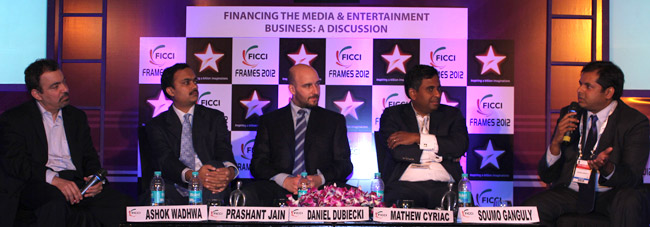
    In a session titled “Financing the Media and Entertainment Business” eminent personalities such as Prashant Jain, Executive Director, HDFC Mutual Fund; Matthew Cyriac, Sr Managing Director, Private Equity, Blackstone; Soumo Ganguly, Managing Director, Moxie Entertainment Pvt Ltd; and Daniel Dubiecki, Founder and Partner, The Allegiance Theatre, Hollywood shared their views on the subject. Ashok Wadhwa, Group CEO, Ambit moderated the session.


    Matthew Cyriac started off the session by pointing out that majority of the investments within the media and entertainment industry were made in television and print as they represent a fairly large share in terms of sheer numbers as against Internet and Radio . The Hindi GECs in TV is where typically where a lot of money into followed by regional GECs and sports channel. For print media, it was the regional publications command a lot of attention as regional advertising is very robust – one which extracts a lot of profit.


    Prashant Jain pointed out thata lot of companies in India have managed to get good funding and that it is not reflective of a very, very sorry picture as is being talked about. “It’s not that all of India in the media entertainment space not attracting funds. Companies like UTV and a few others have attracted investors.”


    Ashok Wadhwa remarked that the film industry in India is not institutionalised enough to attract private equity. Daniel Dubiecki spoke about the need to be more global in concept, widen the scope of the market and thereby making it more viable to attract investments in the films business.


    Photograph: Fotocorp

  • @FF12: Digitization – ball in industry’s court, says I&B secy

    By A Correspondent


    In December 2011, Parliament had passed a bill making analog cable switch to digitization in phases, starting June 30, 2012. FICCI Frames 2012, on day one held a session on ‘Addressable Digitization – The Way Forward.’ This session had two keynote speakers, Dr JS Sarma, Chairman, TRAI (Telecom Regulatory Authority of India) and Uday K Varma, Secretary I&B (Information and Broadcasting), followed by a panel discussion. Almost everyone in the session agreed that digitization is now a reality and an important ingredient for India’s growth. Will digitization be a game changer? Is the industry is ready for digitization, what are the challenges and opportunities that digitization has to offer, and what’s in it for the consumers – these were some of the points raised during the session.


    The session was moderated by Vivek Couto, Executive Director, Media Partners Asia. The panelists were, Sanjay Gupta, COO Star India, Sunil Lulla, CEO and MD Times Global Broadcasting, Sameer Machanda, Founder DEN Networks and Punit Goenka, MD And CEO, Zee Entertainment Ltd.


    Mr Varma was of the view that since there has been no political opposition to the digitization of cable and the fact that the parliament too had passed the bill in December 2011 it is now upon the industry to make digitization a reality. Mr Varma was also quick to point out that as far as monitoring is concerned, the government has already set up mechanisms and task force as well as interest groups to address various concerns of the industry. “The progress of digitization must be a transparent process. There will be a mechanism that will be put in place to ensure transparency. We are certainly at the threshold of revolution. There are huge changes that will take place and these changes will certainly be beneficial changes especially on how we create contents.”


    Dr Sarma, who will be demitting office in two months time observed, “If India has to grow, digitization will be a vital ingredient for its growth and thus it is important that we be technologically updated. Digitization is here to stay and we need to embrace this change.”


    The panelists were of the view that not only the industry is ready for digitization but for some of them, it will be a game changer. While digitization will bring a lot of opportunities in terms of contents and niche channels, the industry will face some challenges too. According to Mr Machanda, digitization will be a game changer as it will bring transparency in the industry. “We are ready for digitization, we have the boxes, call centers are ready etc. I believe in the next few months we will see more momentum in the industry.”


    Taking issue with Mr Machanda, Mr Gupta was of the view that it was not digitization but providing democratization of content which would be the real game changer for the industry. “The big challenge however is to not carry our analog mindset in digitization. As a broadcaster we have not catered to different audiences, we must therefore unlock the value of creating differentiated contents” he said.


    Mr Goenka believed that digitization will not only encourage niche contents but, provide ample opportunities to provide good content and differentiated contents to consumers. Mr Lulla observed, “There is greater good in digitization. There is a lot of work the broadcasters have to do over the next few years as we will have to create pathways. What will however change is not the price of the business but, the view centric business wherein the consumers will decide what they want to watch and the price they want to pay for it.”


    The panelists also agreed that the industry is ready for change but it needs to educate and spread awareness about the benefits digitization has to offer consumers, such as more channels and differentiated content.


    Photograph: Fotocorp

  • Digital attracts ‘desirable’ status on Day 1


    By Team MxMIndia


    The West swears by it, developed countries from Asia Pacific have already made a generational leap in terms of technological innovations while globally, the medium has shown why it is the most sought-after given the dynamic growth numbers it throws up in the shortest possible timeframe. Well, it could be said here with certainty that digital has bought about a significant change in the way the world goes about running its business in the last decade compared to what other mediums have been trying to do for decades together. Little wonder that when the organisers of FICCI Frames were faced with the choice of shortlisting a theme that could alter the media and entertainment industry in India, they didn’t have to think twice before narrowcasting on the medium of preference – digital.


    In keeping with the theme, ‘Embracing the Digital World’, FICCI Frames 2012 got off to a wishful start at Hotel Renaissance, Mumbai on March 14. In keeping with its tradition, the morning session kicked off with a welcome address by the Co-Chair of FICCI Entertainment Committee, Karan Johar. After Mr Johar’s welcome address, Uday Shankar, CEO, Star India & Chairman, FICCI Broadcast Forum, took the stage to address the audience. Making a dash for the core topic of digital, Mr Shankar began by stating, “Digitization is a big reality which will revolutionise the way content (creation and distribution) is offered”. Even though he said that digitisation will create a level playing field for the broadcasters and the cable operators, he had a word of caution to add when he said that his biggest concern was “the chaos which will be caused by the broadcast industry’s inaction.”


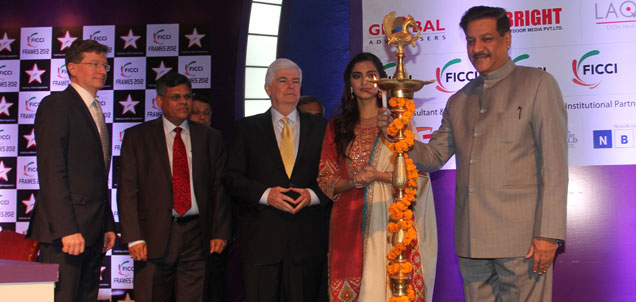
    Though Mr Shankar admitted that there is a need for legislative enablers to remove the bottlenecks surrounding digital, he also said that the broadcast industry is still not ready to move to the digital format. To drive home his point he used the example of the film The Artist, where the star of the film loses out when he refuses to move with the times. Next it was the turn of Prithviraj Chavan, Chief Minister of Maharashtra who took the stage to talk about the “exciting times that all are living in”. He said that the challenge is to adopt the regulatory framework to the new technology and ensure that over regulation doesn’t kill a good thing. He also said that the move towards digitization will create a huge employment opportunity but there is a need to explore how technology can empower the field of education. The Chief Minister also touched upon the need for regulation and suggested that instead of the state regulating the media, the medium should look at regulating itself.


    Following his speech, the event witnessed the release of the FICCI-KPMG Indian Media and Entertainment Industry Report 2012; FICCI-Amarchand Lawbook and ‘Positivity: The impact of television on India’ by The Indian Broadcasting Foundation. Jehil Thakkar, Head, Media & Entertainment Practises, KPMG made a brief presentation about the key highlights of the FICCI-KPMG Indian Media and Entertainment Industry Report 2012.


    Uday K Varma, Secretary, Ministry of I&B, opened his address by stating that the concerns that the industry had over digitization and the Phase 3 of FM radio have been addressed by the move to allow 839 new FM stations and 500 community radio stations. He stressed that the government is committed to ensure time bound digitization and said that come July 1, the four metros will switch over to the digital format and the plan is to ensure that the move to digitization is completed by December 31, 2014. He agreed that the challenge was mammoth- to convert 80 million analog connections to digital format but added that it will ensure faster and deeper penetration. “This will address a plethora of issues facing the television industry, such as addressability, carriage fees, audience measurement and consumer preferences,” he said. Mr Varma added that in order to combat piracy, the government intended to carry out an all-encompassing multi-media campaign involving all stakeholders from the film and music industries, shortly.


    Punit Goenka, CEO & MD, ZEEL too spoke about the pros and cons of digitization, how the ratings are inadequate and how self regulation was the need of the hour for the broadcast industry. Carolyn Everson, VP, Global Marketing Solutions, Facebook elaborated on how Facebook can benefit the media and entertainment industry and cited examples from music, gaming and films to drive home her point.


    ————————————-


    BARC takes wings; Discovery Kids to flag off operations in April

    In between the many promises and hopes that were being doled out at the inaugural session came the news of the Indian Broadcasting Foundation (IBF), the Indian Society of Advertisers (ISA) and Advertising Agencies Association of India (AAAI) announcing the official formation of a nationwide audience research joint body — Broadcast Audience Research Council (BARC).


    The announcement was made at the inaugural day of FICCI Frames 2012 in Mumbai in presence of I&B Secretary Uday K Varma, TRAI Chairman Dr JS Sarma, Managing Director & CEO of ZEE Punit Goenka, Star India COO Sanjay Gupta, Times Television Network MD & CEO Sunil Lulla, Star CJ CEO Paritosh Joshi, Madison Group Chairman Sam Balsara and Landmarc Leisure Corporation MD Paulomi Dhawan.


    While IBF will have 60 per cent stake in BARC, ISA and AAAI will each hold 20 per cent stake. The Board of the council will have 10 members, six members from the IBF and two members each from the ISA and AAAI.


    Another important announcement was made by President & CEO of Discovery Networks International, Mark Hollinger who announced the launch of its new network for children in India, ‘Discovery Kids’. Mr Hollinger said, “Launching in April, the network will initially be available in three languages – Hindi, English and Tamil. The channel will offer children a fun and entertaining way to satisfy their natural curiosity with stimulating and imaginative programming,” he said. The company plans to roll out the channel in Philippines and Indonesia later this year.


    ——————————————–


    Post the promises and pleasantries doled out by committee members and authorities, it was time for some serious discussion which began with a panel discussion on ‘Addressable Digitization – The way forward’. Sanjay Gupta, COO – Star India, Sunil Lulla, CEO and MD Times Global Broadcasting, Sameer Manchanda, Founder – DEN Networks and Punit Goenka, MD And CEO, ZEEL comprised the panellists. The panellists agreed that digitization is the way forward and will soon be a reality. Uday K Varma, Secretary – I&B, put the ball in the industry’s court as he said that there were no political opposition to digitization and the parliament too passed the law in December 2011, therefore it is now incumbent upon the industry to make digitization a reality. Sunil Lulla pointed out that the there is greater good in digitization however, the industry has to do a lot of work over the next few years. Sameer Manchanda was of the view that digitization was a reality and that it will bring more number of channels. While Uday Varma said the government is determined and committed to ensure digitization happens the broadcasters on the other hand also displayed confidence that they are ready for the June 30, 2012 deadline i.e. when metros will switch from analog TV to digital. The session also discussed opportunities and challenges that digitization has to offer and how the industry was gearing for digitization – whether they are ready or not?


    A session on ‘Maximising the power of digital distribution’ saw industry leaders speak about the challenges that come along as the country is experiencing the much talked about shift – from analog to digital cable – the investments that goes into and many such challenges. Industry honchos such as K Jayraman – MD and CEO, Hathway Cable and Datacom Ltd; SN Sharma, CEO, DEN; Anshuman Misra – SVP and MD, Networks and Content Distribution, Turner, Asia Pacific; Vikram Chandra, Group CEO, NDTV; Jagi Mangat Panda, Co-Founder and Director, Ortel; Prof Jonathan Askin, Professor of Law, Brooklyn School of Law and Anita Wallgren, Government Attorney, US Department of Commerce, Former Program Director, US Government’s TV Converter Box Coupon Program. Vivek Couto, Executive Director, Media Partners Asia moderated the session.


    While digitization comes in as a relief for broadcasters who will be benefitted from additional subscription revenue the relaxation on paying heavy carriage fees, and of course providing viewers with a superior content experience – MSOs and cable operators have to quickly respond to the digitization mandate by investing in set-top boxes – the cost that is only possible to recover after four years. Jagi Mangat Panda pointed out that digitization will result in some sort of consolidation in the distribution space where bigger players will look to expand their presence in the Indian market.


    Vikram Chandra talked about the difference digitization makes to the news industry. “Digitisation is important for news players. It is leading players in the news industry into areas they don’t want to be in. In the race of chasing TRPs, people are forgetting that digital has a great potential that has to be tapped, a business model which needs to be looked at.” Chandra also mentioned the role of tablets and high-end devices as new distribution platforms.


    Anita Wallgren and Prof Jonathan Askin spoke about how the United States saw the transition of analog TV to digital – the learnings and challenges.


    It could be said that the media and entertainment industry of India has scripted a glorious growth story in the past ten years or so. And now, when the future looks more promising with digitisation and the advent of technology across media verticals such as broadcast, print and also films – one area which that has not seen enough progress is the lack of private equities and VC funds showing adequate interest. In a session titled “Financing the Media and Entertainment Business” eminent personalities such as Prashant Jain, Executive Director, HDFC Mutual Fund; Mathew Cyriac, Sr Managing Director, Private Equity, Blackstone; Soumo Ganguly, Managing Director, Moxie Entertainment Pvt Ltd; and Daniel Dubiecki, Founder and Partner, The Allegiance Theatre, Hollywood shared their views on the subject. Ashok Wadhwa, Group CEO, Ambit moderated the session.


    Mathew Cyriac started off the session by pointing out that majority of the investments within the media and entertainment industry were made in television and print as they represent a fairly large share  in terms of sheer numbers as against Internet and Radio. The Hindi GECs in TV is typically where a lot of money goes to followed by regional GECs and sports channel. For print media, it was the regional publications that command a lot of attention as regional advertising is very robust – one which extracts a lot of profit.


    Prashant Jain pointed out that a lot of companies in India have managed to get good funding and that it is not reflective of a very, very sorry picture as is being talked about. “It’s not that all of India in the media entertainment space are not attracting funds. Companies like UTV and a few others have attracted investors.”


    Ashok Wadhwa remarked that the film industry in India is not institutionalised enough to attract private equity. Daniel Dubiecki spoke about the need to be more global in concept, widen the scope of market and thereby making it more viable to attract investments in the films business.


    In the session on ‘Protecting Copyrights, Infringements & New Trends i.e. Remake’, the panellists chose to rummage over the impediments surrounding copyright issues in the film and music industry in India. The panellists included Sai Krishna from Sai Krishna Associates; Deborah Benattar, Head, TV & Cinema, French Embassy; Jagdish Rajpurohit, Head, RCL Motion Pictures & Producer; Bertrand Mouiller, former DG IFFPA and Amar Butala, creative director, UTV Motion Pictures. The session was moderated by Dina Dattani, Consultant & Lawyer. Sai Krishna provided a hopeful insight as he said, “The industry should take heart in knowing that the Copyright Amendment Bill is currently being debated in the parliament and is expected to be passed after the current Budget Session. There are provisions that can alter the way the entertainment industry functions in India.” But he cautioned by saying that the Bill has its setbacks too as there are no clear guidelines when it comes to copyright issues between the writer, music composer and the producer of a film. Mr Butala added here saying, “We have made huge leaps in terms of the legal paperwork with actors and performers where copyright issues are concerned. But it is just the start and the challenge would be to sort out legal issues and take the offenders to Court with the hope of finding a favourable outcome from the judiciary.” The panel proceeded to discuss the trend of moviemakers bagging rights for remaking movies and that there was a need for a law that would streamline procedures for the industry at large.

     Photograph: Fotocorp

  • @FF12: Discovery to launch kiddie channel in India

    Video and Text By Shruti Pushkarna


    President & CEO of Discovery Networks International, Mark Hollinger announced the launch of its new network for children in India, ‘Discovery Kids’. The announcement came on the sidelines of FICCI Frames 2012 that is being held in Mumbai from March 14 to 16.


    The channel will be available in three languages. Mr Hollinger said, “We shall be launching a new network in India – Discovery Kids. It will be launched in early April and the network will initially be available in three languages – Hindi, English and Tamil.” The company plans to roll out the channel in Philippines and Indonesia later this year.


    Mr Hollinger said, “Discovery Kids will offer children a fun and entertaining way to satisfy their natural curiosity with stimulating and imaginative programming.” He added, “India is definitely poised for growth in this market. 30% of the population in this country is below the age of 14. In light of the massive digitization drive in India, we believe viewers will express their demand for such distinct television networks. I cannot think of any other country more poised for the launch of such a remarkable network.”


    [youtube width=”400″ height=”250″]http://www.youtube.com/watch?v=gzeqO3KTTww[/youtube]

    The company also expects a significant boost to its subscription revenues from satellite television digitization in India and expects the country to be its biggest satellite television market in the next few years, said Mark Hollinger.


    Speaking about the digitalization drive in India and the country’s subsequent growth potential Mr Hollinger said, “The fact that India is moving towards 100 percent digitalization presents an overwhelming opportunity for all of us. Digitalization of broadcast will make bandwidth usage more efficient, leading to a wider choice for the viewers and newer opportunities for media companies. Digitization means viewers will be more discerning and I predict that the programming with the best storytelling, compelling characters and stunning visuals will win out.”


    Talking about the share of revenue from India, Mr Hollinger said, “International markets account for one-third of our operating profit, of which India contributes a significant part. We don’t break it down on a regional level. India is one of the top five growth markets on a worldwide basis.”


    He also said that going forward the company is looking to enter retail, merchandising and licensing space.


  • @FF12: Financing, a cause for concern in M&E

    By A Correspondent


    The media and entertainment industry of India has scripted a glorious growth story in the past decade or so, and the future looks even more promising with digitization and the advent of technology across media verticals such as broadcast, print and also films. But one area of concern is the lack of private equity and VC funds showing adequate interest.


    In a session titled “Financing the Media and Entertainment Business” eminent personalities such as Prashant Jain, Executive Director, HDFC Mutual Fund; Matthew Cyriac, Sr Managing Director, Private Equity, Blackstone; Soumo Ganguly, Managing Director, Moxie Entertainment Pvt Ltd; and Daniel Dubiecki, Founder and Partner, The Allegiance Theatre, Hollywood shared their views on the subject. Ashok Wadhwa, Group CEO, Ambit moderated the session.


    Matthew Cyriac started off the session by pointing out that majority of the investments within the media and entertainment industry were made in television and print as they represent a fairly large share in terms of sheer numbers as against Internet and Radio. The Hindi GECs in TV is where typically where a lot of money into followed by regional GECs and sports channel. For print media, it was the regional publications command a lot of attention as regional advertising is very robust – one which extracts a lot of profit.


    Prashant Jain pointed out thata lot of companies in India have managed to get good funding and that it is not reflective of a very, very sorry picture as is being talked about. “It’s not that all of India in the media entertainment space not attracting funds. Companies like UTV and a few others have attracted investors.”


    Ashok Wadhwa remarked that the film industry in India is not institutionalised enough to attract private equity. Daniel Dubiecki spoke about the need to be more global in concept, widen the scope of the market and thereby making it more viable to attract investments in the films business.


    Photograph: Fotocorp

  • @FICCI-Frames 2012: TV influences life: IBF study

    By A Correspondent


    The Indian Broadcasting Foundation (IBF) has released an in-depth report on the Socio-Economic Impact of Television at FICCI Frames 2012. The IBF has conducted an extensive research in 3 phases to measure the impact of Television on Indian viewers. In the first phase, qualitative research was conducted across 20 focus groups to identify various forms in which television impacts the audience. This information was used to design the questionnaire for the second phase of the research, in which 5400 respondents were interviewed in the 7-60 years age group across 18 cities. They opined on 54 different attributes that encompassed the impact of television on their lives. The third phase of the research was a set of 25 in-depth interviews that amplified the learnings of the previous two phases. This enormous study spanned across 6 months. The research was facilitated by Ormax Media.


    The research findings are published in a formal documentthat is aptly named ‘Posi-TV-ity’. This in-depth report bears testimony to the overwhelmingly positive impact of television on audiences across the country.


    Uday Shankar, President, IBF emphasized, “Posi-TV-ity showcases the wide-ranging impact of Television beyond its conventionally understood & accepted role of being an entertainment destination. Today, television has moved ahead to offer more… a lot more. It in fact impacts the way India thinks and lives. Its impact on the socio-economic fabric of our country is indelible”.


    Today, television gone beyond entertainment and has become a medium that influences public opinion and stirs up sentiments. Everything that one sees on television has an impact and to measure that impact, this extensive study has been conducted by IBF. In this process of understanding the impact, the study has shattered several myths associated with television that were created due to stereotypes associated with it.


    In particular, Posi-TV-ity identifies 7 key roles that television plays in the life of a viewer. The study validates and substantiates these roles and impact of television in the country:


    Education – Respondents agreed that TV has helped them take more informed career decisions, financial decision and also learn new things that they could apply to their jobs.


    Personality Development – Viewers agreed that TV boosted their confidence, helped them become all-rounders and also widened their thinking.


    Social Interaction -Audience today feel that TV has helped them in having a better relationship with in-laws, keeping families together in today’s changing world, and strike a balance between Indian culture & westernization.


    Exposure – Viewers feel TV keeps them updated on the latest fashion & trends, latest products and also aids their purchase decisions. TV also keeps them informed about health related issues.


    Awakening – Respondents felt TV increases awareness of women’s rights, social issues, and rights as a citizen of India as well.


    Opportunity -It is widely believed that TV also gives opportunities to people from all over the country to showcase their talent, makes viewers feel closer to celebrities!


    Rejuvenation – Many viewers feel that TV makes sure that there is not a single boring or dull moment in their lives.


    Shailesh Kapoor, CEO, Ormax Media Pvt Ltd added, “The role television plays in the life of the Indian viewer is grossly underrated. This research identifies seven distinct roles of television, beyond entertainment. Each of these roles have a deep socio-economic or psychological connect with the viewers’ life. The research offers a new way of looking at the medium, in context of today’s India.”