
Tag: FICCI-EY

  • The Grave Crisis in OOH Continues


    By Indrani Sen


    The EY-FICCI 2019 Media & Entertainment Industry Report estimated that the Indian OOH industry grew by 5% in 2019, taking the industry size to Rs 37.1 billion. The traditional OOH formats, driven by increased advertising opportunities in tier-II and tier-III cities, contributed 54% to the overall revenue. However, according to the report the main driving factor behind the growth is recent development of infrastructure network, including upcoming airports, smart city projects, malls, metros, bus shelters, public utility, coffee shops, etc.
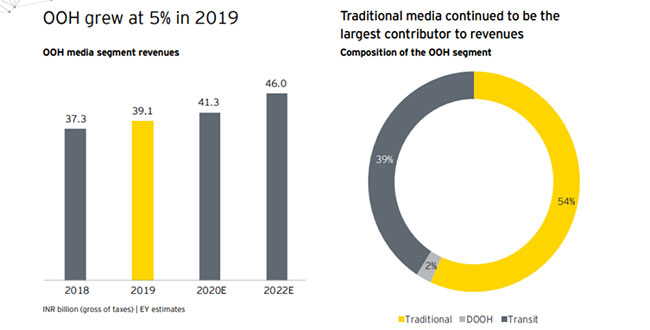
     

    Source: EY-FICCI 2019 M&E Industry Report


    A couple of years back, www.statistia.com published an estimate of out of home advertsing in India from 2009 to 2024 as shown below. It is interesting to note that overall size of OOH industry estimated In the FICCI EY report is higher than shown in the chart for 2019 (Rs. 34 billion).
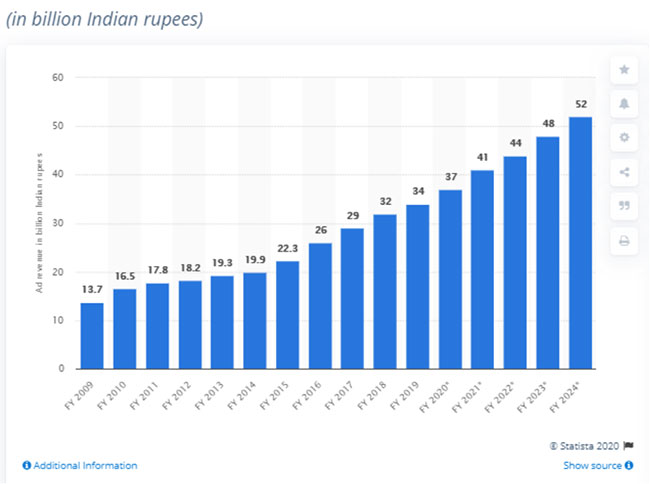
     

    Source: https://www.statista.com/statistics/233491/out-of-home-advertising-revenue-in-india/


    The growth of the OOH industry has been stalled completely as an effect of Covid-19. In the ‘FICCI Frames 2020’ virtual conference, WPP’s CEO Mark Reed remarked that OOH was the most impacted medium due to Covid-19. While we are seeing some signs of revival in digital, TV and print media, the trend has not yet been seen in OOH media under the gradual process of unlocking. While we are still waiting for FICCI EY to release a revised estimate for M&E industry in 2020, the mid-year review of the Pitch Madison Advertising Report 2020 has estimated 35% to 50% de-growth in OOH advertising revenue in 2020.


    At the early stage of lockdown, IOAA also estimated that their annual revenue may see a 50% drop in 2020 and appealed for financial relief to the various state governments who have not yet responded positively. The association also requested the central government to declare the pandemic as natural calamity which is covered under ‘force majeure’ clause of all OOH contracts which also has not received any definite response. In US and couple of other countries, OOH industry registered as small business has received some financial relief, but we have not seen any such relief measures for the OOH industry in India.


    An article published on August 10, 2020 has predicted four key trends for OOH medium in 2020 and beyond (https://www.advendio.com/4-key-ooh-advertising-trends-2020-beyond): 1/ build brand awareness with smart creatives; 2/ adapt value for money messaging approach; 3/ the evolution of touch screen OOH advertisements and 4/ curbside pickup and digital OOH are here to stay. Apart from the first trend, there is hardly any scope seeing of the other trends happening in India. It is high time that our outdoor advertising agencies take stock of their inventories and consider disinvesting in traditional formats and channelize their attention to building up standardised digital OOH formats as per the global trends.


  • 12 minute ad cap may turn to 12 death nails for FTA channels


    By Indrani Sen


    The right thing at a wrong time is a wrong thing.

    Taking liberty with the words of Charles Dickens, one can say this is not the best of times; this is probably the worst of times in the twenty-first century when we are fighting with the deadly Coronavirus, the total number of COVID 19 positive cases and death caused by the pandemic are going up every day in India, the Indian economy is in recession and Media & Advertising Industry has just seen a huge drop of 65% in advertising revenue in Q2 of 2020 (Source: Pitch Madison Advertising Report 2020 Midyear Review). What a time for TRAI to press for the 12% ad cap on Television by pushing for a hearing of the case at the Delhi High Court!


    Dust has not yet settled on NTO 2.0. Indian TV Industry and the Regulating body have been discussing the possible implications of implementation of NTO2.0 over the last few months. It has come as a rude shock to the TV industry that TRAI has pushed the Delhi High Court for an early hearing of the case on 12 min cap per hour on television advertising. The final hearing has now been fixed on 28th September, 2020. If Indian television industry is forced to accept the 12% ad cap during this difficult time, then many TV channels, particularly the free to air channels and news channels may be forced to close their business.


    Let us take a quick look at the effect of the pandemic on TV advertising. The Pitch Madison Advertising Report 2020 Midyear Review released last week has shown that against a 65% loss of total advertising in Q2 2020, loss of TV advertising was 61%. The chart below shows the TV advertising market in April, May, June TV advertising revenue over last 3 years. Across all categories, advertisers have spent less on TV during the first half of the year with 25% of the regular advertisers not spending on TV advertising. Even after the boosting of as spend in the second half of the year due to the festive season, IPL, big ticket properties on TV like Big Boss, KFC, the TV industry is expected to end the year 2020 with 12% to 17% de-growth.


    Source: Pitch Madison Advertising Report 2020 Midyear Review


    Based on consumer complaints in 2012, the TRAI first announced the regulation on 12% Ad cap in 2013. I wrote an article on 12th October, 2015 here comparing the systems of regulations on TV advertising across various countries (https://www.mxmindia.com/2015/10/mediasense-by-indrani-sen-to-cap-it-all/) and requesting TRAI to look beyond the regulatory system of UK to other countries across the world. Since 2015, some of the countries cited as example in my article, have changed their own regulatory frame works and have made it more user friendly for the TV channels. For example in Europe instead of 20% of advertising in every hour, it has been relaxed to overall 20% advertising between 7.00 to 23.00 hours with broadcasters’ own promotions, sponsors’ announcements and product placements not counting under the 20% stipulated time.


    As per the last FICCI EY report we had 918 TV channels in 2019 of which 65% were free to air channels.  Out of the registered TV channels in India 386 (42%) are news channels of which many are in the FTA category. These channels depend solely on advertising revenue and will be really badly hit if the 12% ad cap per hour is imposed at this unprecedented time. The eco system of Doordarshan’s Free Dish will also be affected in the process and the viewers will end up getting a raw deal in terms of the channels available on the Free Dish.


    It is obvious that it is not possible to attract advertising for the repeat shows after 12 midnight till 6am in the morning when the country goes to sleep. Many TV channels have already petitioned for changing the ad cap per hour to an overall ad cap per day. By relaxing the 12 min per hour cap to 12 minute overall cap during 24 hours, TRAI can allow the TV channels the flexibility to distribute the total commercial time of 288 minute per day in a more profitable manner. Alternatively, TRAI’s purpose of providing better content to the consumers would be self defeating as consumers will get less variety of content with many FTA channels going off the air or will have to pay additional cost for viewing better content with more established GEC channels introducing more ‘pay & view’ content.


    Finally, there is a time for taking all actions. If a right action is taken at a wrong time, then it can become a wrong action. After procrastination of 7 years, TRAI can surely wait for normalcy to return to our economy at large and the media and advertising industry in particular before enforcing the proposed ad cap on TV advertising.


  • Forced confinement leading to increase in TV consumption, but…


    By Indrani Sen


    On March 27, 2020 Nielsen and BARC India shared the first edition of their report “Covid-19 Impact- What’s happening in the TV and smartphone landscape” with the industry at large analysing how the lockdown has increased TV viewership in India. In the first week of the partial lockdown from March 14 to March 20 (BARC Week 11), the all-India TV viewership in minutes/week went up by 8% and TV reach went up y 6%. Overall time spent on TV went up by 2%.


    BARC conducts television audience measurement in India while Nielsen passively captures smartphone behaviour through a 12,000 strong smartphone panel. The time spent on smartphones per user also went up by 6.2%. The time spent/user/week on VOD apps saw an increase of 3%. News apps saw 8% more users per week with an increase of 17% in time spent/user/week stimulated by use of non-English News apps (+87%). Gaming apps saw an increase of 2% in users/week supported by 11% increase in time spent/user/week.


    We will look more closely at changes in TV audience behaviour. In Week 11, average daily viewers grew by 32Mn supported by kids, younger age groups and NCCS A. Viewing time for Television increased by over 70 billion minutes in India with each of 592Mn viewers watching TV daily for 3hr 51 minutes. Strangely, there was hardly any growth in the primetime viewership as the growth in viewership was driven by non-prime time. GECs also grew by 32% in non-primetime slots, but saw a 15% dip in the primetime slots which was higher (23%) in the Hindi Speaking Market (HSM) than the south Indian market (5%). An analysis by genres given below show that news, kids and movies gained the most in terms of daily ATS followed by infotainment, lifestyle and youth.


    Last week, Nielsen and BARC released the second edition of the ‘Crisis Consumption: An Insight Series into TV, Smartphone and Audiences’ report of Week 12 (starting March 21) where four days  coincided with the first week of country wide lockdown, showing an unprecedented growth of  298%  in TV news viewership. The increase in the viewership of news channels was accompanied by a 15% growth of average daily free commercial time (FCT) to 6 lakh seconds in between March 21-27 (Week 12) compared to January 11-31, 2020 or the pre-Covid-19 period reflecting last-minute changes in the allocation of TV budgets.


    All the parameters reported by BARC showed increases during Week 12 with the weekly viewing minutes (total number of minutes spent watching TV) touching 1.2 trillion. The number of people watching TV all seven days a week jumped from 32% to 44%, the average time spent per viewer increased 23% from 3 hours 46 minutes to 4 hours 39 minutes. As a result, the total number of channels consumed per viewer in the week also increased from 16 to 22. This surge is TV viewership is expected to continue during the next few days of the nation wise lock down and the spread of Covid- 19 in India will decide its future course.


    It is heartening to see that the news genre has been able to get additional advertising during this lock down period. Kids’ genre, with 20%+ share of total TV viewership and only 3% share of the overall advertising space, has not been so lucky. However, on the whole the prognosis is not good when we look at ad revenue of TV channels in immediate future. Going by the current trends, TV channels will hardly be able to convert this increase in viewership to increased ad revenue. Financial Express reported on March 21, 2020 (https://www.financialexpress.com/brandwagon/coronavirus-impact-ad-expenditure-to-decline-by-50-55-on-tv-between-april-june-2020/1914445/) “As the novel Coronavirus continues to wreak havoc around the world, television is one such industry which is currently under its grip, besides other sectors. According to industry estimates, advertising expenditure on television is expected to decline 50%- 55% to anywhere between Rs 3,750 crore – Rs 4,125 crore between April-June, that is Q1 FY2021 – if the lockdown continues.”


    The economictimes.indiatimes.com reported on April 2, 2020 in similar lines, though their estimate of the loss was pegged at 30-40% than 50-55% reported by Financial Times – “Top broadcasters, media buyers and advertisers ET spoke with, feel that if the situation doesn’t improve by end of April, the TV industry will end up with a 30-40% drop in ad revenues in April and May.” (https://economictimes.indiatimes.com/industry/media/entertainment/media/broadcasters-stare-at-drop-in-ad-revenues/articleshow/74937708.cms?from=mdr)


    While we wait for FICCI-EY to release an update of their report on M&E industry, FICCI’s recent report on the impact of Covid-19 on the Indian economy has predicted that the pandemic will potentially derail India’s growth story by affecting both the demand and the supply side. We are going through unprecedented times when it is extremely difficult to predict even the immediate future.