Tag: FICCI-EY report

  • The Push & Pull of Print


    By Indrani Sen


    Indrani SenPrint media in India was the worst affected by the coronavirus pandemic last year. As per the FICCI EY Report on M&E industry 2021, the revenue of print shrunk by 41% from INR 206 billion in 2019 to INR 122 billion in 2020.  The report estimated that while TV will recover its 2019 level of revenue by 2022 and the combined revenue of traditional media will recover the 2019 level by 2023, it will take print at least till 2025, if not more to recover the 2019 level of revenue.


    I commented on print media in an earlier article in www.mxmindia.com “However, the industry seemed to be recovering well during the first quarter of 2021 as TAM AdEx data for Jan-Mar 21 showed that 1350 new brands advertised on print during that period.  When compared with Jan-Mar 20, the quarter also showed 9% increase in ad space mostly from Hindi and other language newspapers. Similarly, April-May 2021 recorded better results compared to April-May 2020.”


    Now, it appears from the latest TAM AdEx report that the print media has begun the first month of the July-September quarter with an upward swing. At the end of July 2021, ad space per publication on an average has grown by 35% when compared to July, 2020. Multiple educational courses, cars, hospitals/ clinics, two wheelers and real estate have topped the list of categories who advertised in print media during last month. Media planners are hopeful that the next months of August and September will see further increase in print advertising with many regional festivals, Onam, Independence Day, Raksha Bandhan and Ganesh Chaturthi dotting the calendar.  The dhamaka of 15% discount has already begun in newspapers, the tempo will surely build up further before August 15, 2021, the 75th Independence Day. This year, Onam in Kerala begins on August 12 and ends on August 23, overlapping Independence Day and Raksha Bandhan on August 22. Ganesh Chaturthi will be celebrated next month on September 10. Together these festivals will be the precursors of the main festive season of Dussehra (Durga Puja) and Diwali.


    Why print media still works in India, particularly during festivals? It is convenient to execute sales and other promotional campaigns in newspapers at short notice. The entry cost or the cost of creating static creative content for print media is less expensive than creating video creative content for TV, OTT and other digital formats. The local advertisers with comparatively small budgets rely on print media for advertising throughout the year. By definition all traditional media are push media delivering content to the users with little interactions between the media and the users. Pull media by definition is the opposite of push media where the users seek out information from media. During festive season, print media plays a dual role of both pull and push media as brands step up their advertising activity and consumers seek out information on various offers and discounts available in different stores and retail outlets. This interplay of push and pull of the print media will definitely continue for the next two or three years enabling the print media to recover its lost revenues.


    In the last month, we saw many full-page and jacket advertisements in newspapers, a trend which is likely to continue well into the main festival season. Ads placed below the mastheads as well as some other formats which were considered as innovations when first introduced by newspapers, have now become part of the regular options like half page, quarter page, etc. offered by regularly by newspapers. As per market reports the deal sizes in the print media has started going up, demand for inventory for advertising space in newspapers is also on the rise. It can be safely assumed that if the pandemic does not cause any other disturbance, print media will recover a substantial portion of their lost revenue during 2021 and will reach the 2019 level much before 2025.


  • Newspaper Industry in India after the Second Wave of the Pandemic


    By Indrani Sen


    Indrani SenThe Indian newspaper industry faced an unprecedented crisis last year after the National Lockdown was declared at a very short notice. Circulation fell drastically when many subscribers, particularly housing societies, shut their doors for the newspaper delivery persons for the fear of the contagious virus being carried by the newspapers or the delivery folk, leading to change is consumption pattern of newspapers. Lack of local transport also prevented the distributors and hawkers from reporting for work. This was followed by withdrawal of commercial advertising as advertisers were worried about a fall in circulation and readership and were themselves affected by choking of distribution pipelines and economic slowdown leading to loss in their sales. The FICCI EY Report on Indian M&E industry 2021 showed that ad revenue of Print came down from INR 206 billion in 2019 to INR 122 billion in 2020.


    After the National Lockdown was lifted in 2020, the newspaper industry tried its best to recover their lost grounds. As per the same FICCI EY report, it will take Print four to five years to regain the pre-Covid ad revenues level. However, the industry seemed to be recovering well during the first quarter of 2021 as TAM AdEx data for Jan-Mar 21 showed that 1350 new brands advertised on print during that period.  When compared with Jan-Mar 20, the quarter also showed 9% increase in ad space mostly from Hindi and other language newspapers. Similarly, April-May 2021 recorded better results compared to April-May 2020.


    As per TAM AdEx analysis in May 2021, when the second wave of the Covid-19 was at his peak, there was an average 58% growth in ad space per publication as compared to May 2020. However, all was not well as compared to February 2021 and March 2021, the ad space in Print saw a drop of 42% and 29% in April 2021 and May 2021 respectively. As the phased process of unlocking has begun, the newspaper publishers expect that both the ad volume and value would pick up by August 2021 and grow further during the festive season of 2021.


    It appears that newspapers were better prepared to handle the second wave of the pandemic in 2021 and the lockdowns imposed by various state governments across the country. Along with the process of gradual unlocking, the newspapers now are looking forward to recovering their lost grounds. The credibility of the printed word, the vaccination drive, revival of the corporate sector and good rain forecasts are the other factors which are expected to contribute to the overall growth of the newspaper industry in 2021. The Print industry has appealed to the government for a stimulus package and an increase in FDI in 2021. The government has not responded so far, but the industry is still hopeful of getting, some positive response though no relief was announced in terms of waiving the import duties on newsprint by the finance minister in her 2021 Union Budget.


    The newsprint prices, which saw a decline in the international market (below $300/metric tonne) in 2020, have started going up from the beginning of the calendar year 2021. The price was $670/tonne-$700/ tonne in April-May. The industry expects it to go up further. It appears that quite a few paper mills which used to export newsprint to India and other countries, either shut down their business or migrated to the businesses of producing brown papers and craft papers during last year when their business was hit due to the global pandemic.


    As India is far from being self-reliant in newsprint production, our newspaper industry, struggling to recover from the effects of the pandemic, has been hit further by this demand supply imbalance of newsprints in the international market. Many newspapers are increasing the use of indigenous newsprints to balance out their cost of productions.  However, most newspaper owners feel that this crisis of newsprint prices is not going to last for a long term and expect the international market to stabilise before our festive season in the third quarter of 2021.


    To sum up, the newspaper industry in India seems to be set on the path of recovery after a severe decline of both circulation revenue and advertising revenue in 2020. In recent times, during the second wave of the pandemic, the industry was not much affected and would have been in a better financial position if they were not hit by the crisis of newsprint prices. It is expected that by end of the calendar year 2021, their overall performance may be better than predicted earlier by media analysts.

  • 12 minute ad cap may turn to 12 death nails for FTA channels


    By Indrani Sen


    The right thing at a wrong time is a wrong thing.

    Taking liberty with the words of Charles Dickens, one can say this is not the best of times; this is probably the worst of times in the twenty-first century when we are fighting with the deadly Coronavirus, the total number of COVID 19 positive cases and death caused by the pandemic are going up every day in India, the Indian economy is in recession and Media & Advertising Industry has just seen a huge drop of 65% in advertising revenue in Q2 of 2020 (Source: Pitch Madison Advertising Report 2020 Midyear Review). What a time for TRAI to press for the 12% ad cap on Television by pushing for a hearing of the case at the Delhi High Court!


    Dust has not yet settled on NTO 2.0. Indian TV Industry and the Regulating body have been discussing the possible implications of implementation of NTO2.0 over the last few months. It has come as a rude shock to the TV industry that TRAI has pushed the Delhi High Court for an early hearing of the case on 12 min cap per hour on television advertising. The final hearing has now been fixed on 28th September, 2020. If Indian television industry is forced to accept the 12% ad cap during this difficult time, then many TV channels, particularly the free to air channels and news channels may be forced to close their business.


    Let us take a quick look at the effect of the pandemic on TV advertising. The Pitch Madison Advertising Report 2020 Midyear Review released last week has shown that against a 65% loss of total advertising in Q2 2020, loss of TV advertising was 61%. The chart below shows the TV advertising market in April, May, June TV advertising revenue over last 3 years. Across all categories, advertisers have spent less on TV during the first half of the year with 25% of the regular advertisers not spending on TV advertising. Even after the boosting of as spend in the second half of the year due to the festive season, IPL, big ticket properties on TV like Big Boss, KFC, the TV industry is expected to end the year 2020 with 12% to 17% de-growth.


    Source: Pitch Madison Advertising Report 2020 Midyear Review


    Based on consumer complaints in 2012, the TRAI first announced the regulation on 12% Ad cap in 2013. I wrote an article on 12th October, 2015 here comparing the systems of regulations on TV advertising across various countries (https://www.mxmindia.com/2015/10/mediasense-by-indrani-sen-to-cap-it-all/) and requesting TRAI to look beyond the regulatory system of UK to other countries across the world. Since 2015, some of the countries cited as example in my article, have changed their own regulatory frame works and have made it more user friendly for the TV channels. For example in Europe instead of 20% of advertising in every hour, it has been relaxed to overall 20% advertising between 7.00 to 23.00 hours with broadcasters’ own promotions, sponsors’ announcements and product placements not counting under the 20% stipulated time.


    As per the last FICCI EY report we had 918 TV channels in 2019 of which 65% were free to air channels.  Out of the registered TV channels in India 386 (42%) are news channels of which many are in the FTA category. These channels depend solely on advertising revenue and will be really badly hit if the 12% ad cap per hour is imposed at this unprecedented time. The eco system of Doordarshan’s Free Dish will also be affected in the process and the viewers will end up getting a raw deal in terms of the channels available on the Free Dish.


    It is obvious that it is not possible to attract advertising for the repeat shows after 12 midnight till 6am in the morning when the country goes to sleep. Many TV channels have already petitioned for changing the ad cap per hour to an overall ad cap per day. By relaxing the 12 min per hour cap to 12 minute overall cap during 24 hours, TRAI can allow the TV channels the flexibility to distribute the total commercial time of 288 minute per day in a more profitable manner. Alternatively, TRAI’s purpose of providing better content to the consumers would be self defeating as consumers will get less variety of content with many FTA channels going off the air or will have to pay additional cost for viewing better content with more established GEC channels introducing more ‘pay & view’ content.


    Finally, there is a time for taking all actions. If a right action is taken at a wrong time, then it can become a wrong action. After procrastination of 7 years, TRAI can surely wait for normalcy to return to our economy at large and the media and advertising industry in particular before enforcing the proposed ad cap on TV advertising.


  • The Silent Coup by Prasar Bharati


    By Indrani Sen


    In February 2019, post TRAI’s NTO, big broadcasters had pulled out their Hindi mass entertainment channels from DD Free Dish which subsequently led to loss of viewership, weekly GRPs and ad revenue for those channels. The four big broadcasters, who submitted fresh bid invitation for vacant MPEG-2 slots by Prasar Bharati and won the e-auction held on June 2, 2020, must be sighing in relief now after getting five channels back on DD Free Dish. With effect from June 10, 2020, DD Dish TV subscribers would be able to view Star Utsav, Sony Pal, Zee Anmol, Colors Rishtey and Zee Anmol Cinema. It is definitely a win-win proposition for viewers as well as the channel owners in the post Covid-19 scenario.


    Considering that these channels were earlier earning on an average 100 times more that the average carriage fee of Rs 6 to 8 crore paid per annum to DD Free Dish and most of them lost 50% + of their ad revenue after pulling out from DD Free Dish, it is no wonder that they have all boarded back the DD Free Dish Band wagon at the first available opportunity. The five channels are in dire need of restoring their ad revenues in the post-Lockdown stage and cannot do without the viewership numbers which DD’s free-to-air platform promises to add. It is a silent coup by Prasar Bharati for making DD Free Dish an essential part for the survival and growth of these private channels.


    In most of the statistical analyses of subscribers of DTH providers, DD Free Dish is not included which makes the advertising and media Industry forget about its existence. While Doordarshan does not have the built in mechanism to measure the growth of DD Free Dish connections, estimates available from government sources as well as private consultancy firms unanimously agree that DD Free Dish is the leading DTH service provider in India.


    On June 23, 2019 at a programme to launch distribution of DD Free Dish TV set top boxes in Kashmir, Union Minister for Information and Broadcasting Prakash Javadekar claimed that (https://www.indiantelevision.com/dth/dth-operator/dd-free-dish-has-35-crore-subscribers-prakash-javadekar-190623) Doordarshan was the biggest DTH service provider in India with 3.5 crore (35 million) subscribers of DD Free Dish.  He further claimed that there are total 5.5 crore (55 million) DTH connections in India. The 2019 FICCI-EY report estimated 30 million subscribers for DD Free Dish and predicted that it would cross the 50 million mark in near future.


    It is evident from the activity related to DD Free Dish on various private e-commerce sites that their business is doing well. From the sale of DD Free Dish set-top boxes on Amazon (https://www.amazon.in/STC-DD-free-Dish-Set-Top/dp/B07FNKDGGC ) to installation of DD Free antenna on Indiamart (https://www.indiamart.com/proddetail/d-d-free-dish-antenna-installation-5874029873.html) to sale of remote  on Flipkart (https://www.flipkart.com/mase-remote-dd-free-dish-controller/p/itmfdcbspgtjqmgg) , e-commerce sites are doing brisk business due to the popularity of the DD Free Dish.


    DD Free Dish is available in Ku-Band on GSAT-15 (at 93.5°E). It has been upgraded from time to time. The number of channels available increased from 80 to 104 in 2019, of which 26 channels are reserved for Doordarshan. Currently 104 SDTV channels along with 40 radio channels of AIR are available to the subscribers. DD Free Dish has been the greatest contribution which Prasar Bharati has made to broadcasting in India since the satellite TV’s invasion from the sky and privatisation of TV channels. If the set top box for DD Free Dish can be made technically enabled to receive WiFi signals then a new vista of media consumption will open to the vast audiences belonging to  “Bharat”.


  • MxM Open Classroom: Digital Marketing


    Why MxM Open Classroom: Upskill yourself!, That’s what one is told so as to make the extended lockdown work for us. But while doing one of the hundreds of free or paid courses sounds easy, in realit,  it isn’t. And going through the tests and quizzes that are contained in them can be quite daunting. Starting this week, we start a series of ‘open classroom’ sessions. Each week, we will have a five-part series – Monday through Friday that will tackle an important area of the media marketing services domain. We kick off our series with a focus on Digital Marketing with Bhuvi Gupta, a marketing specialist who has


    The HOWs and WHYs of making trends

     

    By Bhuvi Gupta


    According to a FICCI EY report, the Indian Media and Entertainment (M&E) sector grew 9% to reach INR 1.8 trillion in 2019.


    The rapid spread of mobile access is helping the growth of the digital media industry. With a population of 1.3 billion, 688 million internet subscribers and nearly 400 million smartphone users, quantitatively, India already has high numbers but also has high potential for growth. This means that the digital media industry which grew 31% to reach INR 221 billion in 2019 will continue growing and industry experts expect it to grow at 23% CAGR to reach INR 414 billion by 2022. Digital advertising grew 24% to INR 192 billion and is expected to follow a similar growth trajectory. As digital penetration increases, more advertising budgets will get diverted to digital, especially because digital advertising is easier to measure and to finely tailor target audiences.


    The biggest challenge with digital is the evolving landscape – changing algorithms of popular platforms, newer applications of Augmented Reality, new platforms with niche demographics (like Helo, ShareChat, Likee, Bigo), and newer forms of advertising like influencer marketing to only name a few. This makes it difficult to allocate digital budgets effectively because the ‘how’ of being effective is constantly in flux.


    This series is in a sense a cheat sheet to understand digital advertising better and to ease navigating this evolving landscape. In each article, we will evaluate how to best create virality by leveraging popular digital platforms. Key focus platforms will be Instagram, TikTok and Facebook, chosen because of the reach, they garner.


    To kickoff the series we focus on the objective of many if not most campaigns – ‘Virality’. Making a campaign ‘viral’ is the holy grail by which campaigns are measured & many awards given, today.


    Marketers know that in spite of how topical and relevant the communication it is impossible to guarantee campaign virality because there are too many variables.  However, what is attainable is ensuring that a campaign ‘trends’.


    The key difference between a campaign ‘trending’ and it ‘going viral’ are in longevity and organic reach. While a trend may last for a short period of time, may be paid for and limited to a particular target audience, a campaign going viral implies that it has had the longevity of a few days, substantial word of mouth and a high recall value that has surpassed its initial targeting. Hence, while all viral campaigns, trend, not all trending campaigns go viral. With the right strategy it is possible to make a quality campaign trend, which may be the push it needs to achieve virality.


    A quality campaign is one, which while espousing product benefits, is topical and evokes a strong emotional response so that it is prompts the viewer to share it to enable word of mouth. An easy test to determine shareability is to ensure that the messaging is entertaining, inspiring or informative or a combination of the three.


    Here are Five ways to make a quality campaign ‘trend’–


    I. Choosing 1 or 2 focus platforms

    Today every social media platform has a key age and socio-economic demographic. Depending on the messaging, the brand, and campaign budgets focus platforms should be defined. It is wise not to focus on more than two, even if budgets permit. Successful campaigns will spillover organically to other platforms, anyhow.  For e.g. in 2019, Pepsi used TikTok as their primary platform for promoting their new brand anthem with the tagline ‘Har Ghoont mein Swag’. The campaign anthem was sung by 2019’s most popular Bollywood Punjabi singer, ‘Baadshah’ and the music video starred popular Bollywood youth icons & social media influencers, Tiger Shroff & Disha Patani. TikTok was was aligned to the brand’s mass & youth focused targeting. The campaign was a huge success, with 240+ million views and over 15,000 user-generated videos within 24 hours of its launch. The campaign also naturally spilled over to Instagram, where it received 20+ million views. The campaign remains one of TikTok’s most successful brand campaigns in India.


    II. Challenges

    A campaign which requires the consumer to engage will automatically have higher recall value & will also allow for the network effect which will help it to trend organically. The messaging of the campaign is key to how it can have a challenge component.


    Challenges are especially relevant for TikTok, and Instagram. Hashtag challenges form a key component of TikTok and challenges typically trend for a week. Hence, hosting challenges aligned to brand campaigns on TikTok can help a campaign achieve virality.  Currently, a Challenge trending on both TikTok & Instagram is the #PassTheBrushChallenge, where different women, pass a makeup brush to each other while showing before & after images of themselves wearing makeup. The challenge has not been initiated by any brand, but has gone viral with different kinds of iterations being produced, including a male version with a hairbrush!


    III. Hashtags –

    A hashtag, which can be the campaign tagline in entirety or a part of it is a key component of a trending campaign, as it is an easy identifier when the post gets shared, or mentioned. A hash tag is easy to understand, catchy, and related to the brand. It should ideally be not more than 3-4 words, have a verb, and either the brand name or a keyword from the catch phrase.


    Hashtags are vital for discovery on Twitter& TikTok, while they serve as identifiers on Instagram, Facebook & YouTube. Along with the key campaign hashtag, it is advisable to use other aligned & popular hashtags with which the content can be discovered.


    For e.g. in the Pepsi ‘Har Ghoont mein Swag’ campaign the key hashtag used was the same as the tagline, #HarGhoontMeinSwag along with #SwagStepChallenge. The campaign was followed up by a follow up campaign, with a new single called ‘Swag Se Solo’ sung by 2019’s breakout Bollywood singer, Tanishk Bagchi, released in February 2020. This campaign used the hashtag #SwagSeSolo and re-used the hashtag #SwagStepChallenge.


    IV. Influencer Marketing –


    Today, to break the clutter, it is crucial to invest a part of advertising budget on influencer marketing. Influencers enjoy loyal fanbases, and due to their relatibility, are often more trustworthy and credible than celebrities. Targeting influencers aligned to target audiences can help get exponential reach and engagement.


    However, influencers per platform need to be defined because each platform has different influencers in the same niche. A beauty influencer on TikTok may not  enjoy the same following on Instagram & YouTube, and hence can not be used for a campaign with Instagram as the primary social media platform.


    Influencer marketing works on all platforms, but is especially relevant on TikTok, Instagram and YouTube. It is especially effective for marketing new launches. Popular mobile phone brands often leverage influencer marketing while marketing their new launches – One Plus, gets influencers across industries to post videos highlighting the USP of the new launch. Google hosts parties with photo booths and gourmet food and, gifts influencers the latest ‘Pixel’ device. Photos of the party get shared on social media by all the attending influencers, thereby successfully creating a buzz.  One of the most successful examples of influencer marketing remains the selfie taken by Ellen DeGeneres at the2014 Oscar ceremony  (sponsored by Samsung) where Hollywood’s A listers posed for a selfie taken with a Samsung Galaxy Note 3. What remains ‘Note’-worthy is that the picture, which was shared, was not of the selfie but that of the stars taking the selfie so that the ‘Samsung’ logo was prominently displayed.


    V. Digital Advertising –

    For platforms such as Facebook, and now Instagram, which have attained maturity in their life cycle, the competition for organic reach is high. Hence, using advertising for discovery and amplification is necessary for virality. To enable speedier discovery it is advisable to use advertising on TikTok as well. Digital advertising used in conjunction with the above strategies, on the chosen platform (s) can effectively amplify the campaign. While it will definitely help a campaign to trend, it can often serve as a tipping point for creating virality.


    The gulf between a trend and virality is deep and often, a trending campaign that reaches relevant audiences is sufficient to earn ROI and achieve the brands marketing objectives. Virality is very often a vanity metric, which helps the brand create widespread awareness like traditional ATL marketing but may not aid in creating actual consumer intent.


    Bhuvi Gupta is a marketeer with over a decade of work experience, of which the last six have been in the media & entertainment industry. She has been a part of many launch marketing campaigns with experiences at the Times of India group, Republic TV and the latest in marketing a Bollywood film


     

  • EY-FICCI report rediscovers Indian Customer Segmentation


    By Indrani Sen


    Indrani Sen

    It has been nearly two weeks since the FICCI-EY Report on Indian M&E Industry “A billion screens of opportunity” was released at the 20th FICCI Frames held in Mumbai on March 12, 2019. Most leading financial newspapers and industry websites have carried the press release issued by FICCI with highlights of the findings.


    This website www.mxmindia.com carried a report with highlights of the findings on March 13, 2019 http://www.mxmindia.com/2019/03/me-grows-13-rs-1-67-trillion-in-2018-ey-ficci-report/. The marketing and advertising industry experts have been busy analysing and internalising the findings and useful insights given in the report and their strategic significance.


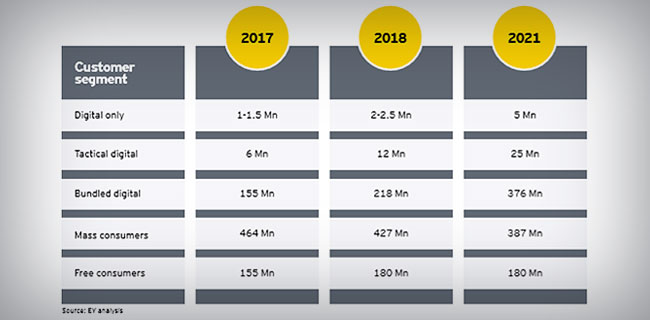
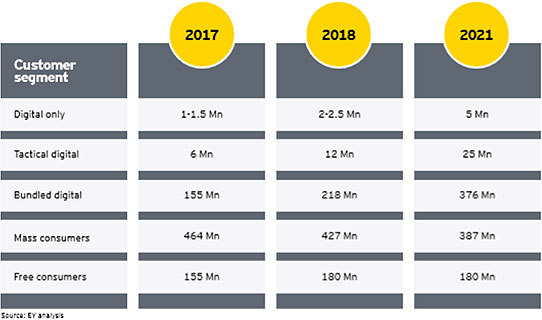
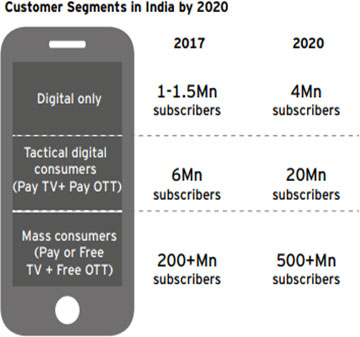
    To me, the most significant insight of the report is its estimate of the customer segmentation in India by their access to various media consumption platforms. Last year, EY introduced the idea of this type of customer segmentation by introducing us to three types of segments, digital only consumers, tactical digital consumers (Pay TV & Pay OTT) and mass consumers (Pay or Free TV & Free OTT) and projected that by 2020 there will be 4 million digital only subscribers, 20 million tactical digital subscribers and 500 + mass subscribers.  I was delighted to discover that EY has refined their estimation of the customer segmentation by introducing another segment “bundled digital” consumers (as provided by telecom services) and segregating the mass consumers from the free consumers as shown in the chart below:

    Customer segmentation by media consumption platforms

    Source: FICCI-EY Report 2019

    The broad category of mass consumers accounting for 500 +million in 2020 has become more specific with 943 million subscribers in 2021 spread across three categories. This analysis of customer segmentation introduced in the FICCI EY report not only has strategic implication for marketers in the short run, but also will help to further accelerate the growth in digital advertising in the long run.

    Digital media has been consistently contributing to the growth of M&E sector. It is expected that digital will overtake filmed entertainment (currently in number 3 position) in 2019 and print (currently in number 2 position) by 2021. TV clocked the highest share (44%) of the entire industry in 2018 and is expected to grow by 8.8% from 2018 to 2021 but its share is estimated to drop from 44% to 40%. Digital media, growing at 28% from 2018 to 2021, is estimated to have 15% share of the entire sector in 2021 from 10% in 2018. It is difficult to predict what will happen in the next ten years and EY has not ventured into that forecast, but it will not be surprising if digital media overtakes TV by end of the next decade.

    In fact, MRUC should consider adopting this customer segmentation for revising their criteria for new socio-economic classifications as the current structure based on ownership of durables etc. is not reflecting the disposable income correctly, given the availability of easy financing schemes for purchase of white goods, etc. and the aspirations of the upwardly mobile population in rural and semi-urban areas.

    Uday Shankar, Chairman of the FICCI Committee said in his opening remarks at the FICCI Frames    “… in my humble opinion, the great Indian media & entertainment story has just begun. We are standing at an inflexion point. In business strategic inflexion point is described as a period when the individually the organisations and collectively the industry needs to respond effectively to the disruptive change in the environment in order to survive and grow.  The Indian ME industry entered the inflexion point/ period in 2018, when Indian ME Industry was at the “Digital Tipping Point”. The scope of making a choice no longer exists for the various segments belonging to the Indian ME industry and in order to stay in the race they need to adapt to the disruptive changes including the customer segmentation based on access to media consumption platforms.

  • Gung-ho TV Advertising Trends


    By Indrani Sen


    Indrani Sen

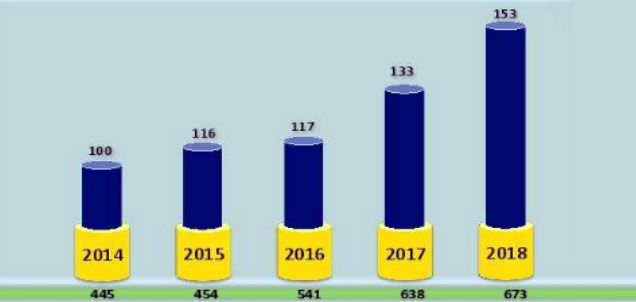
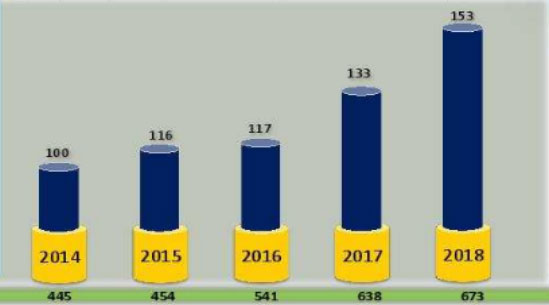
    The recent TAM Axis report on TV advertising trends in India in 2018 published in ET Brand Equity (https://brandequity.economictimes.indiatimes.com/slide-shows/tv-advertising-at-a-glance-tam-report/68096082) on February 22, 2019 shows that contrary to the popular belief TV advertising revenue did not suffer in 2017 after introduction of GST. Demonetisation in 2016 was a big blow which crippled the growth rate, but the advertising revenue was back on its growth track in 2017 which accelerated in 2018.

    Indexed growth rate of TV ad revenue 2014-2018: Source TAM Axis (AdEx India)

    N.B. The number of channels covered by AdEx is shown under each year in the green line.

    The above table shows that from 2014 to 2015 the index rose by 16 points and after adding only 1 point in 2016, it jumped by another 16 points in 2017 followed by 20 points in 2018. Over the last five years, from 2014 to 2018 there has been an overall growth of 53% in TV advertising revenue.

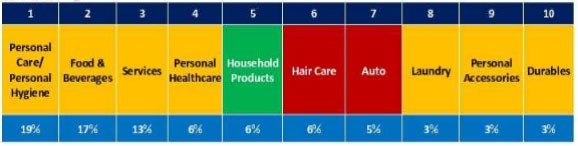
    Top 10 sectors in TV advertising in 2018: Source TAM Axis (AdEx India)

    The Top 10 sectors and the Top 5 sectors respectively account for 81% and 61% of total TV advertising revenue in 2018. While the Top 2 sectors retained their positions, household products rose from rank 7 to rank 5 with 43% growth in TV advertising in 2018 over 2017. Hair Care and Auto ranked lower in 2018 as compared to 2017 while Laundry, Personal Accessories and Durables held on to their ranks.

    It is interesting to note that of the Top 10 categories, 3 (Toilet Soap, Tooth Paste & Perfume /Deodorant) belong to Personal Care/ Personal Hygiene sector; 2 (Washing Powder/ Liquids & Toilet/ Floor Cleaner) belong to Household Product sector; 2 (Milk Beverages & Chocolates) belong to Food & Beverage sector; 2 (Two Wheeler and Cars/ Jeeps) belong to Auto sector and 1 (Shampoo) belongs to Hair Care sector. Though Services and Personal Healthcare hold the 3rd and 4th ranks among the top 10 sectors, no category from the two sectors feature in the list of top 10 categories which collectively account for more than 25% of the total TV advertising revenue.

    Top Ten advertisers accounted for 30% while top 50 advertisers accounted for 56% of the total TV advertising revenue in 2918. Hindustan Unilever topped the list with 10% share, followed by Reckitt Benckiser (India) and ITC who rose from 8th rank in 2017 to 3rd rank in 2018. Wipro and Amazon Online were new entrants among top 10 advertisers in 2018.

    The 2017-18 Annual Report of the Telecom Regulatory Authority of India (TRAI), published last week, indicates that the subscription revenues accounted for 59.5% of the overall TV industry revenue as it rose from Rs 38,7007 crore in 2016-17 to Rs 39,3007 crore in 2017-18. The report quoted the FICCI-EY Report 2018 which indicated that TV advertising revenues rose from Rs 20,1007 crore in 2016-17 to Rs 26,7007 crore in 2017-18, at a much higher rate of 32.8 per cent than reflected in the analysis of TAM Adex data for 2018, albeit referring to a different time period.

    Regardless of different reports based on different time periods, it is a reality that with close to 200 million TV households and 836 million TV viewers In India (Source: BARC Establishment Survey 2018), the Indian advertisers will continue to invest in TV medium for reaching out to the masses. The detailed analysis of TV AdEx data of 2018 by TAM Axis seems to indicate that Indian TV advertising revenue is all set for a roller coaster ride in 2019.

  • Shashidhar Nanjundaiah: What ails our communication education

    By Shashidhar Nanjundaiah


    The Indian media and entertainment industry is growing by leaps and bounds—the annual FICCI-EY report this year estimates that the $22.75 billion industry (2017) grew by 18.55% since 2011. Although it is beginning to stabilise to around 12%, it will still be an impressive $37.5 billion industry by 2021. Television leads, but in terms of growth, predictably, the digital segment is growing the fastest. Growing at 26%, digital already enjoys 10% of the advertising expenditure. According to independent estimates, there are about 1,300 colleges in India offering media courses. Well over 50,000 students with media and communication degrees graduate in an average year in India. Employment issues in the industry are compounded by the fact that notwithstanding its high growth, much of the film and television industry relies on independent crew, and a large proportion of employment in production houses is project-based. It is therefore the strategy jobs in the M&E industry that are mostly available to media graduates.

    On their part, independent colleges have the leeway to develop, seek approval and deliver curricula that they believe is better than the “model” curricula recommended by the University Grants Commission (UGC), the overarching regulatory body for much of our higher education system. There is a 30% leeway to operate with independent thought, and we can see how different universities have adopted subjects with nomenclatures that seem different on the surface. But arguably, it is the prescribed format and structure of the curricula that do the most damage, because many colleges do not venture beyond the UGC-mandated structures. Even when they do, it is debatable whether the results match industry expectations.The most well-oiled machines are in independent filmmaking courses. With the usual exceptions of a handful of specialised institutes, graduates do not prepare to enter the industry. They prepare to graduate.

    WYSIWYG. Among aspirants, communication is one of the least understood disciplines, and predictably, this ignorance is far more pronounced in non-metros. (In metros, too, the understanding is incrementally more largely because of the exposure to the environment, not because the school system or any form of intervention creates any awareness.) The average applicant walks in seeking to “do something in” advertising or filmmaking.Because the media and entertainment (M&E) industries afford partial visibility, this parasocial exposure to what appears glamorous and attractive gladly occupies the aspirational mind.The results, too, are accidental. How many communication graduates can claim to have started and ended with the same focus?

    Neither the partially visible nature of our communication industries nor entering communication education on a clean slate is a bad thing. Just the contrary. But in reality, the slate is hardly ever clean. The visible parts of our industries occupy the clean slate. In institutes I have been involved with, I make it a point to create an unlearning atmosphere at pre-admission and post-admission levels, and make efforts to help students do so before they start learning their disciplines. This helps students take the directionbest suited to their aspiration, aptitude and life goals. But in recent times, competitiveness among communication educators has created another business imperative of sorts. As colleges go corporate, with large marketing departments in place, counselling is less about creating awareness and choice, and more about convincing. Everything goes well when a student comes in with that tabula rasa. Because a large proportion of communication jobs are usually hardnosed strategy roles, and “getting a job” in the creative industries often entails financial risks, students and parents are often put off. After all, they came in search of a communication school exactly because they didn’t want a business degree. Isn’t communication a way to make money by using the art of free expression? They want to know. Further complicating these issues is the fact that working in these industries often does not mean creating anything—it entails managing and understanding creativity.

    Wrong reasons. As the discipline matures, there is a slowly changing comprehension of what it takes—with the huge diversity in academic orientations ranging from the arts to statistics, creativity to business strategy. Students often choose their disciplines within communication because i) they want to enter a particular industry, whatever the role, or ii) the discipline seems familiar enough to grasp, or iii) they are clear what they want to do. The last of the three is a dream for a college, but that is because colleges themselves often do precious little to educate students what is at the other end of the journey. This means students choose with a certain amount of randomness. Being an educator should also mean helping students discover the intersections between natural inclinations, aspirations, and aptitudes.

    Then there is the familiar matter of keeping up with industry trends. While there are principles, schools and concepts in all communication disciplines, anda good communication college often does a fair job of grounding students in them, the curricula continue to live in history. The problem is not with the curricula. As I mentioned in last week’s piece about media education, the problem is how we create repeated practice out of existing curricula.

    This problem is usually more prominent in the more conventional disciplines such as film and advertising. With public relations, for example, the experience may be different. As a newer subject, it affords nimblefootedness in approach simply because of a drawback—not enough traditional literature exists. With advertising, students go through the usual motions of learning the features of copywriting. The strategic practice of copywriting remains obscure, because it is seemingly too much driven by individual talent.

    Digital communication—education hasn’t caught up. Among all the gaping gaps we see in communication education, though, is the chasm between the emergence of digitisation of practice and its learning at college levels. Take, for example, satellite-based distribution systems of creative products and the emergence of film marketing. Only a couple of colleges with roots in the industry have even paid attention to these new trends. The practice of digital communication has taken a quantum leap, attracting fresh talent like a black hole. But few students are systematically prepared for the digital industries, entailing the art, science and commerce of storytelling, content creation and the strategies to market and distribute them. For the PR industry, this brings in a whole new function of content aggregation beyond the traditional media functions.

    As much as digital communication is the medium of the youth, recruiters continue to be disappointed at the numbers and quality of graduating students who are experts at digital communication (notwithstanding a handful of good institutes teaching digital marketing). The larger picture with the frenetic growth of digitisation and of digital media platforms is that it has been creating new ecosystems. I have, somewhat in a Marshall McLuhan-esque way, regarded the digital as a new paradigm, not merely a new medium. Digitisation surrounds us through its three new dimensions: New tools (mobile, computer-based) and technology, revised concepts and ideologies, and an increasing role of digital professionals in professions and societies.

    Digital media literacy itself is a huge opportunity that ironically remains undisturbed among academic circles. Digitisation has added a research and analysis dimension to our practice, but again, it is largely being ignored at preparatory levels.Storytelling and (and through) gamification are potential specialisations within media colleges, being new forms that will occupy a big space in Indian mediated communication. The low-cost advantage to digital should have also sounded the opportunity bugle for digital entrepreneurship as part of the curricula. (Fewer communication students than ever before in my experience are interested in entering the workforce through day jobs.)The “new media” course among colleges does not do justice to the rapid evolution of digital as a new ecosystem. We badly need a digital-first approach specifically training students in digital communication practice.

    Digital media vs digital ecosystem. Learning digital media is never going to be enough unless understanding digital practice is embedded while learning any media-related practice.Many media colleges claim to cover much of what is needed. The important difference, though, is for how long and with how much focus do students absorb these subjects? A guest lecture or even a daylong workshop in gamification ain’tgonna cut it. It is even possible to embed many of these subjects within the existing curricular structure. I argue that all this is not the root cause of the mismatch between a student’s learning and her practice upon entering an industry. UGC mandates a large number of subjects, regardless of which discipline within communication you are specialising in. It does not pay enough attention to strategy and business—perhaps because the regulator does not see the practice of communication as a strategic-enough science. There is an array of diverse subjects that are great for general learning, but in a time-limited programme, some are redundant. Students themselves recognise the impracticality of some input. But in the end, it is all about how a college and its faculty approach specific subjects, what pedagogy they adopt, whether students get enough practice on ideas, technology, strategy and their tools. Believe it or not, communication skills—let alone writing—do not form a core part of a typical media student’s curriculum.

    It is impossible to generalise the issues of communication education, as much as it is impossible to club the problems in the practice of all communication industries. Such is the vast diversity in M&E. That brings to a final point: We need a radical change in the way we approach communication education. A distinction between communication arts and communication strategy is the real difference. Calling it “Advertising”, for example, is misleading both in the way its practice hasgrown and in the fact that its practice entails many divisions with completely different aptitudes and approaches. Similarly, subjects are created with a focus on their marketability with aspiring students. Teaching the concepts and practice of advertising or corporate communication may not occupy more than a semester of weekly input. But taking the student through the understanding of various client industries, through practical application of communication strategy, and developing independent projects is important to effective learning. As in journalism, project- and practice-based learning has no substitute. But the key lies in repeated practice.

    The industry is more active than before in participating in curricular delivery and sometimes in building syllabi. This is commendable, yet more embedding is needed because industry-trained faculty are far and few between. A recommendation I have been making since 2013 is that corporate social responsibility (CSR) must necessarily contribute to creating talent at colleges in their respective domains.MNCs are already building labs and imparting training in engineering and, lately, in journalism colleges. Surely more can be done in the digital, film, advertising, media research and PR industries in alignment with the Companies Act’s CSR clause?

    In conclusion, it must be noted that more corporations than ever before are hiring communication graduates, as are the best advertising agencies. That trend is a good acknowledgment of more acceptable communication education.

    Shashidhar Nanjundaiah has led leading media institutes in India, as  Director of Symbiosis Institute of Media & Communication, founding Director of Indira School of Communication, and first Dean of India Today Media Institute. He pioneered research on the socio-economics of a newly liberalised Indian media marketplace. Currently, he observes how India’s media industry is shaping itself in this decade. He has also edited newspapers and magazines in India and the US. The views here are his own.


  • Indian M&E industry at its Digital Tipping Point


    By Indrani Sen


    “All the segments of the M&E sector are showing growth, consolidation and innovation led by digital, both on consumer side and the content supply chain,”noted Uday Shankar, Chairman, FICCI Media & Entertainment Committee in the introduction of FICCI-EY Report 2018.According to the experts from EY, Farokh Balsara and Ashish Pherwani, the Indian Media & Entertainment Industry has reached its Digital Tipping Point. In other words, thereare significant changes happening all around our M&E industry to cause a larger, more important change which will see the transformation of our country to Digital India.
     

    The FICCI-EY Report 2018 has highlighted quite a few of these changes: distribution of television has become largely digitised increasing its addressability and reach, the OTT platforms for TV and video content are growing rapidly, both print and radio segments are growing continuously with more focus on their digital presence, exponential growth (though from a small base) of digital subscription and online gaming riding on falling data cost, emergence of India as the second largest smartphone market in the world giving easy access of internet to consumers, rapid growth of digital micro-payment ecosystem across urban and rural markets, etc.


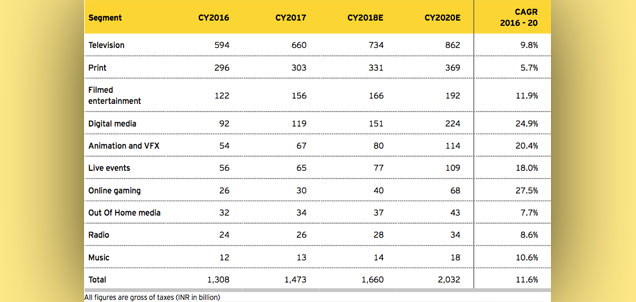
    The above changes are expected to grow our digital content consumption substantially which in turn would increase the size of the total industry from INR 1.5 trillion (USD 22.7 billion) in 2017 to INR 2 trillion + (USD 31 billion+) by 2020 at a CAGR of 11.6%.

    Source: FICCI-EY Report on M&E industry 2018


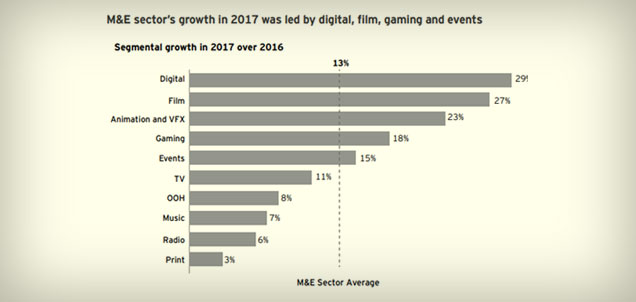
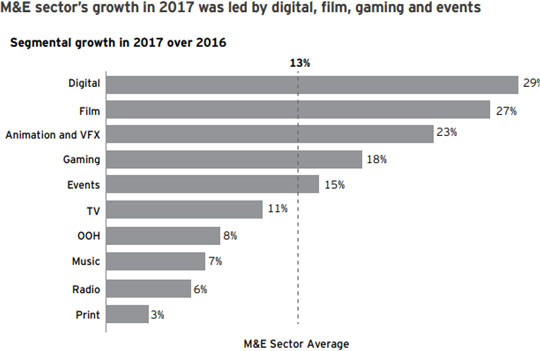
    As shown in the above chart, while the industry grew by 13% from 2016 to 2017, the growth was led by digital, film, animation & VFX, gaming and events. The same trends are expected to continue over the next three years. Another significant trend, which has been seen for the first time in the M&E sector, is outpacing of advertising growth (under10 %) by subscription growth (almost 15%) in 2017 over 2016. This trend will continue to be a major contributor to the Digital Tipping Point.


    Based on this new trend of growth in subscription,the report has made a forecast on new customer segmentation which will be an integral part of Digital India by 2020. This new consumer segmentation will be important for the A&M Industry for targeting their audience.


    Source: FICCI-EY Report on M&E industry 2018


    We can assume that there will be a process of continuous migration from the bottom tier of mass consumers to the tactical digital consumers to the only digital consumers as we go forward to the next decade. As far as deployment of resources for advertising is concerned, we will see online media campaigns slowly gaining over the combination of online and offline media campaigns at the top end of the consumer pyramid.


  • M&E to cross Rs 2tn by 2020: FICCI-EY report


    By A Correspondent


    FICCI-Frames 2018 took off on Sunday evening with I&B Minister Smriti Irani as Chief Guest. As part of the inaugural session, the annual M&E industry report, this time presented by the team at Ernst & Young (EY). The venue this year is the Grand Hyatt in Santacruz East, away from the Renaissance at Powai where Frames has been happening for 16 of the 18 editions.


    Back to the report: the Indian Media and Entertainment (M&E) sector reached almost INR1.5 trillion (US$22.7 billion) in 2017, a growth of around 13% over 2016. With its current trajectory, it is expect to cross INR2 trillion (US$31 billion) by 2020, at a CAGR of 11.6%. The digital segment-led growth, demonstrating that advertising budgets are in line with the changing content consumption patterns The  FICC-EY report is appropriately titled ‘Re-imagining India’s M&E sector’ and captures key key insights from the Indian M&E sector.


    The M&E sector continues to grow at a rate faster than the GDP growth rate, reflecting the growing disposable income led by stable economic growth and changing demographics. The report states that subscription growth outpaced advertising growth in 2017 but advertising will continue to grow till 2020 led by digital advertising. The report estimates that approximately 1.5 million consumers in India today are digital only and would not normally use traditional media. It is expected that this customer base will to grow to ~4 million by 2020 generating significant digital subscription revenues of approximately 20 billion. Going forward, micropayments, enabled through the Unified Payment Interface (UPI) and Bharat Interface for Money (BHIM) platforms developed by the National Payments Corporation of India (NPCI) will further accelerate subscription revenues for entertainment content.


    Said Farokh Balsara, Partner and M&E Leader, EY India:  “Indian M&E sector reached INR1.5 trillion in 2017 led by digital. With digital subscribers expected to reach 20 million by 2020, has Indian M&E reached its digital tipping point? We now need to re-imagine the future of  Indian M&E sector.”


    Added Ashish Pherwani, Partner and M&E Advisor Leader, EY India: “Growth in 2017 was led by the digital, film & animation & VFX segments. We expect sectors like digital and gaming to grow between 2 to 3 times by 2020.”


    Key findings

    :: Television:
    The TV industry grew from INR594 billion to INR660 billion in 2017, a growth of 11.2% (9.8% net of taxes). Advertising grew to INR267 billion while distribution grew to INR393 billion. Advertising comprised 40% of revenues, while distribution was 60% of total revenues. At a broadcaster level, however, subscription revenues (including international subscription) made up approximately 28% of revenues.

    Key insights– While advertising is 41% of the total revenues today, the report expects it to grow to 43% by 2020. There are over 30% households in India which are yet to get television screens, but being at the bottom of the pyramid, these households will tend to move towards first towards free and sachet products.


    :: Print:
    Print accounted for the second largest share of the Indian M&E sector, growing at 3% to reach INR303 billion in 2017. Print media is estimated to grow at an overall CAGR of approximately 7% till 2020 with vernacular at 8%-9% and English slightly slower. This growth is expected despite the FDI limit remaining unchanged at 26% and therefore, restricting access to foreign print players and the imposition of GST at 5% on the advertising revenues of the print industry for the first time in history. While magazines contributed 4.3% to the total print segment, the segment was at largely status quo with not many significant new launches in 2017.

    Key insights– Today, 98% of readers read dailies and 20% read magazines. Reader base is 395 million, or 38% of the population. Readership has grown by 110 million over the last 3 years. Rural (52%) reader base is larger than urban (48%). 44% of children (aged 12 to 17 years) read a newspaper or magazine. Magazines have a higher readership in urban areas (57%) as compared to rural areas (43%).


    :: Films:
    The Indian film segment grew 27% in 2017 on the back of box office growth – both domestic and international – coupled with increased revenues from sale of satellite and digital rights. All sub-segments, with the exception of home video grew and the film segment reached INR156 billion in 2017.The Hindi films comprise the majority component of the Indian film segment. They contribute almost 40% of the net domestic box office (BO) collections annually, despite comprising only 17% of the films made. Films in 29 other Indian languages account for approximately 75% of the films released but they contribute approximately 50% to the annual domestic box office collections. Hollywood and international films comprise the balance. The top 50 films contributed approximately 97.75% of the total net box office collection. Box office collections of the top 50 films grew by 11.60% in 2017.

    Key Insights: Regional movies drove the growth in number of releases in 2017. Screen count increased from 9,481 in 2016 to 9,530 in 2017. Number of Hindi movies crossing the INR1 billion mark was highest in 2017 in the past 5 years. From 31 movies in 2016, Hindi dubbed movies increased more than 3 times to 96 in 2017.


    :: Digital media:

    Digital media has grown significantly over the past few years, and continues to lead the growth charts on advertising. Subscription revenues are emerging and are expected to make their presence felt by 2020. In 2017, digital media grew 29.4% (27.8% net of the impact of GST) on the back of a 28.8% growth in advertising and a 50% growth in subscription. Subscription, which was just 3.3% of total digital revenues in 2016, is expected to grow to 9% by 2020.

    Key insights: 250 million people viewed videos online in 2017 and expected to double to 500 million by 2020. Around 40% of total mobile traffic came from the consumption of video services in 2015. This figure is expected to touch 72% by 2020. 93% of time spent on digital videos is in Hindi and other regional languages. OTT subscription in India is expected to touch INR20 billion by 2020.

    M&A in M&E


    The Indian M&E sector witnessed a relatively new trend in deal activity with emerging segments such as gaming and digital gaining momentum, while the deal activity in the traditional media segments was slower. The slowdown can be partially attributed to challenges faced by the advertising segments of the industry due to demonetisation and GST. Overall, the number of transactions in the M&E sector decreased from 56 deals in 2016 to 40 deals in 2017. Further, the total deal value was also lower at US$1,261 million in 2017 compared to US$2,863 million in 2016.


    The entire report can be accessed at here