By Indrani Sen
 The FICCI EY 2018 Report on Indian M&E Industry paints a bright prospect for the OOH sector by commenting that “There is a clear shift toward digital OOH which is expected to be the growth driver for the industry.†It mentions about applications of AR and VR technologies and other DOOH applications, integration of OOH with activations, creation of immersive experiences through sponsorships of lounges, etc which will help in the future growth of outdoor. The government initiative for expansion of infrastructure by adding airports and MRTS (Mass Rapid Transport System) across the country is also supposed to boost the growth of OOH in general and Digital OOH in particular. The fact that the “Railways getting into the act†with their offer of increased opportunities for commercialisation of railway properties and services will also tilt the scale in favour of OOH industry.
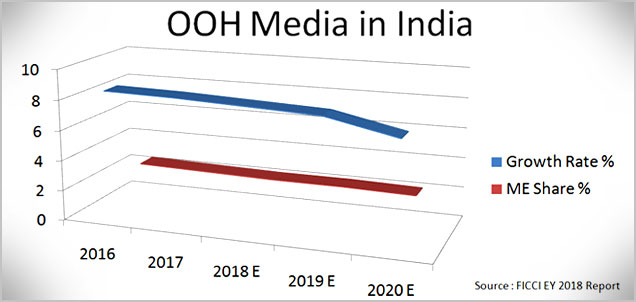
However, the OOH Industry size shown in the report does not reflect the above prophecies for the OOH sector. On the contrary, the report shows a static/diminishing year-on-year growth rate of OOH media and similarly a static/ diminishing share in the M&E Industry.
| OOH Industry Size & Projected Growth | ||||||
| CY 2016 | CY 2017 | CY2018E | CY2019* | CY2020E | CAGR2016-2020 | |
| INR Billion | ||||||
| OOH Media | 31.6 | 34.3 | 37.1 | 40 | 43 | |
| Growth Rate | 8.40% | 8.50% | 8.16% | 8% | 7% | 7.70% |
| ME Industry | 1308 | 1473 | 1660 | NA | 2032 | 11.60% |
| Share of OOH Media in ME Industry | 2.40% | 2.30% | 2.20% | NA | 2.10% | |
Source: FICCI-EY 2018 Report, page 11*Estimated by writer
As per the Pitch Madison Advertising Report 2018, OOH market grew by 6% to reach Rs3085 crores in 2017 with a contribution of 5.8% to the total Advertising Adex.In 2018 it is expected to grow by 10% to reach Rs 3395 crore with a contribution of 5.7% to the advertising pie. The increase in the growth rate in 2018 is based on the upcoming eight State Assembly Elections in 2018 as well as Central Government publicity as a build up to the general Election in 2019. PMAO does not mention about the other opportunities related to growth of infrastructure, etc. There is one common thread between the two reports: the contribution of OOH to the total advertising pie has been hovering around 6% over the years (2013 to 2018E) according to the estimates of PMAO. Admittedly, the percentage shares are different as the two reports deal with different definition of the universe.
What is the future of the OOH sector in India? Is it really poised for an advertising leap based on the coming of age of our millennial population, increased penetration of mobile and social media and availability of digital technologies? I read an interesting article about a year back on “Top 5 Emerging Technologies of Outdoor Advertising in India -207†(https://www.posterstalk.com/Blog/Post/technologies-of-outdoor-advertising-in-india) which described Digital Billboards, Digital Signage, Geo-fencing Technology, Beacons and Near Field Communication (NFC) as the five emerging trends in Outdoor advertising which we can expect to become realities as we progress to the next decade.
It may take a few more years before we see applications of Geo-fencing Technology, Beacons and Near Field Communications in India. But, Digital Billboards and Digital Signage are both poised for immediate growth with huge opportunities of development across our airports, railway stations, MRTS systems and malls, multiplexes, theme parks, sports stadiums and other entertainment complexes. Hospitals and health centres can also benefit from digital signage. Our Ministry of Tourism along with The Archaeological Survey of India can also use this medium for promoting tourism and enabling the travellers with knowledge of world heritage sites and historical monuments.
I strongly believe that we will witness OOH becoming an integral part of social and mobile strategies within next few years. Closer interaction and collaboration is required between the Social Marketing and Digital Marketing Agencies and the Outdoor Agencies for achieving this transformation which will benefit both the parties. Eventually, digital technology will transform OOH from a passive medium to a direct response medium and our media classifications will have to be re-written. While technological churning of the OOH industry takes place, media analysts have to ensure that their industry estimates do not short change the growth of the sector.