Tag: EY India

  • EY survey on music publishing industry

    By Our Staff


    EY, better known as Ernst & Young, has launched a report on the state of the music publishing industry in India titled ‘The music creator economy: The rise of music publishing in India.’


    The report estimates that India generates over 20,000 original songs annually, contributed by 40,000 music creators. Music directly or indirectly generates over INR12,000 crore in revenues each year.


    Commenting on the survey findings, Ashish Pherwani, EY India Media & Entertainment Leader, said: “Music is an important part of India’s media and entertainment sector and is an important contributor to India’s Soft Power. Both local and international labels have driven the music segment’s sound recording revenues for a long time. However, music publishing revenues remain much smaller, given the differing views on its applicability and litigation.”


    Around 500 music creators participated in the study which indicated that their financial income is unpredictable and often limited:

    1. 87% of respondents would have liked to make a living off their music alone, but only 60% were able to do so

    2. Working outside of the traditional employer-employee relationship, one-time payments (upfront fees), live performances and royalties were the primary sources of income for most creators

    3. A majority strongly believed that they needed to learn more about music production and monetization

    4. Only 56% of respondents had access to the equipment and infrastructure required to produce music

    5. 35% of respondents reinvested more than 50% of their earnings from music on equipment, gear, software, and other infrastructure required to create music


  • Indian online gaming biz may reach $2bn by 2023…


    By Our Staff


    The Indian online gaming sector reached US$1.027 billion in 2020, a growth of ~17.3% from US$543 million in 2016. With its current trajectory, it is expected to reach US$2 billion by 2023 in terms of rake fees earned, states the just-released EY- All India Gaming Federation (AIGF) report ‘Online gaming in India – The GST conundrum.’ While India is currently the fourth largest online gaming market globally, the industry requires a robust regulatory and legal environment to help the business scale quickly and achieve its true potential. The report highlights global best practices for taxation and provides much-needed clarity on aspects related to valuation and applicable GST rates.


    Online gamers in India are estimated to grow from 360 million in 2020 to 510 million in 2022. Additionally, there are over 400 gaming start-ups at present that are accelerating the growth of the sector. However, in India, the classification of whether a game comprises a ‘game of skill’ or a ‘game of chance’ has wide consequences for legal implications on the business operations. A game of chance attracts a higher GST rate of tax vis-à-vis a game of skill. Online games operate either on the ‘rake fee’ model wherein the gaming platform charges a rake fee for facilitating games or ‘freemium’ models wherein the gameplay is free but additional features may require users to purchase specific items for a monetary price. A rational imposition of Goods and Services Tax (‘GST’) is therefore vital for sustaining this industry.


    Said Bipin Sapra, Partner – Indirect Tax, EY India: “The online gaming industry is growing at an impressive CAGR of over 20% and holds significant potential for economic growth, job creation and contribution to the Government’s vision of a trillion dollar digital economy by 2025. To enable the industry in realising its peak growth potential, it is imperative that the GST regime for online gaming industry is kept rational and at par with other technology platforms. Adopting globally consistent standards in our tax treatment of the industry will enable it to achieve its true potential.”


    Added Roland Landers, CEO, All India Gaming Federation (and former Chief Brand Officer at Zee and Head of Zee Sports): “The valuation disputes under GST law have been a dampener to the industry. Considering the market size and future growth projections, the online gaming industry is expected to be a significant contributor to the government’s vision and provide future economic avenues considering the ubiquitous digital trends impacting our lifestyle. It is important to highlight that regressive taxation of these emerging sectors may only make the business unsustainable in India. Our recommendation is that the Tax authorities should align its policies with internationally accepted principles of taxing the online gaming sector and provide certainty to the industry. We hope that this report would provide meaningful insights and help accord focus to this sunrise industry.”


    To realise the full potential of online gaming industry, adds the communique, a levy of standard GST/VAT rates is recommended, to be treated on par with any other segments of the economy.


    The valuation mechanism in levying GST on the entire stake value vis-à-vis the rake fee element should be clearly outlined to avoid any ambiguities and potential litigations leading to tax demands. Any uncertainty and possibilities of litigation adversely impacts the business plans, operations, and entry of new players in the industry. Most industry players have a rake fee in the range of 4% – 20%. Any attempt to levy GST on the entire stake value potentially leads to economic unviability of the business model and could force the closure of businesses.


    The report outlines three options:

    (i) GST on rake fee value: Thissuggests a levy of GST only on the rake fee i.e. consideration received by the gaming platform. It is presently being followed across the industry and is in alignment with existing GST mechanism to levy tax on consideration only.


    (ii) Deemed credit model: This has only two data metrics to be considered – stake and pay-outs. This mechanism makes it easier for the Government to verify and audit entities. However, businesses would be required to undertake a change in their ERP systems to compute GST.


    (iii) GST on entire stake value but at a nominal rate of say 1.8%: Thisis simpler to calculate as it has only one data metric to be tracked by business i.e. stake value. However, the mechanism would be discriminatory for industry players having low rake since GST outflow would be high whereas margins are lower. This method is also prone to manipulation where ‘platform fee only’ players without any prize-winning model may offer nominal winnings to lower tax outflow.


    Given the online gaming industry acts as a technology enabler and facilitates gameplays through a web platform similar to software companies’ products, the report recommends a GST rate of 18% to be levied to mitigate any risks of misclassification of the online gaming industry as betting or gambling. The tax rate should not exceed 20% as it could result in the gaming operators as well as consumers entering the grey market.


    Singapore, South Africa and Australia follow the deemed credit model mechanism making it easier to verify and audit the entities. The model is in line with judicial decisions and also takes care of anticipated risk around the misdeclaration of rake fees.

  • Mera Non-Metro India Mahaan


    Given the economic disruption caused by the Covid-19 pandemic, non-metro markets are likely to recover faster than metro markets, an EY survey finds. The report titled ‘Will non-metro markets propel India’s recovery’, reveals a higher percentage of respondents from non-metro markets expect to spend more than before on several categories compared to metro markets indicating that when the lockdown ends, green shoots of recovery would probably sprout faster from the non-metro markets.


    The survey covered a varied demographic mix of more than 4,000 respondents (2,000 each from metro and non-metro markets) to understand the potential impact of the pandemic from the consumer sentiment perspective. It covered key aspects linked to the current and expected attitudes, behaviors and spending trends of consumers as they adapt to the new reality.


    Ashish Pherwani

    Said Ashish Pherwani, Partner and Media & Entertainment Leader, EY India: “The Covid-19 pandemic has radically shifted our way of life. However, despite uncertain and challenging conditions, our research shows that non-metros express a higher degree of resiliency and a resolve to bounce back quicker compared to metros. We may see long-term and even permanent changes in consumption patterns”.


    The survey results reveal that the pandemic and the ensuing social distancing measures put in place have led to fundamental changes in how Indians are consuming media, necessities, luxury products education and travel.


    Some of the key insights from the survey include:

    :: Health, hygiene and online services will continue to grow


    While COVID-19 has impacted overall consumption, categories like heath products, household products, hygiene products, vitamins and supplements and online services (gaming, home entertainment, online education, online banking) are expected to benefit.

    :: Non-metro market recovery is excepted to be faster than metro recovery


    Categories like consumer goods, travel, entertainment, automobiles and white goods are all expected to see increased and faster recovery of demand from non-metro markets post the lockdowns.

    :: Increase in digital adoption


    Digital trials increased significantly during the lockdown period.  However adoption was higher for metros vis-à-vis non-metros.  Some of the obstacles stated by non-metro respondents included lack of technological knowledge, absence of smart phones and fewer language interfaces.

    :: Newspapers remain the most trusted medium


    The impact of coronavirus has unfolded at a dynamic rate, causing a sense of urgency to absorb information, increasing the consumption of news coverage at unprecedented levels. Newspapers continue to remain the most trusted news source. 42% respondents in non-metro markets spend more than 20 mins in reading a newspaper compared to 36% in metros.


  • Reinvent! M&E execs underscore need to survive tech disruption


    By A Correspondent


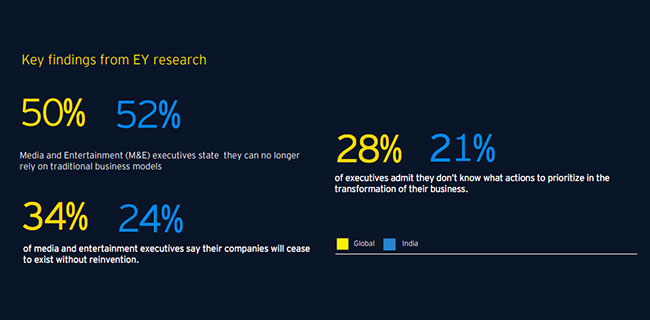
    Faced with multiple evolving and disruptive forces, 52% of executives say they can no longer rely on traditional business models if they are to remain future relevant, according to EY’s report titled, ‘How are media and entertainment businesses reinventing in an age of transformation?’. The report by EY (consulting firm Ernst & Young now refers itself as EY) analyses the views of leading media and entertainment companies and their executives to reveal catalysts, strategies and actions that are reshaping business transformation in a dynamic industry.


    The survey further highlights a sense of perplexity among M&E businesses, with 28% indicating the need to reinvigorate their business, without thorough knowledge of what aspects to prioritise. Due to a plethora of options available to invest in digital tools, one in five executives are unclear on how to prioritize their digital investments. The dilemma of whether to focus on content production for immediate gains as against building direct to customer and platform and data capabilities were cited as key points of contention.


    Said Ashish Pherwani, Partner, Media & Entertainment Leader, EY India: “With fast-paced transformations in business models and revenue streams, media and entertainment companies that otherwise are optimistic about change, are facing a challenge to determine a starting point. While there is no single path to reinvention, businesses are prioritizing direct to customer relationships, platformmatic ad sales and community subscription models, to wade through the waves of technological disruption.”


    The report states that one in two Indian executives felt the pressure to maximize short term results as a barrier to developing innovative business models which also reflected in the findings where just one in three Indian executives believe in upskilling of their existing workforce. 24% of Indian executives felt that their companies would cease to exist without innovation, demonstrating their confidence that traditional media will survive in the future.


    The survey also reveals three ambitions that M&E companies across subsectors are prioritizing above all else:

    :: Pursuing operational excellence and agility is the industry’s top transformation ambition

    Executives believe that simplification is the hallmark of the new operating model. 67% of the executives prioritise consolidation of internal segments to streamline the business, while 50% of executives identify de-layering management and increasing spans of control for remaining executives to be prominent.


    :: Rebooting innovation strategy and approach

    With 48% of executives feeling the pressure to maximize short-term results as a barrier to innovation, balancing sustained success against long-term vision requires a structured approach. 34% of executives see incubators within the core of the business, as a driver of innovation.


    :: Accelerating talent and skills development

    33% of the M&E executives cite upskilling of the existing workforce as the key to talent development highlights the growing imperative to foster continuous learning. To remain relevant, workers need to migrate up the value chain, reinventing themselves and continually improving their capabilities.


    For info: How are media and entertainment businesses reinventing in an age of transformation? is based on a survey of 350 global media and entertainment executives including 29 from India. It takes a representative view of companies by scale, geography and industry subsector. For each question and unless otherwise stated, executives were asked to select their top three responses from a predefined list of options. For example, a response of 50% means it was selected as one of the top three answers by half of respondents.

  • Industry Reax to Budget 2020-21


    A cross-section of the industry reacts to Nirmala Sitharaman’s maiden Budget 


    Girish Menon, Partner and Head, Media and Entertainment, KPMG in India

    Although there was no direct reference to the media and entertainment sector in Budget 2020, the focus on improving India’s digital connectivity bodes well for the sector. The Honourable Finance Minister’s announcement that an amount of INR 6,000 crores will be spent on BharatNet initiatives will see more citizens connected to the proposed pan-India FTTH network. Media and entertainment is increasingly becoming a digital medium and an enhancement of the underlying digital communications infrastructure will support more immersive experiences. Finally, the focus on building a vibrant start-up ecosystem with measures to improve access to funding and IP protection will help India emerge as a global hub for technological innovation.


    Rakesh Jariwala, Partner – International Tax Services, EY India

    Removal of exemption on sale, distribution and exhibition of cinematograph film will subject theatrical revenues to domestic withholding tax considerations and could pose working capital considerations for already funding constrained film industry. Amendment of source taxation rule to include advertising income relating to customer based in India while global consensus is being formed on digital taxation rules may result in short term pain for the foreign businesses which do not have access to a tax treaty. Reduction of withholding tax rate on technical services to 2% will provide relief on potential rate related disputes on production services. Reduction in import duty of news print should help the ailing print businesses. 


    Ashish Bhasin, CEO, APAC and Chairman, India – Dentsu Aegis Network:

    I think this is a good budget in some ways because it has attempted to put money in the hands of the middle class through rationalisation of tax rates as well as has concentrated on looking after the agricultural sector, including introduction of best practises like storage for producers and other measures. However, I do feel that the expectations from the budget were much more and it does feel like a bit of a missed opportunity.


    While it is good to see that the dividend distribution tax has been abolished, I expected more on the rationalisation of direct taxes, particularly the cess introduced over and above the tax rates.


    It is good to see efforts being made to encourage new-age skill development as well as helping the start-ups and what’s particularly interesting is the proposal to set up data centre farms all over the country. This will prepare India for the economy of tomorrow. It is also good to see attempts at simplification of taxation through digitisation but the proof of the pudding will lie in seeing its implementation on ground.


    It would be fair to say that at best it is a mixed budget and while there are some encouraging decisions, enough does not seem to have been done for the situation the economy is in.


    Karan Darda, Executive Director, Lokmat Media Group:

    We welcome the proposed reduction in custom duty on import of newsprint and light-weight coated paper. In recent years, newspaper industry has been facing many headwinds and the environment has overall been very challenging. 10% customs duty was introduced last year and that added to the burden. The reduction in customs duty would ease the burden and help the industry in this critical juncture. 


    Anand Bhadkamkar, CEO, Dentsu Aegis Network (DAN) India:

    The budget has provided relief to middle class with lower tax rates which is a welcome move, as it will provide more liquidity. On direct taxes, the abolition of DDT and introduction of a tax dispute resolution scheme is a welcome step alongside tax reliefs for startups.


    The budget is focusing on easing and simplification of compliance, with changes in corporate laws as well as in GST and direct taxes. However, I was expecting further simplification of cess and surcharges beyond tax rates across slabs.


    The proposals for development of road infrastructure, setting up data centre parks and skill development initiatives are welcome steps in addition to allocations for social welfare schemes.


    However, the expectations from the budget were high on the background of current economic slowdown, and as such seems to be short on matching those expectations, with no specific industry sector focused sops to provide stimulus. While the budget shows focus on long term growth and social development, overall in the current scenario it looks like a mixed budget, falling a bit short of market expectations of more corrective measures.


    Gautam Sinha, CEO – Times Internet:

    Budget 2020 is a promising step towards establishing India’s future as an enduring digital economy. The increased focus on improving data connectivity under Bharat Net, steps to boost the smartphone manufacturing industry and the Rs 8,000Cr allocation for the National Mission on Quantum Computing & Technology will help build better digital infrastructure to support this sector’s rapid growth. Finally, deferring tax on ESOPs for startups is also a major move that will help promising startups attract and retain talent that would fuel our burgeoning digital ecosystem.


    Redickaa Subrammanian, Co-founder and CEO, Resulticks:

    Digital disruption has transformed India’s business landscape and the announcement for building more data centre parks will further aid in laying a strong foundation for a digitally connected country. INR 8000 crore allotment for developing quantum technology is impressive, and this in tandem with the grassroots level skilling initiatives, make for a strong technology ecosystem. Engineering students will also gain real-world experience through the new internship programs, creating a digitally skilled talent pool equipped to work in a digital economy.


    As a fast-growing AI and ML based technology start-up, we welcome setting up of the investment clearance cell. The proposed revisions in the income tax structure should lead to increased consumer demand and provide an overall impetus for economic growth in India. The announcement made in Budget 2020 showcases the government’s support for India’s technological advancement and we are excited about the entrepreneurial spirit it promotes.”


    Prashan Agarwal, CEO – Gaana:

    We appreciate the efforts of the government to boost the digital ecosystem in the country. The increased focus on improving connectivity under the Bharat Net scheme and the emphasis on Artificial Intelligence will allow OTT players to offer bespoke and personalised solutions to consumers. Additionally, the impetus to the smartphone manufacturing industry will make internet consumption accessible to a wider section of Indian society that will expand the scope of revenues for OTT players. The allocation of Rs 8000 crore for setting up the National Mission on Quantum Computing and Technology will also boost the development of the industry by making resources cost-effective.


    Mitesh Shah, Head of Finance, BookMyShow: 

    At the onset, we would like to laud Government for growth driven budget. We welcome the progressive policies aimed at encouraging rural demand, changes in personal taxes spurring consumption and impetus to infrastructure development, measures aimed at bolstering growth and reverse slowdown. Additionally, taxation related on ESOPs as perquisite and removal of DDT are significant moves. However, the benefits of taxation relief on ESOP should be expanded to companies at various stage of growth.


    Compliance on e-commerce has been increased by mandating them to deduct TDS @1% on all goods and services sold on e-commerce platforms. This would be in addition to TCS under GST and this amendment might further increase the cost of compliance for e-Commerce companies. Government’s vision to build data centre parks, allocation towards quantum computing and its focus on using artificial intelligence in statistical and other government departments will take India’s growth story to the next level.


    Increase in compliance on e-commerce by mandating deduction of TDS @1% on all goods and services sold on e-commerce platforms. This would be in addition to TCS under GST and this amendment might further increase the cost of compliance for E-Commerce companies. Government’s vision and focus on investing in new age technologies to build data centre parks, allocation towards quantum computing and its focus on using artificial intelligence in statistical and other government departments will certainly give an impetus to ‘Digital India’.


    Kunal Bahl, CEO & Co-founder, Snapdeal:

    Thankful to the Hon’ble FM for accepting the start-up sector’s request for ESOP taxation reforms. Also, the higher time & turnover limits for carry forward of losses for start-ups will enable them to optimize growth decisions in formative years.


    Overall, Budget 2020 is a thoughtful weaving together of specific proposals to tackle varied issues. Measures to improve access to finance for MSMEs and reduced taxation for the middle-income segment are welcome steps. Boosting physical infrastructure, expanding digital connectivity and growing use of technology in government functioning are important building blocks for the long-term growth of the Indian economy.


  • M&E grows ~13%, Rs 1.67 trillion in 2018: EY-FICCI report


    By A Correspondent


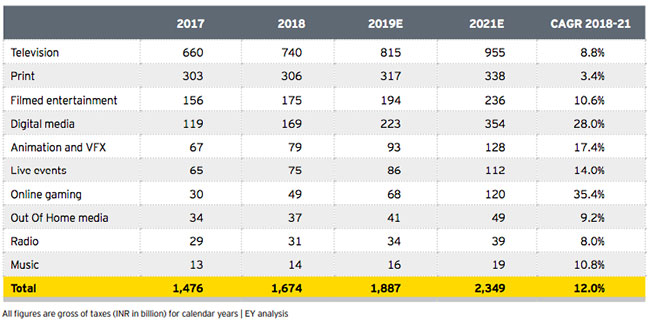
    The Indian Media and Entertainment (M&E) sector reached INR1.67 trillion (US$23.9 billion) in 2018, a growth of ~13.4% over 2017 states the EY-FICCI report ‘A billion screens of opportunity’, launched at the FICCI Frames 2019 in Mumbai on Tuesday.


    With its current trajectory, the M&E sector in India is expected to cross INR2.35 trillion (US$33.6 billion) by 2021, at a CAGR of 11.6%. While television retained its position as the largest segment, growth is expected to come from digital which will overtake filmed entertainment in 2019 and print by 2021. The report captures key insights from the exciting and fast-growing Indian M&E sector.


    The sector continues to grow at a rate faster than the GDP, reflecting the increasing disposable income and economic growth. India has the second highest number of internet users after China with ~570 million internet subscribers growing at 13% annually. The report estimates that approximately 2.5 million consumers in India today are digital only and would not normally use traditional media. It is expected that this customer base will to grow to ~5 million by 2021. Traditional media companies spent 2018 building their customer data through second-screen interactive propositions, polls, house-to-house surveys, integration of third-party data, etc. Digital consumption will grow, and monetisation avenues will see great innovation to cater to the new Indian customer segments. Telco bundling will drive consumption for a majority of Indian OTT audience. Advertising growth outpaced subscription growth and is expected to comprise 52% of the total pie by 2021.


    Said Ashish Pherwani, Partner and Media & Entertainment Leader, EY India: “The M&E sector has a significant opportunity given India’s young demographics. The growth of digital infrastructure is further enabling Indians to fulfil the need for personal content consumption, across languages and genre. There is a large shift in consumer behaviour from mass produced content to specific content defined to audience segments. The sector has an opportunity to serve a billion screens in India and globally.”


    Added Uday Shankar, Vice President, FICCI and Chair, FICCI Media and Entertainment Division, said, “The Indian M&E sector is entering a phase of accelerated growth. The status quo is being shattered by digital disruptions and that’s unshackling the creative economy in India like never before. These are exciting times for all it is to let our imagination and ambition guide us.”


    Key findings 

    :: Television:
    The TV industry grew from INR 660 billion to INR 740 billion in 2018, a growth of 12%. TV advertising grew 14% to INR 305 billion while subscription grew 11% to INR 435 billion. Television viewing households increased to 197 million, which is a 7.5% increase over 2016.Regional advertising growth outpaced national adverting growth on the back of national brands spending more to develop non-metro markets where GST created a level playing field between national and regional brands.  77% of time spent on television was on general entertainment content and film channels.

    Key insights – Broadcasters have started combined selling of ads across OTT and linear platforms to enable better monetisation of marquee properties and increased utilization of digital inventory.  The impact of the TRAI Tariff Order can have implications on total viewership, free television uptake, channel MRP rates and advertising revenues. However, 2019 promises further growth due to the elections and the ICC World Cup. The television segment can reach INR 955 billion by 2021, with advertising growth at 10% and subscription growth at 8%.


    :: Print:
    Print accounted for the second largest share of the Indian M&E sector, despite being static and growing at 0.7% to reach INR 305.5 billion in 2018. Advertising revenues stood at INR 217 billion and subscription revenues grew marginally by 1.2% to INR 88.3 billion in 2018. Newspaper advertising de-grew 1% while magazine advertising fell 10%. The fall in advertising is due to both reduced ad volumes as well as pressure on effective rates. Hindi newspaper publications continued to lead with 37% of total ad volumes, while the share of English publications stood at 25%. Rising newsprint prices and a depreciation in the value of the Indian Rupee led to pressure on print sector margins in 2018.

    Key insights – 2018 witnessed a 26% growth in digital news consumers over 2017 when 222 million people consumed news online. Page views grew 59% over 2017 and average time spent increased by almost 100% to 8 minutes per day in 2018. Print companies will tilt their sales pitch towards performance, linking physical space sales with digital inventory, activations (both physical and digital), interactive concepts like QR codes, digital couponing, etc. This will provide increased consumer data as well as a competitive plank to grow share of print.


    :: Films:


    The Indian film segment grew 12.2% in 2018 to reach INR 174.5 billion driven by the growth in digital/ OTT rights and overseas theatricals. All sub-segments, except home video grew. Domestic film revenues crossed INR 100 billion with Net Box Office collections for Hindi films at INR 32.5 billion – the highest ever for Hindi theatricals. Overseas theatricals grew to INR 30 billion from INR 25 billion in 2017 where China became the largest international market for Indian content. 98 Hollywood films were released in 2018 as compared to 105 in 2017. The box office collections of Hollywood films in India (inclusive of all their Indian language dubbed versions) was INR 9.21 billion. Multiplexes drove up the screen count to 9,601, though single screens continued to reduce.

    Key Insights:

    Digital rights redefined the content consumption processes as the segment grew from INR 8.5 billion to INR 13.5 billion. Online platforms invested heavily in exclusive film rights and a digital-only film market has emerged. In-cinema advertising grew to INR 7.5 billion in 2018 on the back of growing multiplex screens. Thirteen Hindi films entered the coveted INR100 crore club in 2018, which is the highest ever. The digital only film market came into existence in 2018.


    :: Digital media:

    In 2018, digital media grew 42% to reach INR 169 billion. Infrastructure propelled the growth in digital consumption. Digital ad spends grew 34% to INR 154 billion and now contribute around 21% of the ad market. Digital subscription grew 262% to reach INR 14 billion. Video subscription revenues almost grew three times in 2018 to reach INR 13.4 billion, on the back of new and relaunched video streaming platforms, growth of smartphones, spread of affordable broadband, regional language content, exclusive content and live streaming of major cricket and other impact properties.


    Key insights: Digital subscription reached INR 14 billion primarily due to telco bundling of content with their data plans to drive sales of data packs. The number of wireless subscribers grew from 1,167 million in December 2017 to 1,171 million in November 2018. This growth primarily came from rural subscribers who grew from 499 million to 526 million in the same period. Up to 60% of video viewership volumes were generated by telcos and the amount spent by them on acquiring content for their subscribers was INR 3.5-4 billion


    Mergers and Acquisitions in M&E


    The India M&E sector witnessed an interesting mix of deal activity in 2018 both on the traditional as well as the new media front. The number of deals in M&E in 2018 remained the same at around 40 though the deal value more than doubled in 2018 to US$2.8 billion from US$1.3 billion in 2017. 41% of deals were in the digital segment in 2018, compared to 30% of deals in 2017 while deals in the gaming segment came next with 20% of the deals. The digital segment has been at the forefront of deal activity as India’s demographic dividend in the form of smartphone users, internet penetration and improving bandwidth continues to grow exponentially. The consolidation wave in the M&E sector is expected to accelerate and continue as large media corporates strengthen their presence for achieving scale, reach and relevance. The sector is also gaining huge interest from global strategic players who want to be part of the rapid growth in this sector, on the back of greater availability of data.


    Please click here to read the complete report.


  • M&E to cross Rs 2tn by 2020: FICCI-EY report


    By A Correspondent


    FICCI-Frames 2018 took off on Sunday evening with I&B Minister Smriti Irani as Chief Guest. As part of the inaugural session, the annual M&E industry report, this time presented by the team at Ernst & Young (EY). The venue this year is the Grand Hyatt in Santacruz East, away from the Renaissance at Powai where Frames has been happening for 16 of the 18 editions.


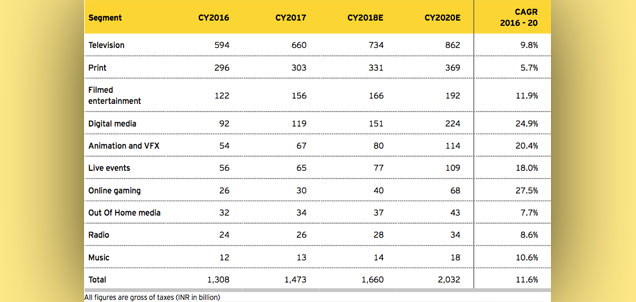
    Back to the report: the Indian Media and Entertainment (M&E) sector reached almost INR1.5 trillion (US$22.7 billion) in 2017, a growth of around 13% over 2016. With its current trajectory, it is expect to cross INR2 trillion (US$31 billion) by 2020, at a CAGR of 11.6%. The digital segment-led growth, demonstrating that advertising budgets are in line with the changing content consumption patterns The  FICC-EY report is appropriately titled ‘Re-imagining India’s M&E sector’ and captures key key insights from the Indian M&E sector.


    The M&E sector continues to grow at a rate faster than the GDP growth rate, reflecting the growing disposable income led by stable economic growth and changing demographics. The report states that subscription growth outpaced advertising growth in 2017 but advertising will continue to grow till 2020 led by digital advertising. The report estimates that approximately 1.5 million consumers in India today are digital only and would not normally use traditional media. It is expected that this customer base will to grow to ~4 million by 2020 generating significant digital subscription revenues of approximately 20 billion. Going forward, micropayments, enabled through the Unified Payment Interface (UPI) and Bharat Interface for Money (BHIM) platforms developed by the National Payments Corporation of India (NPCI) will further accelerate subscription revenues for entertainment content.


    Said Farokh Balsara, Partner and M&E Leader, EY India:  “Indian M&E sector reached INR1.5 trillion in 2017 led by digital. With digital subscribers expected to reach 20 million by 2020, has Indian M&E reached its digital tipping point? We now need to re-imagine the future of  Indian M&E sector.”


    Added Ashish Pherwani, Partner and M&E Advisor Leader, EY India: “Growth in 2017 was led by the digital, film & animation & VFX segments. We expect sectors like digital and gaming to grow between 2 to 3 times by 2020.”


    Key findings

    :: Television:
    The TV industry grew from INR594 billion to INR660 billion in 2017, a growth of 11.2% (9.8% net of taxes). Advertising grew to INR267 billion while distribution grew to INR393 billion. Advertising comprised 40% of revenues, while distribution was 60% of total revenues. At a broadcaster level, however, subscription revenues (including international subscription) made up approximately 28% of revenues.

    Key insights– While advertising is 41% of the total revenues today, the report expects it to grow to 43% by 2020. There are over 30% households in India which are yet to get television screens, but being at the bottom of the pyramid, these households will tend to move towards first towards free and sachet products.


    :: Print:
    Print accounted for the second largest share of the Indian M&E sector, growing at 3% to reach INR303 billion in 2017. Print media is estimated to grow at an overall CAGR of approximately 7% till 2020 with vernacular at 8%-9% and English slightly slower. This growth is expected despite the FDI limit remaining unchanged at 26% and therefore, restricting access to foreign print players and the imposition of GST at 5% on the advertising revenues of the print industry for the first time in history. While magazines contributed 4.3% to the total print segment, the segment was at largely status quo with not many significant new launches in 2017.

    Key insights– Today, 98% of readers read dailies and 20% read magazines. Reader base is 395 million, or 38% of the population. Readership has grown by 110 million over the last 3 years. Rural (52%) reader base is larger than urban (48%). 44% of children (aged 12 to 17 years) read a newspaper or magazine. Magazines have a higher readership in urban areas (57%) as compared to rural areas (43%).


    :: Films:
    The Indian film segment grew 27% in 2017 on the back of box office growth – both domestic and international – coupled with increased revenues from sale of satellite and digital rights. All sub-segments, with the exception of home video grew and the film segment reached INR156 billion in 2017.The Hindi films comprise the majority component of the Indian film segment. They contribute almost 40% of the net domestic box office (BO) collections annually, despite comprising only 17% of the films made. Films in 29 other Indian languages account for approximately 75% of the films released but they contribute approximately 50% to the annual domestic box office collections. Hollywood and international films comprise the balance. The top 50 films contributed approximately 97.75% of the total net box office collection. Box office collections of the top 50 films grew by 11.60% in 2017.

    Key Insights: Regional movies drove the growth in number of releases in 2017. Screen count increased from 9,481 in 2016 to 9,530 in 2017. Number of Hindi movies crossing the INR1 billion mark was highest in 2017 in the past 5 years. From 31 movies in 2016, Hindi dubbed movies increased more than 3 times to 96 in 2017.


    :: Digital media:

    Digital media has grown significantly over the past few years, and continues to lead the growth charts on advertising. Subscription revenues are emerging and are expected to make their presence felt by 2020. In 2017, digital media grew 29.4% (27.8% net of the impact of GST) on the back of a 28.8% growth in advertising and a 50% growth in subscription. Subscription, which was just 3.3% of total digital revenues in 2016, is expected to grow to 9% by 2020.

    Key insights: 250 million people viewed videos online in 2017 and expected to double to 500 million by 2020. Around 40% of total mobile traffic came from the consumption of video services in 2015. This figure is expected to touch 72% by 2020. 93% of time spent on digital videos is in Hindi and other regional languages. OTT subscription in India is expected to touch INR20 billion by 2020.

    M&A in M&E


    The Indian M&E sector witnessed a relatively new trend in deal activity with emerging segments such as gaming and digital gaining momentum, while the deal activity in the traditional media segments was slower. The slowdown can be partially attributed to challenges faced by the advertising segments of the industry due to demonetisation and GST. Overall, the number of transactions in the M&E sector decreased from 56 deals in 2016 to 40 deals in 2017. Further, the total deal value was also lower at US$1,261 million in 2017 compared to US$2,863 million in 2016.


    The entire report can be accessed at here


  • Indian events and activations biz to cross 10k cr by 2020-21: EY


    By A Correspondent


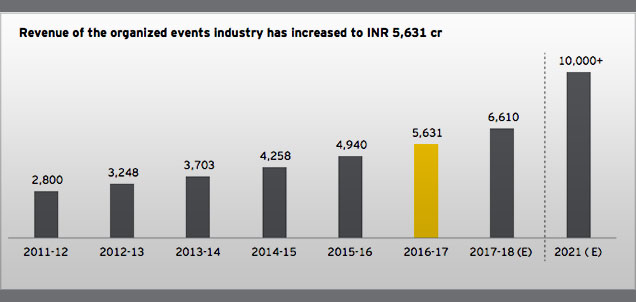
    The Events and Activations industry has grown at 16% in FY2016-17 and is expected cross INR 10,000 crore by FY2020-21 according to EY – EEMA (Event and Entertainment Management Association) report titled ‘#Experience_Next’. The key insights in the report suggests that average number of events are increasing across all formats, Government spending is expected to grow at 14% and sports is expected to grow at 18% over the next 5 years, wherein India attributes to 1% if the global sports market.


    Said Ashish Pherwani, Partner and Media & Entertainment Advisory Leader, EY India: “The Events and Activation industry is growing at a fast pace and is expected to further grow exponentially due to its ability to adapt and grow with innovative technology. With focus on newer avenues such as sports leagues, rural expansion, digital activations, increased Government marketing initiatives etc., we see events industry surpassing overall growth rate of M&E industry.”


    Added Sabbas Joseph, President, Event and Entertainment Management Association:“Event management has now transformed into experience creation with amalgamation of technology, innovative ideas and creative content. The Indian economy has undergone a lot of changes in the recent past and the Events and Activation industry has come out unscathed. This demonstrates the industry’s strength and ability to get things done under any circumstances.”


    According to the report which is based on a survey of 64 event management companies and 31 marketers, overall the events and activations industry is expected to grow from INR 5,631 cr in 2016-17 to INR 10,000+ cr in 2020-21. The organized events industry is growing faster than the 11% – 13% CAGR of the Indian M&E industry. The key growth drivers for the same are digital activation, sports leagues, rural expansion and government initiatives followed by IPs, personal events, product launches, expansion of mini-metros and BTL spends.


    Some more snapshots of the findings from the report on the current scenario:

    [] Managed events is still the largest segment, with around 90% of respondents providing these events

    [] Average IPs and activations per respondent have doubled since 2013-14, while average digital events per respondent have shown a 9x growth since 2013-14

    [] There is a fall in proportionate revenue generated by activations from 31% in 2015 to 22% in 2017, showing that there is a distinct move to digital activations

    [] More respondents are providing services internationally – up sharply from 8% in 2011 to 56% in 2017

    [] Around 75% of all respondents’ clients were corporates

    [] Technology, FMCG, auto, media and entertainment and telecom are the largest users of the Events & Activations industry

    [] An average of 26% of the total employees of the respondents consist of women employees


    And on opportunities for the industry:

    [] Digital is driving growth, as respondents felt that marketers spends on digital events would grow at 20% over the next two years

    [] Most respondents felt that sports would significantly grow at 18%

    [] Most respondents expected ticketed events to witness a moderate level of growth in the next 2-3 years

    [] 95% of the survey respondents agreed that rural events and activations would gain increased importance over next 2-3 years

    [] Over 85% of respondents plan to launch new products or properties in the next two years, and almost a fifth of respondents will launch 3 or more products

    [] 73% of marketers expected their BTL spends to grow during the next two years, with 43% expecting growth to be over 10% per annum

    [] Digital integration was either important or very important for the events of 90% of marketers


  • Uday Shankar among 17 finalists for EY Entrepreneur of the Year Award

    By A Correspondent


    EY, the global professional services organisation, announced the selection of 17 of the country’s most exceptional entrepreneurs as finalists for the 18th Entrepreneur of the Yearâ„¢ – India 2016. The finalists have been selected from among 250 outstanding nominations and will be felicitated at a grand celebratory Awards Banquet to be held on 24 February in New Delhi.


    Together, these 17 finalists have combined revenues of over INR 154,335 crore (USD 23.38 billion) and are providing employment to over 5.2 lakh people in India and globally.


    A distinguished nine-member independent Jury led by Dilip Shanghvi, Managing Director, Sun Pharmaceuticals Industries selected the finalists. Other Jury members include Subodh Bhargava, Chairman, Tata Communications; Sanjeev Bikhchandani, Executive Vice-Chairman, Info Edge (India) Limited; Naina Lal Kidwai, Chairman, Max Financial Services; Uday Kotak, Managing Director, Kotak Mahindra Bank; Kalpana Morparia, Chief Executive Officer, JP Morgan Chase South Asia and India; Rishad Premji, Chief Strategy Officer, Wipro; Renuka Ramnath, Managing Director and Chief Executive Officer, Multiples Alternate Asset Management and A Vellayan, Executive Chairman, Murugappa Group.


    Dilip Shanghvi, Jury Chairman and Managing Director, Sun Pharmaceuticals says, “Like previous years, this year’s finalists too represent extremely successful companies that have not only disrupted the industry with a new business model but have disrupted themselves to chart a new growth path. We need more entrepreneurs to propel our country’s growth and it is important to recognize such innovative entrepreneurs.”


    The finalists for the EY Entrepreneur Of The Yearâ„¢ 2016 India Awards are:

    – Ram Gopal Agarwal, Chairman, Dhanuka Agritech

    – Vishwavir Ahuja, Managing Director and Chief Executive Officer, RBL Bank

    – Hari Mohan Bangur, Managing Director, Shree Cement

    – R Dinesh, Managing Director, TVS Logistics Services

    – Dr Abhay Firodia, Chairman, Force Motors

    – Ajit Isaac, Chairman and Managing Director, Quess Corp

    – Girish Mathrubootham, Founder and Chief Executive Officer, Freshdesk

    – Ravi Modi, Chairman and Managing Director, Vedant Fashions (Manyavar)

    – Vikas Oberoi, Chairman and Managing Director, Oberoi Realty

    – Darshan Patel, Chairman and Managing Director, Vini Cosmetics

    – M. P. Ramachandran, Chairman and Managing Director, Jyothy Laboratories

    – Vivek Chaand Sehgal, Chairman, Motherson Sumi Systems

    – Rashesh Shah, Chairman and Chief Executive Officer, Edelweiss Group

    – Uday Shankar, Chairman and Chief Executive Officer, Star India

    – Samprada Singh, Chairman Emeritus and Basudeo Narain Singh, Executive Chairman, Alkem Laboratories

    – Chandubhai Virani, Whole time Director, Balaji Wafers


    Nandan Nilekani will be honored with the Lifetime Achievement Award for his invaluable contribution to the Unique Identification Authority of India (UIDAI), which is a pioneering citizen identification program, unparalleled in scope and scale worldwide. As the Honorary Advisor to the National Payments Corporation of India (NPCI), he has also helped create the ecosystem for digital financial services in India. He has also played a major role in the growth of the Indian Information Technology industry and is a recipient of the Padma Bhushan, India’s third highest civilian honor, in 2009.


    Uday Kotak, Managing Director, Kotak Mahindra Bank and winner of the World Entrepreneur Of The Year Award 2014 says, “I was delighted to be part of this Jury and impressed with the robustness of the process. This year’s Finalists truly define the India of today and tomorrow. What is really interesting is that we are seeing real-world businesses adopting digital and transforming themselves. My message to every entrepreneur in India is, “Go out there, build your dream and more importantly, build a business model that is sustainable over time.”


    Says Kalpana Morparia, CEO, JP Morgan Chase, South Asia and India, “What made the Jury process truly outstanding is the richness of the candidates. This year’s theme for the Awards – ‘Ideas, Innovation and Inspiration’, are the three ‘I’s that are driving India’s economy and many of the 2016 finalists embody this theme.  Looking beyond the digital services companies, what is phenomenal is that existing established businesses are disrupting their own models to keep pace with the digital economy.”


    The selection criterion included the nominee’s entrepreneurial spirit, recent financial performance, strategic direction and global impact, product or service innovation, company leadership including personal integrity and risk-taking, values and key employee initiatives, and involvement with the community.


    The winners will be announced across several categories, while the national winner will represent India at the EY World Entrepreneur of the Year (WEOY) awards in Monte Carlo from 8-11 June 2017.


    Rajiv Memani, Chairman, EY India, says, “What strikes me about our 2016 Finalists is how they have acquired tremendous scale and size from what were clearly modest beginnings. A strong focus on the customer and a business model based on innovative products and services for niche markets have enabled them to create a lasting impact. Also, reliance on technology and a bold vision for the future has helped them scale up rapidly.”


    Says Farokh Balsara, Partner and EOY India Program Leader, “Entrepreneurs have the power to impact our lives. Their unyielding drive to seize the power of transformative ideas creates jobs, energizes markets, builds wealth and spurs economic growth around the world. We salute their passion and insight that make them different and exceptional. Our EOY 2016 India finalists are a rare group of individuals who with their disruptive ideas and incredible innovation are inspiring a whole new generation of entrepreneurs.”


    Zarin Daruwala, Chief Executive Officer of Standard Chartered and sponsor of the EOY 2016 India Awards says, “We are delighted to sponsor The EY awards, which captures and celebrates the spirit behind India’s economic resurgence – the Indian entrepreneur.  Never before in our history have we seen ideas and innovation spur on with such zeal, whether it is in the exciting world of start-ups with technology as the centrepiece of business ideas, or conventional business which are reshaping themselves by using technology to unleash the full potential of their products and services.  India, today, has the third highest number of Unicorns globally, with two of them in the top 20, and the IITs rank fourth across all institutes in producing billion dollar start-up entrepreneurs. The lasting impact is in the manifold ways entrepreneurship touches and changes lives: creating employment, raising health and education standards, and ushering in a stable and progressive society.  With the government encouraging new entrepreneurship through ‘StartupIndia’ and the success stories already scripted, India is becoming the crucible of ideas, ambition and entrepreneurial spirit.”


    The past winners of the EY Entrepreneur Of The Year India Awards  include Vinita and Nilesh Gupta (Lupin Limited), Dr. Cyrus S. Poonawalla (Serum Institute of India), Uday Kotak (Kotak Mahindra Bank), Adi Godrej (Godrej Group), Rahul Bhatia (Interglobe Enterprises), Dilip Shanghvi (Sun Pharmaceuticals),  Anand G Mahindra (Mahindra Group), Anil Agarwal (Vedanta Resources), Tulsi Tanti (Suzlon Energy), Kumar Mangalam Birla (Aditya Birla Group), Sunil Bharti Mittal (Bharti Group), Ratan Tata (Tata Group), N.R Narayana Murthy (Infosys), Brijmohan Lall Munjal (Hero Group), (Mukesh  Ambani (Reliance Industries), and Subhash Chandra (Zee Telefilms).


  • Convergence & Digital disruption pull for M&E M&As


    The Mergers and Acquisitions (M&A) outlook for the media and entertainment (M&E) sector is being driven by sector convergence and digital disruption, according to EY’s 15th biannual Media & Entertainment Capital Confidence Barometer (CCB). Sector convergence is the greatest disruptor to M&E businesses, according to 31% of executives surveyed.


    Digital remains at the heart of corporate strategy in the sector. Nearly a third (31%) of the executives saw the impact of digital technology on the business model elevated on the boardroom agenda over the past six months, notes the report.


    In India, M&A activity in the media and entertainment sector registered a total of 56 deals with cumulative disclosed deal value of US$1.8 billion in 2016, as against 56 deals with a total disclosed deal value of US$1.2 billion in the previous year. The largest deal of the sector was US$1.2 billion merger of Dish TV and Videocon D2H, which signals that consolidation is the way forward in the DTH space.


    Said Ajay Shah, Partner – Transaction Advisory Services, Media and Entertainment, EY India: “During the year, digital marketing players were also high on the M&A radar, as media and e-commerce companies acquired them to gain technological capabilities and target consumers with customized advertisements. TV Broadcasting was another hot segment as players in the industry made acquisitions to strengthen their presence in the rapidly growing segments of entertainment.”


    In response to both sector convergence and digital disruption, M&E executives are seeking out cross-sector opportunities. Sector blurring — companies making increasing and deeper incursions into adjacent or unrelated industries — has become a prominent feature of the current M&A market. The strongest driver of cross-sector deals, according to 67% of executives, is access to new technologies/digitalisation.


    More than half (56%) of industry executives expect to pursue acquisitions in the next 12 months, up from 46% six months ago. This appetite for dealmaking remains well above CCB’s long-term average of 45%, pointing to an upturn in M&A in the first half of 2017. Executives also expressed a high level of confidence in key deal indicators. Ninety-two percent indicated stable-to-positive confidence in the number of acquisition opportunities, 85% in the quality of acquisition opportunities and 94% in the likelihood of closing acquisitions.


    While 73% of executives see the global economy as stable (53%) or improving (20%), macroeconomic risks still exist. The rise of populist parties across the globe has become a rising concern for executives. Twenty-seven percent regard political instability as the most important risk to their business in the next year; however, this is not causing M&E companies to slow down cross-border investment.


    The report shows that companies are expanding geographic reach in order to gain exposure to high-growth regions and under-penetrated markets. Forty-two percent of executives are targeting a cross-border acquisition in the coming year. The Top 5 destinations for 2017 will be the US, France, the UK, Germany and China. Last year, before Brexit, the UK was number one, finds the report.


    The EY Global Capital Confidence Barometer is a biannual survey compiled by the Economist Intelligence Unit of more than 1,700 senior executives from large companies around the world and across industry sectors. This is the 15th semi-annual Barometer in the series, which began in November 2009; respondents for the 15th edition were surveyed in August and September 2016, 50% were CEOs, CFOs and other C-level executives. The objective of the Barometer is to gauge corporate confidence in the global and domestic economic outlook, to understand boardroom priorities in the next 12 months, and to identify emerging capital practices that will distinguish those companies building competitive advantage as the global economy continues to evolve. In this survey, there were 66 respondents from media and entertainment companies.


    A full copy of the Media & Entertainment Global Capital Confidence Barometer, can be accessed at: ey.com/ccb/mediaentertainment


  • 7 trends in Mobile Advtg marketers must track


    By Srinivas Yelandur


    Mobile Video Experience through VR/Augmented Reality – Affordable, low-cost Virtual Reality (VR) gear will take the entire mobile video experience to a new level.  Content and apps for the augmented or VR environment will lead to a focussed approach for content and app ecosystems.  Advertisers will become more innovative and experimental with VR mobile video advertising. Here are seven trends that are likely to happen:
    1. Mobile Location-based Marketing – Location-based advertising has always remained a small segment in the overall budget of mobile advertising. It is a complex and challenging task to geo-fence the consumer in all his interactions, using the mobile as it is important to gather the right data or intelligence. New mobile marketing technology will make it more accurate in delivering services and targeting the customer.

    2, Mobile Multi-Screen In App Advertising – Video experience is changing the way content is being consumed. As consumers have moved from small screens to large screens, they are adopting multi-screens to drive the right content consumption experience, both in streaming content as well as gaming content. Advertisers now have the opportunity to target a single consumer on multiple screens with the right contextual content.

    3. Mobile Beacon-based Advertising – Advertisers will now change gears from targeting location-based strategies to advertising based on proximity signals — indicators of when users are closer to a beacon or a sensor – as they are more accurate than GPS. This, however, will not replace location-based marketing for mobile advertisers but will only add complementary force to help divert towards sensor-based data, yet.

    4. Mobile/ NFC-based Payments – This new form of device-based payments will continue to play an important role as a bridge between offline and online, which has largely gone under-appreciated, particularly when it comes to retail.  Marketers will now be keen to increasingly leverage mobile in advertising and promotions and provide incentives via digital content.

    5. Mobile Voice Search Engines – Search engines have gone mainstream but with mobile devices getting more sophisticated in voice technology, mobile vendors have invested heavily in technologies like Siri and Google Now. Amazon is using Echo to gather huge volumes of voice data for analysis and marketing more effectively in targeted environments creating a personal advertising strategy.

    6. Mobile Couponing – Mobile couponing will start taking off again. Forty-four per cent of consumers are interested in receiving coupons and deals on their mobile devices – all the more so if they were timely and relevant. Increased use of location targeting and greater dependence on automation platforms will enable brands to do just that.

    7. Mobile Wearables Advertising – Wearable computing is driving a new way of life and advertisers are gathering better insights into ‘self-data’ about individuals. Apps with wearable devices will provide the edge for targeted strategies in various device ecosystems – watches, health bands and activity trackers. Wearables, by their very nature, are more intimate and provide deeper data about consumers which are an advertiser’s delight.


    Srinivas Yelandur is Director – Advisory Services, EY India. This article first appeared in dna of brands on March 21, 2016