
Tag: eMarketer

  • India Shining in Ecommerce Growth


    By Indrani Sen


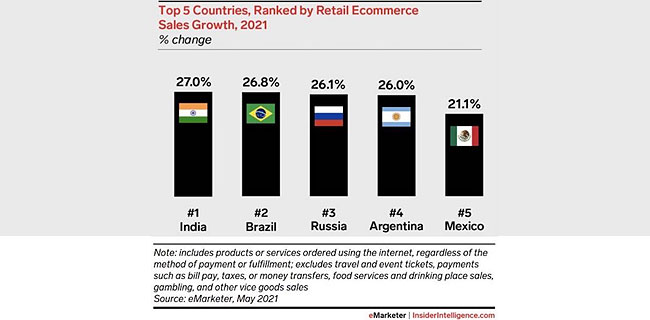
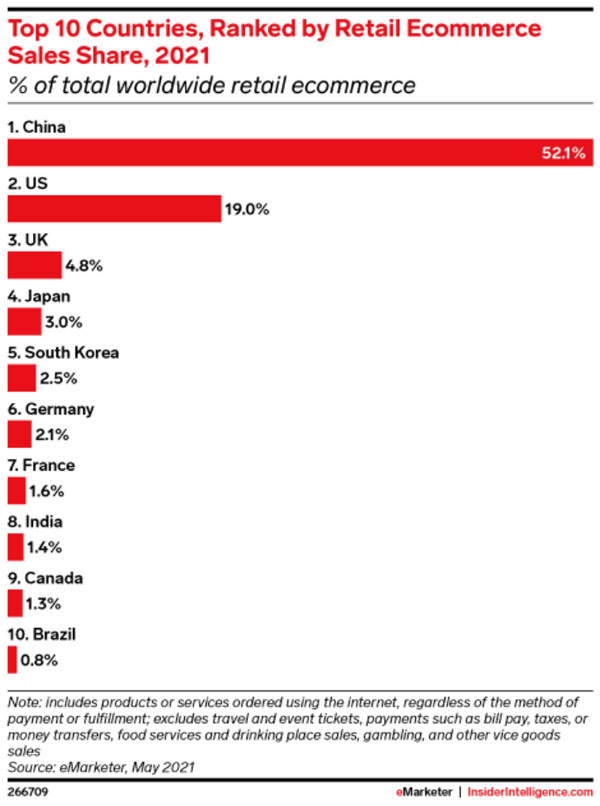
    Indrani SenA study “Global Ecommerce  Forecast 2021” conducted earlier this year, followed by articles published in www.emarketer.com recently show that India ranked eighth in the share of retail Ecommerce  sales in the world in 2020, while leading in the growth rate along with a pack of Latin American countries and Russia. The trend is estimated to continue during 2021 with China leading the pack of countries with US featuring as the poor second. India, thanks to the huge population base and the accelerating drive for a “Digital India”.


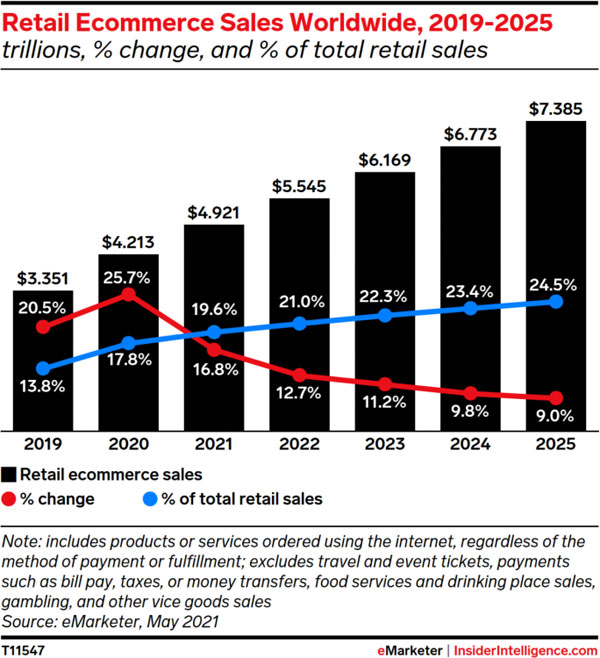
    The retail Ecommerce grew dramatically across the world at the cost of the physical stores sales in 2020 as COCID 19 raged across both developed and developing countries. In an article published on July 7, 2021 Karin Von Abrams wrote “Before the pandemic, we had forecast that total retail sales worldwide would rise by 4.4% in 2020, to $26.460 trillion. We now estimate that retail sales amounted to just $23.624 trillion last year-a decline of 2.8%. But in 2021, this figure will rebound to pre-pandemic (2019) levels, reaching $25.052 trillion.” (https://www.emarketer.com/content/global-Ecommerce -forecast-2021) 


    Another chart published in the same article reflects the worldwide growth of Ecommerce  from 2019 to 2020 and the subsequent drop in the same.


    India, however is expected to have an increase in the growth rate of Ecommerce  in the coming years and reach a size of US$ 99 billion by 2024 as also indicated in another article published on May 9, 2021 (https://www.ibef.org/industry/Ecommerce .aspx)   which lists a series of initiatives taken by the Ecommerce  industry along with Government initiatives and increasing investments as the key factors behind this surge of growth apart from growing demand and attractive opportunities. The road ahead also seems to be full of promises. The growth in this sector has been beneficial for the MSME sector in India and is expected to fuel their growth in the long run.  Along with the growth, the share of India in the world wide retail Ecommerce  is also supposed to increase propelling its rank from eighth to third after US in the coming years.

     

  • Three Key Media Trends Sweeping the Pandemic-hit World


    By Indrani Sen


    Over the last couple of months, we have seen many surveys which have looked at the current level of global and local media revenue and its recovery path over the next two to three years. Most of these surveys have highlighted the bright picture looming at the end of the tunnel. Last week, I came across a survey released by www.emarketer.com which has focussed on three key media trends sweeping the pandemic hit world, providing the advertising and media industry with deep insights.


    On October 23, 2020 eMarketer released Global Media Intelligence Report for 2020, produced in collaboration with Starcom and GlobalWebIndex covering 42 major markets in the world with a focus on internet users’ engagement with digital and traditional media.


    The first trend observed in the study indicates that ownership of PCs and tablets are declining in many countries including India. “Between H1 2019 and H1 2020, ownership of desktops, laptops, and/or tablets declined most sharply in developing markets, including Brazil, China, Egypt, and India—all countries where the focus has long been on mobile devices and services. But the same trend appeared to a lesser degree in several other countries too, including France, Russia, Sweden, and the US.” This trend indicates that smartphones are consolidating their position as the primary screen across the pandemic hit world both in the developed as well as in the developing countries among the internet users. (https://www.emarketer.com/content/3-key-trends-shaping-media-landscape-this-year?ecid=NL1009)


    We already know that in India mobile phones are playing a crucial role in spreading digital media communication with more and more mobile-first internet users coming to the market. This study shows that while there has been hardly any change in the ownership of smartphones from HI2019 to H12020 as it is already near saturation level, the time spend on the device has gone up marginally. “96.0% of internet users ages 16 to 64 owned a smartphone in H1 2020—a figure unchanged since H1 2019. In addition, one in 10 respondents had a feature phone. Time spent with mobile devices averaged 3 hours, 37 minutes (3:37) per day, 1 minute more than in 2019.” Compared to 2019 the ownership percentage of PCs and tablets have come down from 72% to 54.2%, showing a significant decline. Comparatively, ownership of tablets was less affected with only a drop from 24.5% to 22.3%. Time spent by Indians with their PCs and tablets declined sharply from by 45 minutes per day (https://www.emarketer.com/content/global-media-intelligence-2020-india).


    The second trend emphasises on digital video which continues to close its gap with broadcast TV.  In the western countries the share of internet users watching free or paid for digital video have already surpassed the share watching live TV or are almost equal to it. In India, it will take a longer time for a similar trend to set in, but the warning signs should not be ignored by the TV channels who have not yet invested in OTT business.


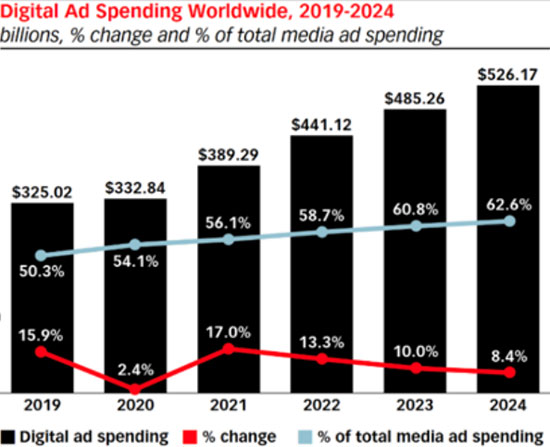
    Based on the various trend of digital media consumption among the internet users, the study predicts that by 2024, digital ad spending worldwide will become $526.17 billion and will account for 62.6% of the total media ad spending. The growth rate of digital ad spend will fall sharply during 2020, but will rise equally sharply in 2021. Over 2022 to 2024. The growth rate of digital ad spending is expected to fall gradually, but its share in the total media ad revenue will continue to grow year on year as shown in the chart below.


    Source: eMarketer


    In India, it will take many years before the digital ad spending crosses 50% of the total media ad spending. However, as shown  in the recently published M&E industry Report 20202 by KPMG, the trend of ad spending on digital and OTT crossing the ad spending on TV media, is expected to set in by FY 2022 (https://www.mxmindia.com/2020/10/the-great-churning-of-the-media-cauldron/).


    The third trend observed in the study indicates that the pandemic is probably hastening the decline of print media: “Print audiences aren’t shrinking everywhere, but print newspapers and magazines did register many of the most dramatic decreases in media engagement this year.” In India, traditional print industry seems to be in a buoyant and positive mood during the current festive season. Some large newspaper houses have also posted good growth during the third quarter of 2020. But, the Pitch Madison Advertising Midyear Review 2020 released in August, 2020 estimated a loss of 31% to 36% in print ad expenditure from 2019 to 2020 (https://www.mxmindia.com/2020/08/dramatic-changes-in-indian-ad-industry/).  Only time will tell if COVID 19  will hasten the process of decline of the print media in India.


  • No-brainer, but shape of things to come…


    By Indrani Sen


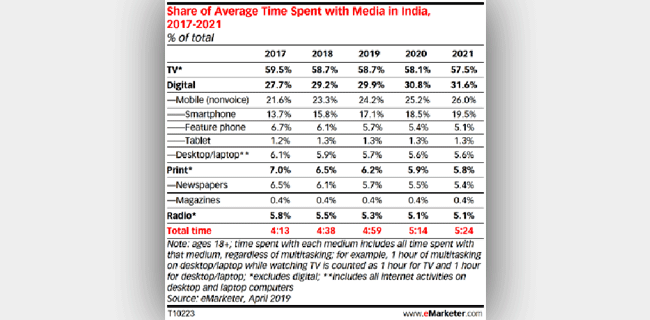
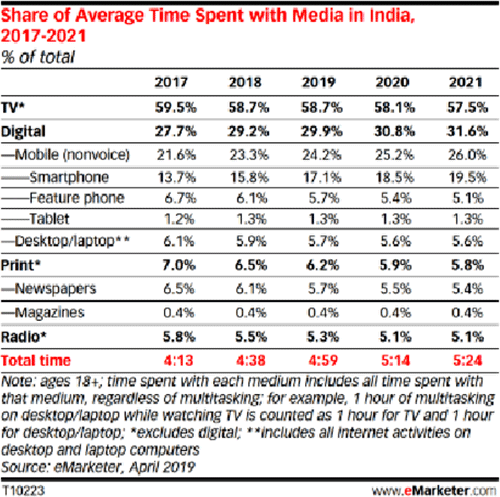
    Recently, eMarketer conduced a global survey of the time consumers in different countries spent on media consumption per day. Adult consumers in India will spend 70.1% (3 hours, 30 minutes) of their daily media time on traditional media and remaining 29.9%, or 1 hour and 29 minutes on digital media in 2019 (https://www.emarketer.com/content/india-time-spent-with-media-2019).


    A large part of the growth for time spent by Indian adults with digital comes from content consumption that takes place over the mobile internet. This trend will continue till 2021 based on availability of cheaper smartphones, a growing number of smartphone users and affordable data. It is estimated that in 2019, adults will spend 1 hour, 12 minutes online, and the majority of that time (76.5%) will be via mobile devices.

    In India, TV takes the largest share of total time spent at 58.7%, or 2 hours, 55 minutes. Digital is the second most popular medium with 1 hour, 29 minutes daily, a little under one-third of media time each day.


    In terms of ad expenditure, digital media is lagging behind their market share of daily media time spent. eMarketer forecast that digital and traditional will, respectively, account for 20.8% and 79.2% of media ad spending in India in 2019.


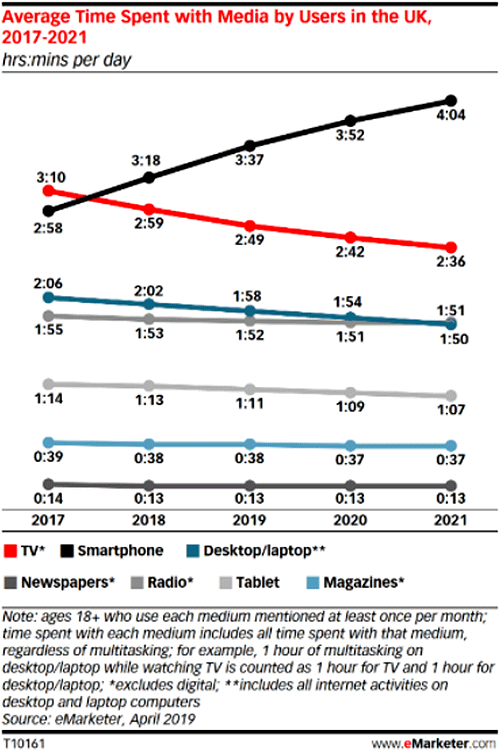
    As per the estimates of daily media time spent, the above table shows that by 2021 adult Indians will spent on an average 5 hours and 24 minutes on media consumption. There is head room for growth in the average media time, as adult consumers in many other countries spend 8 to 9 hours on daily media consumption. In some countries, consumers have reached the limit of their time spent on media and year on year there is hardly any growth. For example, consumers in the UK will spend 9 hours, 38 minutes with media in 2019, a 1-minute increase from last year. Similar to the rest of the world, time spent with mobile becomes a major driver of digital growth in UK as shown in the table below.


    We can expect in the long run, similar trends in daily time spent on media as reflected in the above table. According to the survey, time spent by consumers with digital and traditional media will continue to grow in tandem in India, but digital will grown at a faster rate from 2019 to 2021. However, it will take Indian consumers probably another decade or more before their average daily time spent on media can touch 8 to 9 hours as the growth of time spent on digital media will depend on spread of broadband across the country.


  • Worldwide ad growth buoyed by digital, mobile adoption

    By A Correspondent


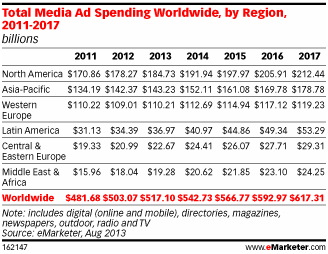
    Global ad spending will rise 2.8% to more than half a trillion dollars in 2013, driven by continued adoption of digital devices and internet connectivity, according to eMarketer’s latest Global Media Intelligence Report, produced in collaboration with Starcom MediaVest Group.


    Still, the global economy is in recovery mode, and while total media ad spending will be up this year, the rate of increase will not be particularly strong. eMarketer estimates ad expenditures will rise 2.8% worldwide to $517.10 billion, compared to last year’s 4.4% spending increase. There are no India-specific numbers with what has been shared with us.


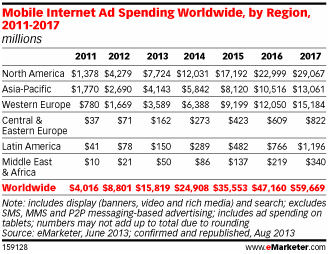
    Digital, however, is a bright spot-particularly mobile. eMarketer estimates spending on digital advertising will reach $117.60 billion this year, up 13.0% compared to 2012 levels, while mobile spending will hit nearly $15.82 billion, representing a whopping 79.7% year-over-year increase.


    Much of the spending growth stems from broader digital adoption on the part of consumers. The full report, which covers six major regions-including Asia-Pacific, Western Europe, Central and Eastern Europe, the Middle East and Africa, North America, and Latin America-and 40 countries, paints a picture of continued device adoption globally.


    Key figures on media usage and spending from the report include:

    :: Internet users: More than 36% of the global population today, compared to 21.7% in 2008

    :: Mobile phone users: 60.7% of the population this year, compared to 40.0% in 2008

    :: Smartphone users: Just under one-third of mobile users and about 20% of the global population, compared to 3.7% of mobile users and 1.5% of the population in 2008

    :: Social network users: About a quarter of the global population, compared to 8.3% in 2008

    :: Facebook users: More than 15% of the global population, compared to 3.1% in 2008

    :: Total ad spending: $517.10 billion in 2013, up 2.8% from last year, compared to $484.30 billion in 2008

    :: Digital ad spending: 22% of total ad spending in 2013, compared to 12% in 2008

    :: Mobile ad spending: Just 2.6% of total ad spending and 11.9% of digital ad spending, compared to 2.1% in 2008


    The Global Media Intelligence report is eMarketer’s largest and most comprehensive snapshot of the state of media usage and spending globally. The report contains more than 700 charts collected from over150 global research sources, which SMG helped identify and gather for local and core global markets, in addition to benchmarks, analysis and context provided by eMarketer.


  • GroupM selects Buddy Media as preferred social ad partner globally

    By A Correspondent


    Buddy Media, the social enterprise software for eight of the world’s top ten global advertisers, announced that GroupM has selected the company’s BuyBuddy social ad product as its preferred social ad management partner.


    “We are proud that GroupM has chosen Buddy Media as its preferred social ad partner,” said Michael Lazerow, CEO and Founder, Buddy Media. “Our self-serve social ad buying technology will make it easy for any GroupM agency to effectively scale and measure social spend for their clients.”


    GroupM will roll out Buddy Media’s BuyBuddy to all of its agencies, including Maxus, MEC, MediaCom, Mindshare, M80 and other business units. It will also begin training on how to maximize the benefits of Buddy Media’s unified social marketing software solution across paid, owned and earned media.


    “After extensive evaluation of the marketplace, GroupM is excited to deploy Buddy Media’s social ad software to all of our agencies,” said Rob Norman, CEO, GroupM Interaction Worldwide. “Social media success is of critical importance to our clients, and Buddy Media is the proven self-serve solution in market that has a focus on empowering agencies and being a true partner. We will continue to work with other partners but believe this consolidation will offer our clients and teams the opportunity to develop consistent high performance in a rapidly developing market.”


    GroupM invested $200 million in Facebook advertising in 2011. Social network ad revenues will grow to nearly $10 billion in 2013, up from to $5.54 billion in 2011, according to eMarketer.