
Tag: emarketer.com

  • Adspending globally degrows only 1.2% in 2020!


    By Indrani Sen


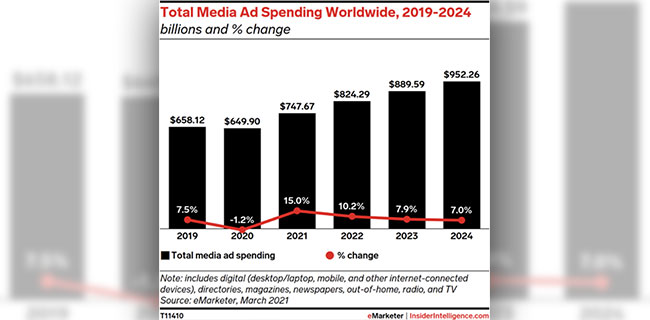
    Indrani SenLast week, I read an article “How the pandemic changed worldwide ad spending” by Etham Cramer-Flood on emarketer.com. The article compared the forecasts made by them with the revised estimates and spoke about their predictions for 2021. The reason I would like to share the highlights of that article here is due to the optimistic attitude reflected in their calculations. They pointed out that according to their analysis, the final figures for 2020 “outperformed dire mid-pandemic projections.” According to this article, the global adspending has a degrowth of only 1.2% in 2020 which is the lowest among all the various estimates seen till now. (https://www.emarketer.com/content/how-pandemic-changed-worldwide-ad-spending?ecid=NL1001)


    As shown in the above chart, after a contraction of 1.2% in 2020, the global ad pending is predicted to grow by 15.0% in 2021. Even traditional adspending will grow this year, by 7.6%.  The growth rate will come down to 10.2% in 2022 and subsequently over next two years will fall down to 7% in 2024 compared to 7.5% growth rate of 2019. By the end of 2024, ad spending worldwide is expected to be close to $1 trillion.


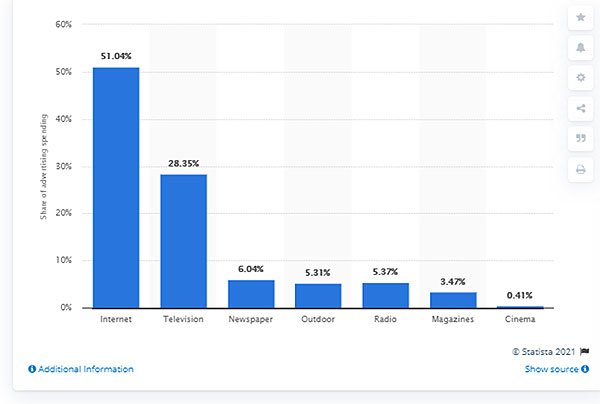
    All the various estimates on global advertising spending released so far agree that while the ad spending on traditional media suffered a huge degrowth, the overall situation was saved by growth of adspending on digital media with the share of digital advertising varying from one research to another. Traditional media were already in slow declining mode across various countries in the pre-pandemic years. The pandemic aggravated their degrowth. As the article does not have a chart showing the share of different medium in worldwide advertising spend. I have sourced one chart from www.statista.com with the medium-wise distribution of global advertising spend in 2020 which is shown below:


    Distribution of advertising spending worldwide in 2020 by medium
    Source: https://www.statista.com/statistics/376260/global-ad-spend-distribution-by-medium/


    The www.statista.com has estimated that in 2020, the shsre of digital advertising in the worldwide advertising has touched 51.%. The balance 49% is distributed among the traditional media with TV leading the pack with 28% share followed by newspapers 6%, outdoor 5%, radio 5%, magazines 4% and cineam 0.4%. The analysis of www.emarketer.com agrees that globally the share of digital advertising spend may touch 60% by end of 2021 and 70% by 2025.
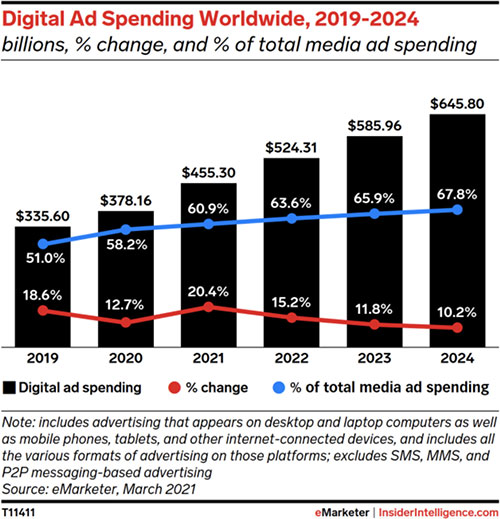


    The pandemic has surely accelerated the growth of digital media across the world in the middle of major economic disruptions.  We have also been surprised by the kind of resilient growth of digital advertising in India showed in 2020. However, it will take at least this decade before the share of digital advertising in India can have the highest share in the Indian advertising pie.

     

  • Three Key Media Trends Sweeping the Pandemic-hit World


    By Indrani Sen


    Over the last couple of months, we have seen many surveys which have looked at the current level of global and local media revenue and its recovery path over the next two to three years. Most of these surveys have highlighted the bright picture looming at the end of the tunnel. Last week, I came across a survey released by www.emarketer.com which has focussed on three key media trends sweeping the pandemic hit world, providing the advertising and media industry with deep insights.


    On October 23, 2020 eMarketer released Global Media Intelligence Report for 2020, produced in collaboration with Starcom and GlobalWebIndex covering 42 major markets in the world with a focus on internet users’ engagement with digital and traditional media.


    The first trend observed in the study indicates that ownership of PCs and tablets are declining in many countries including India. “Between H1 2019 and H1 2020, ownership of desktops, laptops, and/or tablets declined most sharply in developing markets, including Brazil, China, Egypt, and India—all countries where the focus has long been on mobile devices and services. But the same trend appeared to a lesser degree in several other countries too, including France, Russia, Sweden, and the US.” This trend indicates that smartphones are consolidating their position as the primary screen across the pandemic hit world both in the developed as well as in the developing countries among the internet users. (https://www.emarketer.com/content/3-key-trends-shaping-media-landscape-this-year?ecid=NL1009)


    We already know that in India mobile phones are playing a crucial role in spreading digital media communication with more and more mobile-first internet users coming to the market. This study shows that while there has been hardly any change in the ownership of smartphones from HI2019 to H12020 as it is already near saturation level, the time spend on the device has gone up marginally. “96.0% of internet users ages 16 to 64 owned a smartphone in H1 2020—a figure unchanged since H1 2019. In addition, one in 10 respondents had a feature phone. Time spent with mobile devices averaged 3 hours, 37 minutes (3:37) per day, 1 minute more than in 2019.” Compared to 2019 the ownership percentage of PCs and tablets have come down from 72% to 54.2%, showing a significant decline. Comparatively, ownership of tablets was less affected with only a drop from 24.5% to 22.3%. Time spent by Indians with their PCs and tablets declined sharply from by 45 minutes per day (https://www.emarketer.com/content/global-media-intelligence-2020-india).


    The second trend emphasises on digital video which continues to close its gap with broadcast TV.  In the western countries the share of internet users watching free or paid for digital video have already surpassed the share watching live TV or are almost equal to it. In India, it will take a longer time for a similar trend to set in, but the warning signs should not be ignored by the TV channels who have not yet invested in OTT business.


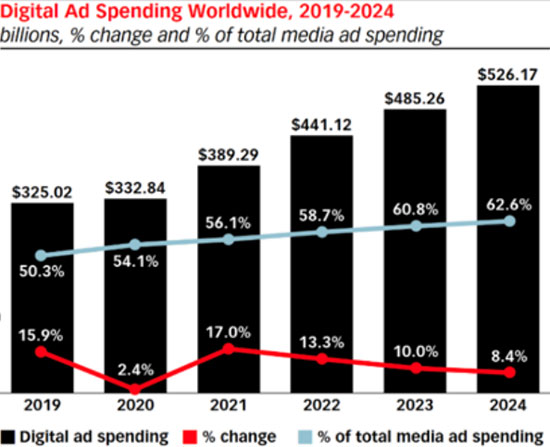
    Based on the various trend of digital media consumption among the internet users, the study predicts that by 2024, digital ad spending worldwide will become $526.17 billion and will account for 62.6% of the total media ad spending. The growth rate of digital ad spend will fall sharply during 2020, but will rise equally sharply in 2021. Over 2022 to 2024. The growth rate of digital ad spending is expected to fall gradually, but its share in the total media ad revenue will continue to grow year on year as shown in the chart below.


    Source: eMarketer


    In India, it will take many years before the digital ad spending crosses 50% of the total media ad spending. However, as shown  in the recently published M&E industry Report 20202 by KPMG, the trend of ad spending on digital and OTT crossing the ad spending on TV media, is expected to set in by FY 2022 (https://www.mxmindia.com/2020/10/the-great-churning-of-the-media-cauldron/).


    The third trend observed in the study indicates that the pandemic is probably hastening the decline of print media: “Print audiences aren’t shrinking everywhere, but print newspapers and magazines did register many of the most dramatic decreases in media engagement this year.” In India, traditional print industry seems to be in a buoyant and positive mood during the current festive season. Some large newspaper houses have also posted good growth during the third quarter of 2020. But, the Pitch Madison Advertising Midyear Review 2020 released in August, 2020 estimated a loss of 31% to 36% in print ad expenditure from 2019 to 2020 (https://www.mxmindia.com/2020/08/dramatic-changes-in-indian-ad-industry/).  Only time will tell if COVID 19  will hasten the process of decline of the print media in India.