
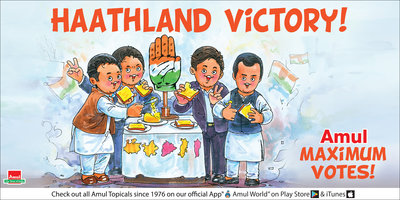
Celebrating the Election Season via Amul topical advertisements
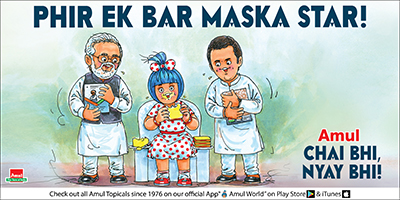
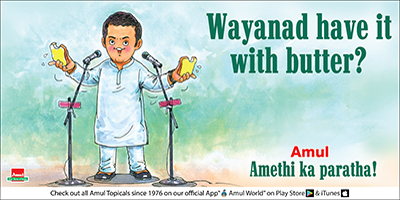


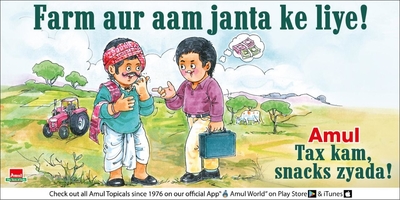

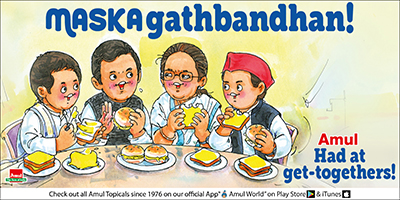
Celebrating the Election Season via Amul topical advertisements
By Shailesh Kapoor
 The elections are here! Sixty-two days from today, we will know the outcome, when the results are announced on May 23. And over these 62 days, we will see a political battle unfold across electronic, print and digital media. A battle bigger than anything we have seen before in Indian politics.
General absence of class and dignity in this political face-off is expected. The standards have dropped over the last decade, and one can expect more degeneration over the next two months. When both sides are willing to lower their standards all the time, the new low can be a really low one.
In such a scenario, it’s the media that could potentially play a pivotal role. That of being the sane voice of fact and truth, and bringing a sense of calm and balance in the political cacophony that will go on uninterrupted for more than two months. But practically speaking, there is little chance of that happening.
The media is politically polarised more than ever before, and there’s a general feeling, especially in the electronic media, that unless you are at one end of the spectrum, you will not be a popular option for your target audience. Whether that’s true or not is a matter of some deep and layered analysis. But for now, that’s the perception with which all news channels, and most newspapers and digital platforms, begin their respective ‘campaigns’, leading towards May 23, 2019.
I’ve always found the behind-the-scenes coverage of elections more interesting than the in-the-face variety. Speeches, rallies and one-liners are for everyone to see and interpret. It’s the strategy that goes into aspects like seat allocation, alliances, political messages, media plans etc. that is rarely covered in any depth. And this is where the fascinating stories often are.
Good election coverage is not about reporting speeches and debating them with a politically-polarised panel. Good election coverage is not about being the fastest on the results day either. Good election coverage is about providing an insight into how political parties approach elections and the key decisions they take during this period. More of this is what I’d wish for in the next 62 days.
On a different note, a new season of IPL starts tomorrow. Unlike the previous election years (2009 and 2014), when IPL had to be shifted outside India (to South Africa and UAE respectively) in part or whole, there has been no such talk this time. The season that kicks off tomorrow is important for its pre-World Cup timing. On the media front, we can expect digital consumption to grow further, to make IPL 2019 the most-watched digital content in India’s history by a comfortable margin.
Digital media has already warmed up to IPL 2019. Earlier this month, Netflix launched Cricket Fever: Mumbai Indians, a fascinating behind-the-scenes view of the Mumbai franchise from the 2018 season. And then, earlier this week, Hotstar launched Roar Of The Lion, a documentary series based on the journey of Chennai Super Kings in the season following the two-year ban on the franchise.
With these two series (which are worth a review here in the coming week or two), IPL has found great content extensions beyond actual live cricket. One hopes to see more such interesting content roll out in the coming years. Because cricket, for the immense popularity it enjoys in India, has been a grossly under-leveraged sport when it comes to mainstream entertainment content.
But that can wait a few weeks. For now, let the games begin. Of the political and the sporting kinds.
By Ranjona Banerji
If this general election is indeed a watershed moment for Indian polity then it is no less a groundbreaker for the Indian media. Television has dominated this election practically setting agendas and leading the battle from the frontlines when it comes to chosen candidates and parties. The battle is won by the trivial and the telegenic. The smaller India grows in terms of communication thanks to telephony and technology, the larger the disconnect from reality: or so it appears.
If the media is going to play such a significant role from here on, then the elements within the media must come out and identify themselves by their ideological and philosophical bearings. The old argument used by journals that they are all things to all people cannot stand any longer. It is in many cases patently untrue. Further, it has reached a stage where you are taking readers for a ride.
Television has no such argument at all and instead has created an atmosphere of rumours, allegations and gossip to thrive. Even within the media fraternity, there is a constant stream of stories about which channel has been sold to which political party or who favours which candidate. Some parties are barely being mentioned when it is evident that they will have some bearing on these elections. Thrown a few corporate houses into the mix and you have a great Indian muddle which barely resembles a delicious homemade khichdi.
Who has financed all these opinion polls to project election results for instance? What is the consumer of news to make of them when ground reports from journalists are at odds with those surveys? In a two-month long voting schedule, a constant stream of opinion polls amounts in fact to trying to influence those who have not yet voted, even if the Election Commission has not cottoned on to it yet. The figures for conducting these polls which are going round the grapevine are astronomical.
It is time therefore for all newspapers, news channels and websites to declare their political leanings. There is no shame in this. All over the world, the reader and viewer knows what their chosen media outlet stands for. This is not just about individual columnists to declare their leanings. This is about the organisation itself. Given the growth of the influence of the media – and these are strong words – to fool your consumer any more is tantamount to fraud.
It is evident that it is not just a nudge from one corporate house and a wink from another that dictates media flow. We have seen epic and sudden changes of direction from left to right to centre and back. What most newspapers do to cover this up is provide a variety of columnists on their opinion pages to portray first one point of view and then another to prove that they are “neutral”. It no longer cuts it.
TV of course is another jungle with its own rules, quite distinct in some cases from print. Editorialising and on the spot opinion-making is now par for the course. As a very senior editor who has a career in both print and television pointed out to me, if a star anchor, who is also the editor, asks a young reporter on live television, “Isn’t the political rally proving what I say?”, what is the young reporter to do? Disagreeing with the boss is not an option. And so news is created, not reported.
For a long time in India, journalists were more left of centre than right but that was not an absolute truth. For instance Girilal Jain, a colossus in the Times of India was distinctly right of centre and the Indian Express was distinctly anti-establishment in the days when the only establishment was Congress.
One must distinguish between the need for media outlets to declare their politics and the accusations and muck thrown at individuals on social media. Gutter language and threats will continue. But now the target will be clear and much larger. And in the interests of fairness, everyone will have a target!

When Facebook gently proclaimed that it now had touched the magical one billion users figure, most of us just dismissed it as a milestone. But it’s an accomplishment that cannot be ignored by not just individual users – but also marketers, sociologists, governments and all those who need to reach out to the masses.
We asked Sanjay Mehta, Joint CEO, Social Wavelength some very fundamental questions on this achievement including whether there is any reason to fear the platform being abused of destabilizing nations.
1 Would it be right to say that a good reason for the Facebook users reaching 1 billion would be thanks to the growth in recent years in India?
LOL… no. We cannot take too much credit considering the Indian userbase, at this time, being a nominal 50 mn in FB’s total of 1 bn. So while the Indian user base has contributed to the overall numbers, it has been a nominal percentage.
Would you say that Facebook is the single biggest marketing development of the 2000s?
Well, I would say Social Media is the single-biggest marketing development. And Facebook is a key player in that social media space. Also though, I would also not claim this to be the greatest development of 2000s. That is a long period, and we have had other key developments including search engine advertising, which have been impactful. But in the last 2-3 years, it has been a clear emergence of social media as a marketing platform, and Facebook is its most significant component!
With one billion users, Facebook users constitute the single largest community of individuals after China and India? Do you think it’s right for it to be seen like that?
Well, yes, sure. So let’s take that analogy ahead. What does a single group – be it citizens or China or India, or registered users of Facebook – mean? That they do share some characteristics (citizenship in case of countries, Facebook in the latter case), but there are enough differences amongst them too. All citizens are not the same kind of people, nor are all registered users of Facebook. Likewise, there is no easy way for a marketer to reach “all Indian citizens” (wouldn’t THAT be a dream?!), and so also, there is no easy way to reach the billion Facebook users.
Except perhaps, for the governments and for Facebook!! But the citizens and Facebook users do constitute a ‘group of sorts’ and there are opportunities built in there, for marketers.
2 Do you think marketing in the present day can be done without a Facebook strategy in the media plan?
All marketing plans may not need Facebook. So there IS a possibility for a few marketing campaigns to not include Facebook However, Facebook is making constant changes to become interesting for more and more brands and perhaps over time, most campaigns will have a Facebook extension! Or a Facebook core!
But is there a lot of abuse of Facebook – fake likes, fictitious users and various strategies adopted to alter perception by marketers. Is there reason for skepticism when people refer to success thanks to ‘Facebook marketing’?
The scepticism is with a few people only, and it is also misplaced. The number of fake accounts or fake likes is a small percentage again, and the matter has been exaggerated. There is also an extent of click fraud in Google ads. But due to good algorithms, this is controlled to a small level. Same is the case with fake profiles and fake likes. It is a small percentage. Facebook does not like these. Recently it identified about 80+ mn fake accounts and went about deleting those.
Can Twitter be put in the same basket as Facebook for marketers?
Well, it depends on what you’d call the basket. So yes, it is also part of the social media space, and in a sense, the marketer will reach the social media active user, via Facebook or Twitter. But within that framework, there is a difference between the two platforms. Not just that, within Facebook or Twitter usage also, there are different patterns of usage and user profiles. So marketers cannot just “go to Facebook or Twitter”. There is a further science in terms of what they want to achieve, whom they want to reach, etc., and based on which campaigns are planned and executed.
3 Just as Orkut was a rage once upon a time and faded out eventually, do you think Facebook could see the same eventuality soon? What do you think is the next big idea?
If I have learned something in the last 10-15 years observing the tech space, it is that, ‘nothing is permanent’ or ‘no platform / brand / service remains on the top for very long’. Facebook could be the exception to this rule, or it could also fall out of favor in sometime.
However, at the present moment, stock price apart, Facebook is extremely well-entrenched as a powerful leader in the space.
If something or someone can displace it from its position, I do not have the crystal ball to gaze into and tell you, what that may be! It could be a platform that is currently present and becomes larger, or it could be something that is being developed in some garage or lab in some part of Silicon Valley or Israel or even Mumbai or Bangalore!
Let’s keep watching the space and discover when it happens!!
4 Do you see social media like Facebook being used by politicians to influence public opinion?
Absolutely! Politicians are also brands that need to be sold, no disrespect meant here! So like any other brand that uses the medium to influence its target market, a politician also needs to do the same, for their communication messaging.
Whether social media will impact an election result or not, just yet, it hard to say. But it will definitely influence few votes!
5 Can there ever be a fear of Facebook being misused to destabilize countries… just as there is a fear of various media vehicles?
We live in interesting times. Many of us are logged into our Gmail accounts all day. There is a decent amount of our web behavior that Google knows about.
We use applications like Whatspp or Truecaller, and we share our contact lists with these applications. And a lot of us do so, and the applications then, know a lot of our cross connections and relationships. Likewise we use Facebook, where we share our relationships, we talk about our vacations, put our photos and videos, and let people know our political preferences or movies that we like.
There is truly a lot of information about us, out there. And this is with a variety of sources, whom we consciously trust, or sometimes do not realize, but end up giving our trust! Just as data stored and flowing through electronic pipes is always susceptible to leaks like Wikileaks, so also our personal data is always susceptible to being abused. Either by means of hackers exploiting some holes, or worse, if the sources that we trust, turn rogue!
We live in hope that these guys don’t turn rogue, and there is no major abuse of our privacy. Each morning, along with the prayers for your health, wealth and prosperity, you must also pray that Google, Facebook, Whatsapp and other such applications do not turn rogue ever!!
 By Anil Thakraney
Very recently, a publisher friend called to seek advice. And his question threw me off-balance. Because not only was the query alarming, I frankly had no ready answers. So I copped out, and left it all to his judgment. The question: “A few assembly election candidates have approached us, asking for favourable coverage. They are offering large sums of money in return. What should I do?”
Since I knew that this particular friend was bleeding and needed some funding desperately, I simply replied with: “Man, it’s really up to you. If you are here to uphold the high standards of journalism, ask them to go fly a kite. But if you rationalize the situation in your mind, and conclude that if you refuse the offer and your rivals would lap it up, then you will be the only loser. In which case, go for it!”
Quite honestly, I have no idea what the publisher eventually did. But speaking from a larger perspective, it’s becoming increasingly clear that paid news is here, and it’s here to stay. There was a time when elections would excite only the political class, as that would mean big moolah gains for the winners. These days, along with them, a section of the media feels ecstatic. For the same reasons.
Corruption in the media isn’t really new. In the past, some journalists would accept alarm clocks and booze bottles from financial companies, and then write sweet words about their public issues. Now, of course, you can get your private party pics flashed in the Page 3 pages if you are ready to pick up the tab. We’ve learnt to live with these malpractices. But newspapers, magazines and TV channels accepting money to write good things about political candidates changes the goal posts. It’s clearly harmful to the nation’s future.
So is there a way out of this mess? I am afraid not. During the 2009 general elections, a few cheating media brands got exposed. Maybe we’ll hear of more culprits after the recent assembly elections in some parts ofIndia. But soon everything will be forgotten. And it will be business as usual.
| [youtube width=”400″Â height=”200″]http://www.youtube.com/watch?v=jjYxE2VD7VE[/youtube] |
Yes, it pays to be in the media biz in modern times. If you won’t get support from advertisers, you can always tap into alternative revenue sources.
Jai Hind!
* * *
PS: The context of the Fiat 500 Abarth ad is different, but this commercial is the kind of stuff Tata Nano ought to have done. A car you can take inside your home. Super positioning for a little gaadi. So much better than pitching it as the broke bugger’s vehicle.