Tag: Ekta Kapoor

  • Sunil Lulla is Chairman of Ashwani Singla’s Astrum

    By Our Staff

    Sunil Lulla
    Sunil Lulla

    On his first day as CEO of MTV India, he walked in with colour on his finger nails. Each one different, and bright. A former friend once told this writer that he wanted to buy the man some printed socks from Kuala Lumpur, given the man’s love for all things stylish. At the press conference for an entertainment channel – yes, a real one – that didn’t quite take off, he stood up the podium with the hair on the back of his painted red.

    And now Sunil Lulla is all set to add colour and style to Astrum, a PR and advocacy firm based in New Delhi NCR. Better known as its founder and Managing Partner Ashwani Singla’s agency, Astrum fashions itself as “India’s first science-based specialist Reputation Management advisory”. We don’t know that what means, but Astrum sure has had a fair good set of clients over the years.

    Ashwani Singla
    Ashwani Singla

    Lulla, a communique said, will play a vital role in strengthening Astrum’s capability as a trusted advisor to the C Suite and adding fuel to its growth engine. Said Singla: “For over two decades that I have known and worked with Sunil, I have admired how he combines strategic clarity with execution excellence to achieve extraordinary outcomes. Our clients and colleagues will benefit from his sage counsel and proven acumen.”

    “The impact of reputation, risk and regulation on business is a major pre-occupation of the C Suite and more so today; I am delighted to be a part of a team that has an enviable track record of helping CXOs successfully negotiate this landscape,” added Lulla.

    Lulla should know, having spent a lifetime in the media ecosystem. Eons at Wunderman Thompson’s earlier avatar of JWT, MTV (where he effected a turnaround), Sony Entertainment Television (not yet Sony-Zee), Times Network (yes, with Arnab Goswami), Indya.com (remember the Sunday Times of India roadblock?) for Pradeep Kar’s Microland, HMV (now SaReGaMa), Grey, Balaji Telefilms (yes, with Ekta Kapoor) and television audience measurement body BARC India, where he was tasked by the Board to undertake some cleansing operations.

    The role doesn’t appear to be a full-time one, and will be in addition to a slew of other projects Lulla is involved in as part of his firm Linus Adventures. Linus, btw, is Sunil spelt ulta.

    Lulla is an active runner (yes, a marathoner), loves swimming, working out in the gym, enjoys his movies, music and books, and if you are on his friend’s list, perhaps the first to greet you on your Big Days. And, yes, he is also good in mixology. 

    We don’t know how he is with mixing liquids. But the number of engagements and bosses he’s worked surely indicates he can mix things well. And Astrum is, as the communique claims, a “science-based” firm. 

    There is some history to the chemistry between Lulla and Singla (they known each and worked with each other for over two decades). Science, mixology… fireworks?!

  • No gandi baat! Pitchfork partners ALTBalaji for PR

    By Our Staff


    Guess we know the kind of content some of the folks at Pitchfork Partners have been consuming in the recent past. Given their new client, ALTBalaji which has some really edgy software. The Ekta Kapoor company has appointed Pitchfork Partners as its communications partner. It will strengthen reputation for ALTBalaji through multi-channel outreach to increase awareness about the platform, its shows and widen the viewer base.


    Said Divya Dixit, Senior Vice-President & Head Marketing, ALTBalaji: “Alternative content being the core ethos of the group, ALTBalaji is focused on building a content bouquet that serves inclusive and individualistic viewing. We are delighted to have Pitchfork on board to support us in our journey and take the platform to the next level.”


    Added Jaideep Shergill, Co-Founder, Pitchfork Partners: “We’re thrilled to partner with ALTBalaji. Our diverse experience with entertainment clients will facilitate us achieving milestones together. OTT is an ever-evolving, dynamic space and increasingly so due to the pandemic, ALTBalaji is disrupting the space by introducing content which caters to mass viewers.”


  • MTV acquires broadcast rights for Box Cricket League

    By A Correspondent


    Youth channel MTV and Box Cricket League come together to offer a mix of cricket and entertainment in typical MTV style.


    MTV will join hands with Balaji Telefilms and Marinating Films to the celebrity cricket matches with the over 200 television celebrities starting February 13, 2018.


    Commenting on the association with Balaji Telefilms Limited, Raj Nayak, COO, Viacom18 said: “We all know about young India’s obsession with cricket! With MTV Box Cricket League, we will be taking the nation’s obsession with cricket and entertainment a notch higher by ensuring we give the youth of India what it wants – celebrities and cricket – on a channel they love the most – MTV. Not only is the MTV Box Cricket League a fun concept but also an opportunity for viewers to see their favourite stars in a new avatar and engage with brand MTV in a whole new manner. It’s going to be extremely exciting to see the league unfold on screen for both, us and the viewers.”


    Added Ferzad Palia, Head – Youth, Music and English Entertainment, Viacom18: “MTV is a brand that knows the pulse of the youth like no one else does and cricket being a sport which fascinates a lot of youngsters, we knew this would be a perfect association for us. When Prime Time stars take on their new role on the cricket pitch, we’re positive young India is going to sit up and not only take notice but follow each match in the league with keen interest. The stellar line up of celebrities will definitely make MTV Box Cricket League all the more engaging for our young viewers.”


    On partnering with MTV, Ekta Kapoor – JMD, Balaji Telefilms, said: “MTV BCL 2018 is a reboot that’s set to excite and entertain viewers across the television and digital medium. With a prime time slot on India’s top youth channel, MTV BCL is poised to take the audiences on a dramatic sport extravaganza. Add to this the top male and female faces of indian television and the landscape is unlike any other. Audiences today are ready for clutter breaking content and this is a step in that direction.”


  • ‘Chandrakanta’ to replace ‘Naagin 2’ on Colors

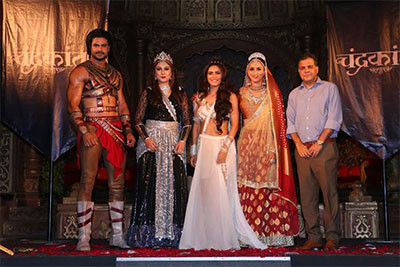
    Starting June 24, Chandrakanta will replace Naagin 2 on Colors


    General entertainment channel Colors has announced that Chandrakanta will replace Naagin 2 wef June 24. The show will air on Saturdays and Sundays at 8pm, and will also be produced by Ekta Kapoor’s Balaji Telefilms. Chandrakanta  showcases a power struggle between two rival Aiyaar kingdoms, Vijaygarh and Suryagarh, and is laden with myths, legends and magic.


    Commenting on the launch of the show, Raj Nayak, COO – Viacom 18 said:  “For two back-to-back seasons Naagin has enjoyed the status of being a favourite of the viewers. It’s their confidence in our content that has allowed us to explore this genre further. The recent success of costume dramas and fantasy offerings not only on television but also in films is a testimony that our viewers have evolved, and is willing to explore different narratives. We are thrilled to collaborate with Ekta Kapoor’s creative intellect yet again to showcase a unique rendition of a story which, though has been narrated before, leaves a lot of scope for creating a cohesive viewing experience.”


    Speaking about the new fiction offering, Manisha Sharma, Programming Head – Colors said, “As a channel, we are committed to bringing viewers a variety of entertainment – be it Naagin, now Chandrakanta or the upcoming Mahakaali that makes for edgy yet pacier story telling as compared to the daily fiction dramas. The success of Naagin tells us that viewers still have a huge appetite for this genre and with Chandrakanta, we are scaling up every aspect of the show and making it as spectacular and thrilling as ever. True to the ethos of the channel that offers differentiated content, be it weekdays or on the weekend – we hope that this enchanting story will be enjoyed by the audiences as much as Naagin was.”


    Said  Kapoor in a statement: “Chandrakanta is a very special show for us and it has very big shoes to fill. That said, we were filled with excitement over the prospect of creating this show. The plot is gritty, complex, passionate and is laced with top class VFX which will transport the viewers into alternate reality. We hope that Naagin’s ardent viewers and voracious fantasy-fiction aficionados enjoy watching Chandrakanta and support this mammoth venture.”


    To promote Chandrakanta an integrated 360-degree marketing campaign will be unveiled.


  • Of the Paper Tigress & Soap Queen


    By Alam Srinivas


    From Shobhana Bhartia: Paper Tigress

    “What did she learn at the Post? One of the most important learnings was that the look and feel of a newspaper matters a lot. These issues were almost irrelevant in India during the 1980s.


    ‘In those days, newspaper was a messy affair, and the black ink used to come off from the newsprint; one would have black hands by the time one had finished reading the paper. There were many manual interventions. Like the fact that column galleys had to be physically pasted before being printed. Sometimes, the galleys would be crooked, but no one would bother; the common reaction was “aaj thoda teda ho gaya and it would okay the next day”.’


    More than a woman…


    Any attempt to dig into the professional and the more challenging personal lives of celebrities takes quite some doing. And if the subject happens to be a woman – and an influential one at that – the task becomes that much more daunting.


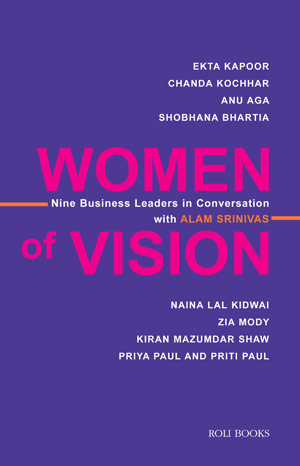
    With Women of Vision, author Alam Srinivas, who is a freelance journalist with over 25 years of experience, has managed to get up close and personal with nine of the most influential women business leaders, who have laid bare their personal and professional lives like never before. As Mr Srinivas says, “I was pretty surprised that each of the women leaders whom I met was so candid and transparent about any or every aspect of their lives.”


    In conversation with Johnson Napier of MxMIndia, Alam Srinivas tells of how in a face-to-face interview, each icon shares her journey of how she battled male-dominated hierarchies to shatter the glass ceiling and set up successful business empires through grit, determination, hard work and merit.


    How did the thought of profiling women business achievers come about?

    There were a few things that went into the whole process of putting together this book. Although there have been books on successful women in India they have been more inclined towards celebrities or people from art & culture, and have included some women from the business arena. But I cannot think of any book that has only focused on women business leaders. So that was one gap that we identified and which we thought ought to be fulfilled. Also if you observe the last twenty years, post-economic reforms a lot of women have done very well not just as entrepreneurs or business women but as business leaders, managers, CEOs…In fact there are enough Indian women leaders who’ve made a mark around the world as well. So there was a need to do such kind of a book and also the time was appropriate to do such a venture because there were enough people to talk to and also enough people who were aspiring to become managers, leaders, CEOs etc.


    Women, especially from the business sphere, have been a source of inspiration for authors to often chronicle and talk about. Right?

    When you talk about successful business women they are not just women who have inherited their family’s wealth or business, there were also women who were first generation entrepreneurs, there were women who have successfully become managers, CEOs, etc. So there was this whole spectrum of women who were doing well and in different ways. Even when you look at their SEC profiles they come from different backgrounds. There are some who hail from middle class families, there are some who come from well-to-do but not rich families, there were people who come from business families…yet again there was this whole spectrum of women who were doing well so I thought one needs to capture all this in a book format. Also the publishers had this idea of doing a book around business women and that’s how it all started.


    Was it a conscious decision to profile just nine women from across diverse fields? There have been quite a few influential names that have been missed out…

    I had made a list of about 40 women from across different age groups and sectors. But as I started going through the research work I realised that a book on 40 people would become very unwieldy, and also a lot of stories and issues were similar so that kind of made it seem repetitive. It’s then that I decided to narrow down to just ten women who encompassed every shade and contour that I need to put on paper. If you look at the current list, there are women from North, South, East and West. Also, in terms of age range, there is a person who is 30 years old and there is someone who is a grandmother. As I said, in terms of SEC there are people who are managers, first generation entrepreneurs, etc. So we had to capture all kinds of nuances and also not become too repetitive. If you read the articles in this book, they are not biographical in nature but rather consist of sketches of these people. So it was not the numbers game but trying to capture the whole idea.


    One is surprised to see the vast access you’ve managed to gain into the lives of each of the subjects. What was it that made them open up and get as candid with you about their personal and professional doings?

    I was pretty surprised that each of the people I met was so candid and transparent and open about any or every aspect of their lives. Like, for example, Ekta Kapoor, who says that there was a phase in her life where she was arrogant but that she is trying to change and be a better person. Similarly with Chanda Kochhar, it was her initiative to take ICICI into Retail Loans which kind of backfired as the global economy went down. So there are multiple such candid moments that have been shared by these women leaders. I am not sure if this has been the case before. Maybe women leaders are more sensitised to their surroundings etc…I was pretty surprised by the response that I got from each of them where they allowed me to get deep into their personal and professional lives.


    What has been the initial response that you’ve been receiving for your book?

    It’s too early to talk about the reception that my book has been receiving from all quarters but the initial reactions are that of surprise for the fact that they have allowed access inside their world so intimately and passionately. That’s been the general reaction as of now.
     

    Shobhana was amazed to find out that the Western media had given up manual technology years ago, and had embraced state-of-the-art systems and software.


    Another critical lesson was the manner in which a global media organization looked at the readers. It studied and figured who its readers were and targeted them. There was a synergy between the readers, the product and the platform that a newspaper provided for its customers.


    ‘This was something we would not think of in the 1980s. None of these insights went into our decision-making process. In addition, most of the Indian newspapers had little competition and were on their own trajectory. Even the Indian consumer never thought of the newspaper as a product. For her, it was more of a habit; she would wake up in the morning and carry the paper as a companion.’


    But, over the next decade or so, the Indian media changed. Along with technology and the rise of the middle class came the concepts of consumer satisfaction and choice. The consumer demanded certain things from her paper, which had to change.”


    From Ekta Kapoor: Queen of Soaps

    “Ekta was 20, and she was willing to slug it out. It took almost 5-6 years for her, and Balaji Telefilms, to break the TV barrier. Hum Paanch ran for five years on Zee; subsequent serials like Itihaas on DD and Kudumbum (Tamil) on Sun TV became huge hits.


    Part luck and part vision helped Ekta achieve initial success. Her entry into Hindi and regional serials coincided with the ongoing boom in cable television and private broadcasting. As the stranglehold of DD waned, a huge viewership was awaiting the launch of new serials, and Ekta was there at the right time to whet their appetite.


    Throughout the second half of the 1990s, while other production houses and broadcasters focused on Western-style soaps, mostly as copies (as even Ekta did with Hum Paanch), Balaji went a step further. Its research showed that the viewership of Hindi fiction-based soaps was 60 per cent, which appealed to a large number of women across regions and languages.


    ‘We were stable only by 2000,’ Ekta said. Her mother added that they continued to keep a strict control on expenditure, and worked out of a basement since the channel’s budgets for shows were low and the margins for the production houses were meagre. ‘We could not afford expensive office space in Mumbai; it was only after our IPO [Initial Public Offering in late 2000] that we moved into this plush office and did well in the TV entertainment business.’


    By 2000, Ekta had arrived. Balaji Telefilms launched seven shows in that year. The next year saw another 3-4 serials. All of them were lapped up by the audience.”


    *****


    “Ekta’s splash in the past two years has been in her achievements in Bollywood. In March 2010 came Love, Sex and Dhoka, followed by Once Upon a Time in Mumbai, and culminated in other hits like Ragini MMS. The final dhamaka came in the form of The Dirty Picture. The string of such films proved that Ekta had acquired a new creative edge, and there was a radical shift in her content strategy. For one, most of these movies were low budget ones. While some had well-known stars like Ajay Devgn and Vidya Balan, who won her first National Award for The Dirty Picture, the production and editing expenses were kept low. Many films had lesser-known actors.


    Two, they were made with a specific audience in mind. Ekta had long realized, in 2008, that the viewers had changed and were fragmented. In urban towns they were younger, urban, mostly liberal, ambitious, aggressive and confident about finding their feet in this dog-eat-dog world. Among them, the more affluent ones went to malls and PVRs to watch movies. Almost all the movies she produced in the 2010-12 period fell under the genre of the so-called PVR movies.


    More importantly, Ekta’s characters changed dramatically. While the K-serials portrayed women as conservative and traditional, those in LSD and The Dirty Picture were in-your-face individuals, who were willing to experiment with life and shed their conservatism. They were women of the 21st century, who rubbed shoulders with men and many times stood above them. They knew their minds and bodies, and they knew what they had to do and why.


    Women of Vision: Nine Business Leaders in Conversation with Alam Srinivas

    Excerpted with permission of the publisher, Roli Books

    Price Rs 140, 128 pages


  • Bhaskar digital biz nets 200 mn page views

    By A Correspondent


    The Dainik Bhaskar digital business has achieved 200 million page views (PVs) and to commemorate their success, the group had noted filmmaker Ekta Kapoor visit their Noida office and participate in the cake-cutting ceremony with Pawan Agarwal, Director and Promoter, Dainik Bhaskar Group, Gyan Gupta, CEO, Dainik Bhaskar Digital Business, Harrish M Bhatia, CEO, My FM and employees.


    Highly impressed with the wide digital reach of the Dainik Bhaskar digital business, Ms Kapoor said, “This achievement speaks volume of the interest people take in their content and how successfully they have catered to the varying demands of the readers.”


    With the number of people accessing their websites – Dainik Bhaskar (www.dainikbhaskar.com), Divya Bhaskar (www.divyabhaskar.com), Daily Bhaskar (www.dailybhaskar.com) and Divya Marathi  (www.divyamarathi.com) -  increasing by the day, it is obvious that their readers not only relate to their news and articles, but also find these interactive and engaging.


    The local language websites have found a connect with the viewers. While Dainik Bhaskar has achieved 136 million page views, Divya Bhaskar has 61 million to its credit, explaining the impact local languages leave on the minds of the readers.


    Since the websites’ highest traffic is generated from their cardinal sections such as local news section, e-paper, entertainment, sports, business and stories flashed on flicker, all websites are designed keeping in mind viewers’ interests.


    Considering the interesting blend of articles, news items, movie reviews, videos and audio links, which all websites offer, there is something substantial for everyone!  In addition to presenting the news of national and international significance in a rational way, it is planned in a way which is simple, enlightening and attention-grabbing!


    Commenting on the group’s accomplishment, Mr Gupta said: “We have been making constant endeavours to give our readers what they want, beyond news. Our huge growth is an endorsement of the fact that our readers are right.”


  • @FF12: Day 3: Industry expects thoughts to lead to pertinent actions

    By A Correspondent


    The last day of FICCI Frames 2012 was an eventful day — insightful sessions, a lot of networking, sharing of ideas, deals being cracked — and amongst all of this, the highlight was the session on Women in Media and Entertainment.


    The day started off with a keynote presentation by Ashok Chawla, Chairman, Competition Commission of India (CCI). He said that the media and entertainment (M&E) industry was one of the fastest growing sectors inIndiawith an expected CAGR of 14-15 per cent. He then proceeded to outline the role of the CCI and its importance: “CCI is an overall market regulator whose objective is to ensure that market forces operate with transparency and fair play. It has been put in place to identify the boundaries of behaviour of the industry.


    Mr Chawla opined that self-regulation was of prime importance to avoid infringement of law or market practices and cautioned industry players that consumers should be given primary importance.


    Taking on the Digital threat

    The next session was on “Sustaining Long-term Newspaper Loyalty” by two biggies — N Ram, former Editor-in-Chief, The Hindu and Girish Agarwal, Director, Dainik Bhaskar Group, who shared their views on the future prospects of the newspaper industry.


    Mr N Ram started off his speech by stating that there was ‘anxiety and gloom’ over the fact that journalism was seeing a meltdown in the mature markets. He outlined two media world phenomenon next, where the less developed countries are witnessing increase in circulation of newspapers unlike the mature market. But he added a word of caution when he said that TV, even in the developing world, is going through a crisis which it has so far covered by showing entertainment as part of news. Inspite of this, Mr Ram was optimistic that the medium term prospects for the media industry are looking good.


    As is been spoken widely about, the key factor for the decline in the newspaper is the increasing popularity of the digital media. Mr Ram called this the Digital Age Paradox and added that in recent times the newspapers have seen an increase in the readership of their online editions but have witnessed a “double squeeze” on their revenue, as they have had to subsidise digital journalism, which in turn is cannibalising their circulation.


    On how to sustain loyal readers, he tipped, “Stick to the basic principles of journalism – they can build a relationship with the readers, which it can rent out to the advertisers. And most important – “newspapering” should not be reduced to consumer marketing of news.”


    Mr Girish Agarwal took the stage next. Contrary to Mr Ram’s belief, he said that Indian newspapers are growing in their circulation and readership. He spoke about the need to engage the ‘consumer’ by asking “How relevant are we (newspapers) to the reader?”


    He opined that a newspaper cannot rest on its past glory but should move ahead by acknowledging and understanding what the consumer wants and giving him what they think he needs. On how to keep pace with changing times, Mr Agarwal said that newspapers should have global vision and hyper local content.


    After the speeches the floor was opened to the audience who questioned Mr Ram and Mr Agarwal about threat perception of the culture of medianet and media houses being bought over by MNCs. Mr Ram denounced paid news as a rogue practice which has been rubbished by the Press Council. Mr Agarwal said that ethically media should report anything that may be perceived as defaming by the parent company but the ground reality is not always so rosy.


    Women to the fore

    A big highlight of Day 3 was a session titled   ‘Women in Media & Entertainment circa 2012: Leading from the front’.

    The panel members of this session were Vidya Balan, Actor; Anurradha Prasad, Managing Director, BAG Films; Jeni Tosi, CEO, Film Victoria; Ekta Kapoor, Creative Director, Balaji Telefilms; Barkha Dutt, Group Managing Editor, NDTV; and Usha Uthup, Singer. The session was moderated by Rajeev Masand, Entertainment Editor, CNN-IBN.


    This session discussed the journey of each of the above eminent women personalities and the challenges they faced during their journey. As the moderator, Rajeev Masand put it: “Traditional media, for long, was dominated by men, but not any longer. It’s become outdated.”


    All the eminent women personalities claimed that despite all their challenges they had an incredible journey and the results have been fruitful.  Ms Tosi observed that there would always be obstacles in a woman’s journey but, at the same she also admitted that at times a little bit of luck and timing also plays a part in one’s success nevertheless, she must also be hard working and committed to succeed.

    According to Ms Dutt, the real heroes are the women who came before them i.e. those who made a mark and their presence felt in the male dominated industry.


    One of the topics discussed at the session was whether ambition for men meant one thing and another for women, and how society reacts to ambitious women. Ms Ekta Kapoor agreed that ambition for men is a virtue, but for women it is seen as something negative. “I never took being a woman as a disadvantage. Today I am successful not in spite of being a woman but, because I am a woman,” she added.


    Ms Prasad said: “Today women have become mature, and so have their families. Women have to juggle multiple roles. Had I thought that since I am a woman, I cannot take on a task, then I would not have been successful. If you are happy with what you are doing, you will be successful in life.”


    Ms Uthup was of the view that what has really changed is the audience. “The field of Arts has been a level playing field for women. You really don’t have gender bias. I believe if we want change to take place, the people need to be awakened. Men and women must work together, but then there are things that women can do and men can’t and there are things men can and women can’t do.”


    Ms Balan said: “The Indian actress today has been humanized; she is getting to play a part in the story. I have never seen my gender as a disadvantage, all I knew was I had to be strong to move ahead in life. There is a wide variety of roles for women today and the fact that there is no model code for women any more is liberating.”


    While all these eminent women had plenty of inspiring stories to share, each of them have had to overcome their own tough challenges, change the societal mindset about women being weak and docile, to climb their way to the top.


    The road is set for 2013


    In a session which ran parallel to the one on Women in M&E, a panel of regional TV experts got together to discuss growth avenues. Moderated by Nachiket Pantvaidya, Executive Vice-President, Star Pravah and with speakers like K Madhavan, Managing Director, Asianet and Sharada Sunder, EVP – Regional Channels, Zee, the session concluded that “Regional was the new National.” One issue which was discussed in the session was how to attract talent and also how does regional broadcast channels attract youth, the single largest segment inIndia.


    A session on GEC regulation discussed dos and don’ts as far as content is concerned, what is permissible and what not. It included Justice AP Shah, Prof Jonathan Askin, Ashok Nambissan of Sony Entertainment Television and Naresh Chahal of IBF.


    The general feedback from delegates was that Frames 2012 had pertinent topics discussed. One hopes that industry put the many ideas and resolutions discussed to action.


     

  • Anil Thakraney: Sex and the city, anyone?

    By Anil Thakraney


    Ekta Kapoor’s legendary saas bahu TV shows are officially dead. Both Tulsi mata and Parvati bhabhi over-stayed their visit to our living rooms, and that’s generally agreed upon. Further proof is Ekta’s increased attention to the movie business… the soap queen perhaps realizes that her sort of forever weeping, forever sacrificing, sati savitri naari is dead. And that’s a good thing; massive audience fatigue had set in on the format.


    However, after watching some of the new prime time daily soaps, I observed that the senior woman/younger woman face/off isn’t really over. Sure, the producers are attempting to feature the ‘modern’ woman and the plots now include remarriage, late marriage, young girl/old man, wife beater husband, and so on. But almost always, lurking in a dark corner, is an older woman who’s ready to give our young protagonist some serious stress. We haven’t really eschewed kitchen politics, in that sense.


    And I suppose the reason is this: Production companies, and more importantly the entertainment channels, are playing a safe game. There is a formula that’s worked in the past, and while they are ready to experiment with new ideas, there seems to be a reluctance to totally deviate from the tried and tested stuff. Too much money rides on television programming, there are also sponsors to worry out, and so it makes sense to be cautious. Fair enough, I understand where they are coming from.


    However, I do believe time has come for a ‘Sex and the City’ sort of a show. This could be exclusively targeted at the upmarket urban women (they are the ones with money power), a segment that really has nothing tailored for it on the massy entertainment channels. It’s a badly starved segment. In any case, high living, blind dating, promiscuity, binge boozing… all of that (and more) goes on in the metro towns. So why not capitalize on it?


    Yup, it’s a slot waiting to be filled; it’s a great programming opportunity. And the first mover will have the big advantage. Marketers of premium brands would be very interested in such a show. A chance for them to exclusively reach the hip, loaded, urban woman.


    [youtube width=”400″ height=”200″]http://www.youtube.com/watch?v=7kKAq6lHgeY[/youtube]

    So people, ready for some sex and sleaze in our living rooms. Any takers?


    * * *


    PS: Fabulous, fabulous media innovation fromIsrael. To create awareness on the problems faced by those suffering from Alzheimer’s disease. Hats off to the creators.


    Brilliant stuff.