Tag: Eikona

  • Over-obsession of tech-based brand-building solutions doesn’t work


    By Siddhartha Mukherjee


    In the last five years or so, our brand management vocabulary has gone up a few notches. Two specific keywords – Artificial Intelligence (AI) and Machine Learning (ML) – have scored the highest share of voice. Global and local organisations have emerged as profitable service providers. Brand-owners are giving jaw-dropping attention and gorging on these domain areas. Crores are getting invested into this. Brand Building, Sustenance and Sales are depending on it.


    However, here is my word of caution. Obsession or, should I say, over-obsession of technology-based brand-building means and thought processes are eroding our sensitivity to the non-linear shifts that occur in all human behaviour. It erodes our natural ability to extract meaning from qualitative information. The world of brands is about emotions – not of the brand-owners but of the stakeholders. Tech-based thought processes will never give us accurate understanding of the emotional shifts based on delta change in social, psychological, geo-political stimuli. It will be counter-productive.


    Neil deGrasse, the versatile physicist, feels: “In science, when human behaviour enters the equation, things go non-linear. That is why physics is easy and sociology is hard.” With tech-based solutions, we are not building brands. We are just experimenting with alternative routes to create a steroid to boost sales revenues.


    Let us understand the basics. A logo is owned by a company. When promise is added to the logo, it becomes a brand. Which again is owned by the company. However, a brand’s reputation is formed based on the stakeholder’s experience and how s/he processes brand promises through this mesh of emotions. Now, reputation is not owned the company. It is owned by the stakeholders outside the company. Brand creation and sustenance, therefore, is about understanding the emotions of these millions of stakeholders across demographics, psychographics, etc. It is about understanding their fears, emotions, expectations, aspirations, sadness, etc based on different brand message stimuli.


    Here is where, I feel, that too much dependence or obsession with STEM (science, technology, engineering, mathematics)-led products and solutions like AI and ML will not do justice to brand building and sustenance. Here is where, we must have a balance between New Age (AI, ML & DM) algorithm-based solutions and old age brand building and data creation techniques. The fact of the matter is that this is something that has been sorely lacking in almost all organizations. Many don’t realise that it is the old way of thinking, led by human intervention and not by machines & robots, that provide brand owners and brand builders something very essential, known as “Critical Thinking”.


    So, it is about a balance of New Age Brand Building Solutions Vs Old School Critical Thinking.


    Critical Thinking comes with the background of Humanities – disciplines that explore human or stakeholder culture – such as literature, history, philosophy, art, psychology, anthropology, sociology, political science, economics, geography, geo-politics and so on.


    Critical Thinking or Humanities understanding provides mental dexterity to brand management professionals. It opens their mind and enhances their ability to read stakeholder emotions more accurately and holistically. It leads to understanding the “emotional connect” of the target audience stakeholder. It provides human intelligence as against machine intelligence.


    Our brand building and marketing machinery’s potential to build strong brand and stronger brand reputation has been hijacked by the promises of the tech-based AI and ML world. Never before has our brand management matrix been so divergently linked with criss-crossing mesh of pretty much all subjects around us. However, both as brand owners and builders, we must remind ourselves that the important role of human intervention is the most important factor towards making sense of changing stakeholder emotions.


    Siddhartha Mukherjee is a senior marketing services research professional. He was until last year Business Head at Eikona and is currently Founder of Brand Balance (brandbalance.in). This column will appear every other Thursday.
     

  • Strong Brand ≠ Strong Reputation


    By Siddhartha Mukherjee


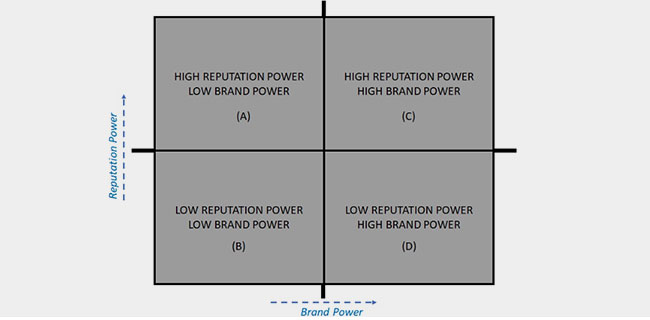
    When you combine a logo with promise, what you get is a brand. However, only when you live up to that promise, you accrue reputation. This means a Brand is Inside-Out, while Reputation is Outside-In. However, many corporates get deceived and misinterpret a strong brand equalling a strong reputation. This is why Balance Sheets go through an imbalance.

    Depending on which Block (A, B, C or D) the Corporate Entity is in, the above construct gives way to an ocean of Brand Research, Measurement and Data Analytics possibilities which will tangibly benefit Board of Directors, CEOs and the Communications Machinery at large. It can lead to a full circle of Data Information and Analysis possibilities.


    Barring Block C, which is a Utopian zone, majority of the Corporate world outside comprises of Corporates who operate from Blocks A, B or D. For them, the relative chances of business success or healthy balance sheet depends on how close they are to the Utopian Block C on the above plot chart.


    There are reasons why majority of the Corporates go through the imbalance of Brand Power and Reputation Power:


    1. FMCGisation: FMCG Industry’s way of brand management and business approach has inspired almost every single industry vertical today. (No wonder, most of the Top CXOs in sectors like BFSI, Automobile, Telcom, etc. got their initial success in FMCG industry). Which is why, they focus on business sales first, Organization Halo effect later. In other words, they believe that the only parameter to measure Reputation Power is demand, sales & revenues.

    2. Focus skewed towards scoring on Brand Promise: Management orientation is towards being visible. No wonder then, Marcomm spends are sky high. CorpComm takes a back seat.

    3. No focus on Corporate Reputation Pillars: Barring visibility of Products & Services and Marketing Initiatives, other Corporate Reputation Pillars like Corporate Thought Leadership, Financial Strength, Commitment to Work Place, Responsibility through CSR & Sustainability, etc. are treated through a cosmetic or adhoc lens.

    4. Archaic Research and Analysis methodologies: Balancing Brand Power with Reputation Power needs a seamless and clever assembly line of Data Information & Analysis Machinery. Listening (to the MOOD of the ecosystem) itself is the biggest chunk. This not just needs resources but starts with Intent.

    5. Perception of Communications Machinery: The age-old saga of Organization’s perception of what value Communication Desk brings to the table is still in poor state. No wonder, “NEWS MANAGEMENT” is the start and end of what this desk is expected to do.


    Having said this, I am aware that there are Corporate Dark Horse which are emerging out of this staid thinking and realigning themselves. The Board, Management and the Corporate & Marketing Communications Machinery are working in tandem. They are ensuring that Corporate Symbols, their Promise and Behaviour (actions and reactions) all create equality within Brand Power and Reputation Power so that it creates a spot closer to or in the utopian Block C.


    Siddhartha Mukherjee is a senior marketing services research professional. He was until last year Business Head at Eikona and has spent a fair time in the PR industry. Starting today, he revives his fortnightly column for MxMIndia.


  • H+K announces strategic partnership with Impact Research & Measurement

    By A Correspondent


    Leading public relations firm Hill+Knowlton Strategies has announced a strategic partnership with specialist news monitoring and analysis services company – Impact Research & Measurement to deliver media research and monitoring services for the India market.


    Notes a communique: “Not only will Impact service all of H+K Strategies’ current clients, Impact will also be the preferred partner for media analytics requirements of all future clients signed up by H+K Strategies. Effective October 1, 2018, The Resource Center (TRC), will cease to offer media monitoring and analysis services to clients. All team members of TRC which was an internal division of H+K Strategies have already been offered new roles at Impact.”


    Interestingly, WPP via Kantar (and TAM) has 50 per cent ownership of Eikona which is also in a similar space. That the WPP-owned H+K Strategies has aligned with Impact and not Eikona and also junked ops of TRC assumes significance. Eikona of course doesn’t offer daily monitoring service, but that an observer noted could’ve been acquired with the resources from TRC. The move also assumes significance given that WPP is attempting to consolidate its functional business and shed extra flab in the system.


    Impact, incidentally, has as per unverified data thrown up by company registration information site Zaubacorp, Prema Sagar, senior PR professional Ashwani Singla and Impact Research & Measurement CEO Aseem Sood as its Directors. Sagar runs Genesis Burson Marsteller in India and as per a communique we had received on Rao’s appointment earlier this year, we were informed that Sagar would also be an adviser and mentor to H+K Strategies.


    Kavita Rao

    Meanwhile, speaking about the partnership, Kavita Rao, President & CEO – Hill+Knowlton Strategies- India, said: “Data and analytics is an important part of all communication campaigns. This partnership enables H+K Strategies and its clients access to advanced tools, analyses and insights to help run communication campaigns better. With our teams having a strong understanding of our clients’ requirements and Impact offering the best-in-class tools based on latest technologies like artificial intelligence and machine learning, this partnership will enable us to offer better business outcomes for our clients. We are thrilled to partner with Impact Research & Measurement to provide our clients a truly integrated and enhanced level of service.”


    Aseem Sood

    Added Sood in a communique: “Clients are no longer interested in just understanding how they did in the past. They want to use data and analysis to understand what could be done better and differently to achieve better success in the future. They also want to make sense of news and trends in a faster and better way. Impact has always been a pioneer – with several firsts in the news monitoring and analysis business industry. We were the first to introduce same-day multi-city monitoring, online repository, real-time dashboards and a mobile app. We are continuing to improve our services and features with investments in news technologies (AI and machine learning). Given the volume of noise out there, it becomes very important to scope the need and use the right charts and visuals to present research results. And this needs to be done in a way that relates to the client’s communication objectives as closely as possible. Our partnership with Hill+Knowlton Strategies will enable them to deliver impactful campaigns for their clients.”


  • PReamble by Siddhartha Mukherjee: The Shift from “BUY ME” to “WHY ME”

    By Siddhartha Mukherjee


    Talking about “Brand Reputation” and “Reputation Economy” in the Corporate world is becoming a fad. When you come to think of it, well, there’s nothing wrong about it! Compared to our (India Inc.’s and its Agency Machinery’s) state of awareness a decade back, a good start I would say. However, when you look at the reality in terms what we are actually doing towards very crucial dynamics of creating and maintaining Brand Reputation, it very clearly smacks of understanding or seriousness. Very simply put, CEOs, CMOs and all other CXOs need to understand the ground-level implications of what Reputation Economy means. The consumer, our revenue contributor, is no longer agreeing to buy our products/services just because of the Product/Brand’s recall, price promotions, packaging or convenience of place. He/She is no longer getting impressed by our communication push that focuses on “BUY ME”. The consumer has started to flip the product packaging and check who the manufacturer is. Does he/she believe him? The consumer wants to very clearly hear an honest “WHY ME”. They want to focus on the Corporate Brand!


    If one were to look at the total annual Indian advertising spends, advertisers do not spend more than 3-5% of the total on  orporate image. In other words, more than 95% is pure marcom (marketing communication) push. It is a “BUY ME” push. The “WHY ME” part has been missing. By “WHY ME”, I mean information about the maker of the product/service, its philosophy, its business ethics, its culture, its vision & mission, its approach towards the social ecosystem, its governance, quality controls, its commitment to employees, investors, government, society at large, vendors and so on and so forth.


    Corp Comm (Corporate Communications) has to emerge as the frontrunner. CEOs need to be aware that all CXOs, not just the CMOs alone, need to have a say in the brand building process. The long standing excessive weightage on Marcom has to shift and move to Corp Comm! The P/L, toplines and bottomlines simply cannot be the guiding and driving force of an organization’s business and communications planning process. For an organisation/ corporate brand, to put in place a robust reputation management machinery, and further aligning it to a singular reputation building agenda internally is paramount. While CMOs mandate is to obviously focus on BUY ME, the CEO should not do the blunder of losing sight of WHY ME? The onus is on him. In the sense that when the consumer flips the packaging/cover of the product to check on the owner or manufacturer of the product, the consumer should not take much time to recall and thereafter, convinced, place it in his/her shopping cart.


    The potential and deliveries that advertising brought to a brand custodian as a standalone communications tool has lost its firmness. Today, brand custodians need integrated help through earned media. While advertising or paid media, for its own inherent challenges is unable to deliver, earned media/ public relations can well be the custodian of both corporate and product brand reputation going forward. Earned Media/PR can well be the conveyor/spokesperson of not just the brand’s “BUY ME” bit, but more importantly, the WHY ME block.


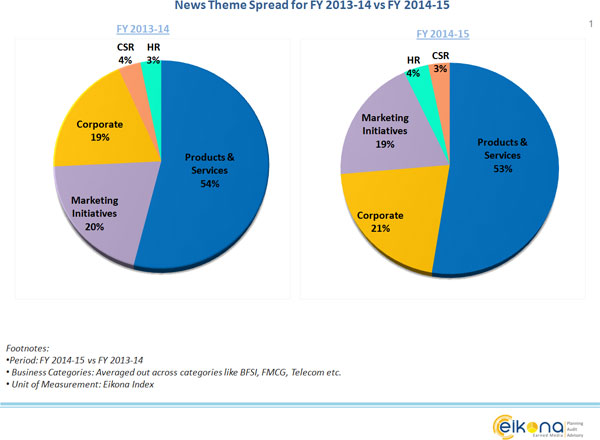
    The Eikona chart, above, gives a sense of what some of the key sectors (averaged out) like Telecom, FMCG, BFSI etc. have focused on. Have they focused on WHY ME or does it continue to be the same story of major focus largely on BUY ME? The following takeaways can be concluded upon:


    a) Things have improved, but Brand ka dil mange more: The above data sets are for the financial year 2013-14 and 2014-15. The above chart splits the total News Push or News Presence of companies across industry sectors and splits them by themes such as corporate image, human resource, marketing initiatives, product and Services etc. If you were to total up product and services and marketing initiatives-related news push, the figure is hovering around a humungous 74%. Which means that a large part of what creates and sustains a corporate brand is missing! However, a silver lining, however, is that these periods are seemingly better when compared with 2011-12 and 2012-13 (not in the chart above). They  used to smack at around 85%. Good news is that the emphasis or push on the “WHY ME” part, comprising Corporate Image, Vision and Strategy, Business Ethics, CSR, Human Resource etc., has increased/improved  as compared to 3-4 years back.


    Further, like I said before, these are averages of some key industry categories. If one were to look at individual sectors, reality in some specific sectors will be harder and much more rude. The message is clear – long-term success is all about corporate brand and not product brand alone! For this, corp Comm has to be in the driver’s seat.


    b) CXOs need to be aware of consumer’s purchase dynamics: Consumer’s purchase dynamics are no longer about Brand Track TOM scores. It is now shifting towards Disposition. It is shifting towards dynamics of strong sustained Messaging which gives away the WHY ME part loud and clear. Any product or service purchase, does’txt matter whether from B2B or B2C category, is about investigating and pivoting the purchase decision on WHY ME. Brand Track survey mechanisms will need drastic revamp. Some of the current ones are archaic and is far from taking care of BTL communication push. Also, the disposition studies will need more robustness.


    c) Why does Earned Media/PR score over Paid/Ad route?: First, the paid/ad route has long lost its credibility. Data sets like ad avoidance, falling Brand Track scores are terrific endorsers of that. Second, the Paid tool is too pricey (let me clarify – I mean money wise! Doesnot justify the ROIs). Third, Ad layout formats doesnot allow me the logistics of laying down details or even relevant snippets of WHY ME. Earned Media scores on ALL!


    d) Can it be measured?: The best part of all this is that Earned Media can be measured neutrally, holistically and continuously and be equated with Corporate and Product Brand Reputation scores.


    Call it Living Company, Loved Company, Successful Company, Lambi Race Ka Ghoda…well, it is time to change. “WHY ME” is the magic wand of long term Business Brand building. CEOs will need to take charge and make amends in the Organizational structure. Communication KRAs and KPIs will need to be recreated with & for all CXOs. Very importantly, they will need to be linked with the Business Objective!


    Siddhartha Mukherjee is a senior PR industry professional and currently Senior Vice President, Eikona – Earned Media Planning, Audit and Advisory. The views expressed here are his own.


  • Introducing a new fortnightly column on PR insights – PReamble by Siddhartha Mukherjee

    By Siddhartha Mukherjee
     

    Advertising is BIG in Size, even BIGGER in Stature. Tracing back many years, one will observe that towards the foundation and gradual development of our Advertising Industry, both in size and aura, the intrinsic role of Public Relations cannot be ignored.


    What has Public Relations got to do with the SIZE of the Indian Advertising Industry?

    Our Indian Advertising Industry would not have been half as rich as it is today had it not been for the Public Relations Industry’s decades of effort to get the multinationals enter the Indian economy smoothly, help them settle and start their operations. I believe that Public Relations has played a key role in transforming our India’s erstwhile Swadeshi Market to today’s India Inc. It is the Public Relations machinery that has worked tirelessly with the media and foreign Investment corridors to ensure the smooth entry of Multinational Organizations before it fell into the lap of the Advertising Industry as prospective Client Revenues.


    Why talk about Multinationals alone? Even the India-based Corporates and Organizations have made a fair use of Public Relations before jumping on the Advertising band wagon. Mergers and Acquisitions, Brand Crisis, Investor Relations/IPOs, CSR, Employee and Trade Relations, Regulatory dynamics, well, many such other dynamics were tackled through Public Relations before those Corporate and Product Brands started using the Advertising tool.


    Ask any PR/Communication professional, especially veterans, and they will have amazing facts to narrate which reiterate the role of Public Relations in creating and stabilizing a brand. PR Consultancy Heads or its Senior Management, Corporate Communication Heads, CXOs, etc., will have an amazingly rich archive of actual, real life PR Effectiveness & Success Case Studies to share – some of which that they themselves ideated or implemented. It is a different story though, that no one has bothered to document these decades of initiatives. All that was needed to be done is to approach the right Industry professionals and Thought Leaders. Case studies will come pouring from various management corridors – Corporate, Human Resource, Marketing, Finance, Manufacturing etc. Function head will have interesting anecdotes to share on how Public Relations helped them in their respective spheres whether it was Business As Usual or Business Not As Usual scenarios.  It really doesnot matter if the case study pertains to a National or Multi-national organization. The important thing here is that every industry vertical will have many case studies buried deep within the wisdom of both veterans & visionary Corporate Business Leaders and Communicators. Each of those stories will somewhere, very humbly, highlight the underlying message of how it helped contribute towards the growing revenues and size of the Advertising Industry.


    Today, if the Indian Advertising revenue size is touching close to 1% of our GDP, well, you know who or rather which Industry to acknowledge!


    How did Public Relations build Advertising Stature?

    My 10-year-old son’s school curriculum has capsules and questions on Advertising, Copy writing, Medium, Slogan etc. It made me wonder & trace back as to what could have been the trigger of all this? Why was my son not being taught about news, news writing, etc. Like advertising, why isn’t he getting the exposure to the world of Journalism as one of the facets of Public Relations?


    Advertising Industry and its Celebrities (well, names like Alyque Padamsee, Sylvester da Cunha, Prem Mehta, Piyush Pandey, Prasoon Joshi, Balki, Vikram Sakhuja, Sam Balsara, Shashi Sinha,…well, it is a long list) have become household names. Parents of employees working in the Industry, their friends and family, social ecosystem, clients, have all acknowledged the  Advertising Industry as a respectable employer, a brand partner and sustainers of brands.


    Well, mind you, this did not happen overnight. This has happened after years of regular use of PR of the Advertising Industry and its Industry Captains.


    Day on day, week on week, Advertising Industry’s credentials, its achievements, plans and yes of course, the Celebrity quotient have an had ominous presence in Newspapers, TV News Channels and Online Networks.


    No wonder then, most of the Management Institutes still continue to believe that when it comes to preparing or revising their marketing course curriculum, Advertising is the nucleus of Brand Communications and Management.


    If anyone doubts on the scientific impact of PR, well, the example is live and all around us. It is one of the best examples to give to establish that PR works, it moves the cheese and how!


    Hopefully! one day, in a similar fashion, PR will have a lot do with PR!


    Siddhartha Mukherjee is a senior PR industry professional and currently Senior Vice President, Eikona – Earned Media Planning, Audit and Advisory. The views expressed here are his own.


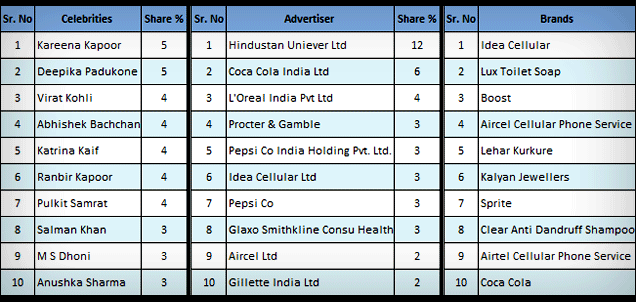
  • Vital Stats: Kareena, HUL & Idea top Celebrity Endorsement & Buzz in Jan-June 2014

    Celebrity Endorsement during Jan – June 2014

    Source : TAM AdEx


    Presenting Celebrity Endorsement Data which comes from TAM AdEx and Celebrity Buzz Data that is from Eikona. Here’s how this data can be helpful for the media industry and professionals:
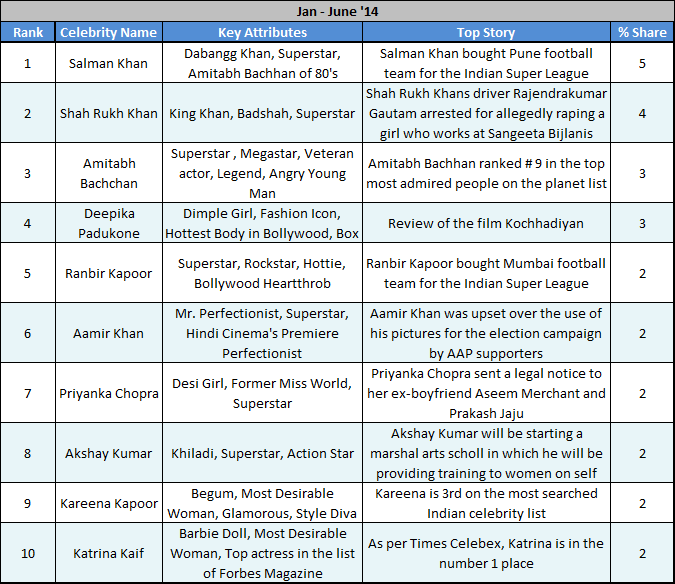
     

    Eikona Data(Celebrity Buzz): While selecting a celebrity for a brand, the connect between brands and a celebrity is always important. The brand personality and celebrity personality have to complement each other. Eikona data with the help of attributes/adjectives used to describe the celebrities can be helpful for the advertiser/advertising agencies to select the proper fit for the brand.


    TAM AdEx Data (Celebrity Endorsement): Celebrity Endorsement Data showcases the visibility of celebrities during the breaktime on TV through Ad Volumes. This can be a great help for advertiser, advertising agencies, celebrity management companies to keep track of their celebrity brand endorsement.


    When we are talking of celebrities and the buzz they create, why have words. Let the figures (no pun intended) do the talking.


    Source: Eikona


  • Eikona samples football popularity before World Cup

    A week before the launch of any product, film, or event is extremely crucial. The pre-buzz prior to the launch created with multiple touch points across editorial, advertising, teasers / promos not only build up curiosity but also pulls the target audience to sample it, at least once. More so, for a massive global sporting event like FIFA, the communication has to get through boundaries of Age, Gender and SEC (Socio Economical Classification), Geography etc.


    Effectively, FIFA is not a very new phenomenon to India. The roaring success in FIFA 2006 has played a key role in repositioning Soccer as one of the most preferred sporting events among the Indian TV audiences. What made FIFA 2006 bridge with the Indian TV audiences? Amongst many, buzz creation was one of cornerstones towards making FIFA 2006 a success story. Within the construct of FIFA 2006 buzz, PR played a key role in influencing and pushing Indian audiences to take interest, watch and re-watch FIFA telecast.


    Eikona, the PR Audit division of TAM, did a curtain raiser on the PR buzz created by the FIFA custodians during the week prior to the opening day in the Print media in comparison with India – West Indies Cricket Series. According to the findings, soccer received an amazing 3 times higher editorial coverage than cricket during the 6 days ending on the first day of FIFA 2006 – June 9, 2006. Front page, sports sections, special supplements etc. FIFA was everywhere in practically every newspaper. Needless to say, these play a vital role in diverting eyeballs towards the channel and the game.


    Having proved the media hype created around soccer, if one were to analyze the day by day build up, one notices that June 9th, the first day of FIFA 2006 received the highest editorial coverage touching 54,000 CCMs as compared to cricket with a mere 7,000 CCMs – a huge 8 times higher.


    Across the six metros (Delhi, Kolkata, Mumbai, Chennai, Bangalore and Hyderabad), Mumbai newspapers generated the highest editorial volumes focusing on Soccer/FIFA touching close to 48,000 CCMs. Incidentally, cricket too received the highest volumes in Mumbai, only at one third that of soccer. Infact, across the 6 metros, soccer on an average received 3-4 times higher editorial space than cricket.


    It furthernites that across the six metros, at a language level, while English newspapers contributed 140,000 CCMs of editorial space to soccer, cricket received a mere 41,000CCMs. Soccer crazy Bengali papers allotted 11,000 CCMs to Soccer while cricket simple received 800CCMs.