Tag: economy

  • Indian adspends to see +8.7% growth in 2012: MPA study

    By A Correspondent


    Media ad sales will grow by 8.7 per cent in net terms this year, against the background of a slowing economy (~7 per cent real GDP growth versus historical range of 8-9 per cent) and the high first half of 2011 base last year resulting from the Cricket World Cup (which happens once in four years) plus an extended IPL season according to Media Partners Asia.


    The growth will be primarily driven by MNCs investing inIndiaand stronger MCG sector, and there could be upward revisions made in the second half of 2012. The outlook for advertising growth across key categories is mixed.


    Some of the highlights are:

    • FMCG 

    Media buyers expect robust growth from the FMCG sector, which is the largest advertising category, contributing 30-35 per cent to total ad spend. MNCs are expected to report robust numbers, while a few large MNC accounts (with annual ad budgets in the region of Rs2-3 billion) are looking to increase spends by 50-70 per cent for the coming year. Domestic FMCG companies are expected to see only marginal growth as the profits of these companies have deteriorated due to rising input costs.


    • Auto 

    Traditional companies such as Maruti and Hyundai have reduced their spends; but global car manufacturers investing inIndiaare driving the overall growth for the sector. As suggested in the recently held Auto Expo 2012, the sector will benefit this year from new launches in the two-wheeler and utility vehicle segments in subsequent quarters.


    • Life insurance

    The forecast is for a steady growth, a prevailing trend seen in this category since 2008. A reversal of interest rates will be the underlying factor influencing consumption and ad spend across sectors. The rising interest rate cycle seems to have peaked out. After raising interest rates by 13 times since March 2010, RBI (Reserve Bank ofIndia) may shift its approach towards the country’s monetary policy. Inflation is likely to fall considering the high base last year, and in order to bring the country’s economic growth back on track, the RBI is likely to reduce interest rates gradually in 2012. This will encourage investments and spending, in turn benefiting the ad market.

    Consumption demand has held up reasonably well though rural demand may be a concern, highlighted by a recent slowdown in sales of two wheelers and durables.


    Other key factors that will have an impact on the ad marker include:

    • Competition in Hindi GEC

    Competitive intensity in the Hindi GEC space is nothing new, though new competition is accelerating amongst second-tier channels. There has been a change in the pecking order of top three Hindi GECs, with Sony climbing up to the No. 2 spot while incumbent Zee TV has now slipped to No 4. Based on discussions with some of the major media buyers, the genre currently has limited supply of inventory, which should keep ad rates healthy.


    • Digitalization to create new niches

    Before the first phase of digitalization is implemented in June 2012 (it may be delayed to December 2012), broadcasters are already rolling out new niche channels in various genres like action and comedy. This will attract advertisers who are willing to target and segment their audience, not just from demographic but also psychographic parameters.


    • FDI in single-brand retail

    Opening up of FDI in single-brand retail (precursor to opening up multi-brand retail) will benefit regional print companies.


    • State elections

    In the near to medium term, print media will benefit from the upcoming closely contested elections to be held in five states: Uttar Pradesh, Uttarakhand, Punjab,Goaand Manipur.


  • Media hiring 9% higher in Jan than Dec

    By A Correspondent


    The Indian entertainment and media sector is one of the fastest growing sectors in the economy, and has witnessed tremendous growth in last couple of years.


    In January 2012, hiring activity in the media sector saw a growth of 9 per cent above December 2011 levels and 3 per cent above the January 2011 levels.


    The May 2011 index at 1025 was the highest point on the job index in three years. The last three months of 2011, however has seen some dipping hiring numbers.


    Hitesh Oberoi, CEO and MD, Info EdgeIndiasaid “With the beginning of the new year, the recruitment scenario seems to be moving in a positive direction. However, this year, firms will be more particular about recruiting the right talent and employees who can make meaningful contributions to the firm.”


    Thus, on an overall level, the index had peaked during the mid-months of 2011 but most months saw the index about 20 per cent lower than the July 2008 levels.


    Naukri.com, India’s No. 1 job site, is the flagship brand of Info Edge. It revolutionized the concept of recruitment inIndia. Since its inception in 1997, Naukri.com has seen continued growth while outperforming its competitors in every sphere. Info Edge is the first internet Company to be listed inIndia.


  • Newswatch by Madan Sabnavis: In media showbiz, real figures take a backseat

    By Madan Sabnavis


    Media is not unlike showbiz. Everybody wants to be a part of the action and the media is the vehicle to fame. Given the intense competition, it is but natural that every newspaper wants to be one up and every television channel would like to be the first to flash breaking news. Suddenly, even a standard release from the government becomes breaking news for the first channel that flashes the story. From politics to economics, it is the same story.


    The economic travails that we are facing today have grabbed headlines as well as eyeballs, thanks to the media, which is a powerful tool for conveying an idea, as we have witnessed in 2011.


    The media’s main focus has been on the policymakers and critics, which added zing to otherwise insipid developments. It is not thatIndiais crawling this year. Growth is reasonable, inflation is high, though not unusual as we have had such patterns in the past and the entire hullabaloo on exchange rate is again not really happening for the first time. But all this has come to the fore due to incessant media attention, and in a way, has gotten exaggerated. How fair has this exposure been?


    The interesting fact here has been the prevalence of the same basic laws of economics – demand and supply of such views in the media industry. TV channels have hours dedicated to business and economy. As every economic indicator is supposed to affect the stock market, it merits fixed hours of discussion. There are time spaces to fill in with views which get in the big names. This has led to constant interactions with government officials, policy makers, bureaucrats, ex-bureaucrats, economists, CEOs, CFOs, journalists, academicians, journalists, and so on.


    More importantly everybody wants the top names in the field, though the rather amusing outcome is that we have the same set of 10-20 experts in each of the fields who circulate the same, standard views.


    There is, in a way, nothing really wrong here, but there may have been a tendency to over-react at times as we have started viewing every economic detail on a realtime basis.


    Today, economic data in India comes with lags. There is a two-week lag for wholesale prices, a month for exports, consumer prices and industrial data. The lag becomes almost a quarter for GDP numbers. To top it all, there are revisions which can be quite horrendous, since the experts look like having contradicted themselves as they comment based on the information provided at that particular point of time. Now the broader question is whether we should believe such data.


    Why do we want to minutely dissect such high frequency data when we know that there will be changes subsequently? This is important because all such data and interpretations invariably affect stock market and investment decisions. If all experts say that interest rates will rise, then individuals will shift to bank deposits, just like how mutual funds may become attractive in case the majority view is that the economy is on track and booming.


    With a tendency for over-exposure and the willingness or over-enthusiasm of experts to come online, there may have been a situation of overstating cases. Generally speaking, theory will say that economies do not function in one week or month, but on a cumulative basis during a year. This being the case, in the past we have been looking only at cumulative numbers.


    But today if one channel looks at month-over-month numbers, all have to do it to stay in the race. This means forcing the speakers to comment or give their forecasts which they have to do once they are on the phone or on camera.


    This has led to a proliferation in the numbers being given on each and every economic indicator by the same person in a short span of time, say one month. When queried on reactions to a dismal number, which is actually a tautological question, the answer has to be that the person is dismayed or surprised or shocked or concerned. But actually, they may not really know why the number turned out to be abysmal.


    The official stance always talks of recoveries in the rest of the year while the corporates will always paint a doomsday picture when interest rates have risen. This, in turn, can drive an opinion.


    Things have hence been magnified throughout the media on account of relatively higher frequency of economic releases which still are subject to revisions.


    Unfortunately there has been a tendency for single numbers to be blown up and the complete picture obfuscated to drive home a point. We have not really had any novel solutions offered in this plethora of debates.


    Let us see some of them: We need to have reforms. But did we not have a good economic picture without these reforms in the past? We need to lower interest rates to help industry. Is industry the only sector driving the economy and is this the only constituency that matters? We should stop predatory competition fromChinawhich affects us. But if the product is an import going into your product, would the stance be the same? There is policy paralysis. But this cannot be a solution when the world is going through a slowdown and everyone has to adjust.


    Surprisingly, we do not hear western critics saying that there is policy paralysis in the Eurozone which is holding back growth – there as it is understood that all crisis situations take time to resolve as there are various constituencies involved.


    How then does one evaluate the performance of the media in bringing to the fore the economic crisis that we are living with? There is a plethora of views, with few interpretations. The viewer or reader has to make a choice and often times, by virtue of selection of the commentators or experts, ends up getting confused.


    As the media invariably represents a single view in a market economy, it has helped to bring to the fore the issues, though admittedly, government action is based on a larger public concerns and hence has remained susceptible to media bashing.


    We have not really had workable solutions coming forth in these discussions. But, nonetheless it has helped to stoke a lot of debate and create awareness of issues which hitherto would have been confined to only a certain section of people. To this extent, it is a job well done. What about the experts who keep giving their views relentlessly on the same lines? To quote Oscar Wilde, to be in it is merely a bore. But to be out of it is simply a tragedy. It’s showbiz after all.


    Madan Sabnavis is Chief Economist, CARE Ratings. The views expressed are personal.

  • The world according to JWT, in 2012


    By A Correspondent


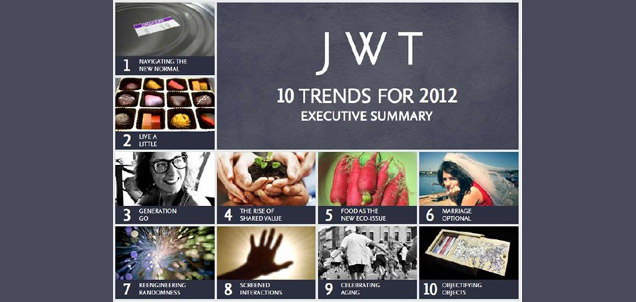
    Ad hotshop JWT feels that in 2012, the economy will push brands into opening up more entry points for cost-sensitive consumers as the “new normal” becomes a prolonged normal in the developed world while at the same time, tough times will generate an unprecedented entrepreneurialism, with the so-called Lost Generation of youth becoming a uniquely resourceful group that creates their own opportunity. The above findings and plenty more, are the result of their annual forecasting exercise – the seventh in the series – of key trends that will drive or significantly impact consumer mindset and behaviour in the year 2012.


    JWT’s ’10 Trends for 2012′ is the result of quantitative, qualitative and desk research conducted throughout the year for the report. It includes inputs from nearly 70 JWT planners across more than two dozen markets and interviews with experts and influencers across sectors including technology, luxury, social responsibility and academia.


    “With our annual trends forecast, we aim to bring the outside in-to help inspire ideas beyond brand, category and consumer conventions-and to identify emerging opportunities so they can be leveraged for business gain,” remarked Ann Mack, director of trendspotting for JWT. “Trends, like any complex and dynamic human phenomenon, are not preordained-once they are spotted, they can be shaped.”


    Previous trends that have been forecasted over the past years include: “De-Teching” in 2011 (more people logging off, at least temporarily, to get a break from technology); “Location-Based Everything” in 2010 (the explosion of location-based or -aware services that leverage data from mobile phones); The Small Movement” in 2009 (the shift away from “bigger is better” in everything from homes to cars to mobile technology); and “Radical Transparency” in 2008 (the “nothing to hide” ethos seen in some online behaviours).


    The top 10 trends that have been predicted for 2012 are as follows:


    1. Navigating the New Normal

    As the new normal becomes a prolonged normal in the hampered developed world, more brands in more categories will open up entry points for extremely cost-sensitive consumers. Marketers will find new opportunities in creating stripped-down offerings, smaller sizes and otherwise more accessible products and services.


    Example: In the US, Heinz is introducing several reduced sizes at a suggested retail price of 99 cents, including a 10-ounce ketchup pouch and a 9-ounce yellow mustard, as well as mini Worcestershire and Heinz 57 sauces.


    2. Live a Little

    Faced with constant reminders about what to do (exercise more, eat better) and what not to do (smoke, overspend), and fatigued from several years of austerity, consumers will look for ways to live a little without giving up a lot. People have been exercising more self-control, and increasingly they are looking to let loose once in a while: indulging in sinful things, splurging on treats and escaping from today’s many worries.


    Example: Whiskey in South Africa, premium beer in the U.K and cheap eclairs in India are small indulgences that consumers with little to spend are enjoying.


    3. Generation Go

    While twenty-somethings in the developed world feel they’ve been dealt an unfair deck, many are finding opportunity in economic adversity. Out of continued joblessness or discontent with the status quo will spring an unprecedented entrepreneurial mindset, enabled by technology that obliterates traditional barriers to entry. A so-called Lost Generation will transform itself into a uniquely resourceful cohort.


    Example: More than half of Millenials in the US agreed that if they lose or have trouble finding a job, they’ll start their own business, according to a JWT survey, up from 25 percent in 2009.


    4. The Rise of Shared Value

    Rather than simply doling out checks to good causes, some corporations are starting to shift their business models, integrating social issues into their core strategies. The aim is to create shared value, a concept that reflects the growing belief that generating a profit and achieving social progress are not mutually exclusive goals.


    Example: Philips is partnering with the Dutch government in a bid to provide affordable, sustainable energy solutions to some 10 million people across 10 sub-Saharan African nations by 2015.


    5. Food as the New Eco-Issue

    The environmental impact of our food choices will become a more prominent concern as stakeholders-brands, governments and activist organizations-drive awareness around the issue and rethink what food is sold and how it’s made. As more regions battle with food shortages and/or spiking costs, smarter practices around food will join the stable of green “best practices”.


    Example: U.K. supermarket Sainsbury’s featured a summer promotion in 2011 offering customers who asked for cod, haddock, salmon, tuna and prawns an alternative, more sustainable species such as herring or mackerel for free.


    6. Marriage Optional

    A growing cohort of women is taking an alternate life route, one that doesn’t include marriage as an essential checkpoint. Both in the West, where this trend is building, and in the East, where it’s gaining momentum, “happily ever after” is being redefined as a household of one, cohabiting or single motherhood.


    Example: In 2010, a third of Japanese women entering their 30s were single, while 37 percent of all Taiwanese women 30-34 were single.


    7. Reengineering Randomness

    As our individual worlds become more personalized and niche-and the types of content, experiences and people we are exposed to become narrower-greater emphasis will be placed on reintroducing randomness, discovery, inspiration and different points of view into our worlds.


    Example: Airtime, due to launch at the end of 2011, is being touted as a random real-time video chat platform where strangers will be “smashed together”.


    8. Screened Interactions

    More flat surfaces are becoming screens, and more screens are becoming interactive. Increasingly, we’ll be touching them, gesturing at them and talking to them – and becoming accustomed to doing so as part of our everyday behaviours. This is opening up novel opportunities to inform, engage and motivate consumers.


    Example: In New York, a restaurant at high-end department store Barney’s features 30 individual screens in a large communal table that’s covered in glass; diners can digitally order their meal, then browse the store’s catalogue while eating.


    9. Celebrating Ageing

    Popular perceptions of ageing are changing, with people of all ages taking a more positive view of growing older. And as demographic and cultural changes, along with medical advances, help to shift attitudes, we’ll redefine when “old age” occurs and what the term means.


    Example: To appeal to Gen Xers and Boomers, Polish beer brand Zywiec launched a campaign with the tagline “The best is ahead of you”. Commercials showed older male celebrities including actors, a boxer and a cartoonist, speaking about their lives, offering insights and advice.


    10. Objectifying Objects

    As objects get replaced by digital/virtual counterparts, people are fetishiZing the physical and the tactile. As a result, we will see more “motivational objects”, items that accompany digital property to increase perceived value, and digital tools that enable creation of physical things.


    Example: Sincerely’s Postagram app allows vacationers and others to turn snapshots into snail-mailed postcards. Similarly, Postcard on the Run reminds potential users that for recipients, a physical card is “a real keepsake they can hold close to their heart, put up on the fridge or display at work”.