Tag: eCommerce

  • Ecommerce and online video to fuel 11% recovery in global adspends: Zenith

    By Our Staff


    Global advertising expenditure will grow 11.2% in 2021, driven by exceptional demand for performance-led ecommerce advertising and brand advertising on online video, according to Zenith’s latest ‘Advertising Expenditure Forecasts’ report. Advertising expenditure will total US$669 billion this year, US$40 billion more than was spent before the pandemic in 2019.


    Growth in advertising expenditure is expected to remain robust in the medium term, with 6.9% growth forecast for 2022 and 5.6% for 2023.


    The coronavirus pandemic has accelerated the structural shift in the economy from bricks-and-mortar sales to ecommerce, driving more consumers than ever to research and complete purchases online. Brands have responded by forming partnerships with retailers and creating new direct-to-consumer operations, using performance-driven advertising – primarily in social media and paid search – to lead consumers down the path to purchase. Zenith forecasts that social media advertising will expand by 25% this year to reach US$137 billion, overtaking paid search in scale for the first time. Paid search will expand by 19% to reach US$135 billion.


    Much of this is new money to the ad market, coming from small businesses that have had to pivot rapidly to ecommerce to survive lockdowns, and from budgets that brands would previously have allocated to retailers to secure physical shelf-space, which they are now spending on display and search ads on retailer websites. The shift to ecommerce will slow down as coronavirus restrictions lift and economies open up again, but won’t go into reverse. Zenith expects ecommerce to continue to pull in incremental revenues to the ad market, driving 13% growth in social media and 12% growth in search in 2022.


    Audiences continue to migrate online, and online video viewing is growing rapidly, even as traditional television ratings shrink again after a one-off spike when lockdowns began in 2020. Advertisers value online video as a means of maintaining reach while television declines, but it’s an effective form of brand communication in its own right. Demand is strong, although the popularity of subscription-funded video-on-demand has helped limit the supply of high-quality online video available to advertisers. Zenith predicts that online video advertising will be the fastest-growing digital channel in 2021, rising by 26% to reach US$63 billion. Specific numbers for India have not been given by Zenith in this forecast.


    Said Benoit Cacheux, Global Chief Digital Officer at Zenith: “The online video landscape continues to transform, fuelled by the growth of streaming services and connected TVs. Its continued evolution requires a radical rethink of how to build the optimal screen-neutral reach model. The ingestion of new data sources into TV planning also creates further opportunities to further sync TV and video planning.”


    Social media and online video have eclipsed traditional static display, which is forecast to shrink by 15% this year, while online classified grows by just 4%. Overall, Zenith expects digital advertising to grow by 19% in 2021, and increase its share of total adspend to 58%, up from 48% in 2019 and 54% in 2020.


    Most other media are enjoying growth this year, as spending rebounds from the 16% drop in traditional media adspend in 2020. Cinema and out-of-home were the worst affected by Covid-related restrictions, shrinking by 72% and 28% respectively, and will enjoy the fastest recovery in 2021, with respective growth rates of 116% and 16%. Radio advertising, which shrank by 22% in 2020, is forecast to grow by 4% in 2021, while television fell 8% in 2020 and is forecast to grow 1% in 2021. Print will continue its long decline, now in its 14th consecutive year, with an 8% drop in adspend in 2021. In 2023 adspend in all these media will still be below 2019 levels, though cinema and out-of-home will have made up almost all of their lost ground.


    Limited supply and rising demand are stoking media inflation

    This year’s rapid recovery in adspend, coupled with the continued migration of audiences from traditional to digital channels, is fuelling substantial increases in media prices, particularly in television. The cost of television advertising is up 5% this year on average, though the variance between markets and audiences is wide. Television spend is up by 1%, so the volume of audiences reached globally is shrinking. Digital media growth, in contrast, is mainly driven by rising audiences and more extensive monetisation, with online video inflation averaging 7%, and social media roughly flat, compared to their 26% and 25% respective adspend growth rates.


    US to add nearly half of all new ad dollars

    All regions will enjoy robust adspend growth in 2021, ranging from 9% in Asia Pacific to 15% in the Middle East and North Africa, which is recovering from the steepest decline in 2020, of 21%. The strongest underlying growth since 2019 is taking place in North America, which is forecast to grow by 13% this year despite shrinking by only 1% last year. Growth in North America is being driven by the very rapid pace of digital transformation in its industries, as well as strong investment in connected TV and advertising-funded video-on-demand.


    The US will be by far the largest contributor to global growth in 2021, accounting for 46% of the US$67 billion added to the global ad market this year, followed by China with 11%, and Japan and the UK with 6% each.


    “After a very tough year last year, the ad market is enjoying rapid and broad-based recovery, and will end this year well above the level it achieved in 2019,” added Jonathan Barnard, Head of Forecasting at Zenith. “Digital advertising is becoming a more effective tool for brand growth as media and commerce continue to move online, attracting greater investment from large brands and small businesses alike.”
  • Does anyone trust online reviews?


    By A Correspondent


    You may have read this report circulating on Whatsapp and online for a few days. But here’s the full report, and which merits consumption of the media, advertising and marketing fraternity.


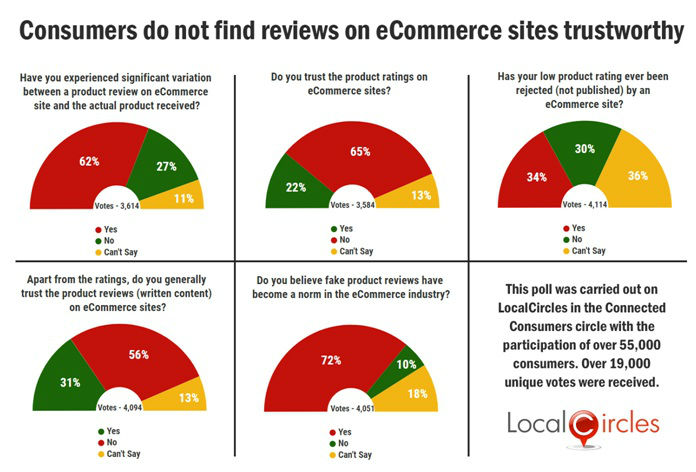
    While consumers reviews have become very important of the buying process, many consumers say that a lot of these reviews are fake or planted. To find the collective consumer pulse on this issue, Local Circles conducted a survey which received more than 18,000 responses.


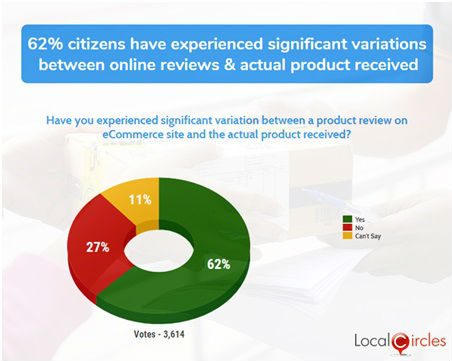
    The first poll asked consumers if they have experienced significant variation between a product review on ecommerce site and the actual product received. Surprisingly, 62% consumers replied with a yes, while 27% replied with a no. 11% chose not to answer.

    Many consumers rely on reviews from other users to decide if the product is fit to be bought or not. Tampering with these reviews leading to a purchase, hence is nothing less than trying to cheating them.

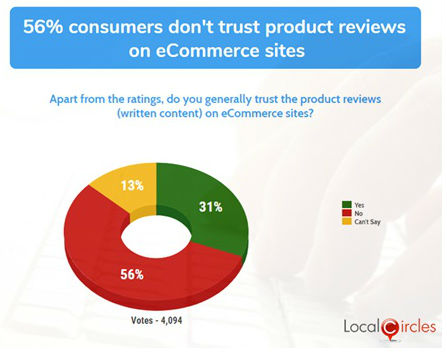
    The second poll asked consumers if they trusted the product reviews on ecommerce sites. 56% responded in a negative while 31% responses were an affirmative. 13% were unsure about it.

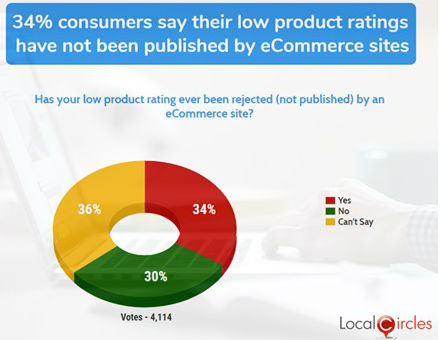
    Some consumers in a structured discussion had earlier reported that many e-commerce sites do not publish a bad product review written by the consumer on their site to make sure that the product sales are not hampered.

    The third poll asked consumers if their low product rating had ever been rejected (not published) by an e-commerce site. 34% consumers said it has personally happened with them and 30% said it had not happened with them. 36% were not sure about it.

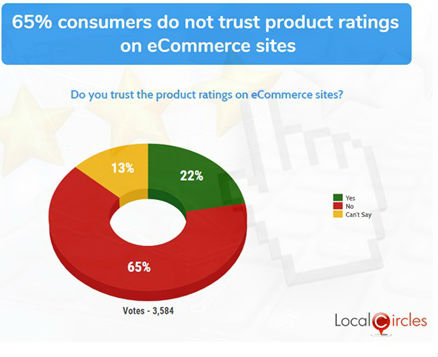
    In the next poll, 65% consumers said they do not trust product ratings on e-commerce sites. Only 22% said they trust them and 13% chose not to answer the question.

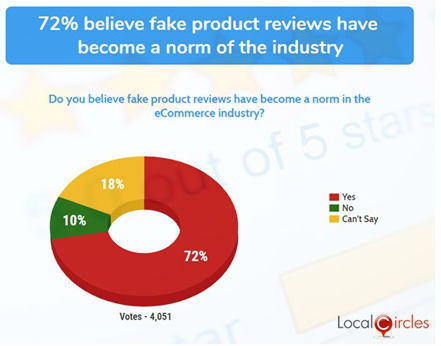
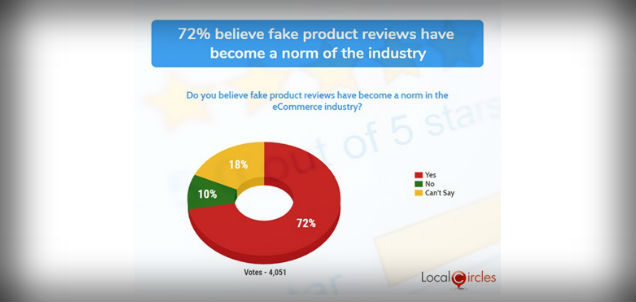
    In the last poll, 72% consumers said that they believe fake product reviews have become a norm in the e-commerce industry. 10% said this was not the case and 18% were unsure about it. Consumers mentioned that many businesses are thriving on their ability to provide fake ‘good reviews’ to the prospect buyers and in most cases once a business lists a product, the seller himself as an individual goes and rates and reviews the product. It is also very common for them to ask family and friends to rate and review their product. Some sellers even go to the extent of making a purchase from their own business so as to getting a “verified purchase” rating and review for their product. Consumers must take into account the number of ratings and reviews when buying on e-commerce sites, suggested some Local Circles members.

    Consumers suggested that publishing of all verified purchase reviews, even if negative, should be made mandatory for e-commerce sites. They also mentioned that PR companies found to be in the business of providing fake online reviews should be identified and penalised. Other suggestions included furnishing real first and last name of the reviewer should be made mandatory, e-commerce sites supporting the practice of fake reviews to be fined and a machinery to be created in the Department of Consumer Affairs, Government of India to keep close watch over the activities of the e-commerce companies as it relates to ratings and reviews.


  • Flip the Cart, Snap the Deal and Amaz-Off. Future to tease ecom majors with ad offensive


    By Sagar Malviya & Pritha Mitra Dasgupta


    Future Group CEO Kishore Biyani, who’s never made a secret of his disdain for ecommerce rivals, plans to step up the offensive with a series of ads that use word play to target the three main marketplaces – Flip the Cart, Snap the Deal and Amaz-Off.


    This is probably the first time a brick-and-mortar retailer will engage in comparative advertising against online rivals, which have been grabbing share by discounting products.


    After nearly three years of deep discounting, most online sellers are now pulling back from this strategy in a desperate effort to shore up their finances, making them vulnerable on this front. Ecommerce discounts are now mostly limited to select brands such as online exclusives, old merchandise and own labels.


    The combined losses of the three leading online companies — Amazon, Flipkart and Snapdeal — ballooned to Rs 5,052 crore in FY15 from Rs 1,000 crore in the year before as they sought to build market share. At the same time, several brickand-mortar retailers clocked double-digit same-store sales growth last year, a reversal from the trend in 2014 when physical stores reported subdued demand as ecommerce players wooed away consumers.


    As part of the Future exercise, three newspaper jacket ads on Friday will direct shoppers to its Brand Factory discount outlet instead of hunting online for better prices in a manner reminiscent of the pot shots that Pepsi and Coca-Cola took against each other in the 1990s.


    The theme will be continued inside the stores, with staff and cashiers wearing T-shirts with messages such as ‘My deal got snapped’ and ‘My cart got flipped’. The 40 or so Brand Factory stores will also wear new facades and selfie zones with the same theme targeting Flipkart, Snapdeal and Amazon.


    “We just want to prove the point that both our merchandise assortment and pricing are better compared to online companies. We need to make consumers aware of this fact,” said Biyani, adding that Brand Factory’s gross merchandise value (GMV) in the year to March 2016 was Rs 3,500 crore. Future is India’s biggest listed retailer.


    “While we use sales numbers to talk about performance, we are bigger than Myntra or Flipkart in terms of GMV,” he said. As part of its Great Offline Denim Festival, Brand Factory will sell nearly a dozen brands such as Levi’s, Benetton, Lee, Wrangler and Pepe jeans at a 50% discount for three days.


    Future has fired ad shots at ecommerce before. For instance, “You can’t take the nation for granted even for a day,” was aimed at Flipkart’s Big Billion Day sale in 2014.


    Snapdeal has taken digs at Flipkart and Amazon with its campaign tag line: ‘You don’t need a billion offers to amaze you. You just need to snap the best ones’. It also had about 100 billboards in 20 cities emblazoned with the phrase ‘Achha kiya bata diya, #YahanSeKharido’ aimed at Flipkart, which was running the ‘Nahin khareeda? #AchhaKiya’ campaign last year.


    “The intent of a campaign is really crucial,” said McCann India CEO Prasoon Joshi. “Whether the campaign is offensive or not will depend on the intent of the brand. If the intent is shallow fun then it is different. But I personally believe that taking creative potshots at competition cannot be a long-term strategy.”


    Brick-and-mortar retailers are also investing in omni-channel strategies and experimenting with global models such as flash sales, such as by offering a single product for sale for a period of 24 to 36 hours. “We are planning flash sales where consumers can get discounts, coupons and offers on several brands by using an app but buying at physical stores for certain hours or days,” said Rajiv Prakash, cofounder of Shouut, which is in talks with Shoppers Stop, Oberoi Mall, Decathlon and DLF Promenade for deal-of-the-day sales.


    Source:The Economic Times

    Copyright © 2016, Bennett, Coleman & Co. Ltd. All Rights Reserved

    Licensed to republish


  • India will be fastest growing market in 2016


    By Ratna Bhushan & Shambhavi Anand


    India will be the fastest growing advertising market this calendar with total ad spend rising 15%, says Lindsay Pattison, global chief executive at media buying agency Maxus.


    “The big growth driver will be ecommerce, followed by telecom, including the rollout of 4G services, the automobiles sector and fast moving consumer goods,” Pattison said.


    Maxus is part of GroupM, the parent company of WPP’s media agencies, that takes care of close to one-third of all media investments worldwide. Pattison is in India with her 11-member board to host the $11-billion agency’s first meet in the country.


    Emerging categories such as ecommerce and other technology startups are advertising heavily across mediums in the country to build brands and they are expected to continue doing the same, said Pattison, the only woman global head of a GroupM agency. The year is expected to see several new launches across the automobiles and consumer goods space, she said.


    In a slowing world market, which saw China and Europe reduce ad expenditure, Pattison said Maxus is banking heavily on India’s fast-growing ecommerce sector to fuel the group’s growth globally.


    “Advertising growth is a very good indicator of GDP growth. India is a star market in terms of quality… Individually, companies may trade down but at a sectoral level, there are no concerns,” she said.


    India, which currently trails only the US advertising market in terms of size, is set to significantly outpace global ad spend growth forecast of 4.5% for this year. The US, India, the UK, Germany and China make up the top five markets for Maxus.


    Pattison said India contributes $750 million to its global revenues. Maxus, which contributes 25% to GroupM’s revenues in India, buys media for firms such as digital wallet and online ecommerce platform Paytm, telecom services provider Vodafone, and personal care products maker L’Oreal.


    She said the agency’s growth would be mainly through retention and the organic route, rather than acquisitions.


    Maxus has rolled out Kaleidoscope, a tool to define parameters such as consumer moods and receptivity, which could play a significant role in the way brands respond to rapidly changing consumer behaviour, especially on the social media.


    Source:The Economic Times

    Copyright © 2016, Bennett, Coleman & Co. Ltd. All Rights Reserved

    Licensed to republish


  • Google Forrester Report predicts online shopper base to reach 100 million by 2016

    By A Correspondent


    Consumer confidence to shop online will continue to rise and India will have 100 million online shoppers by 2016. This was revealed by Google, in its annual online shopping growth trends report, compiled by combining an extensive research conducted by Forrester Consulting and Google search trends. The report revealed that India’s e-tailing market is at an inflection point and will see rapid growth to become a $15 bln market by 2016.


    The research conducted by Forrester Consulting by interviewing 6859 respondents covering both online buyers and non-buyers in 50 cities/towns, revealed  that online shoppers base will grow 3x by 2016, and over 50 million new buyers will come from Tier 1 and Tier 2 cities. The confidence to shop online was on the rise as 71 per cent non-buyers from Tier 1 and 2 cities said they plan to shop online in next 12 months. The findings also revealed that women buyers in Tier 1 cities were more engaged in online shopping, and outspend men by 2x. Women were also responsible for driving growth in categories like apparels, beauty & skincare, home furnishing, baby products and jewelry.


    Looking at the growth trends of the categories, the report also projected that 40 million women are estimated to shop online in India by 2016. 2/3rd of online shoppers highlighted Convenience and Variety as major reasons to shop online in addition to discounts. Over 60 percent respondents also felt that buying online was directly correlated with social status. Mobile phones emerged as an important access device for online shoppers with 1 out of 3 online buyers transacting on their mobile phones in Tier 1 and Tier 2 cities. In Tier 3 cities, 1 in 2 buyers said they use mobile phones to purchase products online. This was also reflected in Google search trends with mobile phones queries growing 3x in last three years. Today, over 50 percent of shopping queries were coming from mobile phones, this share was as low as 24 per cent just two years back.


    Speaking at the launch of the report, Nitin Bawankule, Industry Director for Ecommerce, Local and classifieds, Google India said, “The consumer confidence to shop online has grown significantly in  last year and a half, and our objective was to understand the factors that are driving this growth and arrive at indicators that will help propel the Industry forward. As the report indicates, behavior of Indian online buyer is fast mirroring buyers in more developed markets as more subjective product categories have started to see significant growth. The e-tailing Industry needs to act now to cater to this strong user growth trend. Improved customer experience across all touch points, easy to use mobile apps can create a strong pull for non-buyers to shop online in Tier 1 and 2 cities. Women buyers are set to become the most significant contributor to the growth of online shopping and there is a huge opportunity waiting to be unlocked in this user segment.”


    Amongst the challenges, 62 percent buyers said they were not satisfied with their online shopping experience. 67 percent buyers also highlighted that the current return process was too complicated and expensive. Trust was a major issue with Non buyers, 55 percent non buyers did not trust the quality of products sold online, 63 percent said they were concerned about the safety of transacting online and 65 percent said, they don’t feel comfortable sharing personally identifiable information online. 66 percent of total respondents said that poor connectivity was also a major barrier for them to shop online.


  • Return of dotcom boom, small e-com cos spend big on TV advtg

    By Shambhavi Anand


    The dotcom boom seems to be back, at least for television advertising. And it is not only the big and known names spending money on the most popular and preferred mass medium but also the small online retailers are spending humongous marketing dollars on extremely expensive television advertising.


    Fabfurnish, an online furniture retailer, which is less than two years old, is about to kickstart its first television campaign in January 2014. Backed by German e-commerce incubator-cum-investor Rocket Internet, the company has put in half a million Euros into this campaign. However, the company did not disclose the size of the fund it has raised.


    “Online home decor market is in a nascent stage. We need to create awareness about the category as well as build brand for ourselves,” Vaibhav Aggarwal, CEO and co-founder, Fabfurnish.com said. The campaign is planned for four weeks in January and will be supported by simultaneous digital initiative also.


    TV advertising forms a significant part of media mix for Lenskart.com, the online portals which sells eyewear is backed by venture capitalists. “We spend approximately Rs 10 crore annually on mass media advertising which is mainly done for brand building and gaining trust of the consumers. TV allows us to educate and create much needed awareness for the brand resulting in traffic and building trust,” Peyush Bansal, CEO and founder, Lenskart.com said.


    While the prospects for e-commerce companies cannot be doubted, does advertising on television lead to increased sales? Most e-commerce companies claim that the traffic of their portal increases and so does awareness and trust but most of them do not have numbers to back their claims.


    GreenDust, an online portal, which sells branded factory seconds products (electronics) that are repaired and refurbished that comes with a warranty spends heavily on advertising in the mass media including radio and TV.


    Its founder and CEO, Hitendra Chaturvedi, said, “TV advertising has helped us in reaching to mass audience and building trust for the brand. This in turn has improved the brand recall and we witnessed 100% increase in number of prospective customer’s queries in the month we released our first advertisement itself.”


    He added, “TV ads have helped to break the clutter and to reach across all target audience which has been achieved by targeting different channels covering all the genres and different languages.”


    According to estimates of Madison Media, the advertising spend of online portals have gone up in the last two years. The ad spends of online portals in the April to July quarter of 2013 was 1.2% as compared to 0.8% in the same quarter of 2011.


    The Indian ecommerce market is going through a huge surge of growth. According to a 2012 CRISIL report, Indian online retail industry will grow from Rs 32 billion in 2012 to Rs 100 billion in 2015, a CAGR of 45%-48%. To add to the growth prospects of the industry, infrastructure such as internet connectivity is expected to grow exponentially in the country. Apart from laptops and desktops, mobile phones and tablets are becoming major growth drivers.


    The I-Cube 2013 report released by the Internet and Mobile Association of India (IAMAI) and IMRB International said India has 200-million internet users as of October; the number will grow 40% year on year by December. The number of internet users in India is expected to rise 18.53% in the coming months to 243 million by June 2014.


    In spite of the huge potential, critics seem sceptical about the effectiveness of mass media advertising for e-commerce players, especially the beginners. They say there is hardly any data to establish the link between high traffic and increased sales conversion.


    “There has been a spurt in traditional advertisements by e-commerce sites and this is primarily because mass media such as television tends to bring more credibility. But the question is whether TV advertising brings in the expected return on investment (RoI),” said Gaurav Gupta, senior director, Deloitte in India.


    He, however, says mass media advertising might be done more for brand building and spreading awareness or for establishing credibility to get private equity rather than for increasing sales.


    Seema Gupta, faculty – marketing, IIM Bangalore, advises small ecommerce ventures to look towards marketing activities such as activation in malls or initiatives on the digital media, which can be done over a prolonged duration and, hence, prove to be more sustainable, rather than opt for expensive mass media advertising. “Below-the-line advertising can prove to be more sustainable as they can be done for a longer duration. It will also help in reaching out to the right target audience as compared to mass media advertising, which can burn money very quickly,” Ms Gupta said.


    Source:The Economic Times

    Copyright © 2013, Bennett, Coleman & Co. Ltd. All Rights Reserved

    Licensed to republish


  • ShopClues seeks creative agency

    By A Correspondent


    Ecommerce player ShopClues.com has initiated a multi-agency pitch to bring on board a creative partner to lead its mass media strategy. The multi-agency pitch will happen in Gurgaon. This is the first time that the company has called for a creative pitch.


    Two years into operations, ShopClues.com has previously been active on the social media, radio and the outdoor front. Till now the online and ATL campaigns were done inhouse. With the growth and expansion in the company and the boom witnessed in the E-commerce space, the company is set to get on board a creative partner for its mass media strategy.


    Commenting at the development, Radhika Aggarwal, Founding Member & Corporate Vice President Marketing and Merchandizing at ShopClues.com said, “Having built a wide assortment across 900+ product categories, we are now looking for a creative partner who will further help us strengthen our position as a one-stop destination for millions of online customers across India.”


  • Milestone Brandcom rolls out a widespread campaign for eBay India

    By A Correspondent


    Breaking through the OOH clutter, Milestone Brandcom has executed an exceptional campaign for eBay India , the online shopping destination where thousands of manufacturers and merchants list a range of every-day use products, with the best deals.


    eBay India is a pioneer of eCommerce in India . At any given time, there are over 6 million live listings on eBay India across 2,000 categories of products. eBay India has, over the years, taken significant steps to strengthen the brand through a mix of Offline/Digital campaigns such as the current ‘want it, get it’ campaign.


    The brand communication was targeted at the Indians in the age bracket of 18-40 years. The main audiences being value seeking, shopping enthusiasts who have dreams/wants and are looking for deals and availability of products to fulfill these wants. With a tag line, ‘want it, get it’ the communication was aimed at reinforcing the role of eBay India in everyone’s life.


    “If you have a want, we will get you a deal” crisply established eBay India as the one destination to fulfill all the wants.


    The media mandate to Milestone Brandcom was to position eBay India as the distinguished website where one could get the best deals on a wide variety of products. In an extremely cluttered outdoor scenario, the core communication objective was to stand out and make a bold impression.


    The objective was to drive more customers to the website and make eBay India the hot spot for ‘wants’ to complement all occasions.


    “Communicating with such vast audiences, required strategic site selection and fitting media placement. The brand needed to be positioned amongst the masses as a one stop, online shopping destination. The strategy deployed to achieve these objectives was a media burst across key arterial routes and catchment areas, malls, colleges & hangouts. The objective was to build presence and reach amongst key catchment area where the TG would be inherent in,” said Imtiyaz Vilatra, founder member & managing partner at Milestone Brandcom.


    The OOH media plan covered 700 media touch points in 3 major metros (Mumbai, Delhi and Bangalore) and was spread across an assortment of media formats such as billboards, gantries, bus shelters, fuel station branding, pole kiosks, bus side panels, mall facades & metro station media.


    To tap into the areas close to markets and malls, various unconventional media formats such as mall facades, fuel and railway station media, bus back & side panels, metro station signages and so on were taken up.


    Commenting on the campaign, Kashyap Vadapalli, Chief Marketing Officer, eBay India said: “Our recent campaign is congruent with our goal of step jumping e-commerce trial in general and eBay trial in particular amongst shopping enthusiasts across the country. The campaign plays to eBay’s core strength of unmatched variety, illustrating not only the width but also the depth in categories available on eBay India . Through this campaign, we would like consumers to rediscover their eBay shopping experience with greater variety and better deals.”


    Campaign Details

    Client: eBay India

    Cities: Mumbai,Delhi,Bangalore. 675 media touchpoints

    Media formats used: Besides high reach & frequency media on key arterial roads & busy junctions, the brand communication was around most unconventional media formats to effectively reach the TG. Media formats closer to shopping destinations were extensively and creatively leveraged for maximum exposure and relevant connect – places like fuel stations, metro signages, railway stations, bus backs  collectively invoked shopping enthusiasts with the width and depth in categories available on eBay India.