Tag: eBay

  • LinkedIn @ 20: Transforming the business networking giant


    By Theo Tzanidis


    When someone says social media, you probably don’t immediately think of LinkedIn. But there’s no denying that the business networking site has gone the distance: it is now 20 years since it was founded in Silicon Valley.


    It was the brainchild of Reid Hoffman, a US entrepreneur who worked on an early social media platform for Apple before launching one of his own in 1997. SocialNet was a dating and professional connections site, but folded two years later after failing to find a big enough userbase in those early days of the web.

    LinkedIn founder Reid Hoffman talking at a conferece
    LinkedIn founder Reid Hoffman. Photograph credit: Marco Verch, CC BY-SA


    Hoffman went on to become a senior manager at PayPal, and made a substantial amount of money when it was bought by eBay in 2002. This helped him to co-found LinkedIn on December 28 2002 with a team of former SocialNet colleagues, becoming its first chief executive and later executive chairman.


    This was a period when everyone was realising the importance of individual interconnection and peer-to-peer interactions. LinkedIn launched in May 2003, just ahead of Myspace and Facebook. But where they and others like Friendster went after the consumer market, Hoffman’s venture was always focused on business.


    How it grew

    LinkedIn was originally set up as a place where users could share their CVs and establish a network of people who could recommend them. It took a while for the service to find its feet via innovations like allowing users to upload their contacts books (2004), as well as jobs listings (2005) and public profiles (2006).

    LinkedIn went international in the late 2000s, opening an office first in the UK in 2008 and introducing Spanish and French language versions the same year. Jeff Weiner, formerly of Yahoo, took over as chief executive the following year as the company morphed into a proper business.

    It made money from premium features that enable users to do things like messaging outside their network, send promotional emails and access analytics. It also sells advertising space and packages to help recruiters attract talent.

    It floated on the stock market in 2011 with a valuation of US$9 billion. This helped to finance an acquisition spree that has gradually bolted new features onto the platform, such as posting articles (2015) and videos (2017).

    The company was acquired by Microsoft in 2016 for US$26 billion (£21 billion). With Hoffman joining the Seattle giant’s board the following year and Weiner still LinkedIn’s chief executive today, Microsoft has taken a relatively hands-off approach to ownership.


    Pandemic benefits

    Today LinkedIn is arguably the seventh largest social network after Facebook/Messenger, YouTube, WhatsApp, Instagram, Twitter and Tik Tok. In 2021 it had nearly 824 million users across 200 countries and territories, of which 6% (49 million) are premium subscribers, paying a minimum of US$29.99 a month.

    Not only does LinkedIn’s business focus attract an upmarket userbase, they are also youthful. The majority (59%) is made up of 25-34s, followed by 18-24s (20%) and 35-54s (18%). It generated revenues of over $10 billion in 2021.


    World’s biggest social networks
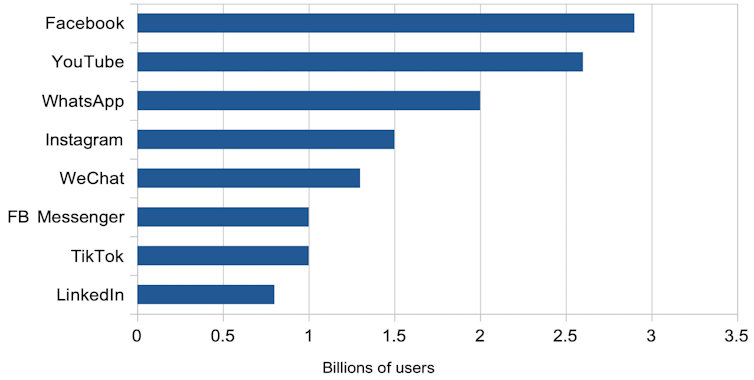
    Bar graph showing the largest social networks by user numbers
    All the data is monthly active users from January 2022, except LinkedIn, which just gives user numbers. Statista


    LinkedIn had a “good” pandemic, with conversations on the platform rising 43% and content-sharing almost 30%. It benefited from a shift in how people networked, related to findings from numerous studies that it’s the “weak links” in our professional networks who are the most important for gleaning critical information that leads us into jobs we genuinely desire.


    At a time when the usual barriers of time and space were less relevant and Zoom calls were ubiquitous, it became the perfect moment for reconnecting with these occasional contacts. Especially with so many people questioning their work situations, LinkedIn was the ideal place to see their posts and reach out to them.


    This meant that LinkedIn played a key role in the great resignation, particularly since like the platform, this movement was dominated by millennials. Users posting about changing or quitting jobs would attract large numbers of likes and comments, inspiring others to do likewise. The fact that so many people were connected on LinkedIn multiplied the effects, making it both the main catalyst and the main solution for employers.


    LinkedIn user growth over time
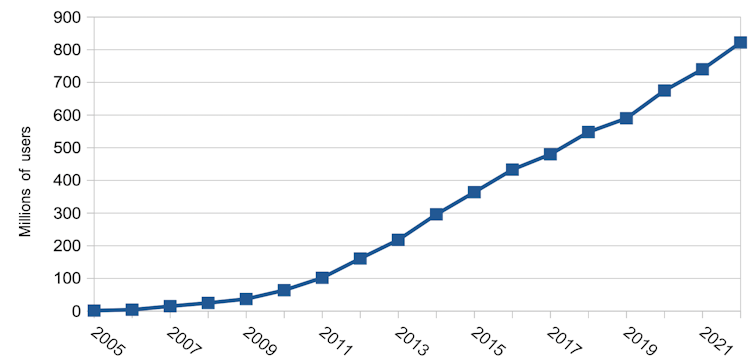
    Line graph showing growth in LinkedIn user numbers over time
    Various sources


    Meet the ‘work-fluencer’

    LinkedIn’s role as a lightning rod for work issues is also likely to determine how it develops, as a new category of social media influencer emerges – the “work-fluencer”. Companies are increasingly finding that employees’ LinkedIn profiles and postings can express the brand better than corporate accounts, allowing them to develop the corporate business network much more quickly and naturallyand naturally.

    When this is done well, employee posts are usually much more authentic than corporate PR. Rather than just curating articles on professional milestones and triumphs, people have become more open and honest about day-to-day work life.

    Over 13 million LinkedIn members have their profile set to “creator mode” to obtain higher exposure for their postings. Many use the hashtag #careertiktok to publish things like their wages and day-in-the-life vlogs about their professions, achieving over 1.5 billion views.

    This new “online watercooler” represents a change in the amount of information people reveal about their work on the internet. Workers are raising formerly taboo concerns like pay transparency, discrimination and professional undermining. Some professionals like lawyers, entrepreneurs and HR experts, have leveraged their posts into new content-marketing businesses and other profitable side hustles.

    Twenty years after LinkedIn was founded, this could enable the platform to enjoy the kind of trust and community growth that other social media networks would envy. Certainly it has challenges – fake accounts are an issue, for example. And LinkedIn inevitably attracts a lot of spam, which is probably one reason it doesn’t achieve the same amount of daily interactions as other social media.

    On the other hand, it benefits from not having a single direct competitor of scale. The nearest big ones would be Facebook Groups or Reddit, but LinkedIn’s purely corporate focus is always likely to be a plus against such players. At a time when traditional platforms like Facebook and Twitter are experiencing difficulties, LinkedIn has a real opportunity to continue succeeding as the one dedicated platform of its size.


    Theo Tzanidis is Senior Lecturer in Digital Marketing, University of the West of Scotland. This article is republished from The Conversation under a Creative Commons license. Read the original article.


  • eBay launches #LocalToGlobal campaign

    By A Correspondent


    eBay in India has launched its #LocalToGLobal campaign to encourage Indian MSMEs to expand their businesses globally.  The campaign was kickstarted by highlighting ‘India Se Duniya Tak’ narrative with a series of specially curated creatives across its social media handles.


    Said Pavan Ponnappa, Head – Growth Categories, Shipping & Marketing at eBay: “eBay has been at the forefront of fostering the culture of entrepreneurship in India. The #LocalToGlobal campaign aims to highlight the potential for Indian products, build awareness among Indian small and medium businesses of this opportunity and the role that the eBay marketplace can play in realizing this business opportunity. There has been a seismic shift in consumer behaviors in the wake of the COIVD 19 pandemic that is seeing growing demand for e-commerce across the globe and Indian MSMEs should capitalize on this by expanding their businesses, thus giving a much-needed push to the economy. We are glad that our marketing service provider Clevertize has been able to translate our vision into this precursor campaign and bring it alive in the most creative fashion”.


    Added Sagar Nidavani, CEO, at Clevertize: “What started as a small topical idea to support #VocalforLocal translated into a beautiful extension called #LocalToGlobal. If [the] 21st century belongs to India, Export has to take the center stage. The campaign captured the imagination of the Indian sellers and got many of them to aspire to sell their products across 190 countries through eBay marketplace platforms. The campaign has reached more than 1 Million Indian Sellers already, with many of them expressing their interest to sell on eBay. This is a step towards establishing eBay as the preferred platform to export for Indian sellers”.


  • eBay India launches new campaign – #ThingsDon’tJudge


    eBay India announced its brand new TV campaign #ThingsDon’tJudge. The campaign aims to inspire consumers to shop online from over 10 crore products available on ebay.in. The TV campaign will go on air from 28th September 2016.


    Conceptualised by BBDO India, the film shows different situation where people are seen breaking away from a certain prejudice that the society imposes. The means for them is a product they have purchased from eBay, which enables them to move away from the shackles of judgments and live as they would. A product is that one thing that doesn’t judge them, though people may.


    Commenting on the launch, Shivani Suri, Director Marketing, eBay India said, “Online shopping is changing how we live. It’s ushering in the acceptance of new. It’s at the heart of our evolving culture that’s gradually helping us distance from the norms around gender, age, cast, creed, social status or preferences. eBay, with over 10 crore products is inspiring consumers to shop for their favorite item and live their passions, desires, choices, and beliefs without inhibitions. With this central theme we decided to launch this campaign to not just capture market share but drive conversational commerce.”


    Said Josy Paul, Chairman, BBDO India on the film: “When we started work on eBay, we had questions: Will our idea provoke conversation? Will the context last longer than the immediacy of the content. Will it influence change? We could feel the energy in the room when this idea came up.  Something happened! The passionate team at eBay – along with BBDO team – are doing what we can to create a better world even as we create greater desirability for the 10 crore products that are available on eBay.”


    Added Hemant Shringy, Executive Creative Director, BBDO India: “When we found out that ebay has over 10 crore products, we knew it had to speak not just like a category leader, but as a conversation and thought leader. And eBay team really encouraged us and helped us find that voice. After an amazingly explorative and collaborative process we arrived at the idea – Things Don’t Judge. With 10 crore things at the heart of the idea, it says that in a time when we are constantly judging and being judged, things have the incredible quality and power of not judging. In fact they become our allies in finding our own versions of perfect, something that ebay stands for. We hope this idea helps create change. We think we have managed to make a film that tells the brand story and really makes you think.”


  • 40% preferred COD in their online Diwali shopping: IAMAI

    By A Correspondent


    While credit card usage took precedence over cash in online shopping during Diwali 2013 as per a survey by the Internet and Mobile Association of India (IAMAI), the COD delivery is not insignificant at 40 percent giving an indicator of confidence levels over sharing vital credit card info online. The dipstick study conducted from October 30 to November 4 in 15 cities, to understand the online shopping trends during the festive week, finds that majority of the transactions took place through credit card, debit card or net banking. The survey finds that 59% of the respondents used credit card to shop online, while 28% used debit card, reflecting the maturing of consumer behaviour in urban markets. 40% of the respondents however, mentioned that they opted for cash on delivery as their payment mode. A total of 3480 responses were received to the survey.


    Source: IAMAI, 2013


    The survey also revealed that electronics and accessories topped the list of items for online shoppers during Diwali. 41% respondents said they purchased travel tickets online, while 39% said they purchased garments.


    Source: IAMAI, 2013


    29% of the respondents mentioned that they purchased products in the range of INR 3000 to INR 5000. Interestingly, 20% of the respondents said that they purchased goods worth more than INR 10,000 and above. A mere 5% said they purchased goods worth INR 100 to INR 500.


    According to the survey, Flipkart was the most frequented e-tailing site followed by ebay, Snapdeal and Jabong. Among the booking sites, IRCTC was the top followed by Bookmyshow, MakeMyTrip, Yatra and Cleartrip.


    Source: IAMAI, 2013


    According to the survey, 31% of online shoppers were from Delhi NCR followed by greater Mumbai with 22% respondents. Bangalore was third with 12% respondents.


    Source: IAMAI, 2013


  • E-commerce brands Myntra, HomeShop18 and Ebay top in overall social engagement with consumers.

    By A Correspondent


    Social media agency WATConsult has released a report on the social health of e-commerce brands in India at the 3rd WATSummit. The report extensively tracks the social media sentiments of eight leading e-commerce brands, Flipkart.com, Inkfruit.com, HomeShop18.com, Jabong.com, Myntra.com, Snapdeal.com, Yebhi.com and Ebay.in.


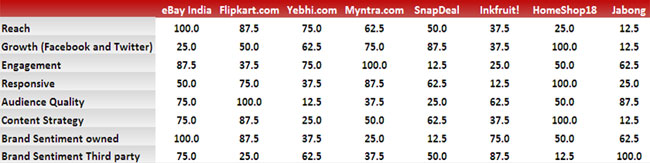
    Based on the multiple scoring parameters of the analysis, Myntra.com, HomeShop18.com and Ebay.in come forward as the scorers among the top 8 e-commerce players in the industry. The report analyses the social media and online trends of the e-commerce portals on parameters like Social Reach, Engagement, Growth, Response Time, Content Type and Audience Quality. The report also analyses the share of voice, brand sentiment, online reputation, source and keywords for each player in the online space.


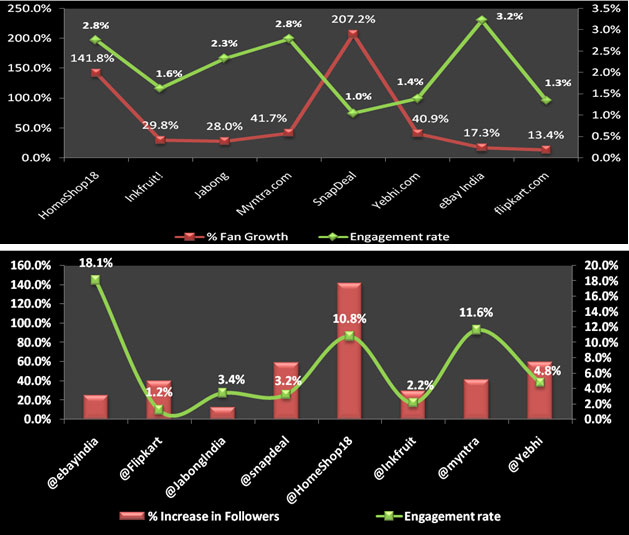
    Snapdeal.com, Homeshop18.com and Myntra.com are e-commerce players with faster growing base on Facebook and Twitter. However Ebay India boasts of the highest engagement on Facebook and Twitter followed by Homeshop18.com and Myntra.com.


    Homeshop18.com tops the chart as e-commerce player with the highest YouTube growth but Yehbi.com has the highest YouTube engagement.


    The top three players with high overall social media engagement are Myntra.com, Ebay India and Yebhi.com.


    Homeshop18.com is the brand with the fastest response time on Facebook and Twitter. The top 3 players with high overall response time are Homeshop18.com followed by Myntra.com and Flipkart.com.


    From an overall e-commerce industry perspective negative sentiment stands at a 48 percent as against the positive sentiment of 13 percent. The rest of the conversations of 38 percent were found neutral. Jabong.com has managed to sustain the top position for neutral and positive sentiment while Flipkart.com on the other hand has the highest neutral conversations of 64 percent to its credit.


    While comparing the social image of brands on Facebook, Myntra.com is a brand with least negative and maximum positive conversations.


    Only 16 percent of the products ordered from an ecommerce player were received on time. Delay in delivery still is a big concern for all players in this industry.


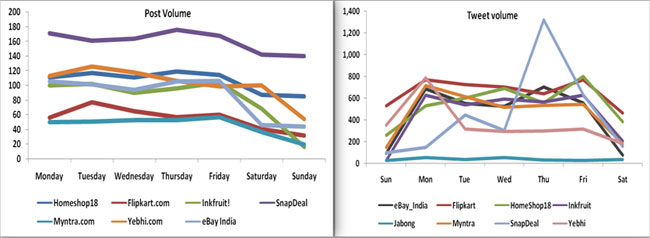
    The report also gives a closer look at the posting activity on leading platforms like Facebook and Twitter. While Tuesdays and Thursdays are the most active days on Facebook, Mondays and Fridays dominated twitter with the maximum tweets. Surprisingly, social media activity on weekends on both platforms reduced as compared the activity on weekends.


    In terms of engagement, the top three brands on both Facebook and Twitter are Ebay India, Homeshp18.com and Myntra.com.


    Commenting on the analysis, Rajiv Dingra, Founder & CEO, WATConsult said, “Crores of rupees are spent regularly by e-commerce brands to acquire new customers, but who are the champions who have managed to engage with their consumers consistently and coherently? Our report highlights the activities carried out by these eight leading ecommerce players on various online platforms and seeks to identify trends related to the digital marketing of these brands.”


  • Debrief: eBay: Yawn Bay

    By Anil Thakraney


    Maha thakela campaign from eBay. Both the communication strategy and the creative suck. There is a series of TVCs on air, essentially selling best deals and safe shopping. Isn’t that an obvious strategy for an online marketing portal? Flipkart and others have already been making the same promise. So there’s nothing new here.


    Given that the strategy is weak, it’s now left to the execution to save the show. And this one’s a disaster. Basically the ads consist of boring discussions between the believers and the cynics. Someone wants the latest phone but wants the price to drop. Another one isn’t sure if it’s a good idea to purchase shoes online. And you can easily predict the rest.


    [youtube width=”400″ height=”220″]http://www.youtube.com/watch?v=0iwtMFwfhBk[/youtube]

    This is really boring stuff. The conversations are dull and unengaging, the treatment is the same old problem/solution approach, and it’s spelt out literally. With no creative spark, these ads, I’m afraid, have zero chance of being noticed. Especially given the pre-Diwali clutter on television. Flipkart has the ditto same approach, but that one single creative leap, of kids behaving like adults, helps them smash the clutter through cute advertising. eBay hasn’t taken any leap, so their ads will wither away.


    To be fair to the ad agency, I strongly suspect the ultra safe-playing client is at fault here. Neither have they come up with a refreshing brief, nor have they allowed their agency to experiment. Net result? Well, check the rating.


    Rating: (On a scale of 1-5): 0. Poor strategy. Poor creative.


  • Does social media boost ROIs for e-commerce sites?

    By Robin Thomas


    Merely setting up shop is not enough today, and brands are not limiting themselves to advertisements on television, print, radio or even the internet alone. They are logging onto social media in a big way, interacting with and updating their consumers about new products or other initiatives, and e-commerce sites are not far behind. Myntra, for instance is already said to have registered over 7 lakh Facebook fans. Myntra also has a fashion blog, ‘Style Mynt’, wherein it shares information about the latest celebrity fashion trends, new product offerings on Myntra.com and so on. Another e-commerce site, Indiatimes Shopping, started its Facebook page early this year and is said to currently have more than 2 lakh fans on Facebook.


    eBay on the other hand claims to answer over 1,200 queries every month across social media platforms. It is said to resolve over 120 post-transaction complaints every month and is ranked sixth in Social Bakers’ ‘Top 100 Global Brands on Facebook’ index and is also said to be the third most engaging FB Brand Page in India. In addition to these, eBay also conducts online contests enabling the e-commerce site to engage with its consumers. For instance, it conducted a contest called ‘Battle of the Fans’ around the IPL last year. It also launched a Facebook application called ‘Battle of the Fans FB App’ for the contest. As a result, the ‘Battle of the Fans’ app is said to have become the most popular Facebook IPL app two years in a row. Simultaneously, over 15,000 streams were said to have been published from within the app and is also said to have witnessed nearly 27 percent click-through from app-to-merchandise on the site. Besides Facebook, e-commerce sites like Indiatimes Shopping, Myntra, eBay India, Olx etc. are also active on other social networking sites like Twitter, Google Plus and so on.


    Social media vs sales targets

    Ashutosh Lawania

    According to industry estimates, nearly 25 percent of the time spent online is on social media platforms. Out of this, 50 million are said to be on Facebook, and 13 million on Twitter. The question however is, do social media activations lead to better ROI’s (Return on Investments)? Do the ‘likes’ and interactions or engagements with consumers translate into sales? According to Mr Ashutosh Lawania, Co-Founder and Head – Sales & Marketing, Myntra.com, “Though engagement is our focus on social platforms, the activities there do contribute to traffic and sales on Myntra, and we keep track of it. Contributions from these platforms are in the lower single digit figures (percentages) when compared to other channels but they do add up. Besides, Twitter and Google Plus, we also use Facebook for advertising along with generating organic traffic. About 80 percent of all Facebook traffic on Myntra is paid with the remaining 20 percent driven via organic.”


    Subhanker Sarker

    Myntra uses tools such as Facebook, Twitter, Pinterest, Google Plus to make announcements about new products, trends and to give out regular fashion updates which Mr Lanwania observed results in increased awareness and in turn influences purchase decisions.


    Having a slightly different take on the impact of social media activities on the sales, Subhanker Sarker, COO,Indiatimes Shopping was of the opinion that social media activities at times do result in better ROI’s. “Experimentation is the key. There is a certain tonality of communication, a very precise targeting of the message and a very strong follow through that can work magic. Social media is an excellent tool to keep expanding the circle of trust. The offer ads introduced recently drive a lot of sales for us now. The revenue percentage would still be in low single digits, but it all depends how you define it. Measured over a longer time period and favourable attribution logic, it touches double digit percentages.”


    Kashyap Vadapalli

    Kashyap Vadapalli, Chief Marketing Officer, eBay India observed, “Social media channels get us over 12% of our daily traffic which translate into deeper reach and higher conversions. In terms of ROI, they are one of the cheapest tools for generation of daily visits and excellent mediums for acquisition & retention marketing.”


    Anurag Gupta

    Anurag Gupta, MD, DGM India was also of the opinion that social media activities surely do reflect on the sales and revenues of e-commerce business. “Most of the e-commerce companies are using advertising on social media to drive transactions in addition to engagement activities. This is on an increase especially since platforms like Facebook have begun providing re-targeting capabilities. Sub-optimal use of social media platform by brands happened earlier, now brands have graduated and are using social media beyond likes and onto engagement and transactions.”


    The road ahead

    Social media is said to play a significant role in driving rapid growth for e-commerce brands. Only recently Myntra is said to have used social media platforms to launch its latest TVC before launching it on other media platforms. “It is an important platform to engage the audience, increase awareness and drive top of mind recall. It also plays a significant role in collecting feedback and giving customers a platform to voice their opinion and share their views on what they like or dislike” explained Mr Lanwania.


    According to Mr Gupta, social media activities for brands are increasing significantly. Most brands today have their presence on social media, including e-commerce brands. The brands are now using social media for engaging with users and a lot of e-commerce brands are increasingly using social media for commerce as well.


    However Mr Sarker was of the opinion that although social media has become a very significant platform today, brands must not be seen intruding their consumer’s privacy. “Social media can give you immense insights into your customers psyche. How you leverage that is up to you. Hence it is definitely significant for everybody. But one must respect the privacy of the audience. They are on social media mainly to socialize. If they were in the mood of buying something they would be on an e-commerce website. Intrusion is not taken kindly. We see social media as a customer insights opportunity rather than a sales one.”


    Taking social media onto a different level altogether, e-commerce sites are beginning to effectively use advertising on social media to drive their transactions. Although the revenue generated or the revenue percentage from social media activities are still said to be in single digits, it is believed to grow depending on the innovations and the engagement that e-commerce sites have to offer to their consumers.


    “Offline shopping tends to be a social phenomenon, and this will catch up with online shopping as well. We foresee online shopping getting integrated with social media as more and more enthusiasts will start seeking opinions before they indulge and seek compliments post indulgence. This could take the form of deeper and richer integration of social tools in the online shopping experience. One would also e-commerce players leveraging the social graph to add engaging ways to enable users to talk & share about shopping on various social media channels” concluded Mr Vadapalli of eBay.


  • Ad Strat: eBay – Want it. Get it

    Sandhya Srinivasan, Chief Strategy Officer, Law & Kenneth


    Name of the Campaign: eBay – Want it. Get it.


    The Brief: eBay India is where you can buy a range of brand new products.


    Research/Insights: 

    Shopping, in reality, has a strong emotional narrative. While money is exchanged and tangible goods are purchased, it’s the intangible flight of the heart that makes shopping such an addiction. People don’t buy products & services. Their attempt is always to fulfill a desire or negate a worry. They want to get back to their waist 24′ jeans or look like the coolest dude in the mohalla and so on. Products they shop for are just means to an end. 


    The thought process behind the creative:

    To fulfill your wants and achieve your dreams, you will need a lot of things along the way. Whatever they are, you will get them on eBay India


    Media vehicles chosen: TV, OOH, Digital, BTL [Cafe Coffee Day and PVR]


    Key issues kept in mind while executing the ad:

    eBay India offers great deals on the widest range of brand new products


    Does the treatment do justice to the brief?

    Yes it does. It puts the products in a life context, almost mirroring the unspoken desire that drives shopping. Makes it relevant in an easy, casual sort of way.


    What according to you is the differentiating factor about the ad?

    Every other brand in the eCommerce space is focused on discounts/deals and modus operandi of the category itself. eBay India’s focus, however, reinforces the role of eBay in every Indian’s life thereby lifting online shopping beyond the mandi/bazaar mentality to a life/lifestyle upgrader.


    Market and client feedback:

    eBay India has witnessed strong double-digit growth in overall traffic to the site as a result of this campaign


  • Debrief: eBay: Simplicity works

    By Anil Thakraney


    You want to patao that supermodel? You want to be a beauty queen? No worries. You can do it all via eBay.


    The promise in eBay’s new TV campaign seems to be simple enough. I watched two commercials. In one, Ms Jabalpur desires to become Ms India. And she easily gets what it takes on eBay. In another ad one rather seedha saadha banda is able to win over a hot babe by buying her scintillating goodies on eBay. Simple enough and very massy concepts. And it works. Only because the communication is single minded.


    eBay only tells you that if you desire it, it’s here. And there’s no clutter of additional promises forced into the advertising. Also because the promise isn’t really earth shattering, the execution has to play a very important role. And must say the ads are done nicely. Although the humour isn’t really strong, they do leave you with a smile. So that’s fine.


    [youtube width=”400″ height=”200″]http://www.youtube.com/watch?v=kTKyVR3RfAI[/youtube]

    All said, it’s done well. And they can produce many ads with this theme. Just one suggestion: What will make the communication work even better is if people are shown to desire bizarre stuff. AND they get them too. Just to give you an extreme example: A man wants to kill himself, but doesn’t know how to go about it. Till eBay comes to his, er, rescue. Of course, it’s macabre. But you get the idea!


    Rating: (On a scale of 1 to 5): 3. Focused and effective.