
Tag: DY Works

  • DY works appoints Ashish Bahl as CEO

    By Our Staff


    DY Works appoints Ashish Bahl as CEO. Ashish takes over from Tresa Paul who has moved out to pursue new opportunities.


    Ashish has spent over 25 years reshaping brands and building memorable campaigns in advertising, marketing & media. He has worked with SABMiller India (now AB-Inbev) Neo Cricket & Sports, Mccann, Contract, JWT, Leo Burnett & O&M, where he’s worked with over 100 iconic global brands including Pepsi,Coca-Cola, MasterCard, Nestle, ESPN, SABMiller, Hero-Honda and many more. Since 2017, Ashish has founded/co-founded three companies including The Happiness Project, 1418 (a platform for 14-18 year-olds) and Happinessperkm (India’s only motorcycling brand built by riders).


    On this appointment, Santosh Desai, CEO & Managing Director, FutureBrands, said: “I’m thrilled to welcome Ashish on-board. Ashish’s appointment signals the evolution of DY Works from building products and experiences to re-crafting and using design-thinking to find impactful solutions rooted in deeper belief systems. I’m excited about what’s yet to come and the change we’ll bring.”


    Said Ashish Bahl, Managing Director & CEO, DY Works, “I’m honoured to join an incredible team at DY. My key focus will be to use design-thinking and semiotics to build purpose-driven brands. In this new phase at DY we will expand the definition of design where we will build brands committed to human-centric business design. I look forward to this new journey and creating some fantastic work with the DY team.”


  • Tresa Paul takes charge of DY Works as Alpana Parida moves on

    By A Correspondent


    Design Thinking firm DY Works has announced the appointment of Tresa Paul as its new CEO and Managing Director. She takes charge from Alpana Parida who has moved out to pursue entrepreneurial opportunities. Paul was until recently Head of Products & Marketing (APAC) for Bonzai Digital, the Singapore-based programmatic creative technology platform and Senior Vice President at Ogilvy India right before.


    Said Santosh Desai, CEO and Managing Director – FutureBrands, which owns a majority stake in the company: “For the past 10 years, DY has done memorable work in brand design and packaging rooted in deep cultural insights with the best brands in India. This next phase is about leveraging the current position and ensuring DY moves into its next chapter of growth and impact. I  couldn’t be more delighted to welcome Tresa to lead DY into its next journey.”


    Added Paul: “ I am excited to take charge of DY Works. DY’s approach of design thinking, cultural insights and semiotics in futureproofing brands is well known. Our added focus will be on design and its impact on systems and communities as a whole while we continue to do what we do best. I look forward to designing this new journey with Team DY.”


  • DY Works appoints Dhaval Shah and Tanvi Shah


    Leading design firm DY Works has made two senior appointments in Dhaval Shah and Tanvi Shah.


    Commenting on the appointments, Alpana Parida, MD, DY Works said, “We are excited to welcome Dhaval and Tanvi to our team. Both come in with varied expertise and experience, and add a new dimension to our Business Design practice.” She added, “Their skills are key to our human centric business design focus, adding further depth to DY’s innovative problem solving capabilities.”


  • Branding firm DY Works rebrands to reflect changing market

    By A Correspondent


    For a firm that prides itself on branding and rebranding, DY Works has rebranded itself as it charts out a new direction to impact businesses through design thinking. DY Works has pivoted to offering human-centric business design. It will harness and leverage the power of design thinking across digital transformation and customer experiences to power businesses to lead at the speed of change, while deeply understanding the cultural context of a changing society.


    Said Managing Director Alpana Parida: “If you do the same things, you get the same results. Category after category is seeing disruptions – and customer satisfaction no longer guarantees loyalty. Businesses today need fans, not customers.”


  • DY Works undertakes rebrand of Anmol Biscuits

    By A Correspondent


    Kolkata-based biscuits and foods major Anmol Industries Ltd has undertaken a rebrand exercise led by strategic design and consultancy firm, DY Works. With the aim of expanding market share and increasing its geographical footprint from eastern and northern India to a pan-India presence, Anmol roped in DY Works to carry out a complete rejuvenation of the brand architecture and visual design.


    Abhijit Sanyal

    Said Abhijit Sanyal, President, DY Works: “We wanted to make the Anmol brand much more modern, warm, approachable – by building on the friendly ‘smile’. We started with an overall corporate branding revamp leading into clutter-breaking packaging not just at the master brand level, but at each sub-segment level too. We believe that this innovative design approach, the unique logo and excellent product quality will help Anmol stand out against competition.”


    Added Ranendra Nath Ojha, Chief Marketing Officer, Anmol Industries: “Based on consumer feedback and our own strategic vision, we have undergone a complete change of our logo and packaging to be seen as a young contemporary Indian brand, which is in line with the aspirations of the youth. The new Anmol logo is a reflection of Anmol’s values of spreading joy and warmth and has been designed to appeal to its core target audience.”


  • Boris Gomes to lead DY Works’ digital practice arm

    By A Correspondent


    Boris Gomes

    Leading strategic design and consultancy firm DY Works announced the launch of an integrated socio-digital practice. This practice will provide clients with seamless online and offline digital platforms based on culture, to create disruptive business interventions.


    Boris Gomes will lead this innovative practice and brings on board his experience in user experience design, user interface design, video/animation production, social media strategy and design as well as interactive on-ground activation experience design. Previously, he has worked with VML Qais and Lowe Lintas. He is an alumnus of Srishti Institute of Art, Design and Technology.


    Commenting on the announcement, Alpana Parida, Managing Director, DY Works, said: “We don’t see digital as a medium, we see it as a destination. A whole generation of Indians will be digital natives and our practice seeks to understand how they inhabit this world one moment and cross over to the ‘real’ one the next! Boris does not follow a formulaic path and approaches each assignment with a deep empathy for the user. His approach is helping us build a totally different socio-digital practice.”


    Added Gomes: “I’m looking forward to creating un-paralleled digital experiences for clients based on DY Work’s unique knowledge of semiotics and understanding of behaviour and culture, ethnography and the science of choosing which will allow our clients to engage meaningfully with consumers.”


  • DY Works hosts session for CEIBS MBA students

    By A Correspondent


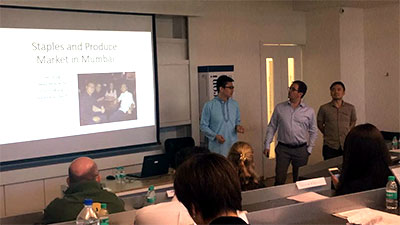
    DY Works recently hosted the global executive MBA students from CEIBS University, Shanghai at a two-day conference at MISB Bocconi in Mumbai. The students/ group members ranged in work experience of between 10 to 15 years and are senior executives at the firms they work in. Their profiles vary from strategic consulting to business development, finance and management control. It was the first time for the members in India, completing a leg of visits with Tata and Infosys in Bangalore and with Future Group and DY Works in Mumbai.


    As part of the study, the members spent time at general trade and modern trade outlets, across South, Central and Suburban Mumbai. The goal was to have them observe changes in package formats, new innovations, and communication methodology. They also had to observe store layouts and ease of navigation in them, the kind of consumers at these venues, buying behavior, purchase patterns and consumer trends.


    It was noted that consumers still spent time in local markets and sabzi mandis for their daily and weekly produce unlike in China where produce purchase had moved largely to the supermarket format. This is governed by the Indian consumer’s need’ to see, touch produce, engage and have a personal relationship with the retailer, which was an important driver in purchase for this category.


    “Overall, the students did understand that culture plays an important role in India and governs our purchase behavior, and that the roles of women and men, through access to education and employment, as well as changing family structures was going to affect product innovation and formats at shelf and thus how brands approach the India psyche. They also felt that the Indian consumer could not necessarily be catered to with a global lens, but needed to be understood and respected and thus businesses would have to have on ground interaction to create products that would win in the country,” commented Alpana Parida, MD, DY Works.


  • Brand Matters by Alpana Parida: Do celeb endorsements work for brands?

    By Alpana Parida


    With the controversial Pierce Brosnan ads, the ubiquitous Deepika Padukone, Amitabh Bachchan and Ranvir Singh, the three Khans, the top male and female actors, the cricketers, the rare winners ofother sports, celebrity endorsements have always been big in India. From underwear to cement, cars to pan masala – no category seems to be without such an endorser.


    Brands spend upwards of at least Rs 10-15cr on such ads: fees to celebrities, production costs of ads and media costs together add up to spends frequently as high as Rs 30-40 cr.


    So does this work?

    Some celebrity endorsers are notoriously promiscuous. They advertise for so many categories, some even jump brands when their contract expires so the same celebrity is now with a different cola or brand of jewellery; that while viewers/ consumers often remember the celebrity and the ad – the brand, very often, has little association. The way celebrity endorsements are supposed to work is by inserting the association of the celebrity with the brand, in our memory system. Associations are how we remember things. And yet, if the association is without relevance or is not unique and is repeated in other contexts as well – it no longer becomes memorable. The chances of the brain remembering this are very low.


    The advertising industry still uses scores for ad recall. Top of mind ads are considered to be effective. Unfortunately, the narratives of ads are getting more and more interesting as budding / arrived film makers try this oeuvre to hone their skills – while they are getting further and further from the brands themselves. An interesting memorable ad is not the same as an effective ad – if the narrative or the celebrity does not resonate the brand values, essence or personality, there is little impact on a brand’s salience.


    Shah Rukh Khan claiming to be a Big Basket shopper or buying/ choosing Nerolac paints is ludicrous. Farhan Akhtar endorsing two wellness brands – Nutrilite and Nutrichoice is confusing (what were they thinking??). Amitabh Bachchan rapping, dancing and appearing as puppets is memorable, creative – but  heis the face of so many brands that TataSky is appearing at the end of the long ad loses out as a brand. Seeing Deepika Padukone connecting with her father for Tanishq, questioning the colour of her jeans for Asian Pains, dropping by on Renuka Shahane to share Coke; all the while being brand ambassador to Axis Bank, Kellogg’s, Garnier, Vogue, Tissot, Van Heusen, Lifestyle Melange, Parachute, HP, Nescafe, Lux, and more confuses us as to which brand is she endorsing now.


    The narrative that engages mores, is more relevant  for the category and is truly reflective of the brand’s values is the one that wins – in this case Tanishq – but the association of the brand is still an uphill battle with so much else attaching to  DeepikaPadukone. Celebrities come swathed with associations already – from their own body of work and success, their relationships and significant others, their awards and accolades,  their other activities such as TV presence, their page 3 appearances and more – that for a brand to try and attach itself to a celebrity particularly at the top of his/ her game is really really hard.


    When does it work?

    It works when it is unique such as James Bond eating Pan Masala. While it is ludicruous to imagine Pierce Brosnan popping small spoonsfull of Pan Masala in his mouth – the audacity of the brand, the sheer fantasy of James Bond, and the need of the category to reach a younger audience has made this a brilliant move. Whether the brand misled him on the contract or that he was a naïve believer who in face of much money, did not ask enough questions is a moot point. Micromax with Hugh Jackman and Pan Bahar with Pierce Brosnan did a lot to elevate the brand’s image. It also helps that international celebrities are not going to be used and overused across categories in India.


    ‘Kya Idea sirji’ worked because Abhishek Bachchan was not associated with any other brand. His relative lack of success workedas he was not an overused face.  He became the face of Idea and the fact that he was seen as being great – even though not at the top, helped the brand. The thing is, the strong association of good, but not a winner dogs the brand still as it has always remained a third to Vodafone and Airtel.


    Brands can do so much more than riding on celebrities – not just through advertising, but also by leveraging many other brand touchpoints to orchestrate a strong brand experience to create a memorable, distinctive and preferred brand. For far less than the cost of a celebrity ad campaign, experience-based brand creation  can shape preferences and create market impact. It is time we gave celebrities a break!


    Alpana Parida is Managing Director, DY Works. A graduate from IIM Ahmedabad and St Stephen’s College, Delhi, she has spent over 30 years across various marketing functions in the United States and India. As part of the steering team at DY Works, she espouses the use semiotics to both decode consumer and category and encode the solutions in design. Brand Matters is a fortnightly column by Alpana Parida for MxMIndia. The views expressed here are not necessarily those of her organisation.


     

  • Is E-commerce Advertising a Sea of Sameness?


    By Alpana Parida


    Over the last five years, e-commerce has consistently clocked double digit growth. With 300 million active internet users (and growing), e-commerce in India is still at an approximate 1.7% of the total retail sales (by revenue). The opportunity is massive and investors are betting big on the category and are pouring in money on marketing and customer acquisition.  E-commerce is one of the biggest spenders on advertising today.


    With Snapdeal spending upwards of Rs 200cr, and Amazon spending Rs 250cr for the advertising of their annual Diwali sales, you would imagine their brands would benefit – and that they would acquire new consumers, create a preference for their brands and thus cause retention of these consumers for the future.


    Actually, this high-spending category is still unable to create brand loyalists. The problem lies with the medium. At brick and mortar establishments, a customer, once in the store, finds store-hopping painful as he/she needs to walk or find transport and physically go to the next destination. E-commerce, however, allows infidelity with a click as choice has no cost and a better deal is just a click away. The entire category has largely played on deals and discounts – a strategy that is inherently at odds with online shopping.  When Big Bazaar says “Is se sasta kahin nahin”, the consumer finds loss-leaders that are cheap such as sugar, atta and other staples and the store benefits because not everything is discounted. The consumer buys into the store and then proceeds to buy discounted AND full-price products. In contrast, for e-commerce, every product can be compared across stores and the lowest price means just that. Lowest price. The entire industry has abetted in creating this unfaithful consumer who only seeks the lowest price.


    The communication strategy of the key players, thus far, has largely been about a deal or choice. Both have been category promises and have done little to build the brand. While Snapdeal, Amazon, eBay, Flipkart, Myntra and Jabong became household names, they did little to distinguish themselves uniquely. With the notable exception of Flipkart, who while also making category promises of genuineness, easy returns, lowest prices etc, broke through the category clutter with its masterful use of kids to subliminally register ‘child’s play’ to the initiates into the category.


    When all promise the same thing, the brand that is the most differentiated benefits the most. Memorable advertising does not translate into long-term brand loyalty. Rather, creation of a distinctive brand that has a distinctive promise and a unique selling proposition requires consistent reinforcement and manifestation of the brand visually and experientially.  They have to engage, provoke and delight.


    Thus, the recent move away from mere category promises to create a deeper connection with the consumer emotionally by all the key players was a much needed shift away from the pure deal/ choice/ exchange based undifferentiated communication.


    But the scourge of undifferentiated communication continues. The eBay ad has an old woman skipping rope, the Amazon ad has a badminton racquet send to a young mother and the Snapdeal ad sends ghungroos to an older lady to help them rediscover their passion. Jabong goes a step ahead, urging consumers to be comfortable in their skins, and boldly expressing themselves. While each one is visualized differently with Snapdeal calling it ‘Unbox Zindagi’, eBay claiming that products do not judge and Amazon exhorting mothers to be a girl again – each is playing on the same theme of rediscovering yourself being true to yourselves and reliving old dreams. Web only ads of Myntra also ran a series of 4 ads that cover homosexuality, single motherhood, career and notions of character. These were cast in the same mould. The exception is their current TV campaign using theuber cool couple – AbhayDeol and Ira Dubey as Myntra shoppers raising the fashion quotient of the brand. Myntra would do well to use them for a longer term – much as Idea telecom had created an association with Abhishek Bachchan.


    What is remarkable in each of these stories is the power that is vested in the self.  Over time, similar ads show a blurring of recall and do not attach clearly to a single brand unless a brand stands out. The red Snapdeal box is clearly distinctive – and if the idea of ‘Unbox Zindagi’ comes alive not just with an evocative box but across all consumer touchpoints – then the brand gains traction. The others, well, will have the satisfaction of creating the category and see some of that growth attaching to themselves.


    The ecommerce space is becoming increasingly cluttered and similar consumer insights have led to similar advertising. When the brand proposition is the same and not differentiated, brands need to stand apart through a clearer definition of their personality and tone of voice. In another category – Axe remains a funny pied piper every single time or an Indigo celebrates the joy of flying in a tongue in cheek way. They tell you that consistency is important and it need not be boring. Ecommerce brands need to learn that before burning more cash. Fast.


    Alpana Parida is Managing Director, DY Works. A graduate from IIM Ahmedabad and St Stephen’s College, Delhi, she has spent over 30 years across various marketing functions in the United States and India. As part of the steering team at DY Works, she espouses the use semiotics to both decode consumer and category and encode the solutions in design. Brand Matters is a new column by Alpana Parida for MxMIndia. The views expressed here are not necessarily those of her organisation.
     

  • DY Works bags branding mandate for Aurangabad Industrial Township

    By A Correspondent


    DY Works has been awarded branding mandate for Aurangabad Industrial Township, also known as Shendra-Bidkin industrial belt, being developed as a part of Government of India’s prestigious Delhi Mumbai Industrial Corridor Project. DY Works bagged the mandate by towering over five peers including JWT.


    Alpana Parida

    Alpana Parida, President, DY Works, said, “This can be termed as an orbital shift for the company. We have always believed that true design always fosters positive transformation. Associating as a brand consultant with smart city is not only a prestigious moment for the team but will enable us to take the narrative of DY Works into newer arenas that demand design thinking.”


    The awarded mandate for Aurangabad Industrial Township is aimed at development of strategic brand identity, in order to improve awareness and visibility within potential local and global investor community as well as the general public.


    Delhi Mumbai Industrial Corridor (DMIC) is India’s most ambitious Infrastructure programme aiming to develop new industrial cities as “Smart Cities” and converging next generation technologies across infrastructure sectors. The objective is to expand India’s manufacturing and services base and develop DMIC as a “Global Manufacturing and Trading Hub”. In the first phase seven new industrial cities are being developed. The programme has been conceptualized in partnership and collaboration with Government of Japan.


  • DY Works appoints Amrita Chowdhury as Business Head

    By A Correspondent


    DY Works has announced the appointment of Amrita Chowdhury as Business Head.


    An alumni of IIT Kanpur, Amrita obtained an MS from University of California, Berkeley and then an MBA from Carnegie Mellon. She has worked on three continents in Chip Manufacturing, Strategy Consulting and has also led the Harvard Business School education portfolio in India. She holds seven US patents for semiconductor manufacturing.


    Prior to joining DY Works, Amrita was the Country Director of publishing firm Harlequin in India. Amrita has also written two fiction books and contributes regularly in mainstream media, magazines and electronic platforms.


    Speaking on the occasion, Alpana Parida, President, DY Works, said, “Amrita joins us at a critical time – when we are searching for new ways to do things – and living our India-centric approach through greater exploration. It is incredibly exciting that she is not from the world of branding or communications – and thus will bring a fresh perspective to what we do and add value immense value to strategic initiatives of the company going forward.”


  • Brand consultant Santosh Desai picks up one-third stake in DY Works

    By A Correspondent


    Eminent brand consultant Santosh Desai, has picked up stake in brand strategy and design firm DY Works. Desai picked up the remaining stake from the erstwhile promoter of DY Works, Sanjeev Malhotra of Alia Group. In 2009, Future Brands helmed by Desai picked up the majority stake in DY Works.


    Alpana Parida

    Speaking on the occasion, Alpana Parida, President, DY Works, said, “We’ll be looking for future synergies between the work Future Brands is doing and design work DY Works does. Given Santosh’s in-depth knowledge and wide experience, we are confident of building synergies through culture-based design and rural-focused brand amplification strategies. We’ll be working together on some projects. We’ll be focusing much more and building design for India in product innovation and creating brands which are more India-specific.”


    Santosh Desai

    Commenting on the development, Santosh Desai, said, “The synergy between strategy and design is relevant. DY Works encodes solutions through design, thereby creating designs that impact market shares and brand valuation, Additionally, an approach embedded in culture is common to us as well. For brands to succeed in India – we need an understanding of the Indian cultural context, of dimly lit kirana stores and changes in consumer mindsets.”


    DY Works has grown almost 3-fold in the last six years and has Corporate, Consumer and SME practices with offices in Mumbai, Delhi and Bengaluru. The firm also focuses on the rural market and is currently undertaking an extensive rural research to understand the emerging consumer – new behaviors and beliefs in over 150 villages firsthand.


    While Alpana will continue as President; Desai will continue as an advisor with the company.