Tag: Draftfcb + Ulka

  • Students impress Coke in Draftfcb Ulka Comstrat 2012

    By A Correspondent


    The finals of the seventeenth edition of Draftfcb Ulka Comstrat 2012 were held in Mumbai in December 2012, in association with K J Somaiya Institute of Management. The case study contest for management schools involves a live case study, and this year’s competition was on the energy drink Burn from the Coca-Cola Company.


    Draftfcb Ulka Comstrat, (Communication Strategy in short), is a reflection of the strong tradition of strategy-based advertising that has been practiced by Draftfcb Ulka over its 50 year life span. The uniqueness of Draftfcb Ulka Comstrat lies in the fact it is the first competition launched in the area of advertising and communication strategy based on a real life marketing situation, on a live brand.


    The competition offers an excellent opportunity for students to work on a live case and build an interface with senior advertisers, marketers and academia. It is designed to help all the constituents, the company gets fresh, inspiring new ideas and perspective, students gain and learn from industry stalwarts and Draftfcb Ulka furthers its academic connections.


    This year it received participation entries from over 50 teams out of which five were shortlisted for the final round. The five shortlisted teams this year were from IIM Indore, JBIMS (Bajaj), MICA, SIMC (Symbiosis) Pune and SIMSR.


    Out of these teams SIMSR Somaiya Institute of Management and Research emerged as the winner by presenting a scintillating demonstration of strategy to increase off trade sales of the energy drink Burn. They brought out clarity of thought in their idea of ‘Turbocharge your passion’, based on the analysis conducted by them.


    The jury for this year included Ajay Konale, (Senior Manager – Brands, Coca-Cola India), Dorab Sopariwala, (Consultant – Consumer Behaviour, and Editorial Advisor to NDTV), Kinjal Medh, (COO, Cogito Consulting), and Vidyadhar Wabgaonkar, (Senior Vice President, Head – Strategic Planning, Draftfcb Ulka Advertising (West and South)).


    Kinjal Medh, COO, Cogito Consulting, and a long time jury member of Draftfcb Ulka Comstrat said, “The competition has grown tremendously in terms of number as well as quality of participants and student’s enthusiasm.”


    Calling it an exciting competition Mr Konale added that “We looked at three parameters, first the relevance and richness of the content, second the structure of thinking, the clarity of thought and hence the clarity of recommendations and third presentation and the communication.”


    This year’s winners SIMSR (Somaiya Institute of Management & Research) received a cash prize and a host of gift vouchers. The sponsors for the 2012 edition are Amul, Act II Popcorn, Croma, Kansai Nerolac Paints, ITC Sunfeast, Wipro and Zodiac Clothing Company.


  • Draftfcb Ulka creates Dark Fantasy for Sunfeast

    By A Correspondent


    Riding on the successful re-launch of brand Sunfeast Dark Fantasy in 2010, ITC Foods has unveiled a new television campaign for Sunfeast Dark Fantasy Chocolate and Vanilla cream biscuits with a new theme ‘How far will you go for a Dark Fantasy?’ Conceived by Draft FCB Ulka, the Sunfeast Dark Fantasy brand communication reflects the core promise of ‘Pure Indulgence’.


    [youtube width=”400″ height=”220″]http://www.youtube.com/watch?v=0CV5ozuBZw8[/youtube]


    Dennis Koshy, Vice President, Draftfcb Ulka Bangalore, said, “Indulgence products are expected to whisk you away into another world – a world of sensorial pleasures. With its premium ingredients, Sunfeast Dark Fantasy is perfectly crafted to deliver on that promise. Even the final signoff ‘Dark Fantasy – escape into one’ flows from this belief.”


    [youtube width=”400″ height=”220″]http://www.youtube.com/watch?v=xdMY5QqOM8Y[/youtube]


    The new campaign developed by Draftfcb Ulka consists of two TV commercials, one for Chocolate and one for Vanilla cream.


    Sunfeast Dark Fantasy, the premium range of creme biscuits from ITC was launched in 2005. The brand is currently the leader in the premium creme segment and is available in three variants, Chocolate, Vanilla and Choco Fills.


    Client: ITC Foods

    Agency: Draftfcb Ulka, Bangalore

    Creative Team – Dharmesh Shah

    Production House and Director: Ginger Water Films, Zap.


  • Draftfcb Ulka Comstrat 2012 – grand finale on Dec 22

    By A Correspondent


    DraftFCB+Ulka’s Comstrat, now in its seventeenth year, is the first ever case-study competition in the area of marketing communications, organized in association with K J Somaiya Institute of Management. The exciting youth oriented brand case study this year, Burn, has been provided by Coca-Cola India. The Case Study can be accessed at http://www.draftfcbulkacomstrat.com/index.html


    Comstrat, Communication Strategy in short, is a reflection of the strong tradition of strategy-based advertising that has been practiced by Draftfcb+Ulka over its 50 year life span. Comstrat is conducted in the area of advertising and communication strategy based on a real life marketing situation, on a live brand.


    Comstrat offers an excellent opportunity for students to work on a live case and build an interface with senior advertisers, marketers and academia, and over the years several management institutes and renowned companies across various industries have participated.


    Here is what Kinjal Medh, Chief Operating Officer, Cogito Consulting and a long time jury member of Comstrat had to say, “The first ever case-study competition in the area of communication strategy, Draftfcb Ulka Comstrat has been a huge success with increasing participation and stronger competition every year from India’s leading B-schools. Students relish the opportunity to spar with real life communication challenges and the industry benefits from inspiring out-of-the-box solutions from fresh young minds.”


    The past years have seen keen participation from management institutes across the country, and enthusiastic support from the industry. Some of the past year cases have been Hutchison Max(1997), Tata Indica (1998), Cadburys Bournvita(2000), Marico Parachute (2001), Philips (2003), Indian Oil Corporation (2004), Colgate Cibaca (2006), Hero Honda Pleasure (2007), Tata Sky (2008), Titan Octave (2009), Nokia C3 (2010) and Bru World Cafe (2011). Past winners include IIM Calcutta, MICA, Bajaj, NMIMS, KJ Somiaya, IIT Bombay SOM etc. This year the finale is to be held on 22 December at K J Somiaya’s Management Centre Auditorium. Be there to cheer the six finalists.


    Event Details:

    2pm, December 22nd, 2011

    Venue: K.J.Somaiya Institute of Management Studies & Research, Vidyanagar, Vidyavihar (East), Mumbai-400077

    http://www.draftfcbulkacomstrat.com/index.html

  • Draftfcb Ulka Delhi appoints K Naresh Kumar as VP Planning

    By A Correspondent


    K Naresh Kumar

    Draftfcb Ulka has announced the appointment of Naresh Kumar as Vice President, Planning for its Delhi operations. Prior to this, Mr Kumar has worked at Momentum Strategy (Bengaluru), Avalon Consulting (Delhi) and Law & Kenneth (Delhi) as well as an independent consultant in his career spanning 16 years.


    Having done engineering from BITS, Mesra and his PG in Advertising & Communications Management from NMIMS in 1997, Mr Kumar has gained a wealth of experience across consulting, market research and planning, across successful brands like Bharat Petroleum (Pure for Sure), MTR Foods re-positioning, Lakme, Tata Steel, Big Bazaar, GMR Infrastructure, ITC and Onida.


    Sanjay Tandon, COO Draftfcb Ulka Delhi said, “As a key player in the Delhi team, Naresh will help us sustain and strengthen our strategic credentials that are the building blocks of creating brandwealth for our clients.”


    Mr Kumar said, “Draftfcb Ulka has an amazing reputation as a strategic brand-building partner to clients. The quality and testimony of their client relationships, and their senior management personnel is ample proof of that. Joining Draftfcb Ulka is like coming home, and I look forward to a long and fulfilling innings here.”


  • Dennis Koshy is VP, Draftfcb Ulka Bangalore

    By A Correspondent


    Dennis Koshy

    Draftfcb Ulka has announced the appointment of Dennis Koshy as Vice President for its Bangalore operations. Prior to this, Mr Koshy was the Vice President & Client Services Director, managing a large chunk of JWT’s business across Bangalore and Chennai offices.


    Commenting on the appointment Nitin Karkare, Chief Operating Officer, Draftfcb Ulka said, “Draftfcb Ulka Bangalore works with prestigious clients like Wipro [Santoor/Chandrika], ITC Foods [Sunfeast/Minto/Candyman], Paragon. We welcome Dennis on board and are confident that he will lead the Bangalore office and the client businesses to even greater heights. He has the support of a core senior and stable team, all of whom have worked alongside each other for almost a decade.”


    Dennis Koshy has done his Post Graduate Diploma in Marketing Communications from MICA in 1997. Post this, he joined Enterprise Nexus, Mumbai, as Management Trainee and worked on clients like Torrent Pharma, American Express Bank and VST [Charms]. In 2000, Dennis joined JWT, Bangalore as Sr Account Executive where he has worked on a wide spectrum of clients like HUL [Knorr, Lipton, Taj Mahal], Spice Telecom, UB, Van Heusen, Levi’s, Lifestyle and many more.


  • HUL asked to erase ‘Ice Cream’ from Kwality Walls ads

    By Ratna Bhushan


    India’s advertising regulator has told consumer goods major Hindustan Unilever to stop mentioning its Kwality Walls brand as ‘ice cream’ in certain advertisements following a complaint by top ice-cream brand Amul.


    Kwality Walls is frozen dessert, which looks and tastes like ice cream but is made with vegetable fat and not milk fat. Hence, under Indian laws, it does not qualify as ice cream.


    “The consumer complaints council has concluded that the mention of Kwality Walls as an ice cream is misleading,” said Alan Collaco, secretary general of Advertising Standards Council of India, the self-regulatory body of advertising industry.


    The advertisements in question are in the form of advertorials, or advertisements designed in the style of editorial matter. HUL published three print advertorials, each featuring a celebrity talking about Kwality Walls brand, complete with heading, extensive text and photograph. They feature singer Shaan, chef Sanjeev Kapoor and TV actress Smita Bansal along with their families.


    An HUL spokesman said the company will replace the word ‘ice cream’ with ‘frozen dessert’ in the ads. “We have agreed with ASCI that wherever the word ice-cream appears in the said advertorial, it should be considered as an expression of opinion of the celebrity featured in the advertisement. However, with a view to close the issue amicably, we agreed with ASCI to include the words ‘Kwality Walls frozen dessert,’” he said in an email response to ET’s query.


    Gujarat Cooperative Milk Marketing Federation, which markets Amul, had complained to ASCI that the mention of Kwality Walls as ice cream was a deliberate attempt to mislead people.


    “The advertorial makes a clear mention to Kwality Walls Strawberry Cheesecake being an ice cream when in reality it is a frozen dessert,” wrote Nitin Karkare, COO of ad agency DraftFCB Ulka that represents Amul, in a letter to the regulator soon after HUL released the first ad featuring Shaan.


    “This is a case of a deliberate attempt at misleading the consumer, considering that the term has been strategically highlighted and hence cannot be a case of oversight,” he added.


    The ice cream-plus-frozen desserts market in India is estimated at about Rs1,700 crore, with market leader Amul holding about 40 per cent share. Other big players include Kwality Walls, Ahmedabad-based Vadilal, NDDB’s Mother Dairy and Ravi Jaipuria group’s Cream Bell.


    Source: The Economic Times

    Copyright © 2012, Bennett, Coleman & Co. Ltd. All Rights Reserved


  • Arvind Sharma elected AAAI President for 2012-13

    By A Correspondent


    Advertising Agencies Association India (AAAI) has elected Arvind Sharma, Chairman, Indian Subcontinent, Leo Burnett as the President for the year 2012-13. MG Parameswaran, Executive Director and CEO, Mumbai at Draftfcb Ulka has been elected as the Vice President. Nagesh Alai, the outgoing President will be the ex-officio member of the new AAAI Executive Committee.


    When MxMIndia congratulated Mr Sharma and asked about his agenda for the year ahead, he said: “AAAI is an industry body and it is a team work. We will be meeting on August 17, where we shall be listening to each other’s views before setting up the agenda.”


    He added: “The industry is growing and transforming at a rapid speed, thereby also providing newer opportunities to an advertising agency for growth. The amount of monies being invested in advertising has increased, and newer avenues have opened up for investments, thus the challenge is to understand and adapt to the changes. As an industry, we need to understand what lies ahead and prepare the agencies for the future.”


    Other elected members of the Executive Committee include Ganesh Baliga (Fifth Estate Communications), Ashish Bhasin (Aegis Group), Nakul Chopra (Publicis Communications), Tanya Goyal (Mogae Group), Kunal Lalani (Crayons Advertising), Vinod Nair (Network Advertising), Pranav Premnarayen (Prem Associates Advertising & Marketing), Sridhar Ramasubramanian (Matrix Publicities and Media India), Vikram Sakhuja (Group M), Umesh Shrikhande (Contract Advertising) and Srinivasan Swamy (RK Swamy BBDO).


  • The Best of Print Ads – 2011


    By A Correspondent


    You may have seen only a few of them and probably even forgotten the underlying message that the campaigns had to tell. But now you could make a dash to have a hard copy of MOSAIC, a compilation of the Best in Print (campaigns) to have hit India n shores in 2011. The compilation has been put together by 23 creative agencies who have submitted their best pieces of work for the category in 2011. Conceptualised by Sanjeev Kotnala and team from the Dainik Bhaskar Group, the initiative has been made special through the “insights” and “personal favourite” sections that have been provided by Media agency bosses. These include Lynn de Souza of Lintas Media Group, Mallikarjun CR, CEO, Starcom MediaVest Group, PM Balakrishna, Chief Operating Ofiicer, Allied Media and Punitha Arumugam, Director – Agency Business, Google India.


    Lynn de Souza, Chairman and CEO, Lintas Media Group, Chairman, Aaren Initiative and Director, Karishma Initiative

    “An excellent idea to recreate interest and remind all about the power and impact of the print medium. My only reservation is that there were too many submissions of ‘pretty pictures-pithy headlines’ work that may or may not have been published and did not appear to fully grasp how the medium must be used effectively.”


    TOP 5 Choices:


    Click on the picture for larger view

    1) DNA – ISKCON (Scarecrow India)

    Reasons for choosing: The intelligent use of the cigarette-turned-food visual immediately targets the smoker and invites him/her to contribute in a very simple way to a cause that benefits both beneficiary and the giver – something not easy to achieve. I like the simple, clean look of the ad and the directness of the headline and copy.


    Click on the picture for larger view

    2) Flying machine “What an Ass” (Lowe)

    Reasons for choosing: This is my idea of perfect ad! One that has used all the elements of the print medium – headline, visual, copy to present a bold, modern attitude through a perfectly harmonised contribution of all three. It’s an unmissable ad whether you are a guy or a gal.


    Click on the picture for larger view

    3) Parker – Ramnath Goenka Excellence in Journalism Awards (Lowe)

    Reasons for choosing: A stark headline supported by the simple bottle of ink that says it all. An attention grabbing reminder of the power of the pen to influence the world. Perfect synergy for the subject – Journalism awards and the ‘always memorable’ image of a gold Parker fountain pen.


    Click on the picture for larger view

    4) The Times of India – A day in the Life of India (Taproot India)

    Reasons for choosing: Fantastic art direction – great visual appeal that hooks you into reading the whole ad. The contemporary feel, using India n kitsch, with attention to detail, is riveting. (Check out the dog lifting his leg to pee on the bed of nails!) Bright, colourful, crowded yet not messy. I could read it again and again!


    Click on the picture for larger view

    5) Vaseline ‘Dear Mr. Vaughan’ (BBH India)

    Reasons for choosing: The kind of ad that every Creative Director who woke up to it that morning would have said: “I wish I had written this”. There are some things you can do impactfully in a topical yet ‘permanent’ medium like print that you can’t do anywhere else, and this ad fits the bill. Nose-thumbingly outstanding!


    Mallikarjun CR, CEO, Starcom MediaVest Group

    “This is a fantastic initiative. As media agency professionals, our lenses to view the world are different. However, what comes across is that great creative work is universal. Really enjoyed it.”


    TOP 5 Choices:


    Click on the picture for larger view

    1) Audi – World Cup (Creativeland Asia)

    Reasons for choosing: Great connect with the Champion’s Trophy ’85 win. Most of the target audience that can buy an Audi will connect immediately with that moment. For a lot of us India ns, that was the first moment of connect with Audi.


    Click on the picture for larger view

    2) DNA ISKCON Food Relief Foundation (Scarecrow)

    Reasons for choosing: A nice calculus linking smoking to food relief. Very innovative, eye catching visuals.


    Click on the picture for larger view

    3) Indigo Campaign (Weiden+Kennedy)

    Reasons for choosing: Stark, consistent visuals. The colours, space everything reflects the qualities of the airlines. Nice word play that grabs your attention and makes you read the copy. The reference to price is as value and not cheap.


    Click on the picture for larger view

    4) Nissan Micra (TBWA\ India)

    Reasons for choosing: Simple stark visuals. Driving home the relevance of a small car without talking price, affordability etc. Great, understated use of a celebrity.


    Click on the picture for larger view

    Reasons for choosing: Great expedient use of Michael Vaughan’s comment. Superb cut through and great visuals.


    PM Balakrishna, Chief Operating Ofiicer, Allied Media

    “I think this is a wonderful initiative and exposes the fantastic creativity. It is a very different platform as it is more an appreciation of great work rather than a competition as I believe each creative is great on its own.”


    TOP 5 Choices:


    Click on the picture for larger view

    1) Bajaj Fans (Leo Burnett)

    Reasons for choosing: The best part of this creative is the way it has integrated everyday common issues and weaved them into the core communication of the product. The creative is also very well crafted visually using the very cause of the product making it very effective.


    Click on the picture for larger view

    2) Birla Cellulose (Salt Brand Solutions)

    Reasons for choosing: The sheer aesthetic treatment to the communication draws you and I like the beautiful and colourful way the creative has used nature and the human body (woman). It brings out the environmental friendly nature of the product in a very soft and appealing manner.


    Click on the picture for larger view

    3)Fuji(Grey)

    Reasons for choosing: Colour and background are intrinsic material for any great creative and nothing better than drawing inspiration from Mother Nature and wildlife. The beautiful use of the animals brings the message home effectively and creatively and connects with any photographer or photo enthusiast.


    Click on the picture for larger view

    4)NipponPaints (JWT)

    Reasons for choosing: They say a great picture is worth a thousand words and the effect is breathtaking when it is beautifully woven into the message making the communication very compelling and effective. In this case the product USP, a central factor in the category has been brought home very beautifully for correct impact.


    Click on the picture for larger view

    5) Zee 24 Taas (Draftfcb Ulka)

    Reasons for choosing: Ganpati Bappa has a significant connect with the India n diaspora and especially with Maharashtrians who revere the elephant God. I like the way the creative has beautifully engaged the viewers in an innovative and personal manner and makes it unique and different.


    Punitha Arumugam, Director – Agency Business, Google India


    “This initiative continues the long tradition of Dainik Bhaskar – breaking boundaries and setting new trends in the industry.”


    TOP 5 Choices:


    Click on the picture for larger view

    1) DNA Mumbai Marathon (Scarecrow)

    Reasons for choosing: The power of long copy. It brings back memories of the old era, which was marked by a great headline and the power of long copy. It inspires and bonds with its audience.


    Click on the picture for larger view

    2) Murphy Richards epilators (Contract)

    Reasons for choosing: The power of a picture. The visual intrigues, makes you pause, demonstrates the benefit and brings a smile – all this without a single word.


    Click on the picture for larger view

    3) MTR Spicy Pickle (Ogilvy)

    Reasons for choosing: The power of insight. A true South India n like me will see this ad and can only say “How true!” Equating spicy with ‘tears’, the way the ad captures the cultural nuances – awesome!


    Click on the picture for larger view

    4) Parker – Ramnath Goenka Excellence in Journalism Awards (Lowe)

    Reasons for choosing: The power of words. While most entries used the power of the picture, this ad stands out because it uses print for what it does best – leverage the power of words and intriguing headlines.


    Click on the picture for larger view

    5) Saffola Healthy Heart (McCann)

    Reasons for choosing: The power of an innovation. A great collaboration between the creative agency, the brand team, the media agency and the publication to convey the brand message interestingly and inclusively so as to trigger an action from the reader.

    Best of Print in Dainik Bhaskar Group’s MOSAIC
     

    Some may see India’s performance of bagging just four Press Lions at Cannes out of the 30 that were shortlisted as a drab effort, but then there are some who would like to think of it as being otherwise. After all, Press Lions as a category managed to get India its largest tally of four metals versus any other category at the awards – a valiant effort considering that India finished 2012 with just 14 metals in its kitty.


    While the category may have received its fair share of fame at the pinnacle of creative awards, many would agree that Indian adland has failed to laud the finesse that stems out from Print creatives over the years. While such is not the case in some large international markets where creative works across categories gets noticed and rewarded that gesture seems to be missing when it comes to India. Luckily for the creative frat in India, an opportunity to showcase their best works – besides the awards shows – were given a fillip by the Dainik Bhaskar Group that released the first of its kind creative compilation of the finest works produced in Print in the form of MOSAIC 2011.


    Elaborating on the initiative, Sanjeev Kotnala, VP & National Head, Dainik Bhaskar Group said, “This has been a first year for MOSAIC, which is a rich collection of 150 creative units part of 77 campaigns that have been submitted by 23 agencies.” The creative showcase has been made special through some individual comments and insights that have been posted by creative leaders of individual agencies.


    Elaborating on the thought process behind the compilation, Mr Kotnala said: “As a group, we believe that the Indian creative across mediums and media is of international standards, in its thinking, relevance and in its execution. Unfortunately there has been no single reference point for the same. MOSAIC bridges this gap and we would want it to be referred by the creative, clients, media and trade.”


    As for the method that was adopted in getting the agencies to submit their campaigns, Mr Kotnala said that it began with Dainik Bhaskar requesting the creative heads at the agency to send their best Print work. “They know better than us – as by placing it in MOSAIC affirms it to be their best work. Though we did have constraints on the number of campaigns we could place in Mosaic from a single agency. This has all been a by-invitation. On the other side, there were few agencies that sent lesser number of creative units as they felt others were not up to the standard to feature in such a compilation. So it was created and evaluated by the creative teams themselves.”


    On how print has evolved over the years as a medium, Mr Kotnala said: “Today print ads are working on all fronts of communication. They are not just for the purpose of awareness building or as a source of providing tactical information; they engage and involve the readers and are very result-oriented in their approach. We always held that the idea is more important than the medium. And it will automatically find its right medium for better efficiencies and effectively delivery of the message.”


    In fact, the compilation has been made special with the involvement of four media agency heads who’ve provided their assessment of the campaigns. They include Lynn De Souza, Chairman and CEO, Lintas Media Group, Chairman, Aaaren Inititative and Director, Karshma Initiative; Mallikarjun CR, CEO, Starcom Mediavest Group; PM Balkrishna, Chief Operating Officer, Allied Media and Punitha Arumugam, Director- Agency Business, Google India.


    With the first edition already finding appreciation within the industry, the Dainik Bhaskar group have their task cut out for the next year too. On his plans for a sequel, Mr Kotnala said, “We would want to see more regional and language work in the collection – and they still should meet the standards set. We would and could try getting clients and media owners also picking their favourites and definitely may wish to incorporate a section on media innovations. Though we have taken the task and brought out the book, in our mind it is an industry level initiative and we would want to keep it that way.”


    Mosaic 2011 can be accessed and downloaded at http://i10.dainikbhaskar.com /dainikbhaskar2010/books/ Final_Book.PDF


  • Rough roads ahead for M&E, but not everyone’s complaining


    By Johnson Napier with Tuhina Anand, Shruti Pushkarna, Meghna Sharma and Shubhangi Mehta


    Not many in the business arena would want to relive the harsh moments of 2008-09, which saw the economy at its most downward. While the phase did see a few corporate entities engage in a growth spree of daredevilry proportions, most brands were put to the ultimate test of surviving the slowdown odds or risk folding up business. The phase was, as most experts would agree, the toughest that had hit the Indian shores in a long time. And that there wouldn’t be anything harsher than that in a long time to come.


    But then that phase was a thing of the past and if one has to assess the current scenario, there is a sentiment of adversity that’s staging a strong comeback yet again. Given the spate of hurdles facing the economy like rising inflation, hike in petroleum prices, falling value of rupee and global uncertainty, the question doing the rounds is whether the current economic crisis is putting as much strain on the industry as it did in 2008-09? And, importantly, will the gloom see the growth numbers nosedive to lower levels than what was originally anticipated for 2012-13?


    To recap the growth numbers that was predicted for the media industry for 2012, Mindshare’s annual report – ‘This Year, Next Year: Indian Media Forecasts’ – had projected net revenue for 2012 at Rs37,397 crore, slated to grow at 12 per cent over 2011. This was somewhat close to the kind of growth that was witnessed in 2011, which stood at 12.8 per cent. But with the current crisis refusing to die down and with the sector already moving at a slow pace since January this year, the growth figures may see a marginal fall or remain stagnant.


    Sectoral evaluation

    Providing his outlook, Sujay Ghosh, Senior Vice President, DDBMudra South said that there is indeed a slowdown being felt across sectors. “There is a slowdown across several sectors like retail, apparel, real estate to name a few. As it happens with every slowdown, consumer spending gets concentrated on essentials and indulgences get affected. So, footfalls have shrunk and “like to like” buying has also come down. And with the petrol price hike, things will worsen further.”

     

    Divya Gupta

    Sharing a similar sentiment, Divya Gupta, CEO, Dentsu India said that there is a slowdown being witnessed in certain sectors, but then there are others that are doing business as usual.


    When analysed further across sectors, the buzzword that’s doing the rounds is “caution”. Expressing such a trend in the domain of television, Ravikumar Gilganchi, VP, Sales, Kasthuri TV shared that in the last two months there has been an increased demand from the advertisers on returns and they have become very rigid on spending: “The dip would be around 15-20 per cent. However, I would like to believe that this is a short-term scenario and by June things would bounce back to normal.” His reason being that since it’s just the start of the financial year many would still be getting their budgets approved and hence, June is when the action would begin.

     

    Sujay Ghosh

    He further shared: “For the first rung channels, there is not much choice for advertisers and they will go with whatever price is being quoted with not much negotiation as they would want that channel to be part of their media plan. They would start negotiating hard with second rung channels where there are many options available.”


    And it’s not just broadcasters who are feeling the heat. Production houses that play an integral part in the broadcast business too are seeing a rough patch. Hemal Thakkar, Director, Playtime Creations, whose show ‘Ruk Jana Nahi’ airs on Star Plus said, “This time economic slowdown has brought inflation with it which is the biggest cause of concern. This has led to a spike in manufacturing cost of product and budget limitation puts everyone in a spot. Interest costs too have shot up in last two years and so it triples the burden of execution in limited budget.”

     

    Hemal Thakkar

    But Rahul Kumar Tewary from Swastik Productions Pvt Ltd  whose show Navya airs on Star Plus thinks there is also an opportunity in all this: “The economic downturn has affected the industry as can be seen with the shutdown of channels like Imagine, but it hasn’t made any impact on the major players. The TV industry is on track for major growth as per the industry reports.” According to him, there are unlimited opportunities in the media space as it is a growing industry.


    Another sector that may see a saturated growth pattern is print, which is the second favourite with the brands after television. Alok Sanwal, Project Head & Editor, Inext, expressed concern as he said, “Largely, there is a note of caution for each one of us and this phenomenon is something that a lot of ad agencies had predicted from the beginning of the year for us. If we look at the larger advertising scenario, it was not good even last year. As of now things have been fine for most publications, including us. I feel each one of us have to be sceptical of how things would shape up in the second and third quarter of 2012-13.”

     

    Rahul Kumar

    As for the larger players, Sanwal feels that there is a word of caution there and the trend is utilitarian, by which he means, it is extremely sales driven: “So to that level, I think, it is a challenge for them. At the end, revenues may continue to grow but the larger challenge would be how to control expenses or optimise investments.”


    R Rajmohan, publisher, Open said: “What we are seeing now is worrisome but the print industry has been witnessing a slump from January this year onwards. The range varies across newspapers and magazines and in some cases it is much more than 20 per cent drop in revenues. The market sentiments have not been positive for a long time and this has led to people curtailing their ad spends on a large scale.” As for the brands, he feels they are playing the game of caution. “They will only spend where they see a genuine need. As for the genre, I feel the lifestyle magazines would continue to do well while the others may not do so well. But the scenario may change with the onset of the festival season. Till then it is wait and watch.”


    But there are those who believe that the scenario is not as bad for the sector and that it is on track for recording modest growth. Krishna Prasad, Editor, Outlook said: “I don’t know if the sentiment is as gloomy as it looks. If you look at the papers and magazines, there are so many sectors that are still promoting ads in them. The media, per se, has been witnessing tremendous action with so many new channels being launched and so many acquisitions and takeovers being the order of the day. So from a macro view, the economic gloom is not really taking a toll on our industry. But that does not mean all our problems are over, far from that. Oil prices are shooting through the roof, the value of rupee is falling further and all these factors will make our growth a challenge. We will have to see how things pan out in a couple of months from now.”


    He added: “Brands are being careful with their spends. Even big brands are treading cautiously and are not going overboard, unless required. We will have to wait and see what the forthcoming months will unfold for the print industry.”


    Agreeing with him, Mr Ghosh said that there are indeed pressures being felt by the clients as well: “There are client pressures in terms of numbers and therefore the client expects us to value add…in terms of strategic thinking on how to get more share of wallet. So our involvement with the client has gone up significantly. Similarly, the clients are concentrating on trying to get more out of their spends from everywhere.”


    He further stated: “I think the spends will remain constant or probably fall a little but nothing drastic will happen. Because the clients have been through it earlier and are experienced enough in not going overboard with expenses…especially with hiring, inventories and so on. So they won’t have to cut down much on marketing spends or any other spends for that matter.”


    Need for self-introspection

    KV Sridhar

    Always the one to be bridging the gap between the client and the consumer, the advertising agencies too are approaching the gloom with a note of caution. Providing his outlook, KV Sridhar, NCD, Leo Burnett, said: “If the industry is affected, the agency is affected and all this is caused by our internal issues more than the external issues. There are three pointers to this. First, advertisers do cost cutting and there are agencies available that are ready to work at lesser prices, this in turn affects the complete industry. Second, there are inefficient government policies, where the government is neither affected nor concerned about the sky-scraping inflation. And third, it’s the fact that we are all a part of a global family as an advertising fraternity. Keeping all this in mind we can still expect a double digit growth, the issue being that growth is also not enough for us, we are always aiming for more.”

     

    Agnello Dias

    Agnello Dias of Taproot India spoke on behalf of small and independent agencies when he said: “Ours is a small and independent agency, and hence personally, I do not think that agencies like us get affected by slowdown. It’s actually the bigger agencies having clients who play a part in the rise and fall of the economy of the country who get affected by the slowdown.”


    Representing the industry as president of AAAI and also the Executive Director – India Operations of Draftfcb Ulka Group, Nagesh Alai too feels that the current slowdown is affecting the advertising industry: “The advertising industry, to a considerable extent, is linked to the fortunes of the country’s economy/GDP. The recalibration of GDP growth to under 7 per cent, the high inflation, the high interest rates, falling FDI inflows and share portfolio pullouts, the plunging rupee, lowered credit rating, policy paralysis at the government et al have significantly heightened concerns in the business world and that is reflected in poor business confidence.” According to him, while a few sectors like FMCG seem a bit more confident, most other sectors are seeing a softening and are seeing revenue and profit pressures.


    Suggesting the possible solution that agencies could adapt, he said: “Overall, it’s going to be quite a challenging 2012. Most agencies will be affected and may have to relook at their numbers. Having said that, it is better to accept the situation as a business cycle and weather it with prudence and caution. It’s certainly not gloom and doom. My sense is that this time around, it is entirely up to us to rescue the situation and the sooner we do it, the better it will be for everybody. I only hope that the incumbent government gets out of paralysis and inaction and takes some positive steps in the interest of our economy and its people, if they are hoping to win at the 2014 general elections.”


    Though a relatively small domain, Out of Home too is seeing the effects of the slowdown. Sunder Hemrajani, MD, Times OOH highlighted the trend as he said: “After the last slowdown which happened in 2008-09, when the industry actually declined, subsequently the industry had two good years, 2010-11 and virtually 2011-12. The last year, 2011-12 started well for the industry, in the first half from April to September, the (Out of Home) industry saw good double digit growth rates. The slowdown started in November and carried on right upto March and April this year. So overall, you had a situation where the industry grew at about 8 per cent but first half was significantly better than the second half.”


    According to Mr Hemrajani, what has happened is the whole environment, and this is true not just of OOH but all media segments, has become very uncertain. “As a result of that uncertainty you find that people are holding on, clients are not making long term commitments. Earlier one used to get an annual deal or a six months deal, but now they have become three months and one month…so the level of commitment is becoming more short-term rather than long-term. Secondly, the pricing…it’s becoming difficult to increase prices and in some segments the prices have declined as well.”


    But the situation is not as bad for Rajan Mehta, Founder and CEO, LiveMedia. He said, “Contrary to the current economic situation, our business is growing quarter on quarter. Possibly because it’s new and hasn’t hit saturation as yet and also because it is very well targeted and hence cost effective. We are seeing that marketers for whom we were not a priority medium earlier are beginning to consider us as their media budgets have been reduced. They say ‘necessity is the mother of invention’ and therefore it is in these hard times that when advertisers are being challenged to get a bang for their buck that they are discovering and adopting mediums like LiveMedia.”


    Adding his thoughts, Haresh Nayak, MD, Posterscope Group India said, “From trade point of view we are seeing trends as close to 2008 and clearly non occupancy has gone up resulting in loss of business. This coinciding with monsoon which is supposed to be the lean period for OOH has brought down business and according to our estimates the non-occupancy has gone to 50 per cent. Though we implemented 18 campaigns last month, we are seeing a trend of quick availability and ease in implementing large campaigns due to slowdown.”


    With the rupee showing slow signs of recovery and with petroleum prices expected to be hiked further in the coming months, the M&E industry will have to look at alternative strategies to see itself emerge stronger from the economic broil. It may help that the mediums of digital, radio and so on are putting up a strong show, especially digital that is scheduled to grow in excess of 30 per cent. Radio, too, could make merry with the stage set for phase 3 rollout, providing them alternate streams for revenue generation. For now, players are opting to tread on the cautious route and one will have to wait a couple of quarters before the fate of the sector could be ascertained.


  • No (or low) ads on HD. Anybody complaining?


    By Meghna Sharma


    While there is no denying the importance of advertisements in a world where subscribers are unwilling to pay subscription fee for channels, there exist many viewers who are tired of innumerable ads interrupting their favourite soaps or sporting. The good news for them is that their ordeal has been put to an end through HD channels. At least for the moment


    With various broadcasters launching HD variations of their channels, many upper-end subscribers are shifting to HD set-up boxes or subscribing to an HD channel. However, as there are no free lunches in the world, these channels come at a premium.


    What media planners think?

    Most media planners feel that since HD channels come with a certain cost attached to them, it is but obvious that they cater to a limited audience.  So, most channels are aware of it and their target group.


    Anita Nayyar

    Talking about the HD channels’ reach, Anita Nayyar, director (customer strategy), BCCL, agrees that not many avail of the facility. However, with digitization being made compulsory, especially in the four metros things might change. “Unlike the West, inIndia a broadcasters make most of their money through advertisements, and not distribution. So, if HD channels reach only a certain section, then how will a channel make its revenue?”


    Ms Nayyar added: “Today, one might pay a premium cost to watch an ad-free telecast, but in the near future, if availability doesn’t increase then channels won’t have an option but to make exception to the rule. They will be forced to show advertisements; however, they might charge a higher cost or have a limited time slot.


    On the other hand, Hiren Pandit, managing partner of Group M, felt that broadcasters with HD channels aren’t feeling the pinch, since they want to cater to a different audience: “Apart from the top-notch TG, most broadcasters have non-HD channels as well, so they capitalize through them. And over a certain period of time, they’ll be able to cut losses.”


    Agreeing with Ms Nayyar and Mr Pandit, Janardhan Pandey added: “It’s not just about reach or money, there is another reason which plays an important part in making HD channels a hit and that’s viewers’ psyche.  A person who might be able to afford HD package might still go for cheaper option because he/she might feel why pay more when the same can be watched at a lesser cost. For them, a few advertisements don’t matter.”


    Marketers’ foresight

    A brand reaches its target audience through advertisements and in today’s time one can reach a cross-section of society through television. Hence, most marketers spend their most of their ad-revenue on TV.


    Karthi Marshan

    Karthi Marshan, EVP & Head Group Marketing, Kotak Mahindra Bank said: “Our estimate is that of the 136mn cable and satellite homes in India, 44mn are DTH. Of these, about 8 lakh are currently HD subscribers. That is less than 2% of DTH homes and a tad over 0.5% of all C&S homes. Now whether this affects a marketer or not depends on who is her core TG. For the average brand with SEC A & B as their TG this probably does not matter much, but yes, premium and super premium brands do stand to miss out on what could be core TG due to the fact that some of the HD channels still don’t run advertising.”


    He added: “The next question that marketers will have to contend with is broadcasters expecting to be paid separately or additionally for these audiences. While brands will make the argument that we have bought programs or channel presences and hence our ads should carry seamlessly to HD as well, broadcasters may well have a tenable argument to the effect that they are in the audience delivery business, and a premium audience can and should command a premium for access.”


    Similarly, Ashutosh Tiwary, EVP- Strategic Marketing, Godrej, feels that one needs to observe the situation over a period of time to know what will happen next: “If the ratings and numbers of non-HD channels on which the media deals are based, get affected due to HD feeds, then HD channels will probably will have to air the ads to make up. However, if HD numbers prove to be totally incremental, then the converse might hold true. Overall, if viewer retention and engagement goes up due to higher quality and reduced clutter, HD might require specific treatment.”


    While Simeran Bhasin, marketing head, Fastrack and new brands at Titan said that as a consumer she loves to watch her favourite programmes on ad-free HD channels, but as marketer she’ll have to look for other methods to reach the TG. “HD is here to stay and marketers will have to figure out ways to reach out their consumers. Because with technology available everywhere, one can easily switch-off their TV sets to watch something online which is accessible without any interruptions. So, marketers will have to sooner or later adapt to survive.”


    Vipin Mehra, former sales head, Pidilite, said: “It’s very important for any brand to send constant reminders to its TG about its existence, especially in today’s competitive market. So, brands will prefer a channel which will help them in doing so.”


    Keeping their fingers crossed

    Creative people on the other hand aren’t very happy with HD channels as they affect their work/business, but feel that things will change for good.


    KS Chakravarthy, director, DraftFCB Ulka, felt that though one might want to enjoy an ad-free telecast, it’s just a passing phase because channels have to make revenue which comes from advertisements. KV Sridhar, National Creative Director at Leo Burnett, too agreed with Mr Chakravarthy, adding: “When and as HD channels availability increases, broadcasters might be forced to start showcasing advertisements as well.”


    Who’ll be the ‘real’ beneficiary?

    Advertisements or not advertisements, broadcasters have to follow a business plan and many feel that they’ll have to succumb to it. “One or two networks have begun taking a smattering of ads, and this will only grow, I am guessing,” said Mr Marshan. A business is run on revenue and if it cannot be generated, then changes have to be made. However, for the time being, the viewer can enjoy an ad-free programme.

    One will just have to wait and watch.


  • Of Haldi, Chandan & all that makes Santoor

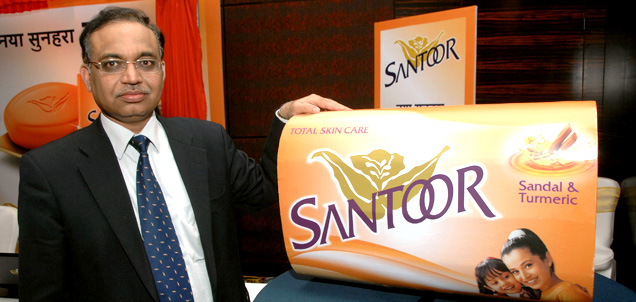
    Consistency in Communication: Anil Chugh, Senior VP, Wipro Consumer Care with a Santoor signage


    By Tuhina Anand


    Did you know that Santoor is the third largest soap brand in India? The brand, belonging to Wipro Consumer Care, has done well for itself by beating the international biggies and carving a niche for itself since it was launched in 1986. In the past 25 years, the run for the brand was not always so good, but a consistent and strategic communication has played a pivotal role in its success. Santoor is a Rs1,000 crore brand and has been growing at a CAGR of 23 per cent for the last five years.


    The communication has always focused on ‘younger looking skin’, but the portrayal has changed with the times to appeal women, who were earlier seen as homemakers to now those who excel in various professions – mirroring the changing aspirations of Indian women.


    Giving an insight into the Santoor story, Anil Chugh, Senior Vice President, Wipro Consumer Care, said: “Santoor is the third largest soap brand in India and the largest selling brand in the South + West India (value MS – 13.5 per cent). The ‘ageless skin’ campaigns and innovative marketing strategies have helped Santoor grow faster than the industry and gaining share over the years. One of the reasons for this is the consistency in communicating our core proposition of younger looking skin while keeping the message contemporary over the years. Also, our focus on providing the right value to the customer has contributed significantly to the brand’s success. The growth was also achieved on the back of a strong distribution network and communication in rural areas.”


    He added: “The strength of Santoor has been its promise which is consistent, powerful and eternally relevant to consumers. For over 25 years, the brand has delivered on the promise of ‘younger looking skin’ through superior product offerings which have used deep acting and trusted natural ingredients. Our campaigns have reinforced this message consistently. Over the years, Santoor has carefully chosen celebrities to endorse the brand and it has worked well for the brand.”


    While factors like distribution cannot be overlooked in the success of Santoor, the communication has been one of the key pillars. However, this was not the case always. MG Parameswaran, Executive Director & CEO, Draftfcb + Ulka elaborated: “When Ulka Advertising was assigned the brand in 1988, it was in a bit of a limbo, growth had stalled. The agency evolved the ‘younger looking skin’ and ‘mistaken identity’ as the key pillars for the brand. The advertising created history of sorts. The brand growth picked up momentum and Wipro has ensured that marketing money was well spent, through judicious correction in the messaging of the brand.”


    “In 1989, Santoor was basically selling in two states of Kerala and Karnataka. It was selling a fraction of what brands like Hamam, Rexona, Cinthol and Liril were selling. By focussing advertising on one promise and evolving it over time, Santoor has become one of the top three soap brands in the country.


    The advertising has evolved in many ways, but the core message of ‘natural ingredients for a young looking skin that will get you accolades’ has not changed. But the Santoor woman has evolved from being a pretty woman at a wedding to a confident woman who is doing aerobics, to a woman who plays cricket with her daughter, to a dress designer, to a TV anchor to a choreographer to a photographer. In a sense, the brand has reflected the aspirations of the new Indian woman,” added Mr Parameswaran.


    He is very clear that the success of its communication is purely because it tells a timeless story that always appeals. As he puts it succinctly, Santoor is about consistency in communication that adds a new layer with every new piece.


    In fact, as Santoor completes its 25 years, it has come out with a new campaign that is the Santoor anthem, giving it a contemporary look and feel yet telling the same story about a mother and daughter. The new advertising campaign features two ads – an anthem film that celebrates the achievement and pride of millions of Santoor women and a new theme film with new brand ambassadors – Saif Ali Khan and Mahesh Babu.


    Over the past few years, Santoor has grown from a single soap brand to talcs, deodorants, soap variants, liquid soap, facewash and so on. Mr Chugh said: “We will continue with our quest to keep the brand relevant and contemporary even in the future. The aim of new campaign is to take the Santoor brand to the ‘next level’. We are constantly looking at consumer needs and expanding/enhancing the brand to meet such needs. The brand has grown ahead of the competition in its core states and is now trying to break out of its traditional stronghold and make quick gains in other markets.”


    As a concluding note, Mr Parameswaran, who has been associated with the brand for almost two decades, said: “I am proud to have been associated with the brand for almost two decades. What is unique about the Santoor story is the great trust and regard this brand has spawned between the agency and client. It is has been a wonderfully rewarding experience and all of us in Draftfcb Ulka are proud of the association. It is not easy to take on large well-heeled multinational FMCG behemoths; we took them on and managed to find a place for Santoor under the Indian sun. The story is far from over. Santoor won against all odds and it will keep winning. I am sure of that.”


  • Info explosion has made India smarter: ‘New Realities 3.0’ study

    By Robin Thomas

    The Interpublic  Group (IPG), one of the world’s premier advertising and marketing services companies, has come out with its global ‘New Realities 3.0’ study that provides a unique window into how the Indian consumer is coping with information overload. The study provides insights on the decision-making process of the consumer in today’s era of information explosion. The study also aims to answer the unanswered queries of marketers on whether the information explosion has made consumers smarter or confused, the role of social media in a making consumers more informed, the role of brand advocates and much more.


    The study covered five countries namely, India, China, Brazil, America (US) and Germany. The India leg of the interview was conducted by Draftfcb Ulka’s independent consulting agency, Cogito Consulting. Over 600 online interviews were conducted in each of the five countries between October 26 and November 10, 2011. Some of the findings from the ‘New Realities 3.0’ study reveal that most Indian consumers feel they have grown smarter with the available product information, which is higher than the other countries. Further, the study notes that consumers in India rated a reasonable 7.3/10 when asked whether the available product information made them feel smarter compared to China that showed a rating of just 3.9/10, the US at 6.8/10, Brazil at 6.4/10 and Germany reporting 7.0/10.


    Interestingly, despite consumers in India claiming to feel smarter and not confused or frustrated with the product information available to them, they do not trust the information they see on brands, especially from the manufacturers end. Further, 32 per cent of Indian consumers say they do not trust most of the information they see on brands, whereas 31 per cent say they do not trust information from manufacturers or providers.


    The trust deficit that brands have among Indian consumers is higher than the other four countries, for instance only 11 per cent of Germans say they do not trust any information from brands whereas 22 per cent say they do not trust information from manufacturers or providers. Even Chinese consumers seem to trust information from brands and manufactures as compared to the Indian consumers. 19 per cent of Chinese say they do not trust information from brands whereas 24 per cent Chinese do not trust information from manufacturers or providers. 16 per cent of those interviewed in the US say they do not trust information from brands whereas 15 per cent do not trust information from manufacturers.


    Another interesting finding is that with the exception of Germany, the remaining four countries interviewed – India, China, Brazil and United States have said that product learning is a source of joy and fulfillment. 54 per cent of Indians have said that they enjoy researching the information for buying decision whereas 52 per cent of them say they find the information on brands fulfilling.


    Terry D. Peigh

    The findings have also revealed that most Indians learn product information to build an expertise about a certain product and brand as well as because it helps them stand out in their social circle. 53 per cent of Indians said that the reason they stay informed about certain products is because ‘people value me and my knowledge about certain products’, whereas 52 per cent of them said it helps them enhance their self-esteem.


    In addition to these, the study also revealed that consumers in India and China are most likely to turn into brand advocates and become a media channel and that in India, Brazil and China, especially, social networking sites are a good source for word of mouth information on brand experience.


    As vague and unique as it sounds, MxM India’s Robin Thomas got Mr Terry D. Peigh, Managing Director and Senior Vice President, IPG to relay more outcomes from the study, the role of social networking sites in decision-making capabilities and much more.


    New Realities… is an online study across multiple countries, including India. What is the sample size that was chosen for this study? Who are the respondents i.e. the TG for this study?

    We interviewed 600 people in each country i.e. in India, China, Brazil, United States and Germany. Out of the 600 people sampled, one-third were Gen X, one-third were Gen Y and one-third were boomers. 50 per cent of those polled were men and 50 per cent women.


    What was the key objective of the study? What, according to you, are the learnings for the Indian market, as well as the global market?

    The key objective was to better understand how the consumer has changed because of the new media. We came across the idea years ago as we noticed that the number of information sources available to consumers today has grown exponentially. So we found out if people were confused, frustrated, overwhelmed, and how are consumers viewing the overall experience of absorbing product information and using that information.


    We learnt that consumers have evolved over the years and hence they are not confused or frustrated with the information explosion. Consumers have not only learnt to easily filter or absorb the information but, they have also learnt how to manoeuvre their way through all the multiple choices of product information available to them.


    We have also learnt that surprising number of consumers, especially from India, are now very open, willing and eager to learn about product information as they find a lot of joy and satisfaction in learning about product information. In fact, our research also shows that people in India are most likely to really enjoy research and product information.


    One of the reasons why many in India are willing or open to product information is because they find it of social value as it allows them to have an expertise in certain products. We have also learnt that consumers are aggressively willing to become advocates of brand. Our research also shows that they are now interested in continuing to learn about a product even after they have purchased a product as they want to learn more about the product and advance their knowledge about that product.


    What this reveals is that communication should not stop at the time of sale and that marketers must continue to talk to their consumers even after they have purchased the product. As a result marketers may convert their consumers to brand advocates.


    The study reveals that Information explosion in India has led consumers to become smarter and helped them beat the system – much higher than what the other countries have reported. What are some of the factors that influence the consumer’s decision-making process around a product?

    We see a dominant role of family and friends in a consumers’ decision-making process. Although social media is still small, its role as a channel is growing, but too often social networking sites are limited to ‘likes’ or number of friends which is wrong. It’s too easy to get someone to push the like button or accept a friend request, even though they may really not like the brand or want to be their friend. A research from Australia finds that less than one per cent of friends are actively engaged and want to be truly engaged to the brand. So we keep encouraging our clients to go beyond ‘friends’ or ‘likes’ on a social networking page but, instead seek true engagement.


    As India becomes more tech-savvy, do you anticipate further information explosion to come about that could lead to further increase or decline in consumers who are confused or frustrated with the information?

    We were, in fact, surprised that the confusion or frustration numbers were not higher. My projection, however, is that it (frustration and confusion) will not go up as consumers have learnt the role of technology very quickly. Technology is fast reaching to the lowest common denominator very quickly so, I think people are learning to process information very quickly.


    Will there be a Phase II of the ‘New Realities 3.0’ study?

    Yes. We will soon be out with the second phase of the study in another 18 or 20 months, which will help us understand more trends. In China, for instance, during Phase I and II we have seen dramatic changes in over 18 months. We found that the Chinese were much more inclined to use the internet for product research. In China, the internet was used primarily for entertainment purposes, now it’s used for product information.


    Not surprisingly, consumers in India do not trust brand information especially from the manufacturers. This is not so with other countries, particularly Germany, US and China. How would you explain this? What must brands / marketers in India do to build the trust deficit among their consumers?

    I believe it is because of the newness of the consumer culture in India. In the US, for instance, there has been a mass market of consumer culture for 100 years and the same in Western Europe. I think consumers need to develop trust for their products. Brands must not be afraid to enter into the world of social media and hearing negative comments about one’s brand. There is probably no quicker way to gain trust with the consumer than to actually legitimately and honestly respond to criticism and fix the problem. This, I believe, is one way for brands to gain trust of the consumers.


    With the exception of Germany all other countries seem to enjoy product learning. What makes the consumers in Germany not really enjoy product learning?

    Yes, German people usually do not associate joy from product information. The Germans usually get their joy from music and food


    How has social media changed consumers’ decision-making across the globe? What role do you see social networking sites play in the near future in India?

    The role of social networking sites as a tool for brand advocates will increase. One thing we have noticed in the western world is that the number of people visiting brand pages on social networking sites is on a decline in Europe. This is not the case in India. In the western world a lot of consumers say that they do not visit Facebook for brands, but for friends therefore, it will be interesting to see if it will be any different in the developing economies. Nevertheless brands like Coca-Cola have leveraged social media well by finding ways to reach out to the consumers by engaging in a good conversation and get them to participate in brand activities. Right now the data shows consumers are willing and eager to visit social media to learn about products or brands.


    Even though broadband penetration is still low in India as compared to the US, why are consumers in the US and Germany reluctant in using social media for product research?

    This may be because brands that first started using the social media didn’t do a good job in engaging the consumers. The consumers may have clicked ‘like’ or may have become friends but, the brand may not have received anything else. Brands must, therefore, learn to go beyond the ‘likes’ and adding of friends to adding value in a consumer’s life as the consumer is not accessing social networking sites for brands but for something else. Therefore, in order to leverage the social media, brands need to operate in a different way. Increasingly, many brands are beginning to use social media effectively to engage with their consumers.


    How do you plan to reach the brands or marketers with the study? What can brands or marketers expect from the study?

    This study is important for clients because it is consumer based, is fresh, is in-depth, is broad, it looks at many different segments by product category, by demographic and it is the consumer telling us what he or she is thinking about.