Tag: Dr. Subho Ray

  • Digital Personal Data Protection Bill Industry-Friendly: IAMAI

    By Our Staff


    The Internet and Mobile Association of India (IAMAI, www.iamai.in) in a statement issued today has lauded the Digital Personal Data Protection Bill (DPDP) as industry-friendly. It has struck the right balance between protecting the interests of the data principals while leaving enough room for tech start-ups to innovate and grow.


    According to the feedback received from the majority of IAMAI members, the reconceptualization of the data protection framework in the DPDP to balance innovation and economic growth with the interests of users will go a long way to assuage concerns of digital businesses and help make India a trillion-dollar digital economy by 2025. In particular, IAMAI appreciates the more liberalized framework for cross-border data flows and the exclusion of non-personal data from the ambit of the DPDP Bill. IAMAI also appreciates that the Bill imposes only financial penalties for non-compliance as opposed to both financial and criminal penalties.


    Commenting on the Bill, Dr. Subho Ray, president, IAMAI said: “By following a deep and wide process of consultation including that of a joint parliamentary committee, excluding non-essential provisions, by making a clear commitment that no Rules exceeding the provisions of the Act would be made, and yet protecting the interests of the state, citizens and the digital economy, this Bill has possibly set up new standards of law-making.”


    On behalf of its members, the association has requested the government to provide clarifications regarding the DPDP so that once it is passed into an Act, there is better compliance by IAMAI members. In particular, there remain ambiguities surrounding the timelines for implementing the various provisions of the Bill and mechanisms for obtaining verifiable parental consent to process the personal data of children. As the inclusion of specific timelines will provide a roadmap for the industry to better comply with the Bill, IAMAI has requested the government to clearly indicate reasonable timelines by which the various provisions of the DPDP will be implemented and to adopt a graded approach to prescribing such timelines. IAMAI has also urged the government to consider a flexible approach to obtaining parental consent, as prescriptive mandates may have an adverse cascading impact on sectors that provide services to younger individuals.


    IAMAI is confident that through consultation and collaboration, the final version of the law will help stakeholders who are invested in and committed to the digital ecosystem of India.


  • Public Affairs Forum of India announces new office bearers

    By A Correspondent


    Public Affairs Forum of India (PAFI) has announced its new officebearers for the year 2020-21. Ishteyaque Amjad takes over as President of PAFI at its AGM held on April 24, 2020. Ahmed is Vice President, Public Affairs, Communications & sustainability at Coca-Cola India and South West Asia.


    Ishteyaque Amjad

    Said Amjad: “I am both humbled and honoured to take on the responsibilities of President of PAFI. We are going through an unprecedented time and PAFI is probably best placed to lead the practice in the area of public affairs and enable a very constructive partnership between Government, Civil Society, Media and Industry. Given the current environment and the increasing need and realisation for Public Affairs as a central function in businesses, now is the time for us to look beyond the horizons and evolve from being an organisation to becoming an Institution. I will strive to work towards providing new opportunities and platforms to our members to achieve the same.”


    Ahmedi takes over the role of President, PAFI, from Raman Sidhu, Chairman of EBG Federation, upon completion of his successful term.


    Meawhile, Dr Subho Ray took over as the Vice President of PAFI. Ray is the President of Internet & Mobile Association of India (IAMAI). Ankhi Das, Public Policy Director  India, South & Central Asia, Facebook India Online Services is Secretary of PAFI. Tanmoy Chakrabarty, Group Government Affairs Officer, Tata Sons Pvt. Ltd., the Treasurer of PAFI.


  • Kunal Shah leads IAMAI CEO’s trip to China

    By A Correspondent


    Kunal Shah, Founder & CEO, FreeCharge and Chairman of the Internet and Mobile Association of India (IAMAI) would lead 20 CEO’s for a week-long trip to China, beginning June 24.


    Members of the team include: J Murugavel, Founder & CEO, Bharat Matrimony; Amarjit Batra, CEO, OLX India; Pawan Gadia, CEO Retail & Online, FernsnPetals; Ms Neelu Singh, CEO Ezeego1; George Antony, MD, UAE Exchange; Dippak Khurana, Founder & CEO, Vserv & Vmax; Nitin Gupta, Co-founder & CEO      PayU India; Ankur Singla, Founder & CEO, Helpchat, Vivek Pani Co-founder & CTO, Reverie; JRK Rao, Founder & MD, Rage Communications; Badri Sanjeevi, CEO, Mauj Mobile; Manish Chopra, Co-founder & CEO, Zovi; Sahil Chalana, Founder, College Dunia; amongst others.


    The focus of the week-long trip is to invite the Chinese companies to set up in India; invest in Indian start-ups; gain Ideas for new businesses and exchange insights for scaling-up.


    The delegation will meet officials from Alibaba, Baidu, Ctrip, Cheetah Mobile; Xiaomi in Beijing and Shanghai. The team would also meet investors like Ant Financials and Start up Street during the week-long trip.


    Speaking about the delegation, Dr. Subho Ray President, IAMAI, said, “Scale and scalability is one of the most important things to learn in China.  Apart from key meetings, the delegation will also visit large internet and ecommerce companies to get first hand feel of scalability.”


  • Interest of Internet users should drive “Encryption Policy”: IAMAI

    By A Correspondent


    Encryption is a fundamental and necessary tool to safeguard the digital communication infrastructure. The interests of Internet users should be foremost in framing any encryption policy, according to a “discussion paper” released by the Internet and Mobile Association of India [IAMAI]. “Trust, convenience and confidence of users are the keywords to designing an ideal encryption policy that will help in getting more people online with safe and secured internet platforms,” said Dr. Subho Ray, president, IAMAI.


    The association has published this discussion paper with the view to encourage discussions and debates around the issue, and has suggested that a broad-based public consultation with all stakeholders including users groups should precede the making of an encryption policy.


    According to the paper, the foundation of a user centric Encryption Policy consists of: Freedom of Encryption, Strong Encryption Base Standard, No Plaintext storage and Mandatory legal monitoring or No Backdoor Entry.


    The most essential element in the paper suggests that support for strong encryption is critical to counter cyber security issues around the globe. Mandating a framework of legal monitoring or building backdoors will affect the users’ trust in the internet. It will make the system weak and prone to illegal hacking without eliminating the real concerns. There is no point in having the world’s best lock if the keys are kept under the doormat.


    In addition, the paper suggests the importance of freedom of encryption for the users, organizations and the business entities. Prescribing a minimum standard is quite retrograde considering various users and internet companies need different encryption strength given the fast pace at which technology is changing.


    Instead of a low ceiling, a high base should be specified based on the internationally proven encryption standards viz., AES-128 and 3DES and 256-bit. In India at present a low ceiling of 40-bit standard is prescribed, beyond which prior approval of the government and handing over the keys is mandatory. This standard is the weakest, outdated and can be easily hacked.


    Antiquated policies such as mandatory plaintext storage and key disclosure violate the objectives of a strong encryption policy. It burdens the users and internet companies while not affecting the actual offender. Instead practices such as forward secrecy and authenticated encryption should be adopted where decryption keys are deleted immediately after use so that stealing encryption keys used would not compromise data protection and privacy.


    Careful consideration should be given to the impact and effectiveness of any proposed policy so that it does not compromise the existing robust system in place or pose unnecessary burdens on the internet users and firms.


  • Books & mobiles enter IAMAI’s monthly tracker

    By A Correspondent


    The Internet & Mobile Association of India (IAMAI) has released the ‘Internet Economy Watch’ for the month of July 2012. ‘Internet Economy Watch’ the monthly tracker by IAMAI, is based on absolute numbers captured from various relevant sites, encapsulates online usage for E-tailing, Online Travel and Vertical Classifieds.


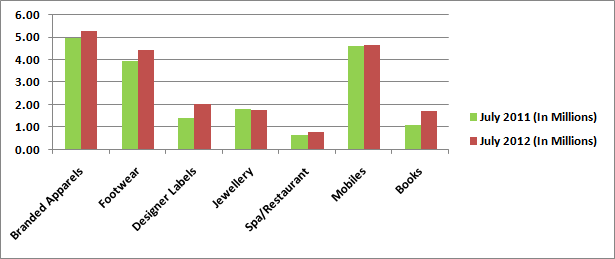
    In the July 2012 report, IAMAI has introduced two new categories – Mobiles and Books. Mobile has infact emerged as the second most popular category among the online consumers i.e. after Branded Apparels. With the exception of Jewellery, all the other e-commerce categories have shown growth in July 2012 as against July 2011. The number of resumes uploaded has continued to decline even in July 2012 as against the previous year whereas the number of matrimonial uploads continued to grow.


    So do these trends indicate that consumers in India are fast adapting to online buying? According to Dr Subho Ray, President, IAMAI, consumers have over the years have become more confident about purchasing online. “Definitely, Indian consumers over a period of time have become more confident about purchasing online. The figures from the Internet Economy Watch report for various that how internet savvy Indians have become and how comfortable and confident they are doing online transactions” he said.


    Speaking on the kind of response IAMAI has been receiving on the ‘Internet Economic Watch’ report, Dr Ray explained, “The Internet Economy Watch report has helped marketers and brands to map the consumer behaviour online and devise their digital strategy accordingly – to be in sync with the online behaviour of consumers. Having said this, we must also keep in mind that the ‘Internet Economy Watch’ report is at a nascent stage and will be of comprehensive use in the months to come.”


    In the months to come IAMAI not only aims to add more categories in the report but, also plans to make the monthly report more comprehensive by giving it a holistic view of usage of internet in India.


    Source: IAMAI/e-Commerce sites


    E-Commerce Sites:

    As per the data captured by the report there has been a significant increase in the online user visit to books and designer label category during July 2012 when compared to the numbers of last year. While 1.74 million hits were registered for the books segment in July 2012 as compared to 1.11 million hits in July 2011, designer label segment registered a y-o-y growth of 45 per cent with 2.04 million user visits in July 2012. It is in comparison to 1.41 million user visits in the corresponding period last year.


    While branded apparel and footwear segment witnessed a marginal rise, y-o-y growth of 6 percent and 12 percent respectively in number of online user visits in July 2012 as compared to July 2011, Jewellery category saw a decline from 1.84 million hits in July 2011 to 1.76 million hits in July 2012.


    Online Travel Portals:

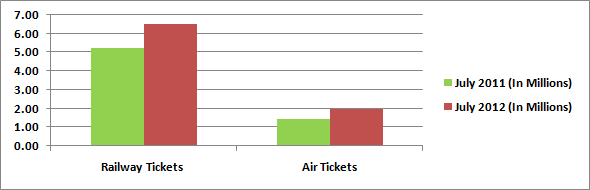
    In e-ticketing segment irctc.com clocked 6.53 million bookings in July 2012 as against 5.23 million in July 2011. The e-ticketing on airlines witnessed a y-o-y growth of 34% with 1.95 million bookings in July 2012 compared to 1.46 million in corresponding month last year.


    Source: IAMAI/ Online Travel Portals


    Verticals Classifieds:

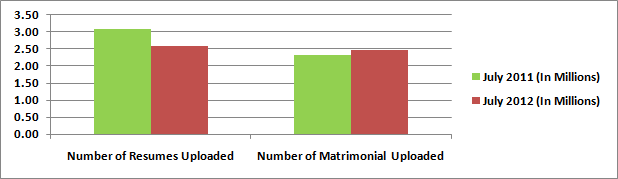
    Data captured from prominent recruitment websites reveals that the number of resume uploads have gone down from 3.09 million in July 2011 to 2.60 million in July 2012. The matrimonial profile uploads has increased from 2.33 million in July 2011 to 2.47 million in July 2012.


    Source: IAMAI/ Vertical Classifieds


    The Internet and Mobile Association of India (IAMAI) is an association which is said to be representing the entire gamut of digital businesses in India. It was established in 2004 by the leading online publishers. IAMAI is also said to be the only professional industry body representing the online and mobile VAS industry in India.


  • The Half-Year That Was-III

    By Team MxM


    Presenting the concluding part of our feature asking some business leaders to review how the January to June 2012 period was for the industry as a whole and/or their specific sectors and organizations.


    Read the earlier parts at: Part 1 Part 2



    Mohit Joshi

    Mohit Joshi, MD, MPG

    There has been a marginal growth (under 5 per cent) in adex in Jan-June 2012, as when compared to the same period in 2011. Some sectors that have been slightly depressed are auto and cellular phone service while sectors that have gone up are education/ institutes, jewellery and insurance.


    Jaideep Shergill, CEO, Hanmer MSL

    Jaideep Shergill

    I would say the PR space is growing but it has not been a year where there have been some big pitches that one would expect. That was what 2010-11 was all about. Although there has been some business, it has been more of an organic one. One of the factors that led to the sluggish growth is the economic scenario which has been going through a hard phase recently. But I would want to think of it as otherwise – when there is a general lack of trust in the market, I think that is where PR has a larger role to play. But that is not what usually happens. For our group too, it has been a good year but it could have been better.

    As the market conditions get more complicated, clients are looking at other streams to expand their business. And that’s where social media is playing a huge role. Our social media unit itself has been seeing some tremendous traction and we have hired more people in the unit. So the medium will continue to see some good growth. But the other thing about social media is that it is evolving continuously – what was happening a year ago and what is happening now is completely different. The medium has been evolving at a good pace.

     

    Pankaj Raj

    Pankaj Raj, Director, Search Value Consultants Pvt Ltd

    I would summarize hiring as still being slow and sluggish in this space. There are 2-3 observations that I would like to bring across. The first is that most organisations today are in ‘sensible hiring’ mode. This is really about replacement, immediate benefit kind of hiring. The second trend that I am seeing is that there is a huge sense on cost consciousness, whose effects are seen in the hiring space as well. The third trend that I am seeing is that increments haven’t been really good. So there is a level of concern amongst employees in the M&E sector. But having said that, some organisations are still hiring and not in standstill mode.


    As for the next six months, it’s a function of revenues – on how the September quarter turns out for the advertisers. Also, the December quarter is a peak season from an advertiser point of view; a lot of advertisers are active during this period. But to predict growth for the March quarter next year is a bit difficult. We will have to wait and watch how the growth pans out till then.

     

    Abha Kapoor

    Abha Kapoor, Executive Director, K&J Consultants

    The Media and Entertainment sector is not an island. This space is as affected as any other by the global and national environment. What’s going on in the rest of the world, and in our own country – the economic indices, inflation, governance or the lack of it, have a universal effect on all sectors, not just Media. So if the indices and sentiment are looking southward, then we are as affected by it as any other sector. You have to consider the macro perspective as also the ones specific to us to probably understand the lull in the hiring market.


    There is likely to be a spike from September-October onwards, during the festival period. That’s when you see brands spending more. Therefore, there is likely to be a more optimistic/feel good factor and an expansion (need-based) in hiring. But it is not likely to be at the rate and scale that we have seen in the past.


    In our case at K&J – we are used to working on three start-ups simultaneously like television, radio and digital – which used to be the case a couple of years ago, but no more! So the pace has definitely slowed down. Digital is the new kid on the block, so there is a lot of activity happening in that vertical.



    K Jayaraman

    K Jayaraman, MD and CEO of Hathway Cable and Datacom Limited

    The industry is been focused on digitization, as its on the anvil and the Indian broadcasting space is in the process of witnessing the dawn of a new digital era with its implementation proposed by the Government of India. With this, the government has paved the way for transition to a Digital Addressable Cable TV system (DAS).


    For the average Indian family, the TV is the primary source of news, entertainment and education. The liberalization of the Indian economy starting 1991 has led to what it termed as an explosion of channels catering to different genres. Today we have more than 550 channels broadcasting leaving out the count of local channels specific to regions.


    As per The Cable Television Networks (Regulation) Amendment Bill, 2011, the cable TV industry is required to migrate all subscribers from analog signals to digital. The overall objective of the industry has been to expose every television viewer to an experience which will invariably give consumers the opportunity to resolve some of the issues they have faced with analog cable systems.


    At Hathway our aim has always been to providing consumers with enhanced viewing experience.

     

    Sanjay Dua

    Sanjay Dua, CEO, Network18 News Media

    This year has been a mixed bag for the industry quite frankly. On the advertising front, the decline in economic sentiment has created a challenging environment, especially for some genres. So, while growth continues to exist, its pace has been muted and variable. However, given the positive move towards digitization, a possible revival in outlook and the impetus of festival spending, the second half holds a lot more promise for broadcasters. We are cautiously optimistic about the scenario going forward.



    Rahul Razdan

    Rahul Razdan, President – ibibo Games & Mobile

    The gaming industry in India witnessed a concerted shift towards mobile gaming on the iOS and Android platforms. Games are now ubiquitous across platforms.


    Games exploiting the touch and tilt features of smartphones were very well received. Our game – Can You Draw, which we’d made for our web platform two years back – became one of the top games on the Android platform within weeks of being launched there.


    While the first phase of web social games plateaued out, live multiplayer games maintained their growth and continue to be the top games on our platform.

     

    Dr. Subho Ray

    Dr Subho Ray, President – Internet & Mobile Association of India (IAMAI)

    I would say that the year began with a bang. Between January and April there were serious hopes that that this would be a bumper year for the industry. However, in the last two months, there have been some caution and apprehension. The very positive performance was the result of key factors like secular growth of traffic both in urban and rural areas, investments coming in on time and some friendly regulatory announcements like removal of service tax on digital advertisement. The more recent sentiment of caution is led by primarily European crisis. However, so far it is only a caution and alert stage.



    Jogi George

    Jogi George, CEO, Percept Sport & Entertainment

    To be frank, the first half wasn’t as it was expected to be. There was business, but it was more about collections. Also, for our company, some of the major projects have been moved to the second half. Hopefully, this trend won’t continue and things will improve once the rupee stabilizes. As for the overall industry, it’s not that people aren’t  ready to spend, but they have become more cautious and selective as some of the sectors are experiencing a gloomy outlook. Hence, there is a wait and watch attitude.



    Hemal Thakkar

    Hemal Thakkar, producer, Playtime Creation

    It’s been a mixed year so far, a major setback was Imagine shutting down and a big welcome was Life Ok. Lot of new format shows have been launched this year – the biggest being Satyamev Jayate. Inflation has put lot of pressure on the industry, and with rising cost of programmes, we have to put together a skilled team to manage our shows within budgets. In future, rising expenses are going to be major burden for the industry. Playtime Creations has had good start with Ruk Jana Nahi and as a company, we feel that this show has given us the opportunity to experiment with new content. There are couple of other projects in the pipeline which we are excited about. The best aspect of our industry is it keeps us on our toes and so we expand rediscover and reinvent and keep breathing.