Tag: downturn

  • Implications of Economic Deceleration for Advertisers


    By Brian Wieser


    Key takeaways:
    :: Economic growth is decelerating in most countries
    :: Advertising growth is also looking neutral to negative vs. last year’s levels, with recent trends likely to continue
    :: Marketers can prepare for opportunities which can emerge in a downturn

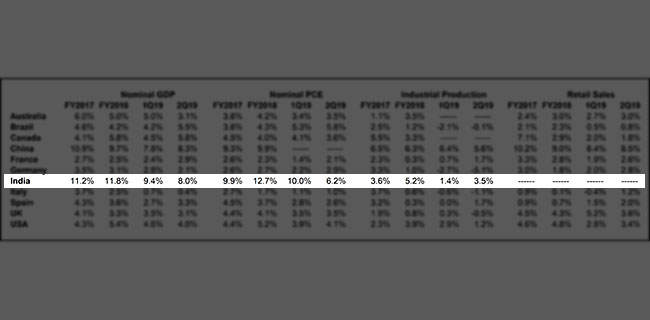
    Fragile global economy shows mild fractures. Concerns have risen around the health of the global economy since we published the mid-year update to our global advertising forecasts at the beginning of June. At the time, we referenced the OECD’s then-recent assessment of the global economy as “fragile,” acknowledging economic growth alongside increasing risks that we might begin to see meaningful deceleration. Since then, most of the world’s major economies have published estimates of economic growth for the second quarter. Along with GDP (the broadest measure of economic growth in a country), we have also wanted to look at current trends in personal consumption expenditures (PCE, usually the majority of a country’s GDP, and often more tightly correlated with advertising than GDP), retail sales and industrial production (each of which can correlate more highly with advertising than either GDP or PCE). All metrics have been tracked here in current/nominal terms, meaning not discounted for inflation, and on a non-seasonally adjusted basis when available.


    Year-over-year growth trends for some key economic variables so far in 2019 are generally negative. For the countries we looked at in recent weeks, if we compare second quarter conditions with those for all of 2018, we see GDP and PCE trends that are generally the same or negative. That is to indicate that we still see growth, but growth which is generally slower than previously observed. However, retail sales and industrial production appear more unambiguously negative versus last year’s levels. Again, these variables tend to be more tightly correlated with advertising because marketers spend on advertising in alignment with the pace at which they make things or sell things.

    Source: GroupM analysis of data from individual country economic bureaus, Refinitiv

    Source: GroupM analysis of data from individual country economic bureaus, Refinitiv


    Advertising growth is looking neutral to negative versus last year, with recent trends likely to continue.  This data is consistent with expectations of neutral to negative trends for advertising around the world.   While the U.S. saw accelerated advertising growth in the second quarter, this followed a relatively weaker first quarter. In many other countries, deceleration appears to be more pronounced, as indicated in the table above.  Further deterioration is likely given the pressures of trade wars – which are likely to persist – alongside Brexit uncertainties impacting both the UK and Europe.  All of this says that marketers need to be prepared for a downturn.


    Marketers can still look for opportunities in a downturn. In a full economic downturn, advertising growth will generally decline, but not necessarily in every country nor in every medium. This can present opportunities. As we have written previously, global markers with flexibility to shift marketing budgets across countries may find opportunities to redeploy resources from countries with weak economies and strong media markets to those with relatively stronger economies and weaker media markets, as marketing dollars may go further in those instances. More generally, as we can anticipate that most marketers will cut their spending, marketers with the flexibility to do so could benefit from maintaining or increasing spending given the relatively inexpensive opportunities to raise “share-of-voice” that would exist under these circumstances. An economic downturn environment may, in fact, provide marketers and opportunity to grab greater share.


    Consumer behaviours could change in response to economic weakness and, as always, require ongoing monitoring. In some instances, we will see shifts in consumer behaviours, but the direction may be hard to anticipate. For example, SVOD services might appear to be discretionary choices that consumers could eliminate in belt tightening.  But on the other hand, the relative value of these services versus more expensive entertainment options like theatrical movies, concerts, and more could actually reinforce consumer interest in SVOD which, could be viewed favourably versus the cost of traditional pay TV services.   There is no history to point to in terms of predicting how new platforms will fare in a downturn, and so close monitoring of consumer adoption will be increasingly important.


    Marketing messages need to maintain relevance. There are, of course, brand-related considerations to consider as well. Marketing messages may need to be adapted in many instances – for example, emphasising a product’s value or how it helps a consumer avoid incurring other costs. In other instances, marketers may find totally new business opportunities as consumers reassess their spending patterns and product preferences.


    “Never let a crisis go to waste.” Choices made under severe economic pressure have the potential to lead to better marketing choices. With the budget cuts that can follow if a company’s revenues fall, some marketers may find themselves forced to be creative in how they deploy resources. If they aren’t doing so already, they should be prepared to assess their mix of spending across marketing services, software and media. For example, some will find investments in marketing technology or other brand experiences prove more effective uses of budgets versus media, especially if they help deepen consumer engagement, enhance “share of wallet,” or reduce customer churn.

    Everyone would rather see sustainable growth for their businesses and the economies in which they operate. However, to assume this may occur uninterrupted over the next couple of years requires excessive optimism. Hoping for the best but preparing for the worst will help you survive and thrive over quarters and years to come.


    Brian Wieser is Global President, Business Intelligence GroupM. This post first appeared on the GroupM website at https://www.groupm.com/news/implications-economic-deceleration-advertisers


  • 2013 – 365 days of engagement


    By Kartik Iyer


    It was a year that began with hope. Hope that we were well past the depressed market, the global turmoil and the poor fiscal reports. Hope that predicted media growth in the range of 12+ percent.


    But as 2012 wore on, it became clear that this was not to be. While it began well, by the end of the first quarter itself signs of what was to come were being seen. Signs of continuing depression, poor fiscal reports for many European countries and signs of uncontrolled inflation within India. All of this meant that the consumer would react and probably postpone purchase. And so it was through the year. With even the festival season not being able to change the trend. Media growth projections dropped to the 7+ percent levels.


    All of this meant that Advertising investments would continue to be challenged for Efficiency. The one word that decided the trends of media in India. So while TV and print continued to be the big boys albeit with low growth numbers, their role was questioned. Digital media became a core part of planning instead of being a media for the leftover budgets and grew at a burning pace of over 35+ percent. Out of Home encompassed the large billboards as well as the Malls, Multiplexes and market places thus growing at a rate of over 10 percent. Social media was no longer about digital alone but also about the various points of social connect like malls, multiplexes etc. And the key objective was to maximize earned media. Which meant that the effort was for every medium to connect with the other and work in tandem to deliver greater effectiveness and engagement.


    In this evolving media space, let’s take a closer look at each medium.


    Print – Will hold but would definitely face growth challenges. This could be the year when TV overtakes print in terms of ad volumes. It is now for media owners and advertisers to redefine the role for the medium and use it for its inherent strengths. Gimmicks aren’t what Print is for. It’s time it played a role as the ultimate Stature medium. As well as a medium that is with the times and is the fountainhead of details.


    TV – Would continue to grow. However audience fragmentation is real and needs to be managed. Digitization will hopefully deliver more realistic information on the consumption trends of the medium and one could see clear niches being carved out. Niches that have their own individual appointments with audiences. Appointments that today have become extremely valuable in the efficiency paradigm.


    OOH – Is no longer a single medium but is split into large format on the road OOH, Ambient OOH in malls, multiplexes and market zones and Retail space Out of Home. Another variant is that of Urban and Rural activation. A medium that enables true one to one engagement with consumers who are curious and focused. All of these will have their own unique capabilities and would probably see the highest rate of technology influx. The medium has come of age and it’s now time for advertisers and agencies to understand the capability of the medium and design communication accordingly.


    Digital – There is a reason that I have mentioned this last amongst all media. And that is because this medium is ready to take on the role of being the backbone of all communication. Very often one gets to see data that clearly shows that the medium has a limited reach which may be true to an extent. However one must bear in mind that even the latest researches on the medium are dated considering the rapid growth the medium enjoys in being adopted. This medium again can be split into a number of areas like Digital display (static) Digital Video, Search (which can lead to display) and the most underused version which is Mobile.


    Mobile – This is the one medium that provides the reach which is wider than any other medium available in the country spanning all of India across Urban and Rural geographies. It is now for the advertiser to get innovative and design communication depending on the capability of the device. And all of this has to be done while encouraging the consumer to opt in for communication. There are already very many cases of brads that have managed to engage across geographies using this medium and it’s time that all advertisers learnt from these pioneering initiatives.


    At an overall level, all media will move from being categorized by the material form to the interaction form. So it will no longer be print, TV, Radio, Internet, OOH etc.


    It could be categorized as Written, Visual and Engagement. This would mean that a TVC (Video) would play out on TV as well as Digital (Pre rolls etc) and OOH (Ambient spaces, Large format OOH etc). A static ad would be released in dailies, magazines, websites and close format ambient media. Audio would be played out on radio and internet and malls and so on. Furthermore, the ads in dailies and magazines would have QR codes or Layar codes built in so that with the use of mobile devices the static ad could lead to video. Similarly with OOH advertising. And all of these things are happening now. Not in the near future but now.


    The die is now cast. Future directions have been defined and 2013 will only see all of the above growing. And digitization will give advertisers more realistic numbers to work with. TV and print will continue to be challenged. Digital will continue on its rampant growth path. Out of Home will become core to engagement plans. Digital will be available in ambient spaces thus merging Digital and Ambient. Brands will start thinking of Integrated Communication Plans rather than media plans. And media will become performance focused and more exciting every day. The good news is that shopping in the last few weeks has seen a significant upswing which could be read as a more upbeat consumer which would be a good point to start from for 2013.


    And finally let’s not forget the Consumer who is now the Emperor. India’s youth is impatient and has no time for the old world order. They are moving and want to be seen with brands that are moving at their pace or leading them. They are continually bombarded with communication and don’t have the patience to remember every piece. It is the ones that engage with them regularly and innovatively which will be remembered and those are the brands which will emerge as winners.


    Kartik Iyer is Managing Director, Carat. Carat, the world’s largest independent media communications specialist, is part of the Aegis Media Group. Carat is Campaign’s Media Agency of the year 2012 for India as well as South Asia. Other companies in the group include Vizeum, Posterscope the global OOH sector leader, Brandscope, Hyperspace (Retail), Ambient (Ambient Media), Carat Fresh Integrated (Activation), PSI (Airports), Doosra (Creative), Isobar, the global communications agency with digital at its heart and iProspect – Communicate 2, the global leader in search and performance marketing.


  • The Anchor: Nagesh Alai on 6 ways advertising & promotion can prosper in the new fiscal

    By Nagesh Alai


    #1 Economic Situation:

    This is one of the prime factors driving advertising and promotions. In a challenging economic environment, which the GDP downtrend seems to be indicating, ensuring brand recall and staying top of mind with the consumers will be a necessity. While the sluggishness in anticipated growth started showing signs on the back of inflation, high interest, falling currency, etc., in the second half of last year, in a research conducted by our Group’s consulting arm, Cogito Consulting, the bold Report 2012 (available on www.cogitoconsulting.com) shows that CEOs and CMOs of leading companies have predicted a slightly more positive outlook this year with a marginally higher growth rate than earlier years. Some see it as the beginning of a slow return to the high growth rates in the past. My expectation is that the more aggressive companies will take advantage of this trend and try and be the early drivers of growth in their respective categories, thereby investing ahead of their competition to establish an early lead.


    #2 The London Olympics

    Usually there is very little interest in the Olympics and more often than not this event slips by the advertisers radar. However, this year there is some interest in Men’s Hockey, Boxing, Wrestling, Badminton, Tennis and the firing range etc….which might pull in a larger number of sports hungry Indian audiences as they search for heroes beyond their usually preferred cricket


    #3 CAS and Digitisation will lead to better segmentation and availability of more robust data about the audience, this will encourage companies as they will be able to measure the efficacy and coverage in a more systematic manner. The recent Star-Zee combine efforts and push for ensuring real reporting of actual subscribers should also give a further fillip in capturing better viewership data, as will the industry bodies ( IBF, ISA and AAAI ) coming together on BARC.


    #4 Blockbusters on TV

    As everyone knows, movies are a big, big draw in India. Nearly 40-50% of total content on TV is directly or indirectly based on films. The entire movie distribution model has changed. Unlike in the past, now blockbuster movies come on TV within weeks of their release in theaters, instead of months earlier. DTH, Pay TV and Video-on-Demand are shortening the time frames dramatically. This is also drawing audiences and therefore attracts higher spends by advertisers, ultimately helping grow the advertising industry


    #5 New/Dormant Categories getting active

    The general anticipation (though some call it sheer optimism) is that the government will open up new categories like retail. An upward trend to the economy would also help drive spends in financial services etc. The government is keen on generating funds for development by diluting it stake in several public sector companies. It is also a reality that there is a huge pent up queue for IPOs planned by various private sector companies as well….an improving economic situation will encourage companies to go public to raise funds and thereby spur the need for corporate campaigns and IPO advertising which will expand the industry further.


    #6 And lastly, but not the least, the increasing “through-the-line” emphasis, whereby communication concepts are conveyed to target audience/consumers seamlessly through print, TV, out-of-home, activation, internet, social media, etc. will ensure that advertising and promotion will prosper. At the end of the day, it is all about building the brands and the clients better see advertising and promotion as an investment (which prudent clients do) and not as a cost – it is important to have long term view of brand building and not be blindsided by quarter pressures.


    Nagesh Alai is the Director – Draftcfcb Ulka Group India Operations and the President, AAAI.


  • Focus on increasing number of formats: Govind Shrikhande, Shopper’s Stop

    As was predicted of the sector, retail did take a beating at the hands of slowdown, especially the second half of FY 2011-12 where growth was difficult to come by. But the downturn is not as bad as it seems and good tidings are being predicted for the medium for 2012-13. Much will depend on how the large players will be geared to tackle this difficult phase including undertaking risky yet calculative decisions that will either see them in the red or see them walk away with pots of money.


    Govind Shrikhande, Customer Care Associate & Managing Director, Shopper’s Stop Ltd is all set to take his company to new heights and feels that expanding its product offerings across the country could work in favour of the company as there are always new markets and consumers who are waiting to savour variety. Mr Shrikhande opened up to Johnson Napier of MxM India on the sidelines of Mindshare-Brand Equity Compass 2012 on how his company is geared to tackle the challenges of the future and what the retail industry needs to do to overcome the downfall scare that’s had everyone on tenterhooks.


    Q: It’s been a shaky 2011-12 for the retail industry in India. How is Shopper’s Stop handling the slowdown conundrum?

    2011 has been a mixed year for us – the first half went pretty well, but Q3 which is the biggest quarter for the retail sector witnessed a slowdown. We expect some recovery to take place in the second half of 2012-13 while the first half of 2012-13 will be a little slow.


    Q: How have you grown organically across the multiple formats that you are present in?

    We have grown very fast in the last one year. We added around 13 stores in the main format; overall we added more than 20 stores in all the big formats that we have. So it’s been a very fast-paced expansion drive for us. Going ahead, we plan to add atleast eight stores every year. I’d like to state here that the opportunity for retail community in the future is big, so it’s important that you expand today. Though there could be some short-term difficulties of sales growth not being as high as one expected it would be but if one prepares oneself so well that the model is good, the consumer traction is strong and the assortment is very good then one can be in a good position to perform well and really be ready to face challenges of the future.


    Q: Are you contemplating expanding your product offerings apart from the staple departmental and hypercity formats that you currently cater to?

    We have enough formats today like Shopper’s Stop in the department store format, Hyper-City in the hyper-market format, Crossword in the books store format…so we have enough formats currently by which we can expand and we are doing that.


    Q: What do you derive from the changing FDI stance between the government and the retail industry?

    I think FDI is getting a new meaning every season now. The Indian government did announce FDI in multi-brand retail and took it back. Also, the concept of cash-and-carry has been around for some time but now it’s getting into a different kind of a situation. I think the industry as such is waiting for the government to come up with some concrete plans around FDI but yes, once it does come in it will definitely help the whole retail industry to expand faster than what it has been able to do right now.


    Q: What is the impact that digital will cast on the retail sector? A lot of brands are taking the e-tailing route to increase product traction…

    Digital will help drive growth of retail because it is has been found that globally, a lot of consumers first check details on the internet and then go to a shop to buy stuff. It plays a support role where shopping is concerned. The fact is that almost 30-40 per cent of shopping that happens in a physical store has already been researched about before by people on the digital platform. So I do not see it posing any competition or threat; it would be self-supporting.


    We too have started our own websites for Shopper’s Stop and Crossword which will further ensure that a customer will get a multi-channel delivery whether through physical store or a digital store.


    Q: Apart from talent, what is the other big challenge facing the retail industry as of today?

    Apart from people, the other big challenge for the retail sector is the availability of quality space and rental. This in fact is a bigger challenge than people. As for the people challenge that we face, we are trying to overcome that by building new programs like Fashion Associates, which should help us to face this crisis in a much bigger way. But availability of quality retail space at reasonable rent is still a big challenge.


    Q: As you move forward, what would be your main objective for 2012?

    We have enough happening in the company right now. The key driver would be expanding into more cities and growing the total number of formats rather than getting into new formats.


  • The MxMIndia LookBacks for 2011


    LookBack 2011 coordinated by Ritu Midha


    By Ritu Midha

    The year 2011 has been full of ups and downs for the global economy. While it started on an optimistic note, the projections have been revised downwards several times since.


    LOOKBACK 2011
    The Year in News Media (Ranjona Banerji)
    Middle India on overdrive (Nielsen report)
    Top TV & Print Spenders
    The Year for GECs
    The Year for News TV
    What creative & media agencies won
    People Movements
    The winnings
    Filmwallahs dominate endorsements
    11 Noteworthy Happenings (Tuhina Anand)

    India was no exception – though it was largely due to the global slowdown – the government’s foot-dragger approach to many a policy, and high inflation rate did not help the matters any.


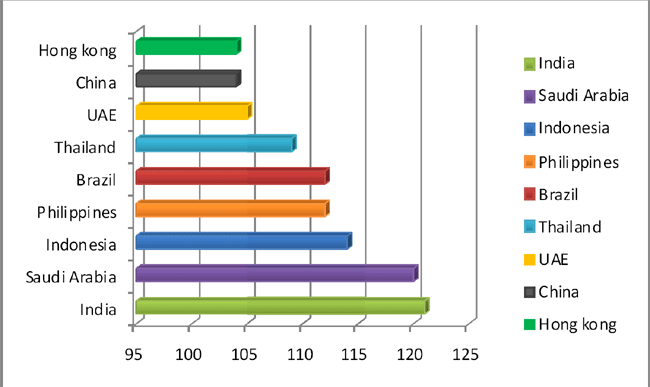
    The slowdown has led to tightened purse strings, however as per a Nielsen report, ‘Global Online Consumer Confidence, Concerns and Spending Intentions – 3rd Quarter, 2011’:  consumer sentiment in India is the most optimistic in the world, for the seventh quarter in a row. (Data Source: Nielsen global consumer online confidence survey, Q3, 2011)


    Click here to download the report from Nielsen website


    As for the economy, in January, World Bank predicted that in the year 2012, India would grow at a pace of 8.7 per cent (and the oft-compared economy, China would grow at a slower pace of 8.4 per cent).


    There is too much water under the bridge since then, and current fiscal is now expected to show growth figures of around 7%, as per Fitch, the credit rating agency.


    However, hope is back for 2012, with credit rating agencies reaffirming India’s ratings in the fag end of 2011.


    Moody’s, in a recently released report, reaffirmed India’s sovereign rating at BAA3. Though it has added that growth downturn is likely to persist for two more quarters.


    As per data released by Fitch in December 2011, the economy is likely to grow by 7.5 per cent in 2012-13. Though, in the current fiscal it is likely to be around 7 per cent.


    Interestingly, the government’s forecast is 7.5 per cent growth in the current fiscal. In its mid-year review released in mid-December, the government revised the growth projection to 7.5 per cent from 9 per cent forecasted in the pre-Budget survey.


    Another good news coming at the end of the year is easing out of food inflation. The index stood at 1.81 per cent in the period up to December10, 2011, while in the previous week it was at 4.35 per cent. The reason behind the improved numbers is the fall in the prices of cereals and vegetables.


    Inflation, till now, has led to a sharp increase in raw material prices, hurting the FMCG companies. As a result, leading FMCG companies like Hindustan Unilever, Procter & Gamble, Reckitt Benckiser, Godrej Consumer Products, Marico and Dabur were compelled to increase their product prices.


    However, according to a report by FICCI, the Indian FMCG market is now expected to grow at rate of 10 per cent (current estimates: Rs 2,600 crore) over the next 10 years and reach a size of Rs 4,13,000 crore by 2015, which would further increase to Rs 6,65,000 crore by 2020. It is good news for media fraternity, as FMCG is their main stay.


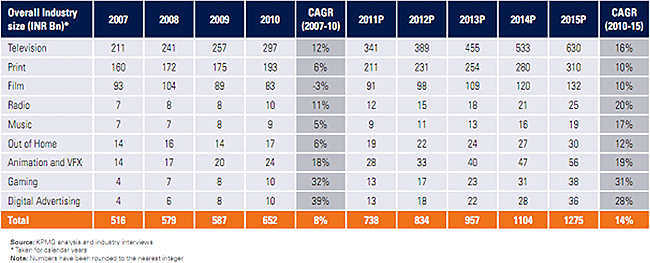
    In this back drop, let us check growth expectations of the media industry. In the beginning of the year, KPMG had predicted that the industry size would grow to Rs 341 billion – an approximate growth of 16 per cent.


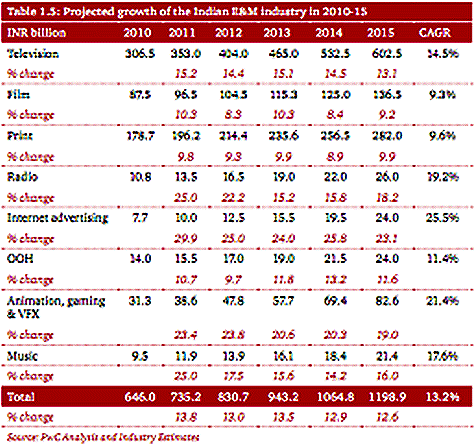
    Meanwhile, as per PricewaterhouseCoopers estimates, the entertainment and media (E&M) industry in 2010 stood at Rs 646 billion as compared to Rs 580.8 billion in 2009.  This was lower than the projected growth rate of 15.1 per cent for last year. The reason for lower growth rate was the decline witnessed in the film segment. The other two key industry segments: television (15.4 per cent growth as compared to 15.6 per cent projected) and print (10.7 per cent as compared to 8.5 per cent projected), showed good growth. As per the estimates, the E&M industry size would have been Rs 735 billion for 2011, but this does not look achievable now.


    In December, both Zenith Optimedia and group M indicated a sluggish growth for 2012 globally.


    As per Zenith Optimedia, global ad spending in major media will grow to $486 billion (4.7 per cent growth). It had earlier predicted a 5.3 per cent growth in 2012. However, Asia Pacific (excluding Japan) is expected to grow by an average 10.4 per cent a year and 33 per cent of the global growth is expected to come from the four Bric markets (Brazil, Russia, India, China).


    Group M, meanwhile expects a 6.4 per cent increase in global ad spending in 2012, As for 2011, it expected to show a 5 per cent increase in ad spends over 2010, to $490 billion.


    As for India, the experts believe that growth rate in 2011 would be in single digits, while Zenith Optimedia prediction of around 11% growth might hold true of 2012.


    Look out for the second part of our yearenders tomorrow