Dove Men+Care, men’s grooming brand, is back with a film that captures the transformation of the modern man.
Commenting on the brand film, Harman Dhillon – Vice President – Skin Care, Colour Cosmetics and Dove Masterbrand said: “Our brand has been built with a spotlight on superior care. With the launch of Dove Men+ Care, our purpose is to inspire every man to experience the transformative effects of care on themselves and those around them. This philosophy is deeply ingrained in our products, which provide the care men need without sacrificing on performance. Our first launch is the 2-in-1 Shampoo+Conditioner that exemplifies our unwavering commitment to offering exceptional care. In our latest brand film, we deliberately chose a football match as the backdrop, to beautifully showcase the power of care even amidst fierce competition.”
Added Zenobia Pithawalla – Senior Executive Creative Director & Mihir Chanchani – Executive Creative Director, Ogilvy: “Dove Men+Care is created for the new age man, who understands the power of care. In this communication, we show how modern men in the most competitive scenarios, won’t shy away from revealing their caring side. Dove Men+Care celebrates men who do not bow down to the stereotypes of masculinity – men who are comfortable showing their caring side and take great pride in self-care.”
The last two weeks were very purposeful. I was a panel member at a leading institute discussing the importance and genuineness of brand purpose in recent times. Coincidentally, two big brands in India, Stayfree and Dove also released some new work on their brand purpose.
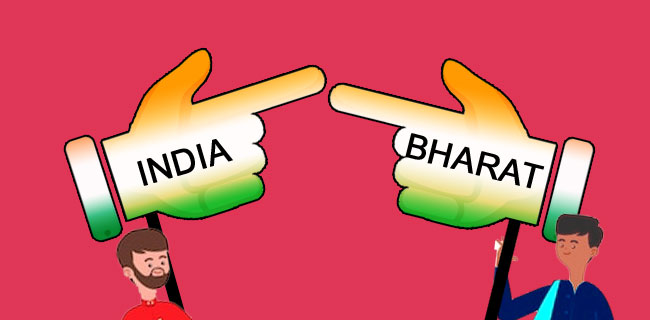
Both the pieces of work, have been panned by some marketing pundits and marketing gurus. While everyone has a reason and right to do so, I find the arguments put forward illuminating the ignorance of what is actually happening in the country. Most of the critics are metro-based with hardly any connect with the real India, Bharat, as it is called by some. Some of course also presume that every consumer is as marketing savvy and informed as they are. Let’s get into the details.
First a look at Dove. And before I begin, here is a disclaimer. I was involved with Unilever brands for more than a decade at a global, regional and local level in South Asia, Middle East, North Africa and Far East and this includes Fair & Lovely now known as Glow & Lovely.
Dove, for many years now, has been talking about body positivity. Very famously, Dove has in the past refrained from using models for its soaps and were using real homemakers, sans glamour and beauty, even in India. So, the body positivity was a natural progression with a scope to use various elements like colour, race, gender, depending upon the market they are in. The current campaign in India is about girls facing beauty issues as parents prepare them for the ‘marriage market”
The issue that critics have raised is first, not with the brand but with the company Unilever. They have chided Unilever who have profited very well with Fair & Lovely in the same marriage market. And I concede it’s a valid point. It does sound hypocritical. But then if a brand is calling out a practice which another brand in the company stable maybe encouraging, is it wrong or gutsy? Sure, the company must look inwards but should it stop raising issues that are real in the society. The marriage market is still a reality. The focus on the daughter’s marriage is still an issue. Or are they saying that the issue is not important. I found some critics mentioning that. And that highlights a bigger problem. If we think that because our daughters or our friends’ daughters or even our driver or help’s daughter are getting educated and are building a career or niche for themselves, it does not mean that the problem does not exist. I live in a small town in North India and I find the focus on the girl’s marriage still takes centrestage from an early age. Prosperity has meant that more money is being spent on the daughter’s beauty issues. Visits to dermatologists, increase in use of facewash, is a sign of the times. But the issue has not subsided or lessened in its importance.
And let us not forget that matchmaking, dowry etc have assumed gigantic proportions. When I started working in marketing more than three decades ago, the big society evil was dowry. Most of public service ads focussed on dowry problems. Now we hardly see any such communication or message. That does not mean that dowry problems or dowry as a society evil has lapsed. It’s in fact more monstrous. A cursory glance at vernacular newspapers in the Class 1 town editions reveal a spate of dowry-related death and torture stories on a continuous basis. The marriage market and the problems associated with someone who is not traditionally beautiful (read fair or blemishless skin) having to shell out more in dowry is a stinking reality of our times. Let us not wish it away. I moved to a small town almost a decade ago and not a month goes by when my wife is not reminded about our daughter’s future in the marriage market and what she should do to help her look better. And my daughter follows in amusement what some of her friends are forced to do.
It’s a bigger hypocrisy that we are trying to attack a purpose which is most relevant just because another brand from the same stable partakes in the marriage market. In fact, I will stick my neck out and claim that Glow & Lovely had stopped partaking in the marriage market even in its earlier avatar of F&L. So that too actually does not hold good. The real issue that Dove has highlighted is the marriage market.
I see similar issues in the panning of the Stayfree communication. Critics claim that the society has moved on from the “period talk is uncomfortable” issue. We have had movies like the Padman and some brands are showing in their demos red colour of blood, so why are we stuck with the same old issue of male friends and relatives uncomfortable with the talk of blood? I am afraid the critics again have a “big city” view. In metros, the issue of periods may not be uncomfortable anymore but in small towns and villages it is still taboo. Actually, I doubt if it has overcome the society stigma even in big cities. Just before the pandemic, I was attending an awards show in a 5-star hotel in a metro and a gent on our table noticed that a lady on the adjoining table had a stain. He pointed it out to his wife and was immediately admonished for making the observation so loudly and openly in front of men too. She then proceeded to discreetly inform the “victim” and help her cover it up with a stole, She was so embarrassed that she left the show, with a fuming partner in tow.
The situations in the Stayfree communication are very common and prevalent in small towns. It’s actually quite irresponsible to think that the issue isn’t relevant anymore. Just because we had many anti-dowry communications did not mean that dowry as an evil was vanquished. Or just because our circle of friends and relatives, even in smaller towns have risen above the period issue does not mean that the society has. The brand has actually opened a new window to the same issue. Teach the boys that talking about periods is not taboo. Just like one detergent brand talks about sharing the load by teaching sons the same at a young impressionable age.
I genuinely think that the metro, western influence phenomena continues to blindside our marketers. We also get overwhelmed by our own rhetoric. Yes, India has done very well. We have taken great strides in pulling up the society and breaking some myths and taboos. But the battle is far from over. A myopic metro-centric view is more detrimental than even the societal woes. Why, the most amusing comment I read was the one in which the marketing person stated that he is not sure that an average Indian user isn’t aware of Unilever, Axe and Glow & Lovely. Did he actually mean that an average Indian user knows that Axe, Glow & Lovely and Dove are all brands belonging to Unilever? Really?
It tells me all about an average Indian marketer.
Vikas Mehta is a senior business and marketing strategy consultant and educator. He is based in Dehradun. This column will appear every other Tuesday (and sometimes on other days as well). His views here are personal
The last few weeks have had us all heaving a huge sigh of relief. The hold that the Covid-19 Delta variant had taken over our lives seems to have abated for the time being. We are all now in between where we have a longing to return to business as usual (usual being the new normal) at least for the short term but are scared about when the Third Wave will rear its ugly head.
The storm of the last month made us all grateful for the positive power of the social media. And Dettol captures this sense of gratitude perfectly in its timely Covid warriors campaign which has just been launched. It hits the ball out of the park for multiple reasons – the timing, the ‘grateful’ mood of the nation, how it captures brand’s promise of protection and safety, and its high virality quotient.
We all depended on Covid warriors the past few months – these are people who managed to save lives by foraging for medicines, ventilators and beds by using social media and extending their networks. It is influencer marketing campaign but in a respectful way because atypical ‘influencers’ are being used. By using influencers, Dettol gets the benefit of their reach and engagement thereby ensuring virality. The campaign replaces its branding on the package to celebrate these unsung heroes. Packaging has long been an under-leveraged branding vehicle. The campaign is hence a win all the way and is bound to pick up many a pencil, elephant and metal.
Dove and ‘Hair Love’
I have talked about how with the information overload that the internet and specifically social media has decreased mental bandwidth for retaining advertising in many of my pieces. Long-form marketing, content marketing, product placements that add credibility to the product narrative hence become more important to kindle a desire to purchase. Internationally, Dove and Nike are both investing in being true to their brand purpose.
It has always fascinated me that the 2020 Oscar-winning short film, Hair Love was funded via a Kickstarter campaign and that a major participant in the Kickstarter was Unilever-owned Dove. Despite funding the short film, Dove did not try an overt product placement but kept its participation covert. Just as other entities that contributed to the Kickstarter, Dove only appears in the ending credits. Because the messaging was true to the brand narrative, it helped market the film by arranging for community screenings, and reaching out to tastemakers and media. This did not help them to sell products but it did help them to cement their perception as a brand which was genuine.
Nike – Breaking2
A similar case is of Nike. Nike has set the bar for sports marketing in the last few decades and they are constantly raising it to ensure they maintain a high share of voice. In 2014, Nike set out to do what was impossible at the time – a project to break the two-hour marathon barrier. The documentary Breaking2 captured the entire three-year journey that culminated in an unsuccessful attempt in May 2017. While the star marathoner, Eliud Kipchoge missed the 2 hour mark by a mere 26 seconds in 2017, he achieved the feat in 2019.
The project leveraged science and research to create an optimum environment which enabled the carefully chosen athletes a shot at breaking the record. The environment comprised of the perfect shoe, the best possible time of year, the track, a mechanism to manage headwinds (which affect speed) and many other miniscule parameters.
While the project executed over a three-year period was directly linked to Nike’s products, it was the larger objective of relentless effort to enhance performance to test the limits of human endurance and capability, which made it closer to brand purpose than marketing communication.
It was hence a perfect balance – communication that served a larger purpose while also enabling the company to sell shoes.
Brand purpose is key in 2021. Customers want brands to embody an inspiring ethos, have a strong point of view and take actions to spread their purpose rather than communicate only to sell products.
In a crowded market, the only way a brand can stand out today is to add credibility in communication. Marketing is inherently transactional in nature, but communication which leads with brand purpose is key to move customers down the funnel and make them return, especially for products which are easily replaceable.
Brand Engagement is always relevant and more so during the lockdown. Brands are using different tricks for engaging with consumers. Some of them are relevant and impactful, few original and innovative. I believe if there is nothing to say, being silliest is a better option.
The car manufacturer shares tips on how to take care of the parked car. Banks deliver newspaper in your inbox. Antiseptic cream makes sanitisers. Porn site gives free access to premium content so that you stay at home! Soaps shouting about washing the virus and Apps are updating for smoother operations.
Brand engagement during lockdown is part of the strategic initiative in preparedness for the post-lockdown market. Naturally, every brand wants to be on the top of the consideration-set whenever markets open. So, they need to keep the brand connect alive through brand engagement. It is known that the brands engaging the consumers now are most likely to emerge as the front runner post-coved scene.
BRAND ENGAGEMENT
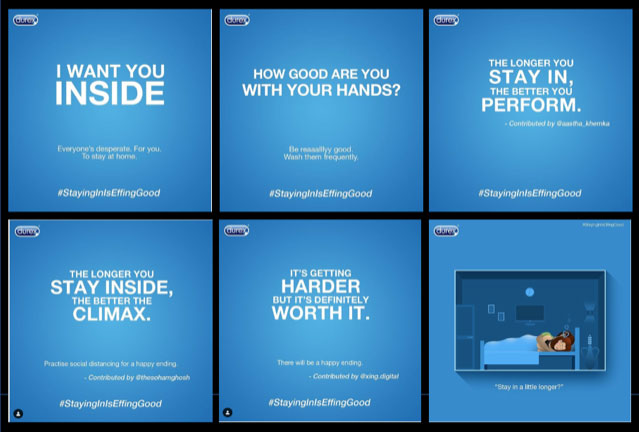
It was interesting to see Durex playing mindgames in its territory. The brand also suggested an innovative way to help out the audience like using it to cover the finger while pressing buttons in the lift.
On the other level, DOVE went ahead to celebrate the Beauty called Courage. It remains credible as the brand is operating within its pre-Covid coordinates defined by inner beauty.
Consider, ‘TAKE THE LOAD’ by Ariel, and it falls in place. The brand is continuously thinking of engaging consumer in different ways and situations. It is an attractive proposition, but I have a problem with it. The brand still addresses housework as a woman’s load. I will discuss this some other day.
Keeping the conversation going during such a crisis is a sensitive area. Some brands have learnt their lessons the hard way. The strategy and the message must remain incomplete internal and external sync. The brand can not have different visible standards or expectations across geographies, product lines and services, internal or external.
BRAND ENGAGEMENT – A TWO WAY STREET.
The brands must realise that ‘The consumer will treat you exactly the way you treat them during this period of crisis’. Remember, we live in an era of information democracy, and it is driving everyone crazy. Once the message is released in the public domain, you no longer are in control. If you are in the arena to commercially exploit the situation, your life will become miserable, sooner than later. At the same time, it is a beautiful space for brands with real purpose and empathy in engaging the audience.
BRAND ENGAGEMENT – PLAY WITH RELEVANCE.
During the crisis, sometimes it is best to remain silent. The well-informed consumer is aware of the situation. Brands are looking towards contactless delivery, but it still is no time for impact-less irrelevant engagement.
The consumer’s transactional deal is restricted to the brand delivering the best at a reasonable price. Or the brands are playfully engaging the consumer while sending a positive, relevant message of importance. Just like the various brands supported Social Distancing by playing around with their logo’s.
BRAND ENGAGEMENT – BE SIMPLE.
One of the compelling ways beyond talk play and intent is to act the intention. Let sharing of the news surrounding the Brand Act be amplification, instead of trying to send out a video in the social space. However, when brands move beyond transactional arena to show their soft touch treating consumers as part of the extended family, the equation shifts from being purely a stakeholder to an active partner. It required empathy, care, understanding and being sensitive to the ecosystem. The brand needs to understand the covert -overt needs and continuously re-defined expectations. It is a tough and risky territory to walk. The brands that see it as only a commercial leveraging opportunity, they fail to understand the double-edged dimensions and in effect do more wrong than the right to their image.
BRAND ENGAGEMENT – ACCEPTANCE COMES WITH RELEVANCE.
Such situations like coronavirus and the lockdown demands that the brands demonstrate care and empathy. However, there is an un-stated boundary between compassion and pity. The brand operating within the bandwidth of experience and tonality have higher chances to succeed.
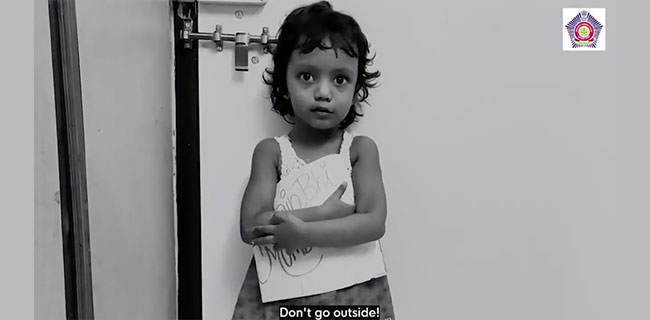
Mumbai police use of citizen vigilance for Stay Home campaign makes sense. People relate to it, knowing that ultimately police can do that much only. They emerge as a partner- as a peer.
Nearer home, Surf team remains true to the thought Daag Aache Hai. And extends it with Daag Bhai Ghar par Rahenge. The brand extends engagement by sharing fun activities for home on Instagram.
Now, this was brilliant as it came well in the early phase when people were still thinking about how to manage work. It works for Sony It works as the scope remains restricted to helping the daily wage earners in the film and television industry. But what is the Kalyan Jewellers link?
When EMIRATES tells you to stay home and assures with positivity that we will fly soon, you like the approach and the tonality. They are, in fact, not making any new point.
https://youtu.be/IRoAQ3dmOUw
On the other side, when UBER uses a similar tone to thank you for not using them, it seems forced. It is the result of earlier experience and perception of the brand ethos, culture and expectations.
Vodafone used both their famous hugely loved mascots, the ZOOZOO and the PUG to deliver the message. The Pug communication still has something going for it, but the ZooZoo fails to impress.
ASIAN PAINTS keeps the tone of voice consistent in ‘Jab Ghar Mai Saab Ho Toh Ghar khilkhilata hai’, #stayhonestaysafe. It remains within known brand coordinates using a picture of everyday life. Similarly, TATA SKY talks about ‘Ghar Baite Kuch Seekhe’. It is an example of excellent connect with its known educative and activity-based channels.
BRAND ENGAGEMENT – CAN ALWAYS MOTIVATE.
And when there is nothing -nothing to say and the brand still wants to keep the conversation going. They fall back on positivity to keep people motivated, usually with a dose of singing and celebrities.
When you overstretch and try being arty like HUL. It snaps because of a hyper stretch. It fails to evoke similar emotions.
However, when Mahindra says,- Some wheels will keep moving, you relate to it. And the treatment makes you feel so much better.
BRAND ENGAGEMENT- AUDIENCE AWAIT ACTION.
Though travel is a bad word during the lockdown, I was looking forward to engaging relevant and sharply focussed communication from Samsonite. It had reoriented its coordinates when they made the earlier communications including the one during Kerala floods. It will be a waste of a marketing opportunity if Samsonite does not subtly engage the audience in this crisis.
……………………
BRAND ENGAGEMENT- LIGHTER MOMENTS.
On the side, the crisis also made room for some absurd but thoroughly enjoyable videos. The one that is my favourites features Shekhar Gupta and @HoeZaay. He tries explaining the concept of tomorrow in a Swami Nityanand style. Shekhar Gupta may not need new audiences – but this viral must have worked for him.
Aiming iconic beauty brands at men may seem as unimaginable as Philip Morris, of Marlboro Man fame, wooing women consumers. But then Marlboro actually began life as a cigarette for women. By crossing over from one gender to another, marketers today are not looking to do a complete role reversal. Rather they’re just attempting to extend brands to a large untapped market – the other half of the species – without destroying the core proposition.
Anglo-Dutch consumer products giant Unilever could seemingly be testing one of its most sharply positioned male brands, Axe, amongst women – a limited edition launch for now. Anarchy will be the first fragrance from the Axe brand that will have a female version packaged in a shimmering silver and glossy pink canister with floral and fruity notes – as against the men’s version with fresh and woody strains. With this new avatar, the quintessentially male deo brand that’s built recall largely on the back of its cheeky commercials extends the boldness theme to its brand extension strategy.
This shift could mark the way forward for marketers in a world in which gender lines are merging.
Brands across categories – from cars to personal care and from denims to alcohol – are on a gender-flirting mission. For some the affair could turn out to be a one nightstand and for others, it may lead to a happily-ever-after marriage. Michael Maedel, President, JWT Asia Pacific, feels that companies in every sector face a fundamental imperative to grow market share and sales. As lines that have traditionally separated male and female consumers – those of income, attitudes and expenditure – continue to blur, more companies that have created brands targeting one half of the species are starting to address the other half with variants, he adds.
For instance, Bacardi has launched Bacardi +, a ready-to-drink mixer available in two variants – cola and lemonade – in the United Kingdom, some parts of Europe, China, Thailand, and now India. This marks a clear shift for the brand in reaching out to the male-drinking populace with its 8per cent alcohol content to entice the strong beer drinking segment. In contrast Bacardi’s Breezers that come in a variety of fruit flavors – and are widely consumed by women – have minimal alcohol content.
Mahesh Madhavan, president and CEO South Asia, Bacardi India explains the logic of the new drink for men: “If you peg anything for men in this market, women will drink it, but the reverse doesn’t happen . Men will not consume a drink positioned for women for sure. It is unfortunate but that is the way it is the world over.”
According to a JWT global research study, brands across different categories need to do more to reach out to women who are earning more, spending more and marrying later than ever before. Brands that have long focused on men – from banks to cars to property – could do a lot more to leverage this trend.
Of course when they do, they need to think about how to make their proposition relevant and attractive to women without changing the essence of their core offering.
Before Axe, there was Allen Solly that had made a sortie into gynic-territory. Allen Solly today is more of a unisex brand although the imagery has been predominantly male. The men’s range was launched in 1993 and the women’s range seven years later. Now, the brand is in the process of a re-branding; the new positioning will also push the gender envelope subtly.
Says Sooraj Bhat, brand head, Allen Solly. “Our endeavour is to make the Friday Dressing concept, launched in the mid 90s, acceptable and relevant to women as well. After all nearly a fourth of the brand’s share is coming from the women’s market.”
Conversely, skin care brands globally that were once the domain of women, says Maedel, have been successful in creating mannish lines, from a department store brand like Clarins to a drugstore brand like Nivea. Back home Garnier had been around for over 15 years as a beauty brand for women before it decided to launch a men’s range.
India is the first market in which the L’Oreal company decided to address the male of the species. Reason: An insight that Indian consumers are less reluctant to use skincare products than in Europe, says Jacques Challes, MD, L’Oreal India. He adds that it was not very risky for Garnier to make the gender-based extension because the values that the brand stands for – efficiency and quality, in a no-nonsense manner – are easily transferable.
Unilever brand Dove, which is present in categories like body wash, hair care, deos and lotions, has launched a Men+Care range in select markets (excluding India). Says Jennifer Bremner, global brand director, Dove Men+Care: “Our research found that many men were already using women’s skin care products, among them Dove. The range has been specifically created to deliver a range of superior products that give men the care they need without sacrificing effectiveness.” Bremner adds that for now there are no plans to launch in India.
Over time, the definitions of what are the masculine or feminine dimensions of a society change, depending on the various factors that drive its culture. Explains Sourabh Mishra, chief strategy officer, Saatchi & Saatchi: “In terms of defining a brand’s ‘gender identity’ within that society, what is acceptable at one point in time may not be so at another time.” He cites the example of Levi Strauss that was once all about the tough all-American man exploring the wild spaces in search of his fortune. It is doubtful if it could at that time have stood for the ‘Levi’s Curve ID’ that addresses a range of feminine body shapes. But it is perfectly acceptable today because there has been a shift in culture since then.
The decision to cross over is not without its dangers. Says Dick Maggiore, President & CEO, Innis Maggiore Group, a leading US-based positioning agency: “The greater the brand’s equity is established with one gender, the greater it should avoid brand androgyny. While a few new customers of the opposite sex could be gained, you would lose many more existing and potential customers while your brand position erodes.” He firmly believes that line extension is almost always a lousy strategy. “The key principle to a positioning strategy is that a brand can only stand for one ‘idea’ in the mind of its prospects and customers.”
Small wonder then marketers burn plenty of midnight oil before deciding to target a new set of consumers. As Russell Taylor, global brand vice president, Axe, Unilever points out: “Even as a limited edition this is not a decision we took lightly. The one golden rule is: ‘do not break the contract you have with your core target’.”
Rather than looking at the other sex as a vast untapped market that can set the cash registers ringing, marketers need to figure whether their brands actually meet a need of the new set of consumers. Consider Ranbaxy which recently extended Revital, a daily health supplement, to women. According to Brijesh Kapil, vice president, Ranbaxy Global Consumer Healthcare: “The product was developed to meet the special needs of women, and the product was extensively researched with consumers before launch.”
In contrast beverage brand Thums Up, whilst claiming to have almost 30 per cent of women consumers, has for some time now been positioned as a ‘macho’ drink in all its imagery and communication. However, a new campaign, in a first of sorts, has a shapely model doing the same stunts as her male counterparts. But we’re still not sure whether that’s a gambit to woo more male drinkers – the model is ‘shapely’, remember – or to invite more women to taste the thunder.
In the 1920s and 1930s as radio caught the imagination of Americans, Procter & Gamble (P&G) moved in to sponsor programmes, giving birth to the term ‘soap opera.’ Over the decades, P&G even began producing soap operas. Suddenly something changed a year ago. The maker of Tide detergent and Ivory soap discovered Facebook, Twitter, Youtube and its countless cousins. By the end of 2010, P&G announced that it had bid goodbye to its association with soap operas and instead embraced social media.
Back home, P&G’s global rival Unilever too is moving along similar lines. It’s not as if the Indian affiliate, Hindustan Unilever Ltd (HUL), is washing its hands off soaps. Rather, soaps and detergents are no longer the biggest winners for HUL. The new hero: the personal care portfolio – from Pond’s cream to Dove shampoo – which now accounts for three fifths of profits as against two fifths eight years ago.
At 47%, soaps and detergents still contribute the most to the top line but only a third of profits. Personal products (PP) account for 28% of sales and that will keep increasing in the years ahead on the back of new product launches, new category creations and brand extensions. Consumer analysts at Standard Chartered Research expect “continuous launches in the fast growing personal care segment such as Vaseline for men, Pond’s Gold radiance, Dove hair care range to increase PP’s contribution to 32 per cent in 2013.â€
That shift will be even more pronounced in the years to come. For two reasons: Unilever’s CEO Paul Polman wants three fourths of the global operations’ sales to come from developing markets. And most of that growth is going to come from health and personal products as awareness levels and exposure to new lifestyles increase in countries like India and China.
What’s more, soaps and detergents are well penetrated categories where growth rates have to taper off sooner than later. Cut-throat competition on price with P&G and a rush of domestic brands will also play its part in slowing growth in this segment. On the other hand, penetration levels in personal care and packaged foods are still in low double digits.
“Our strategy is consumer-led,†explains HUL CEO Nitin Paranjpe in an emailed response. Growing affluence levels, a younger population and changing aspirations and attitudes towards consumption are driving growth in personal care and packaged foods, Paranjpe points out. “Our investments in these segments reflect the changing consumption structure in India.â€
Hair care or shampoo is clearly HUL’s mainstay in PP. With brands like Clinic Plus, Sunsilk and Dove, the consumer products giant has a share of just under 46% of the shampoo market. The other pillars of growth are skin care where, in the premium fairness category in urban areas, HUL has almost 38% of the market in the bag.
Meantime, HUL has also been entering other categories. Over the past year, for instance, it extended the Dove brand into face wash and launched the Sure brand of antiperspirant deodorants for men. Fair & Lovely(FAL) has also been extended to FAL Multi Vitamin Face Wash and to the Anti Marks Eraser Pen.
Bringing in international brands like Sure is one part of the game plan. Extending some of HUL’s timeworn brands – including those of soaps and detergents – is the other prong. For instance, mass soap brand Hamam can now be seen in the hand wash segment; and the Rin detergent bar has been stretched into fabric whitening. And one of HUL’s oldest brands Vaseline has found its way into male grooming segments such as skin cream, face and body wash.
In a recent internal presentation, marketers let on that HUL has a 30% share in the hair conditioner category worth 27 million euros, which is growing at 40% annually. Business in the face cleansing segment has doubled in a year through deployment of a portfolio of brands including Ponds, Pears, Lakme and Fair & Lovely. The presentation also made the point that “in the case of premium skin care products we are focusing on premium skin lightening and anti-ageing with Ponds, Vaseline in hand, body wash and men’s grooming.â€
If Paranjpe and the HUL top brass are keen to pump up the PP volume, it’s also because profit margins are higher there. Analysts reckon that operating margins in PP are 25% whilst in soaps and detergents they have declined from highs of 14% a few yeas ago to 7.5-9% now.
Rivals, however, sound a note of caution. “The personal care industry was seen as a high margin business, but the recent spike in raw material prices and the disruptive competition in the market have seen margin profile of this business change completely,†says Dabur India CEO Sunil Duggal. Analysts reckon that margins in PP would have come down by 150 basis points over the past 3-4 quarters.
Adds Harsh Agarwal, Director, Emami: “There is a misnomer that the personal care segment has very high margins. But it may not be so in mass-priced products where gross margins depend purely on the brand’s pricing power.â€
Just like in soaps and detergents, HUL too has to reckon with intensifying competition in PP. Emami with brands like Fair & Handsome, which is a market leader in skin care for males with a 60%share. In 2010-11, Dabur’s skin care portfolio reported a near 17% growth led by robust growth across the Fem, Gulabari and Uveda brands.
And a clutch of international cosmetic and personal care majors from L’Oreal to Shiseido are keeping HUL on its toes in higher end segments. Still, with relatively new-found categories face wash, hair conditioners and anti-ageing creams opening up, HUL may well be looking at a fairer and lovelier in the road ahead.
 The last two weeks were very purposeful. I was a panel member at a leading institute discussing the importance and genuineness of brand purpose in recent times. Coincidentally, two big brands in India, Stayfree and Dove also released some new work on their brand purpose.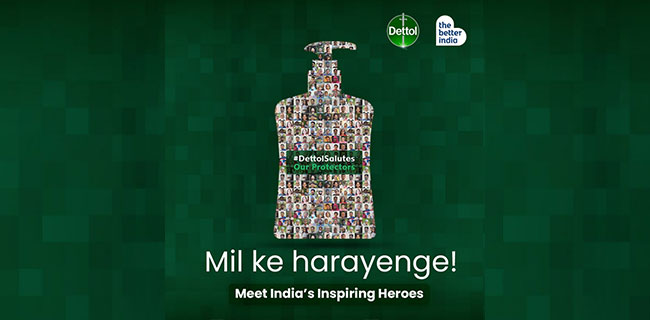
 The last few weeks have had us all heaving a huge sigh of relief. The hold that the Covid-19 Delta variant had taken over our lives seems to have abated for the time being. We are all now in between where we have a longing to return to business as usual (usual being the new normal) at least for the short term but are scared about when the Third Wave will rear its ugly head.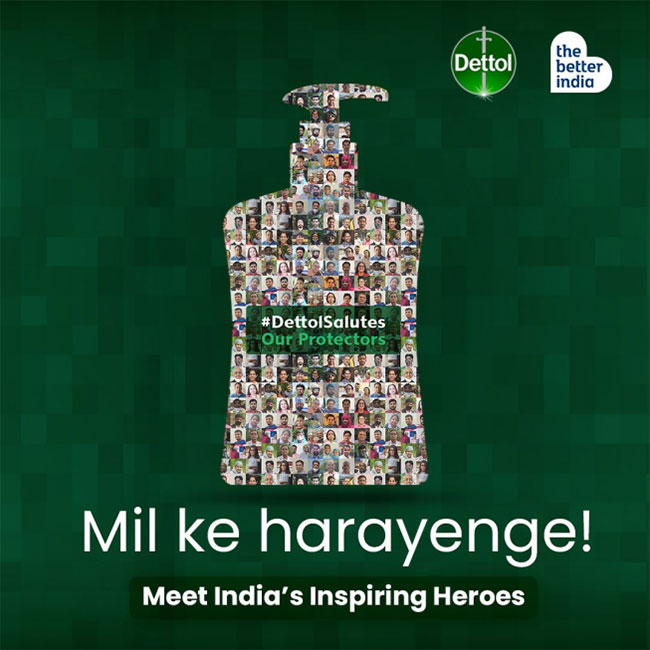

 Brand Engagement is always relevant and more so during the lockdown. Brands are using different tricks for engaging with consumers. Some of them are relevant and impactful, few original and innovative. I believe if there is nothing to say, being silliest is a better option.