Tag: Doordarshan

  • So what will NDTV be under Gautam Adani?


    By Ranjona Banerji


    Ranjona BanerjiIndia’s fastest growing businessman Gautam Adani has almost closed the deal to buy the news channel NDTV.

    Adani has stretched his wings, with a little bit of help from his powerful friends, to various industries from airports to mining to solar power, far from his original bastions of ports and edible oils.

    There has been much ferment over this hostile takeover because for many in India, NDTV has remained the last practitioner of Indian TV’s version journalism, as all its competitors have fallen in line with government diktats. In a sense, NDTV was the forerunner of free non-state-controlled broadcast news in India. Most of the older generation of television presenters were trained by NDTV, and that is where the first star anchors emerged from.

    Dr Prannoy Roy was a major influence on how TV would be conducted in India in the early days, after he and his wife Radhika Roy started NDTV in the mid-1980s. His show The World This Week for Doordarshan was very popular.

    The question now being asked over and over again by loyal viewers is what will happen to NDTV after Adani takes over? What will happen to Ravish Kumar, the fearless anchor who looks after NDTV’s Hindi news channel, the only TV journalist who does not kowtow to government forces?

    Why Adani wants a media outlet of his own is self-evident. His international press is not that good, and that sometimes spills over to India. The general assumption therefore will be one more propaganda channel which focuses on positive publicity for Adani companies and Adani himself. This is how many or most industrialist-owned media houses behave. Earlier the result journalism-wise would be disastrous because people expected some sort of basic standards – the collapse of the Observer papers after the Salgaocar-Ambani takeover is a case study here.

    But since 2014, assisted by a helpful government which demands total loyalty from media houses, the Ambani takeover of the News18 group has been a success. Not obviously when it comes to journalism but definitely when it comes to numbers.

    Hardly surprising then that Adani wants his own mouthpiece.

    What is amusing however – because I am cynical – is that in an interview to the Financial Times, Adani made the following comment: “Why can’t you support one media house to become independent and have a global footprint?… India does not have one single (outlet) to compare to Financial Times or Al Jazeera.”

    https://www.aljazeera.com/news/2022/11/25/indian-tycoon-defends-hostile-takeover-bid-for-broadcaster


    Now that’s an interesting standard for an Indian mainstream media which currently struggles to get even the basics correct. Neither the Financial Times nor Al Jazeera specialise in the sort of nightly high-decibel battles which characterise Indian television. The Financial Times is a serious pink paper, of the sort which today’s media owners scoff at. Indian news consumers, the general feeling goes, are largely thick, easily excitable and undiscerning and thus can only appreciate news in the form of a soap opera.

    There is nothing new in pandering to the lowest common denominator. It is an old media policy. But neither FT nor Al Jazeera fall quite into that News of the World, National Enquirer category. India Today TV recently ran a show where they objected to a tweet by actress Richa Chadha on the Indian Armed Forces. For their show, they ran photos of Chadha in swimwear. That works to belittle women, to put Chadha in her place as it were, and appeal to their crass audience. Actor Akshay Kumar objected to Chadha’s tweet, but the news of that was not accompanied by images of Kumar in revealing swimwear.

    Is Gautam Adani making it clear that this is not the sort of future he envisages for his version of NDTV?

    Well, you can hope as much as you like but the truth is likely to be elsewhere. In the same FT interview, Adani made this remark: “Independence means is government has something wrong, you say it’s wrong”.

    And Adani also said this: that the media should have the “courage” to back the government when it is right.

    There you have it ladies and gentlemen, clear intent from the tycoon himself.


    Ranjona Banerji is a senior journalist and commentator. She writes on MxMIndia on Tuesdays and Fridays. Her views here are personal


  • Government intervention in media must end


    By Ranjona Banerji


    Ranjona BanerjiNo matter how awful news outlets are and how bad their journalism is, government intervention is worse. It is our nursery mentality which wants the government to step in when something goes wrong, even when government is an essential part of the problem.


    News has to be independent of as many influences as possible, for it to be worthwhile to the consumer, whether reader or viewer or both. All too often you hear people saying X, Y channel is so bad, its news is so biased, why can’t the government do something.


    And what can or will the government do, if it controls what the media can or cannot show? Well, we already see that in many of our news channels and some of our other outlets. You don’t even have to go as far as state-owned broadcast media like All India Radio and Doordarshan. You get party and government propaganda masquerading as news. You see pretend journalists and some real journalists who should know better pushing party and government propaganda.


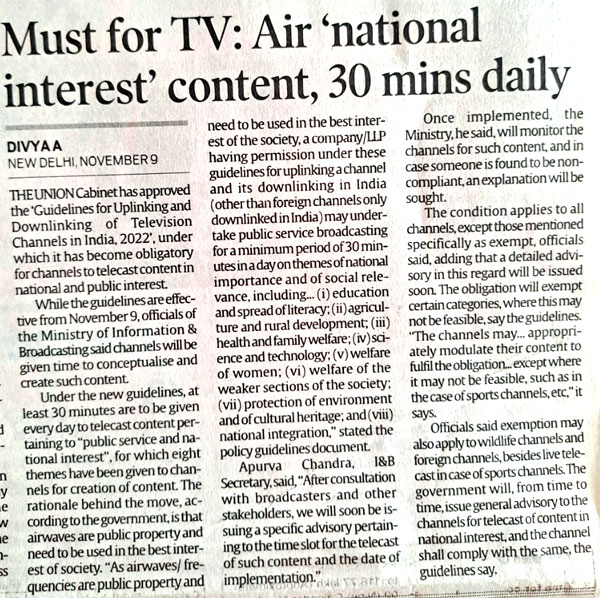
    In an already skewed and biased environment the recent Ministry of Information and Broadcasting rule that television channels must broadcast on themes of “national interest” for 30 minutes a day is a giant step in the wrong direction. It is not the government’s business what an entertainment or news outlet broadcasts, as long as it does not break the laws of the land. To direct media outlets to carry anything, of national interest or not, goes directly against the freedoms provided in Article 19 of the Constitution.


    It is television which governments target, not just for their reach, but because current broadcasting regulations make government intervention easy. The same new rules have brought some aspects of the broadcast media into the 21st century, but what one hand giveth the other taketh away.

    https://www.ndtv.com/india-news/centre-deregulates-uplinking-of-satellite-tv-channels-heres-why-3504929


    Although the I&B secretary claims that channels are “free to create their own content”, the very fact of the rule is a contravention of the media’s right to freedom of expression.


    In fact, the time will soon come when we must seriously discuss why we need a ministry of Information and Broadcasting, why we still need state-owned media and why the broadcast industry’s strings are pulled by government like a toddler in reins.


    After 75 years of Independence, we need a truly independent media. Without any government intervention in broadcast rules or paper import or digital space. Let the state-run media become licensed, where we all pay fees so that it is independent of political manipulation. It is only then what we can become truly adult.


    It is bad enough that so many sections of the media capitulate without being asked to, that media owners lack integrity and courage. We see the results of a population fed on misinformation and publicity campaigns. Free choice, free speech all these will soon be in name only.


    The attached screenshot in fact makes it clear just how much control the government wants. And the more you give in, the more you find you will eventually lose.


    This one is on us.

    And we’re losing for sure.


    Ranjona Banerji is a senior journalist and commentator. She writes on MxMIndia on Tuesdays and Fridays. Her views here are personal


  • India@75: Doordarshan


    By Avik Chattopadhyay

     

    Avik ChattopadhyayWelcome to the third piece in the series on my thoughts about some of the country’s most enduring brands called “India@75”. The first two were on the journeys of ‘Democracy’ and ‘Indian National Congress’ as brands.


    The battle of Kurushetra in the Mahabharata, one of the world’s biggest epics, starts with the words “Sanjaya uvaacha…”. The style of the narration was unique in the format of Dhritarashtra’s advisor and charioteer Sanjaya giving him a ‘live telecast’ of each nanosecond of the 18-day battle. Sanjaya had the divine gift of being able to see and hear everything in person without being at the actual location of incident. He narrates each incident to the king including the killing of his hundred sons at the hands of Bhima without ever flinching. He also describes the entire “Bhoomandal” [universe /galactic system] and entire Bharatavarsha to Dhritarashtra to build the context of all that is to follow in the battle!


    Many equate the direct telecast of Sanjaya to the concept of television, just that it was described somewhere around 1000 BC.


    On September 15, 1959, Sanjaya was reborn as what later got to be called as ‘Doordarshan’. Or DD as the nation prefers to call it. Though not yet 75 years old, but since we attained Independence, it has been one Indian brand that has endured all these years and continues to serve its core purpose.


    From the days of Pratima Puri and Gopal Kaul reading out the short news bulletins, DD grew from a mere part of All India Radio with a five-minute news bulletin to a virtual tour de force in the 1980s. For my generation it was our “Sanjaya”!


    Stamps issued to commemorate the 60th anniversary of DD in 2019


    Since 1982 when colour transmission were launched it was our friend, philosopher and guide on all things proudly Indian while being our eye to the entire world. The 70s and 80s were creatively the best decades for India in terms of exploration and expression. While we were an economically backward nation, when it came to intellectual prowess we were at par with the best. Some of the best institutions of education, research and healthcare had been built. Some of the biggest infrastructure projects on this side of the world had been undertaken. The biggest democratic cooperative movements were here. The 50s and 60s had built the platform to allow creativity take flight, collectively as a nation.


    The country’s biggest cultural movements in terms of art, cinema, theatre, music, and scientific temper started then and what we admire today about our current situation is an outcome of the same. And there was nothing ‘political’ about it, for there was enough upheaval in that field too to add to the magical Samudramanthan that we experienced. And DD was right in the middle of it all, including us all in this journey. It demonstrated the ethos of our Constitution and the values of the democratic system that we had decided to live with.


    The twin principles of DD that made it such a brilliant vehicle of the new Indian ethos were, as I call them, “Door ka Darshan” and “Doordarshita”.


    Door ka Darshan

    Literally meaning viewing far away things, DD helped reduce the distance of knowledge through enjoyment for millions of us who aspired to be one with the rest of the country and the world.


    I was exposed to Fellini, Aravindan, Gopalakrishnan, Ray, Ghatak, Patwardhan, Kurosawa and many more on DD. I gorged tales of Tenali Rama along with Byomkesh Bakshi and Panchatantra. I waited for Spiderman as well as The Old Fox with equal eagerness. I saw movies of all possible languages with subtitles as they were nationally and globally acclaimed. I never learnt to differentiate on language, subject or provenance as I wanted to absorb it all.


    Doordarshita

    Literally meaning vision, DD was carefully crafted by the early leadership of the country as a vehicle that would unite the young nation and equip us with the knowledge and wide perspective to step into the global arena.


    DD was not seen merely as a tool for government propaganda, which all state-owned media platforms are across the world. it was seen as the Indian’s peep into the menagerie that is India and the world.


    A generation of evolved Indians, with a greater sense of empathy and enquiry was built by DD. We were exposed to Chandra Prakash Dwivedi’s ‘Chanakya’ as well as Shyam Benegal’s ‘Bharat Ek Khoj’. We were enthralled by ‘Yes Minister’ as well as ‘Kakkaji Kaheen’. The world was brought onto the screen for us. We watched, consumed, debated and crafted ourselves as evolved Indians with a worldview without even having a passport!


    The Great Indian Thali

    That is what DD was curated as. Right from ‘Krishi Darshan’ [the longest running television programme in the world], to ‘Chitrahaar’ to the Sunday afternoon National Award-winning film, DD had it all.


    It had something for everybody. The sports lover got all the key global events as highlights or direct telecasts. The curious got shows like Quest, Quiz Time and The World This Week. The culturally leaning got Surabhi and Mirza Ghalib. The religious-minded got Ramayan and Mahabharat. The comedy seeking got Yes Minister and Yeh Jo Hai Zindagi. The curious got Sherlock Holmes and Karamchand. The kids got He-Man and Malgudi Days.


    Nobody was left out in DD’s mission to bring the entire nation together. It was a symbol of our unity in diversity!


    Common Conversations

    The nation had similar subjects to deliberate upon. Everybody from Mumbai to Madhyamgram was on the same platform of exposure, entertainment, and knowledge. Every part of the country felt proud to have been amply represented and amplified to the rest of the nation. Indians got to know more about India.


    If an incident disturbed Assam, it disturbed Andhra too, and vice versa. When Adoor Gopalakrishnan received the Swarna Kamal nobody asked “Adoor who?”. When ‘Manthan’ was telecast, the entire nation new of a tiny place called Anand and a man named Kurien. The entire nation debated Salma Sultan’s red rose tucked behind her left ear. We all admired the new reading skills of Tejeshwar Singh. It was inclusive.


    Deliberate Deprivation

    With liberalisation in 1991 came commercialism and private enterprise. With private enterprise came the need to ‘protect and neglect’. To protect the fledgling private television channels, the government neglected DD. Like most government initiatives, this was relegated to being just a mouthpiece of the policy-makers and those in power.


    DD was deliberately deprived of funds to ensure the private channels took over. Equipment was not upgraded, technicians were not paid enough, producers were short-changed, studios were not upgraded, and new technology was not brought in.


    The best talent from DD went over to the private channels and termites had taken over in no time. Management after management had submitted plans of autonomy and revival but to no effect. It was to become a propaganda tool not too different from the likes in China and Russia. Viewership reduced year on year, creating a case of financial unviability and hence no serious infusion of funds.


    The treatment meted out to DD was similar to that towards Air India. To encourage private enterprise the government deprived the shining public enterprises who were qualitatively at par with the best in the world. The intensity of this move was almost to undo the ills of the ‘socialist’ past. And as if all that was public was sub-par.


    Division and Disunity

    DD today is once again symbolic of India today, divided and disunited. We have become more insular while posing as being more global. The broadness of our mind and ability to accept has constricted to all that makes us feel comfortable and ‘superior’.


    The quality of what is consumed today across the country is in direct correlation with the respect towards education and enquiry. The former is totally transactional while the latter is the exclusive domain of a few. Escapism has substituted inquisitiveness. Proliferation has led to dismemberment of issues of national interest and debate. We prefer to escape into a world of ‘reality’ shows and celebrity scandals rather than discuss issues like education and environment. And we don’t care a damn about diversity as we have media that restrict us to our own little worlds of wells.


    As a collective, we are back to being what we were in the early 1900s… some 500-odd kingdoms and principalities busy with ourselves lacking a common identity. Having brought ourselves to such a state over the last 75 years, can DD rise from its ashes and unite us again? While the policy-makers would have none of it and wish to retain it as a political mouthpiece, Prasar Bharati can surely take a long hard look at its child and give it a serious makeover.


    We did hear a statement from the Prasar Bharati CEO a few months back pointing to same, commenting it would be inspired by how the BBC has evolved. For that, one needs both intent and independence. Hope the ministry has the “doordarshita” for the same at the earliest. As we celebrate ‘Azaadi Ka Amrit Mahotsav” we would not like to see one of the country’s biggest brands be finally consigned to the flames. Sanjaya needs to be reborn…

     

  • DD Free Dish Latest Auction: Who wins, Who loses?


    By Indrani Sen


    DD Free Dish has come a long way since its launch in 2005. Last year during the pandemic while Prasar Bharati had an auction of 53 MPG2 slots in March, 2020, followed by various auctions for limited number of channels for limited periods, allowing the Broadcasters to experiment with the pros and cons of having more than one channel from their stable on DD Free Dish.

    This year finallym the 52nd DD Free Dish Auction was announced inviting applications from eligible channels across six buckets of TV channels for the period of one year beginning from April 1, 2021. Prasar Bharati announced the reserve price for MPEG-2 slots according to the below bucket/categories:

    Bucket A+(All Hindi GEC TV channels) – 15 Crore

    Bucket A(All Hindi Movie TV channels) – 12 Crore

    Bucket B(All Hindi Music channels, Hindi Sports channels, Bhojpuri GEC channels, Bhojpuri Movie channels and Hindi Teleshopping channels – 10 Crore

    Bucket CNews & Current affairs (Hindi / English / Punjabi) channels – 7 Crore

    Bucket D– All other remaining Genres/ Regional channels and Regional Teleshopping channels – 6 Crore

    Bucket R1– Devotional / Spiritual / Aayush channels – 3 Crore

    Any channel participating in the auction had to bid above the reserve price in that particular category.


    During the last week, there has been a lot of excitement in the TV industry over the 52nd DD Free Dish Auction. According to industry sources, there was keen competition among Broadcasters for getting the slots across all buckets. Particularly in the News & Current Affairs category, the news channels have ended up investing huge amounts to secure slots on the distribution platform of Prasar Bharati. The final round of auction took place on last Saturday and the final list has been released on March 1, 2021. The results declared shows that 10 players have won the slots in A+ category while 15 players have won the slots in A category as shown below. The results also shows clearly that DD Free Dish has become an essential component of the marketing strategy of all the major Broadcasters.

      Category A + Hindi GEC   Category A Hindi Movies  
    1 ABZY Cool 1 Wah Movies* 9 Maha Movies
    2 Azaad 2 ABZY Movies 10 Manoranjan TV
    3 Big Magic 3 B4U Kadak 11 Movie Plus
    4 Color Rishtey 4 B4U Movies 12 Rishtey Cineplex
    5 Dangaal 5 BDM 13 Sony Wah
    6 Shemaroo 6 Bflix Movies 14 Star Utsav Movies
    7 Sony Pal 7 Dhinchaak 15 Zee Anmol Cinema
    8 Star Utsav 8 Enterr10 Movies    
    9 The Q India * Expected to be relaunched as Dhinchaak 2
    10 Zee Anmol        

    Bucket B earlier used to be reserved for only Hindi Music, Sports, Teleshopping, etc. The inclusion of Bhojpuri channels in that bucket reflects growing viewership of Bhojpuri language beyond its linguistic territory. Of the 13 TV channels winning slots in this category, 7 are Bhojpuri channels. In bucket C, 12 News Channels have fought the auction and both buckets D and R1, have 5 applicants each. As per the information available the news channels winning slots in the auction are Aaj Tak, Aaj Tak Tej, ABP News, India TV, NDTV India, News18 India, News Nation, Republic TV Bharat, TV9 Bharatvarsh, Zee Hindustan and Zee News. The industry grapevine is saying that the news channels have ended up investing proportionately major chunk of their expected annual revenue in the DD Free Dish auction and couple of them may back out subsequently.


    As of now, Prasar Bharati has got INR 730 + crores from the sale of 57 MPG 2 slots on the DD Free Dish from the 52nd DD Free Dish Auction which shows a 23% increase over the last auction of INR 594.25 crore collected from the sales of 53 MPG2 slots in March, 2020. The Bucket A of Hindi Movies Collectively has got the highest collection at Rs 194.85 crore, but a Hindi news channel has come out as the single highest bidder at Rs 22.05 crore.

    .

    The total number of channels participating in the auction has crossed the number of 53 slots which were available for the auction. The senior officials of Prasar Bharati have been huddled together in meetings over last Friday and Saturday trying to decide which Doordarshan channels they should delete from the DD Free Dish offerings to allow all the private channels to come on board.


    It is not really fair for a Public Broadcaster to take such a step as the axe is bound to fall on some smaller Doordarshan Channels catering to small states. Prasar Bharati is yet to declare which Doordarshan channels have been taken out from DD Free Dish to accommodate the private channels. Last year, I wrote in this column about the silent coup by Prasar Bharati. I am an ardent supporter of the DD Free Dish strategy, however, Prasar Bharati should not promote this strategy at the cost of depriving smaller states from the viewing Doordarshan programmes in their own language on the DD Free Dish.


  • 23 winners presented Ramnath Goenka Awards


    By A Correspondent


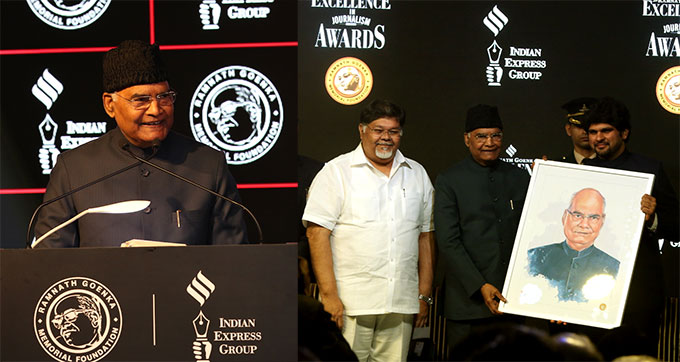
    “Democracy is meaningful” only if its “citizens are well informed…Truth is the only compass for good journalism, ” said President  Ram Nath Kovind as he gave away the Ramnath Goenka Excellence in Journalism Awards in New Delhi .


    Delivering the address at the 14th edition of the Ramnath Goenka Excellence in Journalism Awards in New Delhi, the President said: “The quest for truth is, of course, difficult and easier said than done. But it must be pursued. A democracy like ours deeply relies on the uncovering of facts and a willingness to debate.”


    At the ceremony,  awards were presented to 23 winners in 11 categories — across print, broadcast and purely-digital — for outstanding work done in 2018.

    In his welcome address, Viveck Goenka, Chairman of the Express Group, said: “We couldn’t have had a chief guest who better encapsulates the values we celebrate this evening”.

    Speaking about the winners, he said that “these stories also ask questions of fairness and empathy they take neither a no nor a yes for an answer” and search for what lies in between. He added that “they are firm in their resolve to embrace complexity, not reduce the story to either pro this or anti that… these stories tell us why journalism matters”

    Anant Goenka, Executive Director of the Express Group, presented Kovind with a portrait. Indian Express Chief Editor and author Raj Kamal Jha also spoke on the occasion.

    The RNG Award winners were chosen by an eminent jury that included Tom Goldstein, Professor and Dean, Jindal School of Journalism & Communication, O P Jindal Global University; S Y Quraishi, former Chief Election Commissioner; Pamela Philipose, journalist and Senior Fellow at the Indian Council of Social Science Research; and, former Supreme Court judge, Justice BN Srikrishna. Among those present at the awards ceremony were Chief Election Commissioner Sunil Arora, JD(U) leader KC Tyagi, former ABVP national organising secretary Sunil Ambedkar, Prasar Bharati Shashi Shekhar Vempati, Principal Director General of Press Information Bureau Kuldeep Singh Dhatwalia, eminent jurist Fali Nariman and D Raja, CPI General Secretary.

    The Express Group instituted the Ramnath Goenka Excellence in Journalism Awards in 2005 as part of the centenary year celebrations of its founder, Ramnath Goenka. The awards aim to celebrate excellence in journalism, recognise courage and commitment and showcase the outstanding contributions of journalists from across the country.


    List of winners:


    Here’s the full list of winners of the RNG awards this year

    Reporting from Conflict Zones

    Dipankar Ghose, Indian Express (Print/Digital): For Stories told from the deep jungles of Bastar that often get lost in the State vs Maoists binary

    Dheeraj Kumar, Late Achyuta Nanda Sahu and Mormukut Sharma, Doordarshan (Broadcast): The DD News team came under Naxal attack while covering the Chhattisgarh elections from Nilavaya village. Sahul lost his life in the attack.

    Hindi reporting

    Diti Bajpai, Gaon Connection (Print/Digital): For her seven-part series on rising instances of sexual assault on minors

    Shadab Ahmad Moizee, TheQuint.com (Broadcast): For his report on the agonising wait of families whose dear ones went missing in the 2013 Muzaffarnagar riots

    Regional Languages

    Anwesha Banarjee, EI Samay (Print/Digital): For her stories on human trafficking told through the livest of the women of a nomadic tribe

    Saneesh TK, Manorama News (Broadcast): For bringing out the devastation in Wayanad through people who lost homes, friends and relatives in the August 2018 floods.

    Environment, Science & Technology reporting

    Mridula Chari & Vinita Govindrajan, Scroll.in (Print/Digital): For their two-part investigation on how tax regulations allowed farmers to use at least 99 lethal chemical as pesticides.

    Sarvapriya Sangwan, BBC News Hindi (Broadcast): For capturing the impact uranium mining was leaving on the life of the indigenous people and the environment in Jadugoda, Jharkhan

    Uncovering India Invisible

    Hina Rohtaki, The Indian Express (Print/Digital): For her stories of people in Morni, Haryana, who would wad through the Ghaggar river or walk over a 20-foot high pipeline to get to school or work.

    Asmita Nandy and Meghnad Bose, TheQuint.com (Broadcast): For thier documentary that uncovered why lynchings carried out in the name of the cow have become a new normal.

    Business & Economic Journalism

    Nidhi Verma, Thomson Reuters (Print/Digital): For the economic and politics of sanctions, as India came under pressure from the US to stop importing oil from Iran.

    Politics & Government

    Sushant Kumar Singh, The Indian Express (Print/Digital): For some of the biggest breaks of the year – from Rafale talks to details of the Naga accord.

    Moumita Sen, India Today TV, Shikha, India Today TV (Broadcast): For their show ‘Election Influencer’ that looked at the nuts and bolts ot the giant election machinery.

    Investigative Reporting

    Teena Thacker, Mint (Print/Digital): For her stories detailing the pain that Indian victims of Johnson & Johnson’s faulty hip implants went through.

    Poonam Agarwal, TheQuint.com (Broadcast): For her investigation on whether donations made through the electoral bond scheme were, in fact, anonymous as claimed by the government.

    Civic journalism

    Aniruddha Ghosal, News18.com (Print/Digital): For his investigation that revealed that the UP government’s claim of having controlled encephalitis was based on data that didn’t quite add up.

    Photojournalism

    C Suresh Kumar, The Times of India (Print/Digital): For zooming into places, faces away from headlines, like the heat and dust of Jallikattu, and soccer players queuing up before a yellow plastic pot

    Books (Non-Fiction)

    Gyan Prakash (Print): For his book, Emergency Chronicles, which takes us back to Independence to try understanding the darkest two years in India’s democracy.


  • Digital media entity Asiaville launched in India

    By A Correspondent


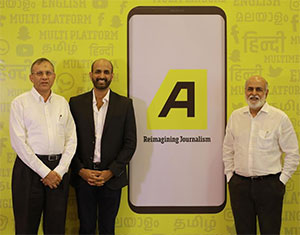
    Asiaville, the digital media venture focused on producing original content across Indian languages, has gone live across digital media platforms. Backed by media practitioner Sashi Kumar, former Doordarshan newsreader, founder of Asianet and the Asian College of Journalism and Tuhin Menon, former president of Culture Machine, the company seeks to reimagine journalism for a new generation audience.
     

    Said Kumar, Chairman & Editor-in-Chief, Asiaville: “The news media today are at crossroads. They are facing new challenges – technological, political and commercial. There is a fatigue operating on the mainstream media which find themselves buffeted by the freewheeling social media on the one hand and the technology platforms purveying media on the other. It is therefore time to reimagine and reinvent journalism, particularly for the millennial who engages less and less with the legacy media. Asiaville, with its multimedia, hybrid heterodox approach, hopes to meet that growing demand of the near and medium term future.


    Added Menon: “With nine out of 10 new internet users likely to be an Indian language user over the next five years, Asiaville seeks to address this burgeoning audience that is coming online through an innovative mix of original content formats that are native to digital platforms. We believe we have the right mix of original content expertise and product acumen to build a pan-Indian language network that is focused on the millennial. We are excited to have embarked on this journey and see great potential for scale and engagement with our digital first audience going forward”.


  • Rebranding Doordarshan?


    By Indrani Sen


    During the last week-and-a-half, after Shashi Shekhar Vempati, the newly appointed CEO of Prasar Bharati, announced the plan for changing the Doordarshan logo through a public call for new designs, we have seen on social media a lot of hue and cry.Indian TV viewers became nostalgic about the iconic logo and Twitter exploded with requests for not changing it.  It is doubtful if the requests from Twitteratis will be considered by Prasar Bharati as the whole aim of the logo change exercise is to woo the millennial generation who has no such nostalgic memory of the Doordarshan logo.
     

    The last date for submissions for the new logo design is August 13 and the winner will be awarded paltry prize money of Rs 1 lakh. We are seeing on social media entries from various aspirant designers and according to reports, the number of entries has crossed 2000.


    Redesigning of a brand logo is such a complicated exercise,that I have been wondering if a public call for entries and the almost one-liner brief can do justice to DD’s strategic need. The designer of the present logo, Devashis Bhattacharya, then a student of visual communication at the National Institute of Design (NID) who now runs his own design outfit, was quoted by Mid-Day saying: “If Doordarshan wishes to appeal to the young, they will have to look inwards, at the very programming of their content, and not just at logos designed by young professionals.”http://www.mid-day.com/articles/the-evolution-of-doordarshans-iconic-symbol/18483157.


    An organisation decides to redesign its logo for various reasons; when two companies merge or product line gets extended or when the logo design gets outdated or recharging of public interest is required or negative association with the logo needs to be changed. The first two reasons do not apply in case of Doordarshan. The current logo vaguely resembling yin-yang symbol is far from being outdated. However, there is no doubt that Doordarshan needs to recharge the Indian TV viewer’s’ attention and to erase the strong negative association about the national broadcaster among the Indian youth.  For achieving such communication goals, the first and foremost task is to change the quality of the programme content of Doordarshan followed by changes in its internal structure and culture. A complete new outlook for promoting and marketing Doordarshan is also essential.


    The senior IAS officers at the helm of Prasar Bharati and Doordarshan understood the importance of quality content for revamping the channel. In May 2016, Prashar Bharati took a decision to auction primetime slots between 7 and 11pm on the national channel of Doordarshan to private producers. After two failed attempt for auctioning, finally in the third auction held in December 2016 Balaji Telefilms and Saaibaba Telefilms were awarded six primetime slots (three each). The downward sliding of revenue was arrested and in 2016-17 Doordarshan recorded net revenue of Rs 827.51 crore, up from Rs755 crore in 2015-16. As reported by www.livemint.com in an article on August 3, “The broadcaster was hoping to generate Rs100 crore in 2017-18 from the auction—Rs20 crore as the collective bidding price of the slots sold in the auction and Rs80 crore in advertising revenue (from new programming)”http://www.livemint.com/Consumer/MvJZqDVMCFxaBI4gxqz8vK/Govt-review-of-Doordarshans-content-scheme-delays-release-o.html .


    The article above also announced that the Ministry of I&B has taken a decision to review the new content acquisition scheme through auctioning of primetime slots by Doordarshan. The two production houses have been working on youth-oriented shows, family dramas and reality shows expected to be rolled out from July 2017. The promos for the programmes were running on Doordarshan and according to industry sources quite a few episodes have already been canned by both the producers. At this point of time it is completely uncertain if the Ministry would allow Doordarshan to implement the existing policy or what changes it will make in the same. The decision of Ministry of I&B, which came immediately after the appointment of Smriti Irani as the Information and Broadcasting minister following the resignation of Venkaiah Naidu, proves once again the authoritarian hold of our government over the so-called autonomous Prasar Bharati.


    An attempt to change the Doordarshan logo without the support of quality content will be a disaster. There are number of case histories of rebranding failures where logo changes could not achieve the desired results. If the Ministry of I&B dictates Doordarshan to go ahead with a logo change without the orchestrated attempt for improving the quality of the content, it will be another addition in the list of rebranding failures.


  • DD set to combat GECS with big-bang shows

    By Vasudha Venugopal


    Watch out private television broadcasters, in 2015 Doordarshan is entering the soap war.


    DD, the host of shows such as Buniyaad, Hum Log and Nukkad in prereforms India, had long lost the ratings and advertising game for serialised TV dramas to private channels.


    But under Modi Sarkar, it is firming up plans to commission and broadcast quality serials. And the process has begun in earnest with a recent meeting chaired by Arun Jaitley, who, apart from heading the finance ministry, also holds the information & broadcasting portfolio.


    The meeting presided over by Jaitley also had I&B junior minister Raghavendra Rathore, senior Doordarshan officials and senior executives of TV production houses in attendance. Among production companies represented in the meeting were Balaji Telefilms and Hats Off productions, outfits that have produced some of the longest running soaps on private channels.


    More such meetings are planned over the next few weeks, EThas learnt. Officials at the broadcaster hope new shows and a new look for DD’s entertainment section will be in place early 2015.


    Officials familiar with DD’s new plans spoke on the condition they not be identified.


    TV production executives are learnt to have assured Mr Jaitley that they will soon send pilot shows to DD. And I&B ministry and DD are learnt to have assured executives that complicated bureaucratic procedures DD is typically associated with will no longer apply.


    Crucially, officials said, the ministry and DD told production houses that the sarkari broadcaster will work on an “incentive model” that will reward shows that do well. It is also learnt that DD has accepted that its revenue sharing model will need to be changed to make doing business with the public broadcaster more profitable for producers. DD, it was said by officials, will be revising its guidelines and will seek producers’ inputs before issuing new rules.


    “We want to revive producers’ trust in DD,” one I&B official said. The meeting also discussed issues such as budget constraints, decision-making time, production timelines (producers complain DD offers shorter contracts than private channels) and revenue generation.


    TV show production houses were enthusiastic about DD’s new efforts. “Daily soaps are Indian TV’s main revenue earners. It is encouraging that DD is looking at shows but DD needs to be revived first,” said Sunjoy Waddhwa, CMD, Sphereorigins, which produced the hit show Balika Vadhu. Waddhwa said his team is ready to work with DD. “Udaan on DD was a memorable serial. We are in talks with our writers to come up with something that can reflect the aspirations of a new India.”


    JD Majethia of Hats Off Productions said the mood of the meeting was optimistic and that all production houses were invited to make suggestions on improving DD. “At least top officials are interested in reviving DD’s old glory,” he said but also pointed out what DD needs to do: “Better telecast technology, simple systems and better offers than others.” Another issue flagged during discussions was the Delhi-Mumbai problem — DD’s headquarters and bosses are all in Delhi while the talent hub for TV productions is Mumbai. Private TV channels are Mumbai-headquartered. Uplinking shows for Delhi-based DD is therefore more expensive.


    But I&B ministry and DD officials are optimistic all problems can be solved. Fuddy-duddy DD is serious about becoming the king of TV soaps again.


    Source:The Economic Times

    Copyright © 2015, Bennett, Coleman & Co. Ltd. All Rights Reserved

    Licensed to republish


  • Ranjona Banerji: Sympathy for the ill-informed DD anchor?

    By Ranjona Banerji


    Last week, a video of a Doordarshan anchor at International Film Festival of India (IFFI) in Goa went viral. Let’s be clear. The girl was awful. She was babbling, did not know cinema, did not recognise important people, did not know how to look at the camera, got easily distracted, did not seem to realise she was on air, kept nodding at people who were off-camera, asked inane questions and was a total disaster.


    Unfortunately for her, her horrendous second appearance on national television was captured for posterity and seen by thousands on social media who may not have otherwise watched Doordarshan. She was also the subject of the sort of vicious remarks that social media excels in. People speculated about whether she was so happy because she had lost her virginity to her being stupid, crazy, dumb and so on.


    The girl is apparently “traumatised” by the attacks:

    http://www.telegraphindia.com/1141129/jsp/nation/story_19102425.jsp#.VHlBlP9yrk1.twitter


    Let’s assume she has no future in television after this debacle.


    But let us also spare a thought for the training that goes into being on television. Or lack of it, as in this case. The head of Doordarshan’s Mumbai office (responsible for the coverage) says her mike was not working. But this technical issue was the least of her problems. She clearly had done no homework and did not know what she was talking about. So what was she doing on air in the first place? We all understand how shallow we are but surely, surely, a few more skills are required in this job than a pretty face? Was there no one more experienced on DD’s payroll or phone books?


    Once it was obvious just how she couldn’t cope, why didn’t DD take her off air? They’ve done enough disastrous switches in the past – my own most traumatic was switching to news at the end of a Wimbledon final in the late 1970s – to know how it can be done. One of those “Rukavat ke liye khed hai” (we are sorry for the break) messages that were once a staple on DD? No? Then how about someone with half a brain using at least a quarter of it?


    And finally, the cruelty on social media is a given. But it is also true that those who can dish it out can rarely take it. Lesson for us all in there somewhere.


    **


    Two girls are groped in a bus (Rohtak, Haryana). They decide to fight back and thrash the men involved. The passengers watch the fun. The bus driver and conductor do nothing. One girl is thrown off the bus. Usual national and television outrage after.


    However, why do news channels make this a political issue? And am I really asking this question? Some problems are social issues and the treatment of women is one of them. No matter which political dispensation is in power, misogyny and patriarchy squeak through. Why not speak to social activists, to the cheerleaders of patriarchy, to the families of the men who groped these women and leave politicians out of it? Most serious conversations get diverted into that ridiculous you did this, you did that game and the issue is forgotten.


    Sorry. I have to end here. I’m going to look for a brick wall.


  • With 18k vacancies, DD officials blame gaffes on ‘adhocism’

    By Vasudha Venugopal


    With a video of a Doordarshan anchor making several gaffes at the Goa film festival going viral on social media, barely two months after another anchor used a roman numeral to address the Chinese President Xi Jinping, the public broadcaster seems to be making news for all the wrong reasons.


    But even as media watchers point out that DD anchors have made at least four major mistakes on air in the past five months, officials blame the lapses on the growing dependence on “casual reporters” for reading news and anchoring programmes since vacancies have not been filled in the organisation for the past two decades.


    The casual reporters hired on contract are often not trained for more than two hours on basic camera management skills before live coverage of an event. Besides, the channel no longer has a skill test mechanism to train and test anchors and journalists before they go on air, mainly because it is opposed by a section of people who feel it is discriminatory.


    Officials say the supervisory programme cadre that has trained professionals looking at last-minute mistakes made by anchors has become almost defunct because vacancies have not been filled.


    “With just 10 of the 191 required supervisors working, checking has become difficult. Also, people are watching DD more, so more mistakes are being reported,” said Prasar Bharti CEO Jawahar Sircar.


    At the Goa film festival, the anchor referred to state governor Mridula Sinha as the governor of India. The anchor was recalled from covering the closing ceremony because “she couldn’t identify important personalities attending the fest”, said officials.


    In September, an anchor pronounced Chinese President Xi Jinping’s name as “Eleven Jinping”. After that, a reporter used names commonly associated with secessionists like Islamabad for Anantnag and Suleiman Hill for Shankaracharya Hill while reporting on the J&K deluge. DD also used a picture of former PM Manmohan Singh instead of Narendra Modi, adding to its string of embarrassments.


    DD has over 18,000 vacancies, which has led to the disintegration of the programming section, said officials at Prasar Bharti, adding the channel survives on “adhocism” – by taking people on contractual or casual basis – a far cry from the government’s ambition of elevating DD to the level of the best public broadcasters in the world.


    Source:The Economic Times

    Copyright © 2014, Bennett, Coleman & Co. Ltd. All Rights Reserved

    Licensed to republish


  • NewsX kicks off show where guests will grill host MJ Akbar

    By A Correspondent

    He would anchor news-based shows on Doordarshan in the ’80s when he was with the Ananda Bazar Patrika group and later his appearances were at best sporadic. Until he joined the India Today group as editorial director when he was on nightly news more often.

    You can expect veteran editor M J Akbar to always come up (and carry off) concepts with a twist. On Sunday, news channel NewsX launched ‘Decode India with MJ Akbar’ where the guest leads the questions and discussions. The guest will question, argue, give his opinion and probe MJ Akbar on a topic of national significance. The inaugural episode of the 30-minute show featured controversial lawyer and politician Ram Jethmalani who discussed if there should be a referendum in Kashmir on the Indian Army.

    Mr Akbar is currently Editorial Director of The Sunday Guardian, which is part of the same media group that owns NewsX and a slew of other media titles.


  • Doordarshan-UNICEF celebrate 10 years of Navjyoti Awards

    By A Correspondent


    Had it been a private broadcaster, it would’ve gone to town about it. But this is pubcaster Doordarshan and not many of us in the trade media watch it. But having read the release which came in, we thought this deserves pride of place.


    A joint venture of UNICEF and Doordashan Mumbai Kendra, the Navjyoti programme aims to recognize initiatives taken by girls despite adverse circumstances. Started in 2003, Navjyoti celebrated its tenth year in a colorfully decked studio in Mumbai’s Doordarshan centre last weekend.


    Stories of ‘girl power’ unfolded and stunned the audience as nine girls from remote Maharashtra were felicitated for resisting child marriages and also helping other girls fight the scourge. They had one common message to share – “Girls are not any less.”


    They received honours from nine eminent and inspiring personalities like Nirmala Sawant Prabhawalkar, Dr. Jamuna Pai, Neela Satyanarayan, Manisha Goel, Priyanka Sinha Jha, Rajeshwari Chandrasekhar, Kiran Juneja, Sucherita Hegde and Grace Pinto. Other dignified personalities present were Dr Jagannath Hegde, Udai Gupta, Ulhas Wagh, Abuzar Zakir and DD Mumbai’s very own Mukesh Sharma.


    DD Sahyadri will get telecast a programme based on this on December 28 and 29 from 10am onwards.