Tag: Divya Marathi

  • Divya Marathi’s Marathi Literature Festival enthrals Nashik


    To strengthen and promote the idea of independent thinking, Divya Marathi organised the second edition of Marathi Literature Festival under the theme‘Confluence of Independent Thinkers’ in Kusumagraj Smarak. The three-day festival concluded on November 5 with a live performance by neo-fusion rock band Kabir Café. The festival also witnessed entertainment packed live performances of Music Maestro Hariharan and Illusionist Abhishek Acharya.

    Said Girish Agarwal, Director, DainikBhaskar Group: “We are happy that Marathi Literature Festival has been able to entice our Marathi readers by marking a confluence of independent thinkers and achievers. This will surely give impetus to our efforts of enabling our readers to think independently without being prejudiced and influenced”.

    A special segment ‘Celebrating the power of Independent Thinking’ saw 12 independent thinkers of Maharashtra getting felicitated for their passion and being change drivers. Few of the eminent speakers of the festival included DevduttPattanaik, Savi Sharma, Sheshrao More, Rajiv Dogra, SheelaReddy,NeelimaDalmiaAdhar, NilotpalMrinal,AabidSurti, NiranjanChapalgaonkar, SambhajiBhagat, Uday Deshpande, Virag Gupta, Ashish Chaudhary, Dr. Neelima Chauhan and Mahesh Kothare.

  • Dainik Bhaskar takes off in Bhagalpur, Bihar

    By A Correspondent


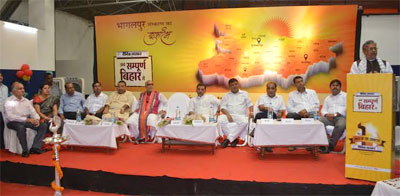
    Dainik Bhaskar, Divya Bhaskar and Divya Marathi announced the launch of Dainik Bhaskar’s new edition from Bhagalpur in Bihar. With this launch, DB Corp Ltd reinforces its presences in Bihar – a region which is of high strategic importance for the company where Dainik Bhaskar has already established a very strong brand equity and a leadership position through the launch of its edition in Patna in January 2014. Dainik Bhaskar now publishes six newspapers with 39 editions in 14 states across India.


     

    Over the next 20 days, Dainik Bhaskar is also set to launch two other main editions from Muzaffarpur and Gaya in August Beginning, with, in between launch of 7 district editions in Hajipur, Purnea, Biharsharif / Nalanda, Arrah, Chhapra, Samastipur and Darbhanga. This will complete Dainik Bhaskar’s full foray in Bihar.


    The Bhagalpur launch was implemented along a similar strategy as that of Patna driven by a well – strategized research and reader-centric survey that was also supported by an aggressive marketing and sales campaign which has once again proved its exceptional execution strength. A region with formidable peers, the Bhagalpur launch success was led by Dainik Bhaskar’s most differentiated content quality, its credibility and a highly un-biased approach as India’s leading media conglomerate.


    Commenting on the launch, Sudhir Agarwal, Managing Director, DB Corp Limited, “We are very encouraged with the overwhelming response to our launch in Bhagalpur. We have been studying the Bihar market for long and while we sensed and explored high market potential in Patna, we were also excited with the economic potential of Bhagalpur. Over the next few weeks we are set to complete our full roll-out in two other main editions and 7 district editions to accomplish our Bihar foray which will make a strong impact on our ability to provide a much deeper reach to advertisers and readers.”


    “Our growth strategy is well aligned to the exciting prospects we find in Bhagalpur where we could establish a leadership position and create a marked impact in terms of readership and circulation. We are very encouraged by the fact that even in a much demanding environment our readers across diverse categories in this region have received the product with great appreciation and confidence. Trust and integrity are uncompromising principles for us and we are fully committed to deliver a superlative product to our readers in Bhagalpur addressing their local news needs as well as emerge as a vehicle of choice for the State’s growth.”


  • Divya Marathi launches 7th edition from Amravati

    By A Correspondent


    DB Corp Limited announced the launch of the seventh edition of its Dainik Divya Marathi daily from Amravati. This is the company’s 66th newspaper edition. The Marathi daily is also published from Aurangabad, Nashik, Jalgaon, Ahmednagar, Solapur and Akola.


    Commenting on the Amravati launch, Sudhir Agarwal, Managing Director, DB Corp said, “Another milestone has been created as we expand our presence in Maharashtra with our 7th edition of Divya Marathi. In line with our launch strategy which we adapted to the Amravati market, we focussed on expanding the readership base in the region which is significantly under-penetrated.”


    The Amravati launch once again saw DB Corp conduct a three-phase process, adds a communique. Beginning with initial introductory branding through seeking views and feedback, crystallization of feedback to develop and design product and finally explore pricing and placing strategies of the product in the market. Corresponding to these phases, respective teams were mobilised to form the survey teams, visibility teams and the final implementation teams that were vigorously trained in communication skills, presentation skills, direct marketing skills, sales techniques and personality grooming.


  • Divya Marathi launches 6th edition from Akola

    By A Correspondent


    DB Corp Limited announced the launch of its latest edition of Dainik Divya Marathi from Akola in Maharashtra. With this launch, the Marathi daily has expanded its presence into 6 cities in Maharashtra with 6 editions in the region and 65 editions across India for the Dainik Bhaskar group.


    Commenting on the launch, Sudhir Agarwal, Managing Director, DB Corp Limited, “Divya Marathi newspaper Akola edition launch has extended our footprint even further across Maharashtra, this being our 6th edition in the state. Akola is a developing city and one of the major cities of Vidarbha region. The city is taking rapid strides in the IT sector and also has a rich cultural heritage. Evidently, Akola brings with it a new proposition and reach to advertisers and we aim to fortify our presence here to emerge as the most preferred media for corporates while also strongly connecting with readers in this region.”


    As has been done by the group for the launch of its previous editions and newspapers, a survey was conducted to introduce the Divya Marathi brand to readers for the first time, connect with them, ascertain their individual preferences to ultimately develop news daily that will address their unique issues and highlight aspects that will contribute to Akola’s socio economic development.


    A brand campaign supported the launch and announced the progress of the survey at every stage – “Tumchi Marji Janoon Ghyayla Yetoye” (We are coming to know your opinion/wishes!) and “Na Ravanchi, Na Sahebanchi, Aata Chalel Tumchi Marji” (Neither of influential class, nor of politicians, now only public opinion will make a difference!)


  • Divya Marathi now a case study at IIM Bangalore

    By A Correspondent


    The fast paced growth and unique new market launch strategy of Dainik Bhaskar Group, an Orbit-shifting innovative process featured as a case in IIM Ahmedabad, and the successful launch of Divya Marathi, the group’s Marathi newspaper, this time has attracted IIM Bangalore to study and create a classroom case on group’s success through the years.


    Seema Gupta

    Prof. Seema Gupta of IIM Bangalore did a detailed analysis of Dainik Bhaskar group processes in her attempt to understand what makes this group succeed. She met with the senior management across verticals; Editorial, Production, circulation and marketing to deep dive into their independent and cross-functional working. Result; ‘Dainik Bhaskar group: Aspiring Growth’ a case study by IIM Bangalore.


    The case delves into the history of the group, the aggressive launch strategy, accelerated business growth and robust marketing plan. It strongly points out that launching of a newspaper and venturing into a monopolistic market space is definitely a decision that is governed by the faith in the brand. Considering the nature of the category, where reading habits are relatively strong and the market leaders create high entry barriers including the competition-intensive cut-throat ground zero strategies, it makes for an interesting study in management strategies, processes and execution. Success in such situations cannot just be attributed to the business acumen, understanding of market dynamics and identification of the need-gap within the market. There are other elements like agility, empowerment, passion and high ambition across the employee set that is a real differentiator and helps convert strategies into reality.


    Elaborating on selecting Dainik Bhaskar Group for the case, Prof. Seema Gupta said, ‘Dainik Bhaskar with its ambitious growth plans exemplifies gutsy business strategy and marketing. It changed the contours of the marketplace by entering into markets with strong and entrenched incumbents. This task was even more arduous considering the nature of the category as it is difficult to change the habit of readers. Newspapers touch the life of every consumer and hence the case would drive strong emotional connect and animated discussion in the classroom. The focus of the company on tier II towns makes it an apt material for case study as small towns would be the drivers of future growth of Indian economy.’


    The case in detail traces the sustained leadership strategy adapted by Dainik Bhaskar Group over the years. It places importance on the way the group evaluates and  identifies the gap between supply and demand. And the process of creation of a product that truly answers the overt and latent needs in the ever evolving market. It identifies that the core business philosophy of the group remains a singular focus on close in-depth understanding of the consumers’ pulse and being consumer-centric in its product creation.


    Girish Agarwaal

    Speaking about this development, Girish Agarwaal, Director, Dainik Bhaskar Group said, “It is always a moment of pride when an institute of repute like ‘Indian institute of Management Bangalore’ seeks to study the organisation and creates a case study. We do believe that in the process of the case creation and discussion, the group also benefits in getting some raw, unbiased and unfiltered views. We attended the first classroom sessions held on July 20 at IIM-B, where second year students discussed the case. It has been a healthy experience and we respect the level of analysis that the students presented in their understanding of the challenges faced by the group.”


  • [MJR] TV journos prove Katju is right

    Ranjona Banerji

    By Ranjona Banerji


    Journalists have evidently signed a pact to prove Press Council of India chairman Markandey Katju right – 90 per cent of Indians are idiots. There seems to be no other reason for this enormous media reaction to the late night fracas between film star Shah Rukh Khan and a security guard at Wankhede stadium two nights ago.


    Of course, the shenanigans of film stars are exciting and when they behave badly it’s even more fun. But is there anything to justify front page headlines and TV debates for two days? What exactly is there to debate? Khan arrived last the stadium around the time Kolkata beat Mumbai, with a bunch of kids. The kids ran into the field. A security guard stopped them. Khan intervened. Words were exchanged and some apparently not very polite ones and then Khan left.


    For this, the world has come to an end. We are discussing politeness, propriety, banning, apologies, role models, respect for the uniform, high-handedness, diplomacy, official inefficiency, entitlement or the sense thereof, protection of children and the decibel level of whistles.


    If we went to war with China, I cannot imagine more being discussed on television. The journalists on TV cannot seem to distinguish between a security guard and a policeman. Rahul Kanwal almost burst a blood vessel when on Headlines Today veteran adman Prahlad Kakkar tore into the behaviour of security guards: “You have to respect the uniform”. I would really like to know how any of these TV guests react when faced with the officiousness of a security guard.


    Kakkad was a rare voice of sanity as was Rohan Gavaskar who said: “Banning Shah Rukh Khan from Wankhede is like banning Sachin Tendulkar from PVR”. Meaningless, in other words. Except for Arun Lal on Times Now, no one wanted to discuss whether officials of the Mumbai Cricket Association, who called for a ban on Khan entering Wankhede, were not over-reacting. Lal said it’s a question of contesting fiefdoms – with Khan as an IPL team owner against MCA officials with their hurt pride at being event managers rather than stakeholders.


    The levels of self-righteous on Times Now were staggering, with anchor Arnab Goswami, veteran columnist and author Shobhaa De and not-so-veteran columnist Simi Chandok leading the way. Goswami kept bringing up police action against Hollywood stars Nicholas Cage and Russell Crowe, again unable to distinguish between security guard and a policeman. (Hint: different uniform.)


    Former Mumbai police commissioner MN Singh tried to point out that criminal charges against Khan were not possible and this led to him being dragged over hot coals by Goswami. When the nation wants to know, let no man or woman try and douse the fire.


    Commentator Charu Sharma however poured cold water on Rahul Kanwal’s spectacular rage – mainly it seemed because uniforms were not being respected, apparently a prime concern in his life – by forecasting that an amicable resolution would be reached and the incident would soon be forgotten. The truth is that everyone knows that that is what will happen.


    As a matter of interest, after all the hot air expended over the fight which Saif Ali Khan had in a restaurant at the Taj a few months ago, can anyone remember the names of those self-righteously hurt complainants from South Africa? Hmmm.


    * * *


    On NDTV, I watched another somewhat circular debate over whether PA Sangma could become the next president of India. These speculative discussion with weak premises only illustrate our emptiness of thought. I greatly admire Divya Marathi editor Kumar Ketkar for his fortitude and level of tolerance as he sits through so many TV debates these days, trying to inject a little sanity into proceedings.


    It seems amazing to me that no TV people seem able to realise that all this political hoopla over the next president is just a diversionary tactic from all the political problems this country is facing.


    Goswami even wants a debate between Sangma and Vice-President Hamid Ansari, since he possibly believes that India has a presidential form of government. Contestant 1: I will plant 400 varieties of roses in the gardens. Contestant 2: I will conduct the tours of Rashtrapati Bhavan myself. Contestant 3: I will never build a large retirement home for myself. Contestant 4: I will never bore school children with my poems and ideas.


    Please, somebody, save us!


  • [MJR] The Modi merry-go-round continues

    By Ranjona Banerji


    As expected, the release of the report by lawyer Raju Ramachandran into Gujarat chief minister Narendra Modi’s role in the 2002 riots got TV channels into a frenzy. Having whipped themselves up over the “clean chit” given to Modi by the Special Investigation Team, the indictment of the chief minister by the “friend of the court” provided just the kind of contradiction that Indian TV thrives on.


    However, the arguments for and against Narendra Modi and his “crimes” or his “achievements” have become old and tired. As have the panellists. There on NDTV was Jainarayan Vyas putting up a stout defence of Modi. And, of course, a short while later he was on Times Now. Kumar Ketkar, editor of Divya Marathi provided the objective line – while slamming Modi for his well-documented anti-minorities stance – also appeared on both.


    But at the end of the day, little is achieved with such debates. The BJP and Modi’s fan club spew their spiel. Modi’s detractors have their own. The debate moves along predictable lines. The events have become so far away that the details have been forgotten which leads to even more chaos. Both Nidhi Razdan and Arnab Goswami had a tough time controlling some of their panellists who as usual forget all rules of civilised behaviour once a TV camera is turned on them. Smriti Irani of the BJP, for instance, gave us ample proof of how she can now graduate to the “saas” role in a poisonous soap – if they still have them on TV that is.


    (A disclaimer: I was deputy resident editor of The Times of India, Ahmedabad, from 2001 to 2004 and have a fairly good idea of what happened during the riots. Watching people who were nowhere around in those dark days holding forth can be both a frustrating and amusing experience.)


    * * *


    The big TV event of the week is of course the first episode of actor Aamir Khan’s Satyameva Jayate on the Star channels and DD. He dealt with the contentious and emotional issue of female foeticide and India’s skewed gender ratio. It was a well-researched show, with the subject presented from various angles and certainly struck a chord with the audience. The cyber world went gaga, judging from the number of tweets about the programme. Newspapers the next day were also congratulatory.


    If there was criticism – especially on Twitter, the home of manufactured outrage – it was about whether female foeticide was such an unknown problem after all as well as whether any change would happen as a result of the show.


    It is amazing to hear journalists talking about whether social change can result from media efforts, since we know from our own experience what a slow and pain-staking experience that can be. Your 140-character aphorism may take seconds to go out to the world; change on the ground takes a tiny bit longer than that.


    * * *


    An evening at the Mumbai Press Club was a great opportunity to meet up with former colleagues and old friends. The now annual awards for journalists in categories from crime and cricket to politics and the environment is a very good idea. Giving the lifetime achievement award to Vinod Mehta was a winner – since he promptly said that working in Bombay (as it was then) were the best years of his life!


    Applause all around.


  • Press Club Bombay honour bigger than Padma Shri: Vinod Mehta

    By A Correspondent


    Acknowledging to the audience that his heart still favoured Mumbai over Delhi and it was Mumbai that saw him at his pioneering best, Vinod Mehta, now advisor to the Outlook Group, was a picture of pride and fulfilment as he received the coveted Lifetime Achievement Award bestowed on him by the Press Club of Mumbai on May 4.


    Receiving the award from Kapil Sibal, Union Minister of Communications & IT, Mehta thanked the members of the fourth estate and said that this award means more to him than even the Padma Shri. Mr Mehta was felicitated for his selfless contribution of more than 35 years to his passion – journalism. Mr Mehta joined a host of winners from the fourth estate that were honoured by the Press Club for outstanding contribution to the trade.


    The evening also witnessed two special awards being given to late Pradeep Vijaykar (formerly with Times of India) and eminent journalist Madhu Shetye for their outstanding contribution to the domain. Gurbir Singh, President of Press Club of Mumbai delivered the keynote address while veteran sports journalist Ayaz Memon was the emcee for the evening.


    Prior to the awards ceremony, the evening witnessed a scintillating panel discussion on the role that media was portraying in the country and whether it was headed in the right direction. The panellists included Arnab Goswami of Times Now, who moderated the session, Vinod Mehta of Outlook Group, Kumar Ketkar of Divya Marathi and Uday Shankar of Star India.


    Mr Goswami began by stating that there is no shortage of attention being showered on media but expressed concern when he said that never has the media done so wrong. “The question that all journalists and editors need to ask ourselves is, are we doing everything right today? Is the chase for news headed in the right direction?”


    Replying to his question, Mr Mehta said: “There is no problem with the direction, what is essential is for us to judge the media in the environment it works in. The judiciary and press media still function with a degree of idealism and integrity but there is so much of self-congratulation that is happening; that is something that is slightly out of proportion.”


    Expressing his views on the issue of responsibility, Mr Mehta said: “Where the young journos are concerned, I feel they have a good sense of idealism and integrity but if there is somebody who has to take the blame for the current state of affairs, it is the editor. Even if somebody from the team has committed an error, the editor has to take ownership of that and find a solution to it. The problem is that the editors have forgotten what their job is and are pursuing their own agenda. The need of the hour is self-examination; we need to introspect and be accountable for our actions.”


    Replying to Mr Goswami’s query on whether there was unity between members of the fourth estate and the role that editors essayed, Kumar Ketkar said: “It is the editors who stop news from being published and not the management as many think. The editors try and control their reporters and that should not be the case.” Mr Ketkar cited the example of the slain BJP leader Pramod Mahajan, who was shot by his brother a few years ago. “When his brother was arrested for his murder, he had written a letter from the jail explaining his stance and he wished to supply the letter to all in the media. I was told that most editors had agreed to play up the letter in their publication and so I went ahead and planned a big editorial spread for the news. But the next day, I was surprised to see that only my paper had carried the news. This shows the lack of unity existing between the media players today.” According to him, “The media today is not clear on the role that it has to essay. They are not mature enough and lack understanding skills. Journalists themselves are timid and lack courage.”


    Uday Shankar, CEO of StarIndia went on to describe how television as a medium emerged in a big way first during the 90s and then again during 2008-09. “A lot is being said about how news television has been crowded space but I feel it managed to rediscover its own agenda during 2008-09. I cannot understand when some people say media doesn’t do self-introspection. If that is what is claimed, then how come they’ve come to rediscover themselves? Personally, I feel media has done the right thing by chasing news. If there are people who still have questions about the role of news channels, then I cannot understand whether media should be responsible for what it does or whether it should concentrate on doing the right thing?”


    The panel went on to discuss how urban centres led by metropolitan cities were receiving maximum attention from the media and how stories from the rural and less important towns were being ignored in a large way. The need of the hour, the panel highlighted, was to bring out stories from these small cities and towns which were inspirational in nature.


    Winnerspeak:

    Ashish Khetan, Editor – Investigations, Tehelka

    “I bagged the top award for my story on the national rural health mission scam that was unfolding in UP. The story was not about the bonds between the corporation and ministers but how corruption was actually killing people. The funds which were allocated for improving healthcare for the needy and rural people were being siphoned off and embezzled by the whole gravy train of bureaucrats, including politicians. Unfortunately the story did not get much play in the national media because it was centered around the poor but I feel the story was more important than 2G, CWG or other scams that were covered by the media.”


    Abhijit Sathe, Sr Asst Editor, Mumbai Mirror

    “I won the runners-up award for Crime (Pradeep Shinde award) for my story Hiranandani vs Hiranandani. The award means a lot to me. The story was a big one that chronicled infighting between families of one of the biggest names in business today. I exposed how two siblings were sabotaging each other’s interests. I am greatful that I was selected for, and eventually won the award.”


    Rafique Baghdadi, Business India

    “More than react to the win, I would like to say this: more than 62 years ago, a lady called Ms Panna Shah, had done a PhD in Indian Cinema and since then there is nobody who has done that course in the industry as yet. It’s high time the business houses, film industry and the state government should give grants and scholarship to aspiring candidates to pursue that course.”


  • Divya Marathi launches fifth edition from Solapur

    By A Correspondent


    The Dainik Bhaskar group announced the launch of the fifth edition of its Marathi newspaper, Divya Marathi, from Solapur.


    Solapur with an urban population of more than14.7 lac and a high per-capita income of Rs61,700 is one of the major cities of South-western Maharashtra. The first edition of Divya Marathi from Aurangabad started in May 2011 and soon other editions from Nashik, Jalgaon and Ahmednagar were launched. With 5 editions of Divya Marathi, it now covers complete central Maharashtra. Divya Marathi, Solapur is also the 65th Edition of the Group.


    “Through the Solapur launch of Divya Marathi, we continue to steadily enhance our footprint in Maharashtra and we now have 5 strong Marathi editions along withAurangabad, Nashik, Jalgaon and Ahmednagar, said Sudhir Agarwal, Managing Director, DB Corp Limited, commenting on the successful launch.


    The key proposition of Divya Marathi  Solapur launch campaign continued to be based on presenting an unbiased and fearless newspaper – “Na Ravanchi, Na Sahebanchi, Aata Chalel Tumchi Marji” (Neither influential class, nor Politicians, now public opinions will matter! ) – a theme that was central to the launches of the other 4 editions of Divya Marathi.


    Commenting on the success Nishit Jain, State Head; Maharashtra said: “The success is a reflection of the critical role brand building can play for a new entrant. It reflects across our processes. Our planning has been meticulous, including our strategically classifying city to understand its demographic nuances. This sharp focus on planning, management, marketing and branding has resulted in a successful launch of Solapur edition.”