Tag: digitisation

  • Digitisation Dhamaka in 3 years


    By Megha Mandavia


    Rating agency Crisil said the next two phases of digitisation of television distribution that is expected to extend until 2018 fiscal end would be best so far for all stakeholders in the industry.


    DTH and MSOs to gain Rs 4,800 crore after investing Rs 22,000 crore

    Government and broadcasters to gain Rs 10,000 crore sans investments


    Excert from the executive summary of the CRISIL report:

    The next two phases of digitisation of television (TV) distribution, which we foresee extending all the way to fiscal 2018-end, should be the best so far for all the stakeholders.


    CRISIL analysis shows stakeholders would benefit by Rs 14,800 crore:

    > Of this, direct-to-home (DTH) operators are expected to garner as much as Rs 3,300 crore

    > Multi-system operators (MSOs) are expected to receive Rs 1,500 crore

    > Broadcasters are estimated to receive Rs 3,900 crore

    >Incremental tax revenues of Rs 6,100 crores are estimated to accrue to the government, thanks to increased disclosure of revenues by local cable operators (LCOs) and increase in overall subscription base. Of this, around 80% will accrue to the central government through licence fee and service tax, and the rest to state governments through entertainment tax


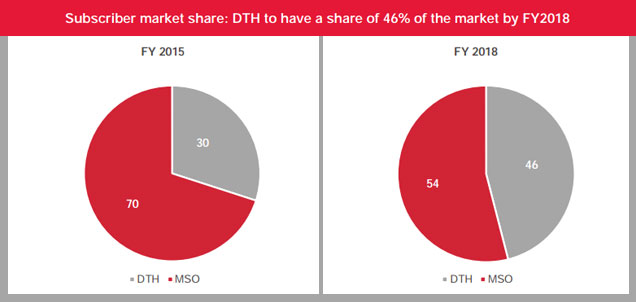
    CRISIL estimates that given their already stretched balance sheets and high capital expenditure (Capex) requirement in these phases, MSOs will be able to garner only 45% of the incremental digital market in the next two phases of digitisation. The balance will go to DTH service providers. This is in contrast to the previous two phases of digitisation wherein MSOs garnered 67% of incremental digital market together with LCOs.


    DTH’s upper hand in ‘cable-dark’ and sparsely populated regions will aid its market growth. And while incremental revenues will be on similar lines for both, profit share will be significantly more for DTH firms as they have complete access to subscription revenues unlike MSOs, which share a large part of their revenues with LCOs. While MSOs will continue to benefit from carriage revenues from broadcasters, CRISIL believes they are unlikely to receive incremental carriage revenues after digitisation.


    The only catch for the DTH operators is that they need to invest around Rs 13,700 crore over the implementation period. For MSOs, capital expenditure (capex) need is around Rs 8,300 crore. The capex requirements will be insignificant after the digitisation phase.


    LCOs, who had hitherto been disclosing only an estimated 20% of their analog subscription base, are the only stakeholders who will lose in this phase of digitisation.


    CRISIL believes the increase in overall market share and higher profits combined with promoter backing to part-fund the capex will benefit the credit profile of DTH operators. On the other hand, MSOs will have to increase their revenue share with LCOs to nearly 60% to prevent deterioration in their credit profile.


    Furthermore, while easing of foreign direct investment (FDI) norms will support fund raising plans for both DTH and MSO operators, the ability of MSOs to attract FDI funding will remain contingent on  improving their revenue share with LCOs.


    Direct-to-home (DTH) operators are expected to garner as much as Rs 3,300 crore, multi-system operators (MSO) Rs 1,500 crore, broadcasters Rs 3,900 crore and government Rs. 6100 crore in taxes, according to Crisil.


    “CRISIL estimates that given their already stretched balance sheets and high capital expenditure (capex) requirement in these phases, MSOs will be able to garner only 45% of the incremental digital market in the next two phases of digitisation. The balance will go to DTH service providers,” the report said.


    This is in contrast to the previous two phases of digitisation wherein MSOs garnered 67% of incremental digital market together with local cable distributors (LCOs), it added.


    Crisil said DTH’s upper hand in ‘cable-dark’ and sparsely populated regions will aid its market growth. “While incremental revenues will be on similar lines for both, profit share will be significantly more for DTH firms as they have complete access to subscription revenues unlike MSOs, which share a large part of their revenues with LCOs,” it added.


    The Indian television industry is the second largest television market of the world, after China, with television penetration in the country exceeding 165 million households in 2014, according to ICRA.


    Source:The Economic Times

    Copyright © 2015, Bennett, Coleman & Co. Ltd. All Rights Reserved

    Licensed to republish
     

  • Media biggies meet Modi, want speeding up of TV digitisation

    By A Correspondent


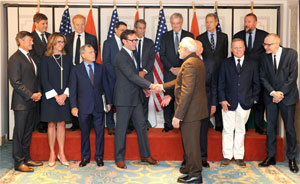
    Prime Minister Narendra Modi chaired a roundtable meeting with top American CEOs from the media and entertainment sector.  This happened last Thursday, September 24, to be precise.

     

    The CEOs present included Rupert Murdoch, Executive Chairman, News Corp and 21stCentury Fox; James Murdoch, CEO, 21st Century Fox; Robert Thompson, CEO, News Corp; David Zaslav, President and CEO, Discovery Communications; Michael Lynton, CEO, Sony Entertainment; Michael Roth, CEO, Interpublic Group of Companies; Shane Smith, CEO, Vice Media; Martin Sorrell, CEO, WPP; Jeff Bewkes, CEO, Time Warner; Nancy Dubuc, CEO, A&E Networks, Anthony Pratt, Chairman, Visy Industries; William Duhamel, Route One Investment Company; and Jeff Ubben, CEO, ValueAct Capital.  Uday Shankar, CEO, Star India was the only Indian M&E CEO in the meeting.


    According to a release, the CEOs appreciated the Prime Minister for energetic and dynamic leadership, and expressed optimism about the future of India. Specifically, the CEOs were enthusiastic about the digital transformation that is taking place in India through the Digital India initiative. They said that the current strong trajectory of the Indian economy makes it at a unique moment to accelerate growth in this sector.  The CEOs called for speeding up of television digitisation and strengthening of the cellular (mobile) infrastructure.


    The Prime Minister and CEOs observed that the changes in technology and media in recent times have led to an enormous democratisation of knowledge. The Prime Minister said that the world is now in a technology- driven era, where growth of digital infrastructure is as important as growth of physical infrastructure. He suggested to the CEOs that India represents both the biggest opportunity and the biggest challenge for them, and urged them to keep regional languages in mind, as they firm up investment plans for India. He spoke of his government’s vision to connect 600,000 villages through broadband connectivity. He asked CEOs to visualise the citizen of the 21st century, and think about what values s/he will represent and what challenges s/he will face. He also spoke of the role that digital technology can play in human resource development. The Prime Minister emphasised that he saw a key role for digital technology in further strengthening democracy, and in India’s development narrative.


  • Think aloud for a Broadcast Regulator: Manish Tewari

    By A Correspondent


    Manish Tewari

    Reiterating the government’s commitment for smooth cable TV digitization and protecting consumer interests, Minister of Information and Broadcasting Manish Tewari has asked the broadcast industry to ‘think aloud’ for a separate broadcast regulator.


    Speaking at the 4th CII CEOs’ roundtable on broadcast, the minister mooted the idea of a ‘techno-commercial’ regulator for the broadcast sector, which is witnessing rapid changes in the wake of cable TV digitization. He also made it clear that content will not be regulated by the government.


    Mr Tewari said that a viable measurement system for assessing audience tastes and preferences would enable the broadcasting industry to position sustainable revenue models. The broadcasting industry needed to initiate immediate steps for setting up the Broadcast Audience Research Council (BARC), he said, adding that the digitization process had created a model where the given database emerging from the process could be analyzed and expanded exponentially. The government was willing to provide this data to an industry-created body. This body in turn could utilize the data for use in the public space. The initiation of this industry-led process would ensure a two-way flow of information necessary for analyzing advertising trends and models.


    KVL Narayan Rao, Executive Vice Chairperson, NDTV Ltd outlined how for some broadcasters, carriage fees remains burdensome and subscription revenues are not forthcoming as yet. “Issues such as TRAI regulation on 12-minute ad cap are the issues that need to be deliberated upon,” he said.


    Elaborating further, the Mr Tewari said that there had to be a balance between the evolution of technology and the regulatory architecture. In view of the changes taking place in the broadcasting space, a discussion was necessary within the industry regarding the need of a regulator on techno-commercial grounds. Referring to the digitization mechanism, he said that all stakeholders had to ensure that they work together for creating an enabling environment. “This is critical in view of the consumer being the biggest stakeholder and end-beneficiary. The government is aware of the needs of the consumer and desires that the whole process of implementation ought to be done causing the least pain to the biggest beneficiary, ie the consumer. Digitization as a process has to be viewed as a game changer as far as the media landscape in this country is concerned, as benefits will accrue to all the stakeholders involved and each plays a vital role in the growth of the industry,” he said.


    In a major relief to broadcast channels, Mr Tewari maintained that a solution would be brought about to the TRAI’s recent regulation barring television channels from telecasting more than 12 minutes of advertisements every hour. He said the broadcast landscape is changing in the country with digitization, and this issue of fixing time slots for advertisements will be taken up at an appropriate time. He also expressed concern over the TAM TRP data and said that the BARC should be created at the earliest.


    Uday Kumar Varma, Secretary, Ministry of Information & Broadcasting, said that the entire exercise of digitization was to bring out a transparent mechanism, credible subscriber data and finally ensure that the dividends of digitization reach the end consumers. “We have discarded a system which was not transparent and are moving towards a system which has to be transparent,” he said.


    The government favoured domestic manufacturing and deployment of set-top box and may also consider fixing certain percentage (for domestic manufacturers) for reaching out to the next 50 million consumers in the subsequent phases of digitization, Mr Varma said, and requested domestic set-top box manufactures to match up with quality, price, and competitive standards as acceptable to MSOs.


    The ministry is also looking at the status of channel aggregators, in the wake of queries on their ‘legal status’ in the digitization process.


  • Ranjona Banerji: Can’t rely on the cable or on media’s coverage of Reliance

    By Ranjona Banerji


    The cable blackout from the night of Halloween has affected me in a peculiar manner. Although I have had a set top box from the cablewallah for four years now, the shift to digitisation has led to the loss of some news and sports channels. Everything else is as it was.


    I am told that normal service will soon be resumed. Interestingly though the biggest play on the impending cable shutdown was in the newspapers and not on television. Evidently, English news channels in India are not really bothered about losing viewers who have not yet subscribed to direct to home services. Or, they are so caught up in the antics of Kejriwal and Subramaniam Swamy and any new entrant in the publicity circus that they forget their main constituents – viewers.
    Since the blackout, I have no idea what Times Now, CNNIBN and NDTV are up to. I do still have Headlines Today – which is how I know about Swamy – and I also have BBC World, CNN and Al Jazeera. The aftermath of Superstorm (according to CNN) Sandy and Hurricane (according to everyone else) Sandy is that non-stop coverage of the weather has receded and other matters like Syria, the Greek economy and the US presidential election are back on the top of the news list.


    **


    After Arvind Kejriwal’s somewhat lacklustre press conference (enlivened only by a shoe that missed its target) about crony capitalism, there was much speculation that the story would not be carried by the media since Kejriwal and cronies had made allegations against the Holy Grail of Indian Industry – Reliance. However, as it turned out, everyone discussed the story, even those who are partly owned by Reliance.


    In fact, nothing that Kejriwal said was that new and the fact that Reliance – along with other Indian companies – manipulates government policy is hardly a revelation.


    However, it is interesting to see how far the media will take this story. It is also true that criticism of the Reliance group – especially the part owned by Mukesh Ambani – is very low key, which his brother Anil has often commented on. After the Radia tapes were made public over two years ago, Ratan Tata got a lot of flak for using the services of a PR consultant to lobby for a suitable Cabinet minister but Mukesh Ambani managed to escape attention in spite of the long and much-publicised conversation between Niira Radia and columnist Vir Sanghvi about how Sanghvi should steer his column towards Mukesh on the KG basin gas issue.


    **


    In the days before Reliance became India’s most feared industrial group it was fair game for media scrutiny and The Indian Express carried out a series of investigations into the then Dhirubhai Ambani led company, at the behest apparently of Bombay Dyeing’s Nusli Wadia. There was even an assassination attempt on Wadia which made the news, amidst all kinds of speculation about who had prompted the unlikely candidate of wedding orchestra conductor Prince Babaria to take this step.
    Since then, the media became more circumspect about Reliance and now we mainly read about Nita Ambani’s cricket team and life coaches.


    **


    The other fallout of cable digitisation is that BBC Entertainment will stop broadcasting in India from the end of November. Delays in digitisation and unreasonable carriage fees are the reasons given by the company on its Facebook page.


    Ranjona Banerji is a senior journalist and commentator. She is also Contributing Editor, MxMIndia. The views expressed here are personal


  • Paritosh Joshi: Cable on steroids

    By Paritosh Joshi


    This week, Media Matrix comes to you live from Singapore (ok, so ignore the hyperbole).


    Just last week we were expressing disappointment about the direction in which digitization appears to be headed with cable not being able to hold its own against DTH. This week, we will look at what a topflight cable system can actually bring to the party.


    I give you StarHub.


    Before someone points out that StarHub is Singapore’s monopoly cable operator and reaches over 99 per cent of all Singapore households, let me say it myself. While this certainly bestows advantages, StarHub also has to contend with a natural cap on the number of households it can service – just over 5 lakh by the way, with nothing left to expand to. For comparison, just the Mumbai (suburban) district has over 17 lakh households, lots of room for a good cable service to deliver compelling services and grow.


    Here is what StarHub Interactive’s landing page looks like. Just five icons but with loads of stuff tucked away under each.


    As you drill down, all manner of options become available. You can check the winning ticket numbers for various lotteries. You can also buy them. Under Movie Ticketing, you can find out films/screens/showtimes and also buy tickets. Under Finance, you have access to all securities and currencies traded on a range of regional and global bourses. That isn’t all.  You can set up your own portfolio, complete with buy/sell triggers, reminders and even connect to your trading account to execute orders.


    It doesn’t take a lot of imagination to conceive of the endless range of possibilities such a service could deliver in India. Remember that vastly more consumers are familiar with the TV ‘UI’ – the good old remote – than with the user interfaces offered by browsers and apps.


    Also, each of these services will find participation interest from whole categories of vendors. Financial intermediaries wanting to develop retail interest in a wide range of saving, investment and insurance products will compete to be on the platform. Every personal and domestic service provider will crave for the customer base. Banks will offer payment gateway facilities to encourage use of credit and debit cards in a more secure environment than the open internet. The nascent Indian homeshopping industry would positively lap up the possibility of concluding transactions in real time. Each of these will be an income opportunity for the cable platform operator, providing an additional B2B revenue stream and accelerating amortization of capital investment in high quality digital infrastructure.


    But is the cable community listening?


    Post Script: Regulatory Overreach

    Those who have been involved with the Television industry long enough might recall Mr. Pradeep Baijal, Chairman- TRAI from 2003 to 2006 commenting to the effect that once the last mile to the consumer’s home became competitive, there would be no case left for tariff regulation and the TRAI would switch to forbearance as it was progressively doing in its primary, telecommunication domain.


    What has actually happened is quite the opposite. The Authority has got ever deeper into tariff regulation. Funnily enough, the entire thrust of the regulatory exercise is in the wrong place. We will deal with what is wrong with TRAI’s television tariff regulation strategy in a subsequent piece but does anyone else share this view? Please use that comment box below. I will be waiting to hear from you.


    Paritosh Joshi was until recently CEO, Star CJ. He has been a marketer, a mediaperson and been a key officebearer on industry bodies. He can reached via his Twitter handle @paritoshZero.

    Media Matrix appears every Thursday. Due to an oversight, we didn’t carry it yesterday… sorry!-Ed.


  • Paritosh Joshi: Wither Digitization?

    By Paritosh Joshi


    We are down to just over a month for mandatory digitisation in the 4 metros. Newspaper stories suggest bullishness among DTH players even as major cable providers signal some nervousness and even seek extra time to get all their ducks in a row.


    Let me say this bluntly.India will lose a massive opportunity if all the spoils of digitization went to DTH.


    But first, a quick look back. To the beginning of this developing story.


    India’s economic liberalization and initiation into C&S television happened almost simultaneously. Even as Peter Arnett on CNN was telling the world about the bombing of Baghdad during Operation Desert Storm in early 1991, Dr Manmohan Singh and Prime Minister Narasimha Rao were getting busy with preparing the blueprint for India’s economic liberalisation. Almost by some divine providence, television and the economy were both getting set to kick into high gear in tandem. As the period since has shown with impressive consistency, as television has grown wider and deeper, so has the economy.


    Inevitably, technology has reached the point where the legacy of the analog system must be superceded by digital technology. The change is not sudden, having begun with the Conditional Access System (CAS) in 2002 and gathered momentum with DTH’s arrival in the form of Dish TV in 2005. While CAS was unable to make much headway, even in markets where it was made mandatory, DTH saw accelerating growth after the launch of Tata Sky in 2006, and then an operator explosion, starting 2008.India now has as many as six commercial and one public service DTH services, more than any other major market in the world.


    By definition, DTH services cover a very wide footprint, typically the entire Indian subcontinent, and often extending to points well beyond that. This provides great advantages to multi- or pan-national audiences, but is of little use to broadcasters or content owners who target a more tightly defined audience, be it based on ethnicity, language or geography. Also, since the service is delivered via satellite and doesn’t have a native return path, return paths have to be bolted on separately using a terrestrial or cellular telecom network, or an independent vendor’s internet service as is being tried by Indian DTH operators.


    Terrestrial digital cable services, on the other hand, frequently bundle television and internet services on the same cable and, by implication, have an inbuilt return path from viewer to platform operator. This creates a range of opportunities in terms of bringing transaction based services, payment solutions and so on that are accessible from a simple TV remote. Indeed, the best of breed in many parts of the world now offer triple play (TV, Internet and Basic Telephony) or even quadruple play (triple + Cellular Telephony) off a single connection.


    In addition to their versatility, digital cable systems simply have much more bandwidth to accommodate more content and services than satellite transponders. This advantage will become more significant as more genres and channels move from standard definition to high definition (or SD to HD is common parlance). HD channels use 3 to 4 times the bandwidth of SD and as setup costs of HD fall, broadcasters will be looking to deliver better viewer experiences with the switch.


    Amongst all the issues we have raised above, perhaps the most significant is the possibility of localizing television. Every city and town in the country is, potentially, a distinct television market. There is local news to be reported. There are local stories that must be told. There are local merchants who must advertise to their customers. And there is plenty of creative talent that is raring to have a go at tapping into these opportunities. If only there is a platform that can support them.


    That platform is not DTH.


    Paritosh Joshi was until recently CEO, Star CJ. He has been a marketer, a mediaperson and been a key officebearer on industry bodies. He can reached via his Twitter handle @paritoshZero


  • 58 Days to D-Day | Analysis: TRAI’s Tariff Order will make channels bleed more

    By A Correspondent


    In another major blow for TV channels, the Telecom Regulatory Authority of India’s (Trai) recent tariff order for digitization has a loophole that allows distributors to surreptitiously charge ransom-like placement fees from broadcasters. While this would be true for all tiers, it would be especially compounded in the Basic Service Tier (BST) where around 80 private free-to-air (FTA) channels are to be offered at Rs100 a month.


    This makes for a crippling double whammy for TV channels and makes the “must carry” proviso meaningless as Trai has also legitimized the usurious carriage fee racket which has turned multiple system operators(MSOs) and cable companies into the most profitable part of the Indian TV industry, even as it has bled nine-tenths of the TV channels into sickness.


    Over and above their other costs, TV channels annually pay over Rs3,500 crore as carriage fees alone, but collectively receive around Rs4,000 crore only of the approximately Rs20,000 crore paid by India’s viewers to cable companies and distributors.


    Trai’s own report had said that there was evidence of tax evasion in the cable industry while independent industry estimates have routinely put under-declaration by this cash-rich industry at a whopping four-fifths of its subscriber base – all of which allows for thousands of crores to be denied to the exchequer every year.


    According to an estimate, the government had lost around Rs5,950 crore in 2006-2011 in service tax alone due to under-declaration even as it posited the income tax evasion during this period at Rs17,413 crore, besides the loss of entertainment tax by states.


    In this situation, industry sources said, Trai’s move to force TV channels to pay carriage fees to distributors, ostensibly to enable them digitize their systems, was totally unacceptable. “There is no justification for robbing the already impoverished TV channels to pay the rich distributors, as they have had a favourable business model for years, and in any case, would reap the rewards of digitisation far more than any other segment of the TV business,” said an industry source.


    Adding that there was no justification for making the broadcasters pay for upgrading the infrastructure of the MSOs, they pointed out that upgradation was a one-time investment, but the carriage fees would continue to be an annual recurrence for broadcasters who, in any event, could not be suddenly made the medium to fund distributors.


    Broadcasters are especially aghast by this move as the prices of their channels are regulated and have been frozen for years, even as distribution costs have been allowed to rise unchecked in the garb of scarcity of bandwidth – problems which were supposed to have been addressed by digitization.


    Industry sources told ET that while they welcomed the Rs100 BST for 100 channels as being in consumer interest, there was a hidden minefield in the Trai tariff order that had come as a further shock. They said that the new order had no rules banning placement fees for channels in any tier, including the BST, and hence, this would again allow cable companies and distributors to fleece TV channels by demanding huge sums of money.


    Distributors already demand placement fee for placing the channel in a particular slot – by a process known as Electronic Programme Guide management. However, they had hoped digitization to end this malpractice.


    This problem is especially compounded, with the BST having only a restricted number of private free-to-air channels in its basket of 100 channels, compared to the large number of channels in the market place. As per the rule, at least five channels are to be carried in each of the following genres: movie, general entertainment, children’s content, news and current affairs and sports. This would allow distributors to cherry pick the minimum five channels in each genre and demand a huge placement fee to carry them since there are many more channels in each genre, language or market. In addition to carriage fees, this would be a crippling double whammy for broadcasters, sources specified.


    The solution, sources said, would be to increase the numbers of channels and also ensure an equitable, but not equal, split between genres, since there is a larger proportion of news channels to, say, sports channels.


    They also said that there was another burden in store for TV channels that Trai did not appear to have foreseen: Since every broadcaster would like to place its channel in the BST, the distributor could potentially subvert the letter and spirit of the Trai digitization order by fixing the carriage fee of the BST much higher than the carriage fee of its platform.

    CARRIAGE FEE

    Earlier, the News Broadcasters’ Association had slammed the Trai move to legitimize the ransom-like carriage fees charged by distributors, which have now been made a mandatory payment by all the broadcasters to the MSOs. Under this order, the MSO will not be bound to carry the channel of a broadcaster unless it pays carriage fees – which means that the broadcaster would have to pay carriage fees to the MSO to be carried on its platform – which would be decided solely by the MSO and would differ from MSO to MSO even in the same geography.


    Industry sources said legitimizing carriage fees could sound the death knell for small broadcasters, particularly the regional channels. The Trai move also goes against the concerns showed by the government for small regional channels. Information and broadcasting minister Ambika Soni, in a Parliamentary motion to discuss the Cable Television Networks (Regulation) Amendment Bill, 2011, had said: “This process of digitalization, I feel, would have a major impact on regional channels. They do not get on to national carriages. They cannot pay the high (carriage) fee. There are small channels catering to different states…”


    MUST CARRY

    However, the nub of the matter was that the evil of carriage fee would be abolished only if the capacity constraint was adequately addressed by mandating MSOs to increase their capacity to 999 channels instead of just 500 channels.


    India currently has around 800 registered channels available in the market and more are lined up for approval in the information and broadcasting ministry.


    Despite this, surprisingly, Trai has put the minimum number of channel at 200 for small distributors and 500 channels for large distributors, which frustrates the purpose of “must carry” as outlined in the regulation. “Assuming for a moment that every broadcaster is willing to pay the carriage fee declared by the MSO in its RIO, how is the MSO going to carry all the channels on its platform if it has no capacity to carry all the channels,” sources asked.


    They feared that the end result would be increased litigation between the broadcasters and distributors, thus potentially adversely affecting the smooth rollout of digitization. They said the situation can be salvaged only if Trai increases the numbers of “must carry” channels to atleast 500 channels by June 30 and 999 channels by January 1, 2013.


    Industry sources also pointed to other major systemic issues which the Trai order had failed to address.


    First, MSOs have been given the unfettered rights to decide the maximum retail price of the channels they carry- a move that would adversely affect both consumers and broadcasters as the MRP of the same channel could be different at the platform of every MSO. This would not only create confusion among the consumers, but would also increase the number of disputes apart from potentially allowing distribution platforms having their own channels a distinct advantage to manipulate for their own benefit. Sources said the solution to the peculiar situation was in allowing the broadcaster to have a say in fixing the MRP as is the right of manufacturers in all other sectors.


    Second, the freeze on the price of a TV channel – which had been introduced as a temporary measure – had not been lifted even after eight years. This has seriously affected broadcasters as many have not been able to recover their basic cost of operation. Given that there are more than 800 channels, with more in the pipeline, market forces should be allowed to play out.


    Source: The Economic Times
    Copyright © 2012, Bennett, Coleman & Co. Ltd. All Rights Reserved


  • Govt can plug revenue leakage by banning carriage fees, says broadcasting industry

    By A Correspondent


    Industry sources have said that banning carriage fees in the new digitisation of cable distribution regime w.e.f July 1 is necessary to ensure that government can plug the huge revenue leakage upwards of Rs10,000 crore annually due to cable companies levying huge carriage fees and grossly under-declaring their subscriber base.


    Moreover, ensuring a “must carry” clause for all TV channels and putting an end to their regulatory pricing wherein TRAI mandates the price that viewers pay for every channel, are also critical to revive the sick TV broadcasting industry, which continues to reel under the triple burden of usurious carriage fees, regulated tariffs for their channels as well as getting a fraction of their due subscriber revenues.


    At present, over nine-tenths of TV channels are in the red and are unable to invest in quality programming, while many smaller/niche channels with big-ticket pedigrees – Imagine TV being the latest – have had to shut down.


    Another fallout of these distorted industry practices has been that potential new export avenues have closed, because India is not able to export television formats and finished content – while other industries like software, music and animation (which do not suffer such a usurious regulatory/industry scenario) have been big-ticket forex earners for over a decade.


    Industry sources said that TV channels collectively paid at least Rs3,500 crore last fiscal to cable companies and distributors as carriage and placement fees, of which news channels alone paid at least Rs1,500 crore. These carriage fees turned many profitable TV channels immediately into the red, thus denying the government a large income tax earning opportunity upwards of Rs1,000 crore per year.


    According to another industry estimate, given the estimated subscription revenues of all MSOs/LCOs in the country, the government has lost about Rs5,950 crore over the five-year period from 2006 to 2011 in service tax alone by reason of under-declaration while the evasion of income tax is about Rs17,413 crore over the five-year period 2006 to 2011; and loss of entertainment tax by states is in addition to that amount.


    Additionally, TRAI had, itself mentioned in a March 2010 paper that “there is evidence of tax evasion in the cable industry…the last publicly available CBEC report of 2005-06 shows only Rs75 crore of service tax being collected from the industry on a base of 68 million subscribers paying an average of Rs165 per month, the estimated service tax collection from analog cable should be in the range of Rs1,400 crore per annum”.


    Another estimate – from HSBC for 2011 – says that the government lost around Rs1,380 crore last year in entertainment and service taxes alone due to cable companies under-declaring their subscriber base by as much as four-fifths. This estimate assumed the potential revenue to government at Rs1,725.90 crore given a Rs165 ARPU for 67 million analog pay TV households and entertainment tax at Rs20 per household along with 12 per cent service tax.


    But because only 20 per cent or 13 million households are disclosed, the actual revenues collated were estimated to be only Rs 345 crore even as TV channels lost out on the bulk of their subscriber fees. These practices have ensured that India now has a cash-rich last mile; India already has the third-largest TV distribution industry in the world where viewers can and are willing to pay for content – borne out by the fact that pay TV penetration is as much as 80 per cent in India, which is amongst the highest in the world.


    On the contrary, TV channels, who actually create the content, get less than a fifth of what viewers actually pay the cable companies. However, broadcasters say that the only opportunity to correct these distortions and ensure that TV channels do not continue to close due to extraneous factors, lies in the digitisation of cable distribution, for which the government is currently putting together relevant rules.


    Under this, it will be mandatory for all viewers to get a digital set-top box and for operators to distribute channels in a digital and addressable format. This will give viewers a wider choice of channels with better viewing quality. In fact, digitisation is now being seen as the game changer for the entire Indian TV industry as it will also significantly benefit distributors the multisystem operators – (MSOs) and local cable operators (LCOs) – whose paying base will improve even further.


    In this regard, Dr Prannoy Roy, chairman, NDTV told ET, that “digitisation of cable distribution is a major step towards making India’s media achieve truly global quality”. However, Rajat Sharma, chairman, India TV, pointed out that digitisation will be “meaningless unless all channels are made available to the consumer and he is given the power to make a choice”.


    He told ET that this can be done “only if it is mandatory for the cable operators to carry all channels and ensure that set-top boxes have the capability to carry more than 500 channels” and added that the government must curb any effort to create an artificial scarcity at the head end or in the box in carrying the channels.


    Pointing to the other issue of price controls on TV channels, Uday Shankar, president, Indian Broadcasting Federation, told ET: “IBF has always believed that channel pricing should be kept under regulatory forbearance and market forces should be allowed to discover channel valuations. Internationally, apart from countries like China or Taiwan, there are no instances of government regulating the pricing of channels. Freedom in pricing is essential for channels to offer best in class, quality programming. In the absence of this freedom, broadcasters are compelled to somehow match spiraling input costs with regulated prices thereby running the risk of compromising quality”.


    He added that there is enough competition in every genre to “remove any fears of exorbitant pricing”, given that the consumer has a choice between multiple DTH platforms and cable operators and “as a result of that, we have seen that the ARPUs have been flat to down”.


    Source: The Economic Times
    Copyright © 2012, Bennett, Coleman & Co. Ltd. All Rights Reserved


  • Counting on digital to be M&E’s trailblazer


    @FF12: Day 1: Digital attracts ‘desirable’ status
    on Day1
    @FF12: Day 2: Seamless blending with traditional mediums – a big want!
    @FF12: Day 3: Industry expects thoughts to lead to pertinent actions
    @FF12: Takeaways: Digitization rules the roost @FICCI Frames 2012

    By A Correspondent


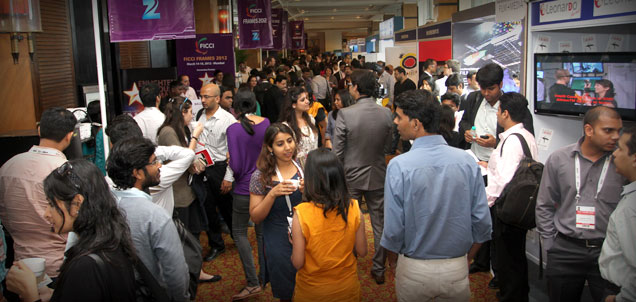
    Those familiar with the going-ons at FICCI Frames would testify how an infatuation gets displayed by delegates at the event each year so as to summarise the mood of the convention even before it broadly takes off across the three days that it is entitled to. But probably, the setting was a bit different this time around when the delegates – joined in unison by the media – were running ballroom to ballroom trying to ingest giveaways that were being thrown up abundantly across several sessions. May be, it was a year where each day had something new to offer to the delegates that kept them at tenterhooks throughout the 3-day event. And going by the loud decibels that were being emanated across every nook and corner of the venue, it was evidently clear that there was some motivating factor that was driving the gathering to go on an overdrive spree.


    The organisers of FICCI Frames 2012 have every right to take credit for coming up with a theme around a medium that attracted the attention of one and all. Having kept it on the sidelines till last year, digital was finally given its due at the convention as experts, authorities and enthusiastic youngsters came face to face to deliberate and come up with outcomes that would redefine the way the consumers consume the medium. From television to print to films and even radio, digitisation and the benefits and effects it would cast on these sectors were discussed in length at the venue. In fact Star India CEO Uday Shankar in his keynote address didn’t hesitate in thanking the FICCI committee for putting across a theme that would go on to redefine the way the industry functions in the future.


    What was apparently clear through the various sessions at the convention is that with the nearing of date for total digitisation across key metros by June 30 2012, and then across the country by 2014, broadcasters had to relook their distribution and content provision models so as to keep the consumer at the heart of every shift that will transpire in the future. Emphasising on the current digitisation scenario in the country, Mr Shankar said, “Most of the discussions that I have participated in are still around whether digitization will happen and if it indeed were to go through, how chaotic it would be. But all these are meaningless discussions triggered by a bunch of retrograde interests who are living in denial.” According to Mr Shankar, digitisation of distribution is a big reality and the 40-45 million homes that have bought DTH boxes at some point or the other are a conclusive evidence of that.


    Shooting back at critics who had doubted whether the makeover to digital would ever be a reality, Mr Shankar said, “To the critics and the cynics who are still wondering whether digitization would happen, my answer is: Look around, it is already happening and the rest of it is bound to happen because even in this country it would be difficult to undo such a momentous shift. To those who wonder how chaotic it would be, my response is that there would be some chaos, but chaos is not necessarily bad if the alternative is status quo or regression. When a transition at such a scale is happening that affects the illegitimate but strong vested interest in certain pockets, then there is an incentive to put up with chaos in the interest of the larger social objectives.”


    A broader outlook was provided by a few panellists who said that digitization will come in as a relief for broadcasters who will be benefitted from additional subscription revenue, relaxation on paying heavy carriage fees, and of course providing viewers with a superior content experience – MSOs and cable operators have to quickly respond to the digitization mandate by investing in set-top boxes – the cost that is only possible to recover after four years.


    Sounding off the challenges that digitisation would present for the broadcast sector, Tarun Katial, CEO of Reliance Broadcast Network Ltd said that, “For television, it will be a combination of content as well as marketing. The old model which was a combination of carriage and product, as it stands today, won’t work. The business plan which currently has a very high rate of carriage will obviously see the content taking precedence.” And as for content, it will be niche content that will call the shots for broadcasters as according to experts at the convention, niche isn’t niche any more as all niche channels put together command a share that is equivalent to the share of Hindi GECs and the mass channels, so to say.


    Perhaps the many advantages that digitisation will have on several mediums was rounded off by Vikram Sakhuja, CEO, South Asia, Group M who said, “The inherent power that digital brings along with it is interactivity and its ability to link multiple devices. Also the ability to enhance real-time consumption of content; linked to that is the entire thing about going mobile.” On the roadmap for the industry, Mr Sakhuja said, “I think integrated media is the best way forward. Today when people think of multimedia planning, they do a separate TV plan, print plan, radio plan, internet plan and so on. I believe that if you actually look at media agnostically and at common metrics of each cost per thousand impressions, these are the ways in which you can construct a media agnostic plan. What it does is, it suddenly gets more money into digital, and when more money can come into digital, that’s when focus is going to come in.”


    While digitisation was the mainstay of every discussion, the all-important issue of regulation too was taken up by panellists who chose to have the government respond to the many queries surrounding the topic. Uday K Varma, I&B Secretary, said that “if people at large seem to be happy with self regulation, I think the government would have no problem in legitimizing them. But I think the self regulation mechanism which has been set up by both the news broadcasters and the entertainment broadcasters, they’ll have to really prove it, not to the government but to the people at large.” He was joined in his cause by Prithviraj Chavan, Chief Minister ofMaharashtrawho said that the challenge would be to adopt the regulatory framework to new technology and ensure that over regulation doesn’t kill a good thing. The Chief Minister emphasised on the need for regulation and suggested that instead of the state regulating the media, the medium should look at regulating itself.


    The other important announcements that came up at the venue included the soon-to-be-passed Copyright Amendment Bill, the roll-out of the imminent phase 3 radio policy that would steer the growth of the medium and increased government aid for the film & entertainment sector.


    New ventures @ FICCI


    BARC takes wings

    In between the many promises and hopes that were being doled out at the sessions came the news of the Indian Broadcasting Foundation (IBF), the Indian Society of Advertisers (ISA) and Advertising Agencies Association of India (AAAI) announcing the official formation of a nationwide audience research joint body — Broadcast Audience Research Council (BARC).

    While IBF will have 60 per cent stake in BARC, ISA and AAAI will each hold 20 per cent stake. The Board of the council will have 10 members, six members from the IBF and two members each from the ISA and AAAI.


    Discovery Kids to flag off ops in April

    Another important announcement was made by President & CEO of Discovery Networks International, Mark Hollinger who announced the launch of its new network for children inIndia, ‘Discovery Kids’. Mr Hollinger said, “Launching in April, the network will initially be available in three languages – Hindi, English and Tamil. The channel will offer children a fun and entertaining way to satisfy their natural curiosity with stimulating and imaginative programming,” he said. The company plans to roll out the channel inPhilippinesandIndonesialater this year.


    Ten Golf tees off

    Taj Television India Pvt Ltd announced the launch of Ten Golf, a dedicated 24-hour golf channel. Ten Golf is the fifth channel from Taj Television India Pvt Ltd and began transmission on March 15, 2012. The dedicated golf channel will showcase a mix of live, non-live and feature programming. The channel will also broadcast live, high quality Golf action from around the world.

    Ten Golf has acquired rights for European Tour and Asian Tour till 2016, and has also entered into partnership with PGTI for three years to telecast the Indian Tour. Further, Ten Golf will be telecasting 400 hrs of golf programming in association with NBC.