Tag: Digital Summit

  • e-India: Seething with creativity, but full potential untapped

    By A Correspondent


    Day one of the 7th Digital Summit 2013 saw much participation from the industry leaders who debated and participated in ‘Creating the World’s Largest Free Market Digital Economy’. Organized by Internet and Mobile Association of India (IAMAI), the summit focussed on five elements of creating this economy: Infrastructure, Regulatory Frameworks, Services and Content, Entrepreneurship/Innovation and Business 3.0.


    Chief Guest Dr Montek Singh Ahluwalia, Deputy Chairman of the Planning Commission, said, “To a large extent, the internet and mobile industry of India is still untapped. There has to be a concerted effort to make people aware of the size, scale and scalability of the industry.” Commenting on e-entrepreneurship, he mentioned that internet and mobile is an industry which has a phenomenal spread of access and should “encourage risk taking young talent and inculcate the spirit of entrepreneurship” to expand the footprint.


    R Chandrashekhar, Secretary, Telecommunications, reiterated that broadband is the third wave of telecom revolution in India. Emphasizing last mile connectivity, he said, “Pure clicks-based model has led to some set of problems. It is important to look at sound business fundamentals since it is also a part of national transformation. We stand at the threshold of an exciting era.” Hitesh Oberoi, Chairman, IAMAI & Co-Founder, CEO, Info Edge India talked about the digital opportunity that exists now and would grow in the next five years. “The opportunity, however, lies in addressing the current challenges of the ability to provide: low cost connectivity, universal access, usable content, secure networks, affordable devices and enabling policy.”


    Creativity in Digital Era

    At ‘Importance of creativity in digital advertising’, Vikas Tandon, MD, Indigo Consulting said, “It is important to note that digital advertising has three core pillars when it comes to creativity: interactive since it not just sends messages, technology is integral to what is delivered and digital has put creativity at the hands of the consumer.” Representing FMCG view, Aditya Save, Head, Media & Digital Marketing, Marico, said, “FMCG companies still look at creativity with a very traditional view, which means communication emotionally,” where Arun Sharma, VP Marketing, Head Media & Rural, Bharti Airtel explained how Airtel used digital media to create the innovation of a friendship band.


    Vineet Gupta, Managing Partner, 22 Feet Communications, noted how the digital media is seeing significant increase in media spends and how some campaign break only on digital platforms now. Mohit Hira, Sr VP & Regional Business Leader – Airtel, JWT, said, “Mobile is not the second screen, but the first screen for youth. For them, mobile is not a private but a public device. Even though for mobile screens, which are smaller, you cannot put in too much production detailing but it is no-brainer that mobile will be the game-changer when it comes to digital economy.”


    Neville Taraporewalla, Sr Director, Emerging Markets, Advertising & Online, Microsoft, said, “What I am amazed at is that Cannes still does not receive an entry from India in digital category even though the digtal creatives are amazing the world over.” The panelists agreed that while digital advertising was on an upswing, it would still take time for digital to become a primary choice of media, and creativity and production detailing would increase with increasing spends.


    Peter Panait Lojmand, Senior VP, Opera Software, pointed out how browser surfing can bring many changes in the mobile internet landscape of India. He said that entry barriers in India for internet browsing are high, which includes technical, trust, cost, educational and accessibility factors.


    All-Inclusive Growth

    Nandan Nilekani, Chairman, UAIDI, and Sam Pitroda, Chairman, NIC, talked about how they are working towards ensuring all-inclusive growth with the help of technology. Mr Nilekani asserted, “Through Aadhar, which we are undertaking on huge technology and cloud-platform is a digital initiative for massive societal inclusion. And for this, we are working with many sectors and industries.”


    Mr Pitroda spoke about ‘Bharat Broadband (National Optical Fibre Network): Going extra mile with public investment.’ He said, “We are essentially at the tipping point in India. What you see in media is totally opposite of what reality is. Thus, we need democratization of information so that everybody has access to information that we need. But we do not get that information, from any quarter including administration, judiciary, and politics because they resist information and flexibility. The idea of NOFN is to integrate collaboration given the multi-disciplinary and multilingual complexities of the country. We will be connecting 500 campuses and talk to 25000 students at the same time on January 23.”


    “While connectivity is one piece, you need application and infrastructure as well. We want to computerize each and every governing and administration body of the country, and when it happens, will be a new day in India. That is why I said that we are at a tipping point,” he said.


    The last session of the day discussed ‘Social Media – freedom, moderation or regulation’. Rajesh Kalra, Chief Editor, Times Internet said care is taken not to do or write anything that puts them on the wrong side of the law. “Of course, the law needs to be changed since it continues to get misinterpreted,” he noted.


    Shivam Vij of Kafila.org said that he was a free speech fundamentalist and “it is important that media or social media is not ashamed of free speech. You have to have the right to justice redressal if the media has to be regulated.” R Sukumar, Managing Editor, Mint said, “We do not need a social media regulator. When you are dealing with a political establishment which is trying to clamp free speech, a regulator cannot be the answer.”
     

  • Digital Summit: Social media and content consumption

    By Shruti Pushkarna


    Day 2 of the 6th India Digital Summit organized by the Internet and Mobile Association of India (IAMAI) began with an informative session on where social media stands today. The session also touched upon some legal nuances with reference to the recent controversy on freedom of expression online.


    Social Media: Whose Food, Whose Poison?

    The panel consisted of Pawan Duggal, Advocate, Supreme Court of India & Cyber Law Expert, Pranesh Prakash, Programme Manager, Centre for Internet & Society, Shubho Sengupta, Digital/Social Consultant & Integrated Marketing Council, Coca Cola and Supriyo Gupta, Founder, Digilogue Communication. The session was moderated by Pradyuman Maheshwari, Editor-in-Chief & CEO, MxM India.


    Cyber law expert Mr Duggal started by outlining for the audience where the law stands on freedom of expression as far as the online medium is concerned. He agreed that as per the Constitution, every citizen has the right to freedom of speech but this is not necessarily an absolute right. The recent amendments in the law have changed quite a few things in cyber law jurisdiction; the most important being the introduction of the term ‘intermediary’. As an intermediary if one does not comply with the law, and allows inappropriate/offensive content to be published online, one can be exposed to both civil and criminal liability, depending on the case in question. While Mr Duggal agreed that there is no escaping the law, he also emphasized on the need for organizations like the IAMAI to step forward and ask for amendments to be made to the almost ‘draconian’ IT Act.


    For Pranesh Prakash the picture seemed grimmer than it’s painted out to be. He cited some examples of how the law is formulated in the country in a ‘cut & paste’ manner rather than with a proper understanding of the larger issue at hand. He expressed concern over how in the physical world law catches up in a very different manner as compared to the virtual world. He said, “Police can’t just walk into a bookstore and remove a book saying it is obscene, there has to be a valid court order banning the book. Then why should the likes of Facebook, Twitter etc. be held responsible for which they are not…”


    Intermediaries, said Mr Duggal, “…are not supposed to use their mind or judgment over an issue. They should just act upon a complaint or government’s advice.” It is when the intermediary starts using his/her judgment, that problem arises.


    According to Supriyo Gupta, the issue of intermediaries is not as big, rather it’s just a flawed process in a developing law. He noted, “The issue of intermediary is going to be a short lived one…the larger issue is that one has the right to publish but does one understand what it carries with it?” He said there is a need for companies to think whether they are going to be able to fix the way people are using social media, whether they use it responsibly or not.


    Talking about whether despite all controversy, social media is still the place for brands to be in, Shubho Sengupta was of the view that social media and brands don’t go together. He said, “Social media and brands aren’t an easy fit, and brands don’t understand this. What social media does is that it creates opportunity for two way communication. Brands need to understand that it’s (social media) the consumer’s world, and brands that are doing well in this space have taken cognizance of this fact that in social media space, consumer is the king.”


    The session concluded with all panelists agreeing with the fact that the law needs amendment and the government needs to be sensitized that for businesses to grow, legislation will have to be minimal. But unfortunately as Mr Duggal mentioned, “In an environment of coalition politics, amending the IT Act Is not a top priority.”


    Moving from Memorable to Meaningful

    The session started with a keynote by Anthony Rhind, Co-Global CEO, Havas Digital, and it was moderated by S N Bhaduri, Country Manager-Consumer Media, Thomson Reuters.


    Mr Rhind , in his presentation, stressed on the fact that we all live in an extremely well connected world, where consumers are influenced by choices and validations more so because of the growing social media experience. In such an environment, where consumers have ample choices to choose from, and where they also have the ability and option to avoid all kinds of communication, the big challenge faced by companies and brands is to engage the consumer at an all new level. For this to happen, Mr Rhind emphasized the need for data integration. He said, “Consumers are most likely to share their experiences post-purchase, especially if the experience is negative…” So there is a need for companies to target consumers in a more relevant way, and once that happens, more involved customers will influence a larger group. To target relevant consumers, it is important to ‘integrate and interrogate’ user-level data. Once you have the required data, companies can target the customers with personalized, more creative messages which will enable and encourage ‘dialogue’.


    So data integration is important to bring about more meaningful ways of targeting the consumer.


  • Video Report: DoT Secy hints at govt hardline on freedom of speech online

    Text and Video by Shruti Pushkarna


    DoT Secy on ICRIER’s report on Impact of Internet
    [youtube width=”400″ height=”200″]http://www.youtube.com/watch?v=Ea03D2jzvUY[/youtube]

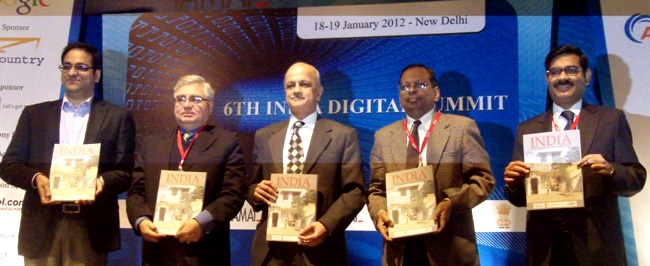
    R Chandrashekhar, Secretary, DoT & SiT and Chairman Telecom Commission, Ministry of Communications and Information Technology, Government of India appears certain that the government is going to adopt a hard line on the issue of freedom of speech line. Interacting with the media on the sidelines of the launch of a book based on the research by the Indian Council for Research & International Economic Relations (ICRIER) on the impact of the internet in India at the IAMAI’s 6th India Digital Summit in New Delhi, Mr Chandrashekhar also spoke onTRAI’s recommendations on spectrum allocation. Although he shied away from giving any real answers to the question, on the issue of freedom of speech online, he was firm on how every company across the world has to comply with the laws of the land and India’s case shouldn’t be any different from the rest of the world.


    DoT Secy on recommendations of TRAI on spectrum allocation
    [youtube width=”400″ height=”200″]http://www.youtube.com/watch?v=qEPbv8AFN04[/youtube]

    Earlier, the book titled India: Impact of Internet was released by Mr R Chandrashekhar. The report comes at a time when the government has just announced its grand plan for taking broadband to the masses, by taking it first to local panchayats. Following the launch, Mr Rajat Kathuria, External Consultant, ICRIER made a short presentation on the findings and recommendations of the study.


    Mr Chandrashekhar congratulated ICRIER at the launch of the report and welcomed the timing of the report and the benefits it will bring to the table in quantifying the actual impact of internet on society and economy.


    DoT Secy on recent controversy on digital freedom
    [youtube width=”400″ height=”200″]http://www.youtube.com/watch?v=hiP-F_wtMWk[/youtube]

    The report stated that States with higher internet penetration can be expected to grow faster, and every 10% increase in Internet and broadband penetration in the country could potentially lead to the addition of 1.08%, to India’s gross domestic product (GDP). The report recommends increasing internet usage in the country, which is still very low at just above 100 million users.

  • Digital Summit: Business in the time of the cloud

    By Akash Raha


    The second day of the Sixth India Digital Summit hosted by IAMAI and Ministry of Information & Technology got underway in Delhi on January 19, 2012. The last day of the summit featured a wide array of discussions and debates between prominent members of the industry.


    Leadership Session 3: The connected home: devices and service revolution

    In the current scheme of things there is a proliferation of newer devices. Each and every day there are a plethora of newer devices coming in the market. To support all these devices a new service industry came up to support them. The session spoke about the nexus of devices, connectivity and the service sector in the back drop of the nuances of the industry, such as security.


    The session was chaired by Mr Sanjay Trehan, Head MSN India, Microsoft and the stage along with him was shared by Mr R Sivakumar, Managing Director, Intel South Asia.


    The discussion started off with Mr Sivakumar talking about the connected home. He said that the times have changed from connected homes to connected life. Earlier, Home was where the first use of technology begins. We have been using technology over the past decade without knowing about it. But some of those ideas are fast dissipating as our devices are no longer wired and we can move outside the periphery of our house and hence the idea of connective life.


    As technology has developed, the proliferation of devices too has increased. He said that the technology in the future will be dominated by three screens out of all the new devices based on convenience and ultra mobility – smart phones, netbooks and large television screens.


    He spoke about the growth of ecommerce and gave the example of the Indian Railway site irctc.co.in which does business of Rs 500 cr each month. The service provided is getting more sophisticated and more available as time goes by. With proliferation of device and connectivity, services provided online are increasing.


    When posed a question on security threats by Mr Trehan, Mr Shivakumar said that the security capabilities are still at its early stages and have to be built on. In terms of new technology, the bogey that we often ride is the talks of national security. National security and integration of security protocol is very important and yet there has to be ways to streamline the whole process and allow newer technologies to come in.


    Power Panel 7: Cloud Cluedo – Solving the mysteries surrounding the cloud

    The following session tried to unveil the mystery of cloud computing technology. Even though everyone in the technological domain are talking about this technology and its use, few people know about the intricacies of it, which the panel tried to unveil. Cloud computing gives one the ability to put business applications on the ‘cloud’ which would then make it possible for the users to access it from wherever he or she wants to.


    The following session was moderated by Manoj Chugh, President India & SAARC, EMC Corporation while the panelists were Mr Fredric Moraillon, VP – Marketing, Asia Pacific & Japan, Akamai Technologies and Rajnish Menon, director – ISV & Cloud Strategy, Microsoft.


    In his opening remark Mr Chugh explained that there are various kinds of clouds, such as Private Clouds and Public Clouds… Moreover, there is a whole mix of these clouds which gives rise to Hybrid Clouds of all shapes, sizes and colors. Cloud computing saves cost of infrastructure and will help businesses grow in the future, thereby creating new job opportunities. Moreover, while the old skill sets are going to remain important, new skill systems are needed for Cloud.


    According to sources, 50% of the cost of infrastructure can be saved when a business employs and moves their infrastructure to the Clouds. The initial cost of the infrastructure will depend on what kind of a Cloud it is. No two clouds are alike and clouds constantly grow and make newer clouds.


    Mr Menon explained to the audience that Cloud is very useful as it standardizes IT capabilities. To show the efficacy of cloud, he pointed out how all the fortune 500 companies have some sort of Cloud or the other. The point is, that Cloud is already here and is all pervasive.


    The next question that Mr Menon talked about is, is Cloud secure? The answer that he proposed was, yes, it is one of the most secure one as authority is given to only one or two who can see all the data. For those who wondered how costly cloud is, Mr Menon told that “Cloud is really cheap, but it depends on what applications you are using etc.”  In terms of regulation, currently, there is no cloud law in place in India and it is all about interpretations of the other existing laws.  Cloud computing has therefore become a new way in which one can deliver and consume IT.


    Talking about the cloud, Mr Moraillon said “From the Cloud perspective the consumer and the business are constantly merging.” He said that one can put anything on Cloud…But the question is what do you want to put on the cloud but the question is what the security level you have to secure that data is? Information is of value and it is important to keep it in the vault. But yet Cloud is useful as it is helpful and makes work and processes much easier. “You can do a campaign, a budget, file travelling expenses etc… Cloud can do all of that very easily and efficiently.” Today, one feels disconnected when ones hard disk crashes – a lot of hard work goes away, but such a thing does not happen with Cloud as the data will be present and secure on the cloud.


    The three important aspects which Cloud is efficient on is Time, Money and Labour; Wherein, it saves time and money, and allows employees to work just the way they want to work, from wherever they want. In the modern times markets are extremely fragmented and clouds helps adapt, open newer avenues to connectivity and the way work is done. The only possible concern that some businesses still have today is that of accessibility and security, however, cloud is developing and is developing fast. It is imperative that businesses move to cloud to be successful in the future.


    The panelists explained that one should move easier process on the cloud first and then go on to bigger process which have legacy and are relatively harder to move. But to start moving to the Cloud, maintained all the panelists, is essential.


    Power Panel 8: “To be or not to be an Entrepreneur”

    Being an Entrepreneur and building a business out of the scratch is never easy. In the current session the panelist discussed and talked about their difficulties in becoming successful Entrepreneurs. The talked about their experiences and shared their visions with the crowds.


    For many, starting a venture was a triggered by their situation, for some it was a choice and for the rest it was a mix of the two. The session was moderated by Manish Vij, Founder and CEO, Vun Network. The panel members for this session were Dhruv Shringi, Co-Founder & CEO, Yatra.com; Dinesh Aggarwal, Founder & CEO, IndiaMart; Rishi Khiani, CEO, Times Internet and Anisha Singh, Founder & CEO, Mydala.com.


    Mr Shringi said that currently the entry barrier is low to get into the business and it is a very good time for people to get into the business as the growth rate is good. Yet, Mr Aggarwal warns that people should not get into the business just because there is opportunity and growth. What is really required is a will to do ecommerce.


    To start off a business, funding is an important issue… Ms Singh pointed out that to garner funding and make profit eventually one has to have conviction in once business. Funding is tough and one has to have the ability to convince the investor, moreover, immense trust in once own vision is required.


    A few of the members in the panel also had a co-founder and investor… Talking about the aspect, Mr Khiani said that it not important that your partners are like you and think like you, but it is important that they have the same vision as you and believe in the product as much as you do.