Tag: digital media

  • Snehil Dixit Mehra joins ALTBalaji

    By Our Staff


    Snehil Dixit Mehra joins ALT Digital Media Entertainment Limited, a wholly-owned subsidiary of Balaji Telefilms Ltd, as Head of Content and Digital Media. Earlier Mehra worked with Sanjay Leela Bhansali as Associate Director.


    In her new role, Mehra will be leading the content and programming division for ALTBalaji and will be responsible for managing the upcoming original content line-up and the platform’s creative strategy.


    Talking about joining the team, Mahra said: “This is my second innings at ALTBalaji, a homecoming for me, however with a larger mandate now. I am looking forward to planning a roadmap for further accelerated growth of ALTBalaji as a leading digital content hub.”


  • IAA seminar on how builders can exploit digital media

    By A Correspondent


    The India Chapter of International Advertising Association (IAA) has organized an industry-specific knowledge seminar for the realty sector on digital media. Digital has emerged as India’s third-largest medium and very few real estate developers have exploited its full potential. This seminar will enable an understanding and appreciation of this important medium which real estate developers can apply, and thereby benefit from, in this fast-changing communication era, notes a communiqué.


    Said Srinivasan Swamy, President IAA India Chapter & Vice-President, Development Asia/Pacific: “Through this seminar, the Indian Real Estate industry gets a new perspective on digital as a medium, grasp global trends, and hopefully apply these for better marketing solutions. When the economy is difficult and many real estate projects are not finding ready buyers, a cost effective medium like digital can help the realty sector. I hope many will participate and benefit from it”.


    Titled ‘Real Estate in a Digitized World’, the seminar will be held on August 2 from 2 to 7:30 pm, 2013 at The Trident, BKC and will have prominent speakers representing leading international companies in digital and social media including Group M, Google, Addikt, Wolff Olins and Panel speakers from Microsoft, Madhouse, Netcore and Magicbricks. Niranjan Hiranandani, Managing Director, Hiranandani Constructions and former Australian cricket captain Steve Waugh will be guests of honour.


    For information: Jaideep Gandhi, Treasurer, IAA-IC and Chairman of this Knowledge Seminar (Tel 9820284578 or gandhi.jaideep@gmail.com).


    For details: http://www.iaaindiachapter.org/vjk/


  • The Anchor: 4 reasons why digital media’s mergers and acquisitions are a good sign

    By Rammohan Sundaram


    #1 It is a sign that the market has matured:

    It shows that India as a market has matured. All these agencies which have been acquired are at least 10 years old and these are the people who have done all the hard work – whether it is Communicate2 which was acquired by Aegis Media or Hungama Digital acquired by JWT, etc. It’s a natural progression and these are things which happen when businesses are scaling up.


    #2 Large agencies bring large clients:

    When large agencies acquire a standalone agency, it comes with large clients and as a result, it helps the standalone agency maintain continuity in the business, especially for clients attached to the agency that they have been associated with over the last several years.


    #3 Standalone agencies are allowed to retain vision:

    It is important for continuity in the business, and there is no reason why the standalone agency needs to change post-acquisition. While operational and financial processes will inevitably change, how you run your business usually doesn’t. This is so that there is a continuity of the vision that first started the standalone agency and has ensured the continuation of its growth.


    #4 Brings more talent to the agency:

    The companies which are successful today are those that have got tremendous talent. In order to build talent, loyalty and attrition rates which are lower than any other competitor is the key to success for an advertising agency in the business today. This is what most of these agencies have managed to do and that’s the differentiator.


    Rammohan Sundaram is CEO and MD, NetworkPlay Media Pvt. Ltd


  • Hungama to manage digital mandate for Timex & Helix

    By A Correspondent


    Hungama Digital Services Pvt Ltd has bagged the digital media AoR duties for Timex India and its youth brand, Helix. Timex Group, one of the world’s largest watch makers that designs, manufactures and markets innovative timepieces and jewelry globally, named Hungama Digital Services as the exclusive agency working on their digital platforms, both web and mobile. The agency will manage social media for both the brands, media buying as well applications.


    Talking about this, VD Wadhwa, Managing Director & CEO, Timex India, said: “The digital medium is fast evolving and presents tremendous opportunity for brands to mark their presence. Given that the measurability of this domain is quantifiable, we at Timex are extremely focused on strengthening our brand presence on this very dynamic platform. We have strategic plans to increase our presence through the launch of brand Webstores, social media pages and impactful search and display campaigns. We chose to partner with Hungama as it is the leader in providing effective digital campaigns to brands across markets and categories. I am very confident of this partnership, as it will act as a catalyst in our journey to become the most influential brand in the digital space.”


    Speaking on the winning the account, Neeraj Roy, Managing Director & CEO, Hungama Digital Services said: “We are excited with the win and look forward to a relationship with the Timex Group. With an experienced and award winning team here, we aim to leverage this opportunity for Timex, towards a widespread exposure and an increased engagement in the digital space. Today, India is at the cusp of digital revolution with the advent of 500+ million consumers getting online in the next 3-4 years. We hope to offer integrated digital and experiential services to clients and prepare brands to connect, interact and transact with their customers.”


    JWT Singapore recently acquired a 51 per cent stake in Hungama Digital Services Pvt.


  • Community panels will change the way research is done: Bruce Wells

    By A Correspondent


    In a business environment that’s getting increasingly competitive by the day, one can find clients making a beeline for research so as to stay ahead of the curve. Over the years, one is aware of the role that research has helped in making clients understand their TG and get closer to addressing their every need.


    From the traditional mode of questionnaire-filling & face-to-face surveys, market research today has evolved to include support from technological resources, including social media, which not only helps in lowering the costs and time but also gives customized information from the target audience. One such client that’s made an entry into India is Vision Critical – one of the largest global software developers for market research. Having achieved success worldwide, the company has entered India by associating with market research company, MRSS India.


    Bruce Wells, Managing Director and President, Asia of Vision Critical was in India recently and spoke to MxM India about his plans for India, expansion plans in Asia and how research software can alter the market research scenario in India. Excerpts:


    How would you describe your foray into the Indian market with a venture with MRSS?

    The Indian market plays a very important part in the global market research landscape and Vision Critical is very excited to partner with MRSS in India. We know that with the digital media coming of age and the rapid increase in the adoption of mobile phones and internet access represents an exciting opportunity for Vision Critical, given our suite of technology. So yes, the going has been exciting this far.


    Do you have a phase-wise activity plan that you’ve drawn up for the Indian market?

    The platform that Vision Critical has works across many different consumer segments such as media companies, FMCG clients, financial services, telecom, travel, and so on. What we are doing in India is looking at segments that have high growth potential, especially in the digital domain. We’ve been talking to some large multinationals and also local companies that have increased number of customers moving into the digital age.


    What is the investment push that you plan to pump into the Indian market?

    The way our business model works in Asia is that we are tying up with local market research companies that have a similar view and strategy in terms of recognising the opportunities of using digital communication. So, we have tied up with our strategic partner MRSS and we are working very closely with them in terms of giving them best practice, giving access to our technology…it’s a partnership model where we are investing our knowledge, experience and skills in supporting Majestic MRSS.


    Research activity in India is still looked upon as being a manual exercise with less inclination towards dependence on software. Going forward, do you see a shift taking place in the way research will be conducted in India?

    What we have observed in other markets is that, for example, people using social media for communication and engaging with the outside world is on an upward swing. This trend is not going to reverse. As the consumers consume media and use social media differently as a communication platform, so must brands and research companies adapt – that’s exactly where Vision Critical sits. Just as social media has changed the way people communicate, we believe community panels will change the way research is done.


    What has been the response from clients to software solutions being doled out by specialist firms like Vision Critical?

    If we look at the clients who are gravitating towards the new way of doing research, these are mostly companies with a technological background. So clients from telecom, ISPs, travel, retail, finance and so on are high on our list. But where we see a greater adoption of digital consumption, those are going to be the areas that we will prioritise in. As I said, it’s amazing to see such an alarming growth of the digital medium…especially the number of new mobile phone subscriptions in the country that’s growing at a staggering rate. So it’s an exciting place to be in.


    We’ve spoken to a host of clients and they have been pretty enthusiastic about the offering. The Indian research market industry is very smart – they produce some of the best research work ever seen. This validates our assumption that we are doing the right thing at the right time and the right place.


    What are the challenges facing research software companies like Vision Critical?

    The first challenge is to use our platform in the community panel space. The thing is that the consumer needs to be online so that will limit certain aspects of research that we will be able to touch on in the short term. The biggest challenge is moving from traditional methodology to something new. Also, the challenge is identifying companies that are ready to adopt new approach where we have seen great success with our technology in the West – from North America all the way through Europe, Australia and now Asia. So it is about finding clients who are eager to move to newer way of doing research.


    Any upcoming or developing markets that you plan to expand to?

    We are looking to expand into Mainland China, Singapore and Japan. These are our next markets to focus on. It will mainly be about focusing on countries that have high concentration on digital. As for the other markets, we expect to expand our footprint in Latin America, Africa and similar markets where we expect to see more people come online.


    What is the growth you are anticipating for Vision Critical in a year’s time from now?

    I would expect at least more than 20 clients to use our service within the next 6-8 months. I am a firm believer of the expression ‘success breeds success’. Once a few companies start using it and we get people aware of using community panel, then we will see what the scene is in other markets. The challenge right now is that most clients are not even aware that these types of technologies exist. But we hope to see people using community panels very quickly.


  • Another win-win digital equation


    By Johnson Napier and Robin Thomas


    ‘By 2015, we want to be the top 3 player in every single sphere we operate in’
     

    What led you to shortlist Communicate2 as the partner of choice?

    Communicate2 is one of the largest and oldest firms in the area of search & performance marketing in India. Vivek Bhargava, as you’d know, is considered to be the guru of search inIndia. He is also one of the guys to be Google-certified and has been in this business since 1997 – a time when the internet and search was in its absolute infancy. In our view, nobody else managed the quality and scale of the business that he has built up, and therefore he was a preferred partner of choice.


    The other important reason for choosing Communicate2 was chemistry – Aegis Media has a certain vision and value outlook which is very close to our heart and Communicate2 seemed to have gelled very well with those attributes. There was a lot of comfort on both sides. So these were some of the key reasons for us to choose Communicate2.


    Will you be laying enhanced emphasis on Search with the current acquisition…

    The focus is on search because it is one of the fastest growing parts of our business. Clearly, Communiacte2 is the biggest player in the space and now with iProspect and Communicate2 together, we are straight away the number one player of search in India. So that’s how it is placed as of now.


    How long has it been since you have been pursuing Communicate2? Did you scan the market for other potential candidates?

    We were working with them about 4-5 years ago, but nothing more came out of that deal. This recent move has been in the works for a few months. Also, we did scan the market as anybody else would and we did have a few names that we shortlisted and we narrowed down to Communicate2.


    The deal seems heavy on the investments front. Would you share with us the monetary plans you engaged in towards snapping the agency?

    An agency that is the oldest and has a workforce of more than 130 people is not going to sell out cheap. I cannot disclose the amounts behind the deal, but I can say that it has been fairly priced.


    The market has been abuzz with news of big communication houses buying out specialist digital agencies in the recent past. What would you infer of this trend that everybody is taking a liking to?

    I cannot comment about others, but there is a clear strategy that Aegis Media believes in and that is by 2015, we want to be the top three player in every single sphere that we operate in – be it out-of-home, search or digital. As part of our strategy to be in the top 3, the best way of getting there was by partnering with Communicate2 because their expertise, their client base and their search professionals coupled with the iProspect tools and knowledge would be an unbeatable combination.


    In an acquisition it is very important that you have to see how the acquisition fits with the plans of your company. So the task of integration becomes key, which is why the quality and type of people and the chemistry become important. So companies that are blindly going out and buying companies will fall flat on their face, but those who are able to acquire and integrate companies and have a great bond with the partners will be successful in the long run.


    Globally, digital contributes more than 35 per cent for Aegis Media. What is it that you anticipate from the Indian market post the acquisition of Communicate2?

    We are looking at being the clear No 1. Globally, iProspect is the world’s largest search network, and in India we now become No 1 with this venture. But we want to be No 1 by a long distance. We want to be double the size of the No 2 guy in a few years.


    What are the immediate changes that will be seen on ground?

    There is a new office that we are in the process of doing up in Mumbai; their staff will be moving into that new place soon. Likewise the Delhi team too would be amalgamated in our office. With this the entire Aegis Media clients will have benefits from Communicate2 and vice-versa.


    As for people, Vivek will be the MD of the new venture. He already has a management team. Of course, as growth happens we will keep recruiting more people. All other aspects remain the same.


    The announcement comes just weeks after Dentsu acquired a stake in Aegis Media. Has this deal been inspired from that takeover…

    These things do not happen overnight; it has been ongoing much before that. The two are not related.


    Future plans from Aegis Media…

    As I said, we will be the top 3 player in every space that we operate in. In some instances we will do that organically, in others we will do that inorganically – provided we get a good partner. We are not on the lookout as of now but if any new opportunity does come up we will not be turning a blind eye to that.

    No doubt people would talk about the number of medals won and the records that were broken in Olympics 2012; but what it will be most remembered for is the use of digital media, particularly social media. All of the Olympics events are being streamed live on YouTube for the first time; there has been an increase in the number of Facebook users and Twitter accounts and one can even get live news updates online. Even Google has been putting up doodles on its home page, giving users information and updates on the Olympic sport of the day. These are just few signs that digital has arrived.


    The past few months have witnessed quite a few mergers and acquisitions in the digital space. Standalone digital agencies, particularly those with over four years of existence, are being acquired by larger advertising networks. Only recently Publicis Groupe has announced the acquisition of Resultrix, a digital marketing agency, with the aim of strengthening Publicis Groupe’s presence in India as well as its digital dominance. Prior to this, JWT, one of the leading advertising agency acquired a majority stake in Hungama Digital Services, the digital and promotions marketing division of Hungama Digital Media Entertainment. Also recently Gruner + Jahr, the publishing division of European media conglomerate Bertelsmann AG, acquired a majority stake in Network play,India’s digital ad network company.


    On August 09, the media and digital communications group Aegis Group plc (“Aegis”) announced that it has acquired Communicate 2, a performance marketing and search agency in India.  With this acquisition, Aegis Media becomes one of the strongest agencies in the digital space in India. Communicate 2  will be merged into iProspect India’s existing operations; strengthening its network in key cities across India and providing additional service capabilities for its clients.


    Speaking to MxMIndia about his views on the increasing trend of big communication houses buying standalone or specialist digital agencies, Mr Ashish Bhasin, Chairman India & CEO South East Asia, Aegis Media said: “I cannot comment about others, but there is a clear strategy that Aegis Media believes in and that is by 2015, we want to be the top three player in every single sphere that we operate in – be it out-of-home, search or digital. As part of our strategy to be in the top 3, the best way of getting there was by partnering with Communicate2 because their expertise, their client base and their search professionals coupled with the iProspect tools and knowledge would be an unbeatable combination.”


    “In an acquisition it is very important that you have to see how the acquisition fits with the plans of your company. So the task of integration becomes key, which is why the quality and type of people and the chemistry become important. So companies that are blindly going out and buying companies will fall flat on their face, but those who are able to acquire and integrate companies and have a great bond with the partners will be successful in the long run,” he added.


    Mr Vivek Bhargava, Managing Director, Communicate 2 was of the view that these are signs that digital media has arrived and that even brands have accepted this reality. “Digital marketing in India has now arrived. More promoters and senior management people now believe that digital is a very critical part of their marketing endeavour. So they are spending a lot of time around the medium. About 3-4 years ago we were talking about digital being the future and today digital is now considered as present. Earlier digital used to attract a small budget from marketers, but now they position it as their first priority and question whether they need conventional media or not.Mobilehas given digital three times the reach of television. So I believe digital is going to be the dominant medium in the future.”


    MxMIndia also spoke to a few industry players to gauge their take on the recent mergers and acquisitions in the digital space, especially Aegis Media acquiring Communicate2′.


    Anurag Gupta

    According to Mr Anurag Gupta, MD, DGM India, it is a win-win situation for Aegis Media and Communicate 2: “Vivek Bhargava has done well for himself, he has created a fairly good outfit and the testimony for this is the fact that it has been acquired. This is a good sign. I believe that this trend will continue – most of the standalone digital agencies will get merged with larger offline agencies. Both search and performance advertising are growing robustly. In fact, a completely new category in digital has emerged in the past one and half years – e-commerce business. They are doing a lot of search and performance advertising, so there is lot of growth.”


    Mr Amardeep Singh, Co-Founder and CEO, Interactive Avenues was also of the view that the Aegis acquiring Communicate2 is a win-win situation: “I believe it is a good move for both Aegis Media and Communicate2, as this kind of transaction will help Communicate2 to scale from where they are currently placed. It doesn’t matter whether an agency is part of, or not part of, a larger advertising networking, if it continues to operate as an independent agency despite being owned by a larger network then it retains its identity. Typically, a specialist agency is able to provide a holistic solution to the clients and everything happens in-house for them. What happens is that when an agency offers an offline as well as online service, the focus on digital is lost. A standalone digital agency is able to give its clients that much more focus than an agency which offers both offline and online services.”


    So, while the Aegis Media acquiring Communicate 2 is seen as a win-win situation by industry players, it is also believed that this is just the beginning in the digital space.


    ‘It was a meeting of the best minds of the world’
     

    The buzz was that you were being hounded by most big communication players in the market for a takeover and now you’ve finally given in to Aegis Media. How would you describe the takeover journey?

    We had the opportunity to talk to every single large player and we found that the way the market is growing, there is going to be a lot of technology components required in it and iProspect globally has the best technology in the world. Also, we are a very dominant agency as far as search and performance marketing is concerned in India while iProspect was the world’s largest search company, so it was a meeting of the best minds of the world. The digital market in India has matured to the level where clients are looking for the best in the world and we felt that with the expertise that iProspect had to offer, it was a perfect solution to offer to our partners. And we endeavour to take decisions for our partners as much as it helps us.


    What is your view on big communication players showing sudden interest in digital in India?

    Digital marketing in India has now arrived. More promoters and senior management people now believe that digital is a very critical part of their marketing endeavour. So they are spending a lot of time around the medium. About 3-4 years ago we were talking about digital being the future and today digital is now considered as present. Earlier digital used to attract a small budget from marketers, but now they position it as their first priority and question whether they need conventional media or not.Mobilehas given digital three times the reach of television. So I believe digital is going to be the dominant medium in the future.


    What is the value that you’d be leveraging from this partnership?

    Globally if you see, there are clients like GM, Nokia, Philips and others who have operations in 60-70 countries and they are aligned with Aegis Media. I see tremendous opportunities there. As for us, we are a 140-people agency which makes us the largest digital agency in the country. So with the clients we have and with the kind of team we have in the enterprise sector, I see it as a perfect marriage of the two. I see tremendous value in the venture.


    How have clients responded to this move of yours?

    I had spoken to clients even before this venture and they seemed pretty positive about it. Also there is no change as such in the team and talent, so there was a comfort level there. Generally they are happy with the merger.


    Do you see the gap between digital and advertising being bridged?

    If you ask me the demarcation between digital and conventional media will probably go away. This is going to be an advertising agency and digital is going to be an integral part of the advertising medium, probably the largest. Demarcation is something that we have created for ourselves but it is about giving out advertising solutions.


  • ‘By 2015, we want to be the top 3 player in every single sphere we operate in’

    What led you to shortlist Communicate2 as the partner of choice?

    Communicate2 is one of the largest and oldest firms in the area of search & performance marketing in India. Vivek Bhargava, as you’d know, is considered to be the guru of search inIndia. He is also one of the guys to be Google-certified and has been in this business since 1997 – a time when the internet and search was in its absolute infancy. In our view, nobody else managed the quality and scale of the business that he has built up, and therefore he was a preferred partner of choice.


    The other important reason for choosing Communicate2 was chemistry – Aegis Media has a certain vision and value outlook which is very close to our heart and Communicate2 seemed to have gelled very well with those attributes. There was a lot of comfort on both sides. So these were some of the key reasons for us to choose Communicate2.


    Will you be laying enhanced emphasis on Search with the current acquisition…

    The focus is on search because it is one of the fastest growing parts of our business. Clearly, Communiacte2 is the biggest player in the space and now with iProspect and Communicate2 together, we are straight away the number one player of search in India. So that’s how it is placed as of now.


    How long has it been since you have been pursuing Communicate2? Did you scan the market for other potential candidates?

    We were working with them about 4-5 years ago, but nothing more came out of that deal. This recent move has been in the works for a few months. Also, we did scan the market as anybody else would and we did have a few names that we shortlisted and we narrowed down to Communicate2.


    The deal seems heavy on the investments front. Would you share with us the monetary plans you engaged in towards snapping the agency?

    An agency that is the oldest and has a workforce of more than 130 people is not going to sell out cheap. I cannot disclose the amounts behind the deal, but I can say that it has been fairly priced.


    The market has been abuzz with news of big communication houses buying out specialist digital agencies in the recent past. What would you infer of this trend that everybody is taking a liking to?

    I cannot comment about others, but there is a clear strategy that Aegis Media believes in and that is by 2015, we want to be the top three player in every single sphere that we operate in – be it out-of-home, search or digital. As part of our strategy to be in the top 3, the best way of getting there was by partnering with Communicate2 because their expertise, their client base and their search professionals coupled with the iProspect tools and knowledge would be an unbeatable combination.


    In an acquisition it is very important that you have to see how the acquisition fits with the plans of your company. So the task of integration becomes key, which is why the quality and type of people and the chemistry become important. So companies that are blindly going out and buying companies will fall flat on their face, but those who are able to acquire and integrate companies and have a great bond with the partners will be successful in the long run.


    Globally, digital contributes more than 35 per cent for Aegis Media. What is it that you anticipate from the Indian market post the acquisition of Communicate2?

    We are looking at being the clear No 1. Globally, iProspect is the world’s largest search network, and in India we now become No 1 with this venture. But we want to be No 1 by a long distance. We want to be double the size of the No 2 guy in a few years.


    What are the immediate changes that will be seen on ground?

    There is a new office that we are in the process of doing up in Mumbai; their staff will be moving into that new place soon. Likewise the Delhi team too would be amalgamated in our office. With this the entire Aegis Media clients will have benefits from Communicate2 and vice-versa.


    As for people, Vivek will be the MD of the new venture. He already has a management team. Of course, as growth happens we will keep recruiting more people. All other aspects remain the same.


    The announcement comes just weeks after Dentsu acquired a stake in Aegis Media. Has this deal been inspired from that takeover…

    These things do not happen overnight; it has been ongoing much before that. The two are not related.


    Future plans from Aegis Media…

    As I said, we will be the top 3 player in every space that we operate in. In some instances we will do that organically, in others we will do that inorganically – provided we get a good partner. We are not on the lookout as of now but if any new opportunity does come up we will not be turning a blind eye to that.


  • ‘It was a meeting of the best minds of the world’

    The buzz was that you were being hounded by most big communication players in the market for a takeover and now you’ve finally given in to Aegis Media. How would you describe the takeover journey?

    We had the opportunity to talk to every single large player and we found that the way the market is growing, there is going to be a lot of technology components required in it and iProspect globally has the best technology in the world. Also, we are a very dominant agency as far as search and performance marketing is concerned inIndiawhile iProspect was the world’s largest search company, so it was a meeting of the best minds of the world. The digital market inIndiahas matured to the level where clients are looking for the best in the world and we felt that with the expertise that iProspect had to offer, it was a perfect solution to offer to our partners. And we endeavour to take decisions for our partners as much as it helps us.


    What is your view on big communication players showing sudden interest in digital in India?

    Digital marketing inIndiahas now arrived. More promoters and senior management people now believe that digital is a very critical part of their marketing endeavour. So they are spending a lot of time around the medium. About 3-4 years ago we were talking about digital being the future and today digital is now considered as present. Earlier digital used to attract a small budget from marketers, but now they position it as their first priority and question whether they need conventional media or not.Mobilehas given digital three times the reach of television. So I believe digital is going to be the dominant medium in the future.


    What is the value that you’d be leveraging from this partnership?

    Globally if you see, there are clients like GM, Nokia, Philips and others who have operations in 60-70 countries and they are aligned with Aegis Media. I see tremendous opportunities there. As for us, we are a 140-people agency which makes us the largest digital agency in the country. So with the clients we have and with the kind of team we have in the enterprise sector, I see it as a perfect marriage of the two. I see tremendous value in the venture.


    How have clients responded to this move of yours?

    I had spoken to clients even before this venture and they seemed pretty positive about it. Also there is no change as such in the team and talent, so there was a comfort level there. Generally they are happy with the merger.


    Do you see the gap between digital and advertising being bridged?

    If you ask me the demarcation between digital and conventional media will probably go away. This is going to be an advertising agency and digital is going to be an integral part of the advertising medium, probably the largest. Demarcation is something that we have created for ourselves but it is about giving out advertising solutions.


  • @INMA: Thriving in a digital world

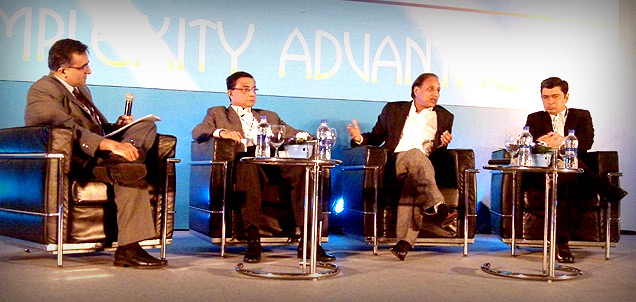
    L to R: Jehil Thakkar (KPMG), DD Purkayastha (ABP), Ravi Dhariwal (BCCL, INMA) and Santosh Desai (Future Brands)


    By A Correspondent


    The second day of the International Newspapers Marketers Association (INMA) South Asia 2012 conference in Delhi threw light on the complexities and challenges of the print newspaper media. The first session of the day was ‘Media 2020: A future backward kaleidoscope’. The session focussed on how the newspaper industry is readying itself to face the challenge from digital media usage.


    Mr Jehil Thakkar, Partner, Head-Media & Entertainment, KPMG India made some interesting observations about the levers that are changing the Indian newspaper industry. He pointed out how empirical studies prove that there exists a positive relationship between the wealth of a nation and newspaper readership: “There also exists positive correlation between growth of economies and technology adoption, which has significant potential to disrupt media consumption.”


    “The rapid proliferation of new-age devices and growth of alternate media has reduced newspaper consumption by 40 per cent with audiences preferring to access paper via their mobile phones,” added Mr Thakkar. According to him, technology would alter the workings of newspaper industry as coverage would become electronic, delivery would become faster; collaboration would become the key; cloud-based service would become a norm; interactivity through QR and barcodes would see an upsurge.


    DD Purkayastha
    If you are having trouble in viewing this video, see link

    Talking of how things will shape up in 2020, DD Purkayastha, MD & CEO, ABP Pvt Ltd said that the future belongs to newspapers who become hyperlocal as cities reach the saturation point. He said: “Regional publications will grow. And consolidation will happen at a much faster pace.”


    Mr Ravi Dhariwal, President, INMA Worldwide and CEO, The Times of India, noted how newspaper of 2020 will undergo a dramatic change. He noted: “Three critical things will emerge in 2020: what brand you own will become important as there will be many more brands on the digital media; curation of the product will become more important as the role of a journalist will shrink and need for analytical news pieces will arise; and business model will change as ad revenue will become a critical source of revenue. As technology improves, and people get more comfortable with using technology, the ad rates would only increase.”


    Mr Santosh Desai, MD & CEO, Future Brands India, remarked: “The larger issue that would emerge would be the tension between decentralisation of news media and fragmentation.” The panel, however, coherently agreed that despite the changes and challenges that the newspaper would undergo, it would still exist with the digital media.


    The session on ‘Increased circulation; dwindling readership: Is it time to measure ‘access’?’ saw panellists discuss the much-debated measurement metrics available. ‘Newspaper distribution channel: How best to nurture it for the future’ and threw light on the vendors and agents who distribute the newspapers. Moderating the session, Mr Sanjeev Vohra, Executive Vice-President – Audiences, BCCL, said: “The vendor currently exists as an independent businessman and as an investor in newspaper business.” His view was supported by Mr PS Venkat, Vice-President, Circulation, The Hindu, who said that changes are needed in distribution model to enable the vendors to become partners in progress.


    Mateen Khan
    If you are having trouble in viewing this video, see link

    Mr Mateen Khan, Product Head of Lokmat Samachar pointed out how the distribution channel in rural areas is still a problem, while it may not seem so in a metro. Taking the discussion ahead, Mr Rakesh Sharma, CEO, Aaj Samaj & ITV Group said: “There should be distribution points every three kilometres, and more distribution points.” He, however, noted that the vendors will remain the key to distribute newspapers in India beyond 2020. Mr OP Rajgharia, Chairman & MD, Overnite Express Ltd appreciated the effort put in by newspaper vendors to ensure the timeliness of delivery.


    ‘Needed to be sector-neutral’


    If you are having trouble in viewing this video, see link


    Bhaskar Das, President & Principal Secretary to MD, The Times of India Group, talks to MxMIndia on curating the INMA South Asia 2012 conference

    When I was talking to the organisers, and was given the task of preparing the content architecture of INMA, I told them very clearly that it is not about newspaper industry -it is about business. So, we have to be sector-neutral since principles of business are same. Newspaper is a sub-set of business. This was the first consideration.


    Secondly, in my case, the delegates were my guiding point. Why should people attend the conference? Are we going to be just another conference? How do I make it distinctive?


    The distinctiveness of the conference is that it creates fluid knowledge; knowledge that one can import when they go back. So, I had to ensure that they learn from each session. That led to the subject. In most of the conferences, people state the obvious. I thought why we don’t address the fact that there are complexities, there are challenges. Being an incumbent player, I realised that if we talk about problems, it is not solved. We should then talk about how we can leverage that problem or challenge. This led me to look for various industries. I scouted the internet, books, academic journals, about what happens when an industry goes through huge challenges, air pockets. There are initial signs of a problem, which I came to know of while researching, such as ‘butterfly effect’ that led to complexity science. This became the theme. The theme has to be intriguing to people rather than being a newspaper conference. The theme was then decided as ‘complexity advantage’. Now that complexity is a given, why not leverage it.


    On the audience mix:

    This time it has been a record attendance. I am not very happy but you to also have to market it that way. If one can maintain this level of content architecture, attendance will grow. For an event that happens once a year, I will have to sustain noise throughout the year. The community needs to talk about it, so that you can have user-generated content architecture next time. Then, there are regional peculiarities that may not be only one; there are eastern and western peculiarities.


    We also have to be industry- or sector-neutral in our audience mix. Why should they be from newspaper industry? Why not from television industry or from client side to discuss business? When people know what you are delivering, I am sure diversity will happen in the audience.


    The session was followed by speakers from Pakistan and Bangladesh who spoke on ‘Managing complexity in South-Asian markets – A Pakistan and Bangladesh Experience.’ The session saw interesting insights about newspaper industry in the two neighbouring countries.


    Industries across the globe are increasingly learning from other industries to improve their operating efficiencies and innovation capabilities across various spectrum of businesses. ‘Media learning from other industries’ saw three specialists from sectors such as retail, telecom and finance discuss the wisdom that newspaper industry could imbibe, given the onslaught of digital media. The panel discussed how the evolution could gain from the exploration of the new path.


    Mr Jaideep Ghosh, Partner, Management Consulting, KPMG pointed out that print media continues to remain the second largest medium in the Indian media and entertainment industry. He also pointed out the key challenges of talent, operational cost, monetizing digital media and fragmentation that the industry faces currently. He said: “Media can leverage data analytics to strengthen the understanding of its customers and build brand loyalty, much like the way telecom, retail and finance sector have done.”


    Drawing from the e-retail experience, Mr Rajiv Prakash, ex-CEO, FutureBazaar.com, said, “The audience is increasingly turning Clomosol, which is an aggregation of Cloud+Mobile+Social+Local. Thus, the digital consumer is a channel omnivore, and should be serviced at every touch-point.”


    Mr Jairam Sridharan, Head, Retail Banking, Axis Bank said that the newspaper organisations should focus on getting their product on mobile, rather than internet as, “the consumer is leapfrogging the internet and becoming increasingly mobile-savvy.”


    The closing session of the two-day INMA conference saw Prof Rishikesha T Krishnan., Chairperson, Corporate Strategy and Policy Area, IIM Bangalore talking about sustainable and thriving media business model that can successfully withstand the vicissitudes of business environment.


    He said, “The internet tends to dampen bargaining power of newspaper channels by providing direct avenues of access to customers. But the other hand, it will help the industry to create new substitutes, and new geographical markets will emerge.” He further noted, “The internet has and would result in targeted advertisements, disappearing role of editor as decision maker; fall in advertising revenues and young people moving away from printed newspaper.” The key decision variables, according to him, were how to embrace internet, and change strategy. Giving the example of Schibsted, Norway, he said that the paper now brings readers to its webpage through the front page and even Google was denied the permission to crawl its pages. “This helped them to monetise the banner ad on its front page,” Mr Krishnan said, adding, “Huffington Post has enaged in user-generated content, and its ad revenues are growing. Axel Springer/Bild has extended its brand to other media.”


    As Indian newspaper industry struggles with low cover price, growth of paid news, entry of non-traditional players, investment to establish presence in non-metros, the panel at INMA South Asia conference tried to address issues as closely as possible. Whether the industry would learn, and implement the learning remains to be seen.


  • WATBlog announces CMO conference

    By A Correspondent


    With an aim to give marketing professionals key insights into digital media, WATBlog announced the Digital CMO Conference. The event will have top CMOs of the country come together to showcase case-studies that have witnessed ground breaking success in digital media. The conference will be held on August 31 in Mumbai.


    WATBlog’s Digital CMO conference will showcase insightful presentations by the biggest brands that have emerged as the thought leaders in the digital media space. The conference will cover all aspects of digital marketing, including the role of social media in Customer Service and how the digital platform can help build brand reputation. The delegates expected to attend the conference would be a mix of CEOs, entrepreneurs and marketing professionals.


    “Digital marketing in India has gained significant momentum over the past year. A lot of brands are now looking at social media as an integral part of their marketing mix. We have organized the Digital CMO Conference to help these brands understand the best practices and soak up valuable insights from those who have run successful campaigns in the digital space” said Rajiv Dingra, Founder and CEO, WATMedia.


    Key speakers at WATBlog Digital Marketing CMO conference will be: Krishnakumar P, Executive Director, Marketing, DELL; Virginia Sharma, Chief Marketing Officer, IBM; Kavita Joshi, Head of Digital Marketing, HDFC Bank; Arun Nair, Head – Digital Marketing, Mahindra Holidays & Resorts; Dharini Mishra, Global Head of Brand, Suzlon Group


  • The Anchor: Faisal Farooqui on 5 changes he would like to see in digital media

    By Faisal Farooqui


    1. Government adopting Digital:

    There is a lot that the government can do by adopting the digital media. We look forward to significant changes in the government where the entire delivery of the government public interface services should be digital. I would like the government to understand that digital media is not just about having a website but it is really about reaching out to your citizens on a larger scale.


    2. More schools adopting Digital:

    All schools inIndiastarting with government schools must adopt digital as part of their curriculum and treat it as a separate medium. All the schools in this country should realize that digital is not a separate medium, but a medium which can be integrated with their teaching and curriculum, and they should make this change.


    3. Cutting down on the middle men:

    I would like advertisers and publishers to reach out directly to each other. There are a lot of middle men involved in the whole process of buying and selling of ads in the digital space. If the digital industry, both on the advertiser and publisher front, has to make progress then we need a lot of direct interaction between buyer and sellers. This will help ad buyers reach out to inventory sellers directly. Therefore, we need to cut down on some of the layers in between.


    4. Cell phone operators adopting digital:

    Cell phone operators inIndiahave not adopted digital completely. They have to realize that digital doesn’t just mean subscribing to SMS jokes. Most of their websites are not optimized. Hence, a great push can be given if the mobile operators can go digital. Cell phone companies must therefore make a lot of their services digital. So if they can change their digital strategies and adopt digital in a bigger way, I think that will be a big boost.


    5. Digital industry must think beyond the websites:

    Digital industry has to think that digital is beyond the website. You have to build social integration and a lot of these digital companies inIndiahave not embraced social media. Hence digital I believe has to become social.


    Faisal Farooqui is the Founder – CEO, Mouthshut.com


  • The Half-Year That Was


    By A Correspondent


    It’s July 2 today, and the first six months of the year have passed. While the slowdown has impacted spends in a major way, most of the 182 days from Jan to June have been eventful. On the positive side: new television channels, new agencies – media and creative, consolidation, people and account movements, government issues, digitization, awards… the list could go on. And on the negative: a channel being shut, pink slips, pay cuts, appraisals deferred, digitization delayed… the list could go on here too.


    We have already embarked on the second half of the year, but as we do that, here’s a quick look at how industry captains review the half-year. We present you the half-yearly review in two parts… the first today and the second mid-week… on Wednesday.


    As you would gather, there is much gloom in the industry, though no despair. Not yet.


    ADSPENDS:


    Nagesh Alai, President, Advertising Agencies Association of India (AAAI) & Executive Director, India Operations, Draftfcb Ulka Group

    Nagesh Alai

    If I were to summarize the indications of the economy, then one has seen softness beginning last November and December leading to a situation of downturn. The macro-economic indications like rupee falling, impact in production and fall in demands have also reflected in the consumer behaviour in a negative way. The last quarter of 2011-12 (Jan-March) has seen a fall in GDP to 5.3 per cent. All this have impacted the manufactures as well as service providers, with the mood being that of postponing a decision. While some would have thought that the situation would not impact FMCG, but that one has seen a resistance from that sector too.


    So in terms of advertising, the impact being in terms of ad outlays and remuneration; while the latter has been up for constant negotiation and any further would only impact the quality of service being provided, it’s the latter that is being hit now. I think this year one would see a growth of maximum 10-12 per cent as compared to 14-15 per cent in the past. While print and TV still comprise 80 per cent of the spends, but advertisers are looking at newer mediums, where the spends is not high and get better mileage for monies being spent.


    I personally believe that even if government were to take corrective measures, one will only begin to see the recovery by mid-2013. The mood can be aptly summarized as being that of cautious approach.


    PRINT:


    Narendra Kumar Alambara, COO, Thanthi Group

    Narendra Kumar Alambara

    In terms of the regional publications, I would say that the past six months have been good and bad. If one looks at readership and circulation, the regional dailies have seen an increase vis-à-vis the English language publications. However, there is a need to be bold and unconventional when it comes to regional publications, both by those selling this space and advertisers themselves. In today’s time when every paisa has to be accounted for in terms of returns, I think regional publications would have been an excellent answer to have targeted reach because of the value they provides for the money and reach.


    However, we have failed to do that. Today when most media houses are not restricted to being uni-dimensional and have different platforms for advertisers be it television, print, digital and even regional newspapers and channels under their umbrella; I think the solution lies in integrating various offerings, including the regional to get a better value and growth.


    Krishna Prasad, Editor-Outlook

    It’s difficult to put a number as yet on the kind of growth that has been witnessed, but you will always see print being challenged by television and other mediums. As far as the past six months are concerned, I would say the growth of print has been at par. By this I mean that even though most advertisers have huge monies, they are shying away from advertising with this medium. This is somewhat similar to what was observed during 2008, where companies didn’t have any reason to opt for cost-cutting, but were up for it. Many advertisers are seeing this downturn as a reason to go easy with their spending and not be too extravagant.


    Most newspapers today, especially in Delhi like Delhi Times, Hindustan Times and others appear chunky in their appearance, which gives you a sense that all is well but that may not necessarily be the case. Most of them are actually going slow with their spending and are trying to play it safe. I expect things to look better from October onwards – around the festival period. So largely, the growth of media will be dominated by how the economy transforms itself; it’s not operating in a vacuum. That’s the best case scenario.


    But the worst case scenario is that it may take a little bit longer for things to get better; perhaps with the elections coming up soon, with the country seeing a new Finance Minister and the markets going topsy-turvy, the print industry may still take some time to stabilise itself.


    RADIO:
     

    Prashant Panday

    Prashant Panday, CEO, Radio Mirchi

    The radio industry has been hit just as hard as any other segment. Maybe a little less than print and a little more than TV. The economic slow-down and the policy freeze has made advertisers a little wary. They are not exactly cutting spends, but they are demanding more from broadcasters. A broadcaster can either cut prices or offer more for the same. In some sectors, the advertising cut has been more severe like telecom, real estate and so on. But there are other segments that have done better – like core retail, and even auto.


    Given the economic conditions, and the lack of new frequencies, radio has done as well as it possible can.

     

    Rabe T Iyer

    Rabe T Iyer, Business Head, BIG FM

    The last financial year was alright, but the last three months have been pretty flat. The reason for that is because categories like BSFI, Auto and some of the campaigns of the usual summer categories were a bit slow. Nevertheless, we expect the next three to six months to be a good run. This is because people ultimately want to keep their goods moving, and hence the next three to six months are going to be good. The last three months were flat for the industry because the dollar exchange hit the sentiments and some categories which were expected to fire up in the month of May-June have taken some more time, mainly because of the overall economy conditions and the sentiments attached to it, and also because of the fluctuating dollar prices. This has directly impacted the ad spends, not just on radio, but across the portfolio on media brands.

     

    Ashit Kukian

    Ashit Kukian, COO, Radio City

    The last six months has been very good for the radio industry. One of the reasons I would say is because the core advertising categories in radio namely: Telecom, FMCG, and Entertainment channels to name a few, had increased their advertising spends on radio.


    DIGITAL:


    Chhaya Balachandran Aiyer, CEO and MD, BCWebWise

    Chhaya Balachandran Aiyer

    More and more brands are getting ready to seriously look at digital media and those who have been using it already, are increasing their spends. Digital is expected to deliver more cost-effectively. Amazingly, even production charges of films are expected to be cheaper, if they are being produced by digital agencies. It would help if brands which see real value in digital and see it delivering, also realize that results won’t come if they tighten their purse strings so much. Fortunately, there are a few clients who have realized the quality v/s quantity value and are waking up to the real digital age and extending their budgets.



    Rajiv Hiranandani

    Rajiv Hiranandani, Co-founder and Executive Director, Altruist, Mobile2win

    I think the mobile industry has underperformed in last six months, as per the overall outlook was supposed to be, in terms of number of handsets sold and amount of value-added services (VAS) consumed. Mobile industry has seen its slowest growth, and this has been also because of the negative outlook in the economy. Some of the reasons have been people waiting for better handsets models, the overall mood of economy not being good, and mobile VAS seeing a lot of restrictions in terms of TRAI guidelines.


    OOH:


    Noomi Mehta, Chairman and Managing Director, Selvel One Group

    Noomi Mehta

    The last six months have not been good for the out-of-home (OOH) industry. The month of June, however, has seen a significant improvement, which is perhaps because the IPL campaigns in the months of April and May have fructified. Otherwise, I believe, the industry figures have been down. The markets, by and large, seem to be in a depressed state, along with the economy. Going forward, one of the basic steps needed to improve the industry’s performance is the need for a common currency for measurement. OOH is part and parcel of the country’s economy, and hence it will also be subject to the same pressures as the economy.


    Image: Rafiq