Tag: Deepender Rana

  • TCS stays India’s most valuable brand


    By Our Staff


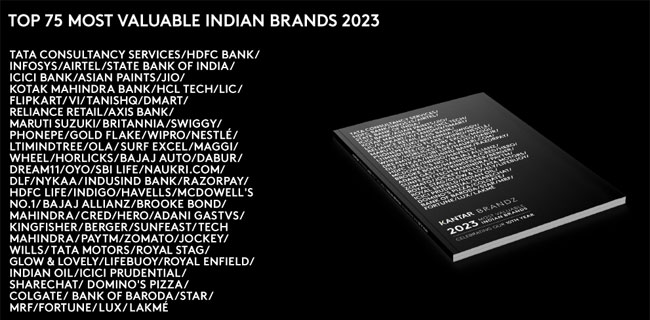
    Tata Consultancy Services (TCS) has retained its #1 position in the 10th edition of Kantar BrandZ Top 75 Most Valuable Indian Brands Report for the second consecutive year, with a brand value of US$43 billion. HDFC Bank, Infosys and Airtel also hold on to their top four positions, while State Bank of India rises one place to enter the Top 5.


    India’s Top 75 brands have a combined brand value of $379 billion, a decline of 4% from 2022 – a modest decrease given the ongoing economic volatility across most of the world. This is testament to Indian brands’ resilience, stability and consistency. The decline has been driven by brands in the Business Technology and Services Platforms category, which have a major presence in international markets, and therefore have been impacted by global pressures, recession threats and geopolitical instability.


    The Automotive category produced the Top 75’s two fastest risers: TVS (No.51; $1.90bn) and Mahindra (No.47; $2.01bn) and achieved the second highest category growth at 19%. India’s automotive brands have quickly responded to changing consumer needs, notably the shift in preference from hatchbacks to SUVs, and the demand for electric vehicles.


    TVS gained 59% in value and leapt 24 places thanks to a number of successful product launches and a 10-year partnership with BMW that gives it leverage in markets such as Europe, the US and Canada. Mahindra, which grew its value by 48%, has made itself incredibly meaningful in Indian consumers’ eyes, and has also significantly boosted its salience.


    The ranking’s 16 Financial Services brands contribute the biggest chunk of its total value. They grew 6%, thanks to the boom in digital banking, led by Axis Bank (No.17; +28%) and ICICI Bank (No.6; +18%).


    Telecom providers also performed strongly, resulting in a 17% rise in total brand value. Airtel (No.4; +29%) took full advantage of the end of the price wars to focus on what makes it special and relevant to Indian consumers’ lives. This included offering differentiated digital services, such as the Xstream entertainment app and Wynk music app. Airtel has also successfully leveraged the rapidly increasing demand among businesses for data and connectivity related solutions, and digital products that enable the delivery of an enhanced omni-channel customer experience.


    There are four newcomers to the 2023 Indian brand ranking, plus two re-entrants. PhonePe – the highest entry at No.21 – has quickly become India’s leading digital payment app by investing heavily in the strength of its infrastructure, building connections with partner banks, and developing a huge network of merchant acceptance points. Also making their debut are fintech brand Cred (No.48; $2.0bn), photo and video sharing app ShareChat (No.67; $1.33bn) and entertainment platform Star (No.71; $1.30bn).


    2023 is the 10th ranking of India’s most valuable brands, during which time the Top 50 have increased almost fivefold in value, from $69.6bn in 2014 to $339.9bn in 2023. The last decade is a story of strength and resilience: 33 of the brands in the current Top 75 were also in the 2014 ranking. The companies behind India’s most valuable brands have consistently outperformed the key market indices – the SENSEX and the NIFTY50 – with share price growth over 10 years of 99.6% compared with 83.2% and 81.7% respectively.


    Kantar BrandZ Top 10 Most Valuable Indian Brands 2023

    Rank 2023 Brand  Category Brand Value 2023 (US$M)
    1 Tata Consultancy Services Business Technology and Services Platforms 42,969
    2 HDFC Bank Financial Services 33,612
    3 Infosys Business Technology and Services Platforms 24,170
    4 Airtel Telecom Providers 22,517
    5 State Bank of India Financial Services 14,483
    6 ICICI Bank Financial Services 12,976
    7 Asian Paints Paints 12,839
    8 Jio Telecom Providers 11,773
    9 Kotak Mahindra Bank Financial Services 10,332
    10 HCL Tech Business Technology and Services Platforms 9,361


    Said Deepender Rana, Executive Managing Director- South Asia, Insights Division, Kantar: “It has been India’s decade. Our GDP has almost doubled with an 82% growth, while the world GDP has grown at 30%. This delta is even more when it comes to the most valuable Indian brands, which have almost quintupled in value (4.9 times), compared to the most valuable global brands, which have grown by 2.4 times. So Indian brands are significant value creators for our economy. We expect this trend to accelerate in the next decade as Indian brands don’t just thrive in India, but also explore growth overseas in their quest to become true multinational giants. Our IT services brands have already done that, with TCS and Infosys already featuring in the Top 100 Most Valuable Global Brand list. The strongest Indian brands have forged powerful connections by consistently adding value to people’s lives, and consumers see them as different to their rivals in ways that really matter. Brands must keep investing in building equity to create future demand, even as they capture existing demand which requires a better balance between short- and long-term strategy.”


    Added Soumya Mohanty, Managing Director & Chief Client Officer- South Asia, Insights Division, Kantar: “There is great diversity within the India Top 75: they are a combination of established names and dynamic young brands, both global and local in footprint. What they have in common is their ability to be essentially Indian. Through a deep and detailed understanding of consumers in the market, and adopting the local culture and ethos, even huge international brands are seen and cherished as ‘homegrown’. The trust and loyalty this engenders has helped Indian brands to suffer less and recover more quickly from the storms that have buffeted them over the past 10 years.”


    Other key highlights from the Kantar BrandZ Most Valuable Indian Brands report include:

    :: Sustainability credentials have a major influence on consumer decision-making – almost 9% of Indian brands’ Demand Power – a Kantar BrandZ measure of the ability to drive predisposition to buy – comes from perceptions around sustainability. However, only 8% of brands in India are seen as leaders in this area, compared to 11% globally, indicating an opportunity for those that can do more.

    :: Differentiation is key to commanding Pricing Power – the ability to justify price charged. Brands that have grown in both Demand Power and Pricing Power over the last year did so by being Meaningfully Different. There are different routes to being perceived as differentiated: a brand could be seen as distinct, to be a specialist, or to have purpose.

    :: The strength of the domestic economy has acted like a shield – Overseas contribution for the Top 30 Indian brands accounts for 31% of brand value, compared with 47% for Japan, 59% for the UK, and 85% for France. This has protected the ranking from the worst effects of international volatility.


    The Kantar BrandZ Most Valuable Indian Brands ranking, report and extensive analysis are available now at www.kantar.com/campaigns/brandz/india 


  • TCS is India’s Most Valuable Brand


    By Our Staff


    Tata Consultancy Services (US$45.5 billion) is the new number one most valuable Indian brand, claiming the top spot from HDFC Bank (no.2, $32.7bn) which had held the position since the first ranking was unveiled in 2014. TCS’s brand value has been accelerated by global demand for automation and digital transformation following the pandemic.


    The Top 10 Most Valuable Indian Brands together contribute just over half of the ranking’s total value. There has been significant movement at the top, in addition to the two most valuable brands switching positions. There are two new entrants – Infosys ($29.2bn) which has rocketed up to no.3 from 12th position, and ICICI Bank ($11bn) which has climbed two places to no.9. State Bank of India ($13.6bn) has also risen four places to no.6.


    There are brands from 23 different categories in the 2022 Indian Top 75. There are a total of 14 newcomers , from 11 categories – including online gaming, education, apparel and real estate, reflecting the diversity and dynamism of the Indian economy.


    India’s strongest brands have bounced back from the pandemic to increase their brand value by a massive 35% CAGR since 2020, when COVID-19 hit the country. India’s top 75 brands are worth a combined $393 billion, equivalent to 11% of India’s national GDP.


    Technology and Banking brands account for over half of the total value. Six B2B Tech brands and 11 Consumer Tech brands contribute 35% to the total value of the ranking, reflecting the rise of Tech India. Overall, B2B brands (tech, payments) are on average almost three times as valuable as B2C brands, reflecting the fact that many of the B2B brands play on the global stage while B2C are more focused on the domestic market. Six banking brands deliver 19% of the total value. Also notable for their performance are Insurance brands, which have performed well as the pandemic increased consumers’ focus on protection of life and health and Telecom Providers, led by Airtel (No.4; $17.4bn) and Jio (No.10; $10.7bn), which took full advantage of growth opportunities as everything moved online, from education to work to parties.


    Key newcomers to the ranking include Vi (No.15; $6.5bn); formed from a merger between Vodafone and Idea, Byju’s (No.19: $5.5bn), the educational technology brand that has become India’s most valuable education brand, and Adani Gas (No.21; $4,5bn).


    Said Deepender Rana, Executive Managing Director- South Asia, Insights Division, Kantar: “India’s leading brands have grown at an exceptional rate, despite global economic headwinds, putting the disruption from COVID-19 behind them. Indeed, they have both driven and benefited from the transformation in consumer and business behaviour as a result of COVID-19, especially where it relates to the use of technology. The challenge now is to sustain momentum as inflation bites worldwide and consumers and businesses adjust to the new normal. Brand owners will need to work harder to identify and build on what makes worth paying for and ensure ROI on their marketing expenditure to avoid a margins squeeze.”


    Kantar BrandZ has identified Four Fundamentals responsible for powering brand growth: Function, Convenience, Experience and Exposure. India differs from other markets around the world, however, in that a brand’s sustainability credentials and purpose matter more.


    Overall, 65% of Indians feel anxious about climate change, and 64% believe businesses must play their part. The highest-ranking brands in the Top 75 are clear on purpose and have a relevant sustainability agenda. These include services platform Zomato (No.30; $3.1bn), which offsets the carbon footprint of its deliveries and packaging. Swiggy (No.20; $4.8bn) elevates consumers’ quality of life with speedy delivery of meals, groceries and healthy items, as does Flipkart (No.12; $8.9bn), while also helping smaller local brands to connect with consumers via its platform.


    Added Soumya Mohanty, Managing Director, Insights Division, Kantar: “Purposeful and sustainable brands are rewarded. Indian consumers look further than the brand attributes that affect them personally – they want brands to improve people’s lives and have a positive impact on wider society. They vote with their wallets, choosing brands they see as ‘doing the right thing’. Indian brands should have a clear view of their purpose, connect strongly with it by embedding it in their culture, talk about it in creative and powerful ways, and deliver on it – without fail.”


    Salience – the ability of brands to spring quickly to mind when a consumer has a need – is also vitally important. India’s Top 10 brands are far more salient than their counterparts in most other countries. However, for growth to be supercharged, brands must also have strong meaning as well. They should have functional meaning – doing a good job of fulfilling a need – but also a layer of emotional meaning. The Kantar BrandZ India Top 75 far exceed other Indian brands on all these of these vital predictors of success.


    Other key highlights from the analysis include:

    :: 57 of the brands in the 2022 Top 75 have been in the ranking since 2018, while 19 have moved up the league table.

    :: The share prices of companies behind strong brands are protected in a ‘bear’ market and recover more quickly. Between August 2014 and June 2022, the SENSEX India Index gained 63.8%, while a portfolio of the most valuable Indian brands rose 81.8%.


    There are eleven consumer tech brands in the Top 75, reflecting the increasingly digital way Indian consumers live, which is 11% of the total brand value. The four most valuable brands in this category are Flipkart (No. 12; $8.9bn), Byju’s (No. 19; $5.5 bn), Swiggy (No. 20; $4.8bn) and Nykaa (No. 25; $3.7bn).


  • Ukraine, cost-of-living & climate changes concern areas for India


    By Our Staff


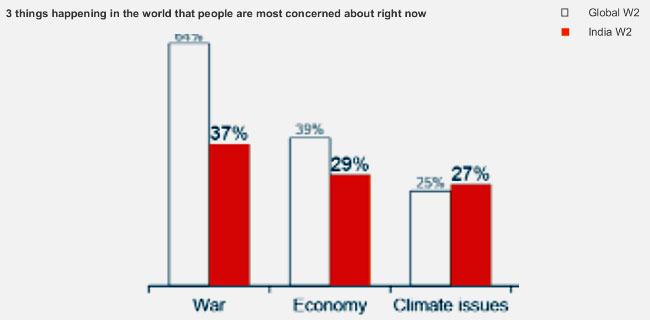
    Kantar’s Global Issues Barometer has found that the invasion of Ukraine remains the #1 concern of people in India followed by economic worries and the cost-of-living crisis. Asked to share their concerns, 37% of people mentioned the war, followed by 29% mentioning economic issues, as their top concerns currently. Climate and environmental issues have also emerged among Top 3 concerns. Covid-19 is no longer seen as a pressing issue like rest of the world, except in China where lockdowns are just lifting.


    Kantar’s Global Issues Barometer study is a detailed analysis of 800 people’s attitudes in India contrasted to 11,000 people across 19 countries (representing 68% of global GDP. The study asked open-ended questions to understand peoples’ real opinions and used Kantar’s TextAI technology to understand and analyse the responses.


    The war in Ukraine

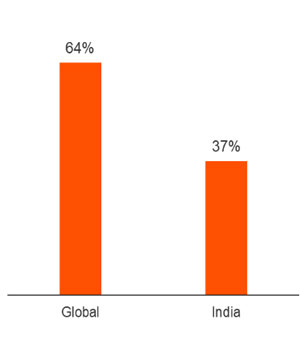
    The war in Ukraine is currently the biggest concern in India like every geographic region surveyed. As expected, the concern is much lower than the European counterparts. There is a high correlation between concern and proximity. 64% of people across the Globe mentioned the war as a concern while only one in three of India’s (37%).


    Figure 1: % Mentions of War


    The cost-of-living crisis

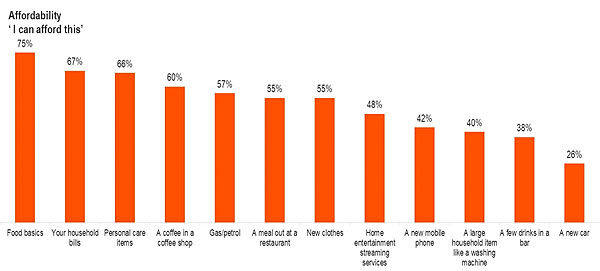
    The cost-of-living crisis is #2 on people’s minds. Price increases in fuel, food & drink and household bills have been noticed the most. Compared to the world, Indians feel the pinch of price increase on white goods more.


    While 35% of the population report their household financial situation is deteriorating, 46% believe the general economic outlook of their country is negative right now. People are struggling to meet their living costs, with 32% of households experiencing difficulties meeting their monthly outgoings and 11% unable to meet their commitments. The problem looks set to continue, a further 71% of people believe inflation will continue to rise even further.


    But there is sliver of hope as two-third of people in India feel secure in their jobs and expect pay rise that will match inflation.


    Figure 2: Affordability


    Eco-anxiety

    Climate inaction is causing remarkably high levels of distress with more than half of people experiencing eco-anxiety.


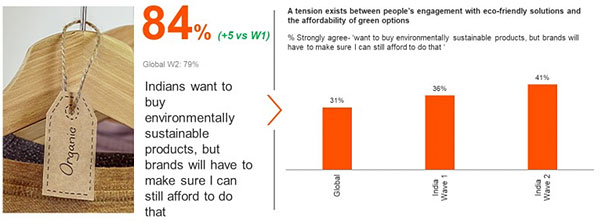
    Two-thirds of the population believe businesses have a responsibility to solve the climate crisis, while 84% of consumers want to buy environmentally sustainable products but need brands to do more work on affordability.


    Figure 3: Eco-anxiety


    Discussing the findings, Soumya Mohanty, Managing Director, South Asia, Insights Division, Kantar, observed: “The current tempest of global events is affecting long-term plans as well as short-term behaviour of Indians. Beyond making cutbacks on general expenditure, people are rationalizing their future savings and working harder.


    Luxury goods, entertainment and holidays look likely to be the sectors to suffer next. Almost half of households (41%) are considering economizing subscriptions to entertainment subscriptions- one industry that did well during the pandemic. Longer-term, almost three fourth of people say the current turmoil is impacting their big life plans; saving for big future life events (47%), children’s education (27%) and retirement plans (24%). So, the impact of this crisis lies in the future as much as in the present and can influence not just financial but also emotional well-being. Brands must therefore recognize what matters in people’s lives and examine brand’s relevance in supporting people overcome these challenges”


    Added Deepender Rana, Executive Managing Director, South Asia, Insights Division, Kantar: “Brands that can offer Green Affordable Solutions are likely to be favoured and become mainstream. With inflation rocketing, in their daily lives, consumers are considering solutions that can help reduce energy and fuel expenditure. They expect brands to do the same and be more efficient, while simultaneously raising the bar on ethical production. If anything, the cost-of-living crisis has reminded people that green products/services shouldn’t come at a premium. Insights from Kantar’s Global Issues Barometer can help brands and businesses understand how to navigate during these uncertain and fast changing times”.


    More on the study at https://www.kantar.com/campaigns/global-issues-barometer 


  • Consumers expect increased allocation for healthcare in the 2022 Budget: Kantar

    By Our Staff


    Kantar, the insights and consulting company, has just released findings from its first ever India Budget Survey. This survey maps consumer sentiments and expectations from the Union Budget 2022, just ahead of its unveil on Feb 1.


    Most Indians are looking forward to Budget 2022 as they have had a largely positive experience with the 2021 Budget. Two out of three consumers claim that the 2021 Budget positively impacted their household budget in the past year. Consumers in the 21–35 age band are more enthusiastic (68%) as compared to the ones in the older age band of 35-55 which stands at 56%. Overall, most are upbeat about what the 2022 Budget holds.


    As the pandemic continues to enter its third year, consumers expect the government to continue focussing on healthcare with 66% expecting an increase in the healthcare budget allocations and strengthened policies.


    Interestingly, consumer sentiments around electric vehicle subsidies and schemes see traction amongst consumers as well. With increased focus on climate change and sustainable living, 60% consumers expect the government to prioritise subsidies on electric vehicles in the coming year.


    However, fuel prices continue to remain a concern. Majority (72%) expect the government of India to bring petrol and diesel under the ambit of GST, with an expectation it may reduce fuel costs. This expectation is higher among metros (74%) than non-metros (65%).


    Cryptocurrency as an investment avenue is expected to continue making noise this year as well. As per a Kantar’s cryptocurrency survey from July 2021, 19% Indians intended to invest in cryptocurrency in the next 6 months in Urban India. As of December 2021, this number has increased to 32%. This is possibly driven by awareness and exposure that advertising and celebrity endorsements have generated over the last few months. Millennials seem to be keener on trying this new investment avenue as their intention to invest is higher at 32% as compared to those in the age group of 36-55 years which is at 26%.


    Majority expect India to launch its own official cryptocurrency in 2022. There is an overwhelming preference towards investing in India’s cryptocurrency with 79% claiming to invest in that over existing cryptocurrencies like Bitcoin, Ethereum, Dogecoin etc. This is driven by the perceptions of it being more secure due to clear regulations laid down by RBI.


    Commenting on the findings, Deepender Rana, Executive Managing Director- South Asia, Insights Division, Kantar, said; “As we step into the third year of the pandemic, the public wants the government to further invest in public health infrastructure and other favourable policies like tax deductions for insurance, which help alleviate the burden of medical expenses. Concerns about fuel prices come through, as does a desire that government should help us wean ourselves off dependency on dirty and ever more expensive fossil fuels, through e-vehicle subsidies. Meanwhile, as cryptocurrencies take off and the government mulls a tax on crypto transactions, investors want the government to play a role in encouraging yet regulating these innovative finance instruments through India’s own cryptocurrency.”


  • Amazon, Asian Paints & Tata Tea are India’s Most Purposeful Brands: Kantar BrandZ India 2021

    By Our Staff


    India’s Most Purposeful Technology Brands Rank India’s Most Purposeful Non-FMCG Brands Rank India’s Most Purposeful FMCG Brands Rank
    Amazon 1 Asian Paints 1 Tata Tea 1
    Zomato 2 Samsung 2 Surf Excel 2
    YouTube 3 Jio Taj Mahal 3
    Google 4 MRF 3 Parachute 4
    Swiggy Tata Housing 4 Maggi
    Flipkart 5 Airtel 5 Britannia 5


    Amazon, Asian Paints and Tata Tea emerge as the most purposeful leaders in India across technology, non-FMCG and FMCG categories respectively. This emerged as insights and consulting major Kantar released the 2021 edition of its annual BrandZ India report on Thursday. This year, the report has moved gears to offer a ranking of 2021’s Most Purposeful Brands in India. According to Kantar BrandZ data, consumers believe that these brands lead with a clear sense of purpose to make their everyday lives better.


    The technology ranking has Amazon followed by Zomato, YouTube, Google and Swiggy jointly in fourth place, followed by Flipkart. The non-FMCG ranking is dominated by telecom brands, with Samsung and Jio jointly second, followed by MRF, Tata Housing and Airtel. The FMCG category ranks some of India’s biggest names: Tata Tea followed by Surf Excel, Taj Mahal, Parachute and Maggi both in fourth position and Britannia completing the list.


    Kantar conducted an analysis of 418 brands across 30 categories and found that in India especially, perceptions of a brand’s purpose, its ability to ‘make people’s lives better,’ is crucial to establishing a brand’s Meaningful quotient and thus, boosting prospects for growth.


    Said Deepender Rana, Executive Managing Director- South Asia, Insights Division, Kantar:  “Brand Purpose provides an anchor amidst constant uncertainty, both as a North Star for brands, but also as reassurance to consumers. Purpose as a contributor to brand equity is 10 times more important in India, in comparison to globally. This shows that a larger societal purpose is even more critical to success for brands in India. Of course, vague slogans and one-off ‘corporate charity’ events do not work, and it is not about jumping on the bandwagon of the latest fashionable cause either. Instead, real Purpose flows from, and builds on, a brand’s existing core values and DNA. This reinforces the need to understand and measure if a brand’s Purpose is perceived as adding real meaning to consumers lives.”


    Key Findings:

    2021 Kantar BrandZ data for India, in conjunction with other Kantar consumer sentiment tracking, has revealed several patterns in what Indian consumers deemed ‘Purposeful’ in 2021. Some of the key highlights:

    >> Amplifying or communicating purpose is critical.

    >> Tech brands show how everyday convenience contributes to brand purpose. These brands have been able to scale-up and showcase a wide range of products plus enter new categories at a time when consumers were desperate for at-home & delivery solutions. Everyday convenience in turn made lives easier and fueled saliency for brands

    >> FMCG brands are focusing on reducing their carbon footprint and taking a social stance. FMCG brands that score high on brand purpose have shown that purpose and profit can go hand-in-hand. They are working to reduce their environmental impact and promote social causes – which in turn attract customers, partners, and talent.

    >> Non-FMCG brands are now adopting marketing strategies that promote the brand in ways that look beyond the function of product or service; the key is to do more than just meeting consumers’ immediate needs, adding new and potentially differentiating associations.

    >> The Indian consumer, on a par with many of their Asian counterparts are actively engaging with sustainability; 77% are prepared to invest time and money in companies that try to do good


    Speaking about Kantar BrandZ’s report in India, Soumya Mohanty, Managing Director- Client and Quantitative, Insights Division, Kantar added: “Purpose can work as a strategy for brands, when it’s based on the right consumer insights, and executed effectively. In India, Kantar BrandZ data suggest that a brand’s Purpose ranking has a direct impact on its Meaningfulness score – which in turn is one of the cores, proven building blocks of brand value growth.”


    The Kantar BrandZ Spotlight on Brands in India 2021 Report, Rankings and extensive analysis are available online: https://www.kantar.com/campaigns/brandz/india