Tag: DDB Mudra Max

  • DDB Mudramax executes the FIFA U-17 World Cup mascot launch event

    By A Correspondent


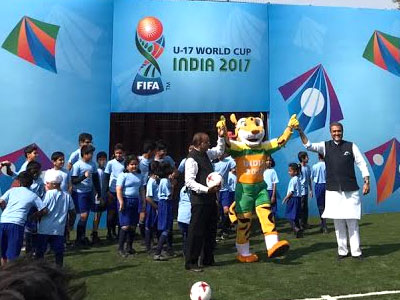
    With just over 200 days  to go until the start of the FIFA U-17 World Cup India 2017, the official mascot of the tournament was revealed at New Delhi’s Jawahar Lal Nehru Stadium recently. The mascot launch event was conceptualised and executed by DDB MudraMax- Experiential.

    The FIFA U-17 World Cup India 2017 is the first global football event that will take place in India (from October 6 to 28). Following a multi- agency pitch win, DDB Mudra Max was entrusted the task of conceptualising and executing the launch event which resonated with this idea. The objective was to create a remarkable recall value for the FIFA U-17 and set the ball rolling for the sporting revolution this event will trigger.

    In a ceremony attended by Minister of Youth Affairs and Sports Vijay Goel and the Chairman of the Local Organising Committee, Praful Patel,  a Clouded Leopard nicknamed ‘Kheleo’ was introduced to hundreds of fans and media representatives. The Clouded Leopard is a wild cat that has descended from the Himalayan foothills through mainland Southeast Asia with a total population suspected to be fewer than 10,000 individuals. The character represents the agility, vigour, uniqueness and potential for the game.

    Following a high spirited event, the seven-foot tall mascot ‘Kheleo’ was introduced to the global football community; as it emerged through two splitting LED screens on stage. The mascot interacted with the young football fans and was cheered on enthusiastically by huge crowd turnout and the media at the unveiling event.

    Quoting on the brand’s experience of working with DDB MudraMax, Joy Bhattacharya, Project Director, FIFA U-17 World Cup India 2017 said, “The show that DDB MudraMax has pulled off cannot be the easiest thing. It is a launch that involves World Football Association, Local Football Association, Ministers making it simply difficult to put a timeline in place.”

    Quoting on the agency’s association with FIFA U-17 World Cup India 2017, Sanjay Shukla, President- DDB Mudra Max said, “2016 was a great year for DDB MudraMax. We gained a lot of momentum and it is great to see the momentum carrying forward 2017 as well where the first marquee event we are pulling off is a part of Indian sporting history. It is a matter of pride and honor for us to be associated with the 2017 FIFA U-17 World Cup India 2017 Mascot launch. The local organising committee are client partners in every sense of the word. I am extremely proud of the team that won this business and pulled off the event.”


  • PNB Housing Finance unveils new multimedia campaign

    By A Correspondent


    After its first brand campaign launched early this year, PNB Housing Finance is back with its corporate campaign in print, digital, TV and outdoor in multiple cities starting September 2016. The campaign has been designed to apprise customers of the company’s strengths and milestones.


    The theme of the campaign has been retained as animals to draw inspiration from their physical traits. For instance, the reason for choosing leopard is its speed which symbolises PNB Housing’s fastest growth among the leading housing finance companies in India as of March 31, 2015, as per IMaCs Report. A large flock of colourful Flamingos signifies the company’s ability to maintain the growth in our loan portfolio without compromising on the credit quality, while the care depicted by the mother deer and her fawn represents the way in which the company handholds its customers. In a way, the company has aligned the manifestations of nature as its own traits.


    Said Shaji Varghese, Business Head and GM, PNB Housing Finance Limited: “We understand that buying a home is a very emotional decision and we at PNB Housing do our best to offer exclusive experience & services to our customers. In line with that, our present campaign has been designed to highlight our key corporate messages, talking about the company’s strengths and strategies. The theme revolves around animals who inspire us by their physical traits. The campaign creatively uses them  to turn the manifestations of nature into PNB Housing’s story – fast growth, market strength, customer centricity and reliability. This campaign is our effort to remain connected with the consumers, establishing PNB housing as a new generation housing loan provider.”


    Tarun Nigam, Executive VP, DDB MudraMax, the media and outdoor agency for the campaign, added: “We are glad be a part of the execution and implementation of the second phase of the PNB housing finance campaign. The campaign is being implemented on across OOH platforms. A key milestone of this campaign is that across media “impact” is the operating word – all the executions are layered with impactful innovations. We used the visual pneumonic of the “nest” in the first leg of the campaign. And now in this phase “homes” is the key peg. We have created “actual home replicas” in the hoardings, airports and mall environments. We have specifically dominated the Mumbai stock exchange locality as well where we have taken branding across e.g… Umbrellas for all the street vendors and the tropllin of the shops has been converted into brand colors.”


  • DDB MudraMax-Experiential creates signature bat for LG

    By A Correspondent


    Being the official sponsor of the ICC World Cup 2015, LG wanted to rejig the zeal of cricket amongst the Indians before the inception of the World Cup 2015 season.


    Moreover, a big ticket event like ICC World Cup 2015 needed a bigger show; a larger-than-life spectacle to further raise the cricket supporters. Hence, DDB Mudra Max- Experiential came up with the idea of the ‘signature bat’ campaign.


    A gigantic bat was created for the cricket lovers to write their wishes for their favorite teams. Further the bat was stalled at strategic locations across Hyderabad, Mumbai, Delhi, Gurgaon and Noida along with the ICC World Cup Cricket Trophy which was kept on display for the spectators.


    The bat amazed the audience with its sheer size and overwhelmed them with the thought of getting an opportunity to send personal good wishes and messages to their favourite team. The original World Cup trophy being on display brought back the nostalgia of winning the World Cup last time and geared up the audience to cheer India to win it back this year.


    The campaign was well received as more than 2, 500 audiences from across cities signed on the bats and wished their team. The zeal multiplied with the presence of famous Indian cricketer VirendraSehwag who addressed his fans at Gurgaon & Noida.


    Niladri Datta, Head- Corporate Marketing, LG Electronics India said: “We are extremely proud to be the official global partners of ICC for all these years and to be a part of 2015’s biggest sporting spectacle, the ICC Cricket World Cup 2015. Indians are one of the biggest followers of Cricket across the world and it gives us immense pleasure and delight to offer our consumers and Cricket lovers an opportunity to experience the trophy in person and share their good wishes with the Indian team through the Big Bat ceremony arranged across five cities. With this activity, LG brought the game closer to the cricket fans and gave them a platform to share their wishes directly to their favorite team.”


    Mandeep Malhotra, President, DDB Mudra Max quoted, “Cricket still remains the one unified religion of our country. Making the signature bat for seeking well wishes for the teams across the country was a brilliant idea, requiring operational excellence. We are glad that our campaign garnered lot of awareness and buzz right before the World Cup 2015. I believe that this campaign was quite instrumental to set the momentum rolling for the cricket season.”


  • DDB MudraMax, Aircel flash mob promotes Pocket Internet Games card

    By A Correspondent


    Aircel in collaboration with DDB Mudra Max organized an ‘exhilarating and exciting’ Flash mob at the Express Avenue Mall to promote their newly launched Pocket Internet Games card. The crowd at the Express Avenue mall in Chennai were entertained with music, footwork and the live gaming activities of boxing and football.


    For starters, two men materialized out of nowhere and got into a heated argument. Their heated argument got the whole crowd interested and even as they listened to the peppy background music. On cue, the duo stripped down to boxing attire, a referee jumped into the fray, cordoned off an impromptu ring and began a round of boxing. Football followed similarly.


    Mandeep Malhotra, President, DDB MudraMax, said, “The ‘Aircel Pocket Internet Games’ Card is a unique property, and we wanted to do justice to the same.  When the word ‘flash mob’ is used, we automatically picture a group of people getting together and dancing on a song. We wanted to change this assumption, so we brought in the idea of gaming in the form of a flash mob.


    Commenting on the idea behind the flash mob, Gunjan Arora, Group Director, Brand Communications, DDB MudraMax, said that Aircel as a brand has always been open to new ideas and innovative practices to aggressively engage consumers and make an impact.


  • Crime pays for GECs

    By Meghna Sharma


    What is it about the dark side that attracts us? A glance over any newspaper or news channel will tell us the increased attention being given to the gruesome incidents.


    The media, especially the television which is a reflection of the society, has reflected this growing interest with the increasing popularity in the number of the unglamorous, and sometimes, gory crime shows. From Karamchand in the 80s on DD to the latest Gumraah on Channel V, most crime shows have done well and have been able to garner an interest that other genres might not be able to. The longest running show on the Indian television, CID, is a crime show which was started in 1998 and recently turned tri-weekly.


    Speaking about the show’s success, Sneha Rajani, senior EVP and business head, Sony Television, said: “CID has been doing well for years now; it’s not a recent phenomenon. On an average, the show gets TVR of 3.3-3.5, and sometimes even goes up to 4.5. So, it’s no surprise that show has its share of viewers, as week after week people switch on their TV sets to get inspired by the bravery and the relentless passion of CID against crime.”


    Popular Crime Shows

    Karamchand – 1980 – DD

    CID – 1998 – Sony

    India’s Most Wanted – 1999 – Zee

    Aadalat – 2010 – Sony

    Gumrah – 2012 – Channel V


    According to industry experts, most GEC experiments with crime shows have been successful – some have garnered a little interest and others have gone on to become national hits like Adaalat and India’s Most Wanted.


    Such crime shows consist of an economically viable format – no huge sets, no major actors, no glamorous outfits or expensive judges are required – hence, the channels don’t mind investing in them.



    Janardhan Pandey

    Janardhan Pandey, associate vice president, DDB Mudra Max feels that apart from reality shows, only crime shows have the ability to create sensationalism and that’s the main reason people are attracted towards the format. “People want to know what’s happening around them. And these shows are able to portray facts through dramatization, without costing too much for the channel.”


    ‘Curiosity killed the cat’ is the apt reason why crime shows work on television according to Anand Chakravarthy, executive vice president, Marketing, RBNL and business head, Big Magic. “Crime, as a genre, has an extremely wide appeal, irrespective of the country. In a developing nation likeIndiawhere crime and corruption are a part of the societal fabric, the audience is most likely to appreciate televised content in the genre.”

     

    Anand Chakravarthy

    He added: “The fascination with the morbid and intrigue that the genre provides work across a cross section of audience, regardless of age and gender, making it acceptable to a larger and diverse audience base.”


    However, the question which still arises is – aren’t such shows the figment of the writers’ imagination? The writers of such shows may choose to disagree about the authenticity. “Though some might say they are a writer’s figment of imagination, but in reality, newspaper reports, sometimes even FIRs and investigations done by channels help us gather facts and details about various cases,” said a writer with a national GEC.


    According to Priti Murthy, national director – Insights, Maxus, crime shows attract not only the middle-aged, but a large number of youth too. “Crime cuts across genres and finds a large number of youngsters hooked on to the genre like action, thriller, and crime. One could say it gives them adrenaline rush.”


    Prem Kamath

    Channel V recently launched a teen crime show, Gumraah, which has became popular for its disruptive format and unique viewpoint of understanding the psyche of young criminals. “V’s Gumrah, in its second season now, details the ecosystem in which a teen crime is conceived and the extraordinary circumstances that lead to it. The show has had an immense impact on us, in terms of viewership as well as vindicating our research and understanding of the youth. We have seen a tremendous response in terms of feedback and appreciation on social media and other consumer responses. It has also further encouraged us to try bolder formats and continue on our chosen content strategy,” said Prem Kamath, Executive VP and GM, Channel V.


    Most crime shows do attract a large number of eyeballs, but most GECs also claim that it’s not about entertainment alone; they are helping the society as well. “As for adults, and specifically parents, this show is an eye-opener: if one neglects their child’s need for attention or dismiss it as juvenile behaviour, it can have serious repercussions and lead to moment of madness, eternally irreversible,” added Mr Kamath.


    “Shows such as Police Files (aired on Big Magic), while showcasing crimes from the region, also attempt to educate and empower the viewer. The depiction of the crimes help the viewers to understand and accept the need to be vigilant in safeguarding themselves and their loved ones. The information imparted by way of applicable laws of the Indian Penal Code, safety tips by experts and NGOs help empower the viewer,” said Mr Chakravarthy.


    So, if one has to go by what industry experts have to say: it’s entertainment with awareness that makes one switch on their television sets to watch crime shows.  Whatever be the reason, the channels can surely say that ‘crime pays’!
     

  • Marketers make hay in Rural India


    By Ritu Midha


    There’s no denying the unprecedented push being issued by marketers in getting their brands to reach out to rural cities and towns. Most marketers, who earlier had shied away from reaching out to these markets, are now reviving their interest and want to be a part of the action in the so-called Rural India. Till recently, the interest was not translated into action due to various issues like lack of infrastructure, information and consumers loyalty to a few brands that braved adversities and made inroads into these difficult-to-reach markets. However, things are changing now and, to a large extent, the change can be attributed to information access and the penetration strategy adopted by the mobile networks, which were closely followed by handset marketers.


    Harish Bijoor
    Avinash Oza
    Mihir Mody
    Mayank Shah

    As per Harish Bijoor, CEO, Harish Bijoor Consults, the rural consumer is just getting the taste of experimenting and owning, and hence a larger opportunity lies there. He elucidates: “I would segment the hinterland into urban, rurban and rural. The hunger deepens as you go from urban to rurban to rural. The opportunity for marketers therefore deepens as one penetrates further down this strata.”


    There are a number of pull factors attracting marketers to these areas; one also shouldn’t ignore the emphasis being laid by the government in improving infrastructure and education levels across the country. Avinash Oza, Director Brand Communications, DDB Mudra Max reflects on this sentiment: “The government’s infrastructure vision of connecting rural with urban through construction of roads and rail network has led to migration, mobile working population, and better education – it has also provided an opportunity for marketers to reach out to rural areas, thereby increasing accessibility across categories. In addition to infrastructure, Doorsanchar Kranti (Telecom Revolution) has bridged the rural-urban divide via satellite cable, and DTH connections.” He, incidentally, believes that it is a crime to call them villagers – they are distant urbanites.


    Presenting his outlook, Mihir Mody, Founder & CEO, Adwallz, said: “There is awareness and good spending power. Gradually these markets are becoming urban in attitude and awareness, thanks to the medium of television. Marketers, too, are exploring a new world in rural – FMCG and telecom success stories are now attracting other product categories… the sheer numbers are formidable.”


    Marketers have taken note of this evolution, and there is an increased focus on rural markets across product categories. Mr Krishna Mohan, CEO, Sales, Emami Limited said: “The great rural-urban divide in household consumption patterns has reduced drastically. Bharat is indeed keeping pace with India when it comes to spending on most fast-moving consumer goods. Rural sales contribute more than 40 to 50 per cent of total sales in various categories for Emami. We have increased emphasis on engaging rural consumers. The market is huge with a lot of potential.”


    Mayank Shah, Group Product Manager, Parle Products too is of the opinion that rural markets are indeed opening up, however there might be a difference in purchase behaviour and consumption pattern. He states: “In case of rural buyers, it is smaller units. Instances and opportunities of buying are less and they buy if the right quality is delivered at the right price.”


    It is not only the FMCG marketer who is witnessing an increased awareness and demand, but also the durables and electronics sectors. Kamal Nandi, VP – Marketing & Sales, Godrej Appliances explains: “It is not only the towns in these areas which are seeking a metamorphosis, but demand in rural markets too has increased. Though it might still be the entry level products that are being sold there – the aspirations are high, and demand is increasing. For instance, we have seen remarkable growth in sale of single-door refrigerators in these markets.”


    The consumerism in rural areas is being led by youth who are better connected, informed and travelled than the generation before. As Mr Oza stated: “Youth here are fast adopters, acceptors and can be termed as change agents. To reach households, the route is to bring youth on your side. Marketers can use youth by following ‘learning with livelihood’ model when they plan to penetrate hinterlands.”


    Another trend that has shown marked improvement is penetration of media in rural areas. This has resulted in more number of consumers who are being exposed to brands and their promises. However, the success of a brand in rural areas, to a very large extent, lies in the retailer’s hands – and it is important for the marketers to win them over. Citing an example, Mr Oza said: “Each retail store has 3-4 shop boards. On my visit to Khandwa in Madhya Pradesh, I came across unique shop boards. One brand – Pariwar tea, even deployed shop boards with retailers’ photographs. This shows that Maslow’s hierarchy pyramid works the opposite in the hinterland.”


    Beyond being in the good books of retailers, marketers have also realised the importance of educating consumers in these markets. The objective, of course, is to increase awareness levels and thereby consumption. Krishna Mohan stated: “The way forward is to help consumers, especially in the rural areas, to make the switch from loose to branded products or aid new consumption habits, either with novel products or new formats. We have embarked on a project called Swadesh, where Emami through its field staff would cover rural markets directly through dedicated organisation structure for rural operation.” He added: “Communication is another vital factor in ruralIndia. We need to reach out the consumers through innovative ways and create brand recall.”


    Though a number of theories have been floating around on the scope that rural markets throw up for brands, what is certain is that this is where the action would come from – and obviously more moolah. This would be driven largely by consumers from these belts that are increasingly becoming savvy, have better disposable incomes and are ready to spend. However, at the same time, the consumer is discerning, price conscious and desires to take small steps. The need of the hour is to communicate to him in a right manner and offer him the right product in the right size – win him over by giving the right advice and see your brand grow. But it must be mentioned here that word-of-mouth or buzz marketing is still the key to a making higher purchase decisions. As one jilted consumer might lead to many being drawn away and that’s the last thing a brand might want to confront itself with.


    Imaging: Rafiq, Photograph: Fotocorp


  • Movies OK will focus on families: Hemal Jhaveri

    By Meghna Sharma


    After the launch of Life OK in December 2011, Star India is planning to launch a new channel on May 6 under the OK banner – Movies OK.


    The channel promises to be different from Star Gold, the movie channel launched by the network in 2000. “There is a difference between the two channels. Movies OK will focus on family audience. This means we are going to showcase movies which a whole family can enjoy together,” said Hemal Jhaveri, general manager, Star Gold, who heads the channel. The channel plans to concentrate on genres like comedy. “There is going to be more comedy and less action on the channel,” he added.


    Apart from content, the other thing which will differentiate the channel from the competitors is the treatment. “The promos are going to be very different and unique from what the other channels do. For instance, we are going to have a Best of Salman Khan Festival called ‘Bhai Ok Please’ where no film footage has been used. So, for the first time, people will see a promo for Salman Khan without him in it. Communication is going to be unique,” explained Mr Jhaveri.
     

    If that’s not enough, the channel also boasts of having a World TV Premiere every night by the end of this month. Mr Jhaveri said: “The 7 day 7 premiere is something which no other channel has experimented with earlier. I think it’s the first-of-its-kind in the world as well. So, every night at primetime, one will get to see movies like Kahaani, London Paris New York, Jodi Breakers and others. We are planning to build our channel as a unique platform.”


    The channel also hopes to use the learnings from their other channels, especially Star Gold which was revamped last year. So, one can expect shorter breaks.


    The channel has a library of over 1000 movies. “We have been investing in the channel from the past two-three years and will continue to do so in the future as well. Therefore, it’s going to be a unique library. Last year, we acquired the Viacom18 library so that will also add to it,” elaborated Mr Jhaveri.


    The Hindi movie genre enjoys the third largest viewership pie, trailing behind regional channels and Hindi GECs, according to a FICCI-KPMG report on the Indian media and entertainment industry, released in March.


    “There are various Hindi movie channels, but there is always space for one more, if it’s different and has good content,” said Mr Jhaveri. Agreeing with Mr Jhaveri’s sentiments, Ashwini Kamat, general manager, MediaCom added: “People don’t have loyalty towards movie channels. So, if a channel has a good library, then it doesn’t need to worry about others because people will switch to it, if they want to watch a particular film.”


    Janardhan Pandey, associate vice-president, DDB Mudra Max elaborated: “There is enough space on TV to launch a channel but all depends on if one can sustain it at the top slot. A new channel might showcase latest movies, but after some time, many stop investing in a new library and repetition starts. It is then people tend to move away from it. So, it might make an impact in the beginning, but it is difficult to say how a channel will do in the future.”


    However, advertisers aren’t optimistic about it. “One more channel means more segmentation. So, I don’t think it’s going to benefit us,” said Praveen Kulkarni, general manager (marketing), Parle. The categories which spend heavily on Hindi movie channels are services, auto, personal accessories and telecom. “Launch of any new channel means fragmentation and overall inflation for advertisers,” added LK Gupta, CMO, LG.


    The channel has a 360 degree promotional plan for the channel. It will also be promoted during Star’s new show, Satyamev Jayate, which will also be premiered on May 6. Radio and digital platforms will be used too.


  • MSM hits the ball hard for Six

    By Rishi Vora


    It’s been about two years since it was first heard that Multi Screen Media Pvt Ltd (MSM) will launch a sports channel. The wait is finally over as the channel was launched on April 7. This is MSM’s sixth channel – one of the reasons why the network chose ‘Six’ as its brand name.


    The TG for Six is skewed slightly towards the younger lot of sports fanatics and the first phase of the content plan is to  make most of the Indian Premier League’s five editions and evoke special interest among fans to watch non-cricketing sports such as mixed martial arts, basketball, badminton and football. Its main property, to begin with, is Ultimate Fighting Championship (UFC), a martial arts contest that has more than 30 events globally. The next season of IPL will be aired on Six.


    The channel will reach out to 80 million homes on DTH and analog platforms in India with a reach of 20 million in phase 1.


    Six is being promoted heavily on network channels and the on-air biggest cricketing property, IPL. Quite surprisingly, the channel has not gone for a 360-degree marketing blitzkrieg – the usual strategy adopted to support the launch. It is learnt that outdoor and radio will subsequently follow promotions on TV.


    If one looks at the sports broadcast arena as is currently placed, it makes an interesting read. Neo Sports and Ten Sports are facing a tough time sustaining business. And, of course, the fact that IPL was running on a sticky wicket as far as sponsors are concerned, tells the story – that advertisers feel there’s no point investing big monies where the returns are not very good. Plus, the recent development of Star winning the BCCI rights… something which MSM was eyeing to provide that much required impetus for the new channel, is a sure-shot big miss of opportunity.


    “We have the IPL and as we move along, we hope to acquire more rights,” said NP Singh, Network COO. He confessed that the BCCI rights was an opportunity missed, however, he also said: “It was in our long term interest to launch a sports channel. We had been talking about it, so it wouldn’t have made sense to further delay the launch just because we did not win the rights to broadcast Indian cricket.”


    According to a senior media planner who wished anonymity, the launch of Six has happened at a time where it may not be easy for the channel to make a mark. “Cricket is the only sport India loves. Besides IPL, Six doesn’t have much to offer. Also, there isn’t much left as far as rights are concerned, so the channel will really have to do well on non-cricketing sports, which is a big challenge in a country like India.”


    Ms Basabdatta Chowdhury, CEO, Platinum Media is of the opinion that though the channel might face many roadblocks, in the end it’ll be a sustainable business. “I think there is space for one more sports channel. It depends on what kind of content they bring to the channel. Football is quite popular in some sections of the country and they will look to target them. Similarly, other sports which have their specific audiences in the country. If the channel does well in targeting these niche sections, it’ll sustain. And of course, they have the IPL and the New Zealand board for cricket lovers.”


    Mr Anwesh Bose, Senior Vice President, DDB Mudra Max offers a similar view: “MSM has made very good profits this year and that would give them muscle to gain rights from other cricket boards around the world, they already have the New Zealand Cricket rights. In addition, there is football and a few other sports to look forward to. With the new channel, new vistas would open for Sony and given their past successes, they can surely make a profitable venture out of the sports channel.”


    He further added: “They still have five years of IPL left and they will make good use of it.”


    Overall, there are mixed reactions on the prospects of MSM’s new channel, Six. One major worrying factor is that there aren’t many rights left to be acquired, and those which are, are available at exorbitant prices, making sports broadcast a challenging business.


    As the Network’s COO mentioned, every time they’ll (channel execs) step out to get the much important rights, the attempt will be to go for a six.


    Time will tell how well they hit the ball.


  • DDB Mudra Max OOH takes Tata Sumo Gold pan India

    By A Correspondent


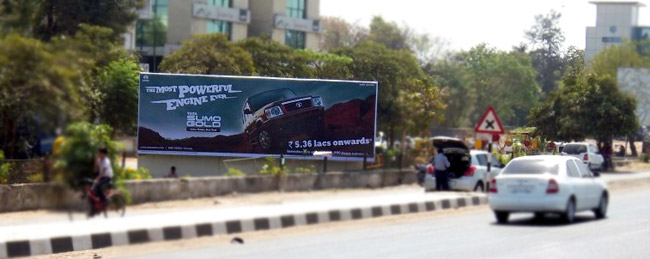
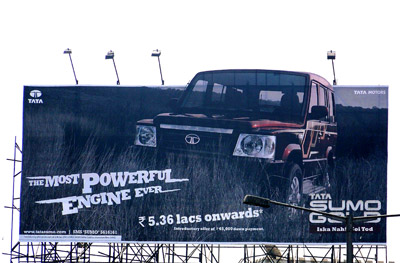
    DDB Mudra Max OOH carried a pan-India Out of Home (OOH) campaign for Tata Motors latest car- Tata Sumo Gold. The out of home campaign had commenced on February 28, 2012 and will conclude by the end of March, 2012. While the creative message of the campaign was ‘The Most Powerful Engine Ever’, its target audience are SEC A, B, those in the early 30s and living in the semi-urban and rural areas. The OOH campaign for Tata Sumo Gold is a pan India campaign spread over 200 plus markets. The OOH media vehicles used in each city were – Bill Boards, Unipoles, WallWraps, Walls for Paintings and BQSs.


    According to the brief from Tata Motors, the main aim behind launching this campaign is to make both personal and commercial segment consumers aware that there is an-all new Sumo variant (Sumo Gold) with a new, powerful CR4 engine. It allows Sumo Gold to take on different (rough and tough) terrain with ease.


    Since most of Tata Sumo’s TG is said to live in the semi-urban centres and that they mainly travel to outside the city to work, one of the strategies was to project Tata Sumo Gold as the vehicle that is adaptable to all kinds of roads and any circumstances. Hence whether it is travelling through difficult and bad roads, small lanes, traffic jams bad patches and other extreme situations, Tata Sumo Gold helps one travel with ease.


    Locations such as major entry and exit points, national highways, railway stations, religious destinations, bus stands, taxi stands etc were incorporated so as to reach the potential customers at all possible touch-points. For markets where OOH options were not available, Wall-Wraps and Wall painting were done to increase the reach. Cut-outs and LEDs were also installed in various markets to further enhance the appeal of the campaign.


    Ashesh Dhar, Head-Utility Product Group, Tata Motors said, “The new Tata Sumo Gold is a result of extensive consumer studies and field tests. The product has been designed to fulfill various requirements, long-awaited by the new generation customer. At the heart of every Tata Sumo Gold, lies a growling engine that thumps out vicious power. The Tata Sumo Gold goes a step ahead in putting the reins of power in the customer’s hands that suits his driving experience, delivering the best-in-class acceleration, power and an excellent torque aided pick-up and pull power. To communicate this message, DDB MudraMax OOH really helped in reaching out to the nooks and corners of the country with the traditional and unconventional outdoor spread.”


    Arun Rogha

    Arun Rogha, Group Account Director, DDB MudraMax OOH said, “It was a daunting task to execute a campaign of such a magnitude. While ensuring the optimum geographic spread we all had to take care of the intensity in each market. Strict Roll out schedule along with streamlined logistics helped us keep a check on the timelines. We had to live upto the benchmarks set by the previous launches of Tata Aria and Tata Sumo Grande. Tata Sumo Gold launch was more important considering the TG we had to reach to, throughout the country.”


    Adille J Sumariwalla, Head, DDB MudraMax OOH said, “Tata Motors have been the pioneers in the UV market in India. With the launch of the new Sumo Gold, we had to effectively communicate the new features and powerful engine, the car comes with. To effectively reinforce the message we had planned the media at important consumer touch points. Creative and Medium led innovations were also executed in important markets to break away from the clutter.”