Tag: David Tiltman

  • Warc & Act Responsible collaborate for best campaigns

    By Our Staff


    Warc, the global marketing insights company, and publisher of the Warc Rankings and Act Responsible, the international non-profit association and largest source of the world’s best ads for social and environmental issues, have collaborated for The Good Report, a ranking of the world’s best use of creative communications to promote sustainability and social responsibility to raise awareness of major social and environmental issues.


    The Good Report is compiled by ACT Responsible, the international non-profit association and largest source of the world’s best ads for social and environmental issues, in collaboration with WARC, the global marketing insights company, and publisher of the WARC Rankings.


    A total of 1,259 campaigns produced by 796 agencies for 1,000 advertisers (non-profit, public sector, and commercial brands) across 80 markets were evaluated for this latest Good Report.


    Of the top 40 campaigns featured in The Good Report 2021, 21 are for non-profits, 15 for commercial brands (including two produced in collaboration with non-profits) and four for public sectors. A total of 45 agencies (34 are from networks and 11 are independent agencies) across 21 markets are represented.


    The top 25 agencies are made up of four independent and 21 networked agencies covering a total of 16 markets. Of the top 20 networks, three are independent and 17 are owned by holding companies. The top ten brands include six non-profits and four for-profit.


    The Good Report 2021 top ranked campaigns and companies promoting good are:


    Campaigns

    #1 Boards of Change, FCB Chicago/FCBX Chicago, City of Chicago

    #2 The Hiring Chain, Small New York, CoorDown

    #3 Water Light, Wunderman Thompson Bogotá, E-Dina Energy

    #4 True Name, McCann New York, Mastercard

    #5 Made to Make a Difference, Saatchi & Saatchi Melbourne, The Royal Australian Mint


    Agencies

    #1 Publicis Conseil, Paris

    #2 FCB Chicago

    #3 FCB Ulka Mumbai

    #4 Wunderman Thompson, Bogotá

    #5 Small, New York


    Networks

    #1 FCB

    #2 McCann Worldgroup

    #3 TBWA\Worldwide

    #4 Havas Group

    #5 Publicis Worldwide


    Advertisers

    #1 WWF

    #2 City of Chicago

    #3 CoorDown

    #4 E-Dina Energy

    #5 Mastercard


    Countries

    #1 United States

    #2 France

    #3 Brazil

    #4 United Kingdom

    #5 Australia


    Said Hervé de Clerck, ACT Responsible Dream Leader: “With the Good Report, ACT Responsible continues its mission of promoting, inspiring and uniting the communications industry for the greater Good. We truly believe advertising has a major role in educating and promoting good to help make the world a better place and we are proud to celebrate this work every year. Producing The Good Report with the collaboration of the WARC Rankings team is a great privilege.”


    Added David Tiltman, SVP Content, WARC: “Creativity as a force for positive change has never been more important. WARC is delighted to collaborate with Act Responsible to continue shining a light on the agencies, brands and NGOs that are creating breakthrough ideas that not only matter to society but can change behaviour.”


  • Rethinking Brand for the Rise of Digital Commerce


    By Our Staff


    WARC, the global marketing intelligence company, has released a white paper titled ‘Rethinking Brand for the Rise of Digital Commerce’ reframing brand-building in the pandemic times. The white paper features analysis by former strategist and researcher James Hurman, who sets out why marketers will need to plan brand and performance together to generate maximum impact, as well as interviews with leading CMOs, plus new research by Adgile, Amplified Intelligence, Analytic Partners, the Ehrenberg-Bass Institute, Facebook, Flywheel Digital, Wavemaker and more.


    Key takeaways highlighted in Rethinking Brand for the Rise of Digital Commerce are:

    1. Rethinking ‘brand-building’ as ‘future demand’

    Marketers are having to increase investment in performance techniques as their sales shift online – known as ‘digital rent’. A balance between brand and performance is still required, but new language may be needed to reframe ‘brand’ in a way that appeals outside the marketing department, and makes sense at a time when platforms are becoming ‘full funnel’.

    James Hurman, Founding Partner, Previously Unavailable, and contributor to the report, lays out an alternative way of thinking about brand and performance that helps bring the two closer together as complementary techniques. He advises: “We need to be creating future demand at the same time as we’re capturing existing demand. When these two things happen concurrently, growth is sustainable, and sustained.”


    2. Strong brands still have an advantage in digital purchase environments

    Brand-building remains important in the digital economy, as demonstrated by the growing investment in brand advertising by FAANG companies (Facebook, Amazon, Apple, Netflix, Alphabet’s Google), which now account for 4% of the total global adspend, per WARC Data.

    Companies selling through digital platforms need a strong presence close to the point of sale.  But those that have taken a cohesive approach to building and communicating their brands still retain an advantage from search through to purchase decisions. This advantage is driven by four factors: fame, mental availability, recognition, and perceptions of value.

    Conny Braams, Chief Digital & Marketing Officer, Unilever, comments: “Strong brands do well in e-commerce. The convergence of media, entertainment and commerce offers many exciting opportunities for brands to grow… Brands need to provide unmissable services, content and experiences.”


    3. Ending the brand-building ‘silo’

    It has also become clear that a siloed approach to brand-building and performance is counter-productive. The two are clearly different approaches and different mindsets. They might involve different teams. But they need co-ordination to maximise their effectiveness. The need to resolve this will become more acute as digital commerce platforms offer ‘full-funnel’ formats.

    Changes in the media market make this need more acute, as digital commerce platforms make a pitch for ‘full-funnel’ ad investment across the purchase journey.

    It will finally be time to drop the distinction between ‘digital’ and ‘traditional’ media, and consider combinations of channels that are right for a brand, its audience and its objectives.

    New measurement models like attention will gain traction as marketers look for the best opportunities across different channel types and ad formats.


    Said David Tiltman, VP Content, WARC: “We need to rethink brand-building and channel assumptions. The events of 2020 saw deep cuts to investment in marketing, and brand-building in general. If we hold that a strong brand is key to the long-term health of businesses, marketers now face a profound risk to their reputation as drivers of growth. With this white paper we bring together the latest evidence to help marketers continue to understand the role of brand in the accelerated digital commerce landscape, and to counter some of the assumptions in the market.”

  • Lessons & Guide for Marketing given Covid-19


    By A Correspondent

    The Covid-19 pandemic has caused shockwaves across the globe with major economies falling into a recession like no other in recent history.

    As the advertising industry considers how to proceed, WARC, the global authority on marketing effectiveness, has released a comprehensive, evidenced-based report: The WARC Guide to Marketing in the COVID-19 Recession.

    The guide includes learnings from past recessions, how the COVID-19 recession is different, lessons from China, key actions that brands can take now, and growth opportunities beyond the lockdown.

    Said David Tiltman, VP Content, WARC: “A global recession is now highly likely, and the shape of the recovery is difficult to predict and will vary by sector. With many brands unable to distribute products and services, the usual advice to “keep advertising” may not apply in all cases, and marketers need to take a nuanced approach based on their brand’s situation.”

    Added Lena Roland, Managing Editor, WARC Knowledge: “This WARC Guide to Marketing in a Recession pulls together the best thinking from across the industry on navigating the post-lockdown period. It presents advertisers, agencies and media owners with relevant frameworks, actionable ideas, and offers examples of how major marketers are already putting plans into practice.”

    The five chapters covered in the WARC Guide to Marketing in the COVID-19 Recession are:

    The playbook for ‘normal’ recessions

    A large body of research studies suggest that significantly reducing adspend in a recession has negative long-term impact on brands in terms of sales, market share, growth and return on investment. Companies that maintained investment recovered more quickly.

    WARC has identified five marketing lessons from previous recessions:

    (1) In a recession, media costs decline. (2) Defend your share of voice – cutting ad spend risks damaging market share. (3) Investing in adspend brings long-term advantage. (4) Decline in share can be hard to reverse. (5) “Going dark” beyond six months can weaken brands.


    Recession 2020: What we know so far

    The COVID-19 recession is the first pandemic-driven downturn of the modern era. It is a healthcare crisis, leading to a severe economic slump. That also makes the shape of the recovery hard to predict, as consequences of the lockdown become apparent and there is risk of further outbreaks.

    Sir Martin Sorrell predicts a “reverse square root” recession – a sharp downturn, a partial bounceback then a plateau.

    Cuts in media spend have been immediate and sharp. According to the latest Advertising Association/WARC Expenditure Report, the COVID-19 outbreak will wipe more than £4bn from the total UK ad spend for the current year, across all channels.

    The 2020 downturn is set to be a demand and supply-side shock, caused first by lockdown and then by critical value chain components breaking down, particularly in China, leading to disruption in product and service delivery.

    In a recent interview with WARC, Sir Martin Sorrell, Executive Chairman, S4 Capital, said: “You can’t say to a client spend your way through this. If you don’t have distribution, what’s the point?”

    In a recent GlobalWebindex survey across 17 markets, 83% of consumers say they have delayed a purchase. But the impact of recession varies by brand and category.

    In a new paper, exclusive for WARC, Les Binet, Group Head of Effectiveness, adam&eveDDB, said: “Different businesses face very different problems, and those problems will change as the crisis proceeds. There is no one-size-fits-all solution. Your strategy should be tailored to your business, and it should evolve as your crisis unfolds.”

    Recession 2020: Actions to take now

    As lockdown measures are lifted and the recession takes hold, WARC offers key actions to help brands rebound. They vary depending on a company’s resources, and if operating in a boom or bust category. Brands should:

    (1) Review their lockdown playbook. (2) Keep advertising if they can. (3) If a brand has to reduce adspend, use other levers to remain visible. (4) Maintain creative where possible. (5) Tailor the approach to brand-building and activation. (6) Kill or cut back on ‘dwarf’ brands. (7) Look for signs of new habit formation. (8) Audit e-commerce capability. (9) Build strategic alliances. (10) Review pricing but try to avoid discounting.

    Early lessons from China

    As lockdown is lifted, Chinese consumers remain cautious and media habits are changing again, meaning marketers should retain a degree of flexibility in their media plans.

    According to Publicis Groupe China, online video, social, and news content will be key during normalization. For outdoor ads, the rebound will be primarily in commuting routes, residential areas, and elevator areas.

    Brands are also starting to reconfigure digital initiatives around e-commerce. For example, Friso China registered new customers into its CRM program through e-commerce incentives (discount coupons).

    Restoring consumer confidence is proving a key challenge in China – and many brands are finding that packaging innovations can help resolve this. Meituan, an online-to-offline service launched contactless shields that protect customers from infection when eating.

    The travel sector, one of the hardest hit by the first wave of the pandemic, should prioritise domestic demand based on the experience in China and North Asia.

    The crisis has broadened the role of the big online platforms, such as Chinese retail giant JD; and China’s wide-ranging apps and digital services, which played an important role in the lockdown, are now doing so in the normalisation period, but data privacy is increasingly a concern.

    Opportunities for future growth

    While the return will be gradual and tentative, and the playbook will vary by region and sector, downturns are an opportunity to initiate and accelerate change. WARC highlights opportunities to help brands on the road to recovery:

    1) Supporting small and local businesses is a powerful strategy: SMEs will be among the hardest hit. Consumers may support initiatives that help rebuild local business and communities.


    2) Finance brands can go beyond communications to support hard-hit consumers: According to Google, online searches for “financial help” recently grew 203% in just one week, as unemployment jumps.

    3) Consumer goods brands can play with pack size to meet consumer needs: For brands seeking to defend market share from private-label, adding value through formats, innovation or value-on pack is going to be critical.

    4) Develop a ‘close-to-home’ strategy: People will be eager to leave their homes, but the potential of a further outbreak – combined with economic hardship – means many will prepare their homes as a safe place of sanctuary and safety. Trend forecasting company WGSN (WARC’s sister brand) predicts home health and hygiene will be a key investment category.

    5) Close-to-home means food stockpiling habits may persist: Conagra, the CPG company, says increased trial of frozen food during the lockdown offers a long-term opportunity for the category. Food companies may benefit from range extension and new product development in frozen and long-life products.

    6) The ‘health economy’ will create new opportunities: The pandemic may be the catalyst for radical and lasting transformation of how health and wellness is experienced and delivered. Brands in categories outside health and wellness may be affected too, and should review opportunities to form partnerships that can reassure or help health-focused consumers.

    7) COVID-19 is accelerating the need for digital transformation: Many of the trends caused or accelerated by the COVID-19 require the rewiring of companies around data and digital services. At a time of significant consumer change, there is an opportunity for CMOs to play a leading role in interpreting those changes and acting as ‘superconnectors’ between internal functions.


    Added Jodi Harris, Global VP for Marketing, Culture and Capabilities, Anheuser-Busch InBev: “Marketing is swiftly moving beyond branding and communications to providing business solutions that address people’s needs… We’re taking on a new leadership role, connecting multiple disciplines within the organization to accelerate programs that make a difference in our communities and people’s lives.”



  • Warc Marketer’s Toolkit 2020 report sheds focus on impact of digital

    By A Correspondent


    Digital platforms are growing ever-more influential and marketers are increasingly tasked with building their brands within ecosystems over which they have little or no control. Building brands in the ‘walled gardens’ is the main theme highlighted in the Industry chapter of Warc’s Marketer’s Toolkit 2020 an annual report that assesses the influences on marketing strategies for the year ahead.


    Said David Tiltman, VP Content, Warc: “For the Industry chapter, we’ve taken a close look at the drivers dictating the competitive environment.

    Customer experience (CX) will remain a priority for marketers’ time and investment and will continue to drive the digital transformation agenda, and in-housing of adtech will continue as brands take charge of their data. However, we see the major story for next year being the growing reliance of advertisers on ‘walled gardens’, the digital platforms that combine paid advertising and payment tech or e-commerce fulfilment.”

    Walled gardens combine advertising with payment

    The report predicts that Amazon is chipping away at Google’s supremacy of the search advertising market and is projected to earn $13.9bn from advertising in 2019. Advertising accounts for a fifth of Tencent’s global revenues, worth over $8bn, while Alibaba and JD.com dominate the retail landscape in Asia, with combined annual revenues of nearly $450bn.


    These walled gardens increasingly combine paid advertising with payment and e-commerce fulfilment, with the promise to marketers of much more visible links between marketing investment and sales performance. However, as those platforms grow ever-more influential, marketers are increasingly tasked with building their brands within ecosystems over which they have little or no control.


    Said Xian Wang, Global Content Director, Edge by Ascential: “Digital ecosystems become the primary place to engage with consumers… The reach of digital marketplaces offers convenient comparisons for shoppers meaning suppliers will have an increasingly difficult time differentiating from the high volume of other vendors.”

    Facebook moves into payment as retailers move into media

    The report also notes that ease of payment is a key pillar to platforms’ success. The mass adoption of apps such as Alibaba’s Alipay and Tencent’s WeChat Pay in China has inspired Facebook’s attempts to launch a cryptocurrency, the Libra Association, and accompanying digital wallet, Calibra.


    Said Sanjib Kalita, Editor-in-Chief, Money 20/20: “Digital platforms have redefined convenience. By eliminating the time between item selection and payment, digital platforms have maximised the opportunity for impulse purchases.”


    While digital companies possess rich user data, including all-important signals of intent from previous search behaviour, physical retailers have an additional advantage in the form of in-store purchase insights and are now copying platform business models.


    Added Jill Baskin, Chief Marketing Officer, The Hershey Company: “The bigger ecosystem coming online is that retailers [like Walmart and Target] are starting to sell media. They’ll have closed ecosystems, so we should be able to see immediately who’s buying, what they’re buying and whether it’s working. That could be huge if it works.”

    Amazon is focused on winning brand advertising dollars in 2020

    Most spend on Amazon is currently linked to performance outcomes. But, as Amazon sets its sights on the brand dollars still being spent on TV media, the platform must decide the extent of compromising user experience to allow brands to engage consumers in more immersive and potentially less efficient ways.


  • Five lessons for impactful advertising


    To coincide with the start of Cannes Lions International Festival of Creativity, marketing intelligence and research firm WARC has released ‘Anatomy of Effectiveness’, a white paper for brand marketers and advertising agencies alike, highlighting five key priorities for brands seeking greater impact.


    The report has been created by distilling evidenced best thinking, expert opinion and real case studies, all combined with 30 years of WARC’s experience on helping the industry advertise effectively.


    Says Paul Coxhill, Managing Director, WARC: “Poor marketing wastes money, time, attention and resource. All of which we can ill-afford in this fast-moving, resource constrained world. With ‘Anatomy of Effectiveness’ we provide five lessons to help combat this and make marketing more effective.”


    Data suggests that advertising, in its current forms, is not driving the growth it should be. Advertising spend is not having the intended impact, and, at its worst, it is alienating the people it is supposed to be engaging:

    :: A study by the Advertising Research Foundation found that 69 per cent of all US TV commercials receive no visual attention (putting up to $40 billion of investment at risk in the US alone); 27 per cent air in an empty room.

    :: A focus on short-termism has halved the business impact of creativity, according to researcher Peter Field.

    :: Only 12 per cent of supposedly ‘viewable’ ads are actually noticed by consumers, according to Lumen Research

    :: Nielsen reported that only 53 per cent of the impressions served in the UK reached their intended target.

    :: More than 600 million devices now have ad blocking, in what US journalist Doc Searls called the biggest boycott in history.


    Says David Tiltman, VP Content, WARC: “Against this background, we wanted to pull together the best thinking from around the world on effectiveness. This white paper examines what the current range of evidence shows, and where it is being challenged by a fast-changing industry.”


    WARC’s ‘Anatomy of Effectiveness’ highlights the following five priorities for brands who want to improve the impact of their advertising:

    :: Invest for growth: Covers the wide range of factors that marketers need to consider when drawing up budgets, setting objectives and working out what they want a campaign to deliver.

    :: Balancing spend: Sets out the frameworks for investment between brand-building and performance marketing.

    :: Be creative, be emotional, be distinctive: Analyses the arguments for investing in creativity – including the power of emotional communications and the importance of distinctiveness.

    :: Plan for reach: Discusses the factors to be considered when planning media spend.

    :: Plan for recognition: Focuses on the need for strong brand assets in an era of short-form ads to ensure consumers know whose ads they are seeing.


    Adds Tiltman: “While it sounds simplistic, none of these concepts is easy to apply. Every element involves trade-offs and hard decisions on where to invest. And, of course, insights and creative thinking are required to bring it all to life – that’s what makes marketing such a dynamic industry. The five priorities are not a linear process. We increasingly live in a world where media selection and creative development go hand in hand, where creativity can be at the heart of business strategy, and where real-time feedback can allow strategies to evolve during the campaign. We hope this report promotes the evidence that exists to help advertisers – and ultimately their consumers.”


    For each of the five key priorities on how to advertise more effectively, the white paper includes evidence, what’s changing, common mistakes, examples, and expert commentary from industry experts including Paul Dyson, founder of Data2Decisions; Les Binet, Head of Effectiveness at Adam&Eve DDB; Peter Field, Marketing Consultant;, Faris Yakob, Co-founder of Genius Steals; and Jenni Romaniuk, International Director of the Ehrenberg-Bass Institute.


  • The Good Report celebrates best campaigns for social responsibility

    By A Correspondent


    ACT Responsible, the international non-profit association and global source of the world’s best ads on social and environmental issues, in collaboration with WARC, has come up with The Good Report, aranking of the world’s best use of creative communications to promote sustainability and social responsibility to raise awareness of major social and environmental issues.


    A total of 827 campaigns produced by 534 agencies for 685 advertisers from 74 countries were evaluated for this latest Good Report. The Good Report ranking is created by combining the industry’s recognition of the best performing campaigns as tracked by the WARC Creative 100, with the promotional effort behind the campaigns and the general public’s recognition from public votes organized by ACT Responsible.


    Of the 40 campaigns featured in The Good Report 2018, 27 are for NGOs, institutions and foundations and 13 are for commercial brands. The Top 25 agencies are made up of six independents and 19 networked agencies. In the top 19 Networks list there are three independent networks and 18 networks owned by holding companies; and the top ten Advertisers include eight NGOs/Institutions and two for-profit companies.


    Said Hervé de Clerck, Leader, ACT Responsible: “With The Good Report, ACT Responsible continues its mission of promoting, inspiring and federating the communications industry for the greater Good. We truly believe advertising has a major role in educating and promoting good to help make the world a better place and we are proud the celebrate this work every year. Producing The Good Report with the collaboration of the WARC Rankings team is a great privilege.”


    Added David Tiltman, Head of Content, WARC: “Whilst purpose-driven campaigns are playing a key role in today’s brand marketing, Act Responsible, together with Gunn Report, have been shining a light on communications for good causes for nearly two decades. Following the recent rebrand of the Gunn Report to WARC Rankings, WARC is delighted to continue this collaboration.”


    Most successful Campaigns promoting good causes 2018:

    #1 Trash Isles, AMV BBDO London, LadBible and Plastic Oceans Foundation

    #2 Prescribed to Death, Energy BBDO Chicago, National Safety Council

    #3 No Conditions Apply – Sindoor Khela, FCB Ulka Mumbai, The Times of India

    #4 Destination Pride, FCB/SIX Toronto, PFLAG Canada

    #5 Touching Masterpieces, Geometry Prague, NeuroDigital for National Gallery of Prague


    Most successful Agencies promoting good causes 2018

    #1 BBDO New York, USA

    #2 AMV BBDO London, UK

    #3 Colenso BBDO Auckland, New Zealand

    #4 la chose, Paris, France

    #5 J. Walter Thompson New York, USA


    Most successful Networks promoting good causes 2018

    #1 BBDO Worldwide

    #2 FCB

    #3 J. Walter Thompson Worldwide

    #4 McCann Worldwide

    #5 Havas Group


    Most successful advertisers promoting good causes 2018

    #1 Amnesty International

    #2 WWF

    #3 Greenpeace

    #4 Procter & Gamble

    #5 Plastic Oceans Foundation


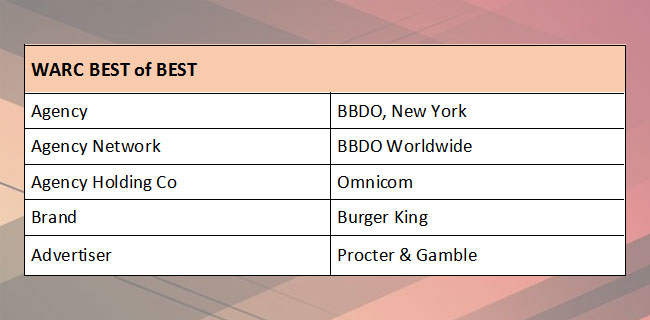
  • BBDO, Omnicom, Burger King & P&G top WARC ‘Best of the Best’

    By A Correspondent

    WARC has released the results of its first-ever ‘Best of the Best’ global index of excellence, to showcase the best all-round agencies and brands by aggregating results from across all three recently released WARC Rankings – Creative 100, Effective 100 and Media 100. No Indian agency or brand features in the Top 10.

    The WARC Rankings, successor to the Gunn Report and WARC 100, are annual rankings providing a global benchmark for campaign, agency, network, holding company, brand and advertisers’ success.

    The Best of the Best 2019 has been calculated by combining the 2018 results of the most prestigious and rigorous global and regional creative, effectiveness and media awards shows and competitions as determined by the industry following a worldwide survey and consultation.

    Said David Tiltman, Head of Content, WARC: “The culmination of the WARC Rankings is the newly launched ‘Best of the Best’. This identifies the best-performing companies across our three benchmarks of marketing excellence – creativity, effectiveness and media excellence.”

    BBDO New York and BBDO Worldwide are the best agency and network respectively across the WARC Rankings. BBDO New York performed strongly in both creativity and effectiveness, and its parent network, BBDO Worldwide, had a total of 59 offices contribute to its winning network total.

    Commenting on their success, Andrew Robertson, President and CEO, BBDO Worldwide, said: “‘The ‘Best of the Best.’ It literally can’t get better than that when it comes to public recognition of BBDO Worldwide. I am proud of, and grateful to, our clients and all of the people in our agencies who made this happen. Having four agencies from four regions all ranked in the Top Ten, including BBDO New York at No.1, demonstrates the breadth of talent in the network.”

    Omnicom Group tops the Best of the Best holding company ranking. BBDO Worldwide’s strong performance was supported by top 10 ranks for DDB Worldwide, PHD Worldwide and TBWA Worldwide.

    “It’s a proud moment to see Omnicom and its agencies topping the ‘Best of the Best’ list as the #1 network, #1 and #2 agency, and #1 holding company,” said John Wren, Chairman and CEO of Omnicom Group. “Employees across the globe come to work every day ready to deliver world-class services for our clients, and that shines through as they’re recognized by WARC for their creativity, marketing effectiveness and media excellence. Congratulations to all our people who can take great pride in these accomplishments.”

    Burger King tops the Best of the Best brands, with placings in the top 50 in all three rankings, and in first place in the Creative 100. The retail brand had 23 award-winning campaigns across all three rankings.

    Procter & Gamble topped the advertiser ranking by less than a point, as the two leading FMCG players continue to produce highly successful work, particularly in effectiveness and media. However, neither had a brand in the top 10. Instead, both had multiple successful brands throughout the depth of the rankings.

    The top companies in WARC’s Best of the Best 2019 are:

    The world’s top 10 agencies across the WARC Rankings

    RankAgencyLocationPoints
    1BBDONew York, USA489.8
    2adam&eveDDBLondon, UK466.7
    3McCannNew York, USA413.1
    4AMV BBDOLondon, UK410.8
    5MediaComLondon, UK390.8
    6Colenso BBDOAuckland, New Zealand351.8
    7LOLA MullenLoweMadrid, Spain343.1
    8McCannLondon, UK316.6
    9Host/HavasSydney, Australia288.3
    10AlmapBBDOSão Paulo, Brazil281.0

    The world’s top 10 agency networks across the WARC Rankings

    RankNetworkPoints
    1BBDO Worldwide3207.1
    2McCann Worldgroup2912.0
    3Ogilvy2006.7
    4DDB Worldwide1746.7
    5MediaCom1511.2
    6IPG Mediabrands1430.9
    7PHD Worldwide1395.2
    8TBWA Worldwide1315.0
    9Dentsu Aegis Network1298.2
    10Mindshare Worldwide1174.2

    The world’s top 10 agency holding companies across the WARC Rankings

    RankNetworkPoints
    1Omnicom Group8926.6
    2WPP8556.4
    3Interpublic Group5772.1
    4Publicis Groupe2714.6
    5Dentsu1398.5
    6Havas Group1151.5
    7Accenture260.3
    8Hakuhodo DY Group259.3
    9MDC Partners189.8
    10BlueFocus152.7

    The world’s top 10 brands across the WARC Rankings

    RankNetworkPoints
    1Burger King593.2
    2McDonald’s465.0
    3IKEA339.0
    4Coca-Cola327.9
    5Pedigree321.0
    6KFC299.6
    7Greenpeace260.4
    8Skittles260.3
    9Palau Legacy Project258.0
    10Nike257.8

    The world’s top 10 advertisers across the WARC Rankings

    RankNetworkPoints
    1Procter & Gamble969.8
    2Unilever969.1
    3Mars963.3
    4Restaurant Brands International593.2
    5Anheuser-Busch InBev567.6
    6Volkswagen Group553.8
    7McDonald’s573.5
    8The Coca-Cola Company469.5
    9Heineken382.3
    10PepsiCo347.3

    The Best of the Best ranking aggregates points across the three rankings. To ensure performance in each ranking has equal weight in the Best of the Best tables, a weighting for the effectiveness and media rankings has been calculated that inflates their scores versus the creative rankings. For this reason, points in the Best of the Best are not simply the total of the three individual rankings.

    An annual survey will be held to ensure that the WARC Rankings remain independent and the competitions tracked reflect the opinion of the industry.

  • FCB Ulka’s ‘Sindoor Khela’ is #9 in WARC’s Most Creatively Awarded list

    By A Correspondent


    WARC has released the results of the WARC Creative 100, an independent global index of creative excellence in advertising, and successor of the Gunn Report. The rankings feature the most awarded campaigns, agencies, networks, holding companies, brands, advertisers and countries, based on an analysis of the results of the most important global and regional creative awards shows in the world in 2018, as determined by the advertising industry.


    ‘Palau Pledge’ by Host/Havas Sydney, is the most creatively celebrated campaign of 2018. In order to tackle mass tourism, the Palau Legacy Project, a sustainable tourism body, created a visa policy for the island of Palau to protect the nation from environmental damage.


    Ranked second is ‘#Bloodnormal’ by AMV BBDO London for feminine hygiene brand Bodyform/Libresse. The campaign centred around an online video to break taboos by showing period blood in a positive light.


    In third place, ‘Project Revoice’ by BWM Dentsu, Sydney, for The ALS Association, a non-profit organisation tackling motor neurone disease, developed innovative technology which enabled ALS patients to speak again.


    BBDO agencies have had an impressive performance around the world with nine agencies ranked in the top 100, three of which are in the top 10. BBDO New York moves up from their second position last year in the Gunn Report, to be crowned best creative agency in the world. AMV BBDO London climb to second place having been ranked #20 last year and adam&eve DDB London follow closely in third position up from fourth.


    BBDO Worldwide heads the networks table for an impressive 13th consecutive year – 12 under Gunn Report and now under WARC Creative 100 – with 22 different offices contributing to their total. DDB Worldwide is in second place and McCann Worldgroup third.


    No changes to the top half of the Holding Companies league table compared to last year as Omnicom takes pole position followed by WPP in second and Interpublic Group in third.


    Global fast-food chain Burger King, having dropped to 7th position last year, has bounced back to take top place in the brands table for the very first time. Nike is down from first place to second, with Pedigree in third.


    Mars, the global manufacturer of confectionery, pet food, and other food products, is the most creative advertiser with campaigns for Pedigree, Skittles and Snickers ranked high.


    USA retains its place as the most creatively awarded country in the world by far. United Kingdom and Australia follow.


    The most highly ranked campaigns and companies in the WARC Creative 100 are:


    Top 10 world’s most creatively awarded campaigns 

    Rank Campaign title Brand Agency Points
    1 Palau Pledge Palau Legacy Project Host/Havas Sydney 250.3
    2 #Bloodnormal Bodyform/Libresse AMV BBDO London 199.5
    3 Project Revoice The ALS Association BWM Dentsu Sydney 189.5
    4 Exclusive the Rainbow case study Skittles DDB Chicago 175.6
    5 It’s a Tide Ad Tide Saatchi & Saatchi New York 154.8
    6 Scary Clown Night Burger King LOLA MullenLowe Madrid 154.4
    7 The Gene Project Marmite adam&eveDDB London 139.1
    8 The Talk Procter & Gamble BBDO New York 133.1
    9 No Conditions Apply – Sindoor Khela The Times of India FCB Ulka Mumbai 128.9
    10 Go With The Fake Diesel Publicis New York / Publicis Milan 125.9


    Top 10 world’s best creative agencies

    Rank Agency Location Points
    1 BBDO New York 403.2
    2 AMV BBDO London 295.9
    3 adam&eveDDB London 291.0
    4 LOLA MullenLowe Madrid 280.3
    5 McCann New York 258.6
    6 Host/Havas Sydney 204.9
    7 McCann London 193.6
    8 Colenso BBDO Auckland 190.9
    9 BWM Dentsu Sydney 189.5
    10 Saatchi & Saatchi New York 185.5


    Top 10 world’s best creative agency networks

    Rank Network Points
    1 BBDO Worldwide 1700.5
    2 DDB Worldwide 1028.7
    3 McCann Worldgroup 1027.9
    4 Ogilvy 991.0
    5 TBWA Worldwide 590.8
    6 MullenLowe Group 452.5
    7 Dentsu Aegis Network 392.0
    8 VMLY&R 365.5
    9 FCB 337.2
    10 Grey Group 336.0


    Top 10 world’s best creative holding companies

    Rank Holding company Points
    1 Omnicom Group 3494.1
    2 WPP 2206.1
    3 Interpublic Group 2009.7
    4 Publicis Groupe 832.9
    5 Dentsu 468.6
    6 Havas Group 314.4
    7 Hakuhodo DY Group 214.9
    8 Accenture 126.6
    9 MDC Partners 83.5
    10 BlueFocus 82.2


    Top 10 world’s best creative brands

    Rank Brand Product Category Points
    1 Burger King Retail 391.6
    2 Nike Clothing & Accessories 208.2
    3 Pedigree Household & Domestic 200.1
    4 Palau Legacy Project Non-profit, public sector & education 200.0
    5 Bodyform/Libresse Toiletries & Cosmetics 199.5
    6 IKEA Retail 198.7
    7 The ALS Association Non-profit, public sector & education 189.5
    8 Diesel Clothing & Accessories 177.7
    9 Skittles Food 177.6
    10 McDonald’s Retail 170.9


    Top 10 world’s best creative advertisers

    Rank Advertiser Location Points
    1 Mars USA 478.2
    2 Restaurant Brands International USA 391.6
    3 Procter & Gamble USA 306.9
    4 Nike USA 232.3
    5 Samsung South Korea 218.4
    6 Volkswagen Group Germany 218.2
    7 Unilever Netherlands 213.0
    8 Essity Sweden 204.0
    9 Palau Legacy Project Australia 200.0
    10 IKEA Sweden 198.7


    Top 10 world’s most creative countries


    Rank Country Points
    1 USA 2988.6
    2 United Kingdom 1241.8
    3 Australia 971.7
    4 Brazil 698.4
    5 Spain 687.6
    6 Germany 633.5
    7 India 405.3
    8 France 380.8
    9 South Africa 336.9
    10 Japan 320.1


    Said David Tiltman, Head of Content, WARC: “The WARC Creative 100 delivers an unbiased and transparent global benchmark for the industry, shining a light on the best creative and inspirational ideas from around the world and the companies behind them. We congratulate all those who have made it into these rankings.”


  • Marketing Trends for 2019


    By A Correspondent

    Warc has released its Marketer’s Toolkit 2019, an annual report outlining the priorities of, and challenges facing, brands in the year ahead and how to address them.

    The report centres on a global survey of more than 800 senior marketing and advertising professionals and dives into the implications of the challenges facing advertising from strategy, technology, and media perspectives.

    “The Toolkit reports of the last two years have been dominated by technology trends; 2019 feels different,” said David Tiltman, WARC’s Head of Content, adding: “It feels like a year of getting the fundamentals right, and using tech where necessary to achieve that end. Brands clearly view ‘experience’ as a form of competitive advantage – and the tech that can help them improve customer experience across channels is being prioritised.”


    Strategy:

    ‘Experience’ will drive the marketing agenda, and shape tech investment The global Marketer’s Toolkit survey and CMO interviews reveal that marketers see improved customer experience – both online and offline – as a key growth lever in addition to a route to strengthening trust in brands. Crucially, the disruption of several categories by direct-to-consumer brands comes up again and again as a concern.

    Almost two thirds (61%) of agencies and 52% of brands cited CX as the most important digital transformation for business in 2019. There is still some way to go, however, as just 15% of brands say their CX is aligned across channels.

    “Always go back to understand the customer,” said Uniqlo China’s CMO, Jalin Wu. “The customer is our need. We are not just presenting ourselves as apparel, we are presenting ourselves as a solution for people to have a better life.”


    Technology:

    Voice is piquing marketers’ interest increasingly, principally in terms of voice search. Just under a third (29%) of brands named voice as a priority for 2019, up 12 percentage points from last year. “Like most big marketers and advertisers, we’re looking at the role of voice and how we can continually make that user experience a whole lot better,” Tourism Australia CMO, Lisa Ronson told WARC.

    In response to the rise of e-commerce, there is also growing interest in payment technology, as more and more brands look to sell more online.

    One of the biggest shifts observed in the report concerns Augmented and Virtual Reality. Just 23% of marketers named the channels as a strategic priority for the year: a drop of 13 percentage points compared to last year’s report.


    Media:

    The overwhelming majority of marketers (79%) expect to increase their online video budgets. Elsewhere search and mobile advertising expect to see continued investment. It is thought that Facebook’s Instagram and Alphabet’s YouTube stand to benefit from this interest. Snapchat meanwhile is expected to see cooling interest from marketers.

    A key winner of the new media landscape is the e-commerce (and soon to be advertising) giant Amazon, toward which 69% of marketers expect to funnel increased spend.


  • WARC’s Future of Strategy


    By A Correspondent


    WARC, the advertising and media effectiveness specialist, has released the results of its recent worldwide survey of senior strategists, highlighting their challenges and the impact the strategic function is having on the ever-changing marketing landscape.

    Based on a survey of more than 500 senior planners and strategists from around the world,WARC’s second The Future of Strategy report provides both quantitative and qualitative data on the current state and future expectations of the industry. Key findings are:


    Strategy teams set to expand as influence grows

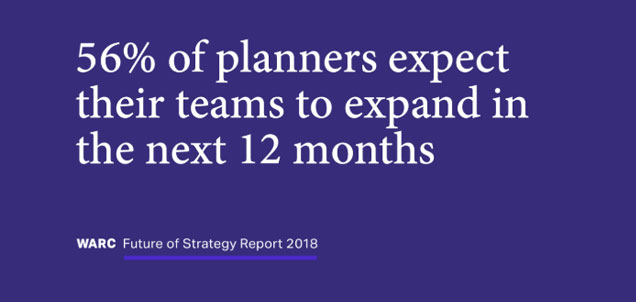
    More than half of strategists and planners expect their teams to grow over the next year, in an era when most feel that the influence of planning is growing both within their agency and among clients. Despite this optimism, there is a feeling that planners’ skills are not always being applied most effectively, commonly attributed to the pace of change in the industry, and a client focus on tech rather than sustainable strategy.

    Shekhar Deshpande, Global Planning Director & Strategy Consulting Director, J Walter Thompson, comments: “Senior clients want more strategy, perhaps to help them navigate the current marketing labyrinth, and become better marketers.”
    Budget cuts are threatening the ‘craft skills’ of strategy

    Budget pressures are a clear obstacle for planners and strategists globally. The majority of respondents in all regions say client-side budget cuts are having an impact on strategy teams. This is leading to more short-term thinking by clients. Within agencies, it means lower budgets and planners who no longer feel able to spend time away from their desks.

    Rob Campbell, Chief Strategy Officer, Deutsch, observes: “Fewer and fewer planners spend much time in the real world, preferring to observe it from the comfort of a research report and Google search.”
    Competition for strategic services is growing

    Marketing strategy is no longer just an agency specialism; increasingly strategy is being offered by consultancies, by tech and media firms, or by in-house client teams. That means greater competition for agency planning teams; but it may also mean more varied career opportunities for individual planners.

    Dan Burdett, Chief Marketing Innovation, Officer, EMEA, eBay, raises the question: “In a world where everybody is in some way competing with the guys in Seattle, how do we form coalitions that are going to benefit all of our businesses and help drive the industry forward?”
    Upstream vs downstream remains a crucial divide

    There is a tension between where planners want to be playing – on upstream business problems – and the reality of their day-to-day roles, with, in many cases, limited access to client data and heightened focus on tactical campaign elements. Reflecting the different visions of strategy in the industry and the potential need for reinvention in marketing services, several respondents argue that a link between strategy and execution remains vital.

    Paula Bloodworth, Brand Strategy Director, Wieden + Kennedy, London, comments: “With consumers moving and changing so quickly, we should be more executional in the way we plan and be nimble and flexible and adaptive.”

    Summing, David Tiltman, Head of Content, WARC, says: “WARC’s 2018 Future of Strategy report reveals a discipline in flux. There is generally a feeling of optimism – of greater influence and growing teams. But that is undermined by the impact of client budget cuts and, more broadly, a sense that the planners and strategists are not thriving as they might in current agency structures, at a time when competition for strategic services is growing.”

    A preview of the Future of Strategy report was unveiled during WARC Day at this year’s Cannes Lions International Festival of Creativity in June, with insights shared by senior global strategists. View the highlights video here.

    A sample of the report is available to download here and a free-to- join webinar discussing the findings of The Future of Strategy report will take place mid-August. The full report, including additional data, analysis and exclusive commentaries from senior survey participants, is available to WARC subscribers on warc.com.

  • Why Brands want a ‘Swachh’ Digital Media


    By A Correspondent


    Digital transparency will be a key challenge for brands in the year ahead concludes WARC, the global marketing intelligence service, in its Toolkit 2018 – a report based on a survey of more than 600 marketing and advertising professionals around the world to obtain their outlook on the coming year. The findings are combined with the latest ideas, research and expert opinion from WARC.


    Led by P&G, brands are putting pressure on the digital media ecosystem to reform and to embrace greater transparency.Issues include the billions of dollars being lost globally to ad fraud; the absence of industry-wide viewability standards; the shortage of impartial, third-party campaign measurement and verification; the rising use of ad-blocking software; and a lack of transparency in the media supply chain.


    Said David Tiltman, Head of Content, WARC: “2018 will be pivotal to the ongoing drive by brands, media owners and the ad tech industry to ‘clean up’ and address the challenges facing digital advertising– viewability, brand safety, measurement, transparency – as they reassert control over media contracts, investments and partnerships, to ensure they are maximising ROI.”


    Added Julia Connaughton, Head of Digital, the 7stars: “With advertisers demanding increased transparency, and agencies and publishers united in a fight against ad fraud, we are entering a period of transition that will have a lasting impact on the future of our industry.”


    Key findings around digital transparency from the Toolkit 2018 survey reveal that:

    :: Both agency (45%) and brand (49%) respondents cited viewability and accurate measurement as the number one industry issue offering cause for concern when drawing up marketing plans for the coming 12 months.

    :: 30% of respondents expect digital spend to be cut if these issues are not resolved.

    :: 51% of brands believe there is now a crisis of trust between brands and media agencies.


    The drive for digital transparency is one of five key challenges highlighted in Toolkit 2018, which also includes a guide to best practice, potential pitfalls and video interviews with industry leaders to help overcome the issues.


    For more information and insights on Toolkit 2018, visit https://www.warc.com/Topics/Toolkit.topic


    PS:

    Interestingly, one of the responses to the survey notes that the “explosive 2016 investigation into rebates and agency contracts by the ANA (Association for National Advertisers) in the US will continue to have ramifications for the media industry in 2018.” Also: “Over half (51%) of brand respondents agree that there remains a crisis of trust between clients and media agencies. This opinion is shared by agency-side colleagues: 52% of those working at media agencies agreed with the statement, as did 57% of respondents from creative agencies.” Enough reason to download the toolkit for more?!


  • How & Why Social Video can turn marketers into broadcasters


    Social video, which involves the dissemination of content in audio-visual format across social media platforms and applications, is experiencing massive growth as a content marketing format, and is expected to continue in 2017. Video is transforming social media marketing and turning social platforms into broadcast media, according to Warc, the global marketing intelligence service. Social video is one of six key trends featured in Warc’s Toolkit 2017. The annual report, produced in association with Deloitte Digital, brings together the best of Warc’s content over the past year – the latest ideas, research and examples. With social media sites now offering a wide range of (paid-for) options for posting and distributing video, brands are finding success with approaches that prioritise quality over quantity, consider emotional and social motivations for content engagement, and focus on a three-second window of opportunity to grab a viewer’s attention. “We’re seeing a growing number of brands experimenting with live video on platforms such as Twitter’s Periscope and Facebook Live and this format tends to work best for content that is exclusive, newsworthy or that requires live audience involvement,” comments David Tiltman, Warc’s Head of Content. “But a major challenge in 2017 will be video measurement.”


    Key insights identified on how video is transforming social are:

    1. Social video will see rapid growth in 2017:
    The signs are that marketers plan to increase the amount they spend on social video advertising, with mobile the major driver of investment and the biggest growth area for video. One Forrester report predicted that worldwide advertising spend on mobile video would grow at a 28% CAGR in the next five years.


    2. Live video is an untapped opportunity for exclusive or interactive content:

    Live video remains an emerging format, but a wide-range of brands are experimenting with it. Early signs show that sharing and comment rates on live video are higher than for standard video. The main decision is considering which opportunities are right for live video. The guiding principles appear to be whether the video will be exclusive or newsworthy enough to attract a live audience, or whether it requires a level of interaction with viewers.


    3. Facebook leads in the ‘broadcast’ model of social:
    The rise of a ‘broadcast’ approach to social media means brands are choosing which platforms will best reach their chosen audience, rather than attempting to entice shares and engagement across all social channels. Facebook is the lead platform when it comes to social media audience reach and popularity, however, platforms such as Snapchat and Twitter offer targeting and formats that may suit certain campaigns.


    4. Sharing rates remain a useful measure of engagement:
    As brands invest in paid distribution of social video, sharing has become less important as a means of generating reach. However sharing remains a useful indicator of engagement with a video. As social video continues to grow and mature, marketers are advised to focus on the fundamental motivations behind the sharing of content on social media in order for it to be as effective as possible.


    5. Brands are advised to make fewer, better posts:
    As the amount of video content on social sites increases, it is becoming harder to gain consumer attention. Some brands that have been experimenting with social video have concluded that quality (high production values) is preferable to quantity (multiple different videos).


    6. Social video has a small timeframe to engage; brands must work ‘with the skip’:
    Brands should look at both the content and context of video consumption. A Millward Brown report concludes that audiences prefer the inclusion of functional aspects that give them control, such as the ability to skip content and click-to-play options. Branded videos that are not advertising also appeal, such as tutorial and review videos, hence brands should consider broadening their strategy beyond paid online video.


    7. On mobile, the 30-second ad is becoming the 3-second ad:
    Brands may have only three to five seconds to grab a mobile social media user’s attention. Advertisers should remember that online video is often watched with the sound turned off, so content should make sense to the viewer without sound, and possibly include captions or entice people to turn on the sound.


    8. Social video metrics should be studied carefully:
    In September 2016 Facebook admitted to significantly overestimating average viewing times over the last two years. The revelation was significant as such metrics are a factor in marketers and media agencies allocating digital budgets. It highlighted the lack of third-party verification on social sites – and this is likely to be an ongoing theme in 2017.


    9. Influencer-focused video is effective as a complement to traditional approaches:
    Online influencers, including ‘vloggers’, have become a focus of advertiser interest. Brands can appear more appealing and enjoyable in a vlogger setting, even if they are limited in reach. Vloggers add credibility, displaying the brand in a new way that’s believable and more relevant than advertising. Vloggers are best for enhancing above-the-line communications, and at presenting the brand in a new way. Critically, they are an addition to, rather than a replacement for, traditional channels.