Tag: David Haigh

  • India moves up in Brand Finance’s Nation Brands ranking

    By A Correspondent


    India has jumped to seventh position in the Brand Finance Nation Brands 2019 ranking, up from ninth last year, after recording a 19 per cent growth in brand value to US$2.6 trillion, according to the latest report by Brand Finance, a leading independent brand valuation consultancy.


    Other movers in the top 10 include: Japan and UK swapping places; Canada, dropping from 7th to 8th (down 2 per cent to US$2.2 trillion); Italy falling from 8th to 10th (down 5 per cent to US$2.1 trillion); and South Korea, which has inched up one place from 10th to 9th (up 7 per cent to US$2.1 trillion).


    Looking beyond the top 10, the average year-on-year nation brand value growth among the developing economies stands at 13.9 per cent, compared to as little as 0.4 per cent for the developed economies included in the annual study into the world’s 100 most valuable nation brands. This means that – on average – the nation brands of developing economies have been growing at a pace 31.3 times faster than the developed ones.


    Said David Haigh, CEO of Brand Finance: “With the Western world seeing a real crisis of leadership on both sides of the Atlantic, the developing world is catching up. Bolder, more agile, increasingly innovative African, Middle Eastern, Asian, and Latin American nation brands are racing ahead at breakneck speed, poised for further growth in the years to come.”


    Although catching up, at US$37.8 trillion – the combined nation brand value of the 65 developing economies in the study remains far behind that of the 35 developed economies – which sits at US$60.3 trillion. Topping the ranking again this year, the nation brand value of the United States alone stands at US$27.8 trillion.


    Claiming second position, China continues to grow at a very healthy rate, recording an impressive 40 per cent increase in brand value to US$19.5 trillion. Building on its solid performance in previous years, China is closing the gap behind long-standing leader the US, which has recorded a brand value growth of just 7 per cent over the past year. The difference in value between the two nation brands has dropped from US$12 trillion last year to just over US$8 trillion in 2019.


    David Haigh, CEO of Brand Finance, commented: “China is undergoing a meteoric rise on the global stage, rivalling the traditional nation brand powerhouses in the West. Despite economic and political challenges, China’s nation brand value has grown by 40 per cent, consistently outpacing the US and other major economies.”


  • The Great Digital Displace


    By A Correspondent


    Digital streaming brands have turned the latest industry ranking by Brand Finance, the world’s leading independent brand valuation consultancy, on its head. Testament to their power to disrupt status quo, digital platforms have claimed five out of 25 spots in the league table, with two brands – YouTube and Netflix – jumping straight onto the podium behind Disney – the industry’s unchallenged leader. As a result of the rise in popularity of on-demand streaming, enjoyed by viewers who no longer need to rely on fixed cable television schedules, most traditional network and studios brands have felt the pinch, sliding down the ranks.


    Online heavyweights YouTube and Netflix have claimed second and third position in the ranking respectively. The last year has seen YouTube’s brand value swell to US$37.9 billion, up 46% from 2018. Meanwhile, Netflix more than doubled its brand valuation reaching US$21.2 billion this year, with its record 105% growth unmatched by any other Western media brand. Alibaba’s Youku (11th) and Baidu’s iQiyi (17th) as well as the Swedish audio-streaming app – Spotify (20th) – have also joined the Brand Finance Media 25 ranking for the first time.


    Competition from online providers has had a marked effect on traditional broadcasting outlets, as one in two of the ranking’s incumbents have either lost brand value or seen meagre growth in the past year. The digital revolution has taken its toll on both sides of the Atlantic, with UK-based BBC (brand value down 9%), Sky (up 2%), and ITV (up 5%), as well as ABC (down 41%), Fox (down 6%), and NBC (down 3%) in the US struggling with the challenge posed by new players in the sector.


    Commented David Haigh, CEO of Brand Finance: “Digital streaming platforms have revolutionised home entertainment, as they are better able to adapt to the needs of modern consumers seeking on-demand and advertising-free content. As customer preferences evolve at a faster pace than ever, the new platforms will need to continue to build relationships with consumers to stay ahead of the curve”.


    Disney’s dreams come true: Unchallenged by newcomers, Disney maintains its position as the world’s most valuable media brand, following an impressive 40% rise in brand value to US$45.8 billion.


    Over the last year, Disney has undertaken several strategic acquisitions in a bid to stay ahead of its competitors. Disney’s acquisition of Star India was an integral move to gain a foothold in the Subcontinent, which is currently the second-largest subscription TV market in Asia. The brand, which already owns a 60% stake in Hulu, is due to take full control of the service imminently, further demonstrating Disney’s pursuit of greater international exposure and dominance within the sector.


    In March 2019, Disney acquired 21st Century Fox for an eye-watering US$71 billion, in preparation for the launch of its own streaming service, Disney+, later this year. Disney now holds the rights to Deadpool and the Fox-owned Marvel characters, to add to its ownership of Pixar’s intellectual property and the Star Wars franchise.


    These purchases have placed Disney in a strong position within the digital streaming media landscape. At US$7 a month, its Disney+ subscription fee is going to be half the price of HBO Now and cheaper than Netflix, which raised its fee by US$2 in January 2019. These factors are set to place the brand as Netflix’s strongest competitor even before the official launch of Disney+.


    US brands dominate ranking: US brands account for 9 out of the top 10 and claim an impressive 18 spots in the Brand Finance Media 25 2019 ranking. Traditionally reliant on the Hollywood powerhouse and the reach of the network giants, the US is now staying ahead of the game thanks to digital players from Silicon Valley.

    However, the nature of the technology behind the digital disruption of the media market makes it easier for brands from other countries to break into the market. As the examples of Youku and iQiyi demonstrate, Chinese media brands may give the US monopoly a run for its money in the coming years. A further challenge can come from European start-ups such as Spotify.


    iQiyi is fastest-growing: With a whopping brand value growth of 326% to US$4.3 billion, iQiyiis not only the fastest-growing brand in the media sector, but across all categories in the Brand Finance Global 500 2019 report. As China’s answer to Netflix, iQiyi hosts over 500 million monthly active users. Recent reports of the brand setting its sights on China’s US$9 billion box office, suggests further rapid expansion over the next year.


    Disney-owned ESPN is strongest: Aside from calculating overall brand value, Brand Finance also determines the relative strength of brands through a balanced scorecard of metrics evaluating marketing investment, stakeholder equity, and business performance. Alongside revenue forecasts, brand strength is a crucial driver of brand value. According to these criteria, Disney-owned sports channel ESPN is the world’s strongest media brand with a Brand Strength Index (BSI) score of 88.9 out of 100 and a corresponding AAA brand strength rating.

    Following some instability over the past couple of years, resulting in the brand’s previous President, John Skipper’s, resignation, ESPN’s strength on the global media landscape has once again resurged. The appointment of new President, Jimmy Pitaro, in March 2018 was a clear sign of the brand’s intent to modernise and marked a shift in its operations. Most notably, the brand launched ESPN+, its streaming service, which hit the one million subscribers mark in under six months. More recently, the network has partnered with the National Women’s Soccer League for the FIFA Women’s World Cup, streaming 14 games live on the ESPN app, exposing the network to 25.4 million domestic viewers.


  • Brandwatch: Tata India’s Most Valuable, HDFC, the strongest


    By A Correspondent


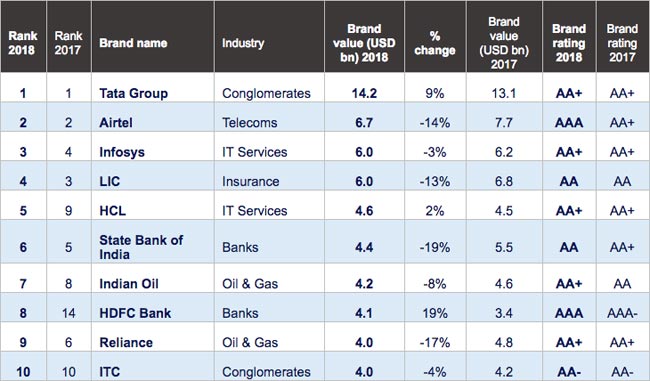
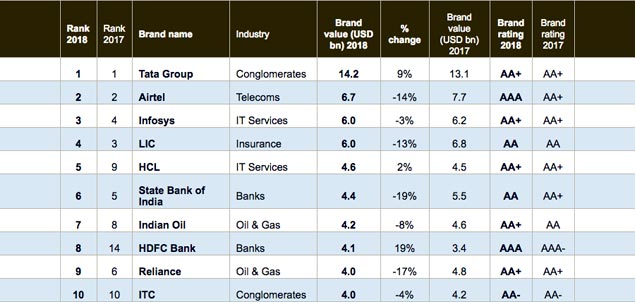
    Tata Group is by far the most valuable brand in India, with a value surpassing that of the second (Airtel) and third (Infosys) ranked brands combined, according to the latest report by Brand Finance, the world’s leading independent brand valuation and strategy consultancy.


    After a few years of below 5% growth in brand value, Tata Group has surged ahead with a 9% growth to US$14.2 billion consolidating its No.1 rank by a huge distance. Considering Tata has been way ahead of the rest at $13.1 billion in 2017, this 9% is a tremendous surge, reflecting a solid year. The US$1 billion increase is the result of much tactical streamlining, refocusing and re-energising of Tata’s key businesses TCS, Tata Motors, Tata Steel and Tata Chemicals.


    Said David Haigh, CEO of Brand Finance: “Under the pragmatic leadership of chairman Natarajan Chandrasekaran, Tata Group is pursuing a consolidated long-term strategy as it ushers in a new era. Chandrasekaran has reviewed the Group’s most senior positions, introduced an experienced team of former bankers tasked with overseeing group finance’s and made tactical leadership changes across the financial services and hotel brands. This year’s success can truly be attributed to a productive first year in office for the new chairman.”


    India’s 10 Most Valuable Brands


    HDFC Bank takes title of India’s strongest brand

    A similar surge is observed in HDFC Bank which has broken into the top 10 this year, following a 19% brand value growth and claiming 8th rank among India’s most valuable brands with a US$4.1 billion valuation. Over the past year, HDFC Bank has grown steadily, making small and sensible acquisitions whilst maintaining its focus on digital banking. The bank has cleverly attracted young customers who want to buy, pay and invest at the click of a button, directly through their cellphones, even offering preapproved personal loans that can be expended within seconds. HDFC Bank is clearly proving its resilience and growth in the face of banking scrutiny and headwinds sweeping the sector.


    Aside from measuring the overall brand value, Brand Finance also evaluates the relative strength of brands, based on factors such as marketing investment, customer familiarity, staff satisfaction, and corporate reputation. Along with the level of revenues, brand strength is a crucial driver of brand value. According to these criteria, HDFC Bank is India’s strongest brand this year with a Brand Strength Index (BSI) score of 88.0 and a corresponding brand rating of AAA.


    And Kotak Mahindra Bank is India’s fastest-growing brand

    Another banking brand which has had a successful year is Kotak Mahindra Bank, (up 74% to US$2.1 billion), making it the fastest-growing brand in the Brand Finance India 100 2018. The brand has not only expanded its countrywide presence but also shown tremendous discipline in shaping its governance and customer experience. It has also recently strategically partnered with Ripple, to provide near-instant cross-border remittances using blockchain technology.


    Public-sector banking brands take a dent

    On the whole, India’s public-sector banking brands have taken a big dent in both their brand value ranks and growth, whilst the country faces its worse crisis of confidence across the banking sector. Most of the top 100 PSU banks have seen a decline in brand value growth: SBI at 19%, IDBI Bank at 30%, Punjab National Bank at 16%, Syndicate Bank at 9%, Central Bank of India at 21%, and Bank of Baroda at 14%.


    Addd Haigh: “In a year of non-performing assets hitting the major banks, with further tightening of India’s financial sector alongside market uncertainties, the towering strength of strong governance is now more important than ever. The year ahead will be a test for brands navigating their way through the changing governance landscape.”


    Telecoms dial down brand values

    There are huge changes afoot across the telecoms sector too, courtesy of Reliance Group’s disruptive operator Jio, triggering a drop in brand value of Airtel (down 14% to US$6.7 billion), Idea Cellular (down 15% to US$1.7 billion) and BSNL (down 23% to US$ 0.5 billion).


    The Indian mobile ecosystem has witnessed incredible growth in recent years, with package offerings and cut-price plans expanding, and 4G becoming more popular in a bid to satisfy the needs of a mobile-data-hungry population.


    Brands to watch

    From among other notable brands featuring in this year’s Brand Finance India 100 league table, Maruti Suzuki has zoomed ahead with a 26% brand value growth to US$3.2 billion over the past year, jumping from 17th to 13th spot in the ranking. It has certainly been a year of many successes for Maruti Suzuki where it has redefined its brand standards, maintained growth of Nexa, its alternative retail dealership format for premium cars, alongside a plethora of product offerings that charmed the market.


    In this year’s Brand Finance India 100 2018, it is evident that brands with strong fundamentals have stood to gain significantly: Bajaj Group (up 30% to US$2.4 billion, ranked 19th), Bharat Petroleum (up 21% to US$2.4 billion, ranked 20th), Yes Bank (up 21% to US$0.7 billion, ranked 36th), and TVS (up 19% to US$0.5 billion, ranked 53rd).


    Finally, there is one brand that has been consistently making its presence felt in the rankings over the last 3 years. The motorcycle manufacturing brand Royal Enfield is gradually taking the “Made in India” tag to a global scale, and it has again registered a 25% brand value growth this year, making it one of the steadiest-growing brands in India. With a brand value of US$0.6 billion it moved up from 59th in 2017 to 43rd this year.


    View the full Brand Finance India 100 2018 report here

  • TCS ranked as the fastest growing IT services brand in 2018

    By A Correspondent


    TCS has been named as the fastest growing IT services brand in the world in an assessment done by Brand Finance.


    According to Brand Finance IT Services 15 annual report for 2018, TCS now has a total brand value of US $10.391 billion – a growth of 14.4 per cent from last year’s total of $9.081 billion, with an increase of $1.309 billion. The new value is the fastest incremental growth of all companies in the industry, and places TCS in the top three most valuable brands in the global IT services sector along with IBM and Accenture.


    Brand Finance’s annual report analyses the brand value and brand strength of the 5000 largest brands across 38 sectors in the world in order to arrive at a list of the World’s most valuable brands. Brand Strength is derived by benchmarking brand related measures against competitors. Brand Strength is used to determine an appropriate stream of forecasted brand royalties, which is discounted to a net present value, the Brand Value.


    “Last year TCS achieved a significant milestone, being ranked as one of the world’s top three IT services brands for the first time ever,” said David Haigh, CEO at Brand Finance. “This year, the company has consolidated that position even further by adding more than $1.3 billion to its value, which is a huge achievement for the company and its new CEO, who completes his first year in office this month. TCS’ forward-thinking approach to digital technologies, its growing brand presence in its key markets, paired with its core values of customer service, employee development and re-skilling has seen its brand value grow exponentially – so much so that it’s now the fastest growing brand in the IT services industry.”


    Said Rajesh Gopinathan, CEO and Managing Director, Tata Consultancy Services: “The growth we have demonstrated on brand leadership is a testament to our steadfast commitment to our clients, our people, and the communities we work in. The innermost core of our company values has always been our resolute focus on our clients and their success. We look forward to using the vast contextual knowledge we have built to further benefit our clients in their transformation journeys towards Business 4.0. As we refocus our company towards the new opportunities in the Business 4.0 era and mark the 50thyear of the founding of TCS, I am certain that each one of our 390,000 employees worldwide will take great pride in TCS’ brand leadership within the industry.”


  • Tata is still India’s Most Trusted


    By A Correspondent


    Every year, leading valuation and strategy consultancy Brand Finance values the brands of thousands of the world’s biggest companies. MxMIndia has carried a few of these rankings in the past. And now there is: India’s 100 most valuable brands as featured in the Brand Finance India 100.View the full list of India’s 100 most valuable brands here


    Here’s a summary from Brand Finance:

    A brand’s strength is assessed (based on factors such as marketing investment, familiarity, preference, sustainability and margins) to determine what proportion of a business’s revenue is contributed by the brand. This proportion is projected into perpetuity and discounted to determine the brand’s value.


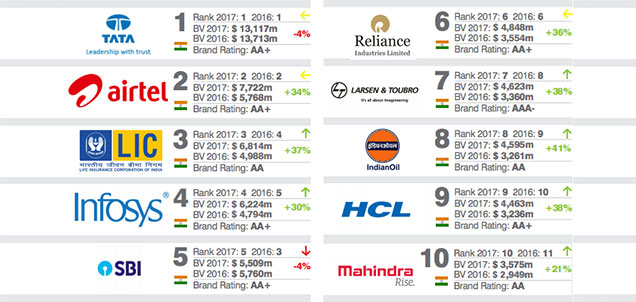
    Strong brand value growth characterises the 2017 Brand Finance India 100. The total value of India’s top brands has increased 15% this year, ahead of the global average of 11%. 68 of India’s 100 most valuable brands have grown in value this year, with 54 of those enjoying double-digit year-to-year percentage growth. There are however some notable exceptions, including India’s most valuable brand, Tata, which fell to US$13.1 billion from last year’s US$13.7 billion.


    There has already been intense speculation as to whether brand value has fallen due to Tata’s boardroom drama. In Brand Finance’s view this is emphatically not the case. Tata’s Brand Strength Index score in fact improved significantly this year and its brand rating was upgraded from A+ to AA+. Corrective action has been taken quickly and the stakeholders at large have not been significantly affected.


    Brand Finance’s CEO David Haigh comments, “The brand value drop of 4% is clearly not positive, however it is a lesser decline than between 2015 and 2016, when brand value fell 11%. Tata is present in a number of industries in which operating conditions are very challenging for all participants. In this context the slight decline can be seen as a stabilisation in challenging times. As Tata’s new chairman, Natarajan Chandrasekaran, settles in and attempts to streamline the conglomerate’s activities, we expect Tata to return to brand value growth soon.”


    IT services brands continue to be one of India’s great success stories, dominating not just the national rankings but the international rankings of their sector too. All of India’s major IT services brands have grown in value this year, including TCS within the overall Tata portfolio. Even as other Indian brands perform strongly, IT services brands are managing to improve their national ranks. Infosys is up from 5th to 4th, HCL from 10th to 9th and Wipro from 12th to 11th.


    The biggest improvement in rankings however comes from Indigo Airlines which is up from 95th last year to 62nd now. India’s biggest airline recently announced the addition of 35 new routes and increasing frequency on existing ones.


    At the opposite end of the scale, the iconic Taj Hotels brand has fallen 14 places to 93rd with brand value dropping below US$300 million. Like so many other hotel brands it has been hit by the impact of technology, with aggregator sites creating pricing pressure and Airbnb introducing competition.


    This year’s fastest falling brand is Micromax. The tech firm has lost 39% of its brand value and nearly fallen out of the Top 100, placing 95th. Micromax is struggling to compete following the influx of strong Chinese mobile brands such as Oppo and Vivo into the Indian market in the last couple of years.


    ITC is India’s most powerful brand. It is India’s only AAA rated brand, with a Brand Strength Index score of 86.  ITC has been expanding its strategic presence, beyond tobacco, for over a decade. In the last four to five years it has become a formidable competitor in the food and beverage, personal care, apparel and stationery sectors, challenging incumbents that have dominated those industries for over a century. This broad spectrum of excellence is making ITC a household name across India and contributing to the brand’s strength.


    Mahindra, a stalwart of Indian enterprise has re-entered the top ten this year, after posting healthy growth in its flagship automotive division and strengthening its presence in SAARC countries. Mahindra’s agricultural division and its tractors business are well-established strengths while more recent initiatives such as crop-care solutions, seed distribution and power solutions through Mahindra Powerol are poised to accelerate growth. This year brand value is up 21% to US$3.6 billion.


  • Apple, Ferrari top world’s brand list


    By A Correspondent


    Ferrari is the world’s most powerful brand. Apple is the world’s most valuable brand. And Tata is the most valuable Indian brand.


    These are the headlines from the Brand Finance Global 500 released on Tuesday, the much-awaited annual study conducted by leading brand valuation consultancy, Brand Finance. The world’s biggest brands are put to the test and evaluated to determine which are the most powerful and most valuable.


    Ferrari is the world’s most powerful brand. The legendary Italian carmaker scores highly on a wide variety of measures on Brand Finance’s Brand Strength Index, from desirability, loyalty and consumer sentiment to visual identity, online presence and employee satisfaction. Ferrari is one of only eleven brands (including Google, Hermès, Coca-Cola, Disney, Rolex and F1 racing rivals Red Bull) to be awarded an AAA+ brand rating and has the highest overall score.


    Said Brand Finance Chief Executive David Haigh: “The prancing horse on a yellow badge is instantly recognizable the world over, even where paved roads have yet to reach. In its home country and among its many admirers worldwide Ferrari inspires more than just brand loyalty, more of a cultish, even quasi-religious devotion, its brand power is indisputable.”


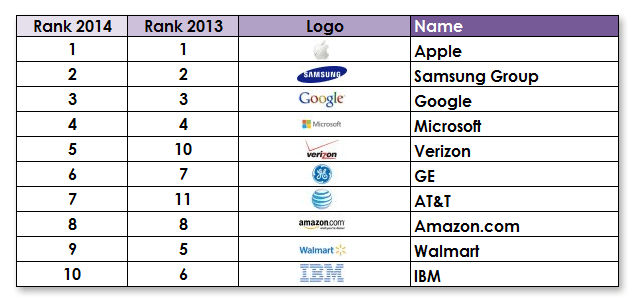
    Though Ferrari is the world’s most powerful brand, being a niche, luxury brand with an officially capped production, it is perhaps unsurprising that it is some way off being the world’s most valuable. Its US$4 billion brand value puts it 350th in brand value terms. Mr Haigh added: “Apple also has a powerful brand, rated AAA by Brand Finance. However what sets it apart is its ability to monetize that brand. For example, though tablets were in use before the iPad, it was the application of the Apple brand to the concept that captured the public imagination and allowed it to take off as a commercial reality.” This is just one of the factors responsible for its US$105 billion brand value; it is the world’s most valuable brand for the third year in a row.


    According to a communiqué: Apple’s dominance is being challenged by Samsung however. The Korean giant’s improving reputation for reliability, a faster pace of innovation and wider range of devices are among many factors that have seen its brand value increase by US$20 billion to US$79 billion this year. Other tech successes include Netflix, which has nearly doubled its brand value to appear in the Brand Finance Global 500 for the first time. Its value has grown 93% in a year to US$3.2 billion, to make Netflix the 468th most valuable brand. Still operating only in the Americas, Scandinavia and the British Isles, there is huge potential for further growth. Facebook meanwhile has recovered from its problematic IPO, which saw its reputation suffer and its brand value plunge in 2013. This year it has rebounded, adding 76% to its brand value to bring the total to US$9.8 billion, putting it 122nd. Investor confidence in its long term prospects has returned as revenues from mobile advertising have grown.


    Tech brands in general have tightened their grip on the Brand Finance Global 500. Walmart is the only non-tech brand remaining in the top 10. Once the world’s most valuable brand, it now sits in 9th having been overtaken by Amazon. The usurpation of the world’s biggest retail brand by the biggest online retailer represents yet another coup for tech brands over ‘real-world’ businesses.


    US brands continue to dominate the Brand Finance’s list, occupying 185 brands of the 500 spots. Japan is second. Despite 7 Japanese brands having dropped out of the table, the total for the country as a whole is up thanks to brand value increases of over 30% from Japan’s three biggest brands; Toyota, Mitsubishi and Honda. President Shinzo Abe’s ‘Abenomics’ programme has begun to pay off and global demand for Japanese goods is improving. Germany, France and the UK complete the top 5. Despite China’s status as the world’s second biggest economy, it is 6th in terms of total brand value as its brands are still developing. Huawei and Baidu have both increased their brand values by over 50%. While controversial for their close associations with the Chinese government, both are likely to exert increasing influence around the world in the next few years.


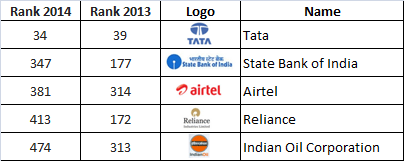
    Nations that have not fared so well include Finland. The country’s only brand, Nokia, has finally been squeezed out of the table after years of slow decline. Nokia has continued to hemorrhage brand value as a result of its inability to effectively counter the challenge Apple and Samsung. Falling out of the Brand Finance Global 500, it follows Blackberry, which dropped out of the top 500 last year. The BRIC nations of Russia, India and in particular Brazil have also fared relatively poorly. The number of Brazilian brands in the table is down from 9 to 5 and those that remain have all lost over 20% of their brand value. One Indian brand has dropped out of the table and several of those that remain have fallen further down the rankings. Tata, India’s flagship brand is the exception however, climbing to 34th worldwide with a brand value of US$21.1 billion.