 By Kavita Lakhani
Governments can’t do enough – they need business to step in. Business can’t step in unless stakeholders see value. As tolerance for corporate malfeasance has dropped, expectations of good corporate behaviour have risen. There has been an increasingly louder voice from the public urging corporations and businesses to fulfill social responsibilities while making legitimate profit.
As a result, authenticity and transparency have become vital for all companies. Adding a social dimension to the value proposition offers a new frontier in competitive positioning. If, corporations were to analyze their prospects for social responsibility using the same frameworks that guide their core business choices, they would discover that Corporate Social Responsibility (CSR) can be much more than a cost, a constraint, or a charitable deed – it can be a source of opportunity, innovation, and competitive advantage.
Â
Do the Right Thing
One of the best ways to win hearts and minds is to do good. However CSR is about more than philanthropy – albeit that’s an important element. CSR is about being a responsible business. It’s about issues like good corporate governance, marketplace transparency, respect for staff, community involvement and reducing environmental impact. Corporates the world over have begun to take their corporate social responsibilities seriously. 64% of the Fortune 500 companies publish CSR reports as part of their annual reports, and 52% publish separate CSR reports. Many companies now include social and environmental commitments in their core mission statements. A growing number are also adopting ‘triple bottom line reporting’ in which social and environmental results are measured and reported next to financial results.
 In India, the Tatas and the Birlas have had a long and distinguished tradition in the area of CSR. As across the world, in India too, the culture of CSR is spreading for various reasons but probably not at the desired rapidity.
Not just acceptable but desirable?
In a survey conducted by Lowe Lintas (in association with MSN India and Cross Tab) earlier this year, an overwhelming 93% of respondents say businesses should bear responsibility towards society when making legitimate profit and 69% of respondents are ready to exert their influence through consumption habits and to pick products that are made by companies with agreeable CSR initiatives. Interestingly 56% respondents say that supporting brands that undertake socially responsible activities is as good as doing socially responsible activities themselves!
Choosing which social issues to address
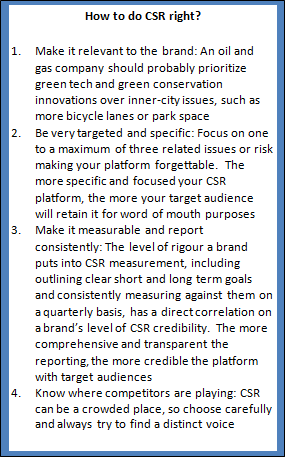
Gandhiji said, “We must become the change we want to see in the world.” No business can solve all of society’s problems or bear the cost of doing so. Instead, each company must select issues that intersect with its particular business. Other social agendas are best left to those companies in other industries, NGOs, or government institutions that are better positioned to address them.
There is nothing authentic about merely writing a cheque. The essential test that should guide CSR is not whether a cause is worthy but whether it presents an opportunity to create shared value – that is, a meaningful benefit for society that is also valuable to the business. Supporting a dance company may be a generic social issue for a utility like Tata Power but an important part of the competitive context f or a corporation like American Express, which depends on the high end entertainment, hospitality, and tourism cluster.
While some may baulk at the idea of deriving commercial benefit out of a social responsibility exercise, the advantage is that when there is a business benefit to be gained through the exercise, the chances of the program continuing and getting larger increase. It’s understandable that the greater the business/image benefit to the brand, the greater the brand’s willingness to continue and even upscale the exercise.
Don’t be shy. Share It!
Our economy is increasingly characterized by easier access to information and speedier communication. And like never before, the general public is better informed and able to shape the success of multinational companies. Every day the world’s political and business leaders perform in front of voters, employees, shareholders and the general public. Every word is weighed, every deed dissected – in print, on air, online and in person. Public relations firms create campaigns that go beyond mere product and brand promotion to emphasize transparency, authenticity, good work, and ethical behaviour.
We advise clients that the speed with which information is disseminated via the Internet can quickly influence a company’s reputation. And a company’s reputation is largely determined by its communication. It has been shown that it is in a company’s best interest to provide substantive information about its responsible initiatives while demonstrating efforts to address vulnerabilities and challenges. We help companies craft the message and carefully consider its tone, because this can considerably impact how the firm is perceived by its stakeholders.
Indeed companies, in my view, should be up front about their commitment to CSR, about how they are measuring their efforts and how they are tracking against their commitments. Of course, there are risks. We live in a far more transparent world where companies need to be wary of sacrificing goodwill for short term publicity. But doing well by doing good, is not only accepted as good business practice, it’s becoming an imperative. That’s nothing to be embarrassed about.
In summation, when looked at strategically, corporate social responsibility can become a source of tremendous social progress, as the business applies its considerable resources, expertise, and insights to activities that benefit society. Peter Drucker said it best. All successful businesses serve social goals. Profit is just an internal metric of how successfully you serve those social goals.
Kavita Lakhani is President, LinOpinion Public Relations & Co-Chair, India, IPG Women’s Leadership Network