Tag: CRISIL

  • Print media revenue to grow ~20% new fiscal: Crisil

    By Our Staff


    Accordiing to Crisil, Print media revenue to grow ~20% next fiscal, but newsprint prices will tear 300-350 bps off operating profitability. India’s print media sector could log ~20% topline growth next fiscal, driven by recovery in its two major revenue streams — advertisement (ad) and subscription — albeit on a low base.


    However, higher newsprint prices will tear as much as 300-350 basis points (bps) off the operating margin, shows an analysis of print media companies rated by Crisil Ratings, accounting for ~40% of the sector’s revenues. Ad revenue should rebound as economic activity improves, given their high correlation, while reopening of offices and people moving back to work locations should shore up subscription revenue. Next fiscal, revenue could climb to ~Rs 27,000 crore from ~Rs 18,600 crore seen in fiscal 2021. But that won’t be enough to reclaim the pre-pandemic highs of over ~Rs 32,000 crore (refer to Chart 1 in annexure).


    Said Nitesh Jain, Director, Crisil Ratings: “Ad revenue, which accounts for ~70% of the sector’s topline, recovered sharply after the second wave of the pandemic, supported by the festive season and state elections. The impact of the third wave was milder and limited to January. Next fiscal, we expect ad revenue of print media companies to grow ~25% on a low base, in alignment with economic activity. Ad volumes are expected to rebound fully to the pre-pandemic level next fiscal, but ad yield will recover only gradually.”


    Subscription revenue — accounting for the balance ~30% of the topline — has recovered to a large extent for Hindi and regional language newspapers, but remains impacted for English dailies. This, too, is expected to grow ~10% next fiscal, led by resumption of offices and migration of working population back to metros. However, the increasing shift in reading preference to digital media would continue to keep subscription of physical newspapers below pre-pandemic levels. Interestingly, lower subscription volume of physical newspapers has helped print media companies sail through the pandemic as it kept a leash on the volume of newsprint consumed (key raw material that accounts for 30-35% of the total operating cost for print media companies). Newsprint prices have risen a whopping ~60% (refer Chart 2 in annexure) in the past one year because of shortage of new and recycled newsprint, rise in freight rates, depreciation of the rupee, and fall in supplies following closure of manufacturing capacities.


    Added Rakshit Kachhal, Associate Director, Crisil Ratings, “Operating margins of print media companies is seen contracting to 6.0-6.5% next fiscal from 9-9.5% this fiscal (refer Chart 3 in annexure), because of elevated newsprint prices. This is despite rationalisation of newsprint consumption and expected increase in cover prices. India imports more than half of its total newsprint demand. Russia is a major exporter, so its war with Ukraine could affect the demand-supply situation and impact newsprint prices.”


    While the credit risk profiles of large print media companies will be cushioned by healthy liquidity and strong balance sheets — most of them are net debt free — liquidity management will be crucial for the smaller ones because of the rise in newsprint prices, as their interest cover is estimated to be 2-2.5 times as on March 31, 2022. The base-case assumption is that newsprint prices will peak over the next few months and soften by the second quarter of next fiscal. Any continued rise in prices, or prolonged geopolitical issues, or further waves of the pandemic impacting India’s economic growth, will bear watching.
     

  • Digitisation Dhamaka in 3 years


    By Megha Mandavia


    Rating agency Crisil said the next two phases of digitisation of television distribution that is expected to extend until 2018 fiscal end would be best so far for all stakeholders in the industry.


    DTH and MSOs to gain Rs 4,800 crore after investing Rs 22,000 crore

    Government and broadcasters to gain Rs 10,000 crore sans investments


    Excert from the executive summary of the CRISIL report:

    The next two phases of digitisation of television (TV) distribution, which we foresee extending all the way to fiscal 2018-end, should be the best so far for all the stakeholders.


    CRISIL analysis shows stakeholders would benefit by Rs 14,800 crore:

    > Of this, direct-to-home (DTH) operators are expected to garner as much as Rs 3,300 crore

    > Multi-system operators (MSOs) are expected to receive Rs 1,500 crore

    > Broadcasters are estimated to receive Rs 3,900 crore

    >Incremental tax revenues of Rs 6,100 crores are estimated to accrue to the government, thanks to increased disclosure of revenues by local cable operators (LCOs) and increase in overall subscription base. Of this, around 80% will accrue to the central government through licence fee and service tax, and the rest to state governments through entertainment tax


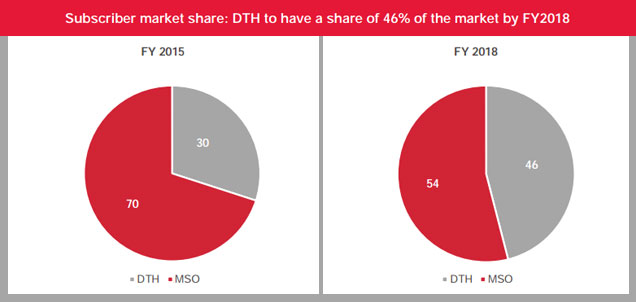
    CRISIL estimates that given their already stretched balance sheets and high capital expenditure (Capex) requirement in these phases, MSOs will be able to garner only 45% of the incremental digital market in the next two phases of digitisation. The balance will go to DTH service providers. This is in contrast to the previous two phases of digitisation wherein MSOs garnered 67% of incremental digital market together with LCOs.


    DTH’s upper hand in ‘cable-dark’ and sparsely populated regions will aid its market growth. And while incremental revenues will be on similar lines for both, profit share will be significantly more for DTH firms as they have complete access to subscription revenues unlike MSOs, which share a large part of their revenues with LCOs. While MSOs will continue to benefit from carriage revenues from broadcasters, CRISIL believes they are unlikely to receive incremental carriage revenues after digitisation.


    The only catch for the DTH operators is that they need to invest around Rs 13,700 crore over the implementation period. For MSOs, capital expenditure (capex) need is around Rs 8,300 crore. The capex requirements will be insignificant after the digitisation phase.


    LCOs, who had hitherto been disclosing only an estimated 20% of their analog subscription base, are the only stakeholders who will lose in this phase of digitisation.


    CRISIL believes the increase in overall market share and higher profits combined with promoter backing to part-fund the capex will benefit the credit profile of DTH operators. On the other hand, MSOs will have to increase their revenue share with LCOs to nearly 60% to prevent deterioration in their credit profile.


    Furthermore, while easing of foreign direct investment (FDI) norms will support fund raising plans for both DTH and MSO operators, the ability of MSOs to attract FDI funding will remain contingent on  improving their revenue share with LCOs.


    Direct-to-home (DTH) operators are expected to garner as much as Rs 3,300 crore, multi-system operators (MSO) Rs 1,500 crore, broadcasters Rs 3,900 crore and government Rs. 6100 crore in taxes, according to Crisil.


    “CRISIL estimates that given their already stretched balance sheets and high capital expenditure (capex) requirement in these phases, MSOs will be able to garner only 45% of the incremental digital market in the next two phases of digitisation. The balance will go to DTH service providers,” the report said.


    This is in contrast to the previous two phases of digitisation wherein MSOs garnered 67% of incremental digital market together with local cable distributors (LCOs), it added.


    Crisil said DTH’s upper hand in ‘cable-dark’ and sparsely populated regions will aid its market growth. “While incremental revenues will be on similar lines for both, profit share will be significantly more for DTH firms as they have complete access to subscription revenues unlike MSOs, which share a large part of their revenues with LCOs,” it added.


    The Indian television industry is the second largest television market of the world, after China, with television penetration in the country exceeding 165 million households in 2014, according to ICRA.


    Source:The Economic Times

    Copyright © 2015, Bennett, Coleman & Co. Ltd. All Rights Reserved

    Licensed to republish